Latest News and Comment from Education

Friday, July 29, 2016

In Philadelphia, Progressive Education Organizers Fight ‘Disaster Capitalism’ - Working In These Times

In Philadelphia, Progressive Education Organizers Fight ‘Disaster Capitalism’ - Working In These Times:

In Philadelphia, Progressive Education Organizers Fight ‘Disaster Capitalism’


This week, Democrats descended upon the city of Philadelphia, attempting to present themselves as simultaneously progressive enough to be the party of racial, gender, and economic justice, but conservative enough to be welcoming to Republicans turned off by Donald Trump.
In a succinct illustration of some of the contradictions at play during the Democratic National Convention, vice presidential candidate Tim Kaine, the former governor of a Right-to-Work state, spoke proudly of his dad running a union shop. While K-12 public education hasn’t played a prominent role in the primetime speeches this week, it’s another thorny issue for a Democratic party struggling to appeal to unions while also advancing a neoliberal education reform agenda.
The battle over public education is, in large part, a battle over labor, and there’s no better illustration of that than Philadelphia. In 2013, the city’s School Reform Commission (which is appointed, not elected) closed roughly 10 percent of the city's schools, laid off almost 4,000 teachers and other school staff and, in 2014, terminated the teachers' contract to save on health insurance costs. They remain without a contract to this day.
“The union has been under very sharp assault,” says Ron Whitehorne, a retired teacher and organizer with the Philadelphia Coalition Advocating for Public Schools (PCAPS).
In the years since the closures, Philadelphia teachers, parents and other public school advocates have been organizing.
“Organizing will help us provide a counter-narrative to shift the paradigm in the nation of how people view public education in our daily lives,” says Ismael Jimenez, a history teacher and member of Working Educators, the progressive caucus within the Philadelphia Federation of Teachers. To him, what’s happening in Philadelphia is illustrative of the attacks on education going on all over the country, including within the Democratic Party.
“I believe organizing is the only real political tool we have today to combat this two-party system that is beholden to neoliberal interests,” he said.
Jimenez was disappointed that the DNC held up Cory Booker, an advocate of the so-called education reform movement, which promotes public school closures and cheers charter schools, which are often non-union.
“This is a designed, planned strategy against labor,” said Antoine Little Sr., a public school parent and union member of the In Philadelphia, Progressive Education Organizers Fight ‘Disaster Capitalism’ - Working In These Times:


Education funding: A tale of two governors' failures - NonDoc

Education funding: A tale of two governors' failures - NonDoc:

Education funding: A tale of two governors’ failures


CHAPEL HILL, N.C. — Wednesday’s news that Oklahoma Gov. Mary Fallin is considering a special session for the purpose of passing a teacher-pay raise reminded me — not for the first time — of just how much she and the governor of my new home state have in common, especially when it comes to funding public education and teacher-pay issues.
Fallin and Gov. Pat McCrory (R-N.C.) are both hapless governors whose most superb political instincts appear to be sticking to their guns until they finally realize their actions have been interpreted as tone deafness or, worse, complete ignorance of reality.
To compensate, they spend an inordinate amount of time frantically backpedaling in an effort to save their political skins. When people haven’t been paying attention (and these governors definitely hope they haven’t), Fallin and McCrory try to pretend like they’ve always been champions of the people’s will. At least, that’s been my takeaway from watching these two political masterminds as of late.

Oklahoma’s education woes

When she became governor in 2010, Gov. Mary Fallin was known for many things, but being a champion of public education certainly wasn’t one of them. She was, however,brazen in her call to cut income taxes, a move that would overwhelmingly benefit wealthier Oklahomans and deprive the state of revenue necessary for delivering quality services to the public. A study released in January showed how income tax cuts over a 10-year period had indeed deprived Oklahoma of more than $1 billion in revenue. State officials, including Fallin, of course, quickly blamed falling oil prices as the culprit.


Will Public Education Survive the Next Administration? – Save Maine Schools

Will Public Education Survive the Next Administration? – Save Maine Schools:

Will Public Education Survive the Next Administration?


Donald Trump has called Common Core a “disaster.” The leaked DNC emails refer to the standards as a “political third rail.”
At this point, however, the controversial standards may be more of a red herring than anything else.
While the pubic remains largely in the dark, a massive upheaval of our public school system is well underway, and recent proposals from both major political parties indicate that the transformation will move full speed ahead regardless of who is elected president this fall.
The new system is designed to expand the education market by allowing out-of-district providers (online programs, non-profits, local businesses, and even corporations) to award credit for student learning.  At the same time, it doubles down on workforce development by aligning educational outcomes to the needs of industry leaders.
According to the U.S. Department of Education, students will “no longer [be] tethered to school buildings or schedules.” Instead, the system will require students to earn “digital badges” that they will display in individual competency-profiles accessible to potential employers and investors.
“By collecting skill-based badges, the record of achievement begun in secondary school becomes the foundation upon which workers build their capabilities and tell their stories to employers,” explains Will Public Education Survive the Next Administration? – Save Maine Schools:


Breaking News: @NAACP calls for national moratorium on charters – Cloaking Inequity

Breaking News: @NAACP calls for national moratorium on charters – Cloaking Inequity:

Breaking News: @NAACP calls for national moratorium on charters


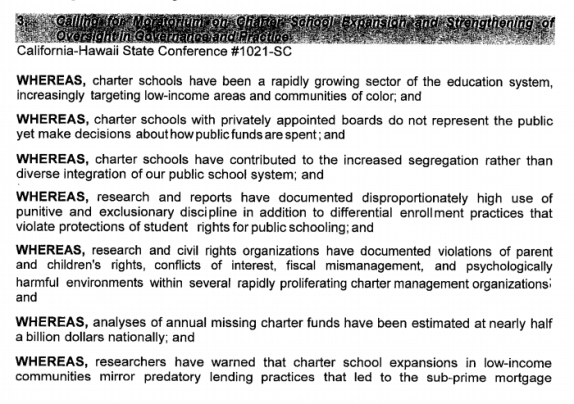
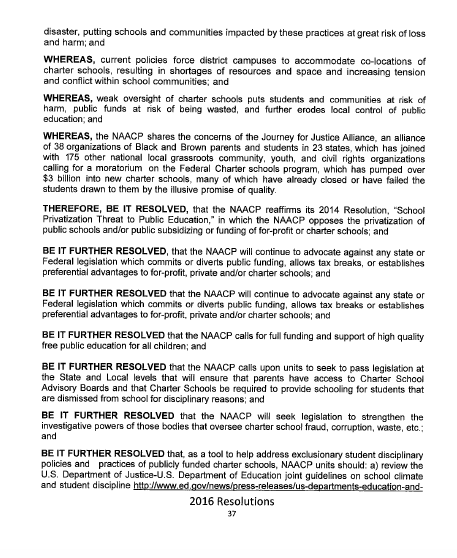
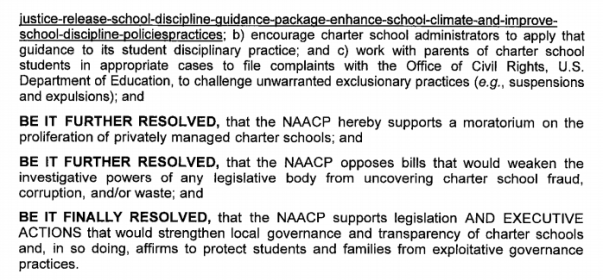
I don’t believe that this has been reported anywhere else. Last week at the NAACP National Convention in Cincinnati, the delegates voted in a new resolution on charter schools. It’s approval as policy will not be official until the National Board meeting in the Fall of 2016. However, this is a big news story that (I suspect because of the political conventions) has not yet entered the traditional media.
Yesterday in the post How will history remember the @NAACP on charters? I discussed the 2010 and 2014 NAACP charter school resolutions. The 2016 NAACP convention voted and approved the following resolution.
Screen Shot 2016-07-28 at 9.30.50 PMScreen Shot 2016-07-28 at 9.33.57 PMScreen Shot 2016-07-28 at 9.31.04 PM
The 2016 NAACP delegates at the national convention called for a moratorium on the proliferation of privately managed charters.
So for those of you who emailed me yesterday saying that NAACP chapters in various places have gone rogue supporting charters— know that the force of the national organization is NOT on their side.
In sum, I believe the NAACP, the nation’s vanguard of civil rights, has AGAIN demonstrated and articulated critical leadership sorely lacking from many other civil rights organizations on the issue of school choice.
For more on what’s going wrong with charters click here.
Please Facebook Like, Tweet, etc below and/or reblog to share this discussion with others.Breaking News: @NAACP calls for national moratorium on charters – Cloaking Inequity:
Want to know about Cloaking Inequity’s freshly pressed conversations about educational policy? Click the “Follow blog by email” button on this page.Breaking News: @NAACP calls for national moratorium on charters – Cloaking Inequity:
Twitter: @ProfessorJVH


CURMUDGUCATION: Looking for Mr. or Ms. Change Agent

CURMUDGUCATION: Looking for Mr. or Ms. Change Agent:

Looking for Mr. or Ms. Change Agent


Over at the Fordham, Mike Petrilli has been slowly unspooling a series of posts looking at how reform goals might be pursued through means other than policy and politics. In his latest, he considers the leadership development approach to school reform.

Petrilli expresses mixed feelings about the argument. On the one hand, he recognizes that great leaders have value. On the other hand, he's not sure that leaders can make a difference in the vast dry dead desert of public schools, and wouldn't we all be better off just putting our energy into helping leaders grow in the lush gardens that are charter schools?


As always, Petrilli has part of a point. Superintendents and principals are fighting an uphill battle these days, though it's certainly worth noting that many of the obstacles were created by reformsters like Petrilli, hamstringing schools with the crappy Common Core State [sic] Standards and bad-test-based accountability. The last decade-plus of ed reform have sidled school leaders with truckloads of crap and foisted on them priorities like "get student test scores up or get fired." So yes-- there are "government" policies in place that subject principals to "the dysfunction of the larger system within which they must work, and the Gordian knot that’s been tied by decades of contradictory, often compromising, laws and regulation"-- and that big mess has been largely grown and built with the assistance of guys like Petrilli, criss-crossing the country to advocate for those same government regulations.

Petrilli also throws shade at "unruly elected school boards," and I wonder once again why reformsters love the rugged chaos of parents choosing their own schools, but hate the rugged chaos of voters choosing their own school board. Choice is good except when it's terrible.

Petrilli nods to Rick Hess's cage-busting while rightly acknowledging that the cages are real and 


American Students of Color Are Still Not Treated to an Equal Education | US News Opinion

American Students of Color Are Still Not Treated to an Equal Education | US News Opinion:

An Unequal Start

Racial bias still persists in U.S. schools, and we must fix it.


 Is racial bias hindering the success and well-being of our nation's children? Civil rights,racial justice scholars and activists have long answered yes; they have also continuously worked to address the structural racism they see as pervasive in our nation's institutions.

During the first night of the Democratic National Convention, the speakers addressed education and inequality at home. "It's about making sure that young people in this country are in good schools and at good jobs, not in jail cells," Vermont Sen. Bernie Sanders said. Massachusetts Sen. Elizabeth Warren and First Lady Michelle Obama both touched on critical gaps in the educational system we provide our nation's children. And last week, Donald Trump underlined the pervasive bias in his Republican National Convention nomination acceptance speech by asking, not declaring, if all American children have the same rights. "Every action I take," Trump said, "I will ask myself: Does this make better for young Americans in Baltimore, in Chicago, in Detroit, in Ferguson who have really, in every way folks, the same right to live out their dreams as any other child in America?"
But American children are not treated or protected equally – especially when it comes to education. A report last month from the U.S. Department of Education's Office for Civil Rights provides important and troubling data on the detrimental consequences of racial bias for students of color, and draws from the Civil Rights Data Collection from 2013-2014, which included data for 99 percent of public schools and districts in the country.

RELATED CONTENT

The Cross African-Americans Must Bear

Strict parenting and reliance on prayer aren't just preferences to African-Americans. They're matters of life and death.

Among the findings is that black and Latino children are disproportionately issued school suspensions as early as pre-kindergarten. Black preschoolers are 3 1/2 times more likely than their white peers to be suspended – despite an overall decline in overall suspensions nationwide.
Black students are also disproportionately expelled from schools and, along with Latino students, are more than twice as likely as their white peers to be arrested or deal with law enforcement throughout the K-12 years. The targeting of students of color for disciplinary actions is all the more troubling because, as the report points out, it is coupled with the reality that these same students are more likely to have underprepared teachers and lack advanced courses in their high schools.
These findings are echoed elsewhere, too. A recent study of Virginia public schools further evidences racial disparities in disciplinary actions taken by schools. They find that American Students of Color Are Still Not Treated to an Equal Education | US News Opinion:

One Democratic Convention Speech Nailed The Progressive Vision

One Democratic Convention Speech Nailed The Progressive Vision:

One Democratic Convention Speech Nailed The Progressive Vision


When Rev. William Barber, best known in progressive circles as the leader of the Moral Mondays protests against the right-wing governor and legislature in North Carolina, was brought to the stage at the Democratic National Convention Thursday night, there was cheering from the North Carolina delegation but polite applause from the rest the hall. They did not know who Barber was, and then they not know what was coming.
Ten minutes later, when Barber finished his address, the entire convention hall was on its feet.
“I come before you tonight as a preacher,” he began, and from that moment Barber took the convention delegates through the convergence of progressive populism and “faith and morality.”
“It may sound strange, but I am a conservative,” he said, “because I work to conserve a divine tradition that teaches us to do justice, love mercy and walk humbly with our God.”
The core of his speech was a challenge for the delegates at the convention to be “moral defibrillators” of the nation. “We must shock the nation with the power of love.”
It is a message that Barber has been consistently pushing as the director of the North Carolina NAACP and an increasingly sought-after spokesperson for his unique ability to frame progressive policy objectives in a values frame. As Barber put it Thursday, “Some issues are not just left vs. write or liberal vs. conservative; they are right vs. wrong.”
In 2013 the Campaign for America’s Future gave Barber the Paul Wellstone Citizen Leadership Award for his work in North Carolina organizing against the budget cuts, voter suppression and other policies advanced by the state’s Republican government.
The words of the Biblical prophet Isaiah, Barber said, calls on us to “pay people what they deserve, share your food with the hungry. Do this and then your nation shall be called a repairer of the breach. Jesus, a brown-skin Palestinian Jew, called us to preach good news to the poor, the broken and the bruised and all those who are made to feel unaccepted,” he said.
The use of religion and faith to promote “meanness” shows that we have a “heart problem,” Barber said. We need to “embrace our deepest moral values and push for revival at the heart of our democracy. … When we fight to reinstate the power of the Voting Rights Act, and we break the interposition and nullification of the current Congress…when we fight for 15 and a union, and universal health care, and public education, and immigrant rights, and LGBTQ rights, we are reviving the heart of our democracy.”One Democratic Convention Speech Nailed The Progressive Vision:

A Quick Note on Race Talks in Education Spaces #EduColor | The Jose Vilson

A Quick Note on Race Talks in Education Spaces #EduColor | The Jose Vilson:

A Quick Note on Race Talks in Education Spaces #EduColor

educolorme
Premise: educators who aren’t challenged to think about systemic inequity offline don’t want to think about it online.
In the last week, much has been made about my impromptu #educolor chat about race and schools, but, like #EduColor itself, it wasn’t borne of a chat, but by resistance to ignorance amongst our colleagues.
You can read the recap for yourself here.
Behind the scenes, I had contemplated whether I even wanted to participate. There were pros and cons to both. The main con was that connected folks of color shouldn’t have to participate in this chat because white educators should do the work themselves without our involvement. This puts the onus on white folks to talk to white folks about race in a space that normally doesn’t do it.
But as I watched it unfold, I started to see how few participants either wanted to engage. In fact, the folks who were originally energized by the topic started to drop out quickly as they saw how quickly A Quick Note on Race Talks in Education Spaces #EduColor | The Jose Vilson:


CURMUDGUCATION: Other Suns and the Illusion of History

CURMUDGUCATION: Other Suns and the Illusion of History:

Other Suns and the Illusion of History

It was impossible to drive across the country without thinking of Isabel Wilkerson's masterpiece The Warmth of Other Suns, a stunning telling of the story of the Great Migration.


Wilkerson weaves numerous threads together (including those of her own life) and shifts effortlessly between close focus and the larger picture, but the book revolves around the stories of Ida Mae Brandon Gladney, George Starling, and Pershing Foster, as each of them makes their own personal journeys. The Great Migration was an unprecedented shift of population in this country and, as Wilkerson says, "it was the first big step the nation's servant class ever took without asking."

I won't try to capture the entire book, but I will share some of what hit me when reading it.

Some were simple factoids. The first Jim Crow law? Passed in Massachusetts.

Some of it echoes our present. Foster's parents were educators, and the picture of black schooling in the South is brutal. For instance, on the matter of financing schools:

"The money allocated to the colored children is spent on the education of the white children," a local school superintendent in Louisiana said bluntly. "We have twice as many colored children of school age as we have white, and we use their money. Colored children are mighty profitable to us."

And perhaps most striking and effective because of Wilkerson's thoroughness, is the ordinary everydayness of the racism these people lived through.

Travel always makes me think of the book because of Foster's story. At one point, this educated physician sets out to drive cross country, heading out West to create a new life, and the simple 
CURMUDGUCATION: Other Suns and the Illusion of History:


Private Prisons on Steroids …The for-profit detention centers - Wait What?

Private Prisons on Steroids …The for-profit detention centers - Wait What?:

Private Prisons on Steroids …The for-profit detention centers


While many are aware of the rise of private prisons in the United States and the lucrative contracts that are given to for-profit companies to run those correctional facilities, far less attention has been given to the for-profit largess associated with massive contracts to run the federal government’s immigration detention centers and other related programs around the country.
As the Center for American Progress explains;
Surprisingly, the largest detention and supervised release program is not operated program in the country is not operated by the U.S. Department of Justice (DOJ), but by the U.S. Department of Homeland Security (DHS), which oversees the nation’s immigration detention centers.  According to the Department of Justice, its Federal Bureau of Prisons has nearly 200,000 individuals in custody as of December 2014.  On the other hand, the Department of Homeland Security’s immigration detention program detains around 400,000 each year.
The nation’s paranoia about immigrants has dramatically enhanced the revenues for two massive for-profit prison companies that are now raking in over $1 billion a year in taxpayer funds running much of the federal government’s prison and detention programs.
As a result of legislation approved by the United States Congress and signed into law by President Obama, the Department of Homeland Security MUST maintain no less than 33,400 detention beds a day — regardless of whether those beds are needed.  It is the only mandated bed quota of any federal agency.
To acquire that many beds, the government turned to for-profit companies to build and run many of the facilities.  Today, more than 60% of the immigrant detention beds are Private Prisons on Steroids …The for-profit detention centers - Wait What?:


To locate your detained loved one:


Contact the Bureau of Immigration and Customs Enforcement Deport Office (see Phone List below). 
Ask to speak with a supervisory deport officer. Give them your loved one’s full name and A#. (Note: Deportation officers may be mean and not speak to anyone besides an attorney. However, it is still worth trying) 
Contact your Consulate. Some Consulates are required by law to be notified when one of their nationals is detained.
The last resort is always to contact the different county detention facilities or wait for your loved one to call.
Remove any blocks on your phone for collect calls.


Do not rush to hire an attorney if you don’t have a basic idea about your loved ones case. First learn as many facts about your loved one, and then approach an attorney
Hire someone specializing in deportation. Many attorneys do not know immigration law and many immigration attorneys do not know deportation very well. If the lawyer does real estate, business and immigration, they are most likely not deportation specialists.
Keep the full information of EVERY lawyer you had. Make sure you receive a copy of everything your lawyer files.
Get a written contract before you give the lawyer money. The lawyer must give you a “retainer agreement.” Read it carefully. Make sure you understand it.
Make sure to inform your lawyer of your entire criminal and immigration history so that they may give you the best advice possible. Do not assume that ANY information is not important.
Ask your lawyer for written information about the immigration consequences of your crime before you plead guilty. If you have an old order of deportation ask your lawyer for written information about how they will prevent your deportation.
If your attorney ever refuses to provide information he promises you in writing, send a certified mailed letter to him outlining the promises he made to you and asking for written verification or clarification of those promises.
File a complaint with the Attorney Grievance Committee if your lawyer cheated you (see Phone List).

Free Legal Information/Advice
Legal Aid Immigration Unit:  (212) 577-3456
Immigration Defense Project: (212)725-6422
Northern Manhattan Coalition for Immigrants Rights: (212) 781-0355
Brooklyn Defenders Services: (718) 254-0700)
Bronx Defenders: (718) 383-7878
Pennsylvania Immigrant Resource Center: (717) 600-8099

Hillary Clinton Declares: I Sweat the Policy Details on Education, Children's Issues - Politics K-12 - Education Week

Hillary Clinton Declares: I Sweat the Policy Details on Education, Children's Issues - Politics K-12 - Education Week:

Hillary Clinton Declares: I Sweat the Policy Details on Education, Children's Issues

DRD_3442.jpg
Philadelphia
Democratic presidential nominee Hillary Clinton, in her historic acceptance speech here Thursday, pledged to provide broader access to a quality education, praised teachers in the couse of attacking her GOP rival Donald Trump, and highlighted her past work on behalf of students with disabilities. 
Her speech was light on K-12 policy specifics, in keeping with a Democratic National Convention that has largely bypassed substantive education talk in favor of more general rhetoric. And she also leaned on language often used by the teachers' unions, some of her staunchest and earliest allies. 
Clinton, the first woman to receive a major party nomination, said she would to build a country where parents can "send their kids to a good school no matter what ZIP code you live in." That's a line straight from the National Education Association's list of talking points about education. 
Excoriating Trump for his remark at the GOP convention last week in Cleveland that "I alone can fix it," Clinton mentioned a litany of professions, including "teachers who change lives" who work to address the nation's needs and problems. 
DRD_3453.jpgJust as other speakers from previous nights of the convention did, Clinton highlighted her work for the Children's Defense Fund, such as advocating on behalf of students with disabilities in Massachusetts, and how it led to changes in legal protections for those children.
"It's a big idea. Every kid with a disability has a right to go to school," Clinton said, adding that she sweated policy details "because it's not just a detail if it's your kid."
She promised to push for affordable child care. And touching on a theme that's been a top priority for her vice-presidential pick, Virginia Sen. Tim Kaine, Clinton gave a nod to career and technical education, saying, "We will help more people learn a skill or practice a trade, and make a good living doing it."
Clinton also pledged to pass comprehensive immigration reform and to "keep families together," touching on a theme earlier in the DNC. 
Clinton mentioned that plan as well on Thursday, and also promised to "liberate" people from student debt
Clinton still doesn't have a comprehensive K-12 plan, and she didn't lay one out during her Thursday speech. But she has addressed specific elements of education policy, such as her plan to eventually create universal prekindergarten programs in the U.S.

Breaking the Glass Ceiling

Policy details or not, Jon Fielbrandt, a high school math and science teacher and Michigan delgeate, said Thursday night he was heartened by everything Clinton has said about bullying, standing up for teachers' collective bargaining rights and early-childhood education.
"I've got faith she's going to take us in the right direction on education," said Fielbrandt, who's a member of the NEA.
But he was most excited to be here Thursday night because he has two daughters.
"That feeling of that glass ceiling being broken. That means a lot," Fielbrandt said.

Early Learning, Equity, Crumbling Schools

In an interview at the convention Thursday, Sen. Patty Murray D-Wash., said she's "just ecstatic" about the prospect of working with a possible President Hillary Clinton on expanding access to early-childhood education.
"I just say the words to her 'early-childhood education.' And she says, 'What do we need to do?' This is a passion for her," said Murray, ranking member of the Senate education committee.
California Rep. Xavier Bacerra raised that issue, too, in his speech Thursday night, highlighting Clinton's plan to provide universal preschool to Americans' 4-year-olds. And he raised Clinton's stated "Chelsea test." That's Clinton's line that if she didn't think a school was good enough for her daughter Chelsea Clinton, it wasn't good enough for any child.
"She'll rebuild our crumbling schools. She'll give our teachers the support and tools they need and the pay they deserve," Becerra said. (Presidents don't directly control and can't dictate teacher salaries, although a portion of the 2009 American Recovery and Reinvestment Act directed funds to shore up local funding for schools.)
DRD_2476.jpgDavid Wils, an 8th grade social studies teacher in North Carolina, gave brief remarks Thursday night—but he didn't talk about K-12.
Instead, Wils, who has $35,000 in student loan debt, detailed his belief that Clinton would help relieve the college debt burden for Americans.
"Teaching offers so many rewards. A big salary isn't one of them," Wils said.
The nation has two educational systems, New York Gov. Andrew Cuomo said in his speech during the 7 o'clock hour: one for rich students, where they work on laptops; and one for poor students, where the most sophisticated technology they encounter is a metal detector.
"That is not educating every child equally," said Cuomo, who's had an uneven relationship with the New York State United Teachers.
Reps. Tim Ryan of Ohio and Becerra promised the crowd that Clinton would put people to work building schools. She expressed a desire to rebuild crumbling schools earlier this year. 

Track Record With Children

When education was discussed throughout the convention, much of it dealt with Clinton's work in her younger years to help children disadvantaged in various ways.
President Bill Clinton made that work a major focus of his Tuesday night speech, ticking off the nominee's efforts in Alabama and Massachusetts, for example, to help put a spotlight on segregated schools and inequality for students with disabilities, respectively. And in Arkansas, Clinton recalled, the nominee worked to improve early-education programs, overhaul the state's academic standards, and change the school funding setup.
electionslug_2016_126x126.jpg
That night, both Bill Clinton and Dustin Johnson, an 5th grade teacher in Arkansas, also discussed Clinton's work on improving classroom instruction and educational standards.
In fact, Clinton said in Iowa last December that, "I wouldn't keep any school open that wasn't doing a better-than-average job," although her campaign later clarified that she wasn't intent on shutting down schools en masse.

Connections to Education

Speakers this week also connected hot-button issues in the campaign to education.  
On Wednesday Sen. Chris Murphy of Connecticut spoke about the 26 students and school staff killed at Sandy Hook Elementary in 2012.
And the daughter of the school's principal, Erica Smegielski, said the nation should not have "our teachers and principals going to work in fear" of gun violence.
DRD_2112.jpg
The school-to-prison pipeline, meanwhile, made it into the speech given by Sen. Bernie Sanders of Vermont on Monday.
Clinton's one-time rival for the Democratic nomination, Sanders urged the nation to make sure young people are not "rotting in jail cells" and added, "Hillary Clinton understands that we have to invest in education and jobs for our young people."
The same night, Sen. Elizabeth Warren of Massachusetts highlighted Clinton's plan to provide free tuition for public colleges and universities. And the children of undocumented immigrants also spoke about their fears of Donald Trump and their confidence that Clinton would support them.
Assistant Editor Alyson Klein contributed to this post. 
Photos: Democratic presidential nominee Hillary Clinton with vice presidential nominee Sen. Tim Kaine of Virginia at the Democratic National Convention on Thursday, July 28; Clinton and Kaine after she finished her acceptance speech; the floor of the DNC the previous day; DNC attendees hold signs in favor of Clinton on Wednesday. (Deanna Del Ciello/Education Week) Hillary Clinton Declares: I Sweat the Policy Details on Education, Children's Issues - Politics K-12 - Education Week:

Don't miss another Politics K-12 post. Sign up here to get news alerts in your email inbox.

Democrats Are Spotlighting A Big Education Problem Pushing Kids Out Of School

Democrats Are Spotlighting A Big Education Problem Pushing Kids Out Of School:

Democrats Are Spotlighting A Big Education Problem Pushing Kids Out Of School

For the first time, the party platform address the school-to-prison pipeline.


Democrats are giving unprecedented attention to a phenomenon that pushes kids out of school and into the criminal justice system.
The Democratic Party platform calls for putting a stop to the school-to-prison pipeline, for the first time ever. The platform, finalized this month, reads:
“We believe a good education is a basic right of all Americans, no matter what zip code they live in. We will end the school-to-prison pipeline and build a cradle-to-college pipeline instead, where every child can live up to his or her God-given potential.”
The school-to-prison pipeline describes an education system that funnels kids ― disproportionately black and brown ones ― out of school and into jail. Reasons for its existence include the proliferation of cops in school, who are more likely to be assigned to buildings where the majority students are minorities. School cops increase the likelihood that a student will be referred to law enforcement, even for a minor offense, according to research from University of Florida law professor Jason Nance.
Practices like school suspensions, which remove kids from classrooms as a form of punishment, add to the pipeline.  
“For the first time ever, our platform calls for ending mass incarceration, shutting down the school-to-prison pipeline, and taking on the challenges of systemic racism,” Maya Harris, senior policy advisor for Hillary Clinton, said in a statement
Marlyn Tillman, a member of the Dignity in Schools Campaign ― a national coalition of organizations dedicated to ending the practice of pushing kids out of school ― called the attention “unprecedented.”
“We appreciate these issues we’ve been fighting for a long time have finally been listed by one of the parties in their education agenda,” said Tillman. “Welcome to where we are and will be for quite some time. Our children don’t come with red and blue labels, so we challenge both parties to push for agendas that are child centered.”
One of Tillman’s sons fell prey to the school-to-prison pipeline. When he was in middle school, he was suspended for wearing what school leaders said looked like Democrats Are Spotlighting A Big Education Problem Pushing Kids Out Of School: