Latest News and Comment from Education

Monday, July 25, 2016

The Gulen Movement’s Collision Course With The Turkish State

The Gulen Movement’s Collision Course With The Turkish State:

The Gulen Movement’s Collision Course With The Turkish State

Fethullah Gulen (left) had been a close ally Recep Tayyip Erdogan (right), but their relationship gradually soured over time. (file photo)


Since Turkey’s failed July 15 coup, the Turkish authorities have accused U.S.-based cleric Fethullah Gulen of being behind the attempted takeover of power. It is an explanation that is widely accepted across Turkey. A brief look at the history of Gulen's movement helps explain why.
What Does The Movement Want?
Gulen was originally a supporter of Said Nursi, an Ottoman-Kurdish scholar from the Hanefi school of Sunni Islam. But in the 1970s, Gulen formed a sect of his own that people later called "Gulen Camaati" (Gulen community or movement).
Like any other Islamic sect under the strictly secular and pro-military Turkish governments, Gulen’s community was banned and operated largely underground until 1983. But, unlike other religious communities, which were mainly teaching the Koran and performing private religious prayers, Gulen’s group became increasingly politicized. Businessmen began to donate money and the movement became a political player among conservative and religious groups of Turkey.
"[Gulen] wrote at that time that he wanted to train 'courageous, selfless men' for society," says Rusen Cakir, a leading expert on Turkish Islamic groups. "It was about them training and planting young people in different important layers of the government: the police, the justice system, the Interior Ministry, and even the army."
But, unlike more transparent political parties, Gulen's sect kept everything secret. It was never clear how many members the group had, who they were, and what exactly they were seeking to do politically. It was widely rumored that his movement, and all its related "foundations" and businesses, were getting wealthier and more and more people were joining his community, but there was little categorical evidence to support this.
How Big Is The Movement?
It is almost impossible to quantify the size of the Gulen movement's membership or its wealth. By many estimates, over the course of some 40 years, the movement has gathered tens of thousands of supporters. 
Gulen has repeatedly denied having a "network." He has said that people may sympathize with him in any government institution even without an organized network, as is the case with other political parties. But analyst Cakir says that directing school graduates to choose positions selected by "community guides"-- members of the Gulen movement who counsel younger members -- was not something any other political party was doing.
Why Did The Movement Clash With The Turkish State?
In the 1970s, the government, army, and security services tried to clean up their ranks and remove those they perceived to be Gulenist "implants."  And in the 1980s, secular parties and magazines (like Nokta from 1986, which is pictured below) were warning against secret "Fethullahists" in the army. 
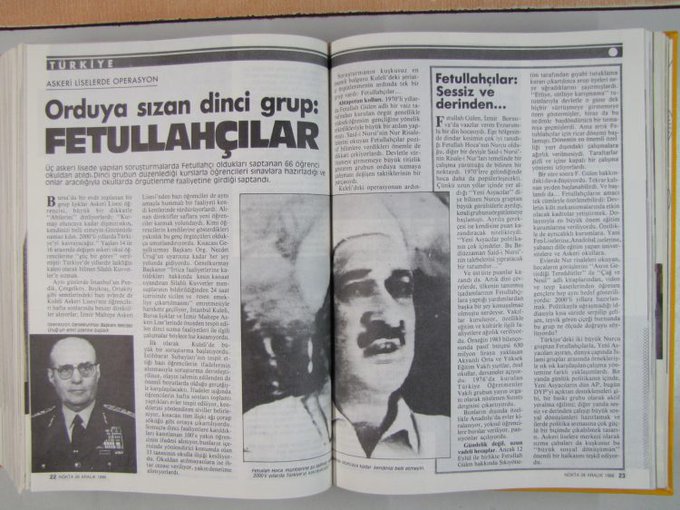
Working up the ladder in the army and civil service, Gulen supporters helped other members of the movement join their ranks. In 2010, prior to a national exam for entrance into government agencies, exam questions were reportedly communicated among Gulen movement members to ensure their passing the exam. 
While Gulen was gathering and guiding supporters, his schools both in Turkey and abroad were bringing him fame and popularity. Critics say that running those successful schools was a "cover" for his "infiltration" of government, although raising the level of Turkey's education and culture was always one of Gulen’s stated goals. 
In 1999, secret recordings of Gulen's speeches were played on state television. In them, he called on his supporters to "silently and patiently" infiltrate government agencies and wait for "the moment" of change. "If you act too soon, you'll have Turkish state institutions on your back," he said. 
Under increasing pressure from secular media and government, Gulen emigrated to the United States in 1999. His movement, though, kept growing.
Why Did The Relationship With Erdogan Turn Sour?
In the 2000s, Gulen already had scores of loyal supporters at high levels of the police, justice system, media, education, and even the army. He was also a close ally of Recep Tayyip Erdogan, who becameThe Gulen Movement’s Collision Course With The Turkish State:


US Commander Campbell: The man behind the failed coup in Turkey

US Commander Campbell: The man behind the failed coup in Turkey:

US Commander Campbell: The man behind the failed coup in Turkey

The organizer and financial distributor of the coup attempt turns out to be an ISAF ex- US commander, investigation reveals

A former U.S. commander of the International Security Assistance Force (ISAF), a NATO-led security mission in Afghanistan, was the organizer of the July 15 military coup attempt in Turkey, sources said.

General John F. Campbell was one of the top figures who organized and managed the soldiers behind the failed coup attempt in Turkey, sources close to ongoing legal process of pro-coup detainees said.

Campbell also managed more than $2 billion money transactions via UBA Bank in Nigeria by using CIA links to distribute among the pro-coup military personnel in Turkey.

The ongoing investigation unveiled that Campbell had paid at least two secret visits to Turkey since May, until the day of the coup attempt.

The coup plot that was foiled by the comprehensive effort of Turkish Nation, including its citizens, politicians, media and police forces, was organized by the Fethullah Terrorist Organization (FETO) led-by so-called cleric Fethullah Gülen who has been living in self-exile in America for several years.

American Intelligence, Military and other institutions are accused of supporting the FETO leader Gülen and his gangs for the military coup.


Military sources said Campbell, who was the commander of ISAF between August 26, 2014 and May 1, 2016, had made some top secret meetings in Erzurum military base and Adana İnicrlik Airbase.

İncirlik Airbase has been used by the U.S. Military for conducting the anti-Daesh campaign in Syria.

Military sources said that Campbell was the man, who directed the process of trending / blacklisting the military officers in the base.

If the coup attempt was successful, Campbell would visit Turkey in a short time, according to the sources.

Transition of $2 billion from Nigeria to Turkey

The Nigeria branch of the United Bank of Africa (UBA) was the main base for the last six-months of money transactions for the coup plotters.

Millions of dollars of money has been transferred from Nigeria to Turkey by a group of CIA personnel.

The money, which has been distributed to an 80-person special team of the CIA, was used to convince pro-coup generals.

More than 2 billion dollars were distributed during the process leading to the coup.

After taking money from their bank accounts, the CIA team hand delivered it to the terrorists under the military dresses.

Categorizing the military officers

The sources said that some familiar figures in the Eastern and Southeastern part of the country had taken active roles during the process, while the members of the Gülenist gang have been used in central and eastern region.

All officers who command a group of soldiers in a patrol station, unit, company, regiment, brigade, division, corps, or army were kept in close surveillance.

In 2015, the pro-Gülenist officers in the İncirlik base established an investigation desk. They drew the map of all soldiers under their command. They investigated the soldiers' trends, their personalities and family background.


All soldiers were categorized in three groups: opponents, neutrals, and supporters.

A commander from the smallest patrol station to all military units had been blacklisted under the process.

Soldiers who were marked as opponents to the junta, was debarred from the “financial support.”

The military personnel who were in a neutral position received a difference in the amount of money, according to the importance of their position and ranks.

The money transactions were started in March 2015 through the commissioned “courier”.

The supports who also were categorized as “those who will move with us,” were provided a huge amount of money.

All soldiers and officers in this category were considered as the devoted members of the FETO terror group.

A bag with a large amount of money was found in the room of Brigadier General Mehmet DiÅŸli, one of the top military officials detained for leading the coup attempt.


 US Commander Campbell: The man behind the failed coup in Turkey:

Nevada divided over landmark school voucher program as it heads to top court | US news | The Guardian

Nevada divided over landmark school voucher program as it heads to top court | US news | The Guardian:

Nevada divided over landmark school voucher program as it heads to top court

Opponents attack ‘reverse Robin Hood’ program that would incentivize parents to abandon public schools by offering $5,100 education savings accounts

 School bus on road


here are cockroaches inside the lockers at Hyde Park middle school in Las Vegas, so Victoria Piñeiro, 13, carries her lunchbox, violin and heavy backpack with her all day long. She attends classes under ceilings that leak during rainstorms. And on hot afternoons, school is often canceled because the air conditioning has broken down.
Victoria told Nevada lawmakers this at an educational forum in April 2015, begging them to prioritize funding for a state school system ranked dead last in the nation.
Instead, in June 2015, the state went on to adopt the most far-reaching voucher-style program in the US, incentivizing parents to abandon public schools with annual $5,100 education savings accounts (ESAs) for private schooling – regardless of household wealth or income level.
But Nevada’s “school choice” program, originally scheduled to begin in January, is on hold pending arguments on 29 July in the state supreme court. A group of parents are suing to kill the program, claiming that it illegally relies on money reserved for public schools. The ACLU is also challenging the law on grounds that state funds cannot be used for religious purposes, such as parochial schooling.
Critics of the vouchers say they will make a bleak situation worse – Nevada received the lowest grade in the nation, a D, in Education Week’s 2016 state report card because of poor school funding, lackluster student achievement and dismal chances of success. Public school advocates claim the vouchers will further deplete resources and increase segregation in the community, and are aghast that the state’s wealthiest families will be eligible for the private school subsidy.
Victoria Piñeiro, 13, with other students and parents in Carson City in March 2015 to tell Nevada lawmakers to prioritize funding for the state school system.
Pinterest
 Victoria Piñeiro, 13, with other students and parents in Carson City in March 2015 to tell Nevada lawmakers to prioritize funding for the state school system. Photograph: Courtesy of Susie Martinez
ESA supporters believe vouchers can help by fuelling competition and easing public school overcrowding.
Both sides agree that if the program survives its present legal challenge, the “sweeping” effort will have implications throughout the US.
“It’s never been done on this scale before,” said Michael Schaus, of the Nevada Policy Research Institute. He noted that other states have limited access to school vouchers solely to low-income families or specific school districts. “ESAs in Nevada divided over landmark school voucher program as it heads to top court | US news | The Guardian:

“JIM CROW! GENOCIDE!” STATE LOAN BOARD APPROVES THEFT OF $1.5 B IN DPS ASSETS, $385 M IN LOANS | VOICE OF DETROIT

“JIM CROW! GENOCIDE!” STATE LOAN BOARD APPROVES THEFT OF $1.5 B IN DPS ASSETS, $385 M IN LOANS | VOICE OF DETROIT: The city's independent newspaper, unbossed and unbought:

“JIM CROW! GENOCIDE!” STATE LOAN BOARD APPROVES THEFT OF $1.5 B IN DPS ASSETS, $385 M IN LOANS


 Dozens traveled to Lansing to oppose state dismantling of DPS district, and further debt of $385 million

Board files whistleblower complaint with SEC alleging that loan rates of up to 18% have cost DPS over $400 million under previous EM’s
EM Rhodes’ advisors told him plan would be “enormously costly”
 Parthenon Group involved: “All students are not equal; SOME ARE MORE PROFITABLE THAN OTHERS”
By Diane Bukowski 
July 23, 2016 
Detroit school board members (l to r) Lamar Lemmons, Tawanna Simpson and Elena Herrada with sign showing what 16 years of state control has done to DPS, after loan board vote.

Detroit school board members (l to r) Lamar Lemmons, Tawanna Simpson and Elena Herrada with sign showing how 16 years of state control has devastated DPS finances, after loan board vote.
LANSING – “You just voted for Jim Crow,” Detroit’s elected school board members and supporters shouted at the Michigan Local Emergency Financial Assistance Loan Board July 18, after it approved the transfer of over $1.5 billion in Detroit Public Schools (DPS) assets to a state-operated “community district,” and $385 million in initial loans, some at an 18 percent interest rate.
Speakers at the meeting called the plan “genocide,” and said it makes Detroit’s children second-class citizens.
“You are taking money from Detroit school kids to pay off a debt the state created,” Board of Education President Lamar Lemmons said.
A state-controlled “community district” was created July 1 under Public Acts 192-197.  DPS itself will remain only to pay off about $3 billion in outstanding debt to the banks, left behind by 16 years of state control. That will come from funds meant to educate Detroit’s children, 59 percent of whom live below the poverty level. The district will be the only one in the state allowed to hire non-certified teachers. Many more of the 104 schools left in the district, down from 261 in 1992, will be required to close.
Elder Helen Moore speaks during loan board meeting July 18, as others crowd behind her waiting their turn to oppose destruction of DPS, loans.

Elder Helen Moore speaks during loan board meeting July 18, as others crowd behind her waiting their turn to oppose destruction of DPS, loans.
Michigan Gov. Rick Snyder, the state legislature, and Emergency Manager Steven Rhodes launched the plan July 1. Rhodes presided over the City of Detroit’s bankruptcy. He has “JIM CROW! GENOCIDE!” STATE LOAN BOARD APPROVES THEFT OF $1.5 B IN DPS ASSETS, $385 M IN LOANS | VOICE OF DETROIT: The city's independent newspaper, unbossed and unbought:

Sunday, July 24, 2016

Newark Charter School Continues Their Discriminatory Social Engineering Enrollment Practices – Exceptional Delaware

Newark Charter School Continues Their Discriminatory Social Engineering Enrollment Practices – Exceptional Delaware:

Newark Charter School Continues Their Discriminatory Social Engineering Enrollment Practices

StopDiscrimination

This school is a piece of work!  Remember last winter when I wrote about how a six-year old girl with disabilities was denied admission in Newark Charter School’s lottery?  In less than 24 hours, parents, legislators, and other citizens swarmed their Head of School, Greg Meece, with emails and phone calls and we got the school to bend and let her in the lottery.  Ultimately, she didn’t make it into the school, but it was still a victory for the parents because she got the right to participate in it.  The reason she wasn’t let in was because the board had changed their admissions policy last fall.  They wouldn’t let anyone who would be above the age of five by a certain date even apply.  For this girl, who has developmental disabilities, she just wasn’t quite ready the year before to enter Kindergarten.  The board got rid of their policy at their May board meeting, but they did introduce a new one: students applying for Kindergarten can only apply once.

Here is the issue with that.  For students like the girl who had to get people to rally to get her into the lottery, parents of pre-schoolers with a disability don’t always know if their child will be ready for Kindergarten until the spring, when they have a conference with the pre-school.  This is common practice.  If a parent of a child with disabilities may not be aware of this or thinks their child is ready, and they apply to Newark Charter School, they can’t apply again the next year based on this latest discrimination stunt by the wunderbars at Newark Charter School.  This way they can keep those developmental disability kids out of their school.
The board also changed their admissions policy where it relates to “students of employees” at their June 21st board meeting.  Any newly hired employee’s kid gets preference over the rest of the general public kids in the lottery.  I have to wonder what this school’s definition of an employee.  I wonder how much cafeteria staff they hire so they can get certain kids into the school!
Of course, the Delaware Dept. of Education will say this is legal and their board can pick those kind of enrollment preferences (without any needed recommendations or training on discrimination from the DOE).  Our state legislators, most of them, won’t bat an eye.  Especially the guy who might as Newark Charter School Continues Their Discriminatory Social Engineering Enrollment Practices – Exceptional Delaware:

Carol Burris: Why charter schools get public education advocates so angry - The Washington Post

Why charter schools get public education advocates so angry - The Washington Post:

Why charter schools get public education advocates so angry

Image result for big education ape charter schools


There are thousands of charter schools in the United States that enroll a few million students. While they are just a fraction of the number of kids who attend school, the charter movement has been a key part of the choice movement and has affected public education in many ways. It has been 25 years since the charter movement began, and it has not evolved exactly as supporters had hoped, with too little oversight of too many charters.
In this post, Carol Burris, a former New York high school principal who is now executive director of the nonprofit Network for Public Education, explains why putting the word “public” in front of “charter school” — which are funded with tax dollars — is “an affront” to people for whom public education is a mission. Burris was named the 2010 Educator of the Year by the School Administrators Association of New York State, and in 2013, the same organization named her the New York State High School Principal of the Year. She has been chronicling botched school reform efforts in her state for years.
By Carol Burris
When Hillary Clinton mentioned public charter schools in her speech to the National Education Association earlier this month, she was greeted with some boos. Her remarks about sharing “what works” seemed innocuous enough.  So why did the teachers in attendance react so strongly?
The obvious answer is the charter sector’s distaste for collective bargaining.  But the antipathy directed at charters runs deeper than that. Charters, regardless of their original intent, have become a threat to democratically governed, neighborhood public schools, and questions about their practices, opacity and lack of accountability are increasing as their numbers grow.
Placing the adjective “public” in front of “charter” is an affront to those who deeply believe in the mission of public schools. Charter schools are privately run academies funded by the taxpayer. Many are governed by larger corporations, known as CMOs. Some are for-profit; others are not for profit yet still present financial “opportunities.”
Democratic school governance is viewed as an obstacle by many charter school devotees. When addressing the California Charter School Association in March 2015, Netflix billionaire Reed Hastings opined that school boards were obsolete and should be replaced with a system of large non-profit corporations.
Yet the governance of public schools is one of the purest and most responsive forms of American democracy. Sunshine laws and public meetings allow citizens to have a say in how their children are educated and how their tax dollars are spent. Even in cities with mayoral control, there is some limited voice through the election of a mayor. In 2010, the then-D.C. Why charter schools get public education advocates so angry - The Washington Post:

Leaked email shows how Seattle Mayor Ed Murray plans to take over the school board | Seattle Education

Leaked email shows how Seattle Mayor Ed Murray plans to take over the school board | Seattle Education:

Leaked email shows how Seattle Mayor Ed Murray plans to take over the school board

Mayor Murray
Seattle Mayor Ed Murray
If Mayor Murray wants to address the “achievement/opportunity gap” in a way that is more appropriate to his office, he needs to focus on a living wage for all in Seattle and affordable housing. That will go a long way in helping children succeed in school and in life. Leave education to the educators not politicians, attorneys and business interests.
The school board in recent years has become troublesome to business interests and those wanting to privatize the Seattle public school system. The board members have accomplished much through hard work and collaboration with each other and the school community, winning successes for students, teachers and families.
In the meantime, Seattle’s Mayor Murray has been busy in the last few years assembling his own Department of Education and working on privatizing preschool, using levy dollars to threaten established city and county subsidized preschools with a percentage of money taken away by the number of children who do not perform, per assessments, up to an established standard set by the city.
This is what Mayor Murray refers to as ensuring a quality education for all.
He also thinks it’s a good idea to use imaginary unused classroom space for the preschool program.
Now he is after the Seattle School Board.
Seattleites are aware of what has happened around the country with mayoral control and want no part of it so the Mayor has come up with another way to control the school Leaked email shows how Seattle Mayor Ed Murray plans to take over the school board | Seattle Education:

Big Education Ape: Mayoral control of schools worked for New York City, but other poor districts haven’t been so lucky - City & Region - The Buffalo News - http://bigeducationape.blogspot.com/2015/04/mayoral-control-of-schools-worked-for.html