Latest News and Comment from Education

Thursday, July 14, 2016

Many ECOT students spend just one hour online for classes each day, state lawyers say | cleveland.com

Many ECOT students spend just one hour online for classes each day, state lawyers say | cleveland.com:
Many ECOT students spend just one hour online for classes each day, state lawyers say


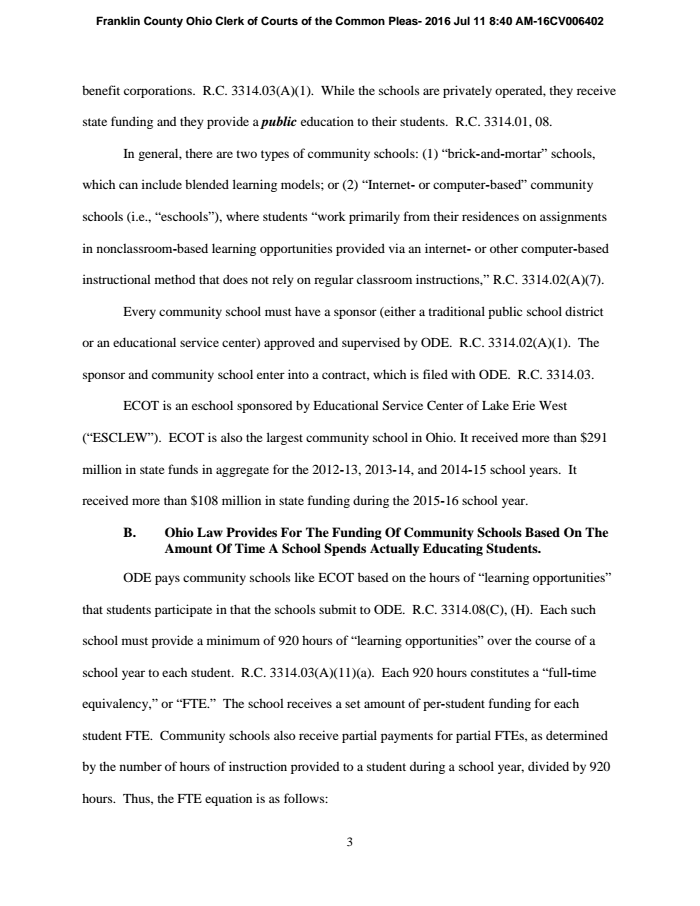
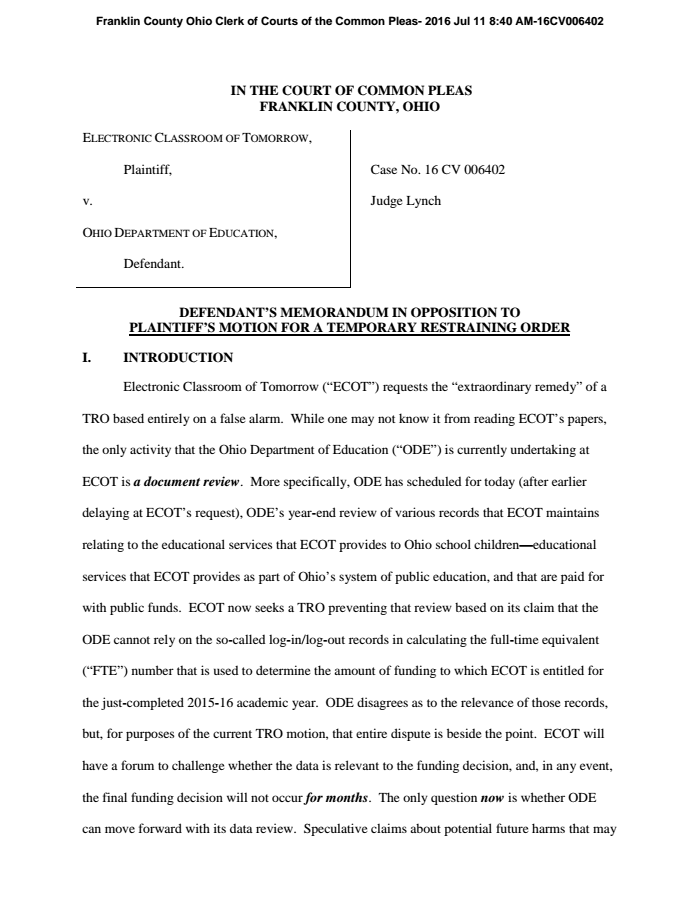
COLUMBUS, Ohio - Many students at the Electronic Classroom of Tomorrow (ECOT) online charter school spend just an hour a day online taking their classes, state lawyers said this week, all while the state pays the school as if they were full-time students.
That detail was included in a filing by the state in Franklin County Common Pleas Court Monday as the Ohio Department of Education audits the giant charter school's records. The state wants to see if ECOT's 15,000 students spent enough time on coursework this past school year to merit the $108 million the state paid the school.
Unlike a traditional school, where teachers can take attendance every day, students at online schools like ECOT take classes at home by computer. That makes it hard to measure whether they are actively taking classes, an issue that is becoming increasingly contentious between Ohio's e-schools and the state.
Since charter schools are paid on a per-student basis by the state, there are millions of dollars at stake in determining which kids qualify as attending a school.
An initial review this spring raised red flags that students at ECOT, Ohio's largest online school, may have done far less work than required.
"Based on its review of a sample of the student log-in records, ODE found that most students logged into ECOT's online platform for only about one hour per day," state lawyers told the court Monday.
That's just a fraction of the six to seven hours per school day that students spend at a traditional school.
It's also far less than the five hours per day students should spend, on average, to reach the 920 hours of learning the state requires over a school year, ECOT's own guidelines say.
"Those (ECOT's) records did not substantiate the number of educational hours for which ECOT had billed ODE," the state's lawyers added.
Until this week, the state had only publicly reported ECOT students spending less than that five hours per week benchmark. The filing on Monday was the first indication of how much less.
Note that students can also meet that five-hour daily average with work offline, but the state and ECOT are sparring over whether the school needs to document that offline time.
The school says that it only has to offer 920 hours of "learning opportunities," regardless of whether students take advantage of them. The state says that students must "participate" in classes for those hours.
The Ohio Department of Education was scheduled to look at records in more detail Monday. ECOT filed suit last Friday to block that audit, but Franklin County Common Pleas Judge Stephen McIntosh on Monday denied the school's request for a restraining order.
Department employees then went to the school to resume the audit Monday afternoon, shortly after McIntosh's lunchtime denial.
The department has not offered any estimate on when a report of its findings will be ready, though state law requires it by Sept. 30.
ECOT spokesman Neil Clark did not dispute the one-hour figure claimed by the state, but said the school is meeting state law.
"ECOT students are offered the required number of hours of learning opportunities everyday, just like students at traditional public schools," he told The Plain Dealer. "As a result of the opportunities provided, ECOT graduates more students than any other school in the state. ODE is unfortunately trying to limit the choice of Ohio families who traditional public schools have failed."
Clark also said the school has clean audits from the state auditor, who has recently blasted the Ohio Department of Education for mismanagement.Many ECOT students spend just one hour online for classes each day, state lawyers say | cleveland.com:
DOCUMENT
PAGES
TEXT
Zoom


THE DEBATE OVER CHARTER SCHOOLS


Weingarten praises Democrats’ education stances for convention platform | New York Amsterdam News

Weingarten praises Democrats’ education stances for convention platform | New York Amsterdam News: The new Black view:

Weingarten praises Democrats’ education stances for convention platform

American Federation of Teachers President Randi Weingarten offered nothing but praise for the Democratic Party after delegates passed amendments that bridged Bernie Sanders’ and Hillary Clinton’s platforms.
“Thanks to collaboration between Clinton and Sanders drafters and platform committee members, the public education plank in the Democratic platform represents a refreshing sea change in its approach to public education, to the students we serve, and to the parents and educators who work so hard to give all our children the opportunity they deserve,” said Weingarten in a statement. “This platform makes it clear that Democrats are committed to ending the failed era of test-and-sanction, and are ready to refocus on strategies that will help each and every child succeed, from early childhood through college and career.”
Some of the amendments to the education platform that Democrats will present at the upcoming convention include charter schools reflecting the neighborhoods they serve and teaching all children regardless of their special needs, their disabilities or their backgrounds.
“This supports the original vision for charter schools: to complement, not to replace or destabilize, traditional public schools,” stated Weingarten.
Another part of the platform, passed via a unity amendment, will include the goal of providing free tuition for middle-class and working families at public colleges and universities and pushing for a debt-free higher education for all Americans. Clinton mentioned this proposal Tuesday after Sanders endorsed her at a rally in New Hampshire. The amendment calls for year-round Pell Grants, additional support for historically Black colleges and universities and an expansion of debt-repayment options.
“Democrats’ higher education plank is the most progressive in American history,” said Weingarten. “It matches Hillary Clinton’s New College Compact, a plan that contains the best ideas from leaders in the field including Sens. [Elizabeth] Warren and Sanders, as well as from the many young people Hillary engaged on the trail.”
The platform also includes increased support for community schools and alternative discipline practices.Weingarten praises Democrats’ education stances for convention platform | New York Amsterdam News: The new Black view:


Seattle Schools Community Forum: Dorn Says He Will File Lawsuit Against Districts

Seattle Schools Community Forum: Dorn Says He Will File Lawsuit Against Districts:

Dorn Says He Will File Lawsuit Against Districts


From the Everett Herald:

Superintendent of Public Instruction Randy Dorn knows school districts use local levies to pay teachers and principals because they don’t get enough money from the state to offer competitive salaries.

He is convinced it is illegal for them to do this.

So the outgoing chief of Washington’s public school system said he intends to sue a few districts to find out.

Dorn is preparing to launch legal action as early as Tuesday in King County Superior Court. He wouldn’t say which districts will be named as defendants. 
The Herald thinks one will be Snohomish because they have one of the highest teachers salaries in the state.Seattle Schools Community Forum: Dorn Says He Will File Lawsuit Against Districts:

Seattle Schools Teacher Keeps Job Even Though He Left Students Alone on Field Trip
I had only vaguely heard about this issue but apparently an investigation happened and the results are in. From the My Northwest: A Ballard High School teacher remains on the job, even after an investigation found he “abandoned” high school students on an overnight field trip with no one but one of the student’s 19-year-old boyfriend. Why did he leave them? So he could attend a Seattle teacher’s u
Dorn Says He Will File Lawsuit Against Districts
From the Everett Herald : Superintendent of Public Instruction Randy Dorn knows school districts use local levies to pay teachers and principals because they don’t get enough money from the state to offer competitive salaries. He is convinced it is illegal for them to do this. So the outgoing chief of Washington’s public school system said he intends to sue a few districts to find out. Dorn is pre
Washington Supreme Court to State on McCleary; We Have Some Questions
The big news is a reply from the Supreme Court to the Legislature on McCleary. The 2017 legislative session presents the last opportunity for complying with the State's paramount duty under article IX, seciton 1, by 2018. What remains to be done to achieve compliance is undeniably huge, but it is not undefinable. Basically the Court is saying to the State: - this has gone on long enough - we don't
Answers Back from District on Garfield Honors for All
But those answers raise more questions. I had written to district communications (and cc'ed the Board) about this issue. Here are my initial questions and what their reply: Does the Superintendent or district have any statement about the issues raised by Principal Howard and the Times' article? As well, does the Superintendent or district have any statement about the news that LA/History at Garfie

YESTERDAY

Things Heat Up on the Democratic Platform for 2016
Update: this post from retired teacher/blogger Fred Klonsky puts it all in perspective. end of update And I'm talking about public education. There was much discussion about the platform's stand on public ed issues early on. With Hillary Clinton waffling about charter schools (only "high-quality" ones), it was hard to say what would happen. But now wording has been tightened and it look


Seattle Schools Community Forum: Dorn Says He Will File Lawsuit Against Districts:

Group that wants to launch new L.A. schools names its first grant winners - LA Times

Group that wants to launch new L.A. schools names its first grant winners - LA Times:

Group that wants to launch new L.A. schools names its first grant winners

A group that has vowed to start high-quality schools across Los Angeles on Thursday announced its first grant recipients: a charter school that is expanding, an after-school and summer enrichment program for children, and an organization that recruits recent college graduates for two-year teaching stints.
None of the money went to the Los Angeles Unified School District, although it’s likely to benefit from the teacher-recruitment effort. 
The grants are the first concrete indication of the direction of Great Public Schools Now, a recently formed nonprofit with a particular formula for school reform: Take a school that works and make it larger or build a new one just like it.
The work is vital, say organizers, because 160,000 students in low-income neighborhoods attend failing public schools.
The reform effort grew out of a preliminary, confidential proposal, circulated last year among philanthropists, to move half of L.A. Unified’s students into charter schools over eight years. The proposal, which called for building 260 new charter schools, was developed under the auspices of the Eli and Edythe Broad Foundation and provoked widespread controversy when The Times obtained a leaked copy and wrote about it.
The plan, however, evolved over time, the group says, and the current strategy is to support any kind of successful school, including those in L.A. Unified.
“This is a fantastic opportunity for all of Los Angeles,” Executive Director Myrna Castrejón said at a news conference at Heart of Los Angeles, the Westlake enrichment program slated to receive $500,000.
Great Public Schools Now said earlier this week that its grant money would go to creating and expanding effective schools and training teachers and principals. 
Heart of Los Angeles does not fit in those categories, but it does well-regarded work.
A second recipient is Equitas Academy Charter Schools, which serves the low-income Pico-Union area, just west of downtown.  
Equitas already was building its third small campus. The $2-million grant will make the project more affordable by reducing long-term debt, leaving more money for academic programs, said founder and Chief Executive Malka Borrego.
Charters, most of which are non-union, are run independently of L.A. Unified.
The third recipient, Teach For America, also will receive $2 million, which will payGroup that wants to launch new L.A. schools names its first grant winners - LA Times: 
Los Angeles “Reform” Group Makes Grants to Other Reformers | Diane Ravitch's blog - http://wp.me/p2odLa-eM4 via @dianeravitch


For LGBTQ Students, Author Says, Safety Is 'Not Enough' : NPR Ed : NPR

For LGBTQ Students, Author Says, Safety Is 'Not Enough' : NPR Ed : NPR:

For LGBTQ Students, Author Says, Safety Is 'Not Enough'

Gay-straight alliance school bus at Seattle Pride, 2008.
Flickr user jglsongs/Flickr Creative Commons

Across the country there are stories like this: In a high-poverty area of Honolulu, a high school social worker helps her Asian-Pacific Islander students talk with their families about being LBGTQ.
At a time when LGBTQ concerns in schools are increasingly visible — and often debated — teachers and administrators are looking for new ways to support students.
In Puyallup, Washington, a third-grade teacher coaches her students on how to respond to language like "that's so gay" by starting discussions about respect for LGBTQ people in the classroom.
And in a Utah, a socially conservative state, students at a high school with supportive staff connect over social media with students in communities that are less accepting of LGBTQ lifestyles.
Michael Sadowski brings us these stories in his new book,Safe Is Not Enough: Better Schools for LGBTQ Students.
Safe Is Not Enough
Safe Is Not Enough
Better Schools for Lgbtq Students
Paperback, 232 pages
purchase
He's an expert in adolescent identity development, focusing on LGBTQ (lesbian, gay, bisexual, transgender, and queer) students. For the book, Sadowski talked to educators around the U.S. to find out how they're integrating LGBTQ-inclusive policies into the curricula and cultures of their schools.
In doing so, Sadowski criticizes strategies that aim for safety as their end goal. Safety is an important goal, he writes— "a critical baseline from which all subsequent work must follow."
But, he tells NPR, "would we accept safety as the one and only goal for any other population of students? Why do LGBTQ kids have to settle for safety as the only thing they can expect from the adults who run their schools?"
Here's our Q&A with Sadowski, edited for length.
Note: NPR normally uses the acronym LGBT to refer to "lesbian, gay, bisexual and transgender" persons. Sadowski adds a "Q" for "queer." We're doing that as well for this report.
You raise a critical question about "safe spaces" in schools such as those labeled by stickers and posters: "If a certain place in the school is designated as a safe space, what does that say about the rest of the building?"
We're in a different political reality than we were in the 1980s and '90s. I think there are many educators out there now who want to make their schools not just safe, but affirming and empowering for their LGBTQ students. They just don't know where to start. The amazing teachers, administrators, counselors, and kids I met while researching the book show how a lot of people are already For LGBTQ Students, Author Says, Safety Is 'Not Enough' : NPR Ed : NPR:

'Get to green:' California wants to grade school performance with colors instead of a single number - LA Times

'Get to green:' California wants to grade school performance with colors instead of a single number - LA Times:

'Get to green:' California wants to grade school performance with colors instead of a single number


 r the last 15 years, a number between 200 and 1,000 told parents in California how good their child’s school was.

Up next: They might have to decipher performance through a series of colored boxes.
California is in the process of redefining its system for rating public schools, in a way that is both transparent for parents and more precise than just using test scores. The changes come after the number system, called the Academic Performance Index, was suspendedand as the state tries to satisfy the Every Student Succeeds Act, the federal government’s replacement of No Child Left Behind.
The latest proposal, presented Wednesday at a meeting of the State Board of Education in Sacramento, is “the California Model,” a display of 17 colored boxes that summarize how a school is doing in such categories as math or career readiness, both in terms of current status and progress over time.
Performance is rated on indicators set by state and federal law as well as those evaluated under the state’s new school funding formula.
Though officials cautioned the draft was preliminary, it engendered a long debate over graphics, with one board member begging to move away from “Easter egg” colors because one pastel-tinged draft.
A school in the red on graduation means that too many students are dropping out; the best color ranking would be blue. To understand what each color means in a particular category, parents could refer to a “lookup table,” a grid of 25 colored boxes explaining in more detail what it means to be labeled a certain color. 
Eric Crane, a designer of the mock-up from the nonprofit consulting firm WestEd, 'Get to green:' California wants to grade school performance with colors instead of a single number - LA Times:

Paying Back School Kids on the Installment Plan – PA Budget Shenanigans | gadflyonthewallblog

Paying Back School Kids on the Installment Plan – PA Budget Shenanigans | gadflyonthewallblog:

Paying Back School Kids on the Installment Plan – PA Budget Shenanigans

allowance2
Hey, Kids!
We’re your Pennsylvania Legislature, and we’re here to help!
We just passed a new state budget that puts $200 million more in your classrooms! Isn’t that great!?
Yeah. We know. Your public schools are crumbling to dust, and your school books are falling apart, and you’re stuffed into overcrowded classrooms, and…
But here’s some more money so it’s all better now!
Um. No. It actually doesn’t heal that huge chunk of cash we slashed from public schools six years ago. We’ve been giving you back about $100-200 million a year for a while now, so with this new budget… uh… We’re actually about $150 million short. But we’re good for it!


The Failure of U.S. Schools as “Guardians of Democracy” | Larry Cuban on School Reform and Classroom Practice

The Failure of U.S. Schools as “Guardians of Democracy” | Larry Cuban on School Reform and Classroom Practice:

The Failure of U.S. Schools as “Guardians of Democracy”


“If 50 percent of a school district‘s graduates could not read, we‘d fire the superintendent. Yet regularly less than half our graduates vote. In our ―accountability era, no superintendent has been fired for failing in this core mission of our ―’guardian of democracy.’ ”
The  quote comes from a paper written by Michael Johanek in 2011 about the century-old history of civic education in the U.S.. However,  since the early 1980s business-minded state and federal reformers “re-purposed”  K-12 schools into building  a stronger, globally competitive economy through higher academic standards, increased testing, and tougher accountability for student results; the traditional goal of civic education has become a “Second Hand Rose.” That has been the case for the past three decades.
Relegated to applause lines in graduation talks, making students into citizens who are engaged in their communities gets occasionally resuscitated by national commissions, occasional reports and books, and pronouncements from top officials (see herehere, and here), but the sad truth is that until the dominant  rationale for schooling the young shifts from its current economic purpose to its historic role as “guardian of democracy,” only   fleeting references to the civic purpose of schooling will occur.
I do not know whether such a shift will occur in the immediate future. I surely want it to occur.  Trimming back the prevailing economic purpose for tax-supported schools and correcting the current imbalance in preparing children and youth for civic participation is long overdue. Consumerism  has enveloped public schools over the past three decades. The role of schools to teach democratic values and skills and insure that students have opportunities to practice the skills and values in their communities has been shoved aside. Were such a political change to occur,  it will be gradual as more and more parents, taxpayers, and policymakers come to see the harmful imbalance among the multiple aims for schools in a commerce-driven democracy. Were that political shift in purposes to occur, the crucial question of what kind of a citizen does the nation want will re-emerge as it had in earlier generations of school reformers.
That question of what kind of citizen has been around since tax-supported public schools were founded two centuries ago. No one answer has sufficed then or now because there are different ways of viewing a “good” citizen (see here and here). Nor has any answer in the 1920s, 1940s, 1960s–when schools were expected to prepare students to participate and engage in the community–sufficed. Arguments over the kinds of citizenship that should be practiced in and out of The Failure of U.S. Schools as “Guardians of Democracy” | Larry Cuban on School Reform and Classroom Practice:
 

Priorities Gone Wrong: Prison Spending Skyrockets, Leaves School Spending Behind | janresseger

Priorities Gone Wrong: Prison Spending Skyrockets, Leaves School Spending Behind | janresseger:

Priorities Gone Wrong: Prison Spending Skyrockets, Leaves School Spending Behind


The U.S. Department of Education just released a report, State and Local Expenditures on Corrections and Education, that reinforces what is known about the alarming explosion in the rate of incarceration in the United States.
The Education Department’s report is about budgets—across states and localities: “From 1979-80 to 2012-13, public PK (PreK)-12 expenditures increased by 107 percent (from $258 to $534 billion), while total state and local corrections expenditures increased by 324 percent (from $17-$71 billion)—triple the rate of increase in education spending…  All states had lower expenditure growth rates for PK-12 education than for corrections, and in the majority of the states, the rate of increase for corrections was more than 100 percentage points higher than the rate for education… In 24 states, the growth rate in per capita corrections spending was more than 100 percentage points higher than the rate for per-pupil PK-12 education spending.”  Finally, “At the postsecondary level, the contrast was even starker: from 1989-90 to 2012-13, state and local spending on corrections rose by 89 percent while state and local appropriations for higher education remained flat.”
The new report confirms the trend in K-12 education spending reported last winter by the Center on Budget and Policy Priorities: “At least 31 states provided less state funding per student in the 2014 school year (that is, the school year ending in 2014) than in the 2008 school year, before the recession took hold.  In at least 15 states, the cuts exceeded 10 percent.”  State governments are spending less on public education than they used to.  Most of the increases in education spending in the past few decades have been for special services mandated under the Individuals with Disabilities Education Act.
The new report from the Department of Education further confirms the reality of the exploding rate of incarceration over recent decades: “(T)he number of people incarcerated in state and local correctional facilities more than quadrupled over the past few decades, rising from about 490,000 in 1980 to over 2 million in 2014, due in part to the enactment of Priorities Gone Wrong: Prison Spending Skyrockets, Leaves School Spending Behind | janresseger:

Diane Ravitch at SOS Rally - Living in Dialogue

Diane Ravitch at SOS Rally - Living in Dialogue:

Diane Ravitch at the SOS Rally, Washington DC, July 8, 2016