Latest News and Comment from Education

Tuesday, July 12, 2016

Democrats make education revisions to 2016 platform — and a key reformer is furious - The Washington Post

Democrats make education revisions to 2016 platform — and a key reformer is furious - The Washington Post:

Democrats make education revisions to 2016 platform — and a key reformer is furious 


In an unexpected move, Democrats have revised the K-12 education section of their party’s 2016 platform in important ways, backing the right of parents to opt their children out of high-stakes standardized tests, qualifying support for charter schools, and opposing using test scores for high-stakes purposes to evaluate teachers and students.
Some of the changes are being welcomed by public school advocates who have been fighting corporate school reform, which includes standardized test-based accountability systems and the expansion of charter schools. Many of these activists have been worried that Hillary Clinton, the presumptive Democratic nominee, would back corporate reform, just as the Obama administration has. While it isn’t clear exactly what she will do if she becomes president — as platform language does not necessarily translate into policy — supporters of those reforms are furious at the changes, highlighting a rift in the party over how to improve K-12 education.
One of them, Shavar Jeffries, president of the Democrats for Education Reform, an influential political action committee supported heavily by hedge fund managers favoring charter schools, merit-pay tied to test scores and related reforms, issued a statement that went so far as to say that the original draft on education was “progressive and balanced” but that the new language “threatens to roll back” President Obama’s education legacy. (See full statement below.)
Negotiators on the platform committee met this past weekend in Orlando (you can watch here, starting at the 31st minute) and changed an earlier draft of the K-12 education plank (one of five education sections) that had drawn criticism from activists who wanted the Democrats to take a stand against some of the key elements of corporate reform, including on charter schools and test-based accountability. Clinton got booed recently when she appeared at the National Education Association’s convention and touted charter schools (though most of her speech was met with approval).
The first released draft said this:
Democrats are also committed to providing parents with high-quality public school options and expanding these options for low-income youth. We support great neighborhood public schools and high-quality public charter schools and we will help them to disseminate best practices to other school leaders and educators. At the same time, we oppose for-profit charter schools focused on making a profit off of public resources. Democrats also support increased transparency and accountability for all charter schools.
Critics pounced. Veteran educator Peter Greene, for example, said the Democrats needed to Democrats make education revisions to 2016 platform — and a key reformer is furious - The Washington Post:

"It's Not Your Funeral: Don't Make BLM About You"? Badass Teachers Association

Badass Teachers Association:

"It's Not Your Funeral: Don't Make BLM About You"?

By Matt Jungblut, Member of BATs


Regarding the recent deaths of black men by some bad police (this piece is not anti-police, there are many more good police doing a a really hard job with a lot of stress, for very little money - if you want to debate that, start another post elsewhere, please), there are many whites who have some confusion and questions as to what to say and do.
Black Lives Matter is not an anti-police or anti-white group or organization. There may be some folks who are using it that way, much in the same way that there are some Christians who hate, Muslims that bomb, Jews who cheat, and so on, but you'd be wrong to think that those bad people represent the entire group.
If you're still with me and not frothing with outrage right now, good, you're probably the target audience, a rational person who isn't instantly offended.
I am trying to support my black friends best right now by being there if they need me or ask me to be. I am also reading everything that they are writing and posting about, I am doing my best to listen.
That's right, listening, reading, and self educating. I consider America's black community to be in mourning right now. There is a lot of pain and people are expressing it as best as they can, and trying to make sense as to why this is still happening in our country. If you are unsure how to act, perhaps you should treat this situation like a funeral.
Some things I'm not doing: I'm not going on their pages and saying all lives matter. I'm not saying I completely understand how you feel. I'm not saying that we can solve this with love. I'm not saying my prayers are with you. I'm not saying white people get killed by police too. I'm not saying I don't see color. I'm not "white-splaining" the situation. It's not about me. I wouldn't go to a funeral and get up and start preaching or making a eulogy unless I was family or invited to do so.
I'm also not asking black folks to help me understand. It's 2016, these conversations should have happened already. It's not up to black folks to educate me. There's plenty books and articles out there, where black people are expressing what they think. And if you read them, you'll see that there are a thousand different viewpoints being expressed by the black community. There is no single black viewpoint; your friend, coworker, child's teacher, student, neighbor, or the person standing next to you in the elevator does not speak for the entire black community. Neither do President Obama, Al Sharpton, Beyonce, Allen West, Ben Carson, Carmelo Anthony, or Serena Williams. They only speak for themselves and from their experiences. I don't speak for you; nor does Donald Trump, Hilary Clinton, Bernie Sanders, Mike Trout, or Steven Colbert speak for all white people. Do not expect black folks to explain Badass Teachers Association:

If Rewards Improve Test Scores, What's Really Being Tested?

If Rewards Improve Test Scores, What's Really Being Tested?:

If Rewards Improve Test Scores, What’s Really Being Tested?

standardized tests rewards

The support for high-stakes testing rests on a belief that a test score accurately measures what a student has learned. Therefore, many argue, standardized tests should be a major factor in evaluating teachers. Jeffrey Livingston,an economics professor at Bentley University, wondered what would happen if you offered students a financial reward of $90 to do well on a standardized test. Encouraged by his wife – a public school teacher suspicious of the tests’ ability to accurately measure learning – Livingston and some colleagues set up a trial with some students in Chicago. They released the findings in May. Livingston recently spoke with NEA Today about how the results call into question the value placed on standardized tests.
What was the specific question you wanted the study to adress and how exactly did the program work?
The concern we hoped to test is whether students in urban schools who are at risk of failing to meet state standards try as hard as they can on standardized tests when they have no personal stake in their score.
The experiment gives students incentives to improve their academic achievement over a two-month period, culminating with a chance to show what they have learned on an incentivized standardized test. We designed it to cover the same skills and knowledge that are tested on the official standardized test. We wanted to see the extent to which they show this same new knowledge on the test that the school administers.
Students took the official tests over one week in March and our incentivized tests the following week. Unless there is a difference in how hard students try on each exam, one would thus expect similar performance on the two exams. What we found is that students do much better on the test that is incentivized, but do not show the same gains on the official test.
There’s been quite a bit of research into these extrinsic motivators. How did your results compare with previous studies? 
Many similar experiments have been conducted, though there are differences – such as the outcome that is incentivized, the amount of the reward, and exactly what one has to do in order to earn the reward. So to some degree it is difficult to say why their results might differ.
However, most experiments which give incentives to improve grades or test scores have actually found very little impact. For example, Roland Fryer’s experiments which incentivize “outputs” such as grades and test scores have resulted in small or even If Rewards Improve Test Scores, What's Really Being Tested?:

News Flash - Pelto to run under Green Party Banner for 2nd Congressional District Seat - Wait What?

News Flash - Pelto to run under Green Party Banner for 2nd Congressional District Seat - Wait What?:
News Flash - Pelto to run under Green Party Banner for 2nd Congressional District Seat 


Wait, What? Readers:
Below is the press release that was issued this morning.  Since my gubernatorial effort in 2014, I’ve learned that the only effective way to get substantive media coverage on the important issues that challenge our state and nation is to be a candidate for office.  Since issues like the corporate education reform industry attack on public education and the nation’s unfair tax system that coddles the rich and burdens the middle class deserve far more attention, I have decided to run for Congress under the Green Party banner.  Discussing the critical issues we face is the most important step toward educating persuading and mobilizing people to stand up and speak out.  Watch for more information and a website soon.  Your support and participation would be greatly appreciated.
Meanwhile, Wait, What? will continue its work.
Jonathan
For Release:                                                                 For More Information Contact:
July 12, 2016                                                                Jonathan Pelto 860-428-2823
Pelto to run under Green Party Banner for 2nd Congressional District Seat
Long-time education advocate and former State Representative seeks to empower voters with issue agenda
(Storrs, Connecticut) Jonathan Pelto, a public education advocate and former Connecticut state representative, announced that he will run for Congress in Connecticut’s 2ndCongressional District this year as a member of the Green Party.  The Green Party’s nominating convention will be held on July 30 at Mansfield Public Library’s Buchanan Auditorium.
“I’m running for Congress as a Green Party candidate because this year’s election is so critical for sustaining the future of our democracy.” Pelto said, “I’m not running against Joe Courtney, whose performance in Congress has been extremely admirable, but to ensure that a variety of key issues are raised in this political campaign cycle.  Uncontested and under-contested elections reinforce apathy,  and this year, perhaps more than any other in recent memory, we need every voter to understand what is at stake and participate by voting.”
The Connecticut Green Party is the Connecticut affiliate of the Green Party of the United States. Ralph Nader, the Green Party’s Presidential candidate in 1996 and 2000, is from Connecticut and signed Jonathan Pelto’s petition to run for Governor in 2014.
“A Congress that will adopt a fair and equitable tax system that requires large corporations and the wealthy to pay their fair share, so that we can pay for vital services and reduce our national debt, is essential for securing the future of our country and create a healthier, safer and more equitable future for all of our citizens” Pelto added.
“In addition to highlighting the importance of an equitable and viable tax system, I will use this campaign to articulate an agenda that stops the privatization of public education and deals with the student debt crisis. Other critical issues include creating a more open and honest government, effective legislation that stops the wealthy from buying political decisions and laws that support, rather than undercut, renewable energy so that we can reduce the devastating effects of climate change.  We must also work to convert our defense industry to develop products for commercial markets,” Pelto concluded.
Over the past ten years, Green Party members have been elected to local positions in New Haven, Windham and New London.  The Connecticut Green Party holds a ballot line in the 2nd Congressional District, having received at least the required one percent of the vote in every election cycle since 2008.
“Jonathan Pelto is Connecticut’s leading voice on behalf of public education” said New London Board of Education member Mirna Martínez. “His willingness to stand up and speak out on the important issues we face will make him an outstanding candidate. We are looking forward to having him heading our Green Party slate in eastern Connecticut.”
Scott Deshefy, who gained ballot access in 2008 to become the first Green Party candidate to run in the 2nd Congressional District, added, “The Green Party is about educating and persuading voters to become better informed and more active in our democracy. Jonathan Pelto’s candidacy is a major step forward in our effort to reach more voters with our agenda of fairness, equity, social justice and grassroots democracy, which touched off the current progressive movement.”
This year’s race presents an unprecedented an opportunity to raise the visibility of the Green Party and to present sensible and humane solutions to the challenges faced by our country, state, and municipalities
“As Connecticut approaches the critically important 2018 gubernatorial campaign, the party and its Congressional candidate must receive at least one percent of the vote in the 2016 election, in order to maintain ballot access and its minor party status in the 2ndCongressional District. I hope to be able to ensure that the Green Party gets those votes” Pelto said.
###
Pelto, 55, has long a long record of involvement in Connecticut politics and government.  Pelto was elected to the Connecticut House of Representatives in 1984, where he served five terms.  During his legislature tenure he served in a variety of leadership positions including deputy majority leader of the House.  In 2014 Pelto was an unsuccessful petitioning candidate for governor.
Pelto is the founder and coordinator of the Education Bloggers Network, a confederation of more than 240 pro-public education bloggers around the country.  For the past six years Pelto has written the Wait, What? Blog, which is purportedly the most read commentary website in Connecticut.News Flash - Pelto to run under Green Party Banner for 2nd Congressional District Seat - Wait What?

ECOT Lawsuit Fails to Block Attendance Audit to Identify Phantom Students | janresseger

ECOT Lawsuit Fails to Block Attendance Audit to Identify Phantom Students | janresseger:

ECOT Lawsuit Fails to Block Attendance Audit to Identify Phantom Students


Everybody has suspected that Ohio’s Electronic Classroom of Tomorrow, Ohio’s biggest charter school and one of the nation’s largest fully online charter schools, has been collecting tens of millions of tax dollars for years for educating phantom students. Yesterday ECOT lost in its attempt to block an Ohio Department of Education audit to confirm that it is actually educating all 15,000 students it says are enrolled. Yesterday morning this blog covered ECOT’s attempt last Friday to block the audit by filing a lawsuit.
A court hearing on ECOT’s lawsuit took place promptly yesterday, and yesterday afternoon Jim Siegel of the Columbus Dispatch reported: “Franklin County Judge Stephen McIntosh denied ECOT’s request for a temporary restraining order blocking the state from moving forward with its attendance audit that was scheduled to start today (Monday).  ECOT filed suit in Franklin County Common Pleas Court on Friday to block the Ohio Department of Education from poring through the online charter school’s attendance records…. School officials argue the department is improperly requiring the school to provide proof of student log-in hours to show students attended the state-minimum 920 hours of (annual) learning time.”
ECOT claims that its students should be given credit for hours of learning when they are not online, but the state is demanding documentation that students are logged in for five hours each day and actively using the online curriculum being provided by the school. ECOT claims that a 2003 contract agreement between the school and the Ohio Department of Education requires that to qualify for an annual per pupil reimbursement from the state, ECOT need merely provide five hours each day of learning opportunities, but not be required to demonstrate that students are actually using the curriculum.
Patrick O’Donnell of The Plain Dealer reports that ECOT also claimed in its lawsuit that, “the department had told online schools last year that it would start requiring more ECOT Lawsuit Fails to Block Attendance Audit to Identify Phantom Students | janresseger:
 
Big Education Ape: Cyber Charter school tuition criticized as unfair | sharonherald -http://bigeducationape.blogspot.com/2016/07/cyber-charter-school-tuition-criticized.html

Big Education Ape: California Reaches Settlement With K12 Over False Claims Allegations - WSJ -http://bigeducationape.blogspot.com/2016/07/california-reaches-settlement-with-k12.html


Big Education Ape: Facing tough questions from Calif. officials, virtual charter school operator settles with attorney general | 89.3 KPCC - http://bigeducationape.blogspot.com/2016/07/facing-tough-questions-from-calif.html

What My Black Student Taught Me, His White Teacher, About Black Lives | gadflyonthewallblog

What My Black Student Taught Me, His White Teacher, About Black Lives | gadflyonthewallblog:

What My Black Student Taught Me, His White Teacher, About Black Lives

student_081910-thumb-640xauto-704
I can’t tell you how many times Darnell was in detention.
After a while, it didn’t feel right if he wasn’t staying at least an hour after school.
Darnell was late to class.
Darnell swore at another student.
Darnell copied someone’s paper.
Darnell did just about everything and anything that came to his mind. And it earned him time after school with me, his newly-minted 8th grade language arts teacher.
In a class full of mostly brown and black students, many living in an impoverished high crime Pittsburgh suburb, Darnell was the standout. Or at least his misbehavior was.
At first, he complained, but I had his mom on speed dial, and she fully supported my holding him accountable.
He wanted to do his homework during this time, but I made him do busy work instead. The way I looked at it as a young teacher just starting out, if I gave him time What My Black Student Taught Me, His White Teacher, About Black Lives | gadflyonthewallblog:


Beyond integration: How teachers can encourage cross-racial friendships | 89.3 KPCC

Beyond integration: How teachers can encourage cross-racial friendships | 89.3 KPCC:

Beyond integration: How teachers can encourage cross-racial friendships 

132755 full
LA JOHNSON/NPR

There's a reason Jose Luis Vilson's students learn in groups: He wants them to feel comfortable working with anyone in the classroom, something he's realized in his 11 years of teaching doesn't always come naturally.
"I don't really give students a chance to self-select until later on, when I feel like they can pretty much group with anybody," he says.
Vilson teaches math at a public middle school just north of Harlem in New York City. Most of his students are Latino and African-American, and Vilson pays close attention to the fact that their racial identities affect their experiences in the classroom.
Children entering adolescence, he knows, are less likely to maintain cross-racial friendships as they grow older. But teachers like him may be able to help change that, according to a new study led by researchers from New York University.
In past decades, it's become increasingly clear that diversity in classrooms isn't just a buzzword. A growing body of research points to classroom diversity as an important aspect of childhood development. Kids who make friends with kids of other races tend to be more socially well-adjusted, more academically ambitious and better at interacting with people who are different from them.
The NYU researchers knew of these findings and wondered if just putting kids of different races in classrooms together is enough to foster lasting connections. Their hypothesis was that, as kids grow into early adolescence, they increase their same-race friendships and decrease their cross-race friendships.
So they looked at data from the Early Adolescent Development Study (EADS), a longitudinal survey where researchers questioned more than 500 elementary- and middle-schoolers over the course of two academic years: fall 1996 to spring 1998. The students in the study all went to school in one district in the American Beyond integration: How teachers can encourage cross-racial friendships | 89.3 KPCC:

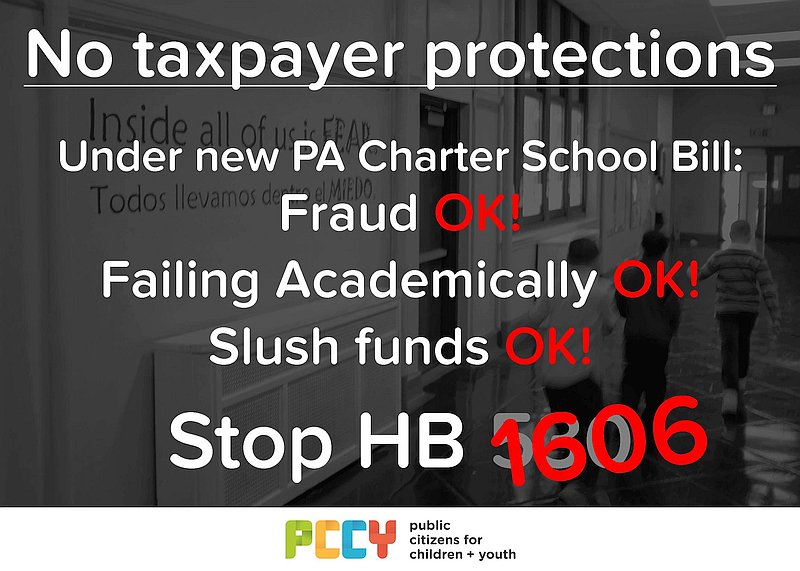
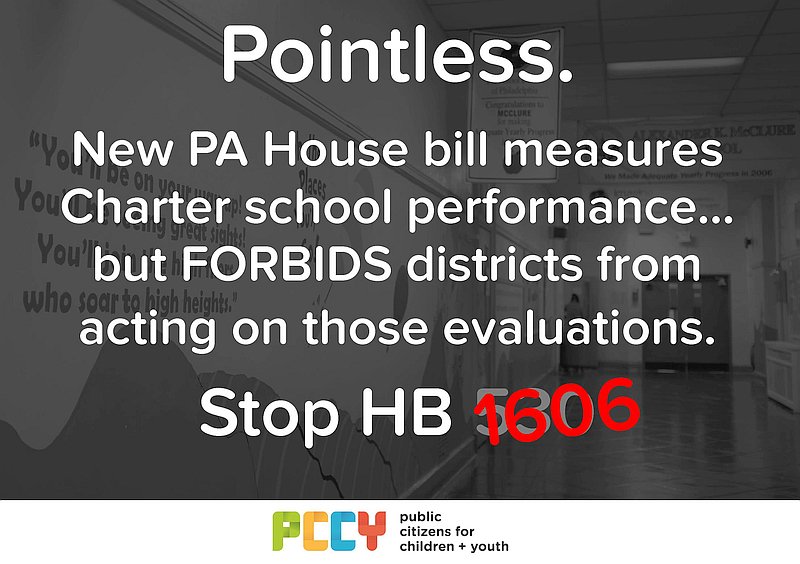
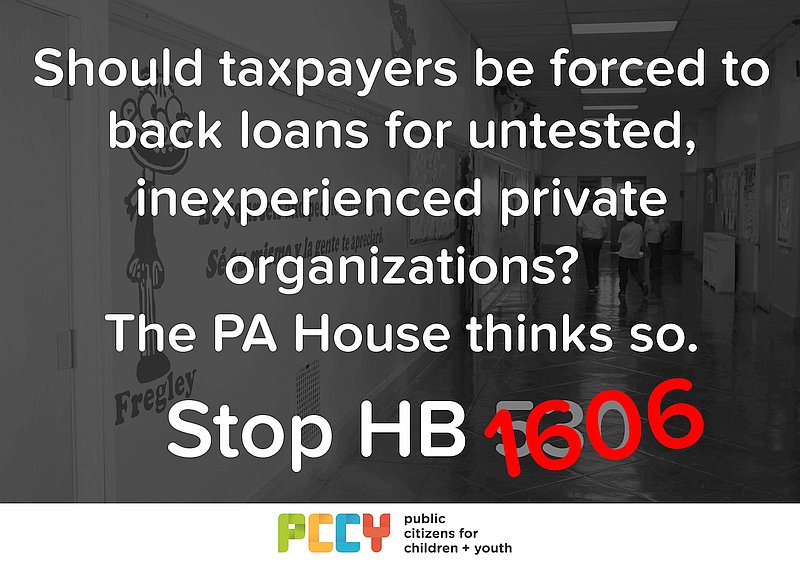
20 reasons to vote no on Pa. HB 530 charter school reform STOP #hb1606! #phled #pabudget #hb530

20 reasons to vote no on Pa. HB 530 charter school reform:

20 reasons to vote no on Pa. HB 530 charter school reform


Pennsylvania taxpayers now spend more than $1.4 billion on charter and cyber charter schools annually, in addition to funding the state’s traditional public schools.  The current “rob from public school Peter to pay charter school Paul” system drains money from traditional public schools, forcing districts to cut programs and services for the students who remain. In 2011, the charter reimbursement line was eliminated from the state budget. It provided state funding to districts for the costs and financial exposure resulting from the addition of charter schools.  
Legislators are now considering House Bill 530, which would bring much-needed reform to the charter school law that was written in 1997. The bill has several helpful provisions, but the harm that it does far outweighs the good. Here are 20 reasons that the legislature should vote against this measure.
  • #HB530 does not provide significant accountability to taxpayers for payments made to charter school entities. 
  • #HB530 would create a Charter School Funding Commission that would consider establishing an independent state-level board to authorize charter school entities, bypassing any local decision-making by school boards and their communities.
  • #HB530 further limits the ability of communities to negotiate the role of charters locally. The decisions about how, when, and where to expand them should be made by those who have the information and expertise to do so in ways that improve education.
  • #HB530 is an entirely unwarranted intervention in the local governance of school districts. It would remove local control of tax dollars from Pennsylvania taxpayers and their elected school directors.
  • #HB530 sets no limits to money that charters can drain from local school districts, eliminating districts' capability to plan and budget.
  • #HB530 is a vehicle for the Pennsylvania legislature to have local taxpayers pay for unlimited charter expansion.
  • #HB530 would let charter operators expand and add grades without any local input or authorization, regardless of performance.
  • #HB530 would let charters expand by enrolling students from outside of the district in which it is located.
  • #HB530 does nothing to address the enormous drain of tax dollars from all 500 school districts for chronically underperforming cyber schools that were authorized by the state. Nearly every national study of virtual schools' performance has found it lacking, including studies by “pro school choice” organizations.
  • #HB530 does not address the poor performance of cyber charters by creating a task force or a commission to study student outcomes in these schools. Not one Pennsylvania cyber charter has achieved a passing score of 70 on the state’s School Performance Profile in the three years that it has been in use. Most cybers never made Adequate Yearly Progress under all the years that No Child Left Behind was in effect.
  • #HB530 sets no annual limits on the amount of taxpayer dollars that can be spent on charter advertising.
  • #HB530 proposes a new 14-member Charter School Funding Advisory Commission without including a single one of the state’s 4,500 locally elected school directors who are responsible for raising revenue in their school districts.
  • Even though more than 90 percent of Pennsylvania kids are educated in district schools, #HB530 stacks the Charter Appeals Board in favor of charter schools.
  • If charter schools are public schools, why should they have different methods of evaluating the schools and their teachers, as proposed in #HB530?
  • #HB530 requires use of a performance matrix that makes it impossible to compare charters’ performance with their sending school districts’ performance.
  • #HB530 creates a separate evaluation system for charter school teachers instead of using the existing state system.
  • #HB530 would let charters keep your tax dollars to accumulate fund balances that are 4 percent to 8 percent higher than their respective school districts.
  • All of the accountability provisions in #HB530 can be easily bypassed if a charter school contracts with a management company to operate the charter. Chester Community Charter School, the state’s largest charter, is the poster child for this with Charter School Management Inc., founded and run by Republican powerbroker Vahan Gureghian.
  • If a charter is run by a management company, the public has zero information on how their tax dollars are spent. #HB530 does nothing to require any fiscal transparency or reporting from charter management companies.
  • #HB530 would divert an additional $25 million in tax money to unaccountable private and religious schools through the Educational Improvement Tax Credit program.
Lawrence A. Feinberg is the founder and co-chair of the Keystone State Education Coalition, a non-partisan, grassroots public education advocacy group.  He is currently serving his 17th year as a school director in Haverford Township.


Prescott, Ohanian: How the Golden State lost its luster - San Jose Mercury News

Prescott, Ohanian: How the Golden State lost its luster - San Jose Mercury News:

Prescott, Ohanian: How the Golden State lost its luster

By Edward C. Prescott and Lee E. Ohanian, Special to The Mercury News


Last month's $167 billion dollar budget deal forged by Gov. Jerry Brown and California lawmakers is four times as large in per capita terms as it was in the early 1960s under Brown's father, Gov. Pat Brown. But despite spending less, the budgets of yesteryear contributed considerably more to economic growth.
State governments of the 1950s and 1960s were an integral part of California's postwar boom, when the state grew from 11 million in 1950 to 30 million in 1990.
The budgets of yesteryear provided a blueprint for how government can promote growth by making investments in education, water and transportation infrastructure.
These investments were made at a challenging time. The baby boom and immigration from other states more than doubled California's population between 1940 and 1960. State resources were strained by the fact that 44 percent of the state's population was 24 years or younger, providing little tax revenue but requiring considerable investments in schools.
Rapid population growth in Southern California highlighted the importance of investing in water and highway infrastructures. Pat Brown's budgets were based on themes of creating opportunities and providing excellence in government. In his 1960 budget statement, Brown argued that "Democracy has come to mean equality of opportunity. Access to education has the highest place."
Pat Brown would undoubtedly be disappointed with today's California education system. A recent UC Berkeley report estimates that over half of California schools do not adequately repair their physical plants. California's K-12 education is now regarded as among the worst in the country.
Brown's 1960 vision of hiring the best teachers and allowing them to excel is hamstrung by teacher unions, particularly the 325,000-member California Teachers Association. The CTA has blocked important education reforms, including modifications to teacher tenure rules that would facilitate removing poorly performing teachers. The state's teacher dismissal rate is about .003 percent per year, reflecting a time-consuming process that can cost as much as $200,000 per case.
Protecting poorly performing teachers is very costly. Stanford University economist Eric Hanushek finds that removing the bottom 5-10 percent of K-12 teachers would raise our student achievement from well below the average of the developed world, to near the top.

California also made remarkable transportation and water infrastructure investments in the 1960s, but those investments are not being adequately maintained nor expanded. The Reason Foundation ranks California roads as the second worst in the country. The Road Information Program estimates that bad roads coststate drivers $44 billion per year, despite the fact that California gasoline taxes are 40 percent higher than the national average.
California's water infrastructure situation is no better. The last major water infrastructure was the 1960 California Water Project. But as state capital spending declined, the California Water Project never realized the capacity that its planners envisioned. Most of the project was completed by the early 1970s, but California's population has grown by 18 million since then.
The failure to expand water infrastructure is not because voters were unwilling to pay. Since 1970, voters approved 15 of 16 state water bonds, yet this did not deliver major new water storage or canals nor maintain existing infrastructure.
California's capital outlays have declined from about 20 percent of the state budget in the 1960s to about 3 percent today. California's political leaders once agreed that substantial infrastructure investment was a major obligation of state government.
This principle, which created so many opportunities that helped generations of Californians succeed, now sadly appears to be lost.
Edward C. Prescott, a 2004 Nobel Laureate in Economics, is a professor of economics at Arizona State University. Lee E. Ohanian is a professor of economics at UCLA and a senior fellow at the Hoover Institution. They wrote this for the Mercury News.Prescott, Ohanian: How the Golden State lost its luster - San Jose Mercury News:

Chicago charter schools tied to fraud of Concept Schools

Chicago charter schools tied to fraud of Concept Schools:

ONGOING FEDERAL INVESTIGATION ON CORRUPTION IN CHICAGO CHARTER SCHOOLS


 Days after federal agents swept into the headquarters of Concept Schools and a charter school it operates in Rogers Park in June 2014, top Chicago Public Schools officials took notice of the raids on the taxpayer-funded charter operator but decided to steer clear.

Jack Elsey — the CPS official in charge of overseeing publicly financed, privately run charter schools like those run by Concept — emailed the district’s top lawyer at the time, James Bebley, and copied then-schools CEO Barbara Byrd-Bennett about the federal investigation.
“James, any guidance on how we should react?” Elsey wrote, attaching a link to news coverage of the raids at Concept’s main offices in Des Plaines and its Chicago Math and Science Academy, at 7212 N. Clark. “My inclination is to see how this plays out.”
“At this point, I don’t know what we would be reacting to,” Bebley replied. “There is really nothing to say except that we will monitor events as they play out.”
“Good, just wanted to confirm my ‘gut’ on this one,” Elsey wrote back.
Byrd-Bennett responded, “Jack, Jack … Jack,” and closed her email with a backwards smiley face emoticon — (: — as she often punctuated more light-hearted email exchanges with other CPS officials. Elsey replied with a correctly executed smiley face: “:)”.
Byrd-Bennett quit as Mayor Rahm Emanuel’s top schools official last year amid an unrelated bribery scandal, pleaded guilty to federal corruption charges and awaits sentencing.
More than two years since the FBI raids brought the still-ongoing federal investigation involving Concept to light, the charter operator has continued to do business with contractors identified in court documents as allegedly having been involved in defrauding a U.S. Department of Education grant program, records obtained by the Chicago Sun-Times show.
The charter-management organization — which runs four taxpayer-funded charter schools in Chicago and dozens more across the Midwest — has paid more than $519,000 since the raids to companies federal authorities said were involved in the corruption probe and their subsidiaries, according to documents the newspaper obtained from individual Concept schools.
There has been no correspondence between CPS and Concept Schools — which gets Chicago charter schools tied to fraud of Concept Schools:

Ohio Public School Students Outscore Private School Voucher Students | News One

Ohio Public School Students Outscore Private School Voucher Students | News One:

Ohio Public School Students Outscore Private School Voucher Students

School choice advocates are shocked, but see the glass half full.


Scores of Ohio parents are using public-funded vouchers to pull their kids out of low-performing public schools and give them a private education. Many of those parents now feel disappointed.
A new study found that Ohio public school students outperform their private school peers on state reading and math exams, reports The Columbus Dispatch.
“Those students, on average, who move to private schools under the EdChoice (voucher) program tend to perform considerably worse than observationally similar students who remained in public schools,” the report stated, according to The Dispatch.
The results are “disappointing,” Chad Aldis, a vice president at the Thomas B. Fordham Institute, told the newspaper. His organization, which supports school choice, commissioned the study.
According to The Dispatch, researchers compared voucher students to their “closely matched peers” who stayed in public schools that were eligible for vouchers. The study covered the 2003-04 school year to the 2012-13 school year.
Ohio’s EdChoice voucher program launched in 2006 and provides vouchers to 20,000 low-income students. The program costs taxpayers $94.6 million. It pays up to $4,650 a year for K-8 students and as much as $6,000 for high school students, the newspaper reports.
Although Aldis is disappointed, he and many others in the school choice camp are looking at the glass half-full.
“For years, voucher critics have argued that students staying in public schools were hurt by voucher programs. It’s heartening to see that healthy competition can improve achievement,” he told The Dispatch.
It’s validation to them that competition improves education outcomes. Ohio has about 40,000 fully funded but unused vouchers. Many families have declined the offer. That suggests to school choice supporters that the flight of some students created competition that encouraged the public schools to improve.
SOURCE: Columbus Dispatch | PHOTO CREDIT: Getty 
SEE ALSO:
Ohio Public School Students Outscore Private School Voucher Students | News One: