Latest News and Comment from Education

Monday, May 16, 2016

The invisible tax on black teachers - The Washington Post

The invisible tax on black teachers - The Washington Post:

The invisible tax on black teachers 

Mount Vernon Woods Elementary School kindergarten teacher Cynthia Walker guides her future charges during the orientation for incoming students and their families on May 5, 2015. (Tin Nguyen/Fairfax County Times)

John King is U.S. education secretary.
One of my top priorities as education secretary is to help our public schools serve the needs of our increasingly diverse students so that they have the opportunity to pursue the American dream and use their talents to help our nation tackle some of its most difficult problems.
To achieve this goal, we need a teaching force that is as diverse as our students. More and more research shows that diversity isn’t just a nicety — it’s a real contributor to better outcomes in our schools, workplaces and communities. But while students of color are now a majority in our schools, teachers of color make up only 18 percent of their faculties. Unless we do something as a country, demographic projections show that this mismatch is likely to get worse.
To address this, we need to encourage a wider array of young people to consider teaching as a career, prepare them to meet the learning needs of their diverse students and actively recruit and hire them. But we also must do more to ensure that, once hired, they will stay.
Research conducted recently by the American Federation of Teachers found that, while more teachers of color are being hired than in the past, they also are leaving the profession more quickly than white teachers.
Improved compensation and working conditions can help address this, of course. But one factor in teachers’ decisions to leave deserves special attention: the “invisible tax.”
According to some African American male teachers, the “invisible tax” is imposed on them when they are the only or one of only a few nonwhite male educators in the building. It is paid, for example, when these teachers, who make up only 2 percent of the teaching force nationally, are expected to serve as school disciplinarians based on an assumption that they will be better able to communicate with African American boys with behavior issues.
It is also paid when they have to be on high alert to prepare their students for racism outside of school. “Every time I take my students to an engineering competition, or to speak with industry partners, or to tour colleges, I have to have the code-switching talk,” explained Harry Preston, an African American physics teacher in Baltimore. “That is a mental tax I personally pay as an educator.”
And it is paid when teachers of color are seen as the experts on any question of cultural diversity.
The tax takes a toll on teachers’ time. Building and maintaining relationships with students across an entire school adds to their already busy schedules as teachers. It also takes an emotional toll. Often, the students whom black male teachers are expected to help have serious needs beyond what any individual teacher can remedy. That leads to burnout.


John B. King Jr. thanks President Obama after being named U.S. secretary of education. (The White House/ Youtube)
Sharif El-Mekki, principal of the Mastery Charter School’s Shoemaker campus in Philadelphia, has noted that the African American teachers he speaks with are of two minds about these extra duties. “They feel honored and appreciated that they are asked,” he said, “but when so many The invisible tax on black teachers - The Washington Post:


NY Times Mocks Opt-Out Parents, Fails Common Core English

NY Times Mocks Opt-Out Parents, Fails Common Core English:

NY Times Mocks Opt-Out Parents, Fails Common Core English

Readers of my Huffington Post blog know I am very critical of the skills focus of the national Common Core standards for turning reading into a discombobulated and often meaningless chore for young people and a strong supporter of the high-stakes testing opt-out movement. But in this case, in this particular case, the Common Core reading standards provide a useful dissecting tool for understanding the motives behind charter school propaganda. And remember, I already know how to read pretty “good,” and I learned to read without Common Core. So let’s turn Common Core on its head.
According to the national Common Core reading standards, endorsed by the New York Times in a 2014 editorial, middle school students should be able to “[i]dentify aspects of a text that reveal an author’s point of view or purpose (e.g., loaded language, inclusion or avoidance of particular facts)” (CCSS.ELA-LITERACY.RH.6-8.6) and “[d]istinguish among fact, opinion, and reasoned judgment in a text” (CCSS.ELA-LITERACY.RH.6-8.8). Despite its support for Common Core, a recent New York Times editorial championing so-called educational reform shows that the paper and its staff definitely need remediation and probably should go back to middle school until they can master the new standards.
On May 10, 2016 another New York Times editorial, “Guess Who’s Taking Remedial Classes,” mocked middle-class suburban parents who oppose the Common Core high-stakes testing regime and support the opt-out movement. They cited a “a striking new study showing that nearly half of the students who begin their college careers taking remedial courses come from middle- and upper-income families.” Apparently, about one-fourth of the students who entered college in 2011 were required to take remedial courses in math, English or writing, and forty-five percent of the students in the remedial classes were from those “middle-, upper-middle- and high-income families.” According to the Times, the study was conducted by “a nonprofit think tank” called Education Reform Now. The study did not “indicate the specific places where these higher-income students grew up,” but the Times believes the “data suggest that many come from suburban communities whose schools did not prepare them for college-level work.” And these “wealthier districts” with failing students are, lo and behold, the very “strongholds of the movement against standardized testing and the Common Core learning standards.”
Maybe the New York Times should have checked the data itself before trusting the nonprofit Education Reform Now think tank. Education Reform Now (ERN) may technically be nonprofit, but it certainly is not anti-profit and its promoters and funders are neither educators nor education researchers. ERN has a five member Board of Directors. According to their website, “John Petry, Co-Chair, is the founder and managing principal at Sessa Capital. Previously he was a partner at Gotham Capital and Gotham Asset Management. John has been active in a variety of education reform causes. He was a co-founder of Democrats for Education Reform, served as a past Chairman of Education Reform Now, and currently serves as a co-chair at the Success Academies network of charter schools.”
Too be clear, Petry is a hedge fund entrepreneur, also known as a vulture capitalist, not an educator. For an excellent discussion of how hedge funds operate see John Oliver’s Last Week Tonight’s show on the Puerto Rico debt crisis. Petry is a promoter of Eva Moskowitz’s highly criticized charter school networks, not an NY Times Mocks Opt-Out Parents, Fails Common Core English:
 

Hillary Clinton Shows How We've Changed The Way We Talk About Teachers | ThinkProgress

Hillary Clinton Shows How We've Changed The Way We Talk About Teachers | ThinkProgress:

Hillary Clinton Shows How We’ve Changed The Way We Talk About Teachers

During a speech for New York State United Teachers last month, presidential candidate Hillary Clinton did more than offer a few vague platitudes about the selflessness of teachers. She vowed to launch a “national campaign” to improve the teaching profession.
“One of my main goals as president will be to launch a national campaign to modernize and elevate the profession of teaching. To reach out to encourage more talented young people to become teachers. To reach out and encourage more talented mid-career professionals to do the same,” Clinton said.
So far, Clinton’s statements on education have been fairly limited, in part thanks to the very few education-specific questions she has been asked during the Democratic debates. We do know that she has been supportive of Common Core state standards, saying they allow states to “organize your entire school system,” though she also advocates for “better and fewer tests,” called New York’s rollout of the standards “disastrous,” and said those tests shouldn’t be tied to New York teacher evaluations, according to an interview with Newsday. When it comes to early childhood education, Clinton has introduced a universal pre-K plan.
But her interest in bolstering the teaching profession by urging that states work on increasing teacher pay, improving recruitment, and provide more funding for public schools is the part of her education platform that represents a bigger change in how Democrats talk about teachers.

How we talk about teachers — and how it’s changing

Some of Clinton’s critics on the both the right and left have argued that the American Federation of Teachers endorsed her too early in the presidential campaign and it’s important to remember that not all teachers support Clinton.
But it’s important to recognize that, up until recently, Republicans and Democrats were taking a similar tone when talking about teachers. Instead of advocating for placing more trust in teachers, giving them more autonomy, paying them better salaries, and minimizing the extent to which test scores are tied to teacher evaluations, politicians were focused on holding teachers “accountable” — and that conversation rarely acknowledged the few resources teachers were provided in struggling public schools.
In the past few years, both Democratic and Republican politicians have been engaged in heated battles with teachers unions over issues like tying teacher evaluations to test scores.
Chicago Mayor Rahm Emanuel (D), wanted standardized testing to make up 40 percent of the rubric for teacher evaluations, which was one of the motivators for the 2012 Chicago teachers strike. His relationship with teachers unions has not improved over time.Hillary Clinton Shows How We've Changed The Way We Talk About Teachers | ThinkProgress:


Sunday, May 15, 2016

Fiery teachers union president wins re-election - CommonWealth Magazine

Fiery teachers union president wins re-election - CommonWealth Magazine:

Fiery teachers union president wins re-election

Madeloni vows to press fight against testing, charters

Fiery teachers union president wins re-election
Delegates listen to Barbara Madeloni's re-election pitch on Friday at the annual Massachusetts Teachers Association convention. To those "unsettled" by the union's new, more aggressive posture, her message: Get used to it.


 A DIVIDED MASSACHUSETTS TEACHERS ASSOCIATION re-elected its firebrand president, Barbara Madeloni, at the organization’s annual meeting on Saturday, ensuring a continuation of the sharp critique of education reform efforts from the top teachers union official in the state.

Delegates to the annual gathering of the 110,000-member organization also voted to spend $9.2 million to defeat a November ballot question that would raise the cap on charter schools.
Madeloni, whose insurgent campaign two years ago knocked off the heir apparent to the MTA presidency, easily outpolled her two challengers at the union’s annual meeting at the Hynes Convention Center in Boston. Madeloni won votes from 805 of the 1,575 convention delegates who cast ballots, while the union’s current vice president, Janet Anderson, garnered 479 votes, and former MTA vice president Tim Sullivan, whom Madeloni defeated two years ago, got 291 votes.
Madeloni has called for a moratorium on all high-stakes testing, vigorously opposes charter schools, and has been broadly critical of education reform measures. “My message was about speaking back to the corporate predatory reform that has really worked to undermine public education,” she said two years following her election.
Too much of the education agenda for low-performing schools serving children in poverty has been driven by “big money and elitists,” she said at the time. “I think it’s an important conversation to have with the parents of those children, but it’s not a conversation to have with rich white men who are deciding the course of public education for black and brown children.”
Madeloni’s victory was much closer than the numbers might suggest. MTA rules require a candidate to win more than 50 percent of all votes cast to be elected. Otherwise, the top the two finishers in the first round of balloting go head-to-head in a runoff round. Madeloni won with 51 percent of the first-ballot votes.
Not only did nearly half the delegates support another candidate, both Anderson and Sullivan had voiced similar criticisms of Madeloni’s combative, uncompromising approach, and supporters of Sullivan, the third-place finisher, would likely have cast their votes for Fiery teachers union president wins re-election - CommonWealth Magazine:
 Madeloni campaign team 2016
Supporters of Massachusetts Teachers Association president Barbara Madeloni gather at their candidate’s campaign table on Friday afternoon at the Hynes Convention Center. Madeloni was re-elected on Saturday to a second two-year term.

Marie Corfield: Is @Pearson the new KGB?

Marie Corfield: Is @Pearson the new KGB?:

Is @Pearson the new KGB?

Pearson: Rolling over teachers who dare to speak out


It began with discreet data collection. For a while now Pearson has been quietly collecting information about our children, students and schools, and sharing it with third party vendors—many of which are funded with 'reformy' money—for a whole host of reasons. 

Then last year, Bob Braun's blog site was mysteriously shut down for a brief period coincidentally right after he posted this piece about Pearson spying on students who were tweeting about the PARCC test. Valerie Strauss picked up the story in her columnat the Washington Post.

But wait, there's more...

Leonie Haimson and the Parent Coalition for Student Privacy have been monitoring student data mining for quite some time. Just two months ago they reported that Lacey Twp parent, Heather Hicks, complained to her local board of ed about a blended learning software used in her son's biology class, the contract for which was later not renewed. 


Heather was surprised to discover later that she was repeatedly criticized by Bruce Friend, the chief operating officer of iNACOL (the International Association of K-12 Online Learning) in a February 10, 2016 workshop he gave at  Pearson’s CITE 2016 conference – in a presentation called “Gaining Stakeholder Buy-in for your Online/Blended Learning Program.”  He later gave the same presentation at the Mid-Atlantic Conference on Personalized Learning, where the session was described this way:
Gaining Stakeholder Buy-in for Blended Learning This session will address the importance of gaining stakeholder support as you seek to build a blended (or online) learning program. Stakeholders include students, parents, teachers, school leaders. We will share effective strategies in gaining the support of these key contacts; discuss barriers to gaining support; and share examples of the consequences when stakeholder support is not achieved.

Heather made this video to tell the real story of what happened. It highlights the length
Marie Corfield: Is @Pearson the new KGB?:


An Open Letter to PARCC CEO Laura Slover | deutsch29

An Open Letter to PARCC CEO Laura Slover | deutsch29:

An Open Letter to PARCC CEO Laura Slover

slover small
Laura Slover
My name is Mercedes Schneider. I am a Louisiana public school teacher, blogger, researcher, and author. On May 13, 2016,  I posted on my blog a copy of the email that you sent to professor Celia Oyler circa May 12, 2016, regarding a post on her blog, one written by an anonymous teacher and including three “live” questions from PARCC’s 2016 grade 4 exam.
In this open letter, I have a few requests of you. If you choose to respond, please do so in the comments section of this post. I will repost any complete and unedited response(s) from you and/or your designee as its own new post. (For any designee response, please title and affiliation of designee.)
First of all, in your email to Oyler, you note that Oyler’s posting the three “live” items “threatens the utility of the assessments… in versions of the assessment to be administered in the future.” I am seeking clarification of this statement. It seems that it would be easy to simply consider the items as released items in the same way that you note PARCC has released over 800 questions from the spring 2015 administration. How is the current release a “future threat” to “assessment utility”?
Next, I noticed that there were a number of days that passed between Oyler’s original, May 07, 2016, post, and your/PARCC’s awareness of it. It seems that what really brought the matter to your attention was Diane Ravitch’s May 10, 2016, reposting of Oyler’s piece as well as Leonie Haimson’s sharing Oyler’s piece on Twitter (Haimson received notification from Twitter about the issue on May 12, 2016). I noticed that you follow both Ravitch and Haimson on Twitter and that your latest “follow” addition on Twitter (as of May 14, 2016) was Celia Oyler. Given that you must anticipate that at least someone will openly discuss PARCC tests during the PARCC testing window, I am wondering if the way that you as PARCC CEO are monitoring An Open Letter to PARCC CEO Laura Slover | deutsch29:

Coming June 24, 2016, from TC Press:

School Choice: The End of Public Education? 

school choice cover  (Click image to enlarge)

Stay tuned.

Panel of Experts Say Charter Schools Adversely Impact Public Education - News - TAPinto

Panel of Experts Say Charter Schools Adversely Impact Public Education - News - TAPinto:

Panel of Experts Say Charter Schools Adversely Impact Public Education

Mark Weber


MONTCLAIR, NJ - What impact does charter school education have on public school districts? A panel of experts gathered in Montclair on Saturday to discuss.
Moderated by Michelle Fine, co-author of “Charter Schools and the Corporate Makeover of Public Education,” the panel of experts included Darcie Cimarusti, President, Highland Park BOE; Liz Mulholland, also known as blogger “Mother Crusader “; Sharon Smith, former Special Education teacher and advocate, Parents Unified for Local School Education (PULSE); and Mark Weber, Teacher, Researcher, blogger known as “Jersey Jazzman,” joined to discuss the impact charter schools have on public education.
Among the large number of attendees were Montclair Mayor Robert Jackson, Councilman Sean Spiller, Gayle Shepard, president of the Montclair Education Association, Anne Mernin who is VP of the Montclair Board of Education, former Montclair school board member David Cummings, Al Pelham of the Montclair NAACP, Newark native actor John Amos, and education activist and Paterson teacher Stan Karp.
Citizens representing Roxbury, Montclair, Bloomfield, Newark, Clifton, Maplewood, South Orange, Morristown, and more, joined on a beautiful May afternoon to sit indoors and attend the presentation.
In a nutshell, most of the viewpoints expressed pointed toward charter schools being not only detrimental to the public school system, but also not serving of the children in most need, as well as a resource drain and a promoter of segregation. Many of the allegations were backed by research presented in a slide presentation by Mark Weber.
Some background was given on how charters began with the intent to promote education for families whose needs were not being served, and initially involved parents and teachers. However, what may have started as a social justice issue eventually got taken over by what panelists coined as 'corporate mandates', making this a for-profit endeavor that they felt does not necessarily serve the public needs.
Cimarusti started by pointing out how Arne Duncan, who was U.S. Secretary of Education from 2009-2016, provided grants and how Chris Christie has played a significant role in moving his charter agenda forward, as evidenced in his State of the State speech. One of Cimarusti’s strong suggestions was to persist in demanding transparency.
She said, “Go back to Senator Nia Gill” referring to Sen. Nia Gill (D-Essex) who filed therequest under the Open Public Records Act (OPRA). Cimarusti said often times the state department is deciding approval or denial of charter applications without community involvement. She also warned that neighboring districts can be impacted and should be included in conversations since many times a charter will reach out to families form neighboring towns, further drawing on resources without offering a reciprocal benefit.
Weber provided slides that painted a not so favorable accountability picture of the charter scenario. His research depicted how special needs students can fall into 12 categories that correspond to needed levels of care. Charters tend to take students with a lower cost special need, and leave ones with higher cost needs to the district. However, they receive the same amount of money for a special need student.
He demonstrated through numbers that certain charters “take more white students…fewer special education students…” and when he showed a linear regression adjusting for student characteristics, the data suggested that the charter schools, on many occasions were still not providing higher educational outcomes.
He suggested the communities ask themselves, “What are you getting for the price?” In many examples presented, it seemed there was actually no justification for having a charter school. One such example was Red Bank, NJ.
In recent weeks in Montclair, after NJ Commissioner of Education David Hespe approved an application for a charter school last month, the decision was met with rebuke from Interim Schools Superintendent Ronald Bolandi and the Montclair Board of Education. In addition, parents who have expressed their dissatisfaction with the decision for a charter school to open in Montclair have been encouraged to write letters the Hespe.
Liz Mulholland likewise painted a very grim picture of how the charters affected schools in Panel of Experts Say Charter Schools Adversely Impact Public Education - News - TAPinto:


 Image result for Jersey Jazzman

Past Time for a Charter School Moratorium in California | tultican

Past Time for a Charter School Moratorium in California | tultican:

Past Time for a Charter School Moratorium in California


In December 2015, elected officials and education professionals in Orange County, California joined a growing number of voices across our state calling for a charter school expansion moratorium:
“So today, we are asking Orange County residents to stand with our children and call for an immediate temporary moratorium on charter schools at all levels until there is transparency and accountability on par with public schools.”
 Michael Matsuda, Superintendent, Anaheim Union High School District
Al Jabbar, Board member, Anaheim Union High School District
Annemarie Randle-Trejo, Board member, Anaheim Union High School District
Brian O’ Neal, Board member, Anaheim Union High School District
Anna Piercy, Board member, Anaheim Union High School District
Kathy Smith, Board member, Anaheim Union High School District

In their joint declaration, they pointed to concerns about lack of transparency in the use of money by publicly supported charter schools. They also worried that charter schools laws do not sufficiently protect students; stating this example, “The USA though, because of lax charter laws that favor privatization, is the only country in the world that allows public taxpayer money to fund schools operated by foreign nationals.”

To this last point, in January, a notice in the San Diego Union about Magnolia Public Schools piqued my interest enough to investigate. To my surprise, I found that Magnolia Public Schools were part of the Gulen charter school empire, the schools governed by the Turkish Imam, Fethullah Gulen. I found that California already has eleven of these schools including one here in my hometown, San Diego.

A Little Charter School History

In 1974 Ray Budde, who taught educational administration at the University of Massachusetts, presented the Society for General Systems Research some ideas for the reorganization of school districts in a paper he titled “Education by Charter”.

Ted Kolderie, one of the original designers of the nation’s first charter school lawin Minnesota tells us:

“Ray Budde’s proposal was actually for a restructuring of the district: for Past Time for a Charter School Moratorium in California | tultican:


Petition REPEAL Charter School Act of 1992 in CA Ballot Initiative http://bit.ly/1Gt6Nu3


California’s charter school law repeal movement update http://bit.ly/1P1Evv9


Schools Matter: California's charter school law repeal movement update http://bit.ly/1YtorCJ


Russ on Reading: The College Remedial Course Hoax

Russ on Reading: The College Remedial Course Hoax:

The College Remedial Course Hoax

This week the New York Times ran an editorial entitled Guess Who’s Taking Remedial Classes? In the editorial the Times cites a study by the “think tank” Education Reform Now that shows that many students from more affluent suburban schools are taking remedial courses in college and claiming that this study is proof that high schools are not doing their job. Diane Ravitch responded by identifying Education Reform Now as an arm of the pro-reform Democrats for Education Reform and chastised the Times for taking their report as gospel. “Jersey Jazzman” Mark Weber eviscerated the report in a thorough analysis on his blog in an article I highly recommend you read. Weber asks all the right questions of this report and of the Times editorial, but I would like to take my own look at the implications of college remedial courses, especially as they relate to four-year colleges. These courses, while initially well-meaning, are a fraud perpetrated on the college student.

The vast majority of four-year colleges accept students based on their qualifications, usually in the form of an SAT or ACT score, a high school transcript, and perhaps a college essay and some other factors like community service or demonstrated leadership ability. Some students who are accepted to college may not meet the academic standards of the institution, but other mitigating factors, including athletic ability, having a parent who attended the institution or having the ability to pay the tuition without financial aid may get them admitted. When a four-year college admits a student, they also should be making a commitment to ensuringRuss on Reading: The College Remedial Course Hoax: 

Recycling Poverty, Segregated Schools, and Academic Achievement: Then and Now | Larry Cuban on School Reform and Classroom Practice

Recycling Poverty, Segregated Schools, and Academic Achievement: Then and Now | Larry Cuban on School Reform and Classroom Practice:

Recycling Poverty, Segregated Schools, and Academic Achievement: Then and Now


 A recent spate of reports and books  linking family poverty, segregated schools, and academic achievement (see here, here, and here) have concluded that school improvement (insofar as test scores are the measure) has hit a wall. Over the past decade, test scores have plateaued in reading and math or even fallen (see hereand here). After thirty years of reform after reform, achievement gaps between high- and low-income schools run to four or more grade levels between schools within and across districts (see here and here)   How come?

Researchers have pointed out for decades that the largest influence on school achievement (as measured by test scores),  has been family socioeconomic status. No surprise now with the release of new data on test scores that the the same findings about poverty and segregation shape student achievement. Such findings have been around since the massive Coleman Report (1966) and have appeared regularly every decade since. With such findings appearing again and again,  the question asked a half-century ago is the same questions now: Can schools make a difference when socioeconomic conditions (e.g., poverty) clearly play a large role in determining academic achievement?
Those who say “yes,” then and now, have urged upon elected decision-makers different reform policies from better teachers and teaching, more parental choice in schools, higher standards, more testing, accountability, new technologies in schools, and larger investments in education. “No excuses” school leaders, Recycling Poverty, Segregated Schools, and Academic Achievement: Then and Now | Larry Cuban on School Reform and Classroom Practice:

Randi Weingarten: Honoring our past and inspiring our future

Honoring our past and inspiring our future:

Honoring our past and inspiring our future

The American Federation of Teachers reached a significant milestone this week: the centennial of our founding. As I’ve pored over historical documents from our archives, it’s clear that, from generation to generation, our union has been a vehicle to fight for positive change both in public schools and in society. As we enter our second century, we remain fiercely committed to creating educational opportunity, building professional voice and agency, and advancing economic, racial and social justice for all.
The seeds of teacher unionism were sown in the late 19th century, with teachers like Henrietta Rodman, who helped found a teachers union in New York City and led the fight to allow women teachers to keep their jobs when they married or had children. In Chicago, Margaret Haley worked through her local union to challenge pervasive poverty, teachers’ lack of resources and low pay, and a curriculum imposed by bureaucrats. Recognizing the strength they would have as affiliates of a national union in a larger labor movement, in 1916 both women’s unions joined with five other local unions to form the American Federation of Teachers.
Then, as now, working people had many reasons to be angry. The AFT has worked to channel the aspirations underlying that anger into positive action. From the start, our leaders have known that power is necessary to bring about change, and that working people build power through their collective action at the ballot box and the bargaining table and through their skills, knowledge and ideas.
For 100 years, the AFT has worked to build power and use it for good. In the 1920s, the AFT lobbied Congress for children’s rights, improved teacher salaries and programs to combat adult illiteracy. We have continued that work. For example, in 2015, as Congress worked to reauthorize the primary federal education law, AFT members took more than 120,000 online actions and met face to face with legislators to help shape the law so it could have the potential to give educators the voice and resources they need to give children the education they deserve.
The AFT has grown to include other school employees, professors, government workers, nurses and healthcare professionals, and early childhood educators. While the AFT and the larger labor movement grew, so did America’s middle-class and working families’ standard of living. The labor movement helped ensure that working people, not simply special interests, had power in our democracy. Collective bargaining provided AFT affiliates leverage to advocate for quality, agency and voice on the job—the embodiment of our motto: “A union of professionals.”
The AFT has also used collective action to advance racial and social justice. As early as 1918, the AFT demanded equal pay for African-American teachers and lobbied for equal educational opportunities for African-American children. In 1953, the AFT filed an amicus brief in support of the plaintiffs in the Brown v. Board of Education case before the Supreme Court, the only educational organization and union to do so. Hundreds of AFT members traveled south in the 1960s to register new African-American voters and teach in AFT-run Freedom Schools. Today, the AFT is working to attract and retain teachers of color and to promote racial equity in education, the economy and criminal justice. And we stand up against bigotry in all its forms.
The AFT’s greatest strength has always been our members, professionals whose skills, knowledge and ideas both strengthen, and are strengthened by, their union. The AFT’s Share My Lesson is the fastest-growing free digital collection of resources for educators. The AFT Innovation Fund cultivates promising union-led ideas to strengthen public education. Our student debt clinics have helped members sharply reduce crushing college debt. And AFT members—from registered nurses and adjunct professors to paraprofessionals and parole officers—practice solution-driven unionism, using our expertise to improve the quality of our work.
You don’t hit 100 without some setbacks. Austerity has caused harmful cuts to public education and services throughout our history. Wisconsin Gov. Scott Walker and other governors intent on destroying any curb on their power have waged war on public sector unions. Many elected officials have sought to destabilize public schools and services in order to promote flawed privatization schemes.
It’s all the more reason to honor the example of the AFT’s founding mothers and fathers, to take our anger, build on our aspirations, and channel them into action—for our cause, our country and our members, and for those we serve and those who will follow. From one generation to the next, we are honoring our past and inspiring our future.
2016-05-15-1463316380-8392459-NYT_MAY15_2016_FULL.jpeg
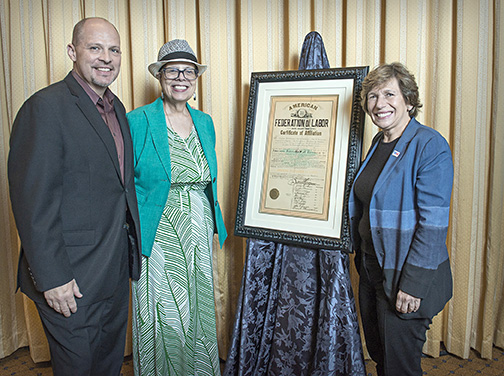
Weingarten, right, with Michael Mulgrew, president of the United Federation of Teachers (AFT Local 2), and Karen Lewis, president of the Chicago Teachers Union (AFT Local 1).
Honoring our past and inspiring our future:


Donald Trump’s Education Mirage

Donald Trump’s Education Mirage:
Donald Trump’s Education Mirage


Donald Trump’s education agenda is puzzling. Where does he stand and what does he know about public schools, teachers and students?
The common thread is that no one really knows what a President Trump would do when it comes to public schools and education. He complains but offers few real solutions.
This is the best you can find. The Video and his claims are disputed by Stauss’s piece. And his  education agenda lacks substance.
The Bullying Problem
When it comes to Donald Trump and education issues, it is first a challenge to plow through the persona that is Trump.
With bullying a problem with young people, it is difficult for many teachers and parents Donald Trump’s Education Mirage: