Latest News and Comment from Education

Wednesday, February 10, 2016

ICE agents won't be going onto Los Angeles public school campuses - LA Times

ICE agents won't be going onto Los Angeles public school campuses - LA Times:

ICE agents won't be going onto Los Angeles public school campuses

Immigration protest at White House
Immigrant rights activists protest in front of the White House in December ahead of deportation sweeps.
 (Shawn Thew / EPA)
Immigration agents won’t be allowed onto the campuses of the Los Angeles Unified School District to look for undocumented students, the school board promised with a unanimous vote Tuesday.
The new resolution directs school staff members not to let any federal Immigration and Customs Enforcement agents enter school campuses or to provide them with student data without clearance. ICE officials who have any reason to be on campus  -- such as those evaluating schools that offer exchange programs for non-immigrant students -- can visit schools only after their requests have been cleared by the superintendent and district lawyers.
Board members noted in the meeting that immigration agents haven’t come to schools looking for students.
Students are not actually in danger of being grabbed by ICE agents while at school; ICE considers schools and churches to be “sensitive” locations and does not carry out raids in schools, said spokeswoman Virginia Kice. 
But families don’t trust the word of the immigration agency, and some were afraid to send their kids to school after ICE carried out a series of raids across the country last month ICE agents won't be going onto Los Angeles public school campuses - LA Times:


Mike Klonsky's SmallTalk Blog: More evidence that PARCC test is bogus. Parents were smart to opt-out.

Mike Klonsky's SmallTalk Blog: More evidence that PARCC test is bogus. Parents were smart to opt-out.:

More evidence that PARCC test is bogus. Parents were smart to opt-out.

 
PARCC officials are still working to determine the full scope and causes of last year’s score discrepancies, which may partly result from demographic and academic differences between the students who took the tests on computers and those who took it on paper, rather than the testing format itself. -- EdWeek
Touted by Arne Duncan, bankrolled by the Gates Fundation and designed by Pearson Education Inc., the world's largest textbook/testing company, PARCC was supposed to provide us with the new and better model of "game changing", 21st-Century, high-stakes standardized testing. Aligned with Common Core standards and curriculum, it was billed as a high-validity measure, not only of student progress in learning, but teacher competency.

But now there's compelling evidence to show that what PARCC really measured had less to do with anything going on in the classroom than it did with demographics (race and class) and familiarity with computers.  Questions have arisen around the validity of the 2014-15 PARCC test results after officials from the testing consortium revealed that students who took the tests on computers scored, overall, lower than those who did not. Four out of every five students took the test via computer.

It was a year ago that Chicago's prison-bound schools chief, Barbara Byrd-Bennett, tried to delay giving PARCC for a year because the district didn't Mike Klonsky's SmallTalk Blog: More evidence that PARCC test is bogus. Parents were smart to opt-out.:

The wounded beast heads home |

The wounded beast heads home |:

The wounded beast heads home

Christie: You gotta problem with wasting taxpayers' money?
Christie: Living and dying by the smirk


Chris Christie’s political persona lived by the smirk–and, this past week in New Hampshire, it died by the smirk. His relentless attack on Marco Rubio on what was, after all, a meaningless point, more than just damaged the Florida senator’s standing, it put an inglorious end to Christie’s hopeless crusade.
Clearly, the New Jersey governor hoped tearing apart Rubio would help his own campaign but all it did was show New Hampshire what New Jersey has known for years–Christie is a shallow wise-ass who can charm some of the boys in the press and sycophantic and traitorous Democrats like Joe DiVincenzo, the Essex County executive,  and Brian Stack,  the mayor of Union City, but he can’t fool an entire nation.
Few New Jersey politicians had less there there–and, eventually, the state’s people found out. In a way, watching Christie perform from a distance–in Iowa and New Hampshire and debate venues–made him clearer in New Jersey’s eyes.
The people of the state knew, for example, he was no hero to the victims of Superstorm Sandy. They knew he was no terrorist-chasing federal prosecutor.  They knew his claims for reaching consensus “across the aisle” was a euphemism for cutting deals with unsavory Democrat bosses like South Jersey’s George Norcross III and Newark’s Steve Adubato.
They also knew–boy, did they ever–that he didn’t “tell it like it is.” He lied and lied The wounded beast heads home |:

LOOK OUT!  If parents opt their children out, the Malloy administration will cut funding for poor children - Wait What?

LOOK OUT!  If parents opt their children out, the Malloy administration will cut funding for poor children - Wait What?:

LOOK OUT!  If parents opt their children out, the Malloy administration will cut funding for poor children


 Wait, What?

Just when it seemed that Governor Dannel Malloy’s arrogance and bullying couldn’t get any worse, Connecticut school officials have been told to instruct parents that they may not opt their children out of the unfair, inappropriate and discriminatory Common Core Smarter Balanced Consortium Assessment (SBAC) or NEW SAT testing schemes.  The Malloy administration has said that if students aren’t forced to take these tests, local school districts will lose their Title 1 education funding.
Despite the fact that there is no law, regulation or legal policy that prevents parents from opting their children out of the destructive testing mania,  school superintendents and principals have been directed to do everything they can to prevent parents from standing up to protect their children.
The latest example of the Malloy administration’s campaign of intimidation and abuse comes from North Haven, where the superintendent of schools wrote to parents telling them that their children must take the Common Core tests.
Covering the development, the North Haven Citizen newspaper wrote;
Opting out of standardized tests is a popular experience for public school students and many North Haven students did just that when it came time to 
LOOK OUT!  If parents opt their children out, the Malloy administration will cut funding for poor children - Wait What?:

Despite problems charter schools could get more state money | Miami Herald

Despite problems charter schools could get more state money | Miami Herald:

Despite problems charter schools could get more state money


Setting up a potential tug-of-war over millions in taxpayer money, the Florida House is rushing ahead with a plan that would force school districts across the state to share local property taxes with charter schools.
Some legislators are pushing to steer more money to charter schools even though a recent analysis by The Associated Press found that as much as $70 million has gone to charter schools that eventually closed.
Republican lawmakers contend that it's time for charter schools, which are public schools run by private groups, to get more money that can be used for capital expenses such as construction costs and rent payments. A House panel on Tuesday approved the proposal (HB 873) even though it was first released to the public four days ago.
"I believe it's time that we recognize that our charter public schools are public schools," said Rep. Janet Adkins, a Fernandina Beach Republican.
But the proposal is already running into fierce opposition from school superintendents who say forcing school districts to share property taxes with charter schools will force them to scale back repairs at existing schools or cancel purchases of big-time items such as new school buses.
"Most districts don't have money sitting around that's idle," Escambia County schools Superintendent Malcolm Thomas told members of the House Appropriations Committee that approved the legislation.
The House will vote this week on a proposed budget that includes $90 million for charter schools. If the separate bill becomes law, then districts would be required to share an additional $63 million.
School construction costs across the state are paid from a combination of sources, including some state money, but a large amount usually comes from local taxes, including voter-approved increases of sales taxes. Charter schools aren't currently eligible for local tax dollars to pay for capital expenses.
Department of Education records show that charter schools have instead gotten more than $760 million from state taxpayers since 2000. Schools can use the money for construction costs, rent payments, buses and even property insurance.
Yet charter schools in 30 districts have wound up closing after receiving as much as $70 million combined in such funding. The list of schools that got money includes Miami'sDespite problems charter schools could get more state money | Miami Herald:

Read more here: http://www.miamiherald.com/latest-news/article59376118.html#storylink=cpy
 

Small Schools: The Edu-Reform Failure That Wasn't - Education Week

Small Schools: The Edu-Reform Failure That Wasn't - Education Week:

Small Schools: The Edu-Reform Failure That Wasn't


 What ever happened to the small-schools craze? A little over a decade ago, philanthropists and policy leaders, believing they had identified the key to student performance, threw their collective weight behind an effort to redesign the nation's large high schools. They spent over a billion dollars and transformed hundreds of large schools into smaller ones. Then, as suddenly as it began, the effort was declared a failure and brought to an abrupt end.

Now, post-mortem research indicates that small schools appear to promote several important outcomes, such as higher graduation rates.
So were small schools just another failed school improvement effort? Or do they actually work? The answer, it turns out, is not an all-or-nothing proposition.
Several years ago, I told the story of the small-schools push in a chapter of my book Excellence for All, which sought to identify the core assumptions and beliefs of contemporary school reformers. I included the small-schools movement because it seemed a perfect case in point of a modern school-change ethos guided by common sense, entrepreneurialism, and ambition. Several high-profile organizations—the Annenberg Foundation, the Carnegie Corporation of New York, and, most prominently, the Bill & Melinda Gates Foundation—along with the U.S. Department of Education, through its Smaller Learning Communities grants, spent aggressively on small schools, with little attention to the myriad other factors affecting school quality. The backers appeared to believe that by making the neediest schools look more like their high-performing counterparts, they could produce equal outcomes.
Creating smaller schools wasn't a bad idea, per se. But as a large-scale school improvement strategy, the movement was destined to fail. The theory of action—that wholesale reproduction of a particular structure would lead to equal learning outcomes—simply didn't make sense. To paraphrase the policy scholar Richard Elmore, schools are vessels "into which educators and communities" can "pour whatever content and pedagogy" they want. In other words, the size of a school building is a limited tool that Small Schools: The Edu-Reform Failure That Wasn't - Education Week:

CURMUDGUCATION: NY: Those Peoples' Kids

CURMUDGUCATION: NY: Those Peoples' Kids:

NY: Those Peoples' Kids


It doesn't get much plainer than this. The headline of the New York Chalkbeat piece is "
Hoping to attract gentrifiers, a troubled school gets a makeover and new admissions policy."

The story is about Satellite West Middle School, a school redesigned to focus on science and art, renamed the Dock Street School for STEAM Studies. And it addresses this question posed by Patrick Wall in the article: How can middle-class families in gentrifying areas be convinced to send their children to local schools with less-than-stellar reputations?

Because District 13 runs on choice (parents can apply to any middle school), Dock Street must find a way to appeal to the now-increasingly-upscale parents in its community. And that means being more careful about who, exactly, they let in. Not just improving the quality of the education offered by the school, but by screening admissions. By making sure that only the Right Children get in.

It is an understandable dilemma for parents, and I'm never willing to say to a parent, "Look, you should put political and philosophical concerns ahead of your own child's concerns." 

But the new development underlines two big lies about the value and benefits of charters to a city's education system.

First, it shows, once again, the one real trick that charter operators know and which some public systems have learned to adopt-- to get a better school, you need to swap out your old students for "better" ones. When a charter or turnaround specialist or state takeover district manages to improve a school with exactly the same student population that was there when the school was deemed "failing" in the first place, that will be noteworthy. But mostly they do what Dock Street is doing-- bar the door and only let in those students who will improve the school. That's exactly what Cris Barbic learned just before he gave up on Tennessee's state takeover district.

That's great for the school, and good for the newly acquired batch of students, but it still leaves a whole bunch of students in the wind, without a school intent on educating them.

Second, it shows that the power of charters and choice to "free" students from their zip code is an 
CURMUDGUCATION: NY: Those Peoples' Kids:


College Board's Real Business


Here's the morning's promoted tweet from the College Board


That link takes you to the College Board page tagged with "Transformed Services for Smart Recruiting." Here you can find all sorts of useful headings like

Student Search Service (registered trademark)

Connect with students and meet recruitment goals using precise, deep data from the largest and richest database of college-bound students in the nation.

Enrollment Planning Service (trademark)

 Achieve your enrollment goals with powerful data analysis tools that efficiently facilitate exploration of the student population and inform a smarter recruitment plan.

Segment Analysis Service (trademark)

 Leverage sophisticated geographic, attitudinal and behavioral information to focus your enrollment efforts and achieve better yields from admission through graduation.

That last one, with its ability to leverage attitudinal and behavioral data-- how the heck do they do 


College Board's Real Business

Wraparound Community Schools Are Long Term Investment, Not Quick Turnaround | janresseger

Wraparound Community Schools Are Long Term Investment, Not Quick Turnaround | janresseger:

Wraparound Community Schools Are Long Term Investment, Not Quick Turnaround

 A little more than a year ago, New York’s Mayor Bill de Blasio launched a massive program of support for 94 public Renew Schools, identified as those where children’s test scores have been chronically low. All of the Renew Schools are neighborhood schools required to accept all the children who arrive at their doors. One of the strategies is to add extra time for children in school and provide additional training and support for parents. Another central part of the strategy is to turn these 94 schools into full-service Community Schools through formal contractual partnerships with a number of NYC social service, medical and child enrichment agencies. This week Elizabeth Harris in the NY Times offers an analysis one-year into this transformation. She notes that test scores haven’t yet significantly risen.

While I commend Harris for her attention to NYC’s effort to support its struggling schools, her story demonstrates what’s wrong with the way we judge schools—what’s wrong with the metric we use and what’s wrong with the time line.
To be fair, Harris examines more than the test scores at Urban Scholars, the Bronx public school she profiles: “Last year, a third of Urban Scholars students were chronically absent, showing up to school less than 90 percent of the time.  This school year, students who regularly miss school have been paired with an adult in the building who makes home visits and daily phone calls to encourage families to get their children to school, and to follow up when they do not.”
But Harris seems to assume that change will come, if not quickly at least in a steady and visible upward trajectory. She also seems to imagine it ought somehow to be visible in the Wraparound Community Schools Are Long Term Investment, Not Quick Turnaround | janresseger:

Ed Notes Online: Learning From Lois (Weiner): Social Justice Unions, Restorative Justice, and Caucus Building

Ed Notes Online: Learning From Lois (Weiner): Social Justice Unions, Restorative Justice, and Caucus Building:

Learning From Lois (Weiner): Social Justice Unions, Restorative Justice, and Caucus Building

Lois talked about how Restorative Justice can only work in a democratically run, collaborative school environment with a non-abusive, instead of a top-down principal.  ... AMEN
 I was at Lois Weiner's very interesting presentation last night, Urban Education & Teacher Unionism Policy Project. MORE co-sponsored it.


This is an exciting venture that, in addition to the goals listed below, will also focus on the various movements within unions rather than the current leaderships. As Lois pointed out, many of these movements like MORE and WE in Philly were inspired by CORE Caucus in Chicago.

Lois pointed out that forming a strong democratic caucus with a large school base is the key. She contrasted cases like Milwaukee. Bob Peterson of Rethinking Schools won election pretty much on his own without a caucus and now leads a union where people are not especially active. That is problematical - trying to build a caucus without a firm school base AFTER winning.

As Lois talked I felt she was affirming the rough strategy MORE has been following - building enough of a base of schools which in NYC with 1800 schools and a Unity machine that battles for every single one, is the biggest challenge. When people say MORE doesn't want to win they are distorting reality. MORE can't win UNTIL it establishes enough of a base to win. Why can MORE challenge in the high schools and why did New Action win the high schools for over a decade? There is enough of a base in the high schools to win.

Lois emphasized the school as the organizing tool. And she is a board member of Teachers Unite, which also emphasizes the school unit. Where I  differ somewhat is that she doesn't focus attention on building geographical clusters of schools on the district level. NYC is a special situation due to size and the massive Unity control of the schools. District level clusters of K-8 schools must be built to begin to challenge Unity in the middle and elementary schools before any caucus has a chance to win.

Lois emphasizes that the social justice component is a key to building an alliance that goes beyond narrow teacher interests, which is proving to be a dead end no matter how much people scream and yell about teacher rights. Without building a community component that supports the teachers, a hostile press will kill them. The teachers walking out in Detroit, even if unorganized, can do so because parents are not killing them for doing it. Imagine if there were gangs of people outside schools screaming at them on days when they do come to school. That hasn't happened.

For me one of the most illuminating parts of her presentation was about restorative justice, which Teachers Unite has made a key part of its operation.

MORE supports restorative justice and has come under criticism for doing so. MORE supports RJ WHERE IT CAN WORK. MORE has to make that clear.

We know that some principals use RJ as a cover - and as a way to suck up to Carmen Farina - "see, we have an RJ program" - while they screw the teachers.

I have not always been comfortable with simply saying we support RJ without qualifying the RJ language used. She talked 
Ed Notes Online: Learning From Lois (Weiner): Social Justice Unions, Restorative Justice, and Caucus Building:

Embedding Leadership in the Teaching Profession - NEA Today

Embedding Leadership in the Teaching Profession - NEA Today:

Embedding Leadership in the Teaching Profession

teacher leadership
Four leading education groups brought some of the best and brightest minds from around the country to the 2016 National Summit on Teacher Leadership in Washington, D.C. on Feb. 5-6 to turn ideas into action and empower more educators to lead their professions.
The National Education Association (NEA), along with the American Federation of Teachers (AFT), Council of Chief State School Officers (CCSS0), and the U.S. Department of Education, organized the summit to allow participating teachers, state superintendents, and union representatives to share ideas, best practices, and examples of existing teacher-leadership efforts. Additionally, the group identified common challenges and created concrete, actionable teacher leadership plans to address them back home.
Nineteen states were represented at the summit, and included an education team from the U.S. Department of Defense.
Teachers and Leadership Not Mutually Exclusive
“[Teacher leadership] needs to be so embedded in the profession that it’s an expectation… I am supposed to lead,” said NEA President Lily Eskelsen García to the group. “It’s not separate from your routine as teachers.”
Educators and leadership is a combination that makes sense because teachers are the experts, said Aman Dhanda, a sixth grade teacher from California, now serving as a Washington Teaching Ambassador Fellow for the federal education department.
“What’s been resonating with me is that a lot of teacher leaders have felt this is the first time their voices are being heard,” said Dhanda of the teachers participating in the summit, which, she adds, is intended to “make sure [teachers] always ask for a Embedding Leadership in the Teaching Profession - NEA Today:

'failing at 15' - Helping the weakest students essential for society and the economy, says OECD - OECD

Helping the weakest students essential for society and the economy, says OECD - OECD:

Helping the weakest students essential for society and the economy, says OECD

 10/02/2016 - Most countries have made little progress helping their weakest students improve their performance in reading, mathematics and science over the past decade. This means too many young people are still leaving school without the basic skills needed in today’s society and workplace, hurting their futures and long-term economic growth, according to a new OECD report.


Low Performing Students: Why they fall behind and how to help them succeed” says that around 4.5 million 15-year-olds in OECD countries, equivalent to more than one in four, fail to achieve the most basic level of proficiency in reading, mathematics and/or science. In other countries, the share is often much larger. 

Analysing results from the OECD PISA survey between 2003 and 2012 reveals that few countries have seen improvements among low performers and nearly as many have seen their share of low performers increase.
 ‌
But countries as economically and culturally diverse as Brazil, Germany, Italy, Mexico, Poland, Portugal, Russian Federation, Tunisia and Turkey reduced their share of low performers in mathematics between 2003 and 2012. This shows that reducing the share of low performers is possible anywhere, given the right policies and the will to implement them, says the OECD.

“The social and economic gains from tackling low performance dwarf any conceivable cost of improvement,” said Andreas Schleicher, OECD Director for Education and Skills. “Education policy and practice can help overcome this issue. It needs to be made a priority and given the necessary resources so that every child can succeed at school.”
 
Click here to download data in Excel for all countries
Low performers also tend to have less perseverance, motivation and self-confidence in maths, and skip classes or days at school more often than better performers. Students at schools where teachers are more supportive and with higher morale are less likely to be low performers, while students whose teachers have low expectations for them and are absent more often are more likely to be low performers. 

In countries where educational resources are distributed more equitably across schools, there is less incidence of low performance in maths, and a larger share of top performers, even when comparing school systems whose educational resources are of similar quality.

Analysis also shows that the degree to which advantaged and disadvantaged students attend the same school is more strongly related to smaller proportions of low performers than to larger proportions of top performers. This suggests that systems that distribute both educational resources and students more equitably across schools would benefit low performers without undermining better-performing students.

To break the cycle of disengagement and low performance, the report outlines a series of recommendations. These include:

  • Identify low performers and design a tailored policy strategy;

  • Reduce inequalities in access to early education;

  • Provide remedial support as early as possible;

  • Encourage the involvement of parents and local communities;

  • Provide targeted support to disadvantaged schools or families;

  • Offer special programmes for immigrant, minority-language and rural students;

A fully embeddable version of Low Performing Students: Why they fall behind and how to help them succeed is available, together with country notes for Australia, France, Germany, Italy, Mexico, Spain, United Kingdom and United States, as well as information about downloadable and print versions of the report.

For further information, journalists should contact the OECD Media division (tel. + 33 1 45 24 97 00).
*******************************************
Note to editors:
Low performers are defined as students who fail to reach level 2 in the PISA survey. This means that they can answer questions that provide clear directions and single information sources and connections. However, they typically cannot make more complex uses of information and reasoning. For example, they struggle to estimate how much petrol is left in a tank from looking at the gauge, or have difficulty understanding instructions on an aspirin bottle. Level 2 is considered the baseline level needed for young people to function effectively in today’s workplace and society.

Educators Unite Behind Dan Wolk for Assembly | Davis Vanguard

Educators Unite Behind Dan Wolk for Assembly | Davis Vanguard:

Educators Unite Behind Dan Wolk for Assembly

#Portrait-43
 Dan Wolk for State Assembly http://bit.ly/20Vtqhe


 Educators from around the region and state are uniting behind Davis Mayor Dan Wolk’s campaign for Assembly, adding to his growing momentum. Today, both the California Teachers Association (CTA) and California School Employees Association (CSEA) announced their endorsement of Wolk. He had previously received the support of the California Federation of Teachers (CFT).

These educators cited Wolk’s desire to reinvest in California’s schools and fully fund public education as major reasons for their endorsements. Wolk is the father of two young daughters and has promised to make education a top priority in the Assembly.
“California’s educators are proud to support Dan Wolk for Assembly because he will make public schools a top priority,” said Cathy Haskell, a high school math teacher in Davis. “Dan has an outstanding record of standing up for our schools, our students and our educators and in the Assembly he will work to reinvest in our schools, provide universal preschool and make college more affordable.”
Wolk is endorsed by a number of important education leaders, including State Superintendent of Schools Tom Torlakson, Napa County Superintendent of Schools Dr. Barbara Nemko and Solano County Superintendent of Schools Jay Speck. He also has the support of more than a dozen local school board members and education leaders from around the 4th Assembly District, among the more than 90 state and local elected leaders who have already endorsed Wolk.
Founded in 1863, the California Teachers Association has become one of the strongest advocates for educators in the country. CTA includes teachers, counselors, school librarians, social workers, Educators Unite Behind Dan Wolk for Assembly | Davis Vanguard:

L.A. teachers union seeks to raise dues as it fights a charter school push - LA Times

L.A. teachers union seeks to raise dues as it fights a charter school push - LA Times:
L.A. teachers union seeks to raise dues as it fights a charter school push


 The Los Angeles teachers union has long been the most powerful player in local education.

But with the Eli and Edythe Broad Foundation and other well-heeled nonprofits pushing hard to fundamentally change the nature of public education in Los Angeles, enrollment in traditional schools is declining and nonunion charter schools are on the rise.
The teachers union needs money to fight back.
There are, however, far fewer teachers to pay dues to United Teachers Los Angeles.


So this week the union asked its 32,000 members — down from 45,000 in 2008 — to raise their dues by nearly a third, to about $1000 per member annually, and also to allow UTLA to pass on to members any future increases in dues owed to state and national parent unions.
The votes will be counted Wednesday.
A previous attempt to increase dues failed in 2008, but this time the stakes are higher and union leaders are more hopeful of success.
Union President Alex Caputo-Pearl said that the money will help combat a brand of reform that favors operating schools more like businesses — for example, by using metrics-based performance evaluations such as standardized test scores to rate teachers.
Nationwide, districts have become battlefields over the business model versus more traditional approaches to public education. And Los Angeles, a pro-labor enclave with the country's second-largest district, is widely seen as the front that could shift momentum in either direction.
Los Angeles school board elections, pitting union-endorsed candidates against union critics, are the most expensive in the nation.
UTLA also wants money for legal fights.
An L.A. County Superior Court judge recently threw out traditional teacher job protections as harmful to students — a verdict that is on appeal. And the U.S. Supreme Court is L.A. teachers union seeks to raise dues as it fights a charter school push - LA Times:

Initiative That Would Shut Down Charter Schools In California Cleared To Gather Signatures « CBS Sacramento

Initiative That Would Shut Down Charter Schools In California Cleared To Gather Signatures « CBS Sacramento:

Initiative That Would Shut Down Charter Schools In California Cleared To Gather Signatures


 SACRAMENTO (CBS13) — A movement in California could shut down the state’s charter schools and return students to public schools.

A grassroots coalition is calling California charter schools discriminatory and unconstitutional. There’s now a proposed ballot initiative to repeal the California Charter Act of 1992.
“Some of these charter schools are literally in strip malls or little warehouses and there’s no building code safety requirements,” said Kathleen Carroll with Voices Against Privatizing Education.
She says it’s her mission to close down every California charter school. She calls it substandard education with no state government oversight.
“They gave private school boards that are unaccountable to the voters. It’s against the democratic process,” she said.
Funded by state taxpayers, charter schools are becoming a popular option for parents. In 1998 there were only 177 charter schools, but last year that number grew to more 1,230.
She says many of those schools lack diversity.
“Intensely segregated schools meaning over 90 percent of the student population is of one race,” she said.
She also claims many have unqualified teachers and staff.
“Teachers don’t have to be licensed and trained. Administrators don’t have to be licensed and trained and building safety codes don’t have to be followed,” she said.
Sac Prep Principal Norman Hernandez says his teachers are credentialed and his charter school has state oversight.
“Charter schools get audited twice a year. We have a preliminary audit in May which looks at all our controls and how we run the school. And then you have the financial audit that happens after the fiscal year closes,” he said.
Hernandez says there’s a long waiting list to get into the school because many parents want the freedom to choose.
“We’ve created an option that we’ve allowed them to have a private school education for free,” he said.
Carroll believes taxpayers shouldn’t spend another dime on charter schools, and the coalition is going to work hard to make that happen.
“Parents need to understand there are more than a few reasons why we need to focus on our real public schools and improve them,” she said.
The California Charter Schools association called it an “extreme measure that is clearly out of touch with the families of nearly three quarters of a million students in charter schools.”
More than 300,000 signatures are needed to get it on the November ballot.Initiative That Would Shut Down Charter Schools In California Cleared To Gather Signatures « CBS Sacramento:

School Busing No More: Obama Wants to Promote Integration on the Basis of Income - The Atlantic

School Busing No More: Obama Wants to Promote Integration on the Basis of Income - The Atlantic:

School Integration’s Comeback

President Obama’s budget includes a new $120 million grant to support school integration.  


 For decades, researchers have found that integrating schools by race and economic status is one of the most powerful levers available for improving opportunities for kids. And for decades, Democratic and Republican presidents alike have been terrified to take any action, as visions of white backlash to forced racial busing in the 1970s danced in their heads.

That political taboo now seems to have been broken. On Tuesday, the White House announced that the president’s budget includes a new $120 million“Stronger Together” grant program to support local efforts to integrate schools by income. The proposed program would set up a competition to reward school districts or groups of districts that voluntarily take efforts to break up school-poverty concentrations. This is important because low-income students, on average, perform far better in middle-class schools than in schools where most of their classmates are poor.
In one fell swoop, the proposed program would more than double federal funding of efforts to encourage school integration. In the past, federal support for integration has consisted of a single, $100 million program for magnet schools that attract students of different backgrounds through special themes or teaching approaches.
Critics may try to demagogue the new socioeconomic-integration proposal as a return of “forced busing,” but the administration seems to be banking on the idea that new programs—which emphasize choice over compulsion and socioeconomic status over race—may have more political viability today than forced busing for racial desegregation did in the 1970s. Two new papers published by The Century Foundation should give the administration reason for confidence.
First, as my colleagues Halley Potter, Kimberly Quick, and Elizabeth Davies note in “A New Wave of School Integration,” while old efforts to integrate explicitly by School Busing No More: Obama Wants to Promote Integration on the Basis of Income - The Atlantic:

Tuesday, February 9, 2016

Choosing Democracy: Support Sacramento Schools and Teachers

Choosing Democracy: Support Sacramento Schools and Teachers:

Support Sacramento Schools and Teachers

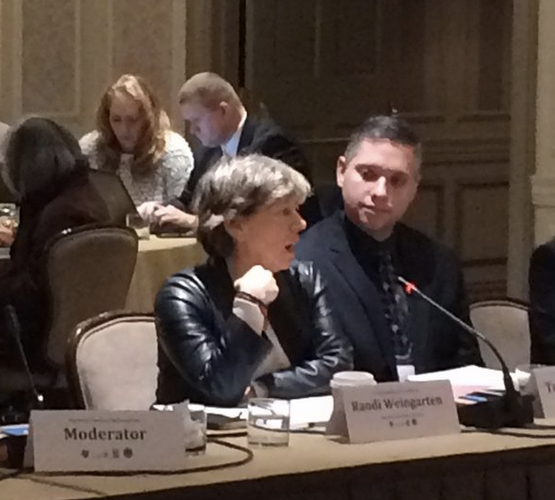
Randi Weingarten: A conversation about a path forward at #TFA25 — Medium

A conversation about a path forward at #TFA25 — Medium:
A conversation about a path forward at #TFA25

Politics and religion have long been known for their potential to turn a conversation into a conflagration. In the last decade, education joined that short list of touchy issues. That’s no wonder, since many self-described “reformers” frame the debate around false dichotomies, such as their claim that one can’t be both pro-child and pro-teacher, or that their camp cares more about children or has a greater sense of urgency than “regular” classroom teachers and the unions that represent them. While I completely reject those propositions, it doesn’t mean that our differences should stop our discourse with each other — quite the contrary, because we can’t solve problems in education or make progress without finding common ground.
And that is what happened last weekend. Thirteen thousand people converged on Washington, D.C., for Teach for America’s 25th anniversary. Even though I have been critical of TFA, I was invited to speak about how to address both education and poverty, along with Howard Fuller, an education activist who supports education vouchers and other forms of privatization. Cecilia Munoz, the White House domestic policy advisor, moderated the discussion and kept it constructive.
I’m pretty sure a fair number of people attended the packed session to see if the discussion between two people who don’t see eye to eye — either physically (he is much taller) or ideologically (in many respects) — would descend into Fight Club.
Fuller didn’t win me over to his side, and I’m sure I didn’t convert him, either. The private school vouchers he introduced as superintendent of Milwaukee Public Schools a quarter century ago have not produced superior academic results for students who receive them, nor have they spurred public schools to improve in order to compete. Sadly, Milwaukee’s public and voucher schools perform at levels comparable to those in rural Alabama and Mississippi. And yet Fuller continues to advocate nationally for choice and privatization. But that wasn’t the point.
My purpose was not to debate Fuller; it was to have a conversation about a path forward, to end the ridiculous debate in reform circles that poverty and greater economic issues don’t matter, and to debunk the notion that individual teachers can do it all.
I caught some flack on Twitter and Facebook for even attending a TFA event. The AFT and TFA disagree on a number of fundamental issues regarding education. I believe that teacher preparation should reflect the complexity and importance of this work, and that a crash course simply doesn’t cut it — it’s not fair to corps members or their students. Further, I think that TFA’s model of inadequately prepared teachers and high turnover deprofessionalizes teaching by design. And it’s dead wrong when districts use austerity as the excuse to hire TFA recruits as replacements for experienced teachers.
I believe that teacher preparation should reflect the complexity and importance of this work, and that a crash course simply doesn’t cut it — it’s not fair to corps members or their students.
Regardless of what one thinks about TFA as an institution, I believe it’s a A conversation about a path forward at #TFA25 — Medium: