Latest News and Comment from Education

Monday, December 21, 2015

These Education Protests Got Results In 2015 | ThinkProgress

These Education Protests Got Results In 2015 | ThinkProgress:

These Education Protests Got Results In 2015

It’s been a year of robust student protests that have effectively highlighted racial and economic inequality in both K-12 and higher education. And unlike previous years, 2015 has made it clear to students that these protests can yield results.
From student debt activists attending meetings and public hearings with U.S. Department of Education officials to college executives stepping down from their posts after students of color demanded a more respectful climate on campus, protesters have proven that activism has a meaningful purpose in reducing inequities in education. Here are some of the most influential student protests of 2015:

Fighting to prevent AP history classes from erasing racism

AP American history courses have become a political battleground in the past few years — particularly after the College Board released new guidelines that included the history of violence against Native Americans, as well as a mention of the growing influence of social conservatives.
Conservatives railed against the standards, arguing that it’s unpatriotic to focus on more negative parts of U.S. history, such as slavery and Jim Crow laws. They said the guidelines should have included more information about the Founding Fathers and military victories. (The College Board, for its part, said it didn’t initially mention the Founding Fathers because it seemed obvious that a teacher would include them in a class on American history.)
The controversy got so heated that the RNC even asked Congress to stop funding the College Board, saying it “emphasizes negative aspects of our nation’s history while omitting or minimizing positive aspects.” Former Republican presidential candidate and soon-to-be former Louisiana Governor Bobby Jindal fanned the flames of conservative anger over AP history standards by suggesting that if history were included in Common Core standards, it would be about “victimhood” and “America’s shortcomings and failures.”
Jefferson County election workers count and stamp petitions collected by a group of parents and educators, called Jeffco United for Action, whose aim is to remove Jefferson County School Board members.
CREDIT: BRENNAN LINSLEY, AP

But some students fought back. After the Jefferson County, Colorado school board voted to create a committee to review the AP history course for similar reasons as those cited by the RNC, high school students protested and walked out of class, telling CNN, “True patriotism ought to be based upon accurate understanding of American history, and not a biased promotion of American exceptionalism.” Soon after the protests, the Jefferson County school board canceled a review of the standards. And the conservative members of the board who supported the review have since been voted out.
The College Board did agree to change the framework of AP history standards after outcry from conservative legislators in a few states like Georgia, Nebraska, Tennessee, Texas, and North Carolina. The Board now includes more information about “American exceptionalism” and more mentions of the Founding Fathers.
However, despite the fact that the College Board caved to conservative pressure by including the phrase “American exceptionalism,” it doesn’t appear that it has backed down on presenting an unvarnished and accurate account of American history. Mentions of slavery will be “roughly the same” as they were in previous standards, according to Newsweek.

Speaking up for racial justice on college campuses

Graduate student Jonathan Butler, center, addresses a crowd following the announcement that University of Missouri System President Tim Wolfe would resign.
CREDIT: JEFF ROBERSON, AP
Protests against universities’ poor handling of racist incidents and an overall hostile campus climate for students of color ramped up this fall. One of the first protests to gain national attention was the decision of the University of Missouri’s mostly black football team to go on strike after These Education Protests Got Results In 2015 | ThinkProgress:

Berkeley Study of Charter Schools in Los Angeles | UC Berkeley - Graduate School of Education

Berkeley Study of Charter Schools in Los Angeles | UC Berkeley - Graduate School of Education:

Berkeley Study of Charter Schools in Los Angeles

The Los Angeles Unified School District hosts more charter schools than any system in the nation. After tracking more than 66,000 sampled students over a four-year period, these new findings inform three pivotal questions:
  • Do charter schools serve students and families that differ from peers served by traditional public schools? 
  • Do charter students display steeper learning curves than peers in traditional schools?
  • How does the performance of conversion versus start-up charter schools compare?
Berkeley Study of Charter Schools in Los Angeles | UC Berkeley - Graduate School of Education:

How Charter Schools Skim and Scam Public Money - CAPITAL & MAIN

How Charter Schools Skim and Scam Public Money - CAPITAL & MAIN:

How Charter Schools Skim and Scam Public Money


Get this. In some states, charter school operators can purchase school buildings from public school districts — using taxpayer money. That’s right. The public pays twice for a building it no longer owns.
This scheme and many others are detailed in the National Education Policy Center’s new research brief on charter school policies. Through a study of policies from across the country, Bruce Baker and Gary Miron reveal how many charter operators use existing laws to profit from the privatization of public assets.
Their conclusion: Many current policies allow new actors into public education who skim profits from the system, pocketing money that might otherwise be spent on direct services for children.
These policies have serious costs. In Florida for example, a recent analysis by the Associated Press found that now-closed charter schools in 30 school districts had received more than $70 million in taxpayer money for capital needs. The state has since recovered only $133,000 of those funds.
Where does the money go? On top of complex real estate deals, charter school operators often “save” money by cutting teacher pay, hiring inexperienced school staff and avoiding children with disabilities. These “savings” are added to executive salaries rather than invested in serving all children and providing solid middle class jobs for teachers and staff.
The charter school growth industry wants to compete directly with traditional public schools, in some places creating a two- or even three-tiered education system.
We need great schools for all children—not just for some. Schools owned by us, not private companies. Let’s make sure every dollar we spend on education is spent on education, not skimmed off by real estate investors or to pay high-priced management fees.How Charter Schools Skim and Scam Public Money - CAPITAL & MAIN:


LA charter school study: who benefits? | Berkeley News

LA charter school study: who benefits? | Berkeley News:

LA charter school study: who benefits?


Children entering charter schools in Los Angeles already outperform peers who attend traditional public schools, then pull ahead even a bit more, especially those attending charter middle schools, according to a study released today from the University of California, Berkeley.
Pupils who enter charter elementary or high schools displayed significantly higher test scores, relative to counterparts entering traditional public schools at the same grade levels, the report said. Elementary students in charter schools benefit from slightly steeper learning curves, relative to peers remaining in conventional schools, researchers said. Charter high schools were no more or less effective than traditional schools in boosting student performance.
Charter schools, while publicly funded, operate independently of many state requirements and the administration of the Los Angeles Unified School District. Some 274 charter schools operate in L.A. Unified this fall, more than any school district nationwide.
The map above shows the spread of charter schools and the income levels of communities where they have been established in the L.A. Unified District since 2002.
Public schools awarded independence from state rules and labor agreements over the past 15 years – so-called conversion charter schools – draw more middle-class and higher-achieving children, compared with peers served by traditional schools, researchers said. Some 55 percent of all pupils attending conversion charters at the elementary level were Latino, compared with 77 percent of those in traditional schools. Half of these charter pupils were eligible for lunch subsidies, compared with 84 percent attending traditional schools.
Newly created charter schools, increasingly run by management firms, also draw students already achieving at higher levels than peers in conventional schools, although these gaps were smaller than the greater selectivity of conversion charters.
These patterns emerged between 2007 and 2011, the period during which the Berkeley team of Bruce Fuller, a professor of education and public policy at the Graduate School of Education, and then-Berkeley graduate student Hyo Jeong Shin, now a statistician at the Educational Testing Service, tracked a sample of 66,000 students and teachers with data from L.A. Unified and the state Department of Education.
“Our study reveals two distinct charter movements,” said Fuller, author of Inside Charter Schools. “Conversion charters often serve middle-class families on the west side of the L.A. district and in San Fernando Valley, while newly created charter schools continue to locate more in blue-collar and poor neighborhoods.”
Small to modest gains
Still, he said, charter students in poor and middle-class communities posted academic gains, as judged by testing, but improvements were most striking and the strongest for middle-schoolers. Significantly steeper learning curves were detected in elementary LA charter school study: who benefits? | Berkeley News:

How new tools meant to help special education students take standardized tests actually made it harder - LA Times

How new tools meant to help special education students take standardized tests actually made it harder - LA Times:

How new tools meant to help special education students take standardized tests actually made it harder

Testing the tests
Special education teacher Julia Kim now teaches at George Moscone Elementary School. Last year, she administered the state's new standardized tests at a different school in San Francisco, Fairmount Elementary. (Gloria Searle)
st spring, Julia Kim’s students with disabilities at Fairmount Elementary in San Francisco were ready to take a new standardized test. They were excited that it had been built especially for them.
In past years, students with visual perception disorders had test questions read out loud. This time, the students sat in front of their computers awaiting the new technology designed to help them complete the test on their own for the first time.
But as soon as the first question appeared, students complained that the print was too small.
The color contrast tool, which used a background to minimize visual distortions, had been developed for the Common Core test to make it easier for special education students to see. But in practice, the tool prevented the one student in Kim’s class who used it from reading questions and marking answers. “I can’t see it,” he told Kim. It was too dark to read.
The Common Core tests, which are based on learning goals adopted in 43 states and the District of Columbia, offer many state-of-the-art technological tools to level the playing field for special education students. But Kim’s students were not alone. School employees across California have reported glitches in the tests’ enhancements for students with disabilities.
A field test administered in 2014 was meant to iron out the kinks. As a result, a noise buffer and closed captioning were added, according to an email sent last April on behalf of Michelle Center, who is now the California Department of Education’s director of the Assessment Development & Administration Division.
Still, according to teachers and administrators, special education students across California spent days last spring toiling over computerized tests that their teachers say often made it more difficult, not easier, for them to access the material. 
“The majority of my students weren’t able to process any of the tests,” Kim said.  
In San Francisco, one school found that text-to-speech tools read passages too quickly for students to follow, so teachers had to jump in and read the text out loud — distracting other students. The California School for the Blind found that different accessibility tools, 
 By the time students with disabilities sat down to take California's standardized tests last spring, they had been promised a set of new tools to help them better access the questions. But some teachers and administrators across the state have reported that this didn't exactly happen.
The California Department of Education says it did not track issues related to the tools created for disabled students using the new tests, which were tied to the Common Core State Standards. Here are some examples of technological problems that popped up.
  • An overly robotic text-to-speech voice. Gabriela Aguirre, a curriculum specialist for special education in the Santa Ana Unified School District, said she was concerned that students using a text-to-speech tool could be distracted by the voice, which she described as “a bit robotic.”
  • Text-to-speech tools that read passages too quickly for students to follow.For students in Los Angeles, the problem occurred on their iPads. The district had 

Sunday, December 20, 2015

IS SUPREME COURT JUSTICE ANTONIN SCALIA A RACIST? - Perdaily.com

IS SUPREME COURT JUSTICE ANTONIN SCALIA A RACIST? - Perdaily.com:

IS SUPREME COURT JUSTICE ANTONIN SCALIA A RACIST?


(Mensaje se repite en Español)

While I have never much liked conservative Supreme Court Justice Antonin Scalia, I would take exception with calling him a racist for the following comments he recently made during oral arguments in theFisher v. University of Texas at Austin case:

"There are those who contend that it does not benefit African Americans to to get them into the University of Texas where they do not do well, as opposed to having them go to a less­-advanced school, a less - a slower-track school where they do well."
"...most of the black scientists in this country don't come from schools like the University of Texas. They come from lesser schools where they do not feel that they're being pushed ahead in classes that are too­­ too fast for them."

In his comments what never occurs to Scalia or any of the people like him is that these comments are rather indicative of an entitled White American whose Sicilian immigrant father encounter none of the limitations and assured damage that is endemic to just being raised Black in American. It mysteriously never occurs to a smart person like Scalia to ask why it is that the son of an Italian immigrant has a chance of doing better in America than people who have been here for 400 years.

Implicit and self-serving in the Scalia's refusal to make any accommodation to what has been the systematic dismantling of Black identity in this country is a belief base on the idea: Well, my father came to this country with nothing, worked hard, and was successful- so why can't Black people do the same? Ignored is the fact that Scalia's White father more than likely got off the boat with the address of an earlier Italian immigrant or community, which could make his transition easier. And while their has been anti-Catholic or Italian feelings at various times in this IS SUPREME COURT JUSTICE ANTONIN SCALIA A RACIST? - Perdaily.com:


Republicans keep pressing for tenure, layoff, evaluation reforms | EdSource

Republicans keep pressing for tenure, layoff, evaluation reforms | EdSource:

Republicans keep pressing for tenure, layoff, evaluation reforms

Republican legislators are continuing to push for passage of three California teacher reform bills, but it’s unclear what the status of the bills will be when the Legislature convenes in January.
The Assembly Education Committee spent three hours discussing the bills last week, with no indication about whether the bills might come up for a vote next year. That lack of clarity frustrated the Assembly Republican leader and sponsor of one of the bills, Kristin Olsen, R-Fresno, who questioned why the majority of Democrats on the committee had voted to send the bills to “interim study,” a parliamentary tactic sometimes used when members don’t want to go on the record on controversial legislation. Interim study is an indefinite status that gives Education Committee Chairman Patrick O’Donnell, D-Long Beach, wide discretion to determine what, if anything, happens to a bill.
“In an effort to avoid casting ‘no’ votes on these worthy, important bills, the chairman and other members of this education committee invoked an obscure procedure that sent these bills to this interim study,” Olsen said. “And it truly saddens me that here we are, two weeks before Christmas, when people are out busy preparing for the holidays, that we’re holding a hearing when nobody is paying attention.”
The hearing was webcast but sparsely attended by the public; two of four Democrats on the committee were absent.
Assembly Republicans proposed the three bills as a package in response to the 2014 ruling in Vergara v. California, in which a Los Angeles County Superior Court judge overturned five California teacher protection statutes. Judge Rolf Treu ruled that the state’s two-year probationary period for new teachers, a layoff system based on teacher seniority and dismissal statutes that can make it difficult to fire the worst-performing teachers, violated students’ constitutional right to Republicans keep pressing for tenure, layoff, evaluation reforms | EdSource:


A Bit About The "End" of No Child Left Behind | The Jose Vilson

A Bit About The "End" of No Child Left Behind | The Jose Vilson:

A Bit About The “End” of No Child Left Behind

obama-education


I’m not a fan.
do think we need to have a nation education reform. I do believe that there should be as much federal oversight as possible in the name of equity. I just happen to disagree vehemently with the folks who’ve been doing education reform on the state and federal level. This ping-pong politic where we think we’re making a dent by giving education back to the states makes me nervous, even in “blue states” like New York. If we keep ping-ponging the same thing, i.e. standardized testing and the deprofessionalization of the teaching profession, then ESSA is no different than NCLB, RTTT, or whatever acronym you’d like to throw in my direction.
Can’t trust it, folks. Those of you believing the media hype that No Child Left Behind is over are in for a rude awakening when your schools stay underfunded and your child overtested.A Bit About The "End" of No Child Left Behind | The Jose Vilson:

No Threat Left Behind: New York City Stifles Opt Out | Michael Elliot

No Threat Left Behind: New York City Stifles Opt Out | Michael Elliot:

No Threat Left Behind: New York City Stifles Opt Out


 Co-Writer Kemala Karmen

Deputy Director, Co Founder NYC Public
With more than 200,000 students -- or nearly 1 in 5 of all eligible test takers--refusing to sit for annual standardized tests, New York State made headlines last spring for leading the nation in sheer number of opt outs. The parent-led opt out movement worked hard to get those numbers, getting an unexpected boost from voters disgusted by Governor Andrew Cuomo's hubristic overreach in pushing the Education Transformation Act of 2015. (The legislation proposed that as much as fifty percent of a teacher's evaluation would hinge on test score "growth.")  However, if you take even the tiniest of peeks at the distribution of those opt out numbers, one thing will immediately become apparent: New York City, with a test refusal rate of only 1.4%, is not keeping up with the pack. Why? What's going on?

As parents of New York City public school children, we can tell you. And it's not pretty. Whether you are a parent in a "high performing" school with plenty of middle and upper class children or a parent with a child in a "low performing" school with a population weighed down by the stresses of poverty, there is a powerful deterrent custom-made for you when it comes to making the decision of whether or not to allow a child to take the tests.

The most dire of threats, school closure, falls heavily on the city's 94 Renewal Schools.  These schools, which serve predominantly low-income, minority, and immigrant communities, receive the "Renewal" designation largely due to their poor showing on state tests. (Graduation rates come into play for high schools.) When the de Blasio/Fariña administration introduced the Renewal Program, which is supposed to pump resources into struggling schools, it was positioned as an alternative to the unpopular school closure policy favored by Bloomberg/Klein. But a school can only be removed from the program through an improvement in test scores--on the same disastrous state tests that have been roundly criticized by parents, teachers, administrators, and now, even Governor Cuomo's own Common Core Task Force.  Parents are scared of losing their schools completely, whether to charterization or state receivership, and the test-based exit criteria pressures them into seeing testing as essential for school survival. In an effort to raise those scores come hell or high water, children who need so much more than drill-and-test are fed the narrowest test-prep workbook curriculum.

The gravest impediment to opt out that the NYC Department of Education hangs over the heads of parents and children in other communities is the middle school and high school admissions process. Unlike elsewhere in the state, New York City has a complicated, and medical-school-competitive, admissions model. (The comparison to medical school is no exaggeration; New York hired the same team who designed the system that matches medical school students to residencies to design the system that matches teenage students to high schools.) Although state law now precludes test scores from being the sole or primary factor in a school's admission formula, the city still sends student scores to the receiving institutions. This makes parents distrust even those schools who say they don't consider test scores at all. After all, if the score is right there in front of the admissions team, what's to stop them from looking and using it to make shorthand determinations about the student? Moreover, admissions rules seem to be constantly changing and no one knows what the future will bring. Currently, in all but a few instances, only 4th grade and 7th grade scores are used, respectively, for middle school and high school admissions, but will the rules change? Every principal will tell you there's no way to know. Getting into the school that is a good match for your child is on the minds of parents from the moment their children hit the 3rd grade, so the fear around this issue is enough to make any parent pause--and to make many of them think, well, even if only 4th grade counts, to be safe, I probably should have my 8 year old take the third grade test as practice. Ditto, the 5th and 6th grade tests, because 7th grade is the admissions ticket. As for 8th grade, that's practice for the new, more stringent, high school Regents exams. There are no avenues for discussion here. In many districts, there is no neighborhood middle school that you can fall back on, and few zoned high schools remain. It's school roulette, and the NYCDOE holds all the cards.
In much of the state, parents were motivated to opt out because they wanted to protect their beloved teachers. They reasoned that refusing the tests would mean there would be no spurious data for test-based teacher evaluations. (Note: No parent we No Threat Left Behind: New York City Stifles Opt Out | Michael Elliot:


BustED Pencils Trending News: Religon; Evolution?; Stopped! | BustED Pencils

BustED Pencils Trending News: Religon; Evolution?; Stopped! | BustED Pencils:

BustED Pencils Trending News: Religon; Evolution?; Stopped!

newsboy_bustedpencils-logo_full colorBustEDstretch

Fired-Religous Struggle-In Social Studies U.S. History Class.
Muslim Teacher Fired After Showing Malala Video
BustEDstretch

“…disregarding science in favor of a particular religious belief is unconstitutional,” writes Stephen D. Foster Jr.

11-Year-Old Student Sues His Florida Public School For Failing To Teach Evolution

BustEDstretch

Reading for enjoyment??? What an idea!
Teacher: Why I stopped assigning homework to my third graders
Get BustED Pencils Trending News to come right to your in-box!
Enter your email under “SUBSCRIBE” on our Home or Trending News page at bustedpencils.com


BustED Pencils Trending News: Religon; Evolution?; Stopped! | BustED Pencils:

Everything you need to know: December solstice 2015 | Astronomy Essentials | EarthSky

Everything you need to know: December solstice 2015 | Astronomy Essentials | EarthSky:


Everything you need to know: December solstice 2015


December solstice 2015 is coming on December 21 or 22 (depends on your timezone). Celebration time!
Sunlight on Earth, on the day of the winter solstice. The north polar region of Earth is in 24-hour darkness, while the south polar region is in 24-hour daylight. Gif via Wikimedia Commons.
Late dawn. Early sunset. Short day. Long night. For us in the Northern Hemisphere, the December solstice marks the longest night and shortest day of the year. Meanwhile, on the day of the December solstice, the Southern Hemisphere has its longest day and shortest night. This special day is coming up on Tuesday, December 22 at 4:48 UTC (December 21 at 10:48 p.m. CST). No matter where you live on Earth’s globe, a solstice is your signal to celebrate. Follow the links below to learn more about the 2015 December solstice.
Day and night sides of Earth on the December 2015 solstice
Day and night sides of Earth at the instant of the December 2015 solstice (2015 December 22 at 4:48 Universal Time). Note that the north polar region of Earth must endure 24 hours of night, while the south polar region gets to bask in 24 hours of daylight. Image credit: Earth and Moon Viewer
Day and night sides of Earth at the instant of the December 2015 solstice (2015 December 22 at 4:48 Universal Time). Note that the north polar region of Earth must endure 24 hours of night, while the south polar region gets to bask in 24 hours of daylight. Image credit: Earth and Moon Viewer
When is the solstice where I live? The solstice happens at the same instant for all of us, everywhere on Earth. In 2015, the December solstice comes on December 21 at 10:48 p.m. CST. That’s on December 22 at 4:48 Universal Time. It’s when the sun on our sky’s dome reaches its farthest southward point for the year. At this solstice, the Northern Hemisphere has its shortest day and longest night of the year.
To find the time in your location, you have to translate to your time zone. Click here to translate Universal Time to your local time.
Just remember: you’re translating from 4:48 UT on December 22. So for most of the world’s eastern hemisphere – Europe, Africa, Asia, Australia and New Zealand – the December solstice actually comes on December 22. For example, if you live in Perth, Australia, you need to add 8 hours to Universal Time to find out that the solstice happens on December 22, at 12:48 p.m. AWST (Australian Western Standard Time).
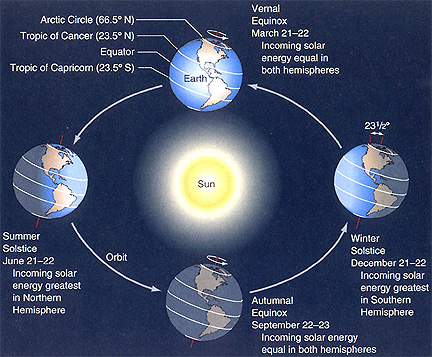
Earth has seasons because our world is tilted on its axis with respect to our orbit around the sun. Image via NASA.
What is a solstice? The earliest people on Earth knew that the sun’s path across the sky, the length of daylight, and the location of the sunrise and sunset all shifted in a regular way throughout the year. They built monuments such as Stonehenge in England – or, for example, at Machu Picchu in Peru – to follow the sun’s yearly progress.
But we today see the solstice differently. We can picture it from the vantage point of space. Today, we know that the solstice is an astronomical event, caused by Earth’s tilt on its axis, and its motion in orbit around the sun.
Because Earth doesn’t orbit upright, but is instead tilted on its axis by 23-and-a-half degrees, Earth’s Northern and Southern Hemispheres trade places in receiving the sun’s light and warmth most directly. The tilt of the Earth – not our distance from the sun – is what causes winter and summer. At the December solstice, the Northern Hemisphere is leaning most away from the sun for the year.
At the December solstice, Earth is positioned in its orbit so that the sun stays below the north pole horizon. As seen from 23-and-a-half degrees south of the equator, at the imaginary line encircling the globe known as the Tropic of Capricorn, the sun shines directly overhead at noon. This is as far south as the sun ever gets. All locations south of the equator have day lengths greater than 12 hours at the December solstice. Meanwhile, all locations north of the equator have day lengths less than 12 hours.
For us on the northern part of Earth, the shortest day comes at the solstice. After the winter solstice, the days get longer, and the nights shorter. It’s a seasonal shift that nearly everyone notices.
Around the time of the winter solstice, watch for late dawns, early sunsets, and the low arc of the sun across the sky each day. Notice your noontime shadow, the longest of the year. Photo via Serge Arsenie on Flickr.
Meanwhile, at the summer solstice, noontime shadows are short. Photo via the Slam Summer Beach Volleyball festival in Australia.
Where should I look to see signs of the solstice in nature? Everywhere.
For all of Earth’s creatures, nothing is so fundamental as the length of daylight. After all, the sun is the ultimate source of all light and warmth on Earth.
If you live in the northern hemisphere, you can notice the late dawns and early sunsets, and the low arc of the sun across the sky each day. You might notice how low the sun appears in the sky at local noon. And be sure to look at your noontime shadow. Around the time of the December solstice, it’s your longest noontime shadow of the year.
In the Southern Hemisphere, it’s opposite. Dawn comes early, and dusk comes late. The sun is high. It’s your shortest noontime shadow of the year.
EarthSky Facebook friend John Michael Mizzi saw this sunset from the island of Gozo (Malta), south of Italy. The earliest sunsets come a couple of weeks before the winter solstice.
Why doesn’t the earliest sunset come on the shortest day? The December solstice marks the shortest day of the year in the Northern Hemisphere and longest day in the Southern Hemisphere. But the earliest sunset – or earliest sunrise if you’re south of the equator – happens before the December solstice. Many people notice this, and ask about it.
The key to understanding the earliest sunset is not to focus on the time of sunset or sunrise. The key is to focus on what is called true solar noon – the time of day that the sun reaches its highest point, in its journey across your sky.
In early December, true solar noon comes nearly 10 minutes earlier by the clock than it does at the solstice around December 22. With true noon coming later on the solstice, so will the sunrise and sunset times.
It’s this discrepancy between clock time and sun time that causes the Northern Hemisphere’s earliest sunset and the Southern Hemisphere’s earliest sunrise to precede the December solstice.
The discrepancy occurs primarily because of the tilt of the Earth’s axis. A secondary but another contributing factor to this discrepancy between clock noon and sun noon comes from the Earth’s elliptical – oblong – orbit around the sun. The Earth’s orbit is not a perfect circle, and when we’re closest to the sun, our world moves fastest in orbit. Our closest point to the sun – or perihelion – comes in early January. So we are moving fastest in orbit around now, slightly faster than our average speed of about 30 kilometers (18.5 miles) per second. The discrepancy between sun time and clock time is greater around the December solstice than the June solstice because we’re nearer the sun at this time of year.
Solstice Pyrotechnics II by groovehouse on Flickr.
The precise date of the earliest sunset depends on your latitude. At mid-northern latitudes, it comes in early December each year. At northern temperate latitudes farther north – such as in Canada and Alaska – the year’s earliest sunset comes around mid-December. Close to the Arctic Circle, the earliest sunset and the December solstice occur on or near the same day.
By the way, the latest sunrise doesn’t come on the solstice either. From mid-northern latitudes, the latest sunrise comes in early January.
The exact dates vary, but the sequence is always the same: earliest sunset in early December, shortest day on the solstice around December 22, latest sunrise in early January.
And so the cycle continues.
Bottom line: In 2015, the December solstice comes on December 21 at 10:03 p.m. CST. That’s December 22 at 4:48 UT. It marks the Northern Hemisphere’s shortest day (first day of winter) and Southern Hemisphere’s longest day (first day of summer). Happy solstice, everyone!
 Everything you need to know: December solstice 2015 | Astronomy Essentials | EarthSky: