Latest News and Comment from Education

Tuesday, August 25, 2015

Special Nite Cap: Catch Up on Today's Post 8/25/15 #SaveDyett


SPECIAL NITE CAP 

CORPORATE ED REFORM


‘The Teacher Shortage’ Is No Accident—It’s the Result of Corporate Education Reform Policies - Working In These Times
‘The Teacher Shortage’ Is No Accident—It’s the Result of Corporate Education Reform Policies - Working In These Times: ‘The Teacher Shortage’ Is No Accident—It’s the Result of Corporate Education Reform PoliciesLike much else in the national education debate, panics about teacher shortages seem to be a perennial event.  In a widely discussed article for the New York Times earlier this month, Motok
LAUSD New Program: Push Non-College Going Students Out of High School—with NO Diploma - California Political Review
LAUSD New Program: Push Non-College Going Students Out of High School—with NO Diploma - California Political Review: LAUSD New Program: Push Non-College Going Students Out of High School—with NO DiplomaLos Angeles Unified has decided that decided that all kids must pass classes that make their eligible for college. The intentions are good—but the results will be a large number of drop outs, since
48,000+ students refused the testocracy in Washington State by opting out. This isn’t an anomaly: It’s an uprising | Seattle Education
48,000+ students refused the testocracy in Washington State by opting out. This isn’t an anomaly: It’s an uprising | Seattle Education: 48,000+ students refused the testocracy in Washington State by opting out. This isn’t an anomaly: It’s an uprisingHow many students opted out of the Smarter Balanced Assessment Consortium (SBAC) in Washington State?  Short answer: More than you probably imagined.N
I hate to say it, but we told you so. — Schoolhouse Voices
I hate to say it, but we told you so. — Schoolhouse Voices — Medium: I hate to say it, but we told you so.For years, I’ve listened to and met with teachers and parents who poured their hearts out, telling me horror stories about the effects of overtesting and its high-stakes consequences.Parents like Christine McGoey, who organized an opt-out movement at her son’s school because she was so frustra
How Rupert Murdoch Suffered A Rare Defeat In American Classrooms - BuzzFeed News
How Rupert Murdoch Suffered A Rare Defeat In American Classrooms - BuzzFeed News: How Rupert Murdoch Suffered A Rare Defeat In American ClassroomsThe media tycoon’s many insurgent businesses have risen to the top of their industries. But after attempting to take over the education market, Murdoch has been forced to retreat.Amplify, Rupert Murdoch’s attempt to disrupt the American education industr
#FightForDyett: NPE Executive Director Robin Hiller Interviews Hunger Striker Jitu Brown – The Network For Public Education
#FightForDyett: NPE Executive Director Robin Hiller Interviews Hunger Striker Jitu Brown – The Network For Public Education: #FightForDyett: NPE Executive Director Robin Hiller Interviews Hunger Striker Jitu Brown00:0000:00Use Up/Down Arrow keys to increase or decrease volume.#FightForDyett: NPE Executive Director Robin Hiller Interviews Hunger Striker Jitu Brown – The Network For Public Education
Seven steps Christie and Cerf can take today to atone for the hurt done to Newark’s children | Bob Braun's Ledger
Seven steps Christie and Cerf can take today to atone for the hurt done to Newark’s children | Bob Braun's Ledger: Seven steps Christie and Cerf can take today to atone for the hurt done to Newark’s children1) Formally recommend to state Education Commissioner David Hespe that the school board receive a score of 80 on the QSAC accountability score, thereby returning the governance prerogative to t
One alarming map shows what today’s school ‘reformers’ are missing - The Washington Post
One alarming map shows what today’s school ‘reformers’ are missing - The Washington Post: One alarming map shows what today’s school ‘reformers’ are missingIn their efforts to change the public education system, today’s school reformers pay close attention to things such as  standardized test scores, graduation and attendance rates, curriculum standards and per-student cost. One thing they don’t t
How parents today are making their daughters emotionally fragile, afraid of new experiences | OregonLive.com
How parents today are making their daughters emotionally fragile, afraid of new experiences | OregonLive.com: How parents today are making their daughters emotionally fragile, afraid of new experiences"Ever tried. Ever failed. No matter. Try again. Fail again. Fail better." -- Samuel BeckettIt's an inspiring quote. So inspiring that tennis player Stan Wawrinka, who won the prestigious Fr
Outsource Local School District Jobs to Private Companies to Cut Administrative Staff! Thanks Common Core and Bill Gates! » Missouri Education Watchdog
Outsource Local School District Jobs to Private Companies to Cut Administrative Staff! Thanks Common Core and Bill Gates! » Missouri Education Watchdog: Outsource Local School District Jobs to Private Companies to Cut Administrative Staff! Thanks Common Core and Bill Gates!Why assessments can be outsourced: Local knowledge is not common knowledge. When assessments must be aligned to the common, th
Normal People Don’t Work in a Public School - Lily's Blackboard
Normal People Don’t Work in a Public School - Lily's Blackboard: Normal People Don’t Work in a Public SchoolI think I just need to say this. I mean it in a respectful way. Kind of. But Normal People don’t work in a public school. I know this, because I know what happened to me every summer break. I taught in a traditional, quite normal elementary school in the suburbs of Salt Lake City. Summer bre
Mike Klonsky's SmallTalk Blog: Day 9 of Dyett Hunger Strike #FightForDyett
Mike Klonsky's SmallTalk Blog: Day 9 of Dyett Hunger Strike: Day 9 of Dyett Hunger StrikeMichelle Gunderson, In These TimesI spent yesterday afternoon over at Dyett and got to meet some of the hunger strikers like UIC grad student Prudence Browne and parent activist Jeanett Taylor-Ramann. They're living on liquids (bring some fresh juice when you come) and desperately hoping for community support
CURMUDGUCATION: Robert Putnam and Cage Busting
CURMUDGUCATION: Robert Putnam and Cage Busting: Robert Putnam and Cage BustingIt was probably because I was reading Robert Putnam's Our Kids and Rick Hess's Cage Busting Teachers, but in Putnam's book, this section leapt out at me. Putnam is describing social capital, the "informal ties to family, friends, neighbors and acquaintances involved in civic associations, religious institutions, ath
2 Polls Span 2 Poles On Testing : NPR Ed : NPR
2 Polls Span 2 Poles On Testing : NPR Ed : NPR: 2 Polls Span 2 Poles On TestingPlease read the following two sentences carefully. Choose which is correct, A or B.A. According to a brand-new national poll, two-thirds of the American public supports annual federal testing, and 59 percent oppose letting students opt out of tests, while only 1 in 4 support opting out.B. According to a brand-new nation
Destroying Special Education through Common Core Testing and Funding Cuts
Destroying Special Education through Common Core Testing and Funding Cuts: Destroying Special Education through Common Core Testing and Funding CutsKindness is a language which the deaf can hear and the blind can see. ~Mark TwainThe U.S. Department of Education says higher expectations mean more tests for students with disabilities (with Common Core’s PARCC and Smarter Balance), and college for ev
Education commissioner begins plan to combat opt outs | POLITICO
Education commissioner begins plan to combat opt outs | POLITICO: Education commissioner begins plan to combat opt outsALBANY — Education commissioner MaryEllen Elia already has begun a battle to stop the rapidly growing opt-out movement before next year’s state tests, reaching out to department attorneys and meeting with superintendents, she told POLITICO New York.“We’re trying to pull together a
Hurricane Katrina Truths | Crazy Crawfish's Blog
Hurricane Katrina Truths | Crazy Crawfish's Blog: Hurricane Katrina TruthsThe success of schools in New Orleans is more fiction than fact.  People in the United States prefer stories with a positive ending, where the good guys win, challenges are face head-on and overcome, and everyone lives happily ever after.  For too many kids in New Orleans, this is not the truth.The improved matriculation rat
8 Frightening Characteristics Of Propaganda | PopularResistance.Org
8 Frightening Characteristics Of Propaganda | PopularResistance.Org: 8 Frightening Characteristics Of PropagandaJacques Ellul’s Propaganda: The Formation of Men’s Attitudes (1965) has been called “a far more frightening work than any of the nightmare novels of George Orwell.” In it, the French philosopher and sociologist dispels some of the popular notions about propaganda and exposes how it reall
New Report, "Out of Control," Shows How School Takeovers Disenfranchise Communities of Color | Alliance to Reclaim Our Schools
New Report, "Out of Control," Shows How School Takeovers Disenfranchise Communities of Color | Alliance to Reclaim Our Schools: New Report, "Out of Control," Shows How School Takeovers Disenfranchise Communities of ColorNEW REPORT   Out of Control: The Systemic Disenfranchisement of African American and Latino Communities Through School TakeoversClick here to download aPDF of t
NYT: Harper report reveals racial disparity in school discipline across the South | Penn GSE
NYT: Harper report reveals racial disparity in school discipline across the South | Penn GSE: NYT: Harper report reveals racial disparity in school discipline across the SouthAugust 25, 2015 — In schools across the United States, Black students are punished more severely than their peers. But nowhere are Black students suspended or expelled more than in the South.A study released today by the Cent
Youngstown school district sues to block new CEO and state's surprise takeover plan | cleveland.com
Youngstown school district sues to block new CEO and state's surprise takeover plan | cleveland.com: Youngstown school district sues to block new CEO and state's surprise takeover planYOUNGSTOWN, Ohio -- The Youngstown school district has filed suit to block the new state takeover plan that Gov. John Kasich and the state legislature sprung on the city this June.The district and several backers wan
Explaining a Hunger Strike to My 3 Year Old: Dyett High School- Hunger Strikes #FightForDyett
Explaining a Hunger Strike to My 3 Year Old: Dyett High School- Hunger Strikes | Dave Stieber: Explaining a Hunger Strike to My 3 Year Old: Dyett High School- Hunger StrikesYesterday my son and I took juice to the 12 parents and community members who are performing a hunger strike. They are protesting Chicago Public Schools' decision to close one of the last public schools in their neighborhood. F
State of U.S. Education May Harm Economic Growth
State of U.S. Education May Harm Economic Growth: State of U.S. Education May Harm Economic GrowthThe statistics speak volumes: the United States is in dire need of education reform. On the 2013 National Assessment of Education Progress (NAEP) reading test, 66 percent of all U.S. fourth graders scored as below proficient. For low-income students, the number testing below proficient jumps to 80 per
Why Vouchers Won’t Fix Vegas Schools - The New York Times
Why Vouchers Won’t Fix Vegas Schools - The New York Times: Why Vouchers Won’t Fix Vegas SchoolsLAS VEGAS — FOR the past year, I’ve lived next door to a public elementary school. With my windows open in the morning, I can hear children’s laughter on the playground, and at 9 a.m., the Pledge of Allegiance over the intercom. My afternoon commute takes me past the entrance, where I see a diverse group
Claypool's lies exceed expectations in letter claiming charter funding is not rigged - Substance News
Claypool nonsense - Substance News: Claypool's lies exceed expectations in letter claiming charter funding is not rigged against neighborhood schools... Sun-Times 'Letter' tries to obfuscate continued favoring of privatization and charters...Rookie Chicago Public Schools "Chief Executive Officer" Forrest Claypool showed off his propaganda skills in a letter to the Chicago Sun-Times follo
LA Times’ ‘Independent’ Education Project Bankrolled by Charter School Backers — FAIR
LA Times’ ‘Independent’ Education Project Bankrolled by Charter School Backers — FAIR: LA Times’ ‘Independent’ Education Project Bankrolled by Charter School BackerEarlier this month, the Los Angeles Times (8/18/15) announced an initiative called Education Matters, “an ongoing, wide-ranging report card on K-12 education in Los Angeles, California and the nation.” The project will cover educational
Today: Join hunger strike for community-based public schools #FightForDyett | Cloaking Inequity
Today: Join hunger strike for community-based public schools #FightForDyett | Cloaking Inequity: Today: Join hunger strike for community-based public schools #FightForDyettToday is my first hunger strike— my first fast.  I have the opportunity today to learn from the example of Jesus Christ, Ghandi and Cesar Chavez. I stand in solidarity with 12 parents and community member who are on hunger strik
Common Core: The sleeper issue of 2016? Chris Hayes talks with Randi Weingarten about the war over Common Core
All In with Chris Hayes on MSNBC: Common Core: The sleeper issue of 2016?Chris Hayes talks with Randi Weingarten about the war over Common Core and the politicization of standardized testing.
Dyett parents in 8th day of hunger strike to save school #FightForDyett
Dyett parents in 8th day of hunger strike to save school: Dyett parents in 8th day of hunger strike to save schoolSupporters of turning Dyett High School into a "green tech" school protest at City Hall on Wednesday July 29, 2015. | Saiyna Bashir/Sun-TimesAs parents pushing a community-backed proposal for the former Dyett High School entered their eighth day of a hunger strike, American F

YESTERDAY

Sparking Curiosity for Truth in the Classroom: An Appreciation of ''Between the World and Me''
Sparking Curiosity for Truth in the Classroom: An Appreciation of ''Between the World and Me'': Sparking Curiosity for Truth in the Classroom: An Appreciation of ''Between the World and Me''Ta-Nehisi Coates, the Atlantic correspondent and author of Between the World and Me. (Photo: Nina Subin)The question of how one should live within a black body, within a country lost in the Dream, is the questi
Will the Newark school board openly confront Christopher Cerf? | Bob Braun's Ledger
Will the Newark school board openly confront Christopher Cerf? | Bob Braun's Ledger: Will the Newark school board openly confront Christopher Cerf?At the end of the last Newark school board meeting, the board president quietly mentioned she would introduce a resolution at the next board session, scheduled for Tuesday night, August 25. Ariagna Perello gave no details but did mention it would concer
Right on banks, wrong on schools: “No Child Left Behind wasn’t designed for the types of realities in my school” - Salon.com
Right on banks, wrong on schools: “No Child Left Behind wasn’t designed for the types of realities in my school” - Salon.com: Right on banks, wrong on schools: “No Child Left Behind wasn’t designed for the types of realities in my school”A congressman says even progressive Democrats fall for "accountability," over-testing and phony education "reform"Elizabeth Warren, Bernie San
Higher Expulsion Rates for Black Students Are Found - The New York Times
Higher Expulsion Rates for Black Students Are Found - The New York Times: Higher Expulsion Rates for Black Students Are FoundWith the Obama administration focused on reducing the number of suspensions, expulsions and arrests in public schools, a new analysis of federal data identifies districts in 13 Southern states where black students are suspended or expelled at rates overwhelmingly higher than
Ex-CPS CEO confided in figure in fed probe, emails show | Chicago Sun-Times
Ex-CPS CEO confided in figure in fed probe, emails show | Chicago Sun-Times: Ex-CPS CEO confided in figure in fed probe, emails showWhen City Hall was planning to announce a property-tax increase in 2013 and Barbara Byrd-Bennett hadn’t been informed, the Chicago Public Schools CEO knew who to turn to for sympathy.“They’re planning a . . . tax increase announcement and no one told me!!!!!! I think
Special Nite Cap: Catch Up on Today's Post 8/24/15 #SaveDyett
SPECIAL NITE CAP CORPORATE ED REFORMCURMUDGUCATION: Cage Busting Teachers?CURMUDGUCATION: Cage Busting Teachers?: Cage Busting Teachers?One of my summer reads was Rick Hess's book The Cage-Busting Teacher. Hess comes to us from theAmerican Enterprise Institute, a right-tilted free-market-loving thinky tank, but Hess is no dummy and has shown at times his willingness to think things through, whethe


‘The Teacher Shortage’ Is No Accident—It’s the Result of Corporate Education Reform Policies - Working In These Times

‘The Teacher Shortage’ Is No Accident—It’s the Result of Corporate Education Reform Policies - Working In These Times:

‘The Teacher Shortage’ Is No Accident—It’s the Result of Corporate Education Reform Policies


Like much else in the national education debate, panics about teacher shortages seem to be a perennial event.  In a widely discussed article for the New York Times earlier this month, Motoko Rich called attention to sharp drops in enrollment in teacher training programs in California and documented that many districts are relaxing licensure requirements as a result, pushing more and more people into the classroom without full certification or proper training.
“It’s a sad, alarming state of affairs, and it proves that for all our lip service about improving the education of America’s children, we’ve failed to make teaching the draw that it should be, the honor that it must be,” mused Times columnist Frank Bruni.
That Bruni would bemoan such a state of affairs is ironic, as he has used his column over the years to repeatedly argue that teaching is too easy a profession to enter and too easy to keep, and amplified the voice of reformers who want to want to make the profession more precarious. But the reality is that speaking of a “shortage” at all is a kind of ideological dodge; the word calls to mind some accident of nature or the market, when what is actually happening is the logical (if not necessarily intended) result of education reform policies.
“This is an old narrative, the idea that we aren’t producing enough teachers,” says Richard Ingersoll, an educational sociologist at University of Pennsylvania who has written extensively on the subject of teacher shortages. “As soon as you disaggregate the data, you find out claims of shortage are always overgeneralized and exaggerated. It’s always been a minority of schools, and the real factor is turnover in hard to staff schools. It may be true enrollment went down in these programs nationally, but there are so many former teachers in the reserve pool.” In other words, the problem isn’t that too few people entering the profession, but rather that too many are leaving it.
Such high turnover rates are disruptive to school culture and tend to concentrate the least experienced teachers in the poorest school districts. A 2014 paper by Ingersoll and his colleagues shows “45 percent of public school teacher turnover took place in just one quarter of the population of public schools. The data show that high-poverty, high-minority, urban and rural public schools have among the highest rates of turnover.”
“If you look at the shortage areas in terms of subject or what districts are having trouble filling jobs, it’s a shortage of people who are willing to teach for the salary and in the working conditions in certain school districts,” says Lois Weiner, an education professor at New Jersey City University and author of The Future of Our Schools. “It’s not a shortage in every district.  Look at the whitest, wealthiest districts in every state and call up the personnel department, ask if they have a shortage in special ed or bilingual ed. They don’t—in fact, they are turning candidates away.”
Ingersoll says it’s no secret what kind of policies will keep teachers in the classroom.
“The most important thing in retaining teachers, according to the data, is sufficient leeway and autonomy in the classroom,” he says. “If low-performing schools that are sanctioned actually allow teachers more autonomy discretion and leeway, their turnover is no higher than high-performing schools.”
A recent survey by the American Federation of Teachers and the Badass Teachers Association cited by Bruni sheds some light on the state of teacher autonomy and job satisfaction. Only 15% of teachers in the survey strongly agreed with the statement “I am enthusiastic about my profession at this point in my career,” although 89% strongly agreed with such feelings at the start of their career. Seventy-three percent said they were “often stressed,” citing mandated curriculum, large class sizes and standardized testing” as their top everyday stressors in the classroom; 71% said adoption of new initiatives without proper training or professional development were major sources of workplace stress. Among the 30% of teachers who claimed to have felt bullied in the last year, 58% of these identify an administrator or supervisor as the culprit.
Far from granting more autonomy to teachers, we appear to be giving them less.
And such working conditions are taking a toll. Last year, a report from New York’s United Federation of Teachers documented a “teacher exodus” from the city’s schools, with nearly half of teachers leaving within the first six years of their career, either to higher-paying suburban districts or to other careers altogether. A new trend in the New York City, according to the UFT, is a sharp increase in resignations among mid-career teachers—those between six and 15 years of service. These teachers are resigning at three times the rate of 2008. 
One of corporate school reform’s many ironies is that its ideological justifications often yield their opposite. In the name of ‘The Teacher Shortage’ Is No Accident—It’s the Result of Corporate Education Reform Policies - Working In These Times:

LAUSD New Program: Push Non-College Going Students Out of High School—with NO Diploma - California Political Review

LAUSD New Program: Push Non-College Going Students Out of High School—with NO Diploma - California Political Review:

LAUSD New Program: Push Non-College Going Students Out of High School—with NO Diploma


Los Angeles Unified has decided that decided that all kids must pass classes that make their eligible for college. The intentions are good—but the results will be a large number of drop outs, since if you can’t pass the courses—because they mean nothing to you or are too hard—kids will drop out without a diploma. They will go into a world where sensitive Leftists want those with no skills or experience to be paid $15 an hour minimum wage, please benefits. Any wonder San Fran has a new restaurant names EATSA—everything is done by robots and technology. No need to pay kids what they are not worth.

“But like many of the other districts, Los Angeles Unified struggled to implement the new requirement. Officials said they miscalculated the large number of students who would have trouble with the college-prep coursework. The loss in state funding caused by the recession hampered other districts’ efforts to add intervention programs, making them reluctant to punish students who could not meet the tougher targets.

Los Angeles Unified eventually adjusted its ambitious plan after officials realized that far too many students were at risk of not graduating. More than 65,000 students were funneled into summer school this year because they were behind on credits.

Other districts that require the A-G sequence have also eased their standards. They include allowing Ds in college-prep courses to count toward graduation credits, even as UC and CSU accept only Cs or higher.”

The lower standards means the diploma is just a piece of paper, worthless—no education behind it, just “time served”. When will the parents get angry?

200px-LAUSD_Logo.svg

Raising graduation bar poses challenges for school districts

By Fermin Leal, EdSource, 8/23/15

Graduating more college-ready students ranks as one of most important education initiatives in California, leading Los Angeles Unified School District to implement a sweeping plan requiring all students to complete a college-prep curriculum before they earn a diploma.

In 2005 the nation’s second-largest district joined a growing number in the state that began aligning their graduation requirements with the A-G sequence, the minimum standards needed for admission into the University of California and California State University systems and other four-year colleges and universities.

But like many of the other districts, Los Angeles Unified struggled to implement the new requirement. Officials said they miscalculated the large number of students who would have trouble with the college-prep coursework. The loss in state funding caused by the recession hampered other districts’ efforts to add intervention programs, making them reluctant to punish students who could not meet the tougher targets.

Los Angeles Unified eventually adjusted its ambitious plan after officials realized that far too many students were at risk of not graduating. More than 65,000 students were funneled into summer school this year because they were behind on credits.

Other districts that require the A-G sequence have also eased their standards. They include allowing Ds in college-prep courses to count toward graduation credits, even as UC and CSU accept only Cs or LAUSD New Program: Push Non-College Going Students Out of High School—with NO Diploma - California Political Review:

48,000+ students refused the testocracy in Washington State by opting out. This isn’t an anomaly: It’s an uprising | Seattle Education

48,000+ students refused the testocracy in Washington State by opting out. This isn’t an anomaly: It’s an uprising | Seattle Education:

48,000+ students refused the testocracy in Washington State by opting out. This isn’t an anomaly: It’s an uprising


Screen Shot 2015-07-30 at 9.59.48 AM
How many students opted out of the Smarter Balanced Assessment Consortium (SBAC) in Washington State?  Short answer: More than you probably imagined.
Now that the final numbers are out, let’s dig in and see what happened.
11th Grade
We knew the opt out numbers were going to be huge. Last week’s OSPI report confirmed that. Across the state, the opt out rate for 11th grade was 49.3% for ELA and 52.9% for Math. This translates into:
37,112 students opted out of the English Language Arts (ELA)
39,444 students opted out of Math
11th_grade_big
(Opt outs are reported as “No Score”. Click image to enlarge.)
Now let’s do a quick run down on the other grades. Although the numbers lack the dramatic impact of the 11th grade, these figures are higher than what was reported by OSPI in July.
3rd Grade
1,590 opted out of the ELA
1,680 for Math
3rd_grade_large
4th Grade
1,579 opted out of ELA
1.702 for Math
4th_grade_large

I hate to say it, but we told you so. — Schoolhouse Voices

I hate to say it, but we told you so. — Schoolhouse Voices — Medium:

I hate to say it, but we told you so.


For years, I’ve listened to and met with teachers and parents who poured their hearts out, telling me horror stories about the effects of overtesting and its high-stakes consequences.

Parents like Christine McGoey, who organized an opt-out movement at her son’s school because she was so frustrated by high-stakes tests that weren’t age-appropriate or aligned with the curriculum — like many parents in New York, where nearly 1 in 5 opted their children out of standardized tests this year.

Teachers like Daniel Santos of Houston and Sheri Lederman of Great Falls, N.Y., who won awards one year and were marked ineffective the next — based on standardized tests that didn’t even align with the curriculum.

Teachers like Susan Bowles of Gainesville, who risked her job and refused to administer Florida’s tests rather than lose up to six weeks of instructional time.

Teachers and their unions have been telling policymakers that the testing fixation is educational malpractice, but they got nowhere for years.

I’ve been telling these stories from every soapbox I could find. Yet, when it mattered, lawmakers either paid lip service to the concerns or out and out rejected them. Instead, they listened to the billionaire hedge fund managers, Silicon Valley tech entrepreneurs and wealthy foundations that pedaled a combination of austerity and testing, arguing that teaching can be boiled down to an algorithm based on a child’s math and English standardized test scores.

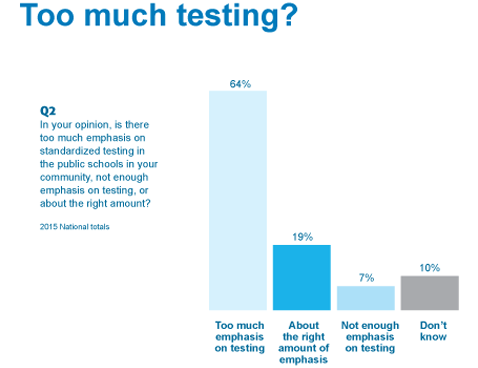
But now, it’s not “just” teachers. The 47th annual poll from Phi Delta Kappa and Gallup — the gold standard for public opinion on education issues — was just released. And Americans are pretty clear about what they want and don’t want from their policymakers when it comes to education.

The question now is will policymakers listen to people’s voices? Will the need to invest in education and common sense trump the test-and-sanction ideology fueled by money and marketers?

Sixty-four percent of Americans believe too much emphasis is put on standardized tests, according to the latest annual PDK/Gallup poll. In no uncertain terms, Americans are saying it’s time to end the obsession with — and misuse of — testing. And if the Every Child Achieves Act makes its way through Congress, we might just be able to end the worst of those practices.


But the fight won’t be easy.

Over the past 20 years, “reform” proponents — led by familiar names like Jeb Bush, Michelle Rhee and Joel Klein — have sold the snake-oil idea that we can measure teaching and learning with a standardized test and fire our way to great schools. And from the media to statehouses to the halls of Congress, it seems like the farther people are from the classroom, the more I hate to say it, but we told you so. — Schoolhouse Voices — Medium:

How Rupert Murdoch Suffered A Rare Defeat In American Classrooms - BuzzFeed News

How Rupert Murdoch Suffered A Rare Defeat In American Classrooms - BuzzFeed News:

How Rupert Murdoch Suffered A Rare Defeat In American Classrooms

The media tycoon’s many insurgent businesses have risen to the top of their industries. But after attempting to take over the education market, Murdoch has been forced to retreat.


Amplify, Rupert Murdoch’s attempt to disrupt the American education industry, had a lot going for it: a lot of hype, a lot of media attention, a lot of high-profile names, and a lot of money to spend. Then add to all that the fact that the education industry seemed especially vulnerable — dominated by big, cozy, slow-moving incumbents, just the way Murdoch likes it.
But none of that mattered in the end. As it turns out, Murdoch’s News Corp. couldn’t even make waves in the education world, much less disrupt it. During its short life, Amplify bled money, losing $193 million in 2014 alone.
On Aug. 12, News Corp. said it was in final talks to sell Amplify, had written down the value of the business by $370 million, and would wind down the education unit’s first and most ambitious project, a custom-made tablet computer that was supposed to revolutionize education technology. The venture lasted just three years at News Corp.
Amplify’s high-profile failure, despite the people and money backing it, is a sign of just how strange and difficult to navigate the education industry can be. The company underestimated almost everything about the industry: the deep entrenchment of the biggest players and the complexities of selling to school districts — not to mention the surprising political power of parents and teachers unions, who had a not-insignificant hand in the company’s troubles.
Amplify’s pitch, when it launched in July 2012, was simple: It was neither an education publisher like Pearson, bogged down by the legacy of printed textbooks, nor a tech company like Apple, which didn’t understand teaching and curriculum. It made products that straddled that line: a tablet customized solely for classrooms, and, later, an education curriculum made only for digital devices.
And it had money, too, to the tune of hundreds of millions of dollars in investment by News Corp, which had exited the education business a decade prior when its publishing arm, HarperCollins, stopped printing textbooks. Amplify hoped the money would allow it to compete on the same level as the country’s dominant textbook companies, Pearson, Houghton Mifflin, and McGraw-Hill, known in the industry as the “Big Three.”
Rather than starting at the bottom, selling directly to individual schools and teachers as many startup ed-tech companies were forced to do, Amplify sold its products just like the big textbook companies did, sending fleets of salespeople to peddle Amplify’s wares directly to school districts.
“I would like to disrupt the delivery model, too, eventually,” Amplify CEO Joel Klein told BuzzFeed News in April 2014. “But these things don’t happen overnight. You have to meet the market where it is, even if you’re a disruptor.”
But from the beginning, Amplify seemed to struggle to meet that market. Big players like Pearson, who have decades of experience in the industry, sell their products How Rupert Murdoch Suffered A Rare Defeat In American Classrooms - BuzzFeed News:

#FightForDyett: NPE Executive Director Robin Hiller Interviews Hunger Striker Jitu Brown – The Network For Public Education

#FightForDyett: NPE Executive Director Robin Hiller Interviews Hunger Striker Jitu Brown – The Network For Public Education:

#FightForDyett: NPE Executive Director Robin Hiller Interviews Hunger Striker Jitu Brown


#FightForDyett: NPE Executive Director Robin Hiller Interviews Hunger Striker Jitu Brown – The Network For Public Education:

Seven steps Christie and Cerf can take today to atone for the hurt done to Newark’s children | Bob Braun's Ledger

Seven steps Christie and Cerf can take today to atone for the hurt done to Newark’s children | Bob Braun's Ledger:

Seven steps Christie and Cerf can take today to atone for the hurt done to Newark’s children


1) Formally recommend to state Education Commissioner David Hespe that the school board receive a score of 80 on the QSAC accountability score, thereby returning the governance prerogative to the local board. Gov. Chris Christie and Newarsk superintendent Christopher Cerf also should apologize for manipulating past QSAC scores for political reasons to keep Newark schools under state control.
2) Put an immediate end to the “One Newark” enrollment plan and allow children to attend their neighborhood schools. End the advantages the plan gives to charter schools.
3) Immediately stop the wholesale transfer of teachers required by the “turnaround” plan–and apologize for using a so-called education “reform” as retribution for the refusal of teachers to weaken their collective bargaining agreement.
4) Rehire to regular classroom positions the hundreds of teachers declared Seven steps Christie and Cerf can take today to atone for the hurt done to Newark’s children | Bob Braun's Ledger:

One alarming map shows what today’s school ‘reformers’ are missing - The Washington Post

One alarming map shows what today’s school ‘reformers’ are missing - The Washington Post:

One alarming map shows what today’s school ‘reformers’ are missing


In their efforts to change the public education system, today’s school reformers pay close attention to things such as  standardized test scores, graduation and attendance rates, curriculum standards and per-student cost. One thing they don’t talk much about — but that is a fundamental part of any effort to really help students learn — are the conditions in which young people live and spend most of their time. In other words, they don’t talk much — if at all — about student poverty rates.
For years, many reformers adopted a “no excuses” motto, meaning that nothing, including living in abject poverty, was an excuse for poor student performance in school if teachers did their jobs effectively. The notion that hunger or chronic illness or trauma could make it impossible for teachers to help students move the performance needle was rejected, and those who raised the issue were labeled as people who simply wanted to defend the “status quo.” (How it became acceptable to ignore the obvious — that needy kids need support services to do better in school — is a story for another time.)
Interestingly, a judge in California is considering an unprecedented class-action lawsuit arguing that the Compton Unified School District has failed to directly address the trauma that many students experience outside of class and that there should be accommodations made in school for this reason because it affects academic performance.
My colleague Emma Brown has this summer written about student poverty rates, first in this July story, with a series of maps showing poverty rates in school districts, and then in this recent story, with a map showing how student poverty has increased since the Great Recession of 2008.
Here is one map with student poverty rates in the nearly 14,000 public school districts around the country in 2013, the latest year for which there is complete information. It was created by the nonprofit EdBuild, which used Census Bureau poverty rates and then constructed an interactive map which you can find here and see how poverty rates changed from 2006 to 2013.  According to EdBuild, there was over that period a 260 percent increase in the number of students who went to school in districts with poverty rates of 40 percent or more.  (That isn’t a typo. It’s a 260 percent increase.)
Meanwhile, school reform is still heavily focused not on getting kids wrap-up around services that they need to help them concentrate in school and have One alarming map shows what today’s school ‘reformers’ are missing - The Washington Post:


How parents today are making their daughters emotionally fragile, afraid of new experiences | OregonLive.com

How parents today are making their daughters emotionally fragile, afraid of new experiences | OregonLive.com:

How parents today are making their daughters emotionally fragile, afraid of new experiences


AX146_3B9C_9.JPG


"Ever tried. Ever failed. No matter. Try again. Fail again. Fail better." -- Samuel Beckett
It's an inspiring quote. So inspiring that tennis player Stan Wawrinka, who won the prestigious French Open in June, had it tattooed on his arm a couple of years ago, back when he was having trouble reaching his potential.
None of the women on the professional tennis tour have followed Wawrinka's example, and it's certainly not because they don't like getting tattoos. They're simply less likely to share Beckett's mindset, says Jessica Lahey, author of the new book "The Gift of Failure: How the Best Parents Learn to Let Go So Their Children Can Succeed."
America's recent generations of girls have suffocated their "natural curiosity and love of learning at the altar of achievement, and it's our fault," Lahey writes. The "our," in this case, refers to parents.
Needless to say, many parents try to shield both sons and daughters from failure, and so has our culture in recent years -- hence the rise of "participation" trophies for every kid who shows up for a peewee league. It's an outgrowth of the idea, first popularized in the 1970s, that instilling high self-esteem in a child is the most important thing a parent can do.
Children's self-image is indeed important, but psychologist and author Jim Taylor insists we've been going about it the wrong way. "Parents were told to love and praise and reinforce and reward and encourage their children no matter what they did," he wrote in a 2010 Psychology Today article. "Unfortunately, this approach created children who were selfish, spoiled and entitled."
Not to mention anxious, depressed and afraid.
Recent studies on the subject suggest that the self-esteem parenting movement only makes early adulthood more difficult for kids, for we all inevitably meet failure and we need to know how to deal with it. And the growing problem appears to be much greater for girls, who tend to take failure more personally. They're more likely than boys to view failure as a value judgment on their inherent ability, as a definitive comment on themselves as individuals. Boys often will view a setback as a challenge to get better. Societal biases, often unconsciously in play, reinforce this attitude more with boys than girls.
The point, Lahey, Taylor and others say, is that failure takes practice. We have to get used to it, even embrace it. Otherwise, it will become a bogeyman.
Time magazine, citing the academic literature, writes that children have "been so protected from mistakes, usually by their parents, that they fear failure, avoid risk, and value image over learning. By the time they go to college, they are more vulnerable to How parents today are making their daughters emotionally fragile, afraid of new experiences | OregonLive.com:

Outsource Local School District Jobs to Private Companies to Cut Administrative Staff! Thanks Common Core and Bill Gates! » Missouri Education Watchdog

Outsource Local School District Jobs to Private Companies to Cut Administrative Staff! Thanks Common Core and Bill Gates! » Missouri Education Watchdog:

Outsource Local School District Jobs to Private Companies to Cut Administrative Staff! Thanks Common Core and Bill Gates!


curriculum outsource
Why assessments can be outsourced: Local knowledge is not common knowledge. When assessments must be aligned to the common, the individual needs of the students are non-existent.

Maybe it’s time to go to your school board members and ask if there can be a reduction in administrative staff in your district.  Many Missouri school districts are asking for more money for staff, but this company, Measured Progress, will outsource the creation of district assessments (to align with the Common Core State Standards) so what’s not to love?  Those bond issues may not be necessary at all if the district can rid itself of redundancy and unneeded administrative layers.  This slide illustrates the upside of cutting local jobs:

cutting cost outsource
Think of the first cuts in administrative positions as curriculum/assessment directors are not needed and your school can join the thousands of schools with private NGO created assessments aligning to the CCSS.  Once the assessments are set, it will be a no brainer for a company such as Measured Progress to inform the district what curriculum would best align to Measured Progress’ assessments.  Another district position, curriculum director, can then be eliminated.
Take this to your school board and urge it to use a private company to provide the services previously supplied by district employees.  If all the assessments need to line up to Common Core (as Bill Gates said was necessary to determine if the experiment worked), you might as well cut out the local administrators whose educational expertise were designing assessments and determining curriculum choices to meet the needs of that individual district and group of students.  Gates’ vision will be close to completion.  The customer market will be unleashed for that large uniform base of products.  The word common is not the same as individual.  Developing curriculum and assessments unique is so unnecessary in the ‘common’ ed reform plan.  Outsourcing for a common goal and objective is the end game, not providing an exceptional education for students.
Isn’t it great to be common?  Just think of the cuts possible in the future when teachers can be replaced by individuals who don’t have an education degree or experience.  It won’t be needed when all the lessons are created by private companies that are aligned to CCSS.  Following a script wouldn’t necessitate a college degree.  All you have to do is follow the recipe.  Maybe the unions and NGOs might want to reconsider Outsource Local School District Jobs to Private Companies to Cut Administrative Staff! Thanks Common Core and Bill Gates! » Missouri Education Watchdog:

Normal People Don’t Work in a Public School - Lily's Blackboard

Normal People Don’t Work in a Public School - Lily's Blackboard:

Normal People Don’t Work in a Public School


I think I just need to say this. I mean it in a respectful way. Kind of. But Normal People don’t work in a public school. I know this, because I know what happened to me every summer break. I taught in a traditional, quite normal elementary school in the suburbs of Salt Lake City. Summer break was a normal routine.
Yeah, I’ll admit that I started relaxing in June. I usually had a professional development class to keep my certification current or my summer job (secretary temp or typing and charging per page), but there was more time for my boys and a camping trip or visiting grandma and grandpa. Things slow down when there aren’t 37 book reports to grade, or lesson plans to revise, or 37 parents to call about the school play.
14273660229_fc01e56d10_b

That’s pretty normal, I guess. But then July would roll around.
By then, we had cleaned out the garage and weeded the tomatoes in the garden. I started calling my teacher friends.
“I’m thinking we should add Where the Red Fern Grows. I’m starting to make a vocabulary list for each chapter,” I’d say to Sue.
And Sue would admit that she’d already started on Tuck Everlasting. We’d talk about whether or not to keep trudging up Timpanogos Cave for our field trip, and how they’d cut our budget and what we were going to do to raise some bucks. We’d talk about how I’d take her class for music if she took my class for P.E., and maybe we should have a 6th grade Valentine’s Day Dance and teach the kids ballroom dancing.
By the end of July, I couldn’t take it. I started gathering things from the kitchen. Baking soda. Vinegar. Chemicals for science experiments. Old sheets and old hats and old things that could be turned into costumes for plays. I’d start hitting yard sales and thrift shops for extra copies of Where the Red Fern Grows and Tuck Everlasting and other books we could use for our literature program that my colleagues and I had created. We kept adding to that program every year until we had over 100 titles with teacher-made vocabulary lists and chapter questions based on critical thinking skills that required debate and discussion and allowed students to come to different conclusions if they could defend their answers with reason and evidence.
15323121972_59e7bce11e_o

By August 1, I was sneaking into my classroom. Our school secretary, Marge, would just shake her head. She had an 11-month contract, but kept reminding those of us who showed up a month before our contract started that WE WERE ON VACATION. I think we caused Steve the Custodian the most heartburn because we wanted to put our desks and chairs in place, and he was still shampooing carpets.
My room was always ready a good three weeks before the first bell rang in the fall. The bulletin boards were cheerful, and the learning centers were inviting, and the lesson plans were chronologically and perfectly and Normal People Don’t Work in a Public School - Lily's Blackboard:

Mike Klonsky's SmallTalk Blog: Day 9 of Dyett Hunger Strike #FightForDyett

Mike Klonsky's SmallTalk Blog: Day 9 of Dyett Hunger Strike:

Day 9 of Dyett Hunger Strike

Michelle Gunderson, In These Times
I spent yesterday afternoon over at Dyett and got to meet some of the hunger strikers like UIC grad student Prudence Browne and parent activist Jeanett Taylor-Ramann. They're living on liquids (bring some fresh juice when you come) and desperately hoping for community support in order to save the last of their neighborhood schools. 

Prudence helped write the strikers' proposal to create a new small school with a strong curricular focus, the Dyett Global Leadership and Green Technology. The proposal is solid but the board is stonewalling it. It seems like the mayor and toady Ald. Burns are determined to go to any lengths, not to allow the activists their victory.


Progressive Caucus Ald. Rick Munoz shows up in support.
She was headed down to New Orleans to do research on the post-Katrina ed "reforms" for her dissertation, when she joined the strike. 

As for the amazing Ms. Taylor-Ramann, check out her interviews in Huffington andCatalyst. She has a great personal story of struggle and school/community activism. 

There's been good coverage of the Dyett hunger strike in independent and social media @FightForDyett, but hardly a word in the mainstream. Why not? It's a great story. An official blackout? I doubt it. Although I'm sure there's City Hall pressure being applied. Where are you great Sun-Times ed reporters? You can't all be on vacation.

Ah, there you are. Still not much. I thought I saw someone from the N.Y. Times. But...
Rabbi Brant Rosen
Yana Kunichoff has a written a good piece on the strike, now in its 9th day, in In These Times,


She writes:

The Dyett hunger strike is only the latest flare-up in a public school system in Mike Klonsky's SmallTalk Blog: Day 9 of Dyett Hunger Strike:

CURMUDGUCATION: Robert Putnam and Cage Busting

CURMUDGUCATION: Robert Putnam and Cage Busting:

Robert Putnam and Cage Busting


It was probably because I was reading Robert Putnam's Our Kids and Rick Hess's Cage Busting Teachers, but in Putnam's book, this section leapt out at me. Putnam is describing social capital, the "informal ties to family, friends, neighbors and acquaintances involved in civic associations, religious institutions, athletic teams, volunteer activities, and so on."

Social capital has repeatedly been shown to be a strong predictor of well-being both for individuals and for communities. Community bonds and social networks have powerful effects on health, happiness, educational success, economic success, public safety and (especially) child welfare. However, like financial capital, social capital is distributed unevenly...

Contrary to romanticized images of close-knit communal life among the poor, lower-class Americans today, especially if they are nonwhite, tend to be socially isolated, even form their neighbors.

Perhaps more important, more educated Americans also have many more "weak ties," that is, connections to wider, more diverse networks. The reach and diversity of these social ties are especially valuable for social mobility and educational and economic advancement, because such ties allow educated, affluent parents and their children to tap a wealth of expertise and support that is simply inaccessible to parents and children who are less well off. 

Now, that speaks to me as a teacher learning about students-- but it also speaks to me just plain as a teacher. Putnam is talking about how the lack of social capital gives poor students a disadvantage, but it got me to thinking about teachers' social capital.

Hess's book talks about authority and power-- but what if Hess the issue Hess is talking about is really social capital?

After all-- one of the side effects of working almost exclusively with children is that teachers don't develop the kind of network of soft ties that other professionals do. In fact, teachers early in their careers are often so busy doing the work that they don't get out, don't join community groups, don't volunteer, don't become part of a "more diverse network." Even things as simple as meeting someone for lunch are not do-able in teacherville.

We've talked a lot about how reformsters have access to a great deal of money, but it's social capital as well. When David Coleman and his buds decided that they had the blueprint for re-inventing 
CURMUDGUCATION: Robert Putnam and Cage Busting: