Latest News and Comment from Education

Wednesday, May 6, 2015

One Newark: Choosing “Great” Schools, or Merely Segregated Ones? #CharterSchoolsWeek

One Newark: Choosing “Great” Schools, or Merely Segregated Ones? « New Jersey Education Policy Forum:

One Newark: Choosing “Great” Schools, or Merely Segregated Ones?


 Full Length Brief: Weber_One NewarkSegregation-1

Mark Weber, PhD candidate, Rutgers University, Graduate School of Education
Executive Summary
This brief provides a preliminary analysis of the potentially segregative effects of One Newark, the school choice plan implemented by the Newark Public Schools (NPS) in 2014. School choices appear to be influenced by ratings assigned by NPS; however, these ratings are correlated to student population characteristics, such as race and economic status. Newark families, therefore, may be the choosing schools – inadvertently or otherwise – that are more segregated.
“Popular” schools under One Newark – the ones chosen most often by families – enroll fewer students eligible for the federal free-lunch program, a proxy measure of economic disadvantage. Popular charter schools also enroll relatively large proportions of black students compared to all of the city’s publicly-funded schools, even as popular district schools enroll relatively small proportions.
While popular schools show better performance on statewide assessments, their “growth” scores, which are intended to take into account differences in student populations, are more mixed. Because test scores are correlated to student population characteristics, families that choose higher-performing schools under One Newark may be selecting schools that are more segregated.
There are notable differences between popular district and popular charter schools: the popular charters have higher suspension rates and more inexperienced teachers than the popular district schools. Whether families are aware of these discrepancies is unknown.
Although the limited data released by NPS is inadequate for a full analysis, I find these results to be sufficient evidence to warrant the release of the full set of One Newark application data.One Newark: Choosing “Great” Schools, or Merely Segregated Ones? « New Jersey Education Policy Forum:

Network for Public Education's Second Annual Conference Makes History - Living in Dialogue

Network for Public Education's Second Annual Conference Makes History - Living in Dialogue:

Network for Public Education's Second Annual Conference Makes History 


By Anthony Cody.
The last weekend of April I joined about 600 other history-makers in the great city of Chicago for the second annual conference of the Network for Public Education. It has been said that American attitudes towards education are like a pendulum, swinging from one side to another. If so, this was a room full of pendulum pushers, decidedly unhappy with the status quo.
The biggest news out of the conference was made when, in response to a question from NPE’s president, Diane Ravitch, both Lily Eskelsen Garcia and Randi Weingarten categorically stated that the NEA and AFT would no longer accept grants from the Gates, Walton or Broad Foundations. (Video here.) Both unions have accepted multiple grants for millions of dollars from Gates and Broad. Several Gates-funded projects have taken on the task of promoting Common Core implementation. While other comments made indicate that both unions remain wed to the Common Core, this is an important step back from collaboration with foundations that are hostile to teacher unions and public education.
Another way this conference made history is by being the largest gathering of education activists in the nation. This activism in support of real change in public education is emerging as a real social movement, and the Network for Public Education has created events that bring this movement together. There was solidarity with other organizations who offered workshops, including leaders from United Opt Out, theBadAss Teachers AssociationFairTest, and Save Our Schools. Many education bloggers and grassroots activists attended as well. The event trended on Twitter both days, and several thousand people tuned in to watch the live streamed sessions broadcast by our talented volunteer Vincent Precht throughwww.Schoolhouselive.org. We managed to broadcast all keynotes and 18 separate workshops, so even those not in attendance could access the conference. Many of the sessions referenced in this post can be viewed on archived video as well.
There were numerous sessions that focused us on how to communicate and organize. Members of the Newark Students Union shared hard won experiences from several years of organizing their peers. (Video here) I accompanied Tanaisa Brown to a meeting of Chicago’s CORE caucus after the conference ended on Sunday, where she told the crowd that the connections the students had made at the conference had them thinking about a national tour, so that NSU members could visit and encourage Network for Public Education's Second Annual Conference Makes History - Living in Dialogue:
 Watch New Video From the NETWORK FOR PUBLIC EDUCATION NATIONAL CONFERENCE Schoolhouse Live

Schoolhouse Live:
THE NETWORK FOR PUBLIC EDUCATION NATIONAL CONFERENCE
April 25-26 educators and advocates gathered in the Windy City to discuss crucial issues facing children in our public schools. From the infiltration of big business into public education to high stakes testing and the Common Core, dangers to America's proud tradition of public education were exposed and efforts to neutralize them examined. Click below to relive this lively weekend, and watch for new video links in the days to come!


From Vincent Precht and SCHOOLHOUSE LIVE

California Father


I am a teacher, writer, filmmaker and live streamer. I have produced live stream events for United Opt Out featuring addresses by Diane Ravitch and Karen Lewis and am making a documentary, which includes interviews with Noam Chomsky, Jesse Hagopian and many others. Published in the New York Times, Seattle Review, TriQuarterly and elsewhere, I have written award winning short stories. I have been a public school teacher for 29 years. The biggest moments of my life were having a son and 40 years earlier meeting the Beatles.

Vincent Precht http://bit.ly/1GwPEPv

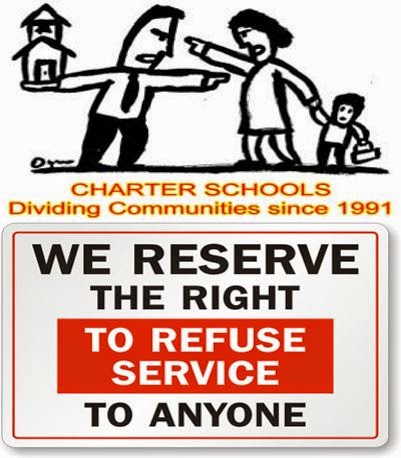
Celebrating National Charter Schools Week: Re-Segregating America’s Schools Part 3 #CharterSchoolsWeek


Celebrating National Charter Schools Week: Re-Segregating America’s Schools Part 3


Choice Without Equity:
 Charter School Segregation and the Need for Civil Rights Standards
Study: Charter schools have worsened school segregation


School Reform, New Orleans Style


Charter Schools and the Risk of Increased Segregation


Russ on Reading: Accountability for Charter Schools in Philadelphia

Russ on Reading: Accountability for Charter Schools in Philadelphia:

Accountability for Charter Schools in Philadelphia

Hey, Philadelphia Mayoral candidates. let's adopt the Annenberg accountability standards for charter school oversight.


It looks like charter school proliferation will continue in Philadelphia for the foreseeable future. While newly elected Governor Tom Wolfe has fired School Reform Commission chair and charter champion, Bill Green, a hopeful sign, the two leading candidates for mayor range from an aggressively pro-charter, pro-voucher Anthony Williams to Jim Kenney, a former board member of Independence Charter School, who says he knows “how important charter schools are to the families they serve.”

Philadelphians interested in a strong system of public education do, however, have a clear choice. Anthony Williams is backed by the virulently pro-charter, pro-voucher Susquehanna International Group (SIG), a suburban Philadelphia investment firm, who has given Williams close to 1 million dollars to support television ads. This after supporting him to the tune of 1.5 million in his quixotic run for governor last year.

According to the Philly Voice Williams campaign manager, Dawn Chavous, has not only worked for SIG, but is a former executive director of Students First, a pro-charter, anti-union lobbying group who has also donated money to Williams in his various campaigns. Clearly, a vote for Williams is a vote for the further decimation of the Philadelphia public schools through the proliferation of charters and efforts to divert scarce public school funds to voucher programs.

Kenney, while a former charter board member and whose public pronouncements have shied away from a position in opposition to charters, has a more balanced view of the issue. He has called for charter schools to work cooperatively with the other public schools for the benefit of all children. He demands that charter schools operate in an open and transparent manner and be both fiscally and educationally accountable. He calls for an end to activities that discourage students with special needs from applying for admittance.

Kenney’s positions strongly echo some of the recommendations of the Annenberg Institute of School Reform out of Brown University. In a white paper that came out last fall, entitled, Public Accountability for Charter Schools: Standards and Policy Recommendations for Effective Oversight, the Annenberg group calls for the following improvements to charter school oversight.

1. Traditional school districts and charter schools should collaborate to ensure a coordinated approach that serves all children.

This recommendation echoes the original purpose of charter schools to be 
Russ on Reading: Accountability for Charter Schools in Philadelphia:

Education Post Goes Postal on John Oliver - Living in Dialogue

Education Post Goes Postal on John Oliver - Living in Dialogue:

Education Post Goes Postal on John Oliver


By Anthony Cody.
Poor John Oliver. After he did a segment on the insanity of our nation’s testing machine, the field of education’s only multi-million dollar blog, The Education Post, has taken after him with a vengeance. Oliver joins others with the nerve to question the nation’s obsession with standardized tests in being declared an enemy of the poor. (See this post from December for more background on Education Post)
First we got a plaintive “Dear John” letter from someone named Valentina Korkes. Ms. Korkes is “Deputy Director of Policy” at Education Post, and worked for two and a half years for StudentsFirst as a Legislative Projects Manager. Korkes complains to Oliver that he “broke her heart” when he failed to point out the many wonderful ways that “testing and accountability are good for kids.”
And if John Oliver was not devastated enough by this kick to the gut, yesterday Peter Cunningham added his scorn. According to Cunningham, Oliver “throws poor kids under the bus,” by taking the side of their enemies, and failing to enumerate the many benefits of tests. His utterly humorless post concludes:
John Oliver sides with the comfortable bureaucrats, self-serving union leaders, and the complacent middle class that abdicates any responsibility for extending the American Dream beyond their own insular worlds.
As Peter Greene points out, there is one central flaw in this indictment. We have ruled our school system by the accountability systems chosen by these reformers now since 2002. And where can they point to school systems that have been greatly improved?
We have had this regimen of testing, this revenue-generating stream of dis-aggregated data collection for over a decade. For over ten years we have been collecting test scores so that, having measured, we can then fix. So again I ask.
Who has been saved?
Where is the urban school system where the state has said, “Damn– this school is in trouble. Get some resources and help and support in there stat. Divert tax dollars and raise more. Hire the best educational experts to help.” And then, having sent the 
Education Post Goes Postal on John Oliver - Living in Dialogue:

Is Rupert Murdoch's (NWSA) Bid to Fix Education With a Tablet Failing? - Pg.2 - TheStreet

Is Rupert Murdoch's (NWSA) Bid to Fix Education With a Tablet Failing? - Pg.2 - TheStreet:

Is Rupert Murdoch's Bid to Fix Education With a Tablet Failing?


Amplify decided to build its own hardware five years ago because the "operating systems didn't give us the kind of flexibility with the learning resources we were creating," Hamilton said. It also allowed school districts one-stop shopping.

That strategy made sense five years ago because it provided Amplify with a competitive edge, said Jordan Shapiro, a Temple University lecturer, and researcher in education technology. Companies such as Houghton-Mifflin and Pearson, Shapiro said, have long-standing ties to school administrators and teachers, making it difficult for new players to gain market share.
"The goal here is adoption, so if you can get your device into a school district, you have a strong grip on content -- that becomes a very interesting strategy," Shapiro said in a phone interview. "It doesn't seem to have had the kind of momentum they imagined yet, but then again, nothing has."
That could be because most schools have insufficient Internet broadband connections to make Amplify's digital learning tools useful. Some 63% of schools don't have enough bandwidth to meet the current needs for digital learning, according toEducation SuperHighway, an ed-tech advocacy group.

And the wireless units aren't cheap. Late last year, the FCC increased its funding for wireless infrastructure for schools and libraries to $3.9 billion though a federal tax of telephone customers. Yet many school districts aren't clear on how they can access that money, Hamilton said. Many districts, Shapiro said, are making their way into education technology piecemeal, using a variety of software publishers and often partnering with foundations for the hardware.

In 2013, Apple partnered with Pearson Education in a $1.3 billion project to supply 650,000 students in the sprawling Los Angeles Unified School District with iPads loaded with the company's digital teaching tools. But the program has been grounded in lawsuits and finger-pointing with the school district demanding a refund.

Houghton Mifflin CEO Linda Zecher said her company is making digital learning tools that can be used on a variety of devices. She said Houghton Mifflin chose not to make its own device because it could divert executive attention away from curriculum development, and it would place a publisher in head-to-head competition with very large technology companies.Is Rupert Murdoch's (NWSA) Bid to Fix Education With a Tablet Failing? - Pg.2 - TheStreet:

Early learner expert ( actor Matt Damon’s mom ) tied to Hollywood takes on Common Core :: SI&A Cabinet Report

Early learner expert tied to Hollywood takes on Common Core :: SI&A Cabinet Report :: The Essential Resource for Superintendents and the Cabinet:

Early learner expert tied to Hollywood takes on Common Core

Early learner expert tied to Hollywood takes on Common Core


(Mass.) Already under fire for its ties to the Obama administration and for unsettling teacher unions – the Common Core has a new adversary, actor Matt Damon’s mom.
Nancy Carlsson-Paige, an author and a professor emeritus in education at Lesley University – as well as the mother of the Hollywood star – is also founder of an early learning advocacy group, Defending the Early Years.
A new white paper out this month from the Boston-based non-profit takes issue with a requirement in the Common Core State Standards that kindergarteners should be reading before moving on to the first grade.
The paper, co-written by Carlsson-Paige with the group’s executive director Geralyn McLaughlin Joan Almon, makes several key points:
  • Many children are not developmentally ready to read in kindergarten, yet the Common Core State Standards require them to do just that. This is leading to inappropriate classroom practices.
  • No research documents long-term gains from learning to read in kindergarten.
  • Research shows greater gains from play- based programs than from preschools and kindergartens with a more academic focus.
  • Children learn through playful, hands-on experiences with materials, the natural world, and engaging, caring adults.
Carlsson-Paige argues that pushing young learners into reading before they are ready can be detrimental over the long term.
“If you present children with information that’s too disparate from what they know then they give up or feel confused, or cry, or get turned off,” she said in a recent interview with KQED television of San Francisco.
“Part of the art of teaching is to understand where a child is in developing concepts and then be able to present information in ways that are new and interesting, but will cause a little bit of struggle on the part of the child to try to understand them,” she said.
Defending the Early Years was founded in 2012 “to take action on policies that affect the education of young children,” according to its website. Among the issues of concern are appropriate practices in early childhood classrooms and the impact of “current reforms” on what they consider to be appropriate practices.
The report notes that the Common Core sets out more than 90 standards that kindergarteners are expected to meet before moving on to the first grade. The key literacy standard requires that kindergarteners should “read emergent-reader texts with purpose and understanding.”
Authors of the paper said that not only is there no research supporting this goal but the findings of many studies contradict the objective.
They note the work of researcher and educator Mercedes Schneider, who has documented “the lightning-quick writing” of the Common Core and the lack of evidence that all kindergarteners need to learn to read.
“If they [the writers of the CCSS] were interested in research they would have started with kindergarten and piloted the standards for a few years and then made adjustments based on their research — and built slowly from there,” Schneider is quoted saying.
“There is absolutely no evidence that developmental stages were considered,” he said. “That is a major problem across the standards and especially for the youngest grades. Anyone who has a cursory knowledge of development knows that it is not linear and that children do not all develop at the same rate — there is a span.”
A better approach, the researchers said, is to allow children to participate in a traditional play-based program from preschool through kindergarten.
“As they construct their ideas through play and hands-on activities that make sense to them, children’s knowledge builds in a gradual progression that is solid and unshakable,” they said.
“Being able to read well will also depend on the strength of a child’s oral language development. Active, play-based experiences in the early years foster strong oral language in children. As children engage in active learning experiences and play, they are talking and listening all the time.”Early learner expert tied to Hollywood takes on Common Core :: SI&A Cabinet Report :: The Essential Resource for Superintendents and the Cabinet:

The Soccer Mom Revolt Against Common Core - WSJ

The Soccer Mom Revolt Against Common Core - WSJ:

The Soccer Mom Revolt Against Common Core

The opt-out movement against taking the tests is growing, and so is the Obama administration’s ire.


 The term “soccer mom”—political shorthand for the upscale suburban women President Clinton courted so successfully in the 1990s—may have fallen out of use with the Beltway set in more recent years, but this swing voting bloc is still around. Just ask Arne Duncan.

As President Obama’s education secretary and the administration’s head cheerleader for the new Common Core academic standards, Mr. Duncan has spent four years trying to convince the country that the biggest problem with K-12 schooling is insufficient federal intervention. His problem is that the more parents learn about this federal effort to impose uniform math and reading standards across state lines, the less they like the idea. And women, who are more likely than men to rank education as “very important” in political surveys, seem to harbor a special disdain for Common Core.
A national poll released by Fairleigh Dickinson University earlier this year put approval for the new standards at 17%, against 40% who disapproved and another 42% who were undecided. A breakdown by gender had Common Core support at 22% for men and only 12% for women.
Wealthier parents tend to be the most skeptical, and they are not satisfied with merely sounding off to pollsters. This year hundreds of thousands of students across the country are boycotting Common Core-aligned state exams, and this so-called opt-out movement has been growing. Preliminary estimates are that between 150,000 and 200,000 students skipped New York state’s mandatory English exams last month, up from the 49,000 in 2014.
The Obama administration is aware of these developments, though you might question how it has chosen to respond to critics. “It’s fascinating to me,” said Mr. Duncan in 2013, “that some of the pushback is coming from, sort of, white suburban moms who—all of a sudden—their child isn’t as brilliant as they thought they were and their school isn’t quite as good as they thought.”
More recently, the administration has pivoted from insulting parents to threatening them. Mr. Duncan told an education conference in April that if the boycott numbers continue to rise, “then we have an obligation to step in.”
His spokesman later informed reporters that the administration is considering whether to withhold federal funding for districts with test-participation rates below 95%. Given that there is no political will or effective mechanism for punishing test opponents without turning them into martyrs, this is an idle threat. The districts doing most of the boycotting are affluent and not dependent on federal money, which in any case parents could easily replace out of pocket.
Nor is this backlash as “fascinating” as Mr. Duncan claims. For the purposes of opposing accountability measures in No Child Left Behind, the 2001 federal education law signed by George W. Bush, the Obama administration told these white suburban moms that their schools were just fine. For the purposes of imposing Common Core, Mr. Duncan is telling them the opposite.
No Child Left Behind had its shortcomings, but Congress went to great lengths to preserve local control. The law’s objective was to produce information—disaggregated data on the racial, ethnic and income groups that were struggling academically. Unlike the Common Core standards and tests, No Child Left Behind didn’t tell schools what to do and what not to do. States were still in charge of determining what to teach and how to teach it.
“The one thing upper-middle-class parents want and have grown accustomed to having is the ability to control their kids’ education,” Jay Greene, an education reform scholar who teaches at the University of Arkansas, told me by phone this week. “They will purchase private school if they have to. They will move to another neighborhood if they must. And they will boycott testing if they feel their control is being interfered with.”
Forty-five states initially signed on to Common Core in return for more federal education funding, but the tide is turning and opponents—including teachers unions who don’t want student test scores, or any other objective measures, used to evaluate instructors—have the momentum. California and Utah already allow parents to opt out of assessments, and CBS News reported in March that 19 other states “have introduced legislation to either halt or replace Common Core.”
This issue won’t go away when students head home for summer vacation next month. The presidential candidates will have to declare themselves. Labor will pressure Hillary Clinton to at least hedge any support for testing, and it is increasingly difficult to imagine a Republican nominee who hasn’t distanced himself from Common Core.
Prof. Greene thinks the administration’s education agenda has crossed the wrong voters. “They’re going to lose,” he said, citing White House hubris and overreach. “You can’t beat organized upper-middle-class people. They will fight back and you will lose.”
Mr. Riley, a Manhattan Institute senior fellow and Journal contributor, is the author of “Please Stop Helping Us: How Liberals Make It Harder for Blacks to Succeed” (Encounter Books, 2014).The Soccer Mom Revolt Against Common Core - WSJ:

Jersey Jazzman: Education "Reform": The Wrong Conversation

Jersey Jazzman: Education "Reform": The Wrong Conversation:

Education "Reform": The Wrong Conversation


 Jennifer "Edushyster" Berkshire has been having a series of conversations with some of the titans of reforminess. As Peter Greene notes, Jennifer is just about the most charming (and consequently disarming) person you'd ever care to meet; it's not a surprise, then, that she's been able to rope in some of the biggest names in education "reform" for her blog posts.


Her latest sit-down is with one of the better-knowns of a new breed of "reasonable" reformer: Peter Cunningham, creator of Education Post. I'll confess I haven't followed Cunningham's site religiously, but near as I can tell he's running a farm system, bringing up a bunch of hot prospects to push back on folks like Jennifer and Peter and me and others who don't buy into the reformy argument.

Except that pushing back isn't the ultimate goal; instead, apparently, we're supposed to lay aside our policy differences on tenure and testing and charter schools, all for the sake of kids. Because, in the "reasonable" reformer's mind, there's just oodles of stuff we can all agree on.

Take, for example, school funding. As Cunningham himself has recently said:
Instead of a tiresome debate around accountability, we agree on simple measures of progress and shared responsibility among teachers, principals, superintendents and taxpayers.
The only way to achieve this vision in a decentralized system like ours is with a much bigger federal investment. Today, 1-2 percent of the federal budget goes to K-12 education, while 16-20 percent goes to defense, when you include the wars. But education is the real defense industry of the 21st Century so let’s talk about shifting a few percentage points from unwinnable wars and unneeded weapons programs toward public education.
Conservatives will insist we also talk about entitlement reforms that could shift dollars from the elderly to the young. We should all welcome that conversation, including those of us who no longer have kids in school and are busy tracking our retirement portfolios. Our collective interest trumps our self-interest.
Now that is a very interesting framework; it deserves some unpacking.

What Cunningham is engaging in here is an argument I called Jonathan Alter out on years ago. Alter coined this position the "Grand Bargain": teachers would have to be held accountable in a system that he didn't care to define specifically; in return they would get "a lot more pay."

As I said at the time, the details in these grand bargains are never fully spelled out -- yet we teachers are expected to agree to them, like saps at the worst used car dealer you could imagine. Ask the teachers in Newark, for example, how their "grand bargain" worked out.

Cunningham isn't down at the teacher level, but his argument runs parallel to Alter's: we'll shift more money into education, so long as we get to keep expanding segregating "choice" systems, and keep ranking teachers using innumerate test-based measures, and keep closing "failing" schools (even though that is itself a failed strategy -- and Cunningham, of all people, should know this).

But notice where Cunningham gets his money for this grand bargain: either the defense sector, or, as an outcome of a conversation "we should all welcome," the elderly. But there is no mention in Peter Cunningham's world (so far as I can find) of raising taxes on the wealthy to pay for better schools for children in economic disadvantage.

Thank goodness I'm not an old, crusty cynic. Because, if I were, I would point out thatEducation Post is funded by multi-billionaires Eli Broad, Michael Bloomberg, the Walton family, and an anonymous plutocrat -- the very people who have benefitted from ourhistorical income inequity and our historically low taxation rate on the wealthy.

Thank goodness.

What I'll instead focus on is this idea of "shifting a few percentage points" of the federal budget to education. Remember, Cunningham was a part of the Obama administration's first term; he was there back in 2009 when the fight to get stimulus money into the economy was being waged. In Cunningham's own words, President Obama was a champion of funneling more money into the schools:
First of all, this argument overlooks obvious areas of agreement among reformers and unions. For example, most reformers join teachers in supporting more funding.
It’s worth remembering that the pro-reform Obama administration provided nearly $60 billion to save some 400,000 teaching jobs during the recession. This money came with no strings attached and dwarfed the administration’s “reform” initiatives. [emphasis mine]
See, there is common ground after all! Sure, us critics of "reform" may have a problems Jersey Jazzman: Education "Reform": The Wrong Conversation: