Latest News and Comment from Education

Thursday, May 9, 2013

The Testing Obsession Widens the Gap - Bridging Differences - Education Week

The Testing Obsession Widens the Gap - Bridging Differences - Education Week:


The Testing Obsession Widens the Gap

Deborah Meier responds to Fordham Institute's Michael J. Petrilli today.
Dear Mike,
The data you present re. the "achievement gap" is consistent with an argument I made against using standardized testing as a barometer 50 years ago. I said (and wrote) that as long as our testing system requires us to rank order we will be tracking income (and wealth), not education. As one becomes less equal, so will the other. Anything else would not meet psychometric standards! The tests are designed by test publishers who, by pre-testing items, can be sure that they've got the "right"—reliable and credible—rank order.
Once one concludes, as I did through 50 years of close observation, that the tests are measuring something other than "reading" skill—decoding and restating—our problem looks different. Yes, E.D. Hirsch is right: You can't measure reading qua reading. I not merely observed but ran little mini-focus groups to understand why some kids got "right" answers and others "wrong" ones. It had little to do with their reading skill.
Read Part 2 of In Schools We Trust and you'll learn what I discovered was happening. It's partly a question of vocabulary, but more importantly it is in their "interpretations" that the poor and rich (and probably black and 

Dennis Van Roekel: Exposing ALEC's Agenda to Defund and Dismantle Public Education

Dennis Van Roekel: Exposing ALEC's Agenda to Defund and Dismantle Public Education:


Exposing ALEC's Agenda to Defund and Dismantle Public Education

Posted: 05/07/2013 11:52 am
Iron Man 3 just opened this past weekend, followed soon by more would-be blockbusters. I'm sure a lot of these movies will be entertaining, but none will be more important or relevant than a half-hour documentary I recently watched: The United States of ALEC.
This film, featuring Bill Moyers, does a masterful job of explaining how the closed-door manipulations of the American Legislative Exchange Council and its corporate lobbyists affect public policy in every realm of our society -- including education.
Our nation spends about $500 billion in local, state and federal funds on public schools from kindergarten through high school. Most Americans view this as a wise investment in our nation's future. Throughout the 20th century the U.S. was the clear leader in public education. We created the most vibrant economy the world has ever known. The record speaks for itself -- public education is a great investment.
But there are people who look at our investment in public education, and they see a treasure chest. Their first thought is, how can they tap into those funds for their own private gain? If just one percent of education spending were diverted to private profit, it would mean $5 billion a year in someone's pockets. And that's just counting K-12; higher education is already a huge for-profit sector.
A simple fact of business: You have to spend money to make money. And those who want to 

Thursday on the Whole Child Virtual Conference — Whole Child Education

Thursday on the Whole Child Virtual Conference — Whole Child Education:


Whole Child Virtual Conference

Thursday on the Whole Child Virtual Conference

We invite you to participate in ASCD's third annual Whole Child Virtual Conference. Entitled "Moving from Implementation to Sustainability to Culture," sessions will offer educators around the globe leadership discussions and strategies to support their work to implement and sustain a whole child approach to education.
ASCD's Whole Child Network: The Importance of School Leadership
Vicki SchulenbergKevin EnersonMarla Dean10:0011:00 a.m. eastern time
Panel Discussion
Join Donna Snyder, manager of Whole Child Programs at ASCD, as she introduces a few school leaders from the Whole Child Network of Schools. The schools involved come from across the United States and Guam and have used the ASCD School Improvement Tool to help assess and guide their progress. Hear about the schools' experiences navigating this first year and moving the initiative along the continuum from implementation to sustainability. Panel members include
  • Marla Dean, principal, Drew-Freeman Middle School, Suitland, Md.;
  • Kevin Enerson, principal, Le Sueur-Henderson High School, Le Sueur, Minn.; and
  • Vicki Schulenberg, principal, Fredstom Elementary School, Lincoln, Neb.
WCVC Registration


Understanding How Young Children Learn:
Bringing the Science of Child Development to the Classroom
Wendy Ostroff12:001:00 p.m. eastern time
Presenter: Wendy Ostroff, associate professor, Curry College, Milton, Mass.
How children learn is the single most important subject for future teachers to understand. To understand learning in all its complexity, we need to examine how it develops. Children's learning as revealed in the latest developmental science research—including that on motivation, attention, memory, cognition and action—are the topics of this presentation. Processes that inspire or propel learning, such as play, confidence, self-regulation, movement, mnemonic strategies, metacognition, articulation, and collaboration, are highlighted. Critical findings and frameworks on children's learning are distilled into a synthesis of the important ideas for teachers to take away and to reference as they design their curriculum and pedagogy.
WCVC Registration


The Whole Child Approach Needs a New Strategy for Working
Within Education Systems
Peter PaulusDan LaitschDoug McCall2:003:00 p.m. eastern time
Presenters: Doug McCall, executive director, International School Health Network, Surrey, British Columbia, Canada; Dan Laitsch, director, Centre on Educational Leadership and Policy, Simon Fraser University, Burnaby, British Columbia, Canada; and Peter Paulus, Institute for Psychology, Leuphana University, Luneburg, Germany
If health, social service, and other agencies intend to truly support the whole child approach in education, they will need to reform their fundamental strategies in approaching school systems. In the past, health and social advocates have tried to involve educators in their many programs by documenting their health, economic burdens, and value in improving student achievement. This reform has led to competition for attention, as well as valid perceptions among educators, that these programs are an "add-on" to the core functions of schooling. This session will discuss how more successful strategies entail deeper understanding of school systems so that health and social concerns can be better integrated into the mandates and constraints of schools.
WCVC Registration


Grit: Multiple Intelligences and Instructional Technology in the Classroom
Thomas R. HoerrWalter McKenzie4:005:00 p.m. eastern time
Presenters: Walter McKenzie, director of Constituent Services, ASCD, and Thomas Hoerr, head of New City School, St. Louis, Mo.
The theory of multiple intelligences (MI) has been used as a tool to give students more ways to learn. How can MI and instructional technology (IT) be used to gain 'grit'? Duckworth's Grit is a key to success in any endeavor, and MI and IT can help develop it. This session will focus on how intelligences and technology can enable teachers to elicit and reinforce grit.
WCVC Registration

Class Size & Funding Inequity in NY State & NY City | School Finance 101

Class Size & Funding Inequity in NY State & NY City | School Finance 101:


Class Size & Funding Inequity in NY State & NY City

New York State repeatedly makes the top of our list of most INEQUITABLE state school finance systems in our National Report Card.
http://www.schoolfundingfairness.org/National_Report_Card_2012.pdf
Further, NY State was acknowledged in a report I prepared last year, with colleague Sean Corcoran of NYU, identifying states that are both generally inequitable and that actually exacerbate those inequities through their state school finance systems.
http://www.americanprogress.org/wp-content/uploads/2012/09/StealthInequities.pdf
As I’ve explained in several previous blog posts, NY State’s primary policy response has been to brush aside the issue – blame school districts for being inefficient – pretend that the state already spends way too much – and ram ill-conceived policies down the throats of local district officials.
Here’s one choice quote from the Governor:
“The problem with education in New York is not money,” Cuomo said. “We have one of the highest 

Shanker Blog » The Relationship Between Teacher Salaries And Teacher Salary Schedules

Shanker Blog » The Relationship Between Teacher Salaries And Teacher Salary Schedules:


The Relationship Between Teacher Salaries And Teacher Salary Schedules

The National Council on Teacher Quality (NCTQ) has released a brief report on teacher salary schedules since the recession.
NCTQ looks at 41 of the 50 largest districts in the U.S. (i.e., all but nine responded to the survey). Between 2007-08 and 2010-11, four out of five of these districts froze pay at least once. As would be expected, districts did so in different ways – sometimes by freezing step increases (or awarding them without associated raises), sometimes via lower (or no) cost of living adjustments, etc. It’s compelling evidence that public school teachers, like most U.S. workers, have felt the pain from the recession. This is useful information (also check out NCTQ’s TR3 database, a terrific resource).
There are, however, a couple of points worth mentioning about salary schedules, which may seem picky (or even 

MORNING UPDATE LISTEN TO DIANE RAVITCH 5-9-13 Diane Ravitch's blog | A site to discuss better education for all

Diane Ravitch's blog | A site to discuss better education for all:

Click on picture to Listen to Diane Ravitch


Tennessee Teacher on PARCC Testing

A reader comments:
Wow, for those opposed to T-cap, wait until you get a good look at common core and the PARCC assessment. The nightmare is about to get worse. As a teacher, I have been working with the debut of common core in Tennessee this year. I don’t even know where to begin to express my frustration with the entire common core movement. It combines an exceptionally narrow curriculum with testing that is vague and open to interpretation (when our group of 6 teachers scored student work we frequently came up with three different scores). The 


In Los Angeles, Both Mayoral Candidates Want to Publish Teacher Ratings

In 2010, the Los Angeles commissioned a rating system based on test scores and published the individual names of teachers and their ratings. New York City did the same last year. To say this was controversial is putting it mildly.
Many researchers opposed it, as did Wendy Kopp and Bill Gates. If the purpose of the ratings is to help teachers improve, how exactly does it help to publish those ratings? Shouldn’t they be part of a discussion between principals and teachers? Right after the ratings went public in Los Angeles, a fifth grade teacher committed suicide. His name was Roberto Riguelas. Collateral damage, you might say.
John Ewing, the head of Math for America, called this thuggish use of data “mathematical intimidation,” and said


Why Rhee’s Test-Driven Incentives Always Fail

In this thoughtful article, Charles Taylor Kerchner of Claremont Graduate University explains that Michelle Rhee’s belief in using test scores to reward and punish teachers is guaranteed to produce adverse consequences like cheating.
Her reliance on test scores plus her “fear-based management style” is the Achilles’ heel of reform policy, he says.
“This is the lesson of organizational history, not an isolated “bad judgment” aberration. It’s about more than school test scores in the District of Columbia, Atlanta, Texas or even Rhee’s possibly outsized claims of how well her students did during the three years she taught school in Baltimore. The policies Rhee endorses create bad incentives. Bad incentives lead to disastrous results. They certainly played a part in the largest business collapses in recent history: Enron, WorldCom, Lehman Brothers and the collapse of the subprime mortgage 

Iowa Teacher: Save This Noble Profession Before It Is Too Late

Amy Prime, who teaches second grade in Newton, Iowa, noticed that many of the teachers she knows and admires are counting the days until they retire or quit.
She writes:
“If you teach, you don’t need to get online to read these thoughts. You hear them every day as you pass your colleagues in the halls, at sporting events, at church and in the grocery store. Teachers who are close to 

Is There Any Organization That Is Not Funded by Gates?

Obscene amounts of money translate into power.
Obscene amounts of money–billions–often translate into the ability to buy elections. But not always, as we saw in the recent school board election in Los Angeles, when the candidate of the Billionaire Boys Club was beaten by Steve Zimmer.
Billionaires don’t just try to buy elections.
They try to buy anyone who might help them or hinder them in their quest for power.
The Gates Foundation, for example, underwrites almost every organization in its quest to control American 

Will Rhode Island Continue to Defend the Misuse of NECAP for Graduation?

Tom Sgouros has written repeatedly about the inappropriateness of using NECAP as a graduation requirement for students in Rhode Island.
This is the same issue that produced the activism of the Providence Student Union.
Commissioner Deborah Gist insists that the critics don’t know what they are talking about.
In this post, Sgouros points out that the test-makers say clearly that the NECAP is not intended for

Kevin Welner: How Charter Schools Game Their Enrollments

As we have seen again and again in recent years, charter schools have mastered the secret of school success. The most predictable way of getting those highly prized test scores is to have the “right” student body.
Want to learn the tricks?
Kevin Welner of the University of Colorado and the 

Network for Public Education Endorses Monica Ratliff

This is the first endorsement by the Network for Public Education.
After a careful review by the board, we endorse Monica Ratliff for school board in Los Angeles.
We promised we would support candidates who support public education.
We don’t have the money to compete with the billionaires.
But we hope our support will persuade parents and teachers to get out and vote.
This is a run off and will be a low turnout.
We urge everyone to get out and vote.
Here is the NPE endorsement:
NPE’s First Endorsement: Monica Ratliff

Diane in the Evening 5-8-13 Diane Ravitch's blog | A site to discuss better education for all

mike simpson at Big Education Ape - 4 hours ago
Diane Ravitch's blog | A site to discuss better education for all: 8th Grade Student: Why So Much Advertising on Pearson Tests? by dianerav A student in a gifted program wrote this piercing analysis of the state tests he and his classmates just endured. The tests he took had many brand names and registered trademarks. He realized this is product placement. He wrote: “Non-fictional passages in the test I took included an article about robots, where the brands IBM™, Lego®, FIFA® and Mindstorms™ popped up, each explained with a footnote. I cannot speak for all test takers, but I ... more »

Leading the way in education – instead of following the failing neo liberal agenda – @ THE CHALK FACE knows SCHOOLS MATTER

Leading the way in education – instead of following the failing neo liberal agenda – @ THE CHALK FACE knows SCHOOLS MATTER:


Leading the way in education – instead of following the failing neo liberal agenda

Jersey Jazzman: Bill Gates's Ridiculous TED Talk, Part I

Jersey Jazzman: Bill Gates's Ridiculous TED Talk, Part I:


Bill Gates's Ridiculous TED Talk, Part I

I didn't even have to go two minutes into this spiel by Bill Gates before he laid out a whopper so large it's simply stunning:


(1:06) Until recently, over 98% of teachers just got one word of feedback: "Satisfactory."
That is astonishingly wrong. No teacher I've ever heard of ever got a one-word evaluation. Every principal I've ever worked for has written multiple pages about my teaching when doing my summative evaluation. Principals are, in fact, required to give meaningful feedback to their teachers; if they don't, they are derelict in their duties. All good school leadership programs require training in teacher evaluation.

Folks, you know I usually give gobs of links in my posts. But I feel stupid trying to add them here. Do any of you reading this actually think principals simply give one word of feedback to 98% of teachers in their evaluations? Do you really think this is how schools work? Does Gates?

There are only two reasons for anyone to make such a transparently incorrect statement: ignorance or 

UPDATE: collective bargaining what Olive Garden is to Italian food + Arne at the AERA + CTU election debate. Fred Klonsky

CTU election debate. The Brawl at the Electricians’ Hall. | Fred Klonsky:


This deal is to collective bargaining what Olive Garden is to Italian food.

olive-garden-never-ending-pasta-bowl
From those who have defended the deal between Cullerton and the We Are One coalition that led to SB2404, there has been a constant theme. They compare the process to collective bargaining.
Well, folks. This process makes a mockery of collective bargaining.
I was talking to a class of college students last night about teacher unions. Of the many things that makes collective bargaining work,  I explained, is the ultimate ability of the rank-and-file members to say no.
Glen Brown says this about that:
Approximately 35,000 retirees are being deprived of an earned and promised benefit. 


Arne at the AERA. The solution to a bad guy with a test is a good guy with a test.

110103_arne_duncan_face_ap_328
Arnold Dodge:
On April 30, Arne Duncan, the Secretary of Education, gave what was billed as a Special Invited Address, at the annual meeting of the American Education Research Association (AERA) in San Francisco. This conference, attended by thousands of higher ed scholars in education departments, is for many, the high water mark of academe. Focused research and investigation from all over the world is shared and critically examined.
What we heard was breathtaking in its lack of awareness about the effects of Race to the Top (RTTT). Far from being chastened by what is going on in schools around the country, the Secretary doubled-down on his test-driven offensive. A look at some of the things he said is eye opening.
“We need you, the researchers, to answer the question, ‘Which approach works better – this one or that one’ and then we need to move forward by your answer.”This is a disingenuous invitation at best. The research community has been telling the administration for years that high stakes testing is an invalid, unreliable and unstable measure of both student and teacher performance. We have not seen any effect on policy from our clarion call for dumping this metric as central to 


CTU election debate. The Brawl at the Electricians’ Hall.

32588_10200747375307288_1208689588_n
CPS Chatter:
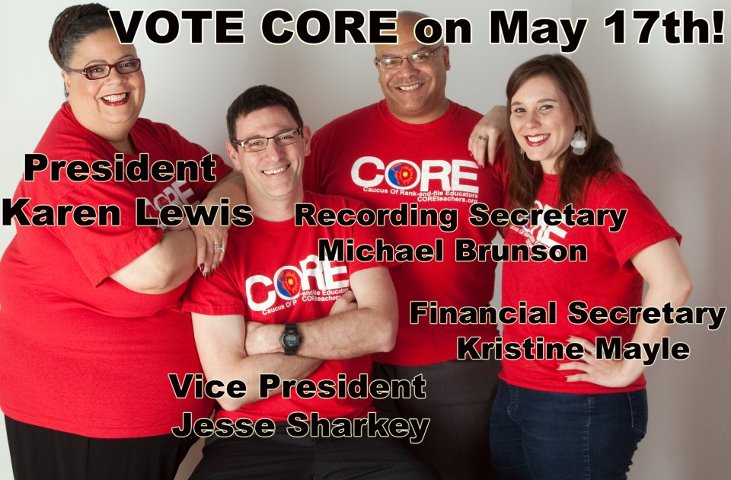
At the CPS Delegates Meeting tonight there were debates for President and Vice-President.  Both were pretty lopsided victories for the CORE slate as the Salvation Caucus seemed to lack any sort of coherent plan for the future of the union beyond picking away at their current leadership.   It was clear that it was going to be a long night for the Salvation Caucus when vice-presidential candidate Mark Ochoa consistently ran out of things to say before coming anywhere close to the two minutes he was allocated to answer questions.
Jesse Sharkey seemed much more capable in response, focusing on how he believed the union could best prepare to combat Mayor Emanuel in the future.  Sharkey, as usual, had great enthusiasm for the task at hand.  Ochoa, on the other hand, seemed to be hoping that once we explained to the Board that we didn’t like things like overtesting, they would simply end the offending practices.
The second debate between Karen Lewis and challenger Tanya Saunders-Wolfe was even testier.  The conflict 

Ed Notes Online: When Davids Boo Goliaths Do They Lack Civility?

Ed Notes Online: When Davids Boo Goliaths Do They Lack Civility?:


When Davids Boo Goliaths Do They Lack Civility?

Civility is the last recourse of the powerful, those who can afford to appear civil because they hold all the power... 
The call for civility exposes a foundational problem with the current education reform debate because, for all practical purposes, there is no debate..... Paul Thomas,  A Call for Non-Cooperation.
I call for a moratorium on requests that we be civil to people bordering on criminality. Straddling the fence is not an option. You can't take the position that we should act in a civil manner in a "debate" between people with nukes and people with pea shooters - in essence there is no debate ... public booing is not just born out of frustration but is a political tactic to draw attention from a very biased media that ignores the voice of the opposition....Even bad press is better than no press.  EdNotes (I love to quote myself).
Paul Thomas reacts here (A Call for Non-Cooperation: So that Teachers Are Not Foreigners in Their Own Profession) to Randi Weingarten's call for a one-year moratorium on high-stakes testing 

Common Core test is on track, State Board told | EdSource Today

Common Core test is on track, State Board told | EdSource Today:


Common Core test is on track, State Board told - by John Fensterwald


Teacher "Appreciation" - Teacher in a Strange Land - Education Week Teacher

Teacher "Appreciation" - Teacher in a Strange Land - Education Week Teacher:


Teacher "Appreciation"

It's 1993, at the Michigan Teacher of the Year celebration in Lansing, and I have just been awarded a lovely parting gift: a Digital 286 computer. It sits on a table in the front of the ballroom, beige and boxy, the 12-inch monitor scrolling "Nancy Flanagan, Michigan Teacher of the Year" in bright pink letters. I am thrilled. My first computer!
The program lists the Lansing business that donated the computer to the TOY program, and their representative stood up for a round of grateful applause at the banquet. As I am unplugging the CPU to take the computer home, I notice that it's scratched and dented a bit. There doesn't seem to be a printer, either. The woman whose company contributed the computer appears at my elbow and tells me that their entire office was just outfitted with brand-new 386 models, so they didn't need the old ones--and then asks for the electrical cord. "We can still use that!" she says brightly.
I have just been given a hand-me-down business computer with no printer or cord. Congratulations!
But--I am still thrilled, although it's harder to get the right cord than you might think, and it takes several more paychecks before I can scrape together the cash to buy a dot-matrix printer. Only a couple of teachers in my building have their own computers, and I am geeked about the cool materials I can now produce--although in 1993 teachers were not yet allowed to use the Xerox machine to reproduce documents. That was reserved for 

Weingarten Wants Me to Want the Common Core State Standards | deutsch29

Weingarten Wants Me to Want the Common Core State Standards | deutsch29:


Weingarten Wants Me to Want the Common Core State Standards

When I was very young, three or four years old, I used to ride with my father as he drove his New Orleans city bus on its morning route. This was before the age of seat belts, and my father used to allow me to stand next to him and operate the money crank. Riders would put their fare in a glass-topped container; my father would verify the amount was correct, and then I was allowed to pull the handle so that the money would drop into a metal container below.
One day, a lady gave me some change, and I put it in the glass container and cranked it. The lady said, Oh, no! That money was for you to keep!” I remember feeling instant panic and loss at having cranked what was to be a gift to me.
My father immediately replied, “It’s okay. She would rather crank the money than keep it.” Suddenly all was well because I believed what my father had said about me. He said I had rather operate the crank, and his saying as 

Mike Klonsky's SmallTalk Blog: Duncan Demagogy

Mike Klonsky's SmallTalk Blog: Duncan Demagogy:


Duncan Demagogy

In the world of ed politics, there are straight shooters and there are those who will say anything, depending on their audience. There's no better example of a straight shooter than Jonathan Kozol, who is being honored tonight by FairTest with the Deborah W. Meier Heroes in Education Award in recognition of his courageous activism. The event will be held at the Multicultural Arts Center, from 6 to 8:30 p.m., at 41 Second Street, Cambridge, MA

Duncan at AERA
Then there's Sec. Arne Duncan, who came to AERA last week to try and cover his ass left flank. To listen to him talk, one would think, here's the man leading the fight against the current testing madness. Hilarious and irritating at the same time

I didn't go to San Francisco this year but it sounds like few were taken in by Duncan's anti-test double-talk. He understandably received with a resounding chorus of boos by hundreds of ed researchers who daily bear witness (about all researchers can do these days) to the destructiveness of Race To The Top and who know better than to take this educational know-nothing at face value.

Arnold Dodge, chairperson of the Department of Educational Leadership and Administration at LIU-Post does a great job of exposing Duncan-style demagogy in yesterday's Huffington Post.

Dodge quotes Duncan:
"Some schools have an almost obsessive culture around testing, and that hurts their most