Tuesday, February 16, 2010

Students sharpen attack on UC costs with satire

Students sharpen attack on UC costs with satire:

"It's been a seriously dramatic year at the University of California, where hundreds of students seized buildings, demonstrated and shut down regents meetings last fall to protest rising tuition and the perceived privatization of the public school."


It's also been a satirically dramatic year, thanks to the UC Movement for Efficient Privatization, a fledgling group of mostly grad students in business attire that uses humor tinged with sarcasm to lampoon UC officials.
Their own name is an example. Many UC students believe leaps in tuition and reduced state funding are turning the public university into a private institution.
The UC Movement for Efficient Privatization says, "Why not?"
"Unlike others whining about the direction of privatization, we're concerned about the snail's pace at which the inevitable transformation is proceeding," said Shane Boyle, 27, unofficial chairman of UCMeP.
That's You See Me ... you get the idea.
In the spirit of theatrical political activists, from Billionaires for Bush to the Yippies, the 5-month-old group says its goal is to help UC leaders advance their goals.
"We take them to the logical extreme to show how ridiculous they can be," said UCMeP's Chief Artistic Officer Brandon Woolf, 26, a doctoral student in theater with Boyle. "It's another tactic for protest."
To wit:
On Thursday, UCMeP organized a dozen or so people into a Student Counter-Activist

Read more: http://www.sfgate.com/cgi-bin/article.cgi?f=/c/a/2010/02/15/BA6A1BUGLU.DTL#ixzz0fheO1oYr

Study offers nuanced view of abstinence education | Philadelphia Inquirer | 02/16/2010

Study offers nuanced view of abstinence education | Philadelphia Inquirer | 02/16/2010:

"Proponents of abstinence-only sex education declared victory earlier this month after a study from the University of Pennsylvania found that a program for Philadelphia sixth and seventh graders deterred young teens from having sex.

Abstinence Clearinghouse, an advocacy group, proclaimed on its Web site that the study proved 'comprehensive sex ed a big flop.'

Not so fast, says the study's lead author, Penn sociologist John Jemmott.

Jemmott's study, published in this month's issue of Archives of Pediatric and Adolescent Medicine, examined an abstinence program that would not have qualified for federal funding during the Bush administration. Those programs required an emphasis on abstaining until marriage, whereas Jemmott's involved no preaching and no denigrating the effectiveness of contraception."

San Diego State University and BIOCOM Institute Receive $4.95 Million Grant: The BRIDGE Project, Linking... -- SAN DIEGO, Feb. 15 /PRNewswire/ --

San Diego State University and BIOCOM Institute Receive $4.95 Million Grant: The BRIDGE Project, Linking... -- SAN DIEGO, Feb. 15 /PRNewswire/ --


SAN DIEGO, Feb. 15 /PRNewswire/ -- San Diego State University, BIOCOM, San Diego Workforce Partnership, and the Southern California Biotechnology Center at Miramar College today announced the award of a three-year, $4.95 milliongrant from the U.S. Department of Labor aimed at assisting the economic growth of the San Diego region's life sciences industry. The Biotechnology Readiness, Immersion, Certification and Degrees for Gainful Employment (BRIDGE) project will provide education, training, and placement services to more than 1,000 veterans, incumbent workers and dislocated and unemployed workers within the San Diego region.
The BRIDGE project is a partnership linking training and higher education with employment opportunities that address the regional and state-wide workforce needs of the life sciences industry. The project will focus on the critical need for clinical laboratory scientists, medical laboratory technicians, medical physicists, and professional scientists. SDSU and MiramarCollege will provide certificate, degree, and Professional Science Master's (PSM) programs. The BIOCOM Institute's Life Science Immersion Program will provide training needed for successful biotechnology careers, and the BioCollaborative,created in cooperation with the Alfred P. Sloan Foundation, will provide an online resource to facilitate seamless transition from higher education to careers in the life sciences industry.
All of these courses are part of a pipeline that can be used to educate, recruit, train and place workers of all levels, from high school students to people with graduate degrees and military

Schools boost green teaching - MontereyHerald.com :

Schools boost green teaching - MontereyHerald.com :


In what officials are calling a landmark move, California public schools now have state-approved environmental curriculum for students all the way from kindergarten through 12th grade.
The state Board of Education this year signed off on 76 sections of curriculum — part of California's Education and the Environment Initiative — and they are expected to be available for teachers online shortly at no charge.
"This is another example of California leading the nation in environmental policy," said Lindsay VanLaningham, deputy director of communications for the California Environmental Protection Agency. The K-12 curriculum is serving as a model, she said, and other states have requested information about California's efforts.
Legislation written by Fran Pavley, D-Agoura Hills, and signed into law in 2003 called for putting environmental education into public schools, and developing the curriculum was a lengthy process with multiple agencies involved, including the California EPA, state Integrated Waste Management Board and the California Department of Education, VanLaningham said.
It includes 85 sections of science and history-social science with academic standards, and the state board signed off on 76 of them at its January meeting. The remaining nine s

Monday, February 15, 2010

The Times Still Doesn’t Quite Understand the Internet � The Quick and the Ed

The Times Still Doesn’t Quite Understand the Internet The Quick and the Ed
The Times Still Doesn’t Quite Understand the Internet


I have no problem with the New York Times charging for Web content. They produce a great number of well-written, well-reported articles that are worth paying for (and since I already get the Sunday edition home-delivered it’s not going to cost me anything extra. ) But as the Times continues the inevitable long-term transition to the Web, it should work harder to embrace the way the Web works. For example, this story on the Texas schoolbook adoption process includes the following:
…the Texas board’s moves to bring Jesus into American history — has drawn anger in places far removed from the board members’ constituencies. (Samples of recent blog headlines on the topic: “Don McLeroy Wants Your Children to Be Stupid” and “Can We Please Mess With Texas?”)
Having written the second blog headline, I’m obviously pleased to see it referenced in the cover story of the New York Times Magazine. But why not include a hypertext link to the actual blog post? We’re talking about something that would consume less than 30 seconds of someone’s time. Instead, all the links in 

With Maldonado Vote, the Assembly Grows a Spine | California Progress Report

With Maldonado Vote, the Assembly Grows a Spine | California Progress Report


For all the hoopla about the rejection of Sen. Abel Maldonado today, Assembly Democrats showed they are a force to be reckoned with. Finally.
Frustrated by their role in budget negotiations over the past year, rank-and-file Assembly Democrats decided not to roll over and reward Maldo with a promotion. Only nine Democrats sided with the Republicans in the vote; just two of them were first-term members: Alyson Huber, who is in a hotly-contested race for re-election, and Bill Monning, who has close ties to former Assemblyman John Laird (who was gunning for the Maldo seat). Even Speaker Bass, who pushed back mightily last year in budget talks, didn't back Maldo.
The overwhelming number of freshman Assembly Democrats, who spent most of their first months in office facing an angry Democratic base back home because of budget cuts they didn't want to make, decided they had enough with Schwarzenegger's "post-partisanship." They remembered, all too well, the deal between Schwarzenegger and Maldo over the budget and open primary that was shoved down their throats. Majority Leader Alberto Torrico referenced the "back room deal" in a tough speech against Maldo on the floor.
Speaker-elect Perez, a freshman himself, let it rip in his statement after the vote.
"The people of California have made it abundantly clear that they loathe the kind of 

SCOTUSblog The Court's impact on the civil rights movement

SCOTUSblog


Podcast with Vernon Jordan
The Court's impact on the civil rights movement

Today our publisher Tom Goldstein spoke with Vernon Jordan – a senior counsel at Akin Gump who has also served as president of the United Negro College Fund, field director of the NAACP, and an adviser to former President Bill Clinton – about his experience with de juresegregation and the effect of the Supreme Court’s rulings on that subject on the civil rights movement.  This is the latest edition in our Race and the Court program.
Here is the link to the fourteen-minute podcast and a road map of highlights:
  • 0:50—The meaning of Brown v. Board of Education: “1954 was a clarion call”
  • 1:37—Indications that Brown was “coming down the pipe”
  • 2:37—Jordan’s impression of Brown while at DePauw University, and his experience with segregated universities and law schools
  • 4:48—The launch of the civil rights movement after Brown: “The Supreme Court decision was an answer to our prayers and a signal to the country that things were going to change”
  • 5:43—The long and gradual road to full desegregation
  • 7:30—Learning constitutional law from James Nabrit, who used to say “Raise it [the constitutional issue]!”
  • 8:17— Is the Court still the friend of the black community?
  • 12:08—The writing of the Voting Rights Act
Subscribe to the SCOTUSblog feed on iTunes to receive our latest podcasts automatically–this one should be available by this evening.

Philadelphia Public School Notebook Notes from the news, Feb. 15

Philadelphia Public School Notebook


Notes from the news, Feb. 15

Submitted by Erika Owens on Mon, 02/15/2010 - 09:59 Posted in Notes from the news | Permalink
Closing the learning gap The Inquirer (opinion)
A reflection on how to close the economic learning gap.
Changes in store for high school choice? The Notebook blog
The release of an RFA report shed light on the lack of real choice in the current system, but how to change that?
See also: Confessions of a Conflicted Public School Advocate Philly School Search blog
What Does Communication Mean in 2010? Philly Teacher blog
EduTweeters, EduCon, Classroom 2.0 communication is changing. Are we at the "tipping point"?
Please email us if we missed anything today or if you have any suggestions of publications, email lists, or other places for us to check for news.

With a Chancellor like this, DCPS doesn’t need enemies � GFBrandenburg's Blog

With a Chancellor like this, DCPS doesn’t need enemies GFBrandenburg's Blog


With a Chancellor like this, DCPS doesn’t need enemies

Isn’t it great to have a superintendent who denigrates DC public schools every chance she gets? Here is an example that she just published:
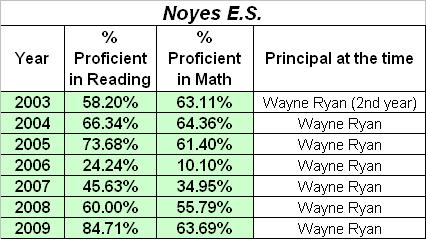
“….under a new principal at one school, student reading proficiency went from 24 percent to 85 percent in just four years, and from 10 percent to 64 percent in math. In another, only 9 percent of the students were on grade level, when just down the street in a successful charter school, over 90 percent of students were. Same kids, same neighborhoods and exposure to violence, same poverty, hunger, and parent education levels. At the successful schools, the primary difference was the team of adults who decided it was possible for lives and outcomes to move in other directions.”
As usual, Rhee operates on innuendo, never actually giving facts that people can check easily.
After doing a bit of research, I figured out that in the first sentence, she was probably referring to Noyes ES in Northeast Washington, where the percentage of students performing at the “Proficient” or “Advanced” level went as follows. Notice that in 2006, in reading, about 24% of the students scored “proficient”, and in 2009, about 85% scored “proficient”.
If you are wondering what happened to make the scores go down so much in 2006, the answer is simple: DCPS contracted with a different testing company that year to make the NCLB AYP tests for the city. Instead of the SAT-9, students took the DC-CAS. Since the change, our “curriculum” has been more and more just “test prep for the DC-CAS”, so it’s not entirely surprising that teachers have been getting better at coaching students to improve their scores.
Here’s the same data in the form of a graph:
Unlike what Rhee wrote, Noyes has had the same principal, Wayne Ryan, since 2002, well before Rhee came onto the scene, so she can’t take credit for hiring him. And with at least 8 years on the job, Ryan is now one of the most veteran principals in DCPS. I 

Schools Matter: Can Ben Austin Speak for Parent Revolution without Speaking for Green Dot?

Schools Matter: Can Ben Austin Speak for Parent Revolution without Speaking for Green Dot?


There are legitimate concerns these days that education outfits have sometimes hidden or unclear relationships with other groups, many of them in the nonprofit sector. This brings up questions of governance, transparency, and other issues of public policy. For instance, should people employed by a charter school have to openly and publicly disclose their financial ties when advising/advocating/consulting on behalf of a different non-profit?
From the Daily News (Los Angeles):


After five years of getting nowhere with Los Angeles Unified officials, fed-up parents in Sunland-Tujunga are using a new state law to force change at a long-troubled middle school.
Parents and community members say problems at Mount Gleason Middle School, which has been on a federal list of under-performing campuses for a dozen years, go beyond failing test scores.
"There is an unsafe atmosphere at this school that is spilling over into the community...," said Lydia Grant, a resident and parent of a former Mount Gleason student. "People are tired of it and we want to see change."

Retired Army officer's new mission: D.C. public schools - washingtonpost.com

Retired Army officer's new mission: D.C. public schools - washingtonpost.com

Anthony J. Tata was an Army brigadier general in northeast Afghanistan's Kunar Province in April 2006 when a Taliban rocketslammed into a primary school in Asadabad, killing seven children and wounding 34.


The vicious attack and others like it by the Taliban left him with a thought: "It struck me at the time that if the enemy of my enemy is education, then perhaps that's a second act for me."

Three years later, Tata began his second act by accepting Chancellor Michelle A. Rhee's offer to become chief operating officer for D.C. public schools, a newly created post that places him in charge of purchasing, food service, technology and other support areas.

After a 28-year career that took him to Kosovo, Macedonia, Panama, the Philippines and the international agency charged with thwarting improvised explosive devices, Tata's mission is to help bring the District's notorious school bureaucracy to heal.

Tata has made inroads in an organization with a history


THIS STORY

Charter schools moving to more traditional venues - The Boston Globe

Charter schools moving to more traditional venues - The Boston Globe:

"Each afternoon, school buses in a long line idle on a busy downtown street, awaiting dismissal at Boston Renaissance Charter Public School. Parents double-park on both sides of a nearby street, annoying rush-hour commuters."


Inside the 13-story school, students board elevators by the dozens over the course of nearly an hour, as 1,200 descend to the lobby.

This snail-paced dismissal should be history in the fall. Renaissance is moving, the latest in a wave of charter schools across the state investing millions of dollars in new facilities to better accommodate their educational needs. In many cases, charter schools are moving out of less-than-ideal classroom settings: storefronts, church basements, or community centers.

Their ascendancy to sparkling new locations represents an evolution from high-flying entrepreneurial start-ups to established institutions of success, the sort of Wall Street darlings of the education sector.

Renaissance, at the corner of Arlington and Stuart streets, is moving several neighborhoods away to Hyde Park, where a $39 million complex is under construction.

“Getting out of here will be a true blessing,’’ said Roger Harris, the Renaissance superintendent and chief executive officer who has nightmares about trying to evacuate students if there ever were a fire at the current location. “It’s a great building for a business, but for kids it has a number of drawbacks.’’

Children adopted from abroad offer insight on language development - The Boston Globe

Children adopted from abroad offer insight on language development - The Boston Globe:

"As Andy Ross learned to speak English, he progressed from simple word combinations like “Andy shoe’’ to the more complex “my red shoe,’’ just like any toddler."


But Andy was older when he began to learn English, after being adopted from Russia, and his chatter - taped in weekly sessions - has provided scientists important clues about how language develops.

Harvard psychologists are finding that preschool-age children adopted from foreign countries learn English in the same sequence as babies: starting with single words and progressing to word combinations and complex grammar.
That means it is not the maturity of the brain but the nature of language itself that dictates how it is learned, the Harvard scientists say.
“Because babies are immature in so many ways, it’s easy to assume their language is simple because their minds are simple,’’ said Jesse Snedeker, the Harvard psychologist leading the research. But this appears not to be the case, she said.
The research is helping scientists and families understand what to expect when a child who may already know one language is plunged into a new one. And it could eventually lead to better ways to teach language.

Demand in charter schools forces lotteries, long waiting lists - The Denver Post

Demand in charter schools forces lotteries, long waiting lists - The Denver Post:

"Alma Meraz's eyes welled when her daughter's name was pulled from a cookie jar during an enrollment lottery for the high-performing West Denver Prep charter school.

'I'm so happy,' said Meraz, who cleans houses for a living. 'I need her to go to this school for better opportunities. For a better life.'

West Denver Prep — which some parents have come to view as a first step toward college and possibly a lifeline out of poverty — is rated the second-best school in Denver.

The school's college-preparatory curriculum and swift interventions for struggling students have been touted for helping at- risk kids beat the academic odds. West Denver Prep now posts some of the best academic growth in the state."

Daily Herald | Innovation is key to policy reform, ISBE chairman says

Daily Herald | Innovation is key to policy reform, ISBE chairman says


The chairman of the Illinois State Board of Education plans to use his new position on a federal policy committee to advocate for practical changes to education legislation, including allowing states more resources and flexibility under No Child Left Behind.
Jesse Ruiz, a Chicago attorney and former law student of President Obama's at the University of Chicago, sat down with the Daily Herald recently to talk about his work on the National Association of School Boards Government Affairs Committee - the group responsible for education policy recommendations and getting lawmakers up to snuff on the priorities of various states.
Q. President Obama recently announced that he is asking for a 6 percent increase for education in his 2011 budget - a $4.5 billion increase in discretionary spending. Much of this is contingent on renewal of the Elementary and Secondary Education Act (known as No Child Left Behind). Coming from a state that saw more schools than ever fail to meet rising benchmarks this year, what kinds of changes will you be suggesting?
A. Frankly, (states) need latitude and more resources. Some of this stuff is not rocket science. States need more authority to step in, when districts are not performing as they should be. NCLB was good in theory ... but it was always heavy on stick and light on carrot. Hopefully with that increase, we need to provide a little more carrot and resources. We can.

Our View: Well-schooled in payback | initiatives, make, california - Editorials - Appeal-Democrat

Our View: Well-schooled in payback | initiatives, make, california - Editorials - Appeal-Democrat:

"The California Teachers Association announced Feb. 5 it would be supporting a ballot initiative that aims to remove certain tax breaks for business in California and another initiative that would make it more difficult for public corporations to make political contributions.

Both of these proposed initiatives are CTA retaliation for three proposed ballot initiatives they view as corporate attacks on unions — two are referred to as 'paycheck protection,' which would stop automatic deductions from government employees that are used for political causes. The third initiative involves reforming public-employee pensions.

The first CTA-backed initiative would repeal a package of tax cuts offered to business in California as part of budget negotiations during last year's state budget melee. The second proposed proposition is a blatantly tit-for-tat initiative that would require publicly traded companies to get shareholder approval before making political contributions."

Cost of teaching English to immigrant adults $630M - DailyBulletin.com

Cost of teaching English to immigrant adults $630M - DailyBulletin.com:

"California taxpayers have shelled out about $630 million over the past 13 years to provide English classes to immigrant adults.

The money was required as part of Proposition 227, an anti-bilingual education initiative passed by voters in 1998.

The measure, approved by 61percent of the voters, said public school kids should learn English as quickly and effectively as possible. It was intended to move students with limited English skills into mainstream classes within one year.

To help accomplish that goal, the state spent $50million annually over 10 years to provide free English classes to immigrant parents and others who pledged to tutor kids with limited English proficiency.

The state Legislature reauthorized the program in 2006. About $130million was allocated in the following three fiscal years. The program is slated to receive about $40million in the 2010-2011 budget."

Epoch Times - UCLA to Research Education Uses of Social Networking Sites

Epoch Times - UCLA to Research Education Uses of Social Networking Sites:

"Social media sites aren't just for networking anymore. UCLA is now using them to support health care education.

The Eunice Kennedy Shriver National Institute of Child Health has given UCLA a $1.1 million grant for the school to test the effectiveness of social media on teen awareness of health care.

According to UCLA's School of Public Health, an average teen spends over nine hours a week on social networking sites. The school is partnering up with Health Net of California to tap into social networking sites in order to inform teenage users how to effectively use health care.

'Over 90 percent of teens today use social networking sites, not just to interact with their peers but also to get information about issues that are important to them,' stated Michael Prelip, a professor of community health at UCLA's School of Public Health in a press release. 'This intervention will provide important clues about the effectiveness of social media in influencing adolescents' understanding of their health care rights, responsibilities, and benefits so that they can become good health care consumers.'"

For first time in decades, Caltech updates core curriculum - Pasadena Star-News

For first time in decades, Caltech updates core curriculum - Pasadena Star-News:

"PASADENA - Caltech's faculty is poised to give the vaunted core curriculum its first overhaul in decades.

The core curriculum is a two-year science education boot camp that begins in large lecture hall classes. Whatever their major, freshman students can expect a heavy dose of physics and math.

A proposal now suggests the school offer more breadth in the sciences, emphasizing more flexibility in the core, better writing skills and a renewed emphasis on teaching.

'We don't want to dumb things down, but we are not entirely convinced that the best way to learn is to have a bunch of work dumped on you,' said Professor Mike Brown, a co-chair on the task force.

The plan has already been floated by the school's"

After protest, UCI pressured by both sides | students, uci, campus - News - The Orange County Register

After protest, UCI pressured by both sides | students, uci, campus - News - The Orange County Register:

"IRVINE – A Facebook page simply calls them 'the Eleven.' A newly created graphic, based on a Register photograph, depicts a student among the protesters raising his right index finger defiantly as he's escorted out by a campus police officer.


The rhetoric surrounding the protesters who disrupted a speech by an Israel's ambassador to the United States Feb. 8 has escalated. University officials face a difficult decision on whether to discipline the students, and if so, how severely. UCI prides itself on its diversity of cultures, religions and political views"


Jewish groups have for years accused the school of being overly tolerant of what they call anti-Semitic hate speech, and they say the Feb. 8 protest is only the latest outrage. Ambassador Michael Oren had been invited to campus to speak about Israeli-U.S. relations, but his lecture before about 500 people at the Student Center was interrupted 10 times by students denouncing Israel's treatment of Palestinians. Earlier that day, UCI's Muslim Student Union had issued a statement condemning the decision to invite a "public figure who represents a state that continues to break international and humanitarian law ... ."
After the 10th interruption, the event deteriorated further as a large group of students walked out of the conference room to jeers – and, the protesters allege, threats – by Oren's supporters. Eight UCI students and three UC Riverside students were briefly detained in another room before being released, after Oren had finished his speech. A planned 30-minute question-and-answer session with Oren was scrapped.