Aware that distance learning didn’t go well in many districts the first time around, the Legislature has imposed new requirements for the fall.
This week, Linda Darling-Hammond, an education adviser to Gov. Gavin Newsom and president of the State Board of Education, explains what districts must do and why they should include live instruction as a component of distance learning. She also forecasts how schools will reopen amid great uncertainly.
EdSource reporter Zaidee Stavely discusses many parents’ ambivalence about sending their kids back to school amid a pandemic and the conflicting factors of safety, child care, work needs and the pros and cons of distance learning weighing on their minds.
For background to this podcast, check out the following from EdSource:
Roberts’ Decision in Espinoza Case Undermines Protection of Church-State Separation; Will Damage Public Education
On Tuesday, the U.S. Supreme Court released a long awaited decision in the church-state separation case of Espinoza v. Montana Department of Revenue. Chief Justice John Roberts wrote the majority opinion in the 5-4 decision. NY Times Supreme Court reporter, Adam Liptak quotes Roberts’ argument: “‘A state need not subsidize private education…. But once a state decides to do so, it cannot disqualify some private schools solely because they are religious.’ In dissent, Justice Sonia Sotomayor said the majority opinion ‘weakens this country’s longstanding commitment to a separation of church and state beneficial to both.'”
Although historically, religious liberty and church-state cases have been decided on the basis of the First Amendment’s “establishment clause,” this week’s decision rests on what’s known as the “free exercise clause.”
In a particularly lucid explication of this week’s decision, VOX’s Ian Millhiser explains: “The First Amendment places two limits on the government’s interaction with religion: ‘Congress shall make no law respecting an establishment of religion, or prohibiting the free exercise thereof.’… Thus, the First Amendment’s Establishment Clause limits the government’s ability to advance religion, and the free Exercise Clause limits the government’s ability to target people of faith. The government is simultaneously obligated both to stay out of religious matters and to protect the rights of the faithful—a dual obligation that courts have often found difficult to reconcile.”
Millhiser continues, explaining that Roberts’ decision rests on a 2017 precedent: “As Roberts argues in his opinion, the result in Espinoza flows from the Court’s previous decision in Trinity Lutheran Church v. Comer... which held that the state of Missouri could not exclude religious organizations from a state program that offered ‘grants to help public and private schools, nonprofit daycare centers, and other nonprofit entities purchase rubber playground surfaces made from recycled tires.’… According to Roberts, Trinity Lutheran reached the ‘unremarkable conclusion that disqualifying otherwise eligible recipients from a public benefit solely because of their religious character imposes a penalty on the free exercise of religion that triggers the most exacting scrutiny.’ Just as the Missouri recycled tires program ‘discriminated against the Church simply because of what it is—a church,’ the Montana constitution ‘bars religious schools from public benefits solely because of the religious character of the schools.'”
KENTUCKY COMMISSIONER OF EDUCATION CANDIDATE PROFILES
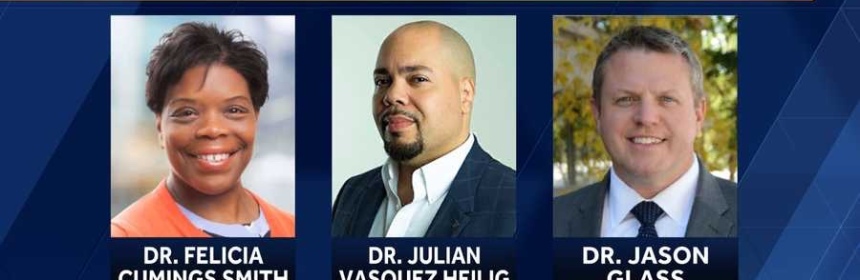
Three candidates remain for the job of Kentucky Commissioner of Education, and they were each asked the same three questions about themselves and their plans for the department by KDE. I’ve reblogged below the release verbatim from here.
He’s been dean of the College of Education at the University of Kentucky for a year, but Dr. Julian Vasquez Heilig traveled a long road as an academic and practitioner to get there.
It started at the University of Michigan, where he earned a bachelor’s degree in history and psychology and a master’s in higher education. Then it was on to Stanford for a doctorate of educational administration and policy analysis and a master’s of sociology.
Now he’s one of three finalists to become Kentucky’s next commissioner of education, along with Jason Glass and Felicia Cumings Smith. The Kentucky Board of Education expects to make a decision by the end of July.
Even before receiving his degree in Michigan, Vasquez Heilig taught English as a second language in China and worked as a researcher at the Chinese Academy of Sciences’ Institute of Psychology.
He served as a 4th-grade 21st Century Learning Program instructor in East Palo Alto, Calif., and worked in central administration for the Houston Independent School District.
He was involved in educational research for several states while at Stanford, and held multiple academic positions in Texas before returning to California as a professor of educational leadership and policy studies and director of the Doctorate in Educational Leadership program at California State University.
He also served as the Education Chair of the California NAACP. He held those posts until coming to UK.
Along the way, Vasquez Heilig garnered a long list of accolades, including being honored with the passage of California Assembly Resolution 1459 — which commended his state and national impact in the field of K-12 education. He has published more than 60 peer-reviewed articles and reports on issues such as racial equity, accountability, school choice and teacher preparation.
Why do you want to be Kentucky’s next commissioner of education?
“With the (Kentucky Education Reform Act) of 1990, Kentucky was the beacon of education reform in the United States,” Vasquez Heilig said. “And I think there’s that opportunity again.”
The Kentucky Education Reform Act (KERA) instituted a range of goals for public schools and changed district funding allocation. Vasquez Heilig said Kentucky can be the “Finland of the United States” by becoming a national leader in community-based, community-engaged education reform.
What would be your first major priority as commissioner?
It would be to gather perspectives from education stakeholders across the spectrum: legislators, parents, civil rights groups, superintendents, educators and others, Vasquez Heilig said. That would aid in determining how Kentucky could develop a community-driven vision for the state’s educational system, with the Kentucky Department of Education leading in a nonpartisan, collaborative manner, he said.
Tell us something about yourself that you think is personally interesting, or which would have some impact on your job as commissioner.
“In every place that I’ve had the opportunity to live, I’ve worked very hard to develop relationships,” Vasquez Heilig said. “It’s the families and the children that matter in this work. I don’t think we can lose sight of the fact that as educators, we wake up each morning thinking how we can improve the opportunities and success of children.”
COVID-19 Reclassification Summative English Language Proficiency Assessments for California (ELPAC)
Dear County and District Superintendent and Charter School Administrators:
COVID-19 Reclassification Guidance for 2019–2020 and Fall Administration
In January and September 2019, the California Department of Education (CDE) provided guidance regarding changes to the Summative English Language Proficiency Assessments for California (ELPAC) threshold scores and the policy decision to standardize the ELPAC criterion to inform English learner (EL) student reclassification decisions. This letter is to provide reclassification guidance, given the suspension of the California assessment (COVID-19) pandemic, and notify you of future adjustments to the Summative ELPAC testing schedule.
Existing Reclassification Criteria
The reclassification criteria set forth in California Education Code Section 313 and Title 5 California Code of Regulations Section 11303 remain unchanged. Local educational agencies (LEAs) should continue using the following four criteria to establish reclassification policies and procedures:
Assessment of English language proficiency (ELP), using an objective assessment instrument, including, but not limited to, the state test of ELPAC;
Teacher evaluation, including, but not limited to, a review of the student's curriculum mastery;
Parent opinion and consultation; and
Comparison of student performance in basic skills against an empirically established range of performance in basic skills of English proficient students of the same age.
ELPAC Overall Performance Level (PL) 4 has been established as the statewide standardized ELP criterion (1), and LEAs shall use Overall PL 4 to determine whether a student has met that criterion. All other reclassification criteria (2–4) remain locally determined.
COVID-19 Reclassification Guidance
Due to the school closures aforementioned and resulting circumstances caused by COVID-19, the 2019–2020 Summative ELPAC was suspended for accountability purposes. The CDE is providing the following reclassification guidance for criteria 1 and 4:
Criterion 1: For those students who completed testing in 2019–2020, LEAs will use the results from the 2019–2020 Summative ELPAC to determine reclassification eligibility. For those students who did not complete testing in the spring of 2019–2020, an optional fall Summative ELPAC window will be open and available between August 20–October 30, 2020. During this window, LEAs can administer the optional fall Summative ELPAC and use the results to meet criterion 1 eligibility for reclassification. The optional fall Summative ELPAC is highly recommended for all English learner students who have already met all other criteria in 2019–2020 except for criterion 1, particularly in grades four to eleven.
Criterion 4: For all grade levels, LEAs can use most recent local assessments or the Smarter Balanced Summative English language arts assessments.
More information regarding the details of the optional fall 2020 administration of the Summative ELPAC for reclassification purposes will be provided at a later date through the LEA ELPAC coordinators.
For more reclassification information, please visit the CDE Reclassification web page at https://www.cde.ca.gov/sp/el/rd/. For questions related to EL assessment, please contact the English Language Proficiency and Spanish Assessments Office by email at ELPAC@cde.ca.gov.
Sincerely,
/s/
Sarah Neville-Morgan, Deputy Superintendent Opportunities for All Branch
SNM:sc
cc: Regional Assessment Network Title III Directors Title III Regional County Office of Education English Learner Specialists Bilingual Coordinators Network LEA ELPAC Coordinators
This is my final address to the NEA Representative Assembly, and I was able to get through it without crying.
Thank you, Becky and Princess and Kim, and my incredible Executive Committee and the NEA staff who work night and day for you – they moved mountains to bring us together in this historic virtual Representative Assembly and thank you especially to St. Teresa – the woman who makes my life possible. I could spend all this time on a roll call of people I adore. I love them so much; I’ll miss them so much as I head out the door.
This is my last report to you as your president.
And so, it’s also my last chance to also thank the other people I love who have no idea what it is I’ve been doing for the last 30 years. They just know I’m never home for dinner.
I want to thank my boys, Jeremy and Jared. Their spouses, Mike (you heard him singing the national anthem) and Tanna, and Lily Jo, my baby girl.
My Mom, Chillie Pace, is watching on her laptop. She turns 91 this summer and so let me repeat – she’s watching on HER laptop. She’s a tech goddess. And she loves coming to the RA and she wasn’t going to miss this one. She sends her love to all her dear friends out there.
And there is no way to properly thank Señor Jose Alberto Garcia Lozano – my husband. El amor de mis amores, for forgiving me all the times that we couldn’t be together.
Alberto got his Green Card this year! He’s now studying for his citizenship test – and we are studying about what democracy looks like these days in the United States of America.
I have told him for years that the NEA Representative Assembly is the largest democratic body in the world. And he has seen us in action and shouting “aye” and “no” and moving to close debate and “division” and he thinks we’re all nuts. And he’s right. Poco loco.
But he tells me when we get serious, “There is power in your people.”
And again, he’s right. The question is: What are we going to do with it? That’s why we come together. To answer that question. What are we going to do with our power?
Do you know why we chose this year’s theme: Our Democracy; Our Responsibility; Our time? Do you know how it got up there on the screen?
Because it’s all about me. Because somebody called me unpatriotic – for telling the truth. I said in an interview, “America never was America for too many Americans.” It’s from a Langston Hughes poem.
NEA President: Educators Will Help Determine Our Democracy’s Future
The nation stands at a crossroads, said NEA President Lily Eskelsen García in her final keynote address to the 2020 NEA Representative Assembly on Thursday, and it’s up to educators everywhere to make sure it chooses the correct path.
Even though the 2020 RA is being conducted remotely during the continuing COVID-19 pandemic, nearly 8,000 educator delegates from every state have come together virtually over the next days.
“We are educators and public servants,” Eskelsen García said today. “We are unionists. We are activists. We’re patriots….We are called on to act. So, what will you do? What will you do for your colleagues; your students; the families you love; the communities where you live? What will you do as we face the most dangerous threat to our democracy that we’ve ever faced?”
In introducing Eskelsen García, whose second term as NEA President ends August 31, NEA Vice President Becky Pringle paid tribute to Lily’s courageous and impassioned leadership of the 3.2 million member association over the past six years.
“Lily was relentless in beating the drum about the horrors and expense of the testing craze that had swept and hoodwinked this country,” Pringle said. “And people did listen, and they joined her crusade. …She set out to lead this organization in taking on its own responsibility to do the work required to move this country toward the systemic, fair treatment of people of all races that ensures equitable opportunities and outcomes for everyone.”
The theme of the 2020 RA is ‘Our Democracy; Our Responsibility; Our Time.’ It will take the collective power of NEA members and their allies to deliver a resounding victory for our students at the polls in November, Eskelsen García said in her speech today. But is also up to educators to leverage electoral success to bring about desperately needed change – namely uprooting the inequality that, to the detriment of millions of students, has become entrenched in every ZIP code across the nation.
Someday when you are asked what you did when democracy was in peril; when your country needed you – you will have a powerful answer: I was part of the collective voice and collective power that refused to be silent.”
“America never was America for too many Americans,” Eskelsen García said, quoting poet Langston Hughes. “But what some folks who know that, haven’t figured out that this wasn’t by accident. Exclusion was intentional….Inequality is by design.”
Throughout U.S. history, people in power have worked the system to make sure their power stayed intact. Opportunity for others has always been deemed a threat to their bottom line. This destructive mindset, Eskelsen García told the delegates today, is personified today by the Koch family and other billionaires who have aggressively sought to exploit the working class, tilt tax codes to their favor, destroy the environment … and support manifestly unfit CONTINUE READING: NEA President: Educators Will Help Determine Our Democracy's Future
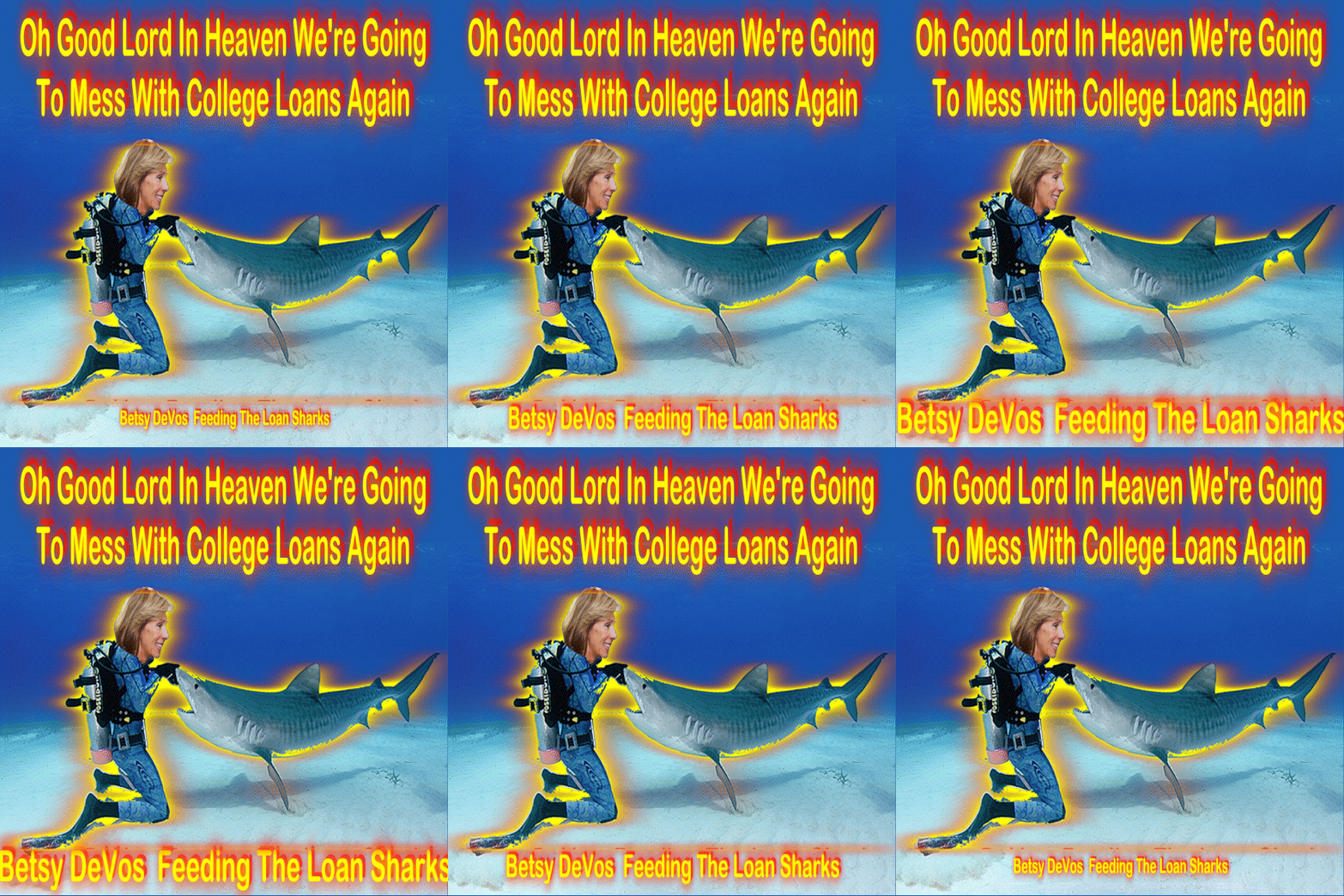
All of this is why some folks have looked askance at her stated desire to shake up Federal Student Aid, the gazillion-dollar operation that helps finance so many college educations. At one point she wanted to spin it off into a stand-alone business, perhaps because that would insure that no future politicians would mess things up by forgiving student debt.
Now she has announced new contracts with some fun new playmates in the loan biz, and also, some no-more-new contracts for other loan biz folks who had previously thought they were doing okay. The stated purpose is to give FSA customers some world class service, and as one such customer may I just say "Oh Good God in Heaven can't you just leave this stuff alone!!??!!"
My older children graduated from high school in 2004 and 2006, then moved on to higher education of one sort or another. I made it a year or two, and then it was time to start borrowing, kicking off an experience that I have mostly blocked out of my memory because Sweet Jesus on a unicorn!
When I started, you had to deal with a bank to get the loan, which meant finding a participating bank with a pile of money, which involved filling out FAFSA etc, a royal pain of its own and heaven help you if you're divorced and not, as I was, co-parenting with someone who feels cooperative. What I didn't really understand at the time was that I was dealing with a bank, and a financial aid CONTINUE READING: CURMUDGUCATION: Oh Good Lord In Heaven We're Going To Mess With College Loans Again
De Blasio Says He'll Open School Buildings. What Could Go Wrong?
Mayor de Blasio has had an interesting couple of days. First, he determined it was too dangerous to open restaurants for indoor dining. Then, he decided to just open all the school buildings. After all, three of four people who took his open online survey, the one you could fill out anonymously as many times as you wished, said they want schools to open.
Mind you, I read the survey, and it didn't precisely ask under what conditions they'd be willong to open. It didn't cite an acceptable sickness or death rate for UFT members, school children, or our loved ones. Broadway, of course, is closed until January because people who pay hundreds of dollars for orchestra seats are so fragile that if anyone touched them, they would probably break.
It turns out, though, that schools will be only sort of open. You know, like when you were in junior high school and that girl liked you, but she didn't like like you? You could talk about that math teacher and how he gave to much homework, but you couldn't run off into the school yard together.
This means students will come in on alternate days, something I discussed here and here already. I've heard from the UFT chapter leader survey that says, if this actually manages to spring full blown from the mayor's opium pipe, that schools will have to alternate between seeing students physically and remotely. If I recall correctly, most schools will have three cohorts, but there are outliers that will see five.
'Perverse': Justice slams Supreme Court ruling allowing taxpayer money to be given to religious schools
Ruling overturns lower court order that shut down public funding of scholarships to private religious schools
As COVID-19 takes toll, Betsy DeVos denounced for new ‘craven’ public school privatization scheme – Raw Story - https://www.rawstory.com/?p=1641056
US Supreme Court Justice Sonya Sotomayor described the court’s ruling that religious private schools cannot be barred from accessing government money available to others as “perverse”.
The Espinoza v Montana Department of Revenue ruling, which has been praised by conservatives and advocates of school choice, including Education Secretary Betsy DeVos, struck down a Montana Supreme Court ruling against a taxpayer funded scholarship program for students to attend private schools.
The fund did not distinguish between religious and non-religious schools, though most private schools are religious. The Montana court ruled that taxpayer money could not fund religious schools, under so-called ‘Blaine Amendments’ that exist in nearly 40 states, thereby ending the program.
However, the US Supreme Court ruled in a 5-4 decision on Tuesday that the lower court ruling violated the “free exercise” clause in the Constitution, which says that the government cannot discriminate against people based on religion.
Chief Justice John Roberts sided with the conservative majority — unlike recent decisions — writing that the state court had discriminated against religion
“A state need not subsidise private education,” he wrote. “But once a state decides to do so, it cannot disqualify some private schools solely because they are religious.”
Justice Sotomayor took issue with this, and in her dissent wrote: “Today's ruling is perverse. Without any need or power to do so, the court appears to require a state to reinstate a tax credit program that the Constitution did not demand in the first place.”
Thoughts For Parents And Educators On School Reopening
For those of us in the northern hemisphere, we will be starting our next school year in the coming weeks and months. Depending on where you live, there will be really difficult decisions made about how school will proceed during the current pandemic the world is facing.
Will school be all online? If so, will it be better than the online experience most of us had back in March and April?
Will we try some sort of hybrid approach with smaller class sizes where remote and on campus learning is alternated? How will that be organized?
If we are at school, can students really wear masks all day? Can teachers teach in them? Will school be a scary place producing too much anxiety for our kids?
How will parents and caregivers balance school requirements with their own work and other obligations?
How will teachers be able to manage and teach students in both traditional and online locations at once?
So. Many. Questions.
My wife and I are both former teachers with graduate degrees in education, so you would think that we’d be ahead of the curve for homeschooling, distance learning, or being able to handle anything education-related thrown our family’s way. However, we don’t feel that way. We’re nervous that our kids will fall behind, we’re sad for the missed experiences we had hoped for our kids, and we’re longing for normalcy.
But we also want to ensure, like every parent and every educator out there, that we do what’s best for our children.
If you are looking for concrete answers and guidance, I don’t think anyone yet knows the answers. But, as we have been discussing and preparing for the upcoming school year for our own kids, it has been cathartic to put together some thoughts, tips, and ideas here in this post that hopefully may help others in similar situations.