Latest News and Comment from Education

Friday, October 11, 2019

Professor Quits Teaching Because of Students’ Use of Technology in Class | Larry Cuban on School Reform and Classroom Practice

Professor Quits Teaching Because of Students’ Use of Technology in Class | Larry Cuban on School Reform and Classroom Practice

Professor Quits Teaching Because of Students’ Use of Technology in Class

The combination of computer use, Internet, and smart phone, I would argue, has changed the cognitive skills required of individuals…. The student can rapidly check on his or her smartphone whether the professor is right, or indeed whether there isn’t some other authority offering an entirely different approach. With the erosion of that relationship [between professor and students] goes the environment that nurtured it: the segregated space of the classroom where, for an hour or so, all attention was focused on a single person who brought all of his or her experience to the service of the group.
Tim Parks, 2019
In the above epigraph taken from “Dying Art of Instruction in the Digital Classroom,” Novelist, literary scholar, and translator Tim Parks gives the reasons why he is leaving his professorship at the University Institute for Modern Languages in Milan, Italy.  Parks describes his experience with students using devices in his class teaching translation:
In the late 1990s, I had my first experience of students bringing laptops into the classroom. At that time, there was no question of their having wifi connections. Since these were translation lessons, students argued that their computers were useful for the fifteen or twenty minutes when I invited them to translate a short paragraph. They translated better on their computers, they said; they could make corrections more easily.
Nevertheless, I noticed at once the tendency to hide behind the screen. Who could know whether a student was really taking notes or doing something else? The tippety-tapping of keyboards while one was speaking was distracting. I insisted laptops be kept closed except for the brief period of our translation exercise.
When the University renovated classrooms with laptops at each desk, Parks CONTINUE READING: Professor Quits Teaching Because of Students’ Use of Technology in Class | Larry Cuban on School Reform and Classroom Practice

The DC Voucher Story Finds Its Way to the Silver Screen, Sort Of. | deutsch29

The DC Voucher Story Finds Its Way to the Silver Screen, Sort Of. | deutsch29

The DC Voucher Story Finds Its Way to the Silver Screen, Sort Of.


There’s a movie about the DC school voucher program scheduled for release on October 18, 2019: Miss Virginia, produced by the nonprofit, Moving Picture Institute.
See a 2-minute trailer below:


The the individual who is the focus of the film, Virginia Walden Ford, was among the first students chosen to desegregate Little Rock, Arkansas, schools in the 1960s. Ford was a high school student at the time. She later advocated for the DC school voucher program, the only federally-funded school voucher program, created in 2004. From Ford’s website:
While she was raising her three children in Washington, D.C., Virginia was shocked that so many children were forced to attend failing, crumbling schools simply because they lived in the “wrong” ZIP codes. In fact, she worried that her own son, William, was falling through the cracks of a system that wasn’t focused on the best interests of children.
In 1998, she took action, forming a grassroots organization, D.C. Parents for School Choice. Along with a group of dedicated parents, Virginia went door-to-door, neighborhood-to-neighborhood, recruiting and training thousands of other parents to stand up for their children’s futures.
In 2003, with the support of national education organizations and CONTINUE READING: The DC Voucher Story Finds Its Way to the Silver Screen, Sort Of. | deutsch29

Illinois’ Tier II is in violation of the law and Pritzker’s pension panel almost says so. – Fred Klonsky

Illinois’ Tier II is in violation of the law and Pritzker’s pension panel almost says so. – Fred Klonsky

ILLINOIS’ TIER II IS IN VIOLATION OF THE LAW AND PRITZKER’S PENSION PANEL ALMOST SAYS SO.


It was a decade ago that I stood on the floor of the Illinois Education Association’s Representative Assembly as a delegate and pleaded with them not to open the door to discussions with the General Assembly on pension reform.
Madigan would read it as our concession, I warned.
And that’s just what he did.
We lost the vote at the RA and a week later Tier II was born.
Beware of following union leaders blindly.
The shocker in the report is something that’s been quietly discussed for awhile in Springfield but has not until now become prominent. That’s the finding that the 2011 reforms may violate federal law.
Under federal standards, local pension systems that substitute for Social Security must pay at least the same level of benefits to get “safe harbor” status, a legal determination that the system follows the law. But, said the report, the creation of CONTINUE READING: Illinois’ Tier II is in violation of the law and Pritzker’s pension panel almost says so. – Fred Klonsky


NYC Public School Parents: New film "Miss Virginia" another attempt by Koch brothers & other privatizers to influence the national education agenda

NYC Public School Parents: New film "Miss Virginia" another attempt by Koch brothers & other privatizers to influence the national education agenda

New film "Miss Virginia" another attempt by Koch brothers & other privatizers to influence the national education agenda


Miss Virginia is new feature film due to open on Oct. 18, about a mom fighting for a DC voucher program so that her son can go to a better school.
The film is supposedly “based on a true story” and is produced by Moving Picture Institute, which receives funding from the right-wing Koch brothers and Bradley Foundations, according to Source Watch. As of 2016, Rebekah Mercer was also on the board, so the organization probably received support from the Mercer Family Foundation too. 
Here’s a summary of the film, from the MPI website:
Based on a true story, Miss Virginia stars Emmy-winner Uzo Aduba as a struggling single mother who is losing her teenaged son to the rough streets of Washington, D.C. Unwilling to see him drop out and deal drugs, she puts him in a private school. But when she can’t afford tuition, she launches a movement to change the system that is destroying him and thousands like him. This is the Moving Picture Institute’s first feature narrative film. On October 18, the film will be released in select theaters and on video on demand.
According to the movie's website, the film was called "a must-see movie" by The New York Times, USA Today, and Essence, though Rotten Tomatoes says this: There are no critic reviews yet for Miss Virginia.

According to Source Watch, MPI also helped produce a 2006 documentary called "Mine Your Own Business," which criticized environmentalists for opposing mining projects CONTINUE READING: 
NYC Public School Parents: New film "Miss Virginia" another attempt by Koch brothers & other privatizers to influence the national education agenda

Privacy warning to parents whose kids will be taking the ACT or College Board (PSAT, SAT, AP) exams | Parent Coalition for Student Privacy

Privacy warning to parents whose kids will be taking the ACT or College Board (PSAT, SAT, AP) exams | Parent Coalition for Student Privacy

PRIVACY WARNING TO PARENTS WHOSE KIDS WILL BE TAKING THE ACT OR COLLEGE BOARD (PSAT, SAT, AP) EXAMS

Both ACT and College Board sell personal student data to colleges and universities, as well as to other non-profit and for-profit organizations to help them recruit students and/or market their products and services.
The College Board makes an approximate $100 million per year from its “Student Search” program, for which it charges organizations 47 cents per student name. [1]  Last year, ACT was sued via a class action lawsuit, because they allegedly included student disability information in the data they sold to customers.[2]
If your child is taking a College Board exam, and you don’t want any of their personal data sold, which may include their race, ethnicity, self-reported grades, religion and/or test scores within a certain range, as well as other confidential information, urge them NOT to fill out any of the optional questions that are included online or in the Student Questionnaire given before the administration of the exam.  They should also be sure not to check the box that indicates they want to participate in the College Board “Student Search” program.
If your child is taking the ACT, you and your child should also refrain from filling out any of the extraneous information requested in the  ACT Student Profile Section, unless you want that data also sold and/or used for marketing purposes.

Thursday, October 10, 2019

The California Charter School Association Purposefully Puts Students In Danger

The California Charter School Association Purposefully Puts Students In Danger

The California Charter School Association Purposefully Puts Students In Danger


Whenever legislative bodies attempt to force accountability on the charter school industry, the California Charter School Association (CCSA) cries “#KidsNotPolitics.” However, while claiming to put Kids First, there are CCSA charters that are among the worst-performing schools in the state. One of their member schools was caught violating the state labor code and illegally charging students to attend summer school. Still another engaged in construction practices so flagrant that the results endangered “the health and safety of students”. According to a recent KCBS News report, there are hundreds of charter school facilities that do not have to comply with the Field Act, the law that ensures that school buildings are safe during an earthquake.
As shown in documents uncovered by Michael Kohlhaas dot org, the CCSA feels that one of the “greatest threats” that they face is requiring that their schools “comply with [the] Field Act.
So much for Kids First.


After 230 schools collapsed during the 1933 Long Beach earthquake, the state of California passed the Field Act, “which mandated rigorous oversight of the construction of every public school to ensure they’re safe.” As a result, California schools “are the safest buildings in the world.” Southern CONTINUE READING: The California Charter School Association Purposefully Puts Students In Danger

Why Market Forces Will Not Provide Charter School Accountability

Why Market Forces Will Not Provide Charter School Accountability

Why Market Forces Will Not Provide Charter School Accountability
It has been a rough day at my house. The IRS is auditing me and needs me to send them money now. My computer has a virus. My Microsoft Windows is expired and will shut down soon. And if I don’t re-enter my personal information, my email, Netflix, and bank accounts will all be shut down. The only good news is that I still have a chance to buy great insurance, and I’m still waiting to hear back from that Nigerian prince.
Why do phone and online scammers keep at it, long after the vast majority of folks have heard about the most common scams, and even your mother knows not to say “yes” to a robocaller? Why don’t these scammers think, “Time to change my business model?” Because if scammers get a return on even one hit out of 10,000, that’s more than enough to keep them in business.
Charter school advocates have long argued that one reason that charters don’t need much formal government oversight is that they are subject to a greater accountability, that they must answer to parents who can “vote with their feet.” But the feet of charter parents don’t exert very much pressure.
The vast majority of charter school operators have nothing in common with phone scammers, but the same basic market principle CONTINUE READING: Why Market Forces Will Not Provide Charter School Accountability

Arkansas: Inside the Shadowy World of the School “Choice” Movement, Part 1 | Diane Ravitch's blog

Arkansas: Inside the Shadowy World of the School “Choice” Movement, Part 1 | Diane Ravitch's blog

Arkansas: Inside the Shadowy World of the School “Choice” Movement, Part 1

Cathy Frye is an experienced journalist who switched careers. Three years ago, she was hired to work for the Arkansas Public School Resource Center as communications director. Before she was hired, she was asked if she had any qualms about charter schools, and she said no. When she quit her job in June 2019, she decided to tell what she had learned, and she started to report about her experiences on her blog. 
Here is the lowdown. Eighty-five percent of the rural public school districts in the state belong to the Arkansas Public School Resource Center, but the APSRC is a Walton-funded school choice operation.
When Frye quit, she said she felt a burden lift.
No more working in an environment steeped in secrecy and paranoia. No more placating a male boss who acted more like an abusive stalker ex-boyfriend than an actual leader. No more weird workplace silos that left “team leaders” completely in the dark as to what other departments were doing. No more legislative education committee meetings that reeked of conspiracy, deception and stale men’s suits in dire need of dry-cleaning. 
I think the turning point for me was when, at the beginning of APSRC’s annual membership drive in the spring/summer of 2019, Smith said on three occasions – in my presence – that “If you can’t dazzle them with brilliance, baffle them with bullshit.” 
“Them” refers to public school districts – as in APSRC’s current member districts and potential member districts.
I spent decades looking for facts. I believe in transparent CONTINUE READING: Arkansas: Inside the Shadowy World of the School “Choice” Movement, Part 1 | Diane Ravitch's blog


DonorsChoose, Teachers Pay Teachers: How school classrooms get supplies - Vox

DonorsChoose, Teachers Pay Teachers: How school classrooms get supplies - Vox

The true cost of being a teacher
7 teachers tell us what they buy for their classrooms, and how.

When you walk into a public school classroom, what do you see? Posters on the walls, baskets of scissors and glue sticks and pencils, dry erase markers, copied and stapled worksheet packets, shelves and bins of books, decorations commemorating the seasons, sometimes bean bag chairs or floor pillows, definitely some kind of big rug for the younger grades. There’s often furniture and a mini-fridge, there are tissues and Clorox wipes and sometimes a class pet.
Schools don’t typically supply this stuff. Teachers do. 94 percent of US public school teachers spend their own money on school supplies. The amount per year varies; what districts and schools provide (or, better put, don’t provide) varies.
So too do teacher salaries. The National Education Association highlighted a $40,000 discrepancy between what the average teacher makes in New York versus what one makes in Mississippi, where the average salary in 2018 was $44,926; New York’s top salary ranking drops to 17th, however, when adjusted for cost of living. Put simply, teachers are underpaid, and many are leaving education at an alarming pace. The NEA found that one-fifth of new teachers leave education within three years, and in urban areas, the percentage of teachers who leave within five years is close to half. According to the Pew Research Center, one in six teachers work second jobs.
The fact that teachers buy stuff for their classrooms is another way to say that we fail to provide teachers with the resources they need to teach our kids. That lack of resources feels to some educators like insult to injury, not just that they need to spend their own money to do their job, but that their low pay makes it hard to even afford to do their job.

School supplies are just the start of it — let’s talk about further education and professional development, about college application fees, about extra sandwiches, about books, about winter clothes, about eyeglasses, about curriculum (yes: curriculum — many districts forgo textbooks, or supply decades-old textbooks, or provide only the most bare-bones of worksheets, leaving it on teachers to cobble together their own instructional materials).
We talked to seven teachers across the country to learn what they spend their own money on, how they try to save, how they strategize any school allotments, and more. We learned CONTINUE READING: DonorsChoose, Teachers Pay Teachers: How school classrooms get supplies - Vox


Has the Chamber of Commerce Hijacked YOUR Education System? Engineering Students For A Low-Wage, Gig Economy – Wrench in the Gears

Has the Chamber of Commerce Hijacked YOUR Education System? Engineering Students For A Low-Wage, Gig Economy – Wrench in the Gears

Has the Chamber of Commerce Hijacked YOUR Education System? Engineering Students For A Low-Wage, Gig Economy

I remember it well, a casual conversation with a neighbor on the sidewalk. It was a brief exchange, the kind that should’ve been quickly forgotten. At the time I knew nothing of Marc Tucker’s “Dear Hillary Letter” or the National Center on Education and the Economy. I hadn’t yet started mapping IBM and Digital On-Ramps, and Ideas42, the behavioral science research institute incubated at Harvard. I can’t remember the exact year, though it was probably some time after the passage of the Workforce Innovation and Opportunities Act (WIOA) but before Colorado and Washington State started talking about adopting the Swiss Apprenticeship model.
But it happens sometimes, certain moments stick with you over the years, important, even if you didn’t know exactly why at the time. Over the course of this particular chat, it came up that the board of the Community College of Philadelphia (CCP) had begun to weigh-in on what courses would be offered at the school. Evidently classes were expected to align to economic indictors. For example, pre-architecture courses would need to be phased out, because “the numbers” indicated there wouldn’t be enough architecture jobs.
I remember it well, a casual conversation with a neighbor on the sidewalk. It was a brief exchange, the kind that should’ve been quickly forgotten. At the time I knew nothing of Marc Tucker’s “Dear Hillary Letter” or the National Center on Education and the Economy. I hadn’t yet started mapping IBM and Digital On-Ramps, and Ideas42, the behavioral science research institute incubated at Harvard. I can’t remember the exact year, though it was probably some time after the passage of the Workforce Innovation and Opportunities Act (WIOA) but before Colorado and Washington State started talking about adopting the Swiss Apprenticeship model.
But it happens sometimes, certain moments stick with you over the years, important, even if you didn’t know exactly why at the time. Over the course of this particular chat, it came up that the board of the Community College of Philadelphia (CCP) had begun to weigh-in on what courses would be offered at the school. Evidently classes were expected to align to economic indictors. For example, pre-architecture courses would need to be phased out, because “the numbers” indicated there wouldn’t be enough architecture jobs.

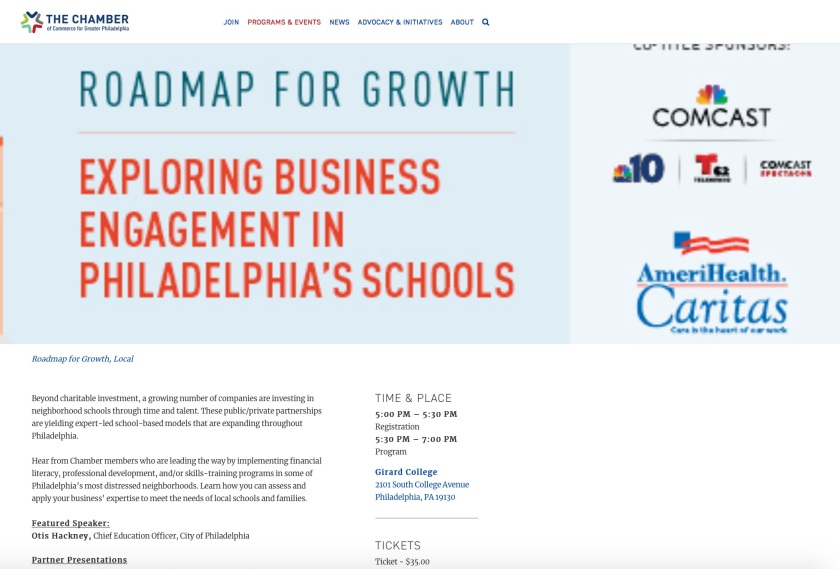
Philadelphia Chamber of Commerce Education
Source: Closed Door Event on Business and Education, January 29, 2018, more here
Whose numbers? Not enough architecture jobs? At the time the city even had a charter high school specifically for architecture and design. Philadelphia’s four-year universities, the University of Pennsylvania, Drexel, and Temple, all offered architecture coursework. So why should students choosing to pursue an Associate’s Degree first be shut out of the field?
In 2012, then mayor, now what works, Moneyball government talking head, Michael Nutter, appointed himself and six allies to the fifteen-person board of CCP. The president would be let go within the year, replaced by Dr. Donald Generals. Generals had formerly worked as an administrator at a questionable, now defunct, for-profit secretarial college in New York. The faculty did not support the appointment.
All of this happened shortly after the city accepted a Smarter Cities Challenge grant from IBM to develop our “human capital” via Gates and MacArthur Foundation-funded badging and career pathway initiatives. Did I mention Lisa Nutter, wife of the mayor now social impact investor, was CONTINUE READING: Has the Chamber of Commerce Hijacked YOUR Education System? Engineering Students For A Low-Wage, Gig Economy – Wrench in the Gears

Texas is bringing the "portfolio model" to its schools | The Texas Tribune

Texas is bringing the "portfolio model" to its schools | The Texas Tribune

Texas is spending millions to bring the "portfolio model" to its schools. The strategy has led to teacher strikes in other states.
The approach is intended to quickly cut down on the number of low-performing schools in the state. So far, Texas has seen mixed results.

Texas is encouraging its school districts to drastically change how they manage their campuses — an effort to quickly cut down the number that are low-performing.
It is spending more than $20 million a year in state and federal dollars on districts and outside consultants working to give individual schools more freedom from state and local regulations, with mixed results: Some schools are performing better in state ratings; others are continuing to struggle.
The controversial national approach is especially unpopular with teacher groups, and has led to strikes in cities like Denver and Los Angeles.
In a traditional school district, an elected school board chooses a superintendent, who runs a central office responsible for budgeting, hiring and curriculum for a set of schools. Under the new approach, leaders at individual campuses have much more power and flexibility to make their own decisions, and are released from some of the constraints of state and local regulations — much like publicly funded, privately managed charter schools are. The elected school board and central office determine which schools open where, but play a much smaller role in managing them.
“The idea is to hold schools accountable but give them more control… so they can influence the policies you’re holding them accountable for,” said Beth Schueler, a University of Virginia professor who has studied similar efforts in Massachusetts.

A system of great schools
Some call this a “portfolio model;” the same way an investor holds a portfolio of stocks, a school district manages a collection of autonomous schools, each offering innovative programs and opportunities that meet parent and student needs. If the schools don’t show returns — by way of higher student test scores and state ratings — the district can bring in nonprofits or charter companies to run them, or just shut them down.
It’s a vision for public education that’s sweeping the country, backed by big-time philanthropists such as the Laura and John Arnold Foundation, the Walton Foundation, and the Bill and Melinda Gates Foundation, which have all heavily invested in encouraging school districts to adopt the approach. Advocates see the work as a middle path between traditional district governance and a state takeover.
Texas is “trying to re-make how school districts approach the work of school improvement,” said Ashley Jochim, who has been studying Texas’ efforts for the Seattle-based Center on Reinventing Public Education, whose founder first coined the phrase “portfolio model” more than 15 years ago. “There are no other states doing this as explicitly or deliberately as Texas that I’m aware of.”
Texas calls its portfolio approach the “System of Great Schools,” a network of school districts that want help changing how they manage their schools. The network includes 14 school districts serving more than 400,000 kids, including rural ones like Longview and urban ones like San Antonio and Fort Worth. They are each matched with outside consultants who have done similar work in other states.
Other school districts can apply for grant money to redesign their schools even if they don't join the network.
Their biggest critics are teachers’ unions and associations, who argue that running a school system like a business results in fewer protections for teachers, accelerated closures of under-resourced schools in low-income neighborhoods, and a heightened focus on standardized tests, all to the detriment of students.
They say taking power away from elected school boards disenfranchises low-income black and Hispanic parents, whose children are overrepresented in the state’s lowest-rated schools. They contend the approach effectively privatizes public education and incentivizes new charter schools, which then compete with traditional public schools for money and students.
“Instead of having a great school system, we’ll have a system of great schools,” said Patty Quinzi, legislative counsel at Texas AFT, a state teachers’ union. “We’re going to pick and choose what kind of schools to keep and charter-ize and close the rest of public schools.”
Debate over charter involvement
The El Paso Independent School District, until recently a member of the System of CONTINUE READING: Texas is bringing the "portfolio model" to its schools | The Texas Tribune

Los Angeles: School Board Committee Rejects Plan to Give Schools a Single Grade | Diane Ravitch's blog

Los Angeles: School Board Committee Rejects Plan to Give Schools a Single Grade | Diane Ravitch's blog

Los Angeles: School Board Committee Rejects Plan to Give Schools a Single Grade

The Resistance won a big victory in Los Angeles.
The idea of grading schools with a single letter was first hatched by Jeb Bush, in his relentless push to impose test-based accountability on every public school in Florida and to set up those with the worst grades to be privatized.
Several states have adopted the Jeb Bush plan, and in every case, the letter grade was a reliable proxy for students’ family income. The schools where poor students predominated received the lowest grades and were fair game for the charter industry.
Jackie Goldberg has a long history as a teacher, school board member, and state legislator, and she strongly opposed the plan.
Nick Melvoin, who was elected with the help of millions of dollars contributed by Eli Broad and other friends of the charter lobby, proposed the plan.
The Los Angeles Unified school board’s Curriculum and Instruction Committee approved a resolution introduced by board member Jackie Goldberg that calls for the district to suspend implementation of “any use of stars, scores, or any other rating system” for its schools. 
The committee’s action includes a shift in support by CONTINUE READING: Los Angeles: School Board Committee Rejects Plan to Give Schools a Single Grade | Diane Ravitch's blog

Chicago Charter School Prepares to Join CTU Strike | Diane Ravitch's blog

Chicago Charter School Prepares to Join CTU Strike | Diane Ravitch's blog

Chicago Charter School Prepares to Join CTU Strike

NEWS ADVISORY:
For Immediate Release| ctulocal1.org
  • 7:00 a.m., Thurs. Oct. 10: Sharkey, charter teachers to announce strike date
    Passages charter school, 1643 W. Bryn Mawr Ave., Chicago
CTU president to join charter teachers as Passages announces strike date
CEO for lone CPS-funded charter earns equal to CPS CEO who oversees 500+ schools, as management undermines special ed, English language supports and sanctuary for immigrant/refugee students.
CHICAGO—After months of fruitless negotiations, CTU bargaining team members at Passages Charter School will announce a strike date at 7:00 a.m. this Thursday, October 10 at the school, located at 1643 W. Bryn Mawr. They’ll be joined by CTU President Jesse Sharkey, as tens of thousands of CTU members in CPS district-run schools brace for a possible strike next week.
Passages’ students speak dozens of languages, and come from across Mexico, Central and South America, Asia and the African continent. Close to 70 percent are low-income. Over half are Black, Latinx or other children of color. Almost four in ten have limited English skills, and the school has one of the highest percentages of refugee students in CPS.
Yet charter holder Asian Human Services, which owns and runs the school, continues to refuse to even bargain over, let alone agree to, sanctuary language to protect the school’s immigrant and refugee students.
“Last year, every union charter school we bargained with agreed to sanctuary language,” said CTU-ACTS Chair Chris Baehrend. “The CTU has even reached a tentative agreement with CPS around sanctuary language in district-run schools. But Asian Human Services, which has a mission of helping refugees and immigrants, refuses to even bargain with us over this critical issue. Many of our students come from immigrant and refugee families. They need these protections—especially in the era of Trump and with the huge carve-outs that remain in Rahm Emanuel’s ‘Welcoming City’ sanctuary ordinance.”
Staffing is also a critical issue. The school’s chronic shortage of teachers and paraprofessionals for English language learners and special education students is approaching a crisis level for students, creating high and destabilizing turn-over and harsh working conditions for remaining educators. Those educators voted unanimously to authorize a strike on September 23.
According to IRS data for the charter holder, Asian Human Services, CEO Craig Maki made $247,725 plus $16,000 in additional compensation for the latest year available. Yet Passages pays teachers at the school 28% less than their colleagues at CPS district-run schools.
# # #
The Chicago Teachers Union represents nearly 25,000 teachers and educational support personnel working in schools funded by City of Chicago School District 299, and by extension, the nearly 400,000 students and families they serve. The CTU is an affiliate of the American Federation of Teachers and the Illinois Federation of Teachers and is the third-largest teachers local in the United States. For more information, please visit the CTU website at www.ctulocal1.org.
Chicago Charter School Prepares to Join CTU Strike | Diane Ravitch's blog