Latest News and Comment from Education

Friday, September 6, 2019

A Very Busy Day Larry Ferlazzo's Websites of the Day... | The latest news and resources in education since 2007

Larry Ferlazzo's Websites of the Day... | The latest news and resources in education since 2007

A Very Busy Day Larry Ferlazzo's Websites of the Day... 
The latest news and resources in education since 2007


“Q&A Collections: The Inclusive Classroom”

Q&A Collections: The Inclusive Classroom is the headline of my latest Education Week Teacher column. All Classroom Q&A posts offering advice on The Inclusive Classroom (from the past eight years!) are described and linked to in this compilation post. Here’s an excerpt from one of them:
Video: “The Life Of An Unaccompanied Minor In L.A.”

OpenClipart-Vectors / Pixabay Lauren Skeen shared this three-year-old L.A. Times video on Leading ELLs Facebook Group:

YESTERDAY

Do’s & Don’ts Of Working With An Aide In An ELL Classroom – Please Add Your Own Suggestions

geralt / Pixabay We’re getting a new bilingual aide at our school sometime in the next week or two, and I thought I write up some “dos and don’ts” for my colleagues who are newer at teaching ELLs and at working with aides. I also thought it would be a good opportunity for me to reflect on my own experience, especially considering that I consider the biggest mistake I have made (so far) in my teac
World War II Began Eighty Years Ago This Week – Here Are Related Teaching & Learning Resources

skeeze / Pixabay Germany invaded Poland eighty years ago. You might be interested in: The Best Online Resources For Teaching & Learning About World War II (Part One) The Best Online Resources For Teaching & Learning About World War II (Part Two) The Best Resources On Japanese-American Internment In World War II The Best Sites For Learning About The Holocaust The Best Sites For Learning About The
Pins Of The Week

I’m fairly active on Pinterest and, in fact, have curated 19,000 resources there that I haven’t shared on this blog. I thought readers might find it useful if I began sharing a handful of my most recent “pins” each week (I’m not sure if you can see them through an RSS Reader – you might have to click through to the original post). You might also be interested in My Seven Most Popular Pins In 2018
New Study Shows Active Learning More Effective Than Lectures – DUH!

There is no shortage of research finding that active learning is more effective than lectures (see The Best Research Demonstrating That Lectures Are Not The Best Instructional Strategy ). However, I was surprised to read in a report on a new study that many students, however, think they learn more from lectures. That same report, fortunately, debunks that belief. Perhaps it can soon go the way of
“How Do You Respond to a Teacher Who Says, ‘I Don’t See Color’?”

How Do You Respond to a Teacher Who Says, ‘I Don’t See Color’? is the headline of my latest Education Week Teacher column. The new question-of-the-week is: What are the best ways to respond to educators who say they “don’t see color” when they teach? Guest-host Shannon R. Waite introduces the upcoming series. Feel free to leave responses in the comments there or here….


This Week’s “Round-Up” Of Useful Posts & Articles On Ed Policy Issues

Here are some recent useful posts and articles on educational policy issues (You might also be interested in THE BEST ARTICLES, VIDEOS & POSTS ON EDUCATION POLICY IN 2019 – PART ONE ): Big news about charters here in California: Charter school compromise could intensify L.A.’s school board 
Larry Ferlazzo's Websites of the Day... | The latest news and resources in education since 2007

New Orleans Will Close Failing Charter Schools In The District : NPR

New Orleans Will Close Failing Charter Schools In The District : NPR

Closing A Failing School Is Normal, But Not Easy, In Charters-Only New Orleans

On a clear morning in late August, 9-year-old Alongkorn Lafargue hops in the back seat of his father's car. He's wearing his school uniform: neatly ironed khakis and a bright blue polo shirt embroidered with the logo of his new charter school, IDEA Oscar Dunn. Alongkorn has been going there only a few weeks, and his dad, Alex Lafargue, says he has struggled to get his son to talk about what it's like.
"He was anxious," Lafargue says. "And [its] his third week there now. He's starting to open up."
Alongkorn is going to a new school because New Orleans' school district shut down his old one, Medard H. Nelson Charter School, for its students' poor performance on standardized tests.
Alongkorn went to Nelson for five years. Lafargue acknowledged that the school had problems — most notably, a revolving door of leadership. The school had three different principals in its last four years of operation. But the Lafargues built a community at Nelson. And the school was just down the street — a six-minute walk door to door.
"This was a great school," Lafargue said. "Orleans Parish School Board [NOLA Public Schools] surely has not allowed me the choice to let him stay with family, to let him stay in the neighborhood, to let him stay within a rich environment that he has pulled from since pre-K."
Lafargue said many students, including his son, were confused and upset when they CONTINUE READING: New Orleans Will Close Failing Charter Schools In The District : NPR

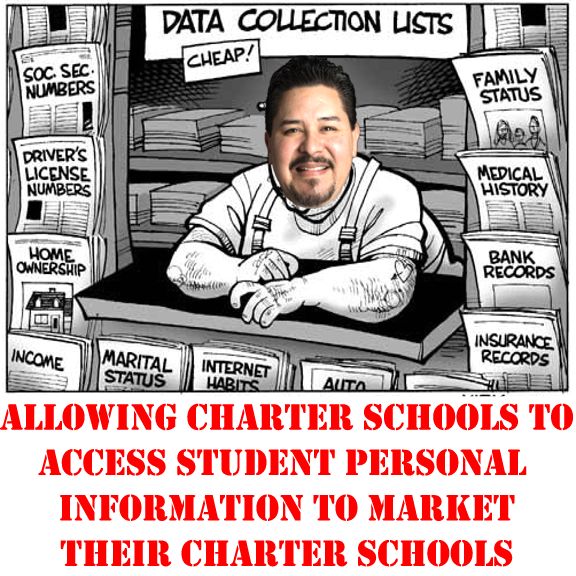
NYC Public School Parents: Make your voices heard! Urge NYSED not to weaken the state privacy law by allowing companies to sell or market personal student data

NYC Public School Parents: Make your voices heard! Urge NYSED not to weaken the state privacy law by allowing companies to sell or market personal student data

Make your voices heard! Urge NYSED not to weaken the state privacy law by allowing companies to sell or market personal student data

The New York Board of Regents is currently considering whether to approve a radical weakening of the state student privacy law, which would allow the College Board, the ACT and other companies that contract with schools or districts to use the personal student information they collect for marketing purposes – even though the original New York law that was passed in 2014 explicitly barred the sale or commercial use of this data.

Parents and all others who care about protecting children’s privacy should send in their comments to the state now, by clicking here or sending their view to REGCOMMENTS@nysed.gov. Deadline for public comment is Sept. 16. More on this below.

Starting in 2014, many states, including New York, approved legislation to strengthen the protection of student privacy, due to a growing realization on the part of parents that their children’s personal data was being shared by schools and districts with a wide variety of private companies and organizations without their knowledge or consent. The US Department of Education had weakened the federal student privacy law known as FERPA twice over the past decade, rewriting the regulations during the Bush and Obama administrations to allow for non-consensual disclosures for different purposes.

At that time, few parents were aware how federal law had been altered to allow their children’s information from being passed into private hands. Then controversy erupted over the plans of nine states and districts to share personal student data with a comprehensive databank called inBloom, developed with more than $100 million of funding from the Gates Foundation.

InBloom Inc. was designed to collect a wide variety of personal student data and share it with for-profit vendors to accelerate the development and marketing of the ed tech industry, to facilitate the adoption of online instruction and assessment. As a result of widespread parental activism and concerns, all nine states and districts that had originally intended to participate in the inBloom data-sharing plan pulled out, and 99 new state student privacy laws were passed across the country between 2014 and 2018.

New York was one of the first to pass a new student privacy law. In March of 2014, our State Legislature approved Education Laws § 2-c and §2-d , which among other things, prohibited the state from sharing student data with inBloom or another comprehensive databank, and also regulated the way schools and vendors must secure student data, including imposing a complete ban on the sale of personal student information or its use for marketing purposes .

As a result of these provisions, New York received a grade of A- in the category of “Limitations on the Commercial Use of Data” in our State Student Privacy Report Card, released last January by the Parent Coalition for Student Privacy (PCSP), which I co-chair, and the Network for Public Education. In turn, this high mark raised New York’s overall grade for protecting student privacy in our rating system to B-, the second highest grade of any state after Colorado. (You can check out the interactive map that grades every one of the fifty states on its student privacy laws, overall and in seven different categories).

Yet to the frustration of many parents and privacy advocates, it would be nearly five years before New York State Education Department drafted any regulations to implement its CONTINUE READING: 
NYC Public School Parents: Make your voices heard! Urge NYSED not to weaken the state privacy law by allowing companies to sell or market personal student data


Trump is Diverting Funds from U.S. School Systems to Build His Wall + Edgar Villanueva | Schott Foundation

Trump is Diverting Funds from One of the Best U.S. School Systems to Build His Wall | Schott Foundation for Public Education

Trump is Diverting Funds from One of the Best U.S. School Systems to Build His Wall

Yesterday the Pentagon announced that it would cut funding to its schools and daycare centers as part of a $3.6 billion diversion of funds toward construction of President Trump’s proposed wall on the southern border:
Schools for the children of U.S. military members from Kentucky to Germany to Japan will be affected. A daycare center at Joint Base Andrews in Maryland - the home of Air Force One - will also have its funds diverted, the Pentagon said.
This diversion, a result of President Trump using “national emergency” powers, means that the Federal government is cutting funding to a school system that educates the children of men and women serving in the military and is one of the highest-performing, most equitable school systems in the United States. 
Under the auspices of the Department of Defense Education Activity (DoDEA), the Pentagon operates 163 schools in seven states, Puerto Rico, Guam, and eleven other countries. Students at DoDEA schools consistently rank among the highest-performing in the nation: 2017’s National Assessment of Educational Progress (NAEP) saw DoDEA 8th graders take top marks in Reading and tie with Massachusetts students in Mathematics.
But what makes DoDEA schools so unique is more than just test scores. As Michael Winerip wrote in the New York Times several years ago,
In the last decade, the gap in reading between black and white fourth graders at base schools has decreased to 11 points this year (233 compared with 222), down from a 16-point difference in 2003 (230 compared with 214), a 31 CONTINUE READING: Trump is Diverting Funds from One of the Best U.S. School Systems to Build His Wall | Schott Foundation for Public Education

A Long Stare in the Mirror

Edgar Villanueva, author of Decolonizing Wealth, says philanthropy needs to take a long stare in the mirror. He’s a leading voice in the push for real equity and inclusion in the sector. “We need to look back at our history,” he said. “We exist with all these contradictions and we have to understand that the work of equity is messy. This is intentional work that we have to do every single day. How far are we willing to go to change things so that it’s not in service of our own comfort?”
Video produced by the Skoll Foundation.

Pay Teachers More, Because Women Have Other Options - The Atlantic

Pay Teachers More, Because Women Have Other Options - The Atlantic

For Teachers, the Money Keeps Getting Worse
When classroom jobs were female college graduates’ best option, U.S. schools could skimp on wages. To fill vacancies now, districts and state legislatures need to offer competitive pay.

As kids and parents settle into another school year, principals and superintendents in districts across the country are still scrambling to fill vacant teaching positions. The severity of the shortages varies from state to state; across urban, suburban, and rural districts; and from one subject area to another. The number of unfilled positions is greatest in high-needs schools, such as those with high poverty rates or a disproportionate number of students with learning disabilities or English-language deficiencies.
If past experience holds true, many vacancies in September will morph into permanent shortages that continue throughout the year. In Arizona, for example, a survey conducted in December 2017—months after class started—by an association of public-school personnel administrators in the state reported nearly 2,000 vacancies. When kids are expecting routine, consistency, and continuity, many face the opposite. On a day-to-day basis, schools make do by casting around for substitute teachers, asking other teachers to work more, deploying nonteaching staff, or even taking a “warm body” approach that allows just about anyone to fill in. The absence of permanent qualified teachers harms student achievement and depletes school budgets. It also adds to the frustrations that led to a remarkable series of local and statewide teacher strikes last year.

To address teacher shortages, policy makers at the national and local levels have proposed more extensive recruitment efforts and looser certification rules. But a deep look at the numbers suggests that such tinkering will only achieve so much. Teachers, on average, are paid significantly less than similar college graduates. According to research that my colleague Lawrence Mishel and I published this year, the pay disparity has reached a record high.
For decades, school districts essentially had a captive labor pool. But even as discrimination against women has decreased in law, medicine, finance, and other professional fields, the United States has continued to pay public-school CONTINUE READING: Pay Teachers More, Because Women Have Other Options - The Atlantic

The Educator-Activist’s To-Do List - Education Votes

The Educator-Activist’s To-Do List - Education Votes

The Educator-Activist’s To-Do List

By Amanda Litvinov
Whether you are a new or veteran educator, the start of a new school year can be overwhelming. The entire community counts on educators to set up the school, help students get situated, and solve whatever problems crop up along the way.
But your community is also counting on you to keep advocating for the resources your students deserve, by telling local, state, and federal policymakers what your kids need to succeed. The educator voice is trusted and needs to be heard.
For Alaska special education teacher Winter Marshall-Allen, being an educator-activist means calling for better school funding and restorative justice practices to ensure that her special needs students are treated fairly and receive the services they need.


Alaska educator-activist Winter Marshall-Allen on a recent visit to Washington, D.C.

Marshall-Allen uses more than just facts and figures to make her case with policymakers. It’s the personal stories that resonate, and her own story is a starting point.
“I would not have my current job and opportunities as an educator were it not for the efforts of social justice and civil rights activists who preceded me,” says Marshall-Allen. “I had an Individualized Education Plan for visual impairment thanks to the American with Disabilities Act. Now, I am able to advocate for those who might be seen as less able or undeserving because they differ from societal expectations.”
True, it can be hard to find time for advocacy work, which can be emotionally taxing. But it’s worth it, says Marshall-Allen.
“Fighting with one’s heart is the most rewarding and significant display of love we can show our students,” she says. “Advocating for education and seeing how that affects my community and my students reaffirms that the struggle is worth it.”
Here are some ideas to help you get started.

Add Everyone Who Represents You to Your Mobile Contacts

Include all elected leaders—from your district school board members to your members of Congress—with their D.C. and back-home office numbers! Be ready to hold them accountable, and thank them when they do right by public schools.

Get the News that Public School Advocates Need

EducationVotes.org is an essential resource that helps busy educators stay in-the-know on state and national politics, legislation, and events that affect public education. It offers quick and easy ways to support good initiatives, speak out against bad ones, and share your story with decision makers. CONTINUE READING: The Educator-Activist’s To-Do List - Education Votes

CURMUDGUCATION: What Should Be Our Hot Topics For The New Year?

CURMUDGUCATION: What Should Be Our Hot Topics For The New Year?

What Should Be Our Hot Topics For The New Year?


It's the beginning of a new school year, and a good moment to take stock of the major policy issues, controversies and problems that we can expect to be (or ought to be) wrestling with in the coming year. Which issues are on the rise, which have lost a little steam and which should we be addressing?

Common Core

For years, the Common Core Standards were the hot button issue. Widespread pushback, from both left and right, changed that. The original Common Core dream was that every student in every school in every city in every state would be studying essentially the same things at roughly the same time. That dream is dead.


But the standards themselves live on. Some states have modified them lightly and given them an assumed name to hide under, but they're still there. Other states have promised to stamp them out, but it remains to be seen if they can really accomplish the task. Much of the discussion of standards is still held in plain sight, under the phrase "college and career ready." But on the school and classroom level, many teachers have long since adapted the standards to fit their own professional judgment.

The standards are still a presence in education, but not the hot-button issue they once were.

High Stakes Testing

High stakes standardized tests have been with us for a while, but the federal push for Common Core CONTINUE READING: 
CURMUDGUCATION: What Should Be Our Hot Topics For The New Year?


ALEC Legislator Retires a “Charter School Millionaire” from ALEC’s Top-Rated School Choice State | deutsch29

ALEC Legislator Retires a “Charter School Millionaire” from ALEC’s Top-Rated School Choice State | deutsch29

ALEC Legislator Retires a “Charter School Millionaire” from ALEC’s Top-Rated School Choice State

This is a post about how school choice works (and pays off) ALEC-style.
ALEC stands for the American Legislative Exchange Council.
ALEC describes itself as follows:
The American Legislative Exchange Council is America’s largest nonpartisan, voluntary membership organization of state legislators dedicated to the principles of limited government, free markets and federalism. Comprised of nearly one-quarter of the country’s state legislators and stakeholders from across the policy spectrum, ALEC members represent more than 60 million Americans and provide jobs to more than 30 million people in the United States.

However, the Center for Media and Democracy’s “ALEC Exposed” website reveals more about ALEC’s workings than ALEC prefers for people to know:
ALEC is not a lobby; it is not a front group. It is much more powerful than that. Through the secretive meetings of the American Legislative Exchange Council, corporate lobbyists and state legislators vote as equals on ‘model bills’ to change our rights that often benefit the corporations’ bottom line at public expense. ALEC is a pay-to-play operation where corporations buy a seat and a vote on ‘task forces’ to advance their legislative wish lists and can get a tax break for donations, effectively passing these lobbying costs on to taxpayers.
Along with legislators, corporations have membership in ALEC. Corporations sit on ALEC task forces and vote with legislators to approve “model” bills. They have their own corporate governing board which CONTINUE READING: ALEC Legislator Retires a “Charter School Millionaire” from ALEC’s Top-Rated School Choice State | deutsch29


Schools Matter: Walmart Shoppers Help Fund Public School Privatization

Schools Matter: Walmart Shoppers Help Fund Public School Privatization

Walmart Shoppers Help Fund Public School Privatization

From the Arkansas Education Association:

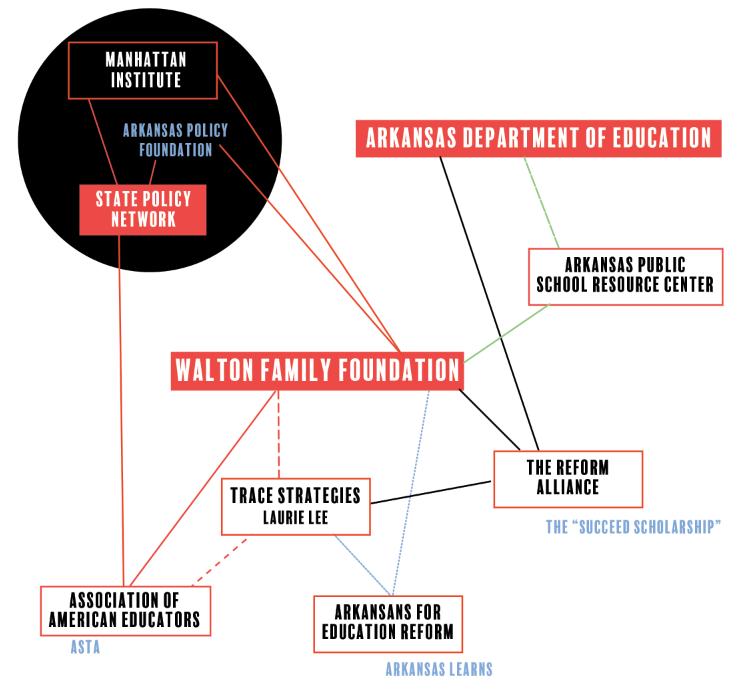
Inside the web of Arkansas’s School Privatization Empire 

A free quality public education for every child is a foundational principle of American society and a right guaranteed by Arkansas’s Constitution. Everyone in this state, regardless of religion, race, income, disability or any other characteristic deserves an equal opportunity to learn and succeed.  
Unfortunately, a vast network of corporate interests and wealthy individuals are chipping away at this bedrock of our democracy in an effort to turn public education into a marketplace where private interests can profit off of our students.  
Across the nation, states have implemented and expanded charter schools that are unaccountable to the public and voucher programs that have siphoned off public taxpayer money to pay for private school tuition. 
This powerful and well-funded effort is nationwide, but one of the biggest contributors is based right here in our state, and each year the network of privatizers working in Arkansas is growing. 

This network uses pass through organizations to fund a swarm of lobbyists and spend dark money on political candidates in our state and across the country. They initiated the recent attack on the Arkansas Teacher Retirement System, and have even co-opted our state’s flagship University to provide cover for the work of partisan think tank alumni who misuse statistics in support of a privatization agenda. They have close ties to members of the Arkansas State Board of Education, and their influence is part of the reason Arkansas’s latest legislative sessions have focused more on privatization schemes like vouchers and charter school expansion rather than the investments we know will actually improve outcomes for Arkansas’s 486,000 public school students.  
This article is a look at just some of the connections in our state. It is important to note that this report is not exhaustive. The web of dark money and organizations working in Arkansas and across the country to plunder public school resources is vast and difficult to track.   
HOME REGION 
The Walton Family Foundation (WFF) and many of its grantees are the major school privatization players in Arkansas and even CONTINUE READING: Schools Matter: Walmart Shoppers Help Fund Public School Privatization

2019 Medley #17: Back to school 2019, Part 2 The Test Fails | Live Long and Prosper

2019 Medley #17: Back to school 2019, Part 2 The Test Fails | Live Long and Prosper

2019 Medley #17: Back to school 2019, Part 2 The Test Fails


Testing and Accountability
THE TEST FAILS
Accountability is the big news in Indiana as school starts this year. It seems that our students didn’t do well on the new iLearn test which replaced ISTEP and was administred last Spring.
Steve Hinnefeld, who blogs at Schools Matter, reported (see The stakes are the problem, below),
Just under half of all students in grades 3-8 were proficient in English/language arts, and just under half were proficient in mathematics, according to the assessment. Some 37% were proficient in both.
Why? Our students did fine on the National Assessment of Educational Progress (NAEP) often called The Nation’s Report Card. At least three/fourths of our students in grades four and eight were At or above Basic in reading and the same in math (for a discussion of the difference between Basic and Proficient on the NAEP see If NAEP “Proficient” Means “Grade Level Proficiency,” Then America’s Private Schools Are in Trouble by blogger Mercedes Schneider. Also see Scale Scores and Achievement Levels).
The problem is, apparently, the test itself. Superintendents from across the state (including the State Superintendent of Public Instruction) have recognized this CONTINUE READING: 2019 Medley #17: Back to school 2019, Part 2 The Test Fails | Live Long and Prosper

The college admissions process is ‘unconscionably unjust.’ Here’s one way to help change that. - The Washington Post

The college admissions process is ‘unconscionably unjust.’ Here’s one way to help change that. - The Washington Post

The college admissions process is ‘unconscionably unjust.’ Here’s one way to help change that.

Late last month, the College Board announced that it was dropping a plan it had introduced a few months earlier to provide colleges with a single numeric rating of the adversity that students who took the SAT faced in their communities.
The original idea, called the Environmental Context Dashboard, was aimed at providing context to college admissions officers about the hardships that some students face as they go through school and try to get into college. Critics pounced, saying, in part, that the data would be questionable, and the College Board decided to change its plan.
The authors of the following post argue that despite its problems, the idea that the College Board introduced was a good one, and that some version of it could help improve “an unconscionably unjust process” — that being the college admissions process.
The writers are Brennan Barnard and Richard Weissbourd. Barnard is the college admission program manager at the Making Caring Common project at the Harvard Graduate School of Education and director of college counseling at the private Derryfield School in New Hampshire. Weissbourd is a senior lecturer at the Harvard Graduate School of Education as well as the faculty director of the Making Caring Common project and the co-director of the school’s Human Development and Psychology Program.
By Brennan Barnard and Richard Weissbourd
How do we measure human potential? And how do we do it in a way that’s both accurate and just, taking into account an individual’s advantages and disadvantages? Schools, college admissions offices, businesses and many other professions have always struggled with these questions, and now the College Board, the organization that owns the SAT, Advanced Placement program, and other educational assessments, finds itself in the thick of them. CONTINUE READING: The college admissions process is ‘unconscionably unjust.’ Here’s one way to help change that. - The Washington Post