Latest News and Comment from Education

Friday, August 30, 2019

What Kids Who Bully Often Have In Common | HuffPost Life

What Kids Who Bully Often Have In Common | HuffPost Life

What Kids Who Bully Often Have In Common
Experts share traits that have been linked to bullying behaviors.

When parents, educators and mental health professionals talk about bullying, there is understandably a lot of emphasis on the victims. But in focusing solely on victims in anti-bullying efforts, an important part of the equation gets forgotten: the kids who do the bullying.
“Bullying is not a one-time event or a random act of mean behavior but rather a pervasive, ongoing pattern of aggression targeted toward another child who in some way has less power in the relationship,” explained school psychologist Rebecca Branstetter, noting that it’s important to distinguish it from other forms of aggressive behavior or typical childhood conflicts.
Obviously every child who bullies comes from different circumstances and has different reasons for this behavior. There is no one profile of a bully, as each child who engages in this conduct has a unique set of challenges. But there are many common traits and experiences among bullies, and examining them can be beneficial.

“When we identify common threads, such as being shame-prone and having trouble with social-thinking and social-communication skills, we can intervene early and in a proactive way,” Branstetter told HuffPost.
“Children’s personalities, integrity and inner-self are still developing ― they are not ‘finished’ yet,” said child psychologist Jillian Roberts. “The earlier we address these issues in both the aggressor and victim, the more opportunities we create for growth and healing on both sides.”
HuffPost spoke to Branstetter, Roberts and other experts to identify some of these commonalities. Here are 10 things many kids who bully have in common.

Lack Of Empathy

Children who bully often tend to be stunted when it comes to self-awareness and CONTINUE READING: What Kids Who Bully Often Have In Common | HuffPost Life

Second tax measure to fund California schools proposed for 2020 ballot | EdSource

Second tax measure to fund California schools proposed for 2020 ballot | EdSource

Second tax measure to fund California schools proposed for 2020 ballot
School boards association seeks backers for $15 billion tax on the wealthy

The California School Boards Association is exploring whether to place a $15 billion tax for K-12 schools, early education and community colleges before voters, creating the possibility of dueling tax initiatives on the statewide ballot in November 2020.

Together with the Association of California School Administrators — its only partner so far — the school boards association has created a “Full and Fair Funding” election fund and website to solicit support. Assemblyman Kevin McCarty, D-Sacramento, who chairs the Assembly Budget Subcommittee on Education Finance, is shopping the idea around the Legislature to see if there’s enough support to ask legislators to put the tax proposal on next year’s ballot.
“We’re talking to anyone who will listen,” and that includes the administration of Gov. Gavin Newsom, said Dennis Meyers, assistant executive director for governmental relations for the California School Boards Association. “They know what we are doing.”
The association’s move coincides with the announcement this month by the organizers of another tax plan that they are rewriting their initiative, which already had qualified for the November 2020 ballot, to exempt more small businesses. The initiative from the Schools and Communities First Coalition would revise Proposition 13’s 40-year-old limits on property taxes to increase the take from business and commercial properties. Organizers say they will replace the text with the latest version once they’ve again collected the more than 1 million signatures needed to put the initiative on next year’s ballot — an expensive and possibly daunting challenge.
Their proposal for a “split-roll” tax would leave Prop. 13’s tax protections for residential property owners intact while raising an estimated $11 billion annually from business and commercial properties. About $4.5 billion would go to schools and community colleges and the rest to cities and counties, which provide the bulk of the CONTINUE READING: Second tax measure to fund California schools proposed for 2020 ballot | EdSource

How DeBlasio Protects the Charter Industry in NYC | Diane Ravitch's blog

How DeBlasio Protects the Charter Industry in NYC | Diane Ravitch's blog

How DeBlasio Protects the Charter Industry in NYC

When Mayor Bill DeBlasio was on the Democratic debate stage, he lashed out at the charter industry and vowed to fight the privatizers.
But as mayor, he is protecting them.
As Leonie Haimson explains, DeBlasio’s Department of Education routinely hands over the lists of public school students to the charters, despite the protests of parents.
No other city, she says, gives charters the names and addresses of public school students.
Now he says parents may ask to remove their names, but that is not good enough.
This is the official statement from DeBlasio’s Department of Education. If you want to take your child’s name off the charter mailing list, it is your responsibility to ask to CONTINUE READING: How DeBlasio Protects the Charter Industry in NYC | Diane Ravitch's blog

The truth about Finland’s great schools: Yes, kids do get homework, and no, they didn’t stop teaching individual subjects. - The Washington Post

The truth about Finland’s great schools: Yes, kids do get homework, and no, they didn’t stop teaching individual subjects. - The Washington Post

What Finland is really doing to improve its acclaimed schools

Finland has been paid outsized attention in the education world since its students scored the highest among dozens of countries around the globe on an international test some 20 years ago.
And while it is no longer No. 1 — as the education sector was hurt in the 2008 recession, and budget cuts led to larger class sizes and fewer staff in schools — it is still regarded as one of the more successful systems in the world.
In an effort to improve, the Finnish government began taking some steps in recent years, and some of that reform has made for worldwide headlines. But as it turns out, some of that coverage just isn’t true.
A few years ago, for example, a change in curriculum sparked stories that Finland was giving up teaching traditional subjects. Nope.
You can find stories on the Internet saying Finnish kids don’t get any homework. Nope.
Even amid its difficulties, American author William Doyle, who lived there and sent his then-7-year-old son to a Finnish school, wrote in 2016 that they do a lot of things right:
What is Finland’s secret? A whole-child-centered, research-and-evidence based school system, run by highly professionalized teachers. These are global education best practices, not cultural quirks applicable only to Finland.
Here is a piece looking at changes underway in Finnish schools by two people who know what is really going on. They are Pasi Sahlberg and Peter Johnson. Johnson is director of education of the Finnish city of Kokkola. Sahlberg is professor of education policy at the University of New South Wales in Sydney. He is one of the world’s leading experts on school reform and is the author of the best-selling “Finnish Lessons: What Can the World Learn About Educational Change in Finland?”

2019 Medley #16: Back to school 2019, Part 1 | Live Long and Prosper

2019 Medley #16: Back to school 2019, Part 1 | Live Long and Prosper

2019 Medley #16: Back to school 2019, Part 1


SPECIAL EDUCATION NEEDS AND LEAD POISONING
In nearly all my previous posts having to do with the lead poisoning of America’s poor children, I have commented that we would likely see increased numbers of students needing special services in areas where lead is an identified problem.
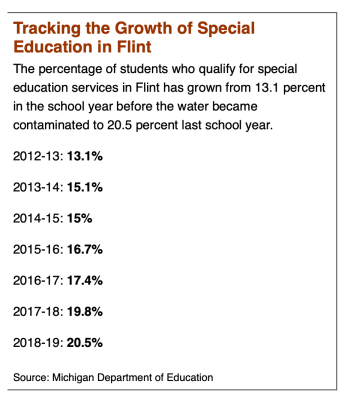
Flint, Michigan is facing that situation. There aren’t enough special education teachers to handle the increased case load in Flint’s schools. The author of the article (and the plaintiffs in the lawsuit) don’t blame the lead in the water for the increased need for speical ed services in Flint. It seems likely, however, that the near doubling of the number of children identified for special education over the last 8 years has something to do with the damage done to Flint’s children by the lead in the water.
Who should pay for the permanent damage done to an entire community of lead poisoned children? Who should be held accountable? Will teachers’ evaluations reflect the lower test scores of their students damaged by policy makers’ neglect?
By the way, the title of this article refers to the “Aftermath of [Flint’s] Lead Crisis.” Is Flint’s water safe yet? What about Newark? What about the lead in the ground in East Chicago, IN?
In a suit brought by the American Civil Liberties Union of Michigan, the Education Law Center, and the New York-based firm of White & Case, lawyers representing Flint families have sued the school system, the Michigan education department, and the Genesee County Intermediate school district, alleging systematic failure to meet the needs of special education students. The Genesee district helps oversee special education services in Flint and other county districts.

While the lawsuit does not pin the increased need for special education services solely on the prolonged lead exposure, research has linked lead toxicity to learning disabilities, poor classroom performance, and increased aggression.
STUDENT ACHIEVEMENT TESTS AREN’T VALID FOR TEACHER EVALUATIONS
CONTINUE READING: 2019 Medley #16: Back to school 2019, Part 1 | Live Long and Prosper

What Kind of A—hole Ransoms School Data? | gadflyonthewallblog

What Kind of A—hole Ransoms School Data? | gadflyonthewallblog

What Kind of A—hole Ransoms School Data?
You’ve got to be a grade A sleaze bag to steal from kids’ public schools.
But that’s exactly what a growing number of slime balls are doing when they hack into schools’ computer networks and hold their data for ransom.
Even worse – districts are paying it!
Just this week the Rockville Center School District in New York state paid an $88,000 ransom to get back files that had been encrypted by Ryuk ransomware.
The district negotiated the payment down from $176,000. School directors only decided to pay after realizing it would cost more to hire another firm to fix the problem.
Plus the school had insurance that covered ransomware so it only ended up losing its $10,000 deductible.
But this district isn’t the only one being extorted by CONTINUE READING: What Kind of A—hole Ransoms School Data? | gadflyonthewallblog

Seattle Schools Community Forum: In How We Talk about Race and Equity

Seattle Schools Community Forum: In How We Talk about Race and Equity

In How We Talk about Race and Equity

As some of you may know, I have had issues with a small cabal of people who think that loud namecalling and hyperbole can change the landscape around race and equity in this district (state, nation).

Here's the problem with that - it will not work.

The reason I say that with confidence is because as I have seen through the years, many people shrink back from any kind of talk they feel is aggressive.  I think some of it is the sensibility of any given person who prefers a more civil or engaging way of talking about issues. Some of it is a dislike of hearing talk about tough issues in a blunt manner.

(And note to everyone - don't even try to engage.  It will not work, they will not listen.  They seem to hang out at the SPS Community Discussion and Resource Exchange Facebook page. It's a sad thing because that Facebook page in question does sometimes have good information/discussion. But let a couple of these people go at it like whirling dervishes and see people leave in droves.)

Make no mistake, there will be tough talk around race and equity and it will be uncomfortable.  But it does not have to demean and tear down.  It doesn't have CONTINUE READING: 
Seattle Schools Community Forum: In How We Talk about Race and Equity


Helping Students Cope with Active Shooter Drills - NEA Today

Helping Students Cope with Active Shooter Drills - NEA Today

Helping Students Cope with Active Shooter Drills

It’s back-to-school time across the country and as students settle into new classes and routines, they’ll also be practicing lockdown and active shooter drills, an unfortunate consequence of what’s become a new normal in America: mass shootings.
The United States has witnessed nearly 2,200 mass shootings since the 2012 Sandy Hook massacre, according to data from the Gun Violence Archive, and gun violence is now the second-most-common cause of death for people ages 1 through 19.
With news about shootings like those in Dayton and El Paso still fresh in student minds, lockdown and active shooter drills can be traumatizing.
NEA Today spoke to Janet Shapiro, dean of the Graduate School of Social Work and Social Research, professor of Social Work, and director of the Center for Child and Family Wellbeingabout the impact on students.
In the weeks following a shooting, the news is impossible to escape. What affect does it have on students around the country?
Janet Shapiro: It’s important to look at the context of your students’ community. They are either directly experiencing violence or its happening elsewhere. Some are exposed to constant media coverage, while others are are not only exposed to the coverage of the mass shootings, but also live in neighborhoods where they experience violence every day — on the way to school, in neighborhood parks and CONTINUE READING: Helping Students Cope with Active Shooter Drills - NEA Today

CURMUDGUCATION: Is It Really That Simple?

CURMUDGUCATION: Is It Really That Simple?

Is It Really That Simple?

Some days I look at the landscape of educational issues, and I think that all our educational problems boil down to one, simple, two-part problem.

1) We don't spend enough money on education because

2) We don't want to.

We could erase the pockets of educational underserving, by spending the money necessary to fix the buildings, provide the resources, support the students, create a safe and effective learning environment. We could coax people back into teaching by raising the pay and providing supports to make the job more attractive (imagine a school with, for example, a secretary for every department). We could provide a better array of support staff-- nurses, counselors specifically for personal issues, post-high school planning, in-school issues. Hell, we could do simple things like provide school-issued pencils and backpacks and paper for each student, and if we thought uniforms were important, we could provide those, too.

But we don't. We propose solutions that aren't solutions, like school choice, which proposes that we take the same money that isn't enough to support a single system and spread it around among several systems, which is like Daylight Savings Time to create more sunlight or pushing your lima beans around to make it look like you actually ate them.

No, we stay stuck tight to a system of districting and funding that is welded to housing, which all CONTINUE READING: 
CURMUDGUCATION: Is It Really That Simple?


Thursday, August 29, 2019

"FLINT WATER" IN CA: Lead Found in Drinking Fountains at 17% of California Public Schools | Capital & Main

Lead Found in Drinking Fountains at 17% of California Public Schools | Capital & Main

Lead Found in Drinking Fountains at 17% of California Public Schools
The state only requires schools to take action if lead levels exceed 15 ppb. But the CDC says there’s no safe blood lead level for children.

Two years ago Assembly Bill 746 required all California K-12 public schools built before 2010 to test for lead in drinking fountains and faucets by July 1, 2019. So far, 1,256 of 7,188 schools tested by the California State Water Resources Control Board (17 percent) have reported levels of lead that exceed five parts per billion (ppb). The American Academy of Pediatrics recommends that lead in school drinking fountains not exceed 1 ppb, whereas the Centers for Disease Control and Prevention says there is no blood lead level for children that can be considered safe.
The state, however, only requires schools to take action – including notifying parents, shutting down dangerous fountains and conducting more testing – if lead levels exceed 15 ppb. Schools that do detect levels of lead above 15 ppb must take follow-up samples from the place at which the school’s plumbing connects to the community water supply to identify whether tainted water is reaching the school from the outside. As of mid June, 268 California schools reported lead levels above 15 ppb, according to the Water Resources Control Board.
AB 746 builds upon 2017 permit amendments, issued by the state’s Division of Drinking Water, that give all California schools (public, private and charter) the right to request testing from their local water systems of up to five samples, and to receive repeat tests to confirm the effectiveness of any steps taken to lower lead levels.
The presence of lead at so many schools is particularly alarming because lead is especially toxic to children, even at low levels. “Lower levels of lead have the potential to cause significant effects on children’s brain development, on their attention levels, on behavior and on their ability to learn,” said Susan Little of the Environmental Working Group, an advocacy CONTINUE READING: Lead Found in Drinking Fountains at 17% of California Public Schools | Capital & Main

Bombshell in California: E-Mails Reveal Charter Lobby’s Goal of Complete Privatization of All Schools in the State | Diane Ravitch's blog

Bombshell in California: E-Mails Reveal Charter Lobby’s Goal of Complete Privatization of All Schools in the State | Diane Ravitch's blog

Bombshell in California: E-Mails Reveal Charter Lobby’s Goal of Complete Privatization of All Schools in the State

Blogger Michael Kohlhaas received a huge trove of leaked emails from the Green Dot Charter School organization in Los Angeles.
He has been releasing them as he reviews them.
No one has disputed their accuracy.
Yesterday, Kohlhaas released one of the most startling of these documents, in which the charter lobby reveals its ultimate goal: by 2030, every student in the state of California will attend a charter school or a “charter-like public school.”
He writes:
It’s not clear at all what they mean by “charter-like public school[s]”. It’s especially unclear given the amount of time they spend ranting about how charter schools are in fact public schools, so presumably charter schools are the most charter-like public schools of all, but whatever. The point is that this is an acknowledgement by the CCSA that they are in fact trying to destroy public education in California by removing ALL students from it or, if that’s not possible, making public schools be so much like their CONTINUE READING: Bombshell in California: E-Mails Reveal Charter Lobby’s Goal of Complete Privatization of All Schools in the State | Diane Ravitch's blog

The Walton Presence in Louisiana K12 Education (Still Watching for a 2019 BESE-Influencing Money Dump) | deutsch29

The Walton Presence in Louisiana K12 Education (Still Watching for a 2019 BESE-Influencing Money Dump) | deutsch29

The Walton Presence in Louisiana K12 Education (Still Watching for a 2019 BESE-Influencing Money Dump)

I have been watching for the billionaire Walton influence in the upcoming, October 2019 elections of Louisiana’s Board of Elementary and secondary Education (BESE).
On August 21, 2019, I posted about the disbanding of the Louisiana PAC (Louisiana businessman Lane Grigsby’s Empower Louisiana PAC) used to funnel $3M in out-of-state billionaire money into Louisiana’s 2015 BESE election. Siblings Jim and Alice Walton pumped $650K into that election and subsequent, November 2015, runoff via that single Louisiana PAC, with Alice and Jim each donating $200K to the BESE primary and Jim donating an additional $250K for the runoff. Grigsby used the money to advertise for specific ed-reform candidates and against specific traditional-ed candidates.
alice-and-jim-walton
billionaire siblings Alice and Jim Walton
By August 2015, both Alice and Jim had already made their $200K donations to influence the 2015 BESE race, with both donations being made on August 20, 2015. (To verify, search via name here.)
(Also on August 20, 2015, the same day that Jim Walton donated $200K to Empower Louisiana PAC, he also donated $100K to La. Federation for Children PAC and $250K to Stand for Children IEC.)
Since the Empower Louisiana PAC has been disbanded prior to the 2019 BESE election, that specific vehicle for Walton and other out-of-state billionaire money CONTINUE READING: The Walton Presence in Louisiana K12 Education (Still Watching for a 2019 BESE-Influencing Money Dump) | deutsch29

Grassroots Education Network- August 2019 Newsletter - Network For Public Education

Grassroots Education Network- August 2019 Newsletter - Network For Public Education

Grassroots Education Network- August 2019 Newsletter


The NPE Grassroots Education Network is a network of over 135 grassroots organizations nationwide who have joined together to preserve, promote, improve, and strengthen our public schools. If you know of a group that would like to join this powerful network, please go here to sign up.
If you have any questions about the NPE Grassroots Education Network please contact Marla Kilfoyle, NPE Grassroots Education Network Liaison at marlakilfoyle@networkforpubliceducation.org
Notes from Marla
As many of us return Back to School, you will see in this newsletter great ideas from across the nation for Back to School events, forums, campaigns, and actions.
National Organizing
Read Dr. Denisha Jones reflections from Defending the Early Years first leadership institute. In the Public Interest’s informative article How to Spot — and Stop — Privatization (of prisons, water, schools, etc.) Before it Happens is a must read and share. The Journey for Justice Alliance podcast On The Ground, hosted by Jitu Brown, airs every Monday at 6 PM CST. Make sure you check out their new website which follows all their actions and movements. J4J went to Puerto Rico in August to be part of a transnational meeting in defense of public education. Check out their livestream of the event. Fairtest publishes an amazing newsletter each week covering the flaws of relying on standardized exams to make high-stakes educational decisions. Rethinking Schools heads Back to School with their plan book for social justice teachers – Planning to Change the World 2019-2020The Parent Coalition for Student Privacy has toolkits for parents, students, and teachers that detail how to protect data privacy. Go to their website to access and share these excellent resources. Parents for Public Schools National published a series on their website celebrating the unsung heroes within their communities who show how to make positive change. Parents Across America’s position papers and key documents are a valuable resource for parents. Go to their website to access and share. At this year’s annual Social Impact Exchange conference, Schott Foundation Vice President Edgar Villanueva spoke on a panel with other philanthropic leaders to discuss how funders can help address the systemic problems at the root of so many of the challenges we face. The Badass Teachers Association Quality of Worklife (QWL) team held an informative webinar this month on Educators Facing their Fears. For the archive of that webinar go here. For other informative webinars from the QWL go here. The Trinational Coalition to Defend Public Education (USA) exists in a network with many other organizations in Canada and Mexico. Check out their network here. The Ontario (Canada) Secondary School Teachers Federation issued a statement on the STEM and skilled trades not being fully funded with the government’s cuts to the provinces high schools. Wear Red for Ed tracks the Red for Ed movement nationwide. Check out their open Facebook page for the latest on the Red for Ed movement. Find out what Save our Schools March is up to by following their open Facebook page. First Focus Campaign for Children produced a fact sheet on how the proposed SNAP rule will overwhelmingly harm children and their family members. They also co-sponsored a tweetstorm on August 14th. Check out the hashtag #HandsOffSnap to learn how you can raise your voice for children and their families. Please make sure to visit the Network for Public Education’s 8 Powerful Voices for Public Education video series.
NPE Grassroots Education Network – State Organizations Support Public Education CONTINUE READING: Grassroots Education Network- August 2019 Newsletter - Network For Public Education