Latest News and Comment from Education

Thursday, April 18, 2019

How popular are charter schools in California? | The Sacramento Bee

How popular are charter schools in California? | The Sacramento Bee

Charter school growth slowing in Sacramento. What’s driving the statewide trend?


After years of vigorous growth, charter school enrollment is showing early signs of decline in Sacramento County just as state lawmakers zero in on ways to limit the industry’s swift expansion in California.
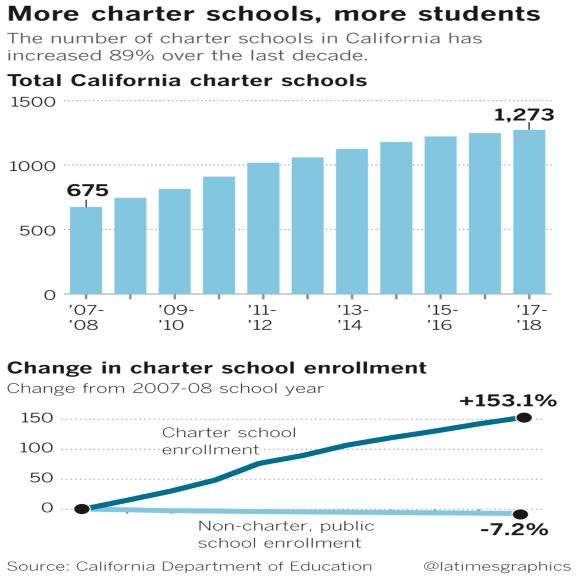
New enrollment figures show charter school enrollment grew by 2.6 percent this school year in Sacramento County – the slowest rate in at least the last decade – and climbed by 4 percent statewide.
Still, twice as many students are taught in charter school programs now than during the 2007-2008 school year, according to data from the California Department of Education. More than 33,000 Sacramento County students are now enrolled in charter programs, which includes virtual schooling and independent study, accounting for 13 percent of the student population.
The slowdown has not resulted in any boon for the county’s public schools, which have seen meager or negative growth since 2010, data shows. The trend lays bare a new reality in K-12 education where parents are exercising choice and privately-run and public schools are trying to accommodate them.

Although Anastasia Harrison lives walking distance from an Elk Grove public elementary school, she enrolled her children in the nearby California Montessori Project, which is home to 500 students. The school also has other campuses throughout the Sacramento region.
The school teaches children in block grades, so Harrison’s third-grade daughter is in a class with first- and second-graders. Entrance to the school is tight but she said the lottery and waitlist didn’t discourage her from applying.
“I was a little concerned about public schools. I told myself that if they didn’t get into the charter school, I was going to homeschool them,” Harrison said. “It’s not a traditional classroom where kids may get bored. My kids are able to work ahead, and when they help the younger kids, it reinforces what they already know.”
Many parents want specialized programs that emphasize different learning styles and second languages. Others feel a public education may not offer their children enough. Districts, perhaps in a race to keep up, have pivoted to charters, too, converting some of their traditional neighborhood schools.
That’s one of the reasons behind the seemingly explosive growth, said Willow Herrington, vice CONTINUE READING: How popular are charter schools in California? | The Sacramento Bee

How Charter Schools Became Such a Big Player in California's Education System | The California Report | KQED News - https://www.kqed.org/news/11729643/how-charter-schools-became-such-a-big-player-in-californias-education-system by @MGreenKQED on @kqed

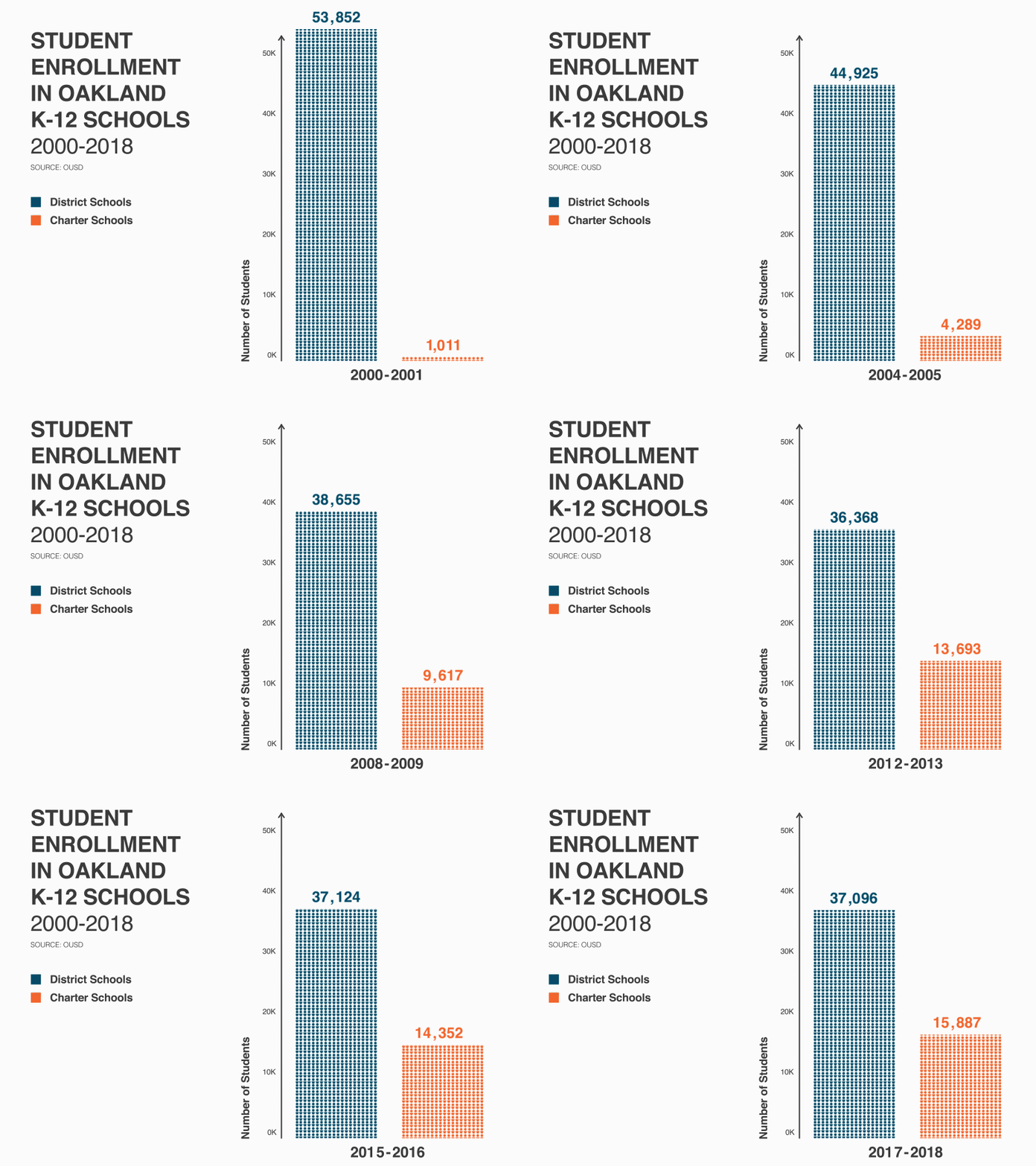
Fueled by a large influx of outside funding from wealthy donors and a succession of charter-friendly district superintendents and city and state officials, new charter schools in Oakland proliferated, particularly in the decade after 2000, when the number of charter schools in the city more than tripled.
https://docs.google.com/document/d/18der2D2inCn9SpWtnc1MbGB_mLCDjIwbwATf1qtKz8E/edit
Graphic: A steady decrease in public school enrollment is matched by a similar steady increase in charter school enrollment. (Elena Lacey/KQED)


And while certainly not the sole cause of Oakland Unified’s perennial budget woes, the rise of charters is a factor that has undeniably contributed to the district's fiscal distress. Because OUSD receives per-pupil state funding, having fewer students means a lot less money for the district, even as its school building and administrative costs remain roughly the same. The Los Angeles and Oakland teachers unions frequently cite a 2018 report by the left-leaning Bay Area policy center, In The Public Interest, estimating that charter growth cost L.A. Unified more than $508 million in 2014-15 and Oakland Unified $57 million in 2016-17.

What Kids with Low Self-Esteem Say - Teacher Habits

What Kids with Low Self-Esteem Say - Teacher Habits

What Kids with Low Self-Esteem Say


A guest article from Chris, publisher of TeachingWoodwork.com
When the children in your class look in the mirror, do you think they like what they see?
What do they think about the world around them?
Do they think they are loved and valued or do they feel judged and inadequate?
It is normal for a youngster to lack confidence at times. However, if a child persistently struggles with feelings of worthlessness and incompetence, then there is a huge problem. They could be dealing with low self-esteem.
Low self-esteem is debilitating to young people. It makes them have a negative image of themselves that is completely removed from reality. They harbor harsh opinions and beliefs about themselves that when they persist long enough, cripple their lives.
Low self-esteem eats away at a child’s happiness. It creates fear and expects failure. Indeed, it can be physically, emotionally and psychologically debilitating.
While some signs of low self-esteem are easy to sport, others could be a bit obscure. However, the language that the youngster uses could be the clearest indication that they are suffering from low self-esteem.

Examples of Things young People say when suffering Low Self-esteem

‘I don’t deserve it.’ ‘I am not worth it.’ ‘I am stupid.’

Shame is a constant small voice at the back of the mind of a child who CONTINUE READING: What Kids with Low Self-Esteem Say - Teacher Habits

Read Robert Mueller’s Trump-Russia report: full text - Vox

Read Robert Mueller’s Trump-Russia report: full text - Vox

Read Robert Mueller’s Trump-Russia report: full text


Finally.
Special counsel Robert Mueller’s long-awaited report on potential collusion between Donald Trump’s 2016 presidential campaign and Russia is finally out — and time will tell if it will either help or hurt the president.
Roughly 450 pages, the document is the definitive account of whether Moscow and political operators around Trump worked together to win the White House. It also includes details about whether the president tried to obstruct justice by interfering with Mueller’s probe.
Attorney General William Barr released a four-page summary of the report on March 24 in which he stated that Mueller found no collusion, but added that the probe also didn’t exonerate Trump on the obstruction issue. That led to a major controversy between Democrats and Republicans, mainly because Barr’s brief summary didn’t explain how Mueller came to his results and offered scant other details.
Now, after two years, the public has a chance to see the report — with some redactions concerning information Barr deemed sensitive — for themselves.
Read Robert Mueller’s Trump-Russia report: full text - Vox


Video: Watch the premiere of Wyatt Cenac’s HBO show “Problem Areas” for free–and truly understand the new educator uprising in America – I AM AN EDUCATOR

Video: Watch the premiere of Wyatt Cenac’s HBO show “Problem Areas” for free–and truly understand the new educator uprising in America – I AM AN EDUCATOR

Video: Watch the premiere of Wyatt Cenac’s HBO show “Problem Areas” for free–and truly understand the new educator uprising in America


School is fundamentally one of the greatest sources of humor.
The premise of mainstream schooling is that a lot of young people, at different developmental stages, are packed into a room with an adult who is trying to get them to do something they often have little idea why they should care about.  That basic set up produces all kinds of problems but it also produces a natural environment for sitcom. That’s why from Ferris Bueller’s Day Off and the Breakfast Club, to Napoleon Dynamite and Freaks and Geeks, everyone has a favorite classroom comedy.
Now Wyatt Cenac, formerly a correspondent and write for The Daily Show with Jon Stewart, has brought us season two of his HBO show “Problem Areas,” all about education.  The show has been described by Anne Branigin at The Root, as “among the most ambitious comedy shows on TV”….or by one viewer as, “a millennial, stoner version of ‘Mister Rogers’ [Neighborhood].”
Throughout season two, Wyatt travels to some ten cities around the country to explore the education system: From the mass strikes for education and teacher pay in West Virginia, to the struggle to redefine school safety in New York City, to school lunches in Minneapolis, to my home town of Seattle to examine powerful public school innovations, and beyond.
Problem Areas does something all too rare in conversations about education in mainstream media: It centers on the perspectives of educators, students, parents, and community members–rather than politicians and billionaire “education reformers.” I was amazed when I, a classroom teacher, got the call from Wyatt’s studio to join the CONTINUE READING: Video: Watch the premiere of Wyatt Cenac’s HBO show “Problem Areas” for free–and truly understand the new educator uprising in America – I AM AN EDUCATOR

Burris and Ravitch: An Open Letter to Betsy DeVos about the Failure of the Federal Charter Schools Program | Diane Ravitch's blog

Burris and Ravitch: An Open Letter to Betsy DeVos about the Failure of the Federal Charter Schools Program | Diane Ravitch's blog

Burris and Ravitch: An Open Letter to Betsy DeVos about the Failure of the Federal Charter Schools Program

In this post on Valerie Strauss’s Answer Sheet blog at the Washington Post, Carol Burris and I respond to Betsy DeVos’s putdown of the Network for Public Education’s meticulous documentation of the failure of the federal Charter Schools Program. Our report, “Asleep at the Wheel,” showed that the U.S. Department of Education had handed out hundreds of millions of dollars–close to a billion dollars–between 2006 and 2014, to nearly 1,000 charter schools that never opened or that closed soon after opening. DeVos, as you will see, dismissed the report out of hand, and we assume that she never read it. The report was carefully documented, with references drawn mainly from government sources, including the website of the U.S. Department of Education. And for an added bonus, we show that 42% of all charter schools in DeVos’s home state of Michigan that received federal funding either never opened or closed soon after opening. What will she do to correct the lack of oversight in her own department?
We write:
Here is a link to 109 Michigan charter schools, called “academies,” that were awarded Charter School Program (CSP) grants from 2006-2014 but either never opened or closed. That number represents 42 percent of all recipients. Those highlighted in maroon shut down. Those highlighted in tan are schools that received funds but never opened. You will find ample documentation for your staff to review our work.
As anxious as you are to open new charter schools, if nearly half of them do not make it, we suggest that something is wrong with the selection process.
In total, $20,272,078 was awarded to defunct Michigan charter schools. And yet, in 2018 you awarded the State of Michigan an additional $47,222,222.
Your home state is not alone. Posted here is a similar list from the state of Ohio showing the names of 117 charter CONTINUE READING: Burris and Ravitch: An Open Letter to Betsy DeVos about the Failure of the Federal Charter Schools Program | Diane Ravitch's blog

Unmaking the Ontario Model: Austerity Comes to Canada – Have You Heard

Unmaking the Ontario Model: Austerity Comes to Canada – Have You Heard

Unmaking the Ontario Model: Austerity Comes to Canada


Deep spending cuts and ballooning class sizes are coming to Ontario. Have You Heard talks to parents, students and teachers in Toronto about what controversial changes proposed by the new conservative government will mean for a public education system success story. Hint: nothing good… Full transcript available here.
And if you like what you hear, please consider supporting Have You Heard on Patreon!


Melinda Gates and the Blindness of Privilege | janresseger

Melinda Gates and the Blindness of Privilege | janresseger

Melinda Gates and the Blindness of Privilege


Last Sunday, the New York Times Magazine published an interview—David Marchese talking with Melinda Gates—about the enormous power of the Bill and Melinda Gates Foundation for shaping our lives.  Marchese asks Ms. Gates directly about the Gates Foundation’s role in driving today’s neoliberal public education policy. Doesn’t a giant foundation—“Its endowment at $50.7 billion… the largest in the world.”—have an outsized impact on social policy? “What about the notion that the foundation’s work on an issue like public education is inherently antidemocratic?  You’ve spent money in that area in a way that maybe seems like it’s crowding out people’s actual wants in that area. What’s your counter to that criticism?”
Ms. Gates cheerfully counters his critique: “Bill and I always go back to ‘What is philanthropy’s role?’ It is to be catalytic. It’s to try and put new ideas forward and test them and see if they work. If you can convince government to scale up, that is how you have success.  But philanthropic dollars are a tiny slice of the United States education budget. Even if we put a billion dollars in the State of California, that’s not going to do that much. So we experiment with things.”
Despite Melinda Gates’ protestations, as we look back, we can see that when the Gates Foundation has experimented with with reforming institutions like public schools, there have been no real consequences for Bill and Melinda and their staff at the Foundation when projects have failed. In the history of the Foundation’s projects with America’s public schools, however, there are many examples of negative consequences for the schools, our communities, and our children.  Here are two.
The first is local—situated in metropolitan Tampa, Florida.  In 2009, The Gates Foundation made a $100 million grant to the Hillsborough County School District in Florida.  The money was to pay for  a huge experiment in merit pay for teachers. Then in 2015, the Gates Foundation deemed the experiment a failure and walked away, leaving the school district to cover millions of dollars of sunk costs and the responsibility for undoing the damage. According to an extremely thorough and arresting report by Marlene Sokol for the Tampa Bay  CONTINUE READING: Melinda Gates and the Blindness of Privilege | janresseger

Destroying Public Education in St. Louis | tultican

Destroying Public Education in St. Louis | tultican

Destroying Public Education in St. Louis


By T. Ultican 4/18/2019
On April 2nd, St. Louis city voters picked Adam Layne and Tracee Miller to serve on their seven-member Public School Board. They appear to be the two least likely candidates out of seven to protect public schools. With the state poised to end twelve years of control over the city’s schools, this is not a happy result for public education advocates.

The Seven Board Candidates

  1. Adam Layne is a former Teach for America (TFA) corps member assigned to a St. Louis charter school and is currently a board member of the Kairos Academy charter school.
  2. Tracee Miller was a TFA corps member and is currently running a math tutoring program in St. Louis for the Gates Foundation supported Khan Academy.
  3. Louis Cross boasts a long career with St. Louis Public Schools. He served as principal and interim superintendent of the now defunct Ethel Hedgemen charter school.
  4. Bill Haas served on the school board from 1997 to 2005, and again from 2010 to 2018. He was one of two board members that stood in opposition to contracting with Alvarez and Marsal to run St. Louis schools in 2003.
  5. David Merideth served on a special committee in 2017 that studied the school board’s role in future governance of the district when state control is relinquished.
  6. Barbara Anderson is a graduate of St. Louis Public Schools who taught on the elementary, middle and university levels throughout her career.
  7. Dan McCready is from Cincinnati, where he taught third and fifth grade math at a Cincinnati public school. He currently works at KIPP Victory Academy, a St. Louis charter school.
Dark Money Keys Election Results
Layne and Miller
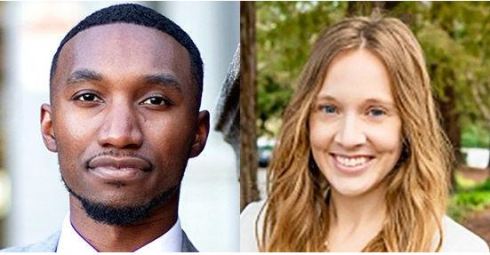
Adam Layne and Tracee Miller
New board member Adam Layne appears to be a talented and idealistic young man. In 2011, he graduated with a bachelor’s degree in finance from George Washington University. Unfortunately, that youthful idealism was corrupted  CONTINUE READING: Destroying Public Education in St. Louis | tultican

An open letter to Betsy DeVos, from two leading public education advocates - The Washington Post

An open letter to Betsy DeVos, from two leading public education advocates - The Washington Post

An open letter to Betsy DeVos, from two leading public education advocates

At a recent hearing on Capitol Hill, Education Secretary Betsy DeVos testified before the House Education Committee and had a brief discussion with Rep. Haley Stevens (D-Mich.) about charter schools.
Here's how some of it went:
STEVENS: So your budget proposes to eliminate billions of dollars in K-12 programs, from professional development for teachers and principals, to after school programming, to mental health services, and one of my personal favorites: STEM education. And obviously, we’ve heard you talk about some of the hard decisions that you’ve had to make. Yet, somehow, you found $60 million for an increase in the federal charter school program. I just really wonder if charter schools are the answer here, whereas it really should be the Title I funding. A recent report by the Network for Public Education found that more than $1 billion in charter school program funds have been given to support charter schools that never opened or they’ve closed -- they kind of abandoned the children and families. Since 2010, 25 schools in Michigan that have received $1.7 million in charter school funding just never even opened. And the Inspector General found waste, fraud, and abuse due to the frequency of school closures in the charter school program. Can you just explain for me the mark of effective programs here, and can you justify the proposed increase for the charter school program, and on what measures or studies you have been using?
DeVOS: Let me first comment on the study you’re referring to. I’m not sure you can even call it a study. We’re looking more closely at it of course, and anything that is truly waste, fraud, or abuse we will certainly address. But the reality is that the study was really funded by and promoted by those who have a political agenda against charter schools. And the other reality is that there are currently over one million students on wait lists for charter schools in the country. So, we want to see more charter schools, not fewer. More students that can access options that are right for them, not fewer.
The report to which they refer is “Asleep at the Wheel,” published in March by the Network for Public Education, a group that advocates for policies supporting publicly funded school districts. It says the U.S. government has wasted up to $1 billion on charter schools that never opened, or opened and then were closed because of mismanagement and other reasons. The report said the U.S. Education Department has not adequately monitored how its grant money has been spent by Republican and Democratic administrations.
I wrote about the report, which was slammed by many supporters of charter schools who do not want restrictions on how charters operate. Those supporters include DeVos, who has made clear in speeches and testimony that she believes the market, and not the government, should decide the fate of schools.
Charter schools are publicly funded but privately operated — some by for-profit companies. About 6 percent of America’s schoolchildren attend charter schools, with 44 states plus the District of Columbia, Guam and CONTINUE READING: An open letter to Betsy DeVos, from two leading public education advocates - The Washington Post

CURMUDGUCATION: The Charter Effect On Teachers

CURMUDGUCATION: The Charter Effect On Teachers

The Charter Effect On Teachers


Unions, we have been told, have a deleterious effect on  teachers, forcing them to accept lousier deals than they could get in a free market where they each negotiated their own deals. In such a market, schools would compete for teachers, bidding up the salary offers. Teachers could negotiate from a place of strength. No teacher would ever want a union ever gain.

I confess that there was a time when I thought this might be true. Long ago, I thought that whatever their flaws, charter and choice systems would turn popular and successful teachers into sports stars, with schools throwing money and cars and lord-knows-what-else at them.


There were several factors I didn't reckon with, the chief one being the degree to which the charter industry would view teachers less like LeBron James and more like Pat the fry cook. I didn't foresee that charterpreneurs would imagine a system where the teacher was just a fleshy bot, a particularly lifelike animatronic content delivery device with a shelf life of only a few years. I failed to realize that a teacher's ability to walk away would be overshadowed by a school's ability to fire teachers for any reason at all.

Over the years the anecdotes kept rolling in to show me how wrong I was. But there was also some actual research, like this report from Public Source in Allegheny County PA (the county that surrounds Pittsburgh). I missed this report when it came out two years ago, but it's worth looking at now.

Public Source did a separate report about charter staff turnover. The turnover is high, and that's CONTINUE READING: 
CURMUDGUCATION: The Charter Effect On Teachers


2019 Medley #8 | Live Long and Prosper

2019 Medley #8 | Live Long and Prosper

2019 Medley #8 


Grade Level, Student Achievement,
Society’s Mirror, Teacher Shortages,
Charter Accountability,
Disenfranchising the Voters
CHILDREN DON’T EAT ON GRADE LEVEL
This post isn’t about reading, but Mitchell Robinson brings up important information we should remember.
Last month, third graders in Indiana took the IREAD-3, a reading achievement test. Those who fail to achieve the arbitrarily designated cut score must take the test again during the summer. Those who fail it again must repeat third grade.
The concept of grade level should be flexible, not based on an arbitrary cut score. It should reflect the average reading level of a child in a particular grade instead of a goal for every child to achieve on a given test day. We should teach children at their zone of proximal development — the level just beyond the child’s independent level, not at the level the test insists upon.
Would we like all children to be above average? Of course, but we can’t ignore the math which renders that impossible. Additionally, we can’t ignore the detrimental impact of poverty on school achievement. Our job, as teachers, is to analyze a child’s achievement and make our plans based on what will help him progress as quickly as possible. That means starting where the child is…not at some vague “grade-level” determined by an outside source.
By setting a cut score on a test, and using the test to determine grade placement, the state is ignoring this basic concept of academic achievement and development, usurping the professional judgment of the classroom teacher, and ignoring the best interests of children in a misguided quest to get a number with which to label teachers, schools and school districts.
I agree with Robinson when he says that we can set “goals as teachers for when we introduce various literacy concepts to our students.” We do that by understanding the reading process and observing our students. [emphasis in original]
Children don’t “read on grade level” anymore than they “eat on grade level” or “care about their friends on grade level.” Anyone who has actually helped  CONTINUE READING: 2019 Medley #8 | Live Long and Prosper


MetWest Internships (Part 7) | Larry Cuban on School Reform and Classroom Practice

MetWest Internships (Part 7) | Larry Cuban on School Reform and Classroom Practice

MetWest Internships (Part 7)


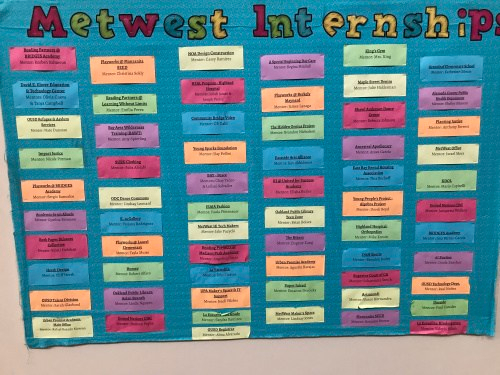
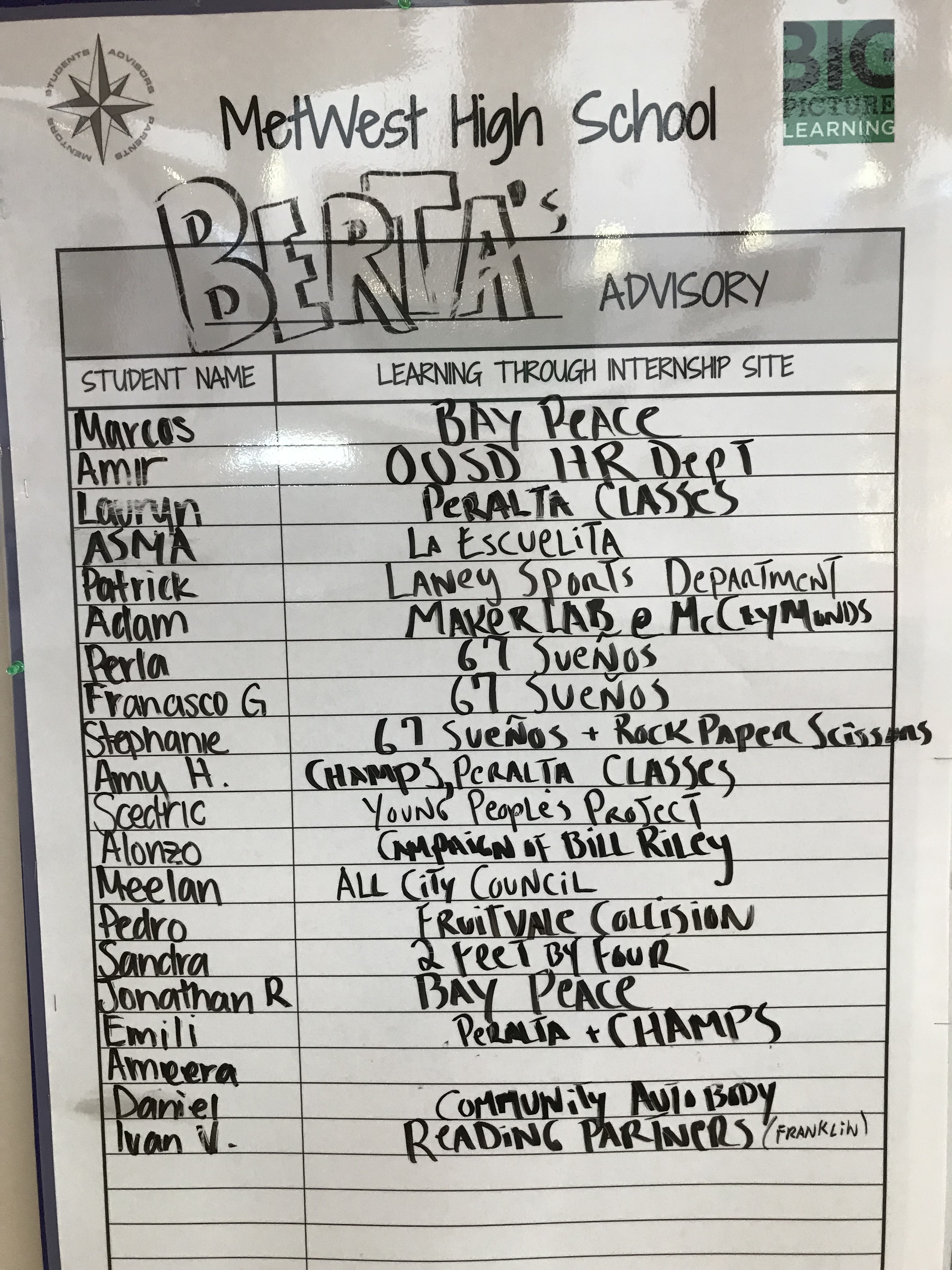
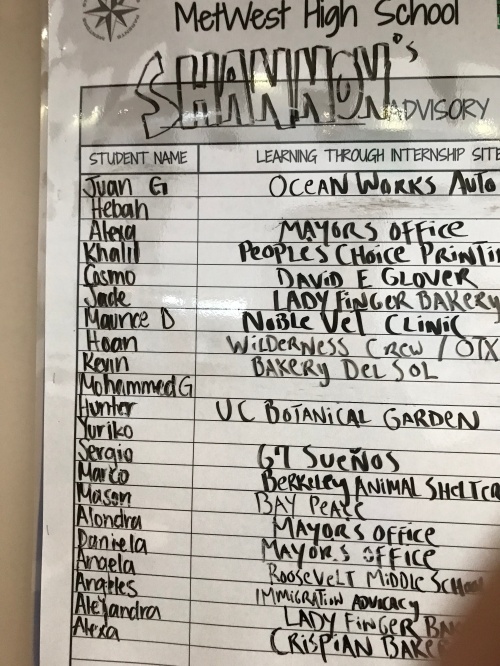
The last post described student and teacher participation in twice-weekly internships in Oakland businesses, government agencies including schools, health facilities, and social services.
img_2382.jpg

Advisor/Teachers work closely with students in their sites and are responsible for connecting what they learn with the academics they teach–English, history, math, science, foreign language.
IMG_2479.jpg
img_2375.jpg
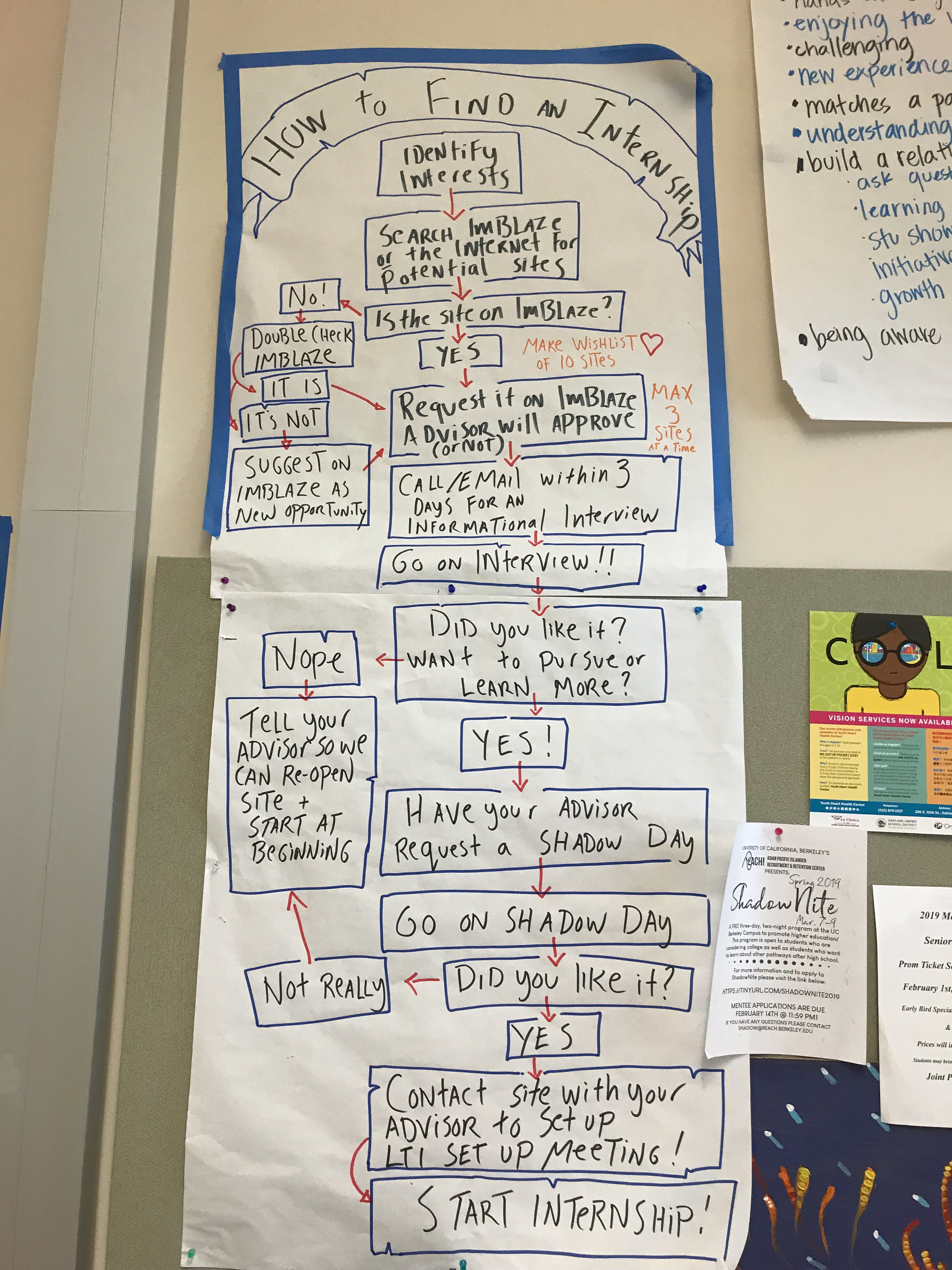
Mike Cellemme is Learning Through Internship (LTI) coordinator. He finds a site and locates a mentor willing to take and supervise a MetWest student. He talks to students about what they are interested in and want to learn more about and then finds a match between site, mentor, and student. He supervises the overall program. The process looks like this:
IMG_2438.jpg
*ImBlaze is a website that Big Picture schools use to identify possible internships for students

A former teacher at The Met in Providence (RI), he is experienced, savvy,and committed to making the program work for students, teachers, and work site mentors. What follows describes an afternoon I spent with Mike working with students and then going to an internship work site.
Like any high school program with many moving parts involving 160 students, a dozen or so teachers, and over a hundred mentors in their workplace, some things go smoothly, some less so.
On March 21, 2019, I went to room 136 in MetWest to see Mike and Mayra Acosta (a graduate of program and now Resource Program Specialist) work with various students searching for and working in varied internships. Students came in, asked questions about their mentors and sites and left; others stayed and sat with Mike and Mayra to talk about issues that came up in their classes, Senior Thesis Project, and internships.
Here is what I observed over the next hour. Alonzo who had worked as an intern on an Oakland political campaign during the fall semester is now searching for a new internship. On her laptop screen, Mayra pulls up some possibilities for him to consider. She asks questions about what he learned during the last internship, his current interests, and what he has heard from other students about their  CONTINUE READING: MetWest Internships (Part 7) | Larry Cuban on School Reform and Classroom Practice