Wednesday, March 13, 2019

DeVos opens door to taxpayers funding religious orgs by stopping enforcement of church-state separation rule

DeVos opens door to taxpayers funding religious orgs by stopping enforcement of church-state separation rule

DeVos opens door to taxpayers funding religious orgs by stopping enforcement of church-state separation rule


Secretary of Education Betsy DeVos has announced she will no longer enforce the provision of federal law that bans religious organizations from being funded with taxpayer dollars for secular projects.
DeVos is citing a 2017 Supreme Court decision that ruled a Missouri Lutheran church-run school could not be barred from having taxpayers pay for repaving its playground under a local ordinance that made it ineligible solely due to separation of church and state policies.
The Education Secretary, in an official notice to Congress, now appears to be turning that ruling on its head.
“The law calls for students in public and private schools to receive ‘equitable services,’ such as special education, tutoring or mentoring, and allows districts to hire contractors to deliver those services,” The New York Times explains.
The Washington Post adds, “school districts are now open to contract with religious organizations,” although “the services they provide must be ‘secular, neutral and non-ideological.'”
The education reporter for US News, a right-leaning news site, says, “DeVos blurs church-state boundaries” with her new rule.
Indeed, DeVos is claiming that the provisions of the federal laws she is now refusing to enforce are “discrimination against religious organizations.”
The Education Secretary, in an official notice to Congress, now appears to be turning that ruling on its head.
“The law calls for students in public and private schools to receive ‘equitable services,’ such as special education, tutoring or mentoring, and allows districts to hire contractors to deliver those services,” The New York Times explains.
The Washington Post adds, “school districts are now open to contract with religious organizations,” although “the services they provide must be ‘secular, neutral and non-ideological.'”
The education reporter for US News, a right-leaning news site, says, “DeVos blurs church-state boundaries” with her new rule.
Indeed, DeVos is claiming that the provisions of the federal laws she is now refusing to enforce are “discrimination against religious organizations.” CONTINUE READING: DeVos opens door to taxpayers funding religious orgs by stopping enforcement of church-state separation rule


Improving Democracy: Ranked Choice Voting

Improving Democracy: Ranked Choice Voting

Improving Democracy: Ranked Choice Voting


– Lawrence Lessig
In Los Angeles, the allegedly cash-strapped school district will spend approximately $2.4 million in the special elections to replace disgraced former Board member Ref Rodriguez. This is money that won’t be available to reduce class sizes, give students with special education needs the services they need or ensure that every school is staffed with a trained librarian. Even worse, it will be used in an electoral system where the vast majority of those eligible to participate will not do so and little will be done to promote the exchange of ideas between candidates.
In the primary round of this election, Jackie Goldberg won handily with 15,241 votes, representing 48.45% of the ballots cast. This was 11,097 votes more than her closest competitor who was only chosen by 13.17% of those who voted. However, since Goldberg did not win more than 50% of the vote, a runoff election will be held on May 14. There is little reason to believe that turnout will be any more than the 9% that voted in the primary.
If Los Angeles used a Ranked Choice method of voting like Berkeley, Oakland and San Leandro, the Los Angeles Unified School District (LAUSD) would not be preparing to spend more money on another CONTINUE READING: Improving Democracy: Ranked Choice Voting

CURMUDGUCATION: NY: Rochester, Mayoral Control, Vultures, and the Problems of Democracy.

CURMUDGUCATION: NY: Rochester, Mayoral Control, Vultures, and the Problems of Democracy.

NY: Rochester, Mayoral Control, Vultures, and the Problems of Democracy.


It has been almost a decade since a mayoral school coup was a hot topic in Rochester. Mayor Robert Duffy wanted to implement NYC style mayoral control. There seemed to be support for the move; the superintendent even had a nifty portfolio plan whipped up and ready to go. But Andrew Cuomo tagged Duffy as his running mate for governor, and Duffy was out of Rochester politics about a year after he'd proposed the takeover. The Senate was moving on it, opponents were ready o file lawsuits, but the whole business just sort of languished.

Well, there's your problem.
Fast forward to last year. In August, Education Commissioner MaryEllen Alia sent a consultant to Rochester to talk to folks, assess the situation, and make recommendations. Jaime Aquino,Distinguished Educator (seriously, that's his title), had held leadership positions in NY, Denver, and Los Angeles before he arrived in Rochester to talk to many people and wsw`determine that-- well, the full report, issued in November 2018, was a brutal sixty pages. It's not pretty:

“That lack of stability in leadership really has an impact on the work that happens in school," Dr. Aquino said of the district having five superintendents in the past decade. "There is also, in the district, lack of a laser-like focus on student achievement. There’s not a lot of attention being paid to teaching and learning, and a lack of accountability in the system in terms of monitoring what goes on in the school and in the progress the kids are doing.”

The picture that emerges from the report is of fully-dysfunctional top-down leadership, starting with a dysfunctional board that is both splintered and prone to micro-management, and on to a  CONTINUE READING: 
CURMUDGUCATION: NY: Rochester, Mayoral Control, Vultures, and the Problems of Democracy.


Politicians Forget that Cut Scores on Standardized Tests Are Not Grounded in Science | janresseger

Politicians Forget that Cut Scores on Standardized Tests Are Not Grounded in Science | janresseger

Politicians Forget that Cut Scores on Standardized Tests Are Not Grounded in Science


Last week the NY Times‘ Dana Goldstein and Manny Fernandez reported on a political fight in Texas over the scoring of the STAAR—the State of Texas Assessments of Academic Readiness—the state’s version of the achievement test each state must still administer every year in grades 3-8 and once in high school.  The federal Every Student Succeeds Act, passed in 2015 to replace No Child Left Behind, still mandates annual testing, although Congress no longer imposes its own high stakes punishments for failure.
However, Congress still does require the states to submit plans to the U.S. Department of Education declaring what will be the consequences for low-scoring schools.  Goldstein and Fernandez explain that Texas, like many other states, still imposes punishments for the low scorers instead of offering help: “The test, the State of Texas Assessments of Academic Readiness, or STAAR, can have profound consequences not just for students but for schools across the state, hundreds of which have been deemed inadequate and are subject to interventions that critics say are undue.”  Schools have to provide help for students who are not on grade level. Also: “Texas grades its districts on an A through F scale, in part based on how many students are meeting or exceeding grade-level standards… Persistently failing schools, and districts with just a single such school, can be shut down or taken over by the state—a threat facing the state’s largest school system, in Houston.”
Decades of research show that, in the aggregate, standardized test scores correlate with family and neighborhood income. In a country where segregation by race and poverty continues to grow, it is now recognized among experts and researchers that rating and ranking schools and districts by their aggregate test scores merely brands the poorest schools as failing. When sanctions are attached, political regimes of test-based accountability merely punish the schools and the teachers and the students in the poorest places.
In an excellent 2017, book, The Testing Charade: Pretending to Make Schools Better, Harvard professor Daniel Koretz explains the correlation of aggregate standardized test scores with CONTINUE READING: Politicians Forget that Cut Scores on Standardized Tests Are Not Grounded in Science | janresseger


Tuesday, March 12, 2019

Pam Harbin Wants to Go From Pittsburgh School Board Watchdog to School Board Member | gadflyonthewallblog

Pam Harbin Wants to Go From Pittsburgh School Board Watchdog to School Board Member | gadflyonthewallblog

Pam Harbin Wants to Go From Pittsburgh School Board Watchdog to School Board Member

My friend Pam Harbin is trying to undergo a startling metamorphosis.
She wants to transform from an education activist into a Pittsburgh School Director.
Now that Board President Lynda Wrenn is stepping down after 4 years, city voters in District 4 will have to decide whether Harbin can make the change. The election is on May 21.
Residents in parts of Squirrel Hill, Point Breeze, Shadyside and North Oakland already know Harbin as a fierce warrior for children’s civil rights, the plight of disabled kids and authentic public schools.
I’ve known Pam, personally, for years in my own role as an education activist. Though I don’t live in the city, I’ve participated in numerous collective actions to fight for the schools all our children deserve. And right beside me in every case – often in front of me – was Pam.
img_8279
I may not live in the district, but I wish I could vote for her. Harbin is an amazing leader with boundless energy, piercing intelligence, a deep knowledge of education policy, an advanced degree in finance and marketing, and an impressive track record of education justice achievements.
“I am deeply concerned for our system of public education,” she says. “The status quo isn’t working for all children. Thankfully, there are many people here in Pittsburgh and across the country who are fighting for investment in, and transformation of, our public schools. Unfortunately, their efforts are hindered by the well-funded organizations who fight for public school disinvestment, privatization, and for the elimination of teachers’ right to unionize.”
For the past 12 years, Harbin has been at the forefront of every major battle for the future of Pittsburgh’s public schools and the rights of its students.
Harbin was instrumental in pushing city school board directors to enact a suspension ban from Pk-2nd grade for minor non-violent conduct. She successfully fought to CONTINUE READING: Pam Harbin Wants to Go From Pittsburgh School Board Watchdog to School Board Member | gadflyonthewallblog

MORE ABOUT PAM
Pam Harbin for School Board District 4 - https://www.pamharbin.com/
Meet Pam Harbin

IMG_5302.jpeg


Pam Harbin is the mother of two children in Pittsburgh Public Schools (PPS) and has been active with the district for the past twelve years, working for the schools all our children deserve. She is a qualified, proven leader with experience in school policy at the local, state, and national level. Pam is the Co-Founder of the Education Rights Network, a parent-led organization working for fully resourced, inclusive and quality education for students in Pennsylvania. She is also a member and past Co-Chair of the Pittsburgh Local Task Force on the Right to Education (LTF), a parent-led organization that works with administrators of PPS and community agencies to improve services for students with disabilities.
Pam is the immediate past president and serves on the board of directors for Evolve Coaching (formerly Arts for Autism Foundation of Pittsburgh), supporting individuals with disabilities and their communities through education, employment, and the arts. Pam’s children currently attend Sci-Tech and Allderdice; before that they both attended Liberty and one of them attended Sterrett. As a PPS volunteer since 2007 Pam has served on district-wide advisory committees, including the Community Schools Steering Committee, Envisioning Educational Excellence Advisory Committee, Parental Involvement Policy Committee, Excellence for All Steering Committee, and the Special Education Delivery Model Advisory Committee. Pam has also been an unofficial school board watchdog, streaming and/or attending more than 2000 hours of school board meetings in the last 12 years. Pam is also a past member of the board of trustees at Rodef Shalom Congregation where she chaired the Family Center Committee overseeing preschool and family programming.
Pam holds a BS in Finance and Marketing from LaSalle University in Philadelphia.

MORE ABOUT PAM
Pam Harbin for School Board District 4 - https://www.pamharbin.com/

California’s Teachers Are Finally Going After the Original Sin That Wrecked the State’s Public Schools – Mother Jones

California’s Teachers Are Finally Going After the Original Sin That Wrecked the State’s Public Schools – Mother Jones

California’s Teachers Are Finally Going After the Original Sin That Wrecked the State’s Public Schools
“There’s no reason that California shouldn’t be the state that spends the most on students.”


On February 20, just before Oakland’s teachers went on strike, Carmelita Reyes organized a carpool of 35 city principals to travel to Sacramento to meet with state lawmakers. Their plan: to urge legislators to spend more on schools, cancel the Oakland Unified School District’s $36 million in outstanding debt, and revise the state’s laws on charter schools.
A day before the trip, Reyes, the co-principal of Oakland International High School, had laid out their argument in an open letter to the state that she’d written with 74 other school leaders. “If our education budget is a reflection of our values, then we are morally bankrupt when it comes to our children,” they wrote. That letter echoed a San Francisco Chronicle op-ed written in early February by Oakland school board president Aimee Eng and board member Jody London, who warned that the district’s issues “will be the problems that far too many California school districts will face in a few years if the state does not step up to solve the basic problem: inadequate funding.” 


When the principals got to Sacramento—dressed in red in a nod to the #RedForEd teacher protests that swept the nation last year—they split up and met with lawmakers, staffers, and Superintendent of Public Instruction Tony Thurmond. Cliff Hong, the principal of Roosevelt Middle School, said he left the capitol that day feeling empowered, noting that legislators offered “some assurances” they would spend more money on education.
Now comes the hard part. The recent strikes in Los Angeles and Oakland are over, with teachers winning raises and calls for checks on charter schools, CONTINUE READING: California’s Teachers Are Finally Going After the Original Sin That Wrecked the State’s Public Schools – Mother Jones


How for-profit charter schools are ripping off California taxpayers

How for-profit charter schools are ripping off California taxpayers


Across California and the country, corporations are expanding their ownership and operation of charter schools and their profits, subsidized by taxpayers.
In California, 34 charter schools operated by five for-profit education management organizations enroll about 25,000 students. These for-profit charter schools siphon hundreds of millions of dollars of taxpayer money away from students to generate massive corporate profits, and in many cases provide an inferior education.
They exploit loopholes in California’s charter school law allowing them to cheat our students and reap huge profits at taxpayer expense.
We have a long way to go before California’s public education system is adequately funded and cannot afford to line shareholder pockets with scarce state revenues.
The Legislature has the opportunity to fix this flaw in state law. Assembly Bill 406, authored by Assemblyman Kevin McCarty and sponsored by the California Federation of Teachers, would prohibit for-profit corporations from operating public charter schools. The bill was approved by the Assembly on Wednesday and now heads to the state Senate.
It is estimated that California taxpayers provide these companies with more than $225 million a year with little public transparency or accountability.
K12 Inc., the state’s largest for-profit education management organization, received $310 million in state funding over the past dozen years. In 2016, it reported revenue of $872 million, including $89 million paid to its Wall Street investors.


It pays millions to top executives while its average teacher salary is $36,000, thanks to heavy  CONTINUE READING: How for-profit charter schools are ripping off California taxpayers

California: Tony Thurmond Called Me | Diane Ravitch's blog

California: Tony Thurmond Called Me | Diane Ravitch's blog

California: Tony Thurmond Called Me


Many of the readers of this blog were disappointed, as was I, to see that the new Superintendent of Public Instruction in California, Tony Thurmond, appointed a task force to review charter law in which six of the 11 members are or were connected to the charter industry. We know how hard that industry has opposed any regulation or accountability. We know how many billionaires have used their influence to support the charter industry, both financially and politically. We know that they spent millions to defeat Tony Thurmond, and they lost. Many of us were disappointed in the task force’s composition, because we had supported his candidacy, believing that he would fight charter abuses.
The task force is expected to analyze the fiscal impact of charters on public schools. I wrote several critical posts, because I didn’t like the optics of having this review conducted by a committee in which a majority of the members were associated with the charter sector.
If I had had Tony Thurmond’s phone number, I would have spoken to him first to understand how this happened. I didn’t have his number.
This morning, Tony called me. He had my number.
He assured me that the task force will present recommendations for reform of the charter law. He assured me that he is personally in charge of the task force and its work product. He asked that I (we) (all of us) judge the task force and him by results.
I told him that I thought that was a reasonable request and that I would suspend judgment until I see what the task force produces.
I reminded him, though he needed no reminder, that California has one of the worst charter laws in the nation. It is a law that the charter industry has fought to keep weak and to allow bad actors to proliferate. I pointed out that it is wrong to allow a district to authorize a charter in someone else’s district, without its consent, especially when the authorizing district is hundreds of miles away.
California has more charter schools (more than 1300) than any other state, in part because it has such a large population. It has also seen more charter closures (more than 300) than any other state, including charters that opened and closed on the same day or within a few months. Under current law, a charter begins by applying to a district. If the district says no, the charter operator appeals to the county board of education. If the county says no, the charter operator appeals to the State Board of Education. Under Governor Schwarzenegger and then Governor Brown, the State Board of Education has rubber-stamped charters, no matter how awful their record or their application.
California charter law is in desperate need of reform. Tony knows that.
The charter sector is not going away; but it should play by the same academic, ethical, professional, and financial rules as public schools, and it should not drain resources away from the public schools. Charters should be audited and monitored to the same extent as public schools. Certification requirements for charter teachers and principals and superintendents should be no less than for public schools. Only educators, not entrepreneurs, should be allowed to operate charters. Charters should open only in districts that approve them and need them, and when they close, their students and property should revert to the public schools. Charters should enroll the same demographic as the district in which they are located. If I had my druthers, charter chains would be banned, as would charters managed by foreign entities. That’s my view.
I pledged to Tony that I would withhold judgment and see what his task force produces.
I think that is fair.
He promised that there would be charter reform.
I normally do not report on private communications, but Tony encouraged me to report our conversation.
Let’s watch and wait and hope that the task force produces the reforms that are needed.
California: Tony Thurmond Called Me | Diane Ravitch's blog


Don't Be Fooled: Charter Schools Are Not About Choice - LA Progressive

Don't Be Fooled: Charter Schools Are Not About Choice - LA Progressive

Don’t Be Fooled: Charter Schools Are Not About Choice


In a moral society, “Single Payer” is the singular, optimal solution.
Steve Lopez says:  “…There’s a place for both [innovative, popular charters and regular district schools], and a need for greater support of all public schools”.
These are separate, and non-touching, concepts. The latter is a question of funding, more funding, being sent down the Education pipeline.  That is well, good and necessary. Learn more and sign the petition here.
But whatever you send down the chute, is what’s there in that chute.  When you set up a school system with that public money, what you’ve got is a “fixed margin” of monies:  that’s all you’ve got. The apportionment of monies within the system is “zero sum”: giving to Paul takes away from Peter.  Period.

What is being asked by the charter school system, is a pass for allowing some to have more than others by pretending there is “Choice” involved. By privileging some at the expense of others.

There may be a place for both “types” of schools, but an innovative, popular school is what any and every child wants, nay deserves. There is no moral justification for isolating the offering. What is being asked by the charter school system, is a pass for allowing some to have more than others by pretending there is “Choice” involved. By privileging some at the expense of others.
This is why the conversation about charters is not and never can be about “excellence”. Never mind the uncomfortable truth that “excellence” will always be a subjective term no matter how much you paint it in quantitative metrics. Never mind the structural aspect to charters that is an inherent driver of segregation.
What Lopez is referring to in invoking funding in a democratic educational system, is Sharing Risk.
If you’re not willing to sanction better for some, or more funds for others; separate-but-equal doctrines or an inherent acceptance of structural disparity, then public education must be understood as shared, pooled risk. Just like health care.
The cheapest, most efficient way to share the risk of the high expense of health care is for CONTINUE READING: Don't Be Fooled: Charter Schools Are Not About Choice - LA Progressive

Teachers speak out at Indianapolis rally to defend public education - World Socialist Web Site #REDFORED

Teachers speak out at Indianapolis rally to defend public education - World Socialist Web Site

Teachers speak out at Indianapolis rally to defend public education


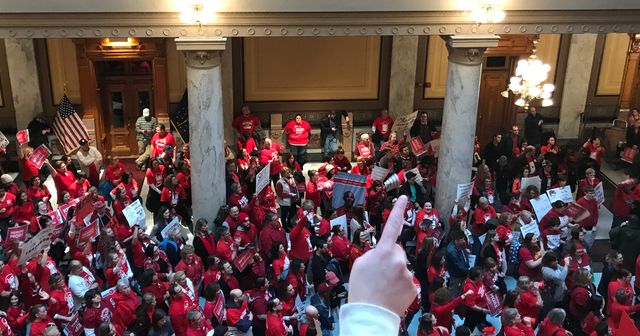
On Saturday, over a thousand teachers from across Indiana rallied in the state Capitol to oppose the growing attacks on public education. The rally, sponsored by the Indiana State Teachers Association (ISTA), was officially billed as the “Indiana Red for Ed Rally” and described as an event to “demand lawmakers provide more resources for our kids and increased pay for teachers.”
Held inside the Indiana Statehouse, ISTA created a party like atmosphere. Continuous loud music blared, reducing the possibility of discussion amongst teachers. Union leaders gave demagogic speeches urging teachers to pressure the Republican legislature of Indiana to fund public schools.
The words “strike” and “walkout” were not mentioned by any of the union officials during their speeches and the union is urgently attempting to avoid a walkout like those that have hit West Virginia and other states.
Nonetheless teachers chanted “strike!” multiple times during the rally. In comments to reporters from the World Socialist Web Site teachers spoke about their conditions and the struggle to defend public education.
Teachers chanting during the rally
Lisa, a first-grade teacher from Washington Township for 15 years, said, “I love teaching students and being there to witness the growth that occurs among our children and to witness when they tap into their own strength and intelligence as we try to nurture that along.
“I’m here because I support public education. The growth of charter schools and privatization is weakening the public school system. It’s an attack against democracy. Public education is the one way that ensures everyone has access to upward mobility, and now that ladder is being shaken.
“As a whole, teacher pay is not increasing, it’s stagnating. Meanwhile, everything else is rising in prices. [With] the growth of the charter schools, CONTINUE READING: Teachers speak out at Indianapolis rally to defend public education - World Socialist Web Site

NYC Public School Parents: John Pane of RAND writes to correct my post on Teach to One and my response

NYC Public School Parents: John Pane of RAND writes to correct my post on Teach to One and my response

John Pane of RAND writes to correct my post on Teach to One and my response


About two weeks ago, I posted a history of the program Teach to One (TtO): how it had first been developed in NYC Department of Education as a blended learning math program called School of One, how after it had spun off from DOE as a separate company called New Classrooms, the developer Joel Rose had promised never to charge NYC schools a fee to use it, instead granting them with a “royalty free, perpetual, non-exclusive license”, but then how the company has continued to charge a license fee to NYC schools anyway. The main focus of the piece was to describe how the huge hype surrounding the Teach to One program and the suppression of the findings of negative or null evaluations of its results has allowed it to expand to more schools, despite disappointing  results and a 60 percent school attrition rate.
In a single paragraph towards the end of this rather lengthy post,  I summarized the findings of a RAND report on the Next Generation Learning Challenge (NGLC) schools, assuming that schools using Teach to One were part of the evaluation, since TtO is a grantee of the NGLC program.  Diane Ravitch subsequently ran excerpts of my blog on hers.
John Pane, the lead researcher on the Rand report, wrote to Diane that New Classrooms / Teach to One was not one of the programs included in this evaluation.  I have posted a correction on that matter on my original blog post.   
He also critiqued the way I reported his remarks to Education Week about “personalized learning” schools in general, that “the evidence base is very weak at this point,” and said that the paragraph in which I described the results of the Rand report had “numerous false and misleading statements,” including my summary of survey results that suggest that the students at NGLC schools “were more likely to feel alienated and unsafe compared to matched students at similar schools.”

He has granted his permission to quote his letter in full below, which I have done, along with my response to the points in his letter.   

On Thu, Mar 7, 2019 at 12:17 PM Pane, John <jpane@rand.org> wrote:
Dear Diane, 
On March 4, 2018 you published this blog entry, “Leonie Haimson: Reality Vs. Hype in “Teach to One” Program,” excerpting from Leonie Haimson’s blog. Your excerpt included this paragraph about my own research (with colleagues) and my public statements:
“The most recent RAND analysis of schools that used personalized learning programs that received funding through the Next Generation Learning initiative, which have included both Summit and Teach to One, concluded there were small and mostly insignificant gains in achievement at these schools, and their students were more likely to feel alienated and unsafe compared to matched students at similar schools. The overall results caused John Pane, the lead RAND researcher, to say to Ed Week that ‘the evidence base [for these schools] is very weak at this point.’“
 This paragraph by Haimson has numerous false and misleading statements. Here I summarize my critique, excerpting the original paragraph: 
“The most recent RAND analysis of schools that used personalized learning programs that received funding through the Next Generation Learning initiative, which have CONTINUE READING: NYC Public School Parents: John Pane of RAND writes to correct my post on Teach to One and my response

Argosy University Collapse Exemplifies Lax Protection of Students—and Taxpayers—Under DeVos | janresseger

Argosy University Collapse Exemplifies Lax Protection of Students—and Taxpayers—Under DeVos | janresseger

Argosy University Collapse Exemplifies Lax Protection of Students—and Taxpayers—Under DeVos


Argosy University, a for-profit college serving  8,800 students at 22 sites across the country, shut down suddenly last Friday.  Actually the collapse has been happening since 2017, but somehow across Argosy’s many campuses most people didn’t quite connect the dots.
And the U.S. Department of Education didn’t intervene until it became clear that the Argosy University had used $13 million in student financial aid for another purpose: paying off the debts of the collapsing institution. Finally when fraud was documented, the Department was forced to step in and deny further financial support in the form of student loans and grants. The university was so completely dependent on federal financial aid for its operations that, when the money stopped arriving, it closed mid-semester. It seems that Argosy was known for its graduate programs in psychology, and its closure leaves its students—some in the midst of writing their dissertations—in the lurch.
Argosy University was part of Dream Center Education Holdings—a nonprofit, religious social service agency.  NY Times reporters Stacy Cowley and Erica Green explain that when Dream Center acquired colleges and trade schools from the failing Education Management Corporation in 2017, Dream Center hoped to make a profit to support its charities. “But Dream Center had never run colleges… Almost immediately, the organization discovered the schools were in worse shape than expected, with aging facilities and outdated technology… Dream Center had anticipated a $30 million profit in its first year…. Instead, it was facing a $38 million loss.”
While last Friday’s closure may have seemed sudden, there were a lot of warning signs, including that Argosy University was in receivership.  Cowley and Green report: “The problems grew in mid-January when a creditor sued Dream Center Education Holdings over unpaid bills and asked a federal court to install a receiver to wind down the insolvent CONTINUE READING: Argosy University Collapse Exemplifies Lax Protection of Students—and Taxpayers—Under DeVos | janresseger


Betsy DeVos’s $5 billion school tax-credit plan is being slammed. And not by whom you might think. - The Washington Post

Betsy DeVos’s $5 billion school tax-credit plan is being slammed. And not by whom you might think. - The Washington Post

Betsy DeVos’s $5 billion school tax-credit plan is being slammed. And not by whom you might think.


You might think that allies of Education Secretary Betsy DeVos would applaud the announcement that the Trump administration is seeking $5 billion for a federal tax credit program that would use public funds to send students to private and religious schools.
Isn’t expanding school choice always a positive to those who want more alternatives to traditional public school districts?
Apparently not in this case — at least not to some of the fiercest school choice advocates who ordinarily embrace DeVos’s thinking on education policy.
The Trump administration is proposing a $5 billion tax-credit program that would be operated from the Treasury Department to provide dollar-for-dollar tax credits to individuals and corporations that contribute to programs that pay for students to attend private and religious schools. The amount would be capped at 10 percent of an individual’s gross income and 5 percent of a business’s taxable income.
Supporters say using public money for private and religious school tuition is part of a necessary movement to provide families with choices for their children, while opponents say such programs harm the school districts that enroll most schoolchildren and that they serve to privatize the public education system.
DeVos recently announced her support of the federal tax-credit proposal, which would mirror programs in Florida, Arizona and other states. She appeared at an event to push legislation creating the program that was introduced in the Senate by Sen. Ted Cruz (R-Tex.) and in the House by Rep. Bradley Byrne (R-Ala.).
While Cruz is gung-ho on the idea, the Republican-led legislature in Texas has repeatedly refused to pass a program that would use public funds for private education, even though there are many charter schools in the state.
Legislators in rural areas in Texas — and other states — who support school choice don’t like these kinds of programs largely because so few private schools exist in the jurisdictions they represent. In 2017, legislators in the Texas House rejected such legislation, and last year, some of the initiative’s biggest backers were voted out while a number of voucher opponents were elected.
DeVos has been active for decades in efforts to push charter schools and voucher and tax-credit programs through state legislatures. But she has always opposed federal involvement in education policy, saying it CONTINUE READING: Betsy DeVos’s $5 billion school tax-credit plan is being slammed. And not by whom you might think. - The Washington Post