Latest News and Comment from Education

Friday, January 18, 2019

In L.A. Teachers' Strike, the State Is the Real Problem - The Atlantic #UTLA #REDFORED #UTLAStrong #StrikeReady #March4Ed #WeAreLA

In L.A. Teachers' Strike, the State Is the Real Problem - The Atlantic

Blame Sacramento
In the L.A. teachers’ strike, the state is the real problem.


Undeterred by an afternoon rainstorm, a band of students, teachers, and parents crowded the streets outside Hollywood High School the other day to chant, whistle, and brandish protest signs in support of United Teachers Los Angeles, the city’s striking teachers’ union.
stop cheaping out on the children read one sign that pretty much summed up the union’s bargaining stance.
Similar scenes are playing out across L.A. in the city’s first teacher strike since a nine-day walkout in 1989. Rallies and protests on behalf of the 35,000 union members have scrambled the daily schedules of nearly 500,000 students and their parents and sparked a tweetstorm of support from boldfaced names in Hollywood and Congress.
The strike was all but inevitable. From his first day in office as union president in 2014, Alex Caputo-Pearl made clear that his vision of quality public education included more money for teachers, smaller class sizes, and expanded student support in the form of more nurses, counselors, and librarians—demands the district has addressed since then only modestly.
Caputo-Pearl’s first contract with the Los Angeles Unified School District expired almost two years ago, and tensions have been building ever since. Teachers simply aren’t buying the argument that there isn’t enough wiggle room to meet their needs in a $7.5 billion operating budget, plus the district’s roughly $2 billion reserve fund. The district’s unwillingness to spend the latter is a major point of contention with the union.
The state requires every district to set aside money for periods of economic uncertainty, for large and unanticipated expenditures, and to be eligible for a higher credit rating. While the union argues that the reserve should all go to teachers, the district says that it has already been earmarked for various costs over the next several years.
And that, says Superintendent Austin Beutner, a former investment banker and publisher of the Los Angeles Times with no prior experience in public education, could push the district into insolvency by 2021.
What if he’s right? What if the district really can’t afford the sort of investment CONTINUE READING: In L.A. Teachers' Strike, the State Is the Real Problem - The Atlantic


Study links black college enrollment to having black teacher in elementary school

Study links black college enrollment to having black teacher in elementary school

To Add Black College Students, Recruit Black Schoolteachers
Study finds long-term impact of having a black teacher in kindergarten through third grade.


Many studies have found a positive impact on black students from having black teachers in elementary and secondary schools. A new working paper from the National Bureau of Economic Research finds that the positive impact may extend far beyond school, to whether black students enroll in college.
The study was primarily based in Tennessee, taking advantage of an experiment in which cohorts of students were randomly placed in different types of classrooms with different student-teacher ratios. The experiment was not designed to focus on black student achievement but provided researchers with a rare sample of students randomly selected to different classes, allowing for comparisons based on a variety of factors. The researchers also replicated their findings in North Carolina, where the study found that having a single black teacher at a young age can decrease the black dropout rate by about one-third.
The key finding in the working paper: "black students randomly assigned to a black teacher in grades K-3 are 5 percentage points (7 percent) more likely to graduate from high school and 4 percentage points (13 percent) more likely to enroll in college than their peers in the same school who are not assigned a black teacher."
The researchers describe their findings as "arguably causal" and say that they are "robust" in a series of comparisons they made. (The Tennessee program has very few Latino participants, so the researchers were unable to measure whether the impact was the same there, although they write that this is an important research question to study.)
Given the way many colleges struggle to recruit black students, the findings could point to a different approach to, over the long term, increasing black college enrollment, by trying to educate more black students to be teachers. At the same time, the authors note that the challenge for American educators isn't just recruiting more black people into education, but thinking about all of the consequences of such a move.
"Findings from this research provide some reason to be optimistic as they provide a path to reducing stubbornly persistent racial attainment gaps," the authors write. "However, they also raise a number of questions, some of which could be addressed in future research, surrounding efforts to diversify the teaching work force. For example, while our study provides strong support for the idea that diversifying the teaching work force could ceteris paribus have a strong and positive effect on historically disadvantaged students, a pipeline that could achieve massive growth in the number of black teachers is nonexistent. Hiring practices that attempt to diversify while maintaining high teacher quality would thus necessitate, for example, re-allocating college educated blacks from other lucrative fields to teaching, a relatively low-paid occupation. Doing so might lead to unintended consequences, such as exacerbating existing racial wage gaps, at least in the short run. To put this issue into perspective, consider the following back-of-the-envelope calculation. Of the roughly 3.8 million K-12 teachers in the U.S., approximately 256,000, or 6.7 percent, are black. Comparing this fraction to the 15.4 percent of K-12 students who are black suggests that doubling CONTINUE READING: Study links black college enrollment to having black teacher in elementary school

Betsy DeVos, in first public appearance after bike accident, criticizes helicopter parents who obsess on 'safety and security’ - The Washington Post

Betsy DeVos, in first public appearance after bike accident, criticizes helicopter parents who obsess on 'safety and security’ - The Washington Post

Betsy DeVos, in first public appearance after bike accident, criticizes helicopter parents who obsess on 'safety and security’


Education Secretary Betsy DeVos on Thursday made her first public appearance since being sidelined in a cycling crash, turning up at an event about youth entrepreneurship in a wheelchair and criticizing parents of the millennial generation who have obsessed on “safety and security” rather than allowing children to take “calculated” and “interesting” risks.
She also said school experiences for children have not changed much from decades ago. “It’s only more protected and more safe,” she said.
DeVos underwent surgery earlier this month for what the Education Department said at the time was a broken bone. On Thursday, DeVos said at the event that she had broken her pelvis and hip socket and that it was “very painful,” Politico reported. She also said: "But it will heal. I just have to stay off of it for quite a few weeks, so I’m getting around with other means.”
DeVos appeared onstage for a question-and-answer session at the headquarters of Gallup, the management consulting firm, at the second annual briefing on “Business Startup Challenges and Youth Entrepreneurship,” which was co-hosted by Gallup and the Lemonade Day national youth entrepreneurship nonprofit organization. The education secretary sat in a wheelchair, and at the end of DeVos’s appearance, a woman walked up to help maneuver the chair off the stage, a video of the event shows.
DeVos has frequently criticized public schools for failing to change over time, and she is a champion of alternatives to traditional public schools.
Taking questions from Joe Daly, a partner at Gallup and a member of Lemonade Day’s board of directors, DeVos offered her opinion about why entrepreneurship among young people has declined. Daly reported polling data that said young people have become less entrepreneurial since 1977 but mostly in the last decade. And the millennial generation is “on track to be even less entrepreneurial” than Generation X and baby boomers.
“Well,” she said, "you certainly are the ones with data, but I have some sort of instinctual ideas about it. I CONTINUE READING: Betsy DeVos, in first public appearance after bike accident, criticizes helicopter parents who obsess on 'safety and security’ - The Washington Post


U.S. Public Education Is Driven by High-Stakes Testing. Are the Proficiency Cut-Scores Legitimate? | janresseger

U.S. Public Education Is Driven by High-Stakes Testing. Are the Proficiency Cut-Scores Legitimate? | janresseger

U.S. Public Education Is Driven by High-Stakes Testing. Are the Proficiency Cut-Scores Legitimate?


Back in 2005, I worked with members of the National Council of Churches Committee on Public Education and Literacy to develop a short resource, Ten Moral Concerns in the No Child Left Behind Act. While closing achievement gaps seemed an important goal, to us it seemed wrong that—according to an unrelenting year-by-year Adequate Yearly Progress schedule—the law blindly held teachers and schools accountable for raising all children’s test performance to the test score targets set by every state. Children come to school with such a wide range of preparation, and achievement gaps are present when children arrive in Kindergarten.  At that time, we expressed our concern this way:
“Till now the No Child Left Behind Act has neither acknowledged where children start the school year nor celebrated their individual accomplishments. A school where the mean eighth grade math score for any one subgroup grows from a third to a sixth grade level has been labeled a “in need of improvement” (a label of failure) even though the students have made significant progress. The law has not acknowledged that every child is unique and that Adequate Yearly Progress (AYP) thresholds are merely benchmarks set by human beings. Although the Department of Education now permits states to measure student growth, because the technology for tracking individual learning over time is far more complicated than the law’s authors anticipated, too many children will continue to be labeled failures even though they are making strides, and their schools will continue to be labeled failures unless all sub-groups of children are on track to reach reading and math proficiency by 2014.”
Of course today we know that the No Child Left Behind Act was supposed to motivate teachers to work harder to raise scores. Policymakers hoped that if they set the bar really high, teachers would figure out how to get kids over it.  It didn’t work.  No Child Left Behind said that all children would be proficient by 2014 or their school would be labeled failing. Finally as 2014 loomed closer, Arne Duncan had to give states waivers to avoid what was going to CONTINUE READING: U.S. Public Education Is Driven by High-Stakes Testing. Are the Proficiency Cut-Scores Legitimate? | janresseger

Special Education: How Has Teacher Preparation Changed?

Special Education: How Has Teacher Preparation Changed?

Special Education: How Has Teacher Preparation Changed?


Sometimes parents of students with disabilities will complain that teachers don’t know how to teach special education. This generalization is difficult to pin down. What specifically makes parents believe this? What is it about their student’s teacher that makes them so critical?
With more student placement in inclusion classes, it also isn’t always clear if they are complaining about a general or special education teacher.
If their child’s teacher didn’t do a good job, why not? What college did that teacher attend, and why didn’t they learn what they needed to effectively teach students with disabilities?
I recently wrote a post critical of Teach for America Corps Members who obtain little preparation to teach students with disabilities, but what about teachers who have college degrees and adequate credentials?
Was the child in an inclusion class where the teacher could not specialize their education well? Resource and self-contained classes are often shunned because CONTINUE READING: Special Education: How Has Teacher Preparation Changed?


Update: Day FOUR Of The L.A. Teachers’ Strike | Larry Ferlazzo's Websites of the Day... #UTLA #REDFORED #UTLAStrong #StrikeReady #March4Ed #WeAreLA

Update: Day FOUR Of The L.A. Teachers’ Strike | Larry Ferlazzo's Websites of the Day...

UPDATE: DAY FOUR OF THE L.A. TEACHERS’ STRIKE


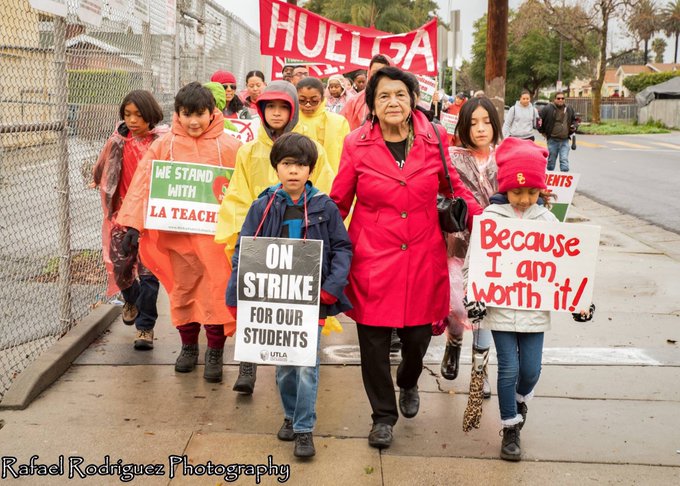
@DoloresHuerta marched with her grandson and his peers, students of LAUSD in support of LA teachers on the third day of their strike.


Thursday, January 17, 2019

Steven Van Zandt: Why I Joined the L.A. Teachers’ Strike – Rolling Stone #UTLA #REDFORED #UTLAStrong #StrikeReady #March4Ed #WeAreLA

Steven Van Zandt: Why I Joined the L.A. Teachers’ Strike – Rolling Stone
Steven Van Zandt: Why I Joined the L.A. Teachers’ Strike
“Teachers are an underfunded and underappreciated part of our working class,” E Street Band guitarist says


Anyone scrutinizing photos of those picketing the current teachers’ strike in Los Angeles may have seen a familiar face (and clothed head) Wednesday: Steven Van Zandt. The strike, which involves 30,000 teachers and affects about 350,000 students, is centered around issues like charter schools (Los Angeles has 224, a huge number for a major city), class size and funding for more staff.
Van Zandt, who has just launched TeachRock, an education program that uses the history of rock as a way into American culture and history, shares his front-line memories to Rolling Stone.
I happened to be here; I was finishing a new record, and someone said, “By the way, people are striking here,” and I said, “I might as well join them. Get some action here.” This celebrity thing is really only good for a couple of things. You can get into a restaurant, and you can do something that’s actually usable.
It’s the unsexiest issue ever, but we’ve been engaged with teachers for a couple of years, trying to raise awareness. Teachers are an underfunded and underappreciated part of our working class. We just finished a tour [the Teacher Solidarity Tour, with free tickets for educators] and everywhere we went, there were teachers on strike — West Virginia, Kentucky, Arizona, Oklahoma. Teachers are right there on the front line fighting against ignorance, and, boy, do we need that right now.
There was a lot of good energy out there. People were holding signs that said, “Beep if you support the teachers,” so it was one big beep-fest. I was on the picket line with a kid who spent last year on the floor in chemistry class. There weren’t enough desks in the room. Jesus Christ! Dozens of teachers told me they’re buying pencils and paper for their classes or starting GoFundMe campaigns for a class trip. These are things we took for granted growing up, but it’s not that way anymore. They CONTINUE READING: Steven Van Zandt: Why I Joined the L.A. Teachers’ Strike – Rolling Stone

Big Education Ape: Picketing with UTLA: A Great and Inspiring Morning | Diane Ravitch's blog #UTLA #REDFORED #UTLAStrong #StrikeReady #March4Ed #WeAreLA - http://bigeducationape.blogspot.com/2019/01/picketing-with-utla-great-and-inspiring.html

L.A. teacher strike may be cutting edge of a revolution against what’s rotten in America | Will Bunch

L.A. teacher strike may be cutting edge of a revolution against what’s rotten in America | Will Bunch

L.A. teacher strike may be cutting edge of a revolution against what’s rotten in America


Joseph Zeccola, a part-time playwright and full-time educator whose passion in the classroom earned him Los Angeles County Teacher of the Year honors just last year, said he heard something recently from an out-of-state union activist that really stuck with him, that “the thing about teachers that makes us different is that we’re always adjusting to the status quo.”
Zeccola said he’s seen his fellow teachers — even himself — calmly accept that status quo over the last decade as tighter and tighter budgets started strangling classroom education in America’s second-largest city, even as the rest of L.A.'s vibrant economy was booming. That meant passive acceptance of skyrocketing class sizes that often jammed more than 40 kids into a room, or forcing schools to make painful spending decisions whether to make nurses, librarians, or mental health aides only part-time — or to ditch those vital services completely.
At the Sherman Oaks Center for Enriched Studies where Zeccola now teaches English and drama after working for years in economically distressed South Central L.A., the school found the cash to pay a librarian two days a week — two days more than many other nearby public schools.
“As an English teacher, there’s nothing more important for success in life than literacy,” he told me by phone Wednesday night, adding: “They also cut out the custodians. At my old school in South Central you could have eaten off the floors — now they mop it twice a month.”


When the calendar flipped over to 2019, Zeccola decided that enough was finally enough — and so did 33,000 other unionized school teachers in the City of Angels. Monday’s walk-out by the United Teachers Los Angeles — the city’s first teachers' strike in 30 years — is CONTINUE READING: L.A. teacher strike may be cutting edge of a revolution against what’s rotten in America | Will Bunch


The L.A. Teachers' Strike Highlights Growing Division On Who Decides: Parents or Government? #UTLA #REDFORED #UTLAStrong #StrikeReady #March4Ed #WeAreLA

The L.A. Teachers' Strike Highlights Growing Division On Who Decides: Parents or Government?

The L.A. Teachers' Strike Highlights Growing Division On Who Decides: Parents or Government?

TWEET THIS


Randi Weingarten, president of the American Federation of Teachers, speaks during a teachers strike rally outside of John Marshall High School in Los Angeles, California, U.S., on Monday, Jan. 14, 2019. Tens of thousands of teachers in Los Angeles walked off the job Monday after months of negotiations between their union and the second largest U.S. school district failed to resolve long-simmering disputes over pay raises, class sizes, inadequate support staffing and public funding for charter schools. Photographer: Scott Heins/Bloomberg© 2019 BLOOMBERG FINANCE LP
The Los Angeles teachers’ strike is in its third day, with no end in sight and only about a quarter of the L.A. Unified School District’s 600,000 students attending classes, which are being taught by substitute teachers.
The strike by the 31,000 members of United Teachers Los Angeles, the union that represents not only teachers, but also nurses, counselors, and librarians, is ostensibly about higher pay and more benefits. That a teachers union, in California of all places, would need more pay and benefits is curious. After all, government unions—especially the teachers unions—enjoy enormous clout in California, from the governor’s office to the Democratic supermajority in the legislature down to local school districts.
But this strike really isn’t about just pay and benefits. It’s about charter schools—specifically, killing them . The real reason for the union’s concern was revealed when on the second day of the strike, the picketers mobbed the downtown L.A. headquarters of the California Charter Schools Association.
Charter schools in California are a form of public school, as they are elsewhere. They’re paid for by the same taxpayers who fund the traditional public school system, and generally, the same neighborhood families attend them. But charters have more flexible rules, less teacher union control, influence and representation. They allow for teacher merit pay, and, most importantly, management more in line with business practices than government bureaucracies. Another difference between charters and traditional schools is charters are schools of choice and cannot exist unless families CONTINUE READING: The L.A. Teachers' Strike Highlights Growing Division On Who Decides: Parents or Government?

Sweetwater Union – the Largest High School District in California – Is Under Attack by Charter School Proponents – Including the San Diego U-T and Voice of San Diego

Sweetwater Union – the Largest High School District in California – Is Under Attack by Charter School Proponents – Including the San Diego U-T and Voice of San Diego

Sweetwater Union – the Largest High School District in California – Is Under Attack by Charter School Proponents – Including the San Diego U-T and Voice of San Diego


Editordude: Here’s the latest post from Thomas Ultican about the latest shenanigans from local charter school supporters in their quest to undermine public education, how the students recruited from public schools into charter ones have drained public school districts’ funds, and how the Sweetwater Union High School District is under attack. In delving into the details, Ultican takes on the San Diego Union-Tribune and the Voice of San Diego for their unabashedly support for charter schools over public schools.
By Thomas Ultican / Tultican
The newly hired Chief Financial Officer of Sweetwater Union High School District (SUHSD), Jenny Salkeld, discovered a significant problem with the budget she inherited. She presented her findings to the Sweetwater leadership team in early September which forwarded her report onto the County Office of Education (COE). The SUHSD board also called in all bargaining units to suspend contract negotiations and inform them of the budgetary uncertainties. Sensationalism and subterfuge became the new reality in Chula Vista, California.
An October San Diego Union-Tribune article reported,
“On June 25, the school board approved a budget for this school year that assumed the district had spent $328 million in unrestricted funding last school year and had $17 million in reserves going into this school year. In September, Salkeld presented a report showing that the district actually had spent $20 million more than that and started this school year with a negative reserve balance of $4 million.
“On top of spending more than previously estimated, the district received $6 million less in one-time state funding than it had expected.”
After receiving Sweetwater’s alert about the accounting errors, the COE officially disapproved the 2018-19 budget the district had submitted. The reasons for disapproving the budget were the reasons Salkeld had reported.
Here are some other key points Ultican makes:
Apparently someone at the county leaked the budget information to the Voice of San Diego. The district which was in the process of understanding the extent of the problem did not have that opportunity. Instead they were faced with a withering public attack in both the CONTINUE READING: Sweetwater Union – the Largest High School District in California – Is Under Attack by Charter School Proponents – Including the San Diego U-T and Voice of San Diego


Betsy DeVos’ bet on boot camps

Betsy DeVos’ bet on boot camps

Betsy DeVos’ bet on boot camps
Why the Department of Education wants to get behind a popular—but unaccredited—new style of education.


As Americans look to build the skills they need for the fast-changing job market, a new type of education provider has swept onto the scene: the coding boot camp, an intensive, short-term training program for students trying to land high-tech jobs.

Although they still account for a tiny share of American higher education, they’re growing fast; last year the camps graduated 20,000 students, 20 percent up from the previous year. As more workers sign up, the camps are drawing attention from policymakers as an efficient, job-focused alternative to a costly and complicated higher-education system.

"These nontraditional technology education models are part of the solution to closing the skills gap,’’ Rep. Kevin McCarthy (R-Calif.) said when he introduced legislation to promote coding camps for military veterans in 2017.

The appeal is easy to see: Instead of the big, expensive infrastructure of traditional higher ed, boot camps tend to be small, adaptable and infused with the kind of startup mentality that drives much of the high-tech job market. And graduates tend to see quick results: Many get jobs quickly with a salary boost that easily covers the average $12,000 tuition.

As boot camps proliferate, policymakers in Washington have been asking whether the federal government should get behind the idea—specifically, by opening up some of the $130 billion it doles out annually in student loan guarantees and Pell Grants for higher education. Currently, this aid can be used only for accredited schools, which means students can’t use federal grants or loans for coding camps, which are unaccredited and largely operate as for-profit businesses.

But the Trump administration, led by Education Secretary Betsy DeVos, wants to expand alternatives to traditional higher education and loosen some federal restrictions to make it easier for accredited colleges and universities to partner with boot camp operators.

The Obama administration had already dipped a toe in that water, experimenting with allowing a small amount of federal aid to go to coding boot camps, among other types of nontraditional education providers. And Congress in 2017 added CONTINUE READING: Betsy DeVos’ bet on boot camps


Update: Day THREE Of The L.A. Teachers’ Strike | Larry Ferlazzo's Websites of the Day... #UTLA #REDFORED #UTLAStrong #StrikeReady #March4Ed #WeAreLA

Update: Day THREE Of The L.A. Teachers’ Strike | Larry Ferlazzo's Websites of the Day...

UPDATE: DAY THREE OF THE L.A. TEACHERS’ STRIKE