Latest News and Comment from Education

Saturday, January 5, 2019

Wrench in the Gears – A Skeptical Parent's Thoughts on Digital Curriculum

Wrench in the Gears – A Skeptical Parent's Thoughts on Digital Curriculum

Wrench in the Gears 
 A Skeptical Parent's Thoughts on Digital Curriculum


When “Community Foundations” Go Global (Or Coastal)

Silicon Valley Community Foundation, Part Five Here for the introduction and parts one , two , three , and four . Community foundations were established a century ago to aggregate assets from individuals, families and businesses and advance the activities of nonprofits operating in a particular geographic area, hence the “community” designation. The first example is generally considered to be The
Charter, Public Health, and Catholic Charity Interests Help Launch “Disruptive” Pay for Success Program

Silicon Valley Community Foundation, Part Four Go here for parts one , two , and three . In a 2013 interview for the Mission Investors Exchange publication, “Community Foundation Field Guide to Impact Investing,” Chief Giving Officer Ellen Clement Glass stated there had been talk of exploring impact investing as early as 2006, before the Silicon Valley Community Foundation had even been officiall
Philanthropy’s lesser known weapons: PRIs, MRIs and DAFs

Silicon Valley Community Foundation, Part Three Go here for parts one and two . Last year, the 800+ community foundations in the United States held a combined total of over $91 billion in assets and awarded $8.3 billion in grants. As non-profits are incorporated into the “evidence-based” impact agenda, it is important to keep in mind $8 billion+ buys a lot of influence. All you need to do is spen
To Serve Man: It’s A Cookbook!

Silicon Valley Community Foundation, Part Two Go here for part one. Not only is the Silicon Valley Community Foundation (SVCF) among the largest foundations in the country, it is also situated in the belly of the beast. The Bay Area is where vast amounts of venture capital have combined with public and privately funded research to propel advances in Artificial Intelligence (AI), machine learning,
Silicon Valley’s Social Impact Deal Maker

Silicon Valley Community Foundation, Part One Here for parts two , three , four and five. Feature image is from this New York Times article . The Silicon Valley Community Foundation (SVCF) has been a key player in outcomes-based contracting test cases emerging in the Bay Area over the past five years ( here for more information). It is the largest community foundation in the United States with as
Toxic Philanthropy Part Three: The Silicon Valley Community Foundation

I spent quite a few hours over winter break exploring various aspects of the Silicon Valley Community Foundation’s (SVCF) operations and have prepared a series of posts documenting what I have found thus far. This series is intended to provide context for my previous research on Pay for Success pilot programs being rolled out in Santa Clara County, CA, the heart of Silicon Valley (more here ). SV

DEC 22 2018

Silicon Valley: A Laboratory of “Smart” Surveillance and Privatization

The scope of my research has expanded greatly since I began this journey five years ago. My starting point was standardized testing. At the time I was under the naive impression that withholding student test scores could in and of itself forestall the closure or “turnaround” of neighborhood schools in Philadelphia. During the spring and summer of 2015, I realized “end of year testing” was merely

DEC 20 2018


When “What Works” Harms Students: Why Stopping Summit Learning Isn’t Enough

Featured image from OpenPTrac , body-based cyberlearning tools, developed as part of an NSF grant “Promoting Learning Through Annotation of Embodiment (PLAE),” Dr. Noel Enyedy, co-principal investigator. On December 
Wrench in the Gears – A Skeptical Parent's Thoughts on Digital Curriculum


Those Wishing to Destroy Public Education Are Retooling for 2019

Those Wishing to Destroy Public Education Are Retooling for 2019

Those Wishing to Destroy Public Education Are Retooling for 2019

By Thomas Ultican / Tultican
The destroy public education (DPE) national coordinating organization, Education Cities, has been closed, with its assets and personnel distributed to three new organizations; The City Fund, School Board Partners and Community Engagement Partners.
And there is more. In an interview with The 74, City Fund’s Managing Partner, Neerav Kingsland, revealed the establishment a new political action committee under IRS code 501 C4 called Public School Allies.
In October, the California Charter Schools Association (CCSA) announced that its leader for the past 10 years, Jed Wallace, would step down in January, 2019. The new President of CCSA will be Myrna Castrejón who is currently Director of Great Public Schools Now (GPSN). The announcement says of Wallace’s future, “He will move onto a new role advising charter school organizations across the United States.” Under Wallace’s leadership the CCSA replaced the California Teachers Association as the state’s largest lobbying effort on education issues.
The LittleSis map below shows the money coming into The City Fund and the new postings for the former Education Cities’ staff. During the interview cited above, Kirkland said, “Along with the Hastings Fund and the Arnold Foundation, we’ve also received funds from the Dell Foundation, the Gates Foundation, the Walton Family Foundation, and the Ballmer Group.” The amount of money given by the Walton family and Ballmer is unknown.
[Editordude: for the balance of this article, please to to Tultican blog.]


Challenging the myths about teachers – Live Long and Prosper

Challenging the myths about teachers – Live Long and Prosper

Challenging the myths about teachers


It’s always dangerous to read comments on the internet. The anonymity afforded users makes it easy for them to rant, bitch, and promote myths and lies. The last week of 2018 was no different.

The Wall Street Journal posted the following article on Dec. 28th…
Teachers Quit Jobs at Highest Rate on Record by Michelle Hackman and Eric Morath.  (Note: This article is behind a paywall. You can read a review of the article at The Hill, Teachers in America quitting jobs at record rate)
The authors discussed the teacher shortage, last year’s state-wide teacher strikes, and the lack of support that teachers get. You can read about all that on your own…today I’m going to focus on the comments the article generated.
Now, I know that the editorial page of the Wall Street Journal is very conservative so it’s not surprising that many of the people who comment are similarly inclined. For one reason or another, some of those conservatives, seem to hate public education, public school teachers, and public sector unions (surprise, surprise!). Many left angry CONTINUE READING: Challenging the myths about teachers – Live Long and Prosper


How Many Decisions Do Teachers Make Every Day? | gadflyonthewallblog

How Many Decisions Do Teachers Make Every Day? | gadflyonthewallblog

How Many Decisions Do Teachers Make Every Day?

Teaching is an exhausting job.
If you’re a parent, you know how tiring it is with just one or two kids.
Imagine having a room full of them — Twenty to thirty children, each demanding your attention, each requiring your urgent help – every minute, every day, for hours at a time.
Back in the late 1980s, before education became totally absorbed by standardized testing and school privatization, we used to wonder about the effects of such need on a single individual.
We used to wonder how much was really being asked of our teachers.
Today no one outside of the classroom really gives it much thought. We think of educators as part of a vast machine that is required to give us and our children a service.
We’re stakeholders. They’re service providers. And the students are a national resource.
None of us are people.
Perhaps it’s this dehumanizing economic framework that’s helped the edtech industry and testing corporations make so much headway trying to replace educators with apps and iPads.
But back in the days before George W. Bush’s No Child Left Behind or Barrack Obama’s copycat Race to the Top, or Donald Trump’s blatant Destroy Public Education, we Continue reading: How Many Decisions Do Teachers Make Every Day? | gadflyonthewallblog

Sign up for our free Jan. 20 webinar on how educators can better protect their students’ privacy — and their own | Parent Coalition for Student Privacy

Sign up for our free Jan. 20 webinar on how educators can better protect their students’ privacy — and their own | Parent Coalition for Student Privacy

SIGN UP FOR OUR FREE JAN. 20 WEBINAR ON HOW EDUCATORS CAN BETTER PROTECT THEIR STUDENTS’ PRIVACY — AND THEIR OWN


A few weeks ago, it was reported that the personal information of 500,000 San Diego students, former students and school staff was exposed in a massive breach. At about the same time, education institutions and organizations were rated as the worst sector for cybersecurity in a 2018 report.
We invite you to join us for a short webinar on Jan. 20, with important tips on how teachers and district/school staff members can better protect their students’ privacy of and their own.
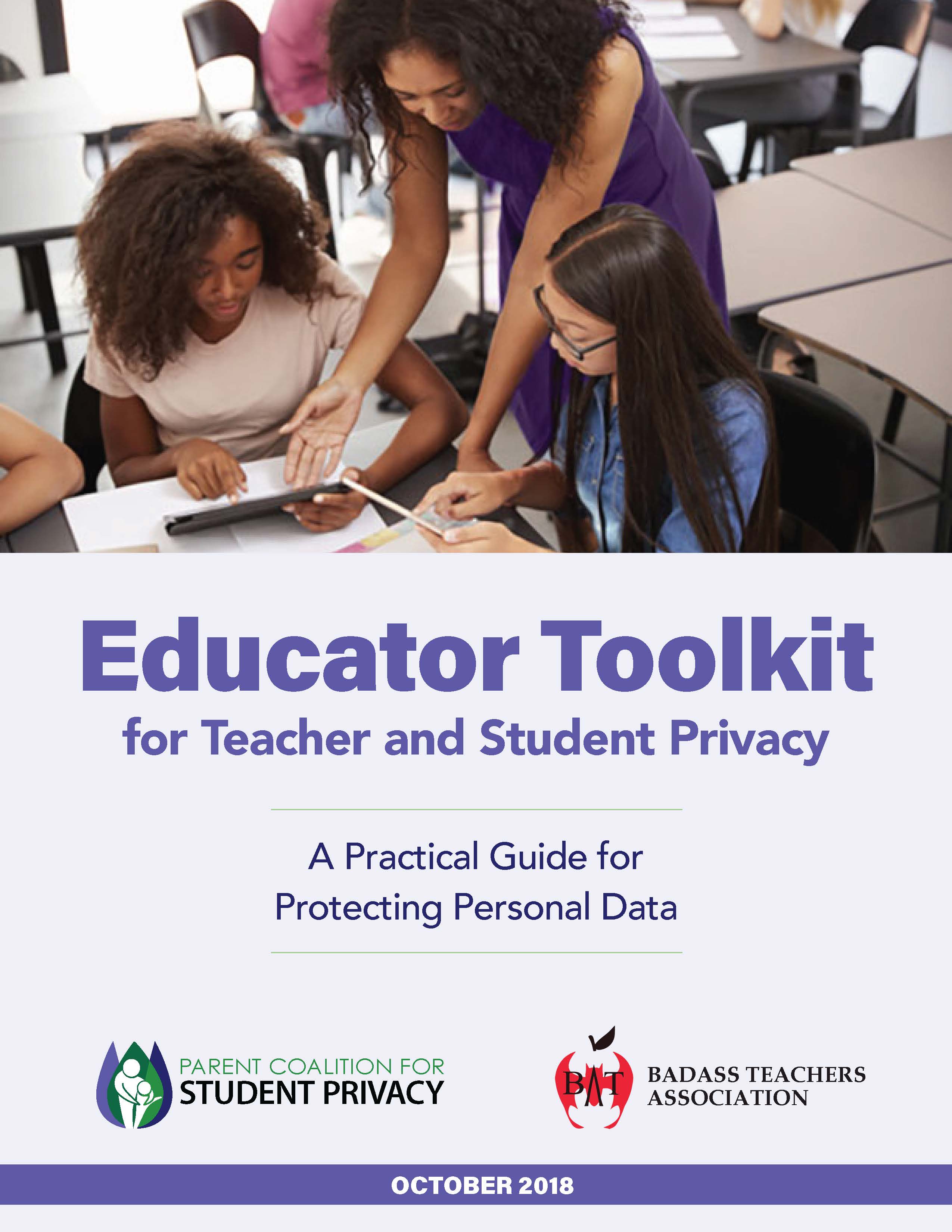
We will be offering guidance along with Marla Kilfoyle of the Badass Teachers Association from our  Educator Toolkit for Teacher and Student Privacy, released this fall. Educators will receive a certificate of participation. Don’t miss out! Space is limited!
When? Sunday, January 20 from 6-7 PM EST (3-4 PST). We’re saving lots of time for questions!
How? Sign up here – it’s free!
We hope to see you on the 20th.
Leonie Haimson  and Rachael Stickland
Co-Chairs, Parent Coalition for Student Privacy
Sign up for our free Jan. 20 webinar on how educators can better protect their students’ privacy — and their own | Parent Coalition for Student Privacy

Cover
Learn how to protect teacher and students data.
Download a copy of the toolkit HERE

Friday, January 4, 2019

Julian Vasquez Heilig: NEPC Review: Bigger Bang, Fewer Bucks? (University of Arkansas Department of Education Reform, February 2018) | National Education Policy Center

NEPC Review: Bigger Bang, Fewer Bucks? (University of Arkansas Department of Education Reform, February 2018) | National Education Policy Center

NEPC Review: Bigger Bang, Fewer Bucks? (University of Arkansas Department of Education Reform, February 2018)


Reviewer:  Julian Vasquez Heilig
A report released by the University of Arkansas Department of Education Reform contends that charter schools produce more achievement per dollar invested, as compared to public schools. This newest report is focused on city-level analyses in eight US cities (Atlanta, Boston, Denver, Houston, Indianapolis, New York City, San Antonio, and Washington D.C.) and uses cost effectiveness and Return on Investment (ROI) ratios. It concludes that charter schools deliver a weighted average of an additional 4.34 NAEP reading points and 4.73 NAEP math points per $1000 invested. The report also argues that that charter schools offer an advantage of $1.77 in lifetime earnings for each dollar invested, representing a ROI benefit of 38%. However, there are a variety of methodological choices made by the authors that threaten the validity of the results. For example, the report uses revenues rather than actual expenditures – despite well-established critiques of this approach. The report also fails to account for the non-comparability of the student populations in charter and comparison public schools. Three other problems also undercut the report’s claims. First, even though the think tank’s earlier productivity report included a caveat saying that causal claims would not be appropriate, the new report omits that caution. Second, the report’s lack of specificity plagues the accuracy and validity of its calculations; e.g., using state-level data in city-level analyses and completely excluding race and gender. Finally, the authors again fail to reconcile their report with the extensive literature of contrary findings.


Share

Document Reviewed:

Bigger Bang, Fewer Bucks? (University of Arkansas Department of Education Reform, February 2018)

Corey A. DeAngelis, Patrick J. Wolf, Larry D. Maloney, & Jay F. Mayand
University of Arkansas Department of Education Reform

NEPC Review: Bigger Bang, Fewer Bucks? (University of Arkansas Department of Education Reform, February 2018) | National Education Policy Center


How School Reform, Including Common Core, Has Devastated Children and Their Joy of Learning to Read

How School Reform, Including Common Core, Has Devastated Children and Their Joy of Learning to Read

How School Reform, Including Common Core, Has Devastated Children and Their Joy of Learning to Read


School reform has taken a toll on children starting in kindergarten (even preschool). There’s little doubt that children are being forced to learn to read earlier than ever before. The reading gap likely reflects the developmental differences found in children when they are forced to read too soon.
Why are schools doing this? Forcing kindergarteners to read before they’re ready means that many will fail.
Are the resulting poor reading scores being used to bring teachers and public schools down?
Blaming teachers and public schools for reading failure, might make parents more amenable to placing their children in front of computer screens for unproven reading instruction, or it helps to sell reading programs that promise miracles for all children.
Great Schools is a nonprofit that rates public schools and promotes virtual education. They’re no friend to teachers or public education.
If learning to read is like building a skyscraper, then kindergarten is the year to CONTINUE READING: How School Reform, Including Common Core, Has Devastated Children and Their Joy of Learning to Read


Change is Coming in the World of Education Reform: Fordham Institute Edition | Eclectablog

Change is Coming in the World of Education Reform: Fordham Institute Edition | Eclectablog

Change is Coming in the World of Education Reform: Fordham Institute Edition

I have to say that it’s pretty amusing to see an–allegedly–education-focused website like the Fordham Institute print this “sky is falling” forecast of new Wisconsin governor Tony Evers’ predicted influence on schooling in the state, but it’s illustrative of Fordham’s deep hatred for public education, and their support for the corporate ed reform agenda. Between the twisting of facts and innuendos, it’s like taking a stroll through a hallway of funhouse mirrors…so join me as we take a peek at their concerns:
  1. They are concerned that Evers wants to adequately fund schools: “Evers wants to increase school funding—even more than Walker”…
Yes, because Walker was such a big supporter of public schools. (My eyes just rolled back so hard they bumped into the rear of my skull.)
This point is supported by some snarky references to the “fact” that spending increases (caveat: above a certain threshold) don’t improve student learning–because, you know, no one with the financial means to do so ever decides to buy a house in a community that spends a lot of money on their kids’ schools. And because standardized test scores aren’t directly correlated with parental income levels. And because spending more money on stuff helps in every single other aspect of life…except for education.
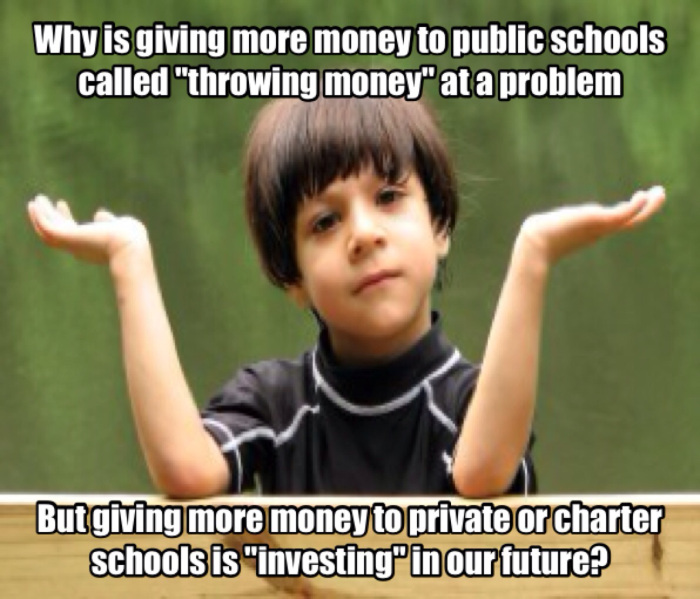
(The next time some neo-con tells you that “throwing money at education doesn’t do any good!”, tell them, “You may be right, but spending less money on schools hasn’t worked, so let’s try CONTINUE READING: Change is Coming in the World of Education Reform: Fordham Institute Edition | Eclectablog

CURMUDGUCATION: After the Education Wars: The Best and Worst of Reform

CURMUDGUCATION: After the Education Wars: The Best and Worst of Reform

After the Education Wars: The Best and Worst of Reform


Andrea Gabor is a business journalist by trade, and it's our great good fortune that she followed the thread of business-style reform into the world of education. Her recent book, After the Education Wars: How Smart Schools Upend the Business of Reform, is an invaluable addition to the literature of ed reform-- not the faux reform that has been foisted on us for the past decades, but ac dual improvement of schools and education. With a journalist's keen eye for detail and gift for story-telling, Gabor delivers compact, fair and gripping tales of education reform in four cities, showing both what worked and what didn't. The book combines thorough research with sharp insight and-- well, there are plenty of books about ed reform that are "interesting if you're into that sort of thing." Gabor's book is just plain interesting and hugely readable. If you're afraid this review is too long to read, let me cut to the chase-- read this book.


Gabor is a fan of W. Edwards Deming, the American engineer who helped Japan create their post-war industrial boom but who was long ignored in this country. The story she finds in business-driven ed reform is the story of businessmen who keep learning and applying the wrong lessons, and whose distrust of educators combine with their arrogance about their own expertise result in repeated versions of the same mistakes. They keep returning to a topdown, hierarchal, siloed organization driven with carrot-and-stick incentives "about as successful," says Gabor, "as a Ford Pinto or a Deep Water Horizon drilling operation." But the debates about industrial management in this country were largely won by the Taylorites, who put their faith in sort-of-scientific data and a view of workers as rats in a Skinner box. The Deming systems approach, valuing an atmosphere of trust and empowerment.

This may all seem very esoteric, but it shakes out in some important ways. To oversimplify-- a Taylorite approach says that individuals mess up the system, and you make the system better by rooting out the "bad" individuals, while a Deming approach says that problem individuals are signs of flaws in your system. You can see the Taylorite approach manifest in the long-standing reformer emphasis on finding bad teachers and firing them as a ay to fix schools. My favorite Deming observation is about deadwood in an organization. Deming asked if it was dead when you hired it or did you hire a live tree and then  CONTINUE READING: 
CURMUDGUCATION: After the Education Wars: The Best and Worst of Reform


Support Season 2 of 'Radical Cram School'

Support Season 2 of 'Radical Cram School'

SUPPORT SEASON 2 OF 'RADICAL CRAM SCHOOL'

"Sesame Street for the resistance"


Our pal, performance artist and provocateur Kristina Wong, is in the throes of raising money for season two of Radical Cram School, her kid-centric, unscripted web series that empowers Asian American kids and all kids of color to embrace their identities, fight for social justice, and be the revolution. Think that's a bit too much for kids to handle? Just watch season one. Under Kristina's tutelage, these kids our going to save us all.


Radical Cram School was a conceived by a team of parents, educators, artists, comedians and activists as the kind of programming they wished they had as kids -- tools for combating the misogynit, xenophobic, and anti-immigrant rhetoric of today's political climate. Season 1 premiered in August 2018 to righteous acclaim, as well as considerable hate from all the kinds of people you certainly want to piss off. 

You can help make another season of progressive, heartfelt, humorous content for kids. Season 2 of Radical Cram School promises even more timely, more inclusive programming to tackle even bigger issues our kids have to navigate: consent, gun violence, undocumented immigration, emasculation and civic participation.

The goal is raise $20,000 to cover production costs. For further information about Radical Cram School, and to make a pledge to support a second season of this revolutionary web series, head over to Seed & Spark


Support Season 2 of 'Radical Cram School'

Angry Asian Man
Angry Asian Man - http://blog.angryasianman.com/ via @angryasianman

How K–12 Schools Have Adopted Artificial Intelligence | EdTech Magazine

How K–12 Schools Have Adopted Artificial Intelligence | EdTech Magazine

How K–12 Schools Have Adopted Artificial Intelligence
AI integration offers new potential to improve student outcomes and security.

Over the past several years, artificial intelligence transitioned from the movie screen to reality, and soon it will be everywhere.
The ubiquity of AI across industries leads to two key points for K–12 schools
First, K–12 schools should use current AI solutions to help with everything from classroom performance to network safety and monitoring. Second, students need to start learning how to design, manipulate and work alongside AI machines in order to build the foundation they need as they prepare to enter the workplace.
Organizing a successful AI integration and education plan will take collaboration and proper planningon the part of school decision-makers.
“AI may hold the potential to personalize instruction and learning. Yet its use in educational settings will require educators and school leaders to develop an understanding of how it can be implemented safely and smartly,” Keith Krueger, CEO of the Consortium for School Networking said in a recent statement

AI Can Act as A Multifaceted Digital Assistant

Artificial intelligence offers a helping hand to K–12 educators, staff and administrators, easing the burden of daily tasks and extending constrained resources.
Personalized learning, for example, is being rapidly adopted by educators as a key pedagogy. However, one of the most difficult parts of personalized learning is finding the time to give each student the attention he or she needs. 
AI-enabled teaching assistants and mobile applications help educators meet that challenge, using input from students to adjust course materials through educational apps, leaving teachers time to CONTINUE READING: How K–12 Schools Have Adopted Artificial Intelligence | EdTech Magazine
Image result for can you spot an infomercial

Charter Schools Haunt More Election Races | Dissident Voice

Charter Schools Haunt More Election Races | Dissident Voice

Charter Schools Haunt More Election Races


The intensely controversial nature of nonprofit and for-profit charter schools in the U.S., due in no small part to endless news about the infinite problems plaguing them, is increasingly a major issue in local, state, and federal election campaigns. It is hard to find a political race today where a candidate, especially a school board candidate, is not expected to have some position, hopefully well-worked out, but usually not, on charter schools. Tens of millions of dollars are being spent in some places based almost entirely on whether a candidate supports or opposes charter schools (e.g., California recently). This point is especially critical to appreciate as the tide against charter schools steadily rises. The last thing charter school advocates want is to open the door to disciplined investigation and serious discussion on charter schools. For them, disinformation and propaganda must have the upper hand. Informed, conscious, and oriented people do not serve their agenda.
Currently, more than a dozen individuals are vying for the position of Mayor of Chicago, a powerful position in one of the country’s largest cities, not to mention home to about 125 charter schools and the place from whence education privatizer and former U.S. Secretary of Education, Arne Duncan, sprung. Elections will be held on February 26, 2019. Incumbent Mayor, Rahm Emanuel, is not seeking reelection.
A December 28, 2018 Chicago Sun-Times article titled, “Where 14 candidates for mayor stand on charter schools — their full responses,” exposes the extreme confusion that has traumatized the public and distorted the “great charter school debate” for decades.
The first paragraph of the Chicago Sun-Times article reads: “Fourteen of the candidates for mayor responded to our question about the future of charter schools in Chicago. We asked: What is the appropriate role of charter schools within the Chicago Public Schools system?”
Revealing its bias, the Chicago Sun-Times automatically assumes that charter CONTINUE READING:Charter Schools Haunt More Election Races | Dissident Voice


Walmart Heirs Invest Heavily to Promote Charter Schools | janresseger

Walmart Heirs Invest Heavily to Promote Charter Schools | janresseger

Walmart Heirs Invest Heavily to Promote Charter Schools


Twas the night before Christmas, and if you were reading the newspaper, you may have noticed some coverage of school privatization.  In case you missed it, please read Sally Ho’s article for the Associated Press on the Walton family’s financial investment in promoting charter schools in African American communities.
Ho describes how the Waltons have been investing to swing a contentious debate about the implications of growing school privatization: “Charter schools, which are publicly funded and privately operated, are often located in urban areas with large black populations, intended as alternatives to struggling city schools.  Black enrollment in charters has doubled over the course of a decade, to more than 760,000 students as of 2015-16… but the rise also has been marked by concerns about racial segregation, inconsistent student outcomes, and the hollowing-out of neighborhood public schools.  While some black leaders see charters as a safer, better alternative in their communities, a deep rift of opinion was exposed by a 2016 call for a moratorium on charters by the NAACP, a longtime skeptic that expressed concerns about school privatization, transparency and accountability issues. The Black Lives Matter movement is also among those that have demanded charter school growth be curbed.”

Ho reports that pro-charter Walton money has flowed to organizations like the United Negro College Fund for scholarships for students who want to pursue education “reform,” to the Congressional Black Caucus Foundation to sponsor events, and to 100 Black Men of America and the National Urban League for support of charter schools.  Walton money also paid for a luncheon at a conference of the National Association of Black Journalists, a luncheon featuring a panel of Walton pro-charter grantees.
Walton money has underwritten local efforts as well, including transporting three busloads of charter school supporters from Memphis to protest at a Cincinnati meeting of the NAACP, where the agenda focused on the NAACP’s 2016 resolution to press for a moratorium on new charter schools.
At the local level this year the Waltons are also bankrolling political candidates. The Chicago Sun-Times followed up the day after Christmas with an in-depth report on Walton money CONTINUE READING: Walmart Heirs Invest Heavily to Promote Charter Schools | janresseger


Yes, there are online preschools. And early childhood experts say they stink. - The Washington Post

Yes, there are online preschools. And early childhood experts say they stink. - The Washington Post

Yes, there are online preschools. And early childhood experts say they stink.


In February 2015 I wrote a post with this headline: “And now, online preschools. Really.”
Given that medical experts warn against too much screen time for young children, and given that early childhood experts say the best way for young children to learn is through structured play, it might have seemed that online preschools didn’t have much of a future.
Guess again.
As early childhood education has increasingly become focused on what is called “rigor,” or an academic focus, which means that kids spend a lot of time in chairs, online preschools have gained a foothold. In 2015, Utah sponsored the first state-funded online “preschool” of its kind, called UPSTART. And the company has expanded pilot programs to at least seven other states, according to the nonprofit Defending the Early Years, which commissions research about early childhood education and advocates for sane policies for young children.

Here’s how the Hechinger Report, an independent nonprofit that reports education news, described some of them in this October 2018 post:
Some online preschool programs boast “award-winning curriculum” and offer money-back satisfaction guarantees. Others offer subjects like science and art and virtual field trips to animated farms. One kindergarten-readiness program offers children the promise of academic growth in as little as 15 minutes a day, five days a week. It receives funding from the state of Utah to provide online learning to rural children and has launched pilot programs in several states across the country, including Mississippi...
Online preschool programs have been growing in recent years, and thousands of parents have signed their children up. The programs offer everything from educational games to a full preschool curriculum complete with boxes of activities that are shipped to a student’s home and a teacher’s guide for an adult. Most online programs are offered by for-profit companies, although perhaps the fastest-growing is UPSTART, which was developed by the nonprofit Waterford Institute and is advertised as a kindergarten-readiness program. That program has been used by children in Idaho, Indiana, South Carolina, rural Ohio and Philadelphia, and is used by 30 percent of Utah’s 4-year-olds. In 2013, the Waterford Institute received an $11.5 million federal grant to expand the program to rural children in Utah.
This past October, more than 100 early childhood experts and organizations signed a statement calling for an CONTINUE READING: Yes, there are online preschools. And early childhood experts say they stink. - The Washington Post