Tuesday, December 11, 2018

Screen time kids study: Groundbreaking study examines effects of screen time on kids - 60 Minutes - CBS News

Screen time kids study: Groundbreaking study examines effects of screen time on kids - 60 Minutes - CBS News

Groundbreaking study examines effects of screen time on kids

60 Minutes goes inside a landmark government study of young minds to see if phones, tablets and other screens are impacting adolescent brain development


If you have kids and wonder if all that time they spend on their smartphones endlessly scrolling, snapping and texting is affecting their brains, you might want to put down your own phone and pay attention. The federal government, through the National Institutes of Health, has launched the most ambitious study of adolescent brain development ever attempted. In part, scientists are trying to understand what no one currently does: how all that screen time impacts the physical structure of your kids' brains, as well as their emotional development and mental health.
At 21 sites across the country scientists have begun interviewing nine and ten-year-olds and scanning their brains. They'll follow more than 11,000 kids for a decade, and spend $300 million doing it. Dr. Gaya Dowling of the National Institutes of Health gave us a glimpse of what they've learned so far.
Dr. Gaya Dowling: The focus when we first started talking about doing this study was tobacco, marijuana, all drugs the screen time component really came into play because we were wondering what is the impact? I mean, clearly kids spend so much time on screens.
The first wave of data from brain scans of 4,500 participants is in and it has Dr. Dowling of the NIH and other scientists intrigued.
The MRI's found significant differences in the brains of some kids who use smartphones, tablets, and video games more than seven hours a day.

"We're sort of in the midst of a natural kind of uncontrolled experiment on the next generation of children."

Dr. Gaya Dowling: What we can say is that this is what the brains look like of kids who spend a lot of time on screens. And it's not just one pattern.
Anderson Cooper: That's fascinating.
Dr. Gaya Dowling: It's very fascinating.
The colors show differences in the nine and ten-year-olds' brains. The red color represents premature thinning of the cortex. That's the wrinkly outermost layer of the brain that CONTINUE READING: Screen time kids study: Groundbreaking study examines effects of screen time on kids - 60 Minutes - CBS News

Fight for Federal Right to Education Takes a New turn Education Law Prof Blog

Education Law Prof Blog

Fight for Federal Right to Education Takes a New turn


A new fight to secure a federal constitutional right to education is spreading across the country. This fight has been a long time coming and is now suddenly at full steam.
In 1973, plaintiffs in San Antonio Independent School District v. Rodriguez argued that school funding inequities violated the right to education. The Supreme Court rejected education as a fundamental right under the federal Constitution, leaving funding inequalities in Texas and elsewhere completely untouched. For more than 40 years, no one even dared to directly challenge Rodriguez’s conclusion in court. Now, in just two years, four different legal teams and plaintiff groups have done just that. But this time, they are shifting their arguments away from just claims about money. They are focusing on educational quality, literacy and learning outcomes.
The boldest claim was filed on Nov. 29 in Rhode Island, arguing for an education that prepares students for citizenship – an argument that draws directly on my own legal research and expertise as a scholar of education law.
When plaintiffs filed the first two cases in Detroit and Connecticut in 2016, the Supreme Court was set to shift significantly to the left. Hillary Clinton was a strong favorite to win the presidency and fill the vacancy created by the death of Justice Antonin Scalia. What looked like perfect timing for plaintiffs in mid-2016 turned awful a few months later when Clinton lost. The questions now are why plaintiffs, including new ones, continue to press forward and whether they have any chance of winning. The answers lie in a strange and tangled confluence of events that include school funding shifts, new legal theories and evolving cultural challenges.


Steep declines in school funding

Schools’ real-world problems are first and foremost driving the litigation. Detroit’s schools, for instance, are among the most segregated, lowest performing and most financially strapped in the country. The net result, plaintiffs allege, are schools where “illiteracy is the norm.” Detroit’s problems, while severe, are not entirely unique. Public schools nationwide are suffering from increasing segregation and a decade of steep funding cuts.
State tax revenues have been up since 2012, but most states continue to fund education at a lower level than they did before the 2008 recession.
While many state supreme courts allow students to challenge educational inequality and inadequacy, about 20 do CONTINUE READING: Education Law Prof Blog


 (Also see FY 2015 chart or FY 2014 chart.) 


NOTE: Adult education, community services and other nonelementary-secondary program expenditures are excluded. Enrollments for state educational facilities and charter schools whose charters are held by nongovernmental entities are also not reflected in the totals. "Other" spending includes non-personnel related expenses, such as capital outlays and transfer payments to municipal entities.
SOURCE: U.S. Census Bureau 2016 Annual Survey of School System Finances

Education Spending Per Student by State - http://www.governing.com/gov-data/education-data/state-education-spending-per-pupil-data.html on @governing

New from the National Education Policy Center: “How School Privatization Opens the Door for Discrimination” | janresseger

New from the National Education Policy Center: “How School Privatization Opens the Door for Discrimination” | janresseger

New from the National Education Policy Center: “How School Privatization Opens the Door for Discrimination”


Last week this blog explored some of the ways the expansion of school choice ends up creating injustice and inequality. The National Education Policy Center just published a new report, How School Privatization Opens the Door for Discrimination, in which Julie Mead of the University of Wisconsin and Suzanne Eckes of Indiana University further investigate one particular aspect of the same topic: how privately operated charter schools and private schools receiving publicly funded tuition vouchers fail, often quite legally, to protect the civil rights rights of their students and staff.
Mead and Eckes explain: “Our review of relevant laws indicates that voucher and charter school programs open the door to discrimination because of three phenomena.  First, federal law defines discrimination differently in public and private spaces. Second, state legislatures have largely ignored the issue of non-discrimination while constructing voucher laws and have created charter laws that fail to comprehensively address non-discrimination. And third, because private and charter schools have been given authority to determine what programs to offer, they have the ability to attract some populations while excluding others.”
The new report briefly summarizes the history of attempts to ensure that public schools protect the rights of all students: “Whether and to what degree schools should be available to all children without regard to race, national origin, religion, immigration status, first language, sex, sexual orientation, gender identity, and disability has a long litigious history.  While it is routine now to observe that public schools must enroll all students, that understanding evolved over time beginning with litigation in the 1950s.  As illustrated by the decisions in Brown v. the Board of EducationLau v. Nichols, Plyler v. Doe, and Mills v. the Board of Education of the District of Columbia, it took many brave plaintiffs and unflinching jurists to reach the conclusion that the term ‘public’ excludes no one and that equal educational opportunity defines our collective obligation to our nation’s children.  Congress reinforced those rulings by enacting a series of federal laws to emphasize that discrimination has no place in public education… Despite such hard fought judicial and legislative battles, public schools still struggle to realize that aspirational ideal.  Persistent achievement gaps, funding disparities, over-representation of students of color in special education, under-representation of students or color in advanced placement and honors programs, and the continued overuse of suspension and expulsion all suggest that public schools and the state and local officials who operate them have much work to do before equal educational CONTINUE READING: New from the National Education Policy Center: “How School Privatization Opens the Door for Discrimination” | janresseger


Florida: Governor-Elect Appoints a Public School Hater as Commissioner of Education | Diane Ravitch's blog

Florida: Governor-Elect Appoints a Public School Hater as Commissioner of Education | Diane Ravitch's blog

Florida: Governor-Elect Appoints a Public School Hater as Commissioner of Education


Republican Ron DeSantis was elected Governor of Florida in a close election, besting Andrew Gillum. DeSantis is a Tea Party extremist who has pledged to continue Rick Scott’s ruinous policies towards the environment and education. His choice for Commissioner of Education is Richard Corcoran, Out-of-office speaker of the House, whose wife runs a charter school. Corcoran supports charters, vouchers, and every possible alternative to public schools. He sponsored legislation to award bonuses to teachers based on their high school SAT/ACT scores. He has no education experience.
The League of Women Voters of Florida published a strong statement opposing his nomination.
The League sent this letter to The State Board of Education:
Dear Chairwoman and State Board Members,
With the impending departure of Commissioner of Education Pam Stewart, the League of Women Voters of Florida reminds you that as members of the State Board of Education you not only have the opportunity, but a constitutional responsibility, to conduct a national search to find the person who is best suited to oversee Florida’s system of public education.
Article IX, Section 2 of the Constitution of Florida was overwhelmingly adopted by the people of Florida in 1998. That provision created the Board of Education, consisting of seven members serving staggered terms to oversee Florida’s system of free public schools.

By enacting that provision, the people of Florida made it clear in the Constitution that it is the Board of Education — not the Governor — that has the responsibility to appoint a Commissioner of Education. Further, the Board of Education members’ terms of office were purposely CONTINUE REAIDNG: Florida: Governor-Elect Appoints a Public School Hater as Commissioner of Education | Diane Ravitch's blog

Monday, December 10, 2018

Teachers Union Leaders on Chicago Charter School Strike Victory

Teachers Union Leaders on Chicago Charter School Strike Victory

Teachers Union Leaders on Chicago Charter School Strike Victory


CHICAGO - American Federation of Teachers President Randi Weingarten, Chicago Teachers Union President Jesse Sharkey, and union bargaining committee member Martha Baumgarten issued the following statements after the bargaining team for 500 striking educators at 15 Acero charter schools reached a tentative agreement with management today. The strike—the first ever at a U.S. charter school network—received overwhelming support from parents and the community.
The tentative agreement reduces class size and includes language in the contract to provide sanctuary for the school’s predominantly immigrant population, including protection from federal immigration enforcement on school grounds, and aligns pay for teachers and paraprofessionals with the pay scales of their colleagues in Chicago Public Schools, among other provisions. It will now go to the full Acero membership for ratification.

The AFT’s Weingarten said: “This strike may be the first of its kind for teachers in charter schools, but the struggle is strikingly similar to so many public school educators’ across the United States. The educators at UNO/Acero saw that their union was the vehicle to help strengthen their students’ educational opportunities and help get equity and fairness for themselves and their colleagues. When they couldn’t achieve it after seven months at the bargaining table, they took to the streets in the bitter cold and snow to strengthen their schools, and our union nationwide and the Chicago community stood with them.
“Educators fought for more classroom resources, smaller class sizes, sanctuary protections for their immigrant students and fair wages, including a stronger career path for paraprofessionals, with no loss of instructional time. And make no mistake: This strike was also about rejecting a charter school model that puts administrators and profits over students and educators. If charters are here to stay, they need to provide the learning and teaching conditions for kids to thrive.
“The past week was an inspiring lesson in what unionism is all about: to achieve together what can’t be achieved alone—in this case, better teaching and learning CONTINUE READING: Teachers Union Leaders on Chicago Charter School Strike Victory


“We’re one union”: Why Chicago teachers are out on the first charter school strike in the country | Salon.com

“We’re one union”: Why Chicago teachers are out on the first charter school strike in the country | Salon.com

“We’re one union”: Why Chicago teachers are out on the first charter school strike in the country
Charter teachers’ demands include equal pay for equal work


On Tuesday, teachers at 15 Chicago charter schools voted 98 percent to authorize a strike as they continue to bargain a contract with Acero Schools, the largest unionized charter network in the city. On Friday, four locations of the Chicago International Charter Schools (CICS) will take a strike authorization vote. And teachers at nine other Chicago charter networks are also in contract negotiations, and could similarly opt to take strikes votes in the coming months. 
If no agreement is reached, Chicago could be home to the nation’s first-ever charter strike. Teachers have been inching closer to this possibility for the past two years, during which time eleventh-hour deals have narrowly averted strikes against at least three other charter operators.
That’s a stunning reversal from 2012, when Chicago charter operators bragged that, unlike unionized public schools, charters were unaffected by teacher strikes.
Since then, “Chicago has become the epicenter of charter union organizing in the country,” as Illinois Network of Charter Schools President Andrew Broy lamented in the Chicago Tribune last year.
What’s more, charter teachers are currently bargaining their first contracts as members of the Chicago Teachers Union (CTU), which also represents the city’s 27,000 public school teachers. In March, the Chicago Alliance of Charter Teachers and Staff, an affiliate of the American Federation of Teachers that represents more than 30 charters in the city, merged with the CTU in a bid to strengthen the hands of CONTINUE READING: “We’re one union”: Why Chicago teachers are out on the first charter school strike in the country | Salon.com


Big Education Ape: Breaking: Tentative agreement in first charter teacher strike. – Fred Klonsky - http://bigeducationape.blogspot.com/2018/12/breaking-tentative-agreement-in-first.html
47575896_2364352510261366_7105538274675916800_n


Heavy screen time appears to impact childrens' brains: study

Heavy screen time appears to impact childrens' brains: study
Heavy screen time appears to impact childrens’ brains: study


Researchers have found “different patterns” in brain scans among children who record heavy smart device and video game use, according to initial data from a major ongoing US study.

The first wave of information from the $300 million National Institute of Health (NIH) study is showing that those nine and 10-year-old kids spending more than seven hours a day using such devices show signs of premature thinning of the cortex, the brain’s outermost layer that processes sensory information.
“We don’t know if it’s being caused by the screen time. We don’t know yet if it’s a bad thing,” said Gaya Dowling, an NIH doctor working on the project, explaining the preliminary findings in an interview with the CBS news program 60 Minutes.
“What we can say is that this is what the brains look like of kids who spend a lot of time on screens. And it’s not just one pattern,” Dowling said.
The NIH data reported on CBS also showed that kids who spend more than two hours a day on screens score worse on language and reasoning tests.
The study — which involves scanning the brains of 4,500 children — eventually aims to show whether screen time is addictive, but researchers need several years to understand such long-term outcomes.
“In many ways, the concern that investigators like I have is, that we’re sort of in the midst of a natural kind of uncontrolled experiment on the next generation of children,” Dimitri Christakis, a lead author of the American Academy of Pediatrics’ most recent guidelines on screen time, told 60 Minutes.
Initial data from the study will begin to be released in early 2019.
The academy now recommends parents “avoid digital media use — except video chatting — in children younger than 18 to 24 months.”

Don't let Silicon Valley control what you see. Get more stories like 


Exclusive: Ed Department To Erase Debts Of Teachers, Fix Troubled Grant Program : NPR

Exclusive: Ed Department To Erase Debts Of Teachers, Fix Troubled Grant Program : NPR

Exclusive: Ed Department To Erase Debts Of Teachers, Fix Troubled Grant Program

Students and grads cross a rickety bridge.

For public school teacher Kaitlyn McCollum, even simple acts like washing dishes or taking a shower can fill her with dread.
"It will just hit me like a ton of bricks," McCollum says. " 'Oh my God, I owe all of that money.' And it's, like, a knee-buckling moment of panic all over again."
She and her family recently moved to a much smaller, older house. One big reason for the downsizing: a $24,000 loan that McCollum has been unfairly saddled with because of a paperwork debacle at the U.S. Department of Education.
But for McCollum and many public school teachers, it appears the nightmare is nearly over.
The Education Department is releasing a plan Sunday to help these teachers who have been wrongly hit with debts, sometimes totaling tens of thousands of dollars, because of a troubled federal grant program.
The move comes after an almost year-long NPR investigation that brought pressure on the department. In May, the Education Department launched a top-to-bottom reviewof the program. Amid continued reporting, 19 U.S. senators sent a letter, citing NPR, saying the problems should be fixed.
When NPR breaks the news to McCollum that the Department of Education is going to fix this, she is astonished.
"Are you serious?" McCollum says quietly. The teacher from Columbia, Tenn., is in her new home, where the walls are bare but there's a Christmas tree that she and her husband, A.J., have just put up. The floor is littered with pine needles as her 19-month-old son, Louther, plays in the next room.
Her eyes well up. She lifts a hand to her mouth and laughs. And then she cries. "That is CONTINUE READING: Exclusive: Ed Department To Erase Debts Of Teachers, Fix Troubled Grant Program : NPR


The debate over students with learning disabilities, suspensions and race - The Hechinger Report

The debate over students with learning disabilities, suspensions and race - The Hechinger Report

The debate over students with learning disabilities, suspensions and race
New research finds that learning disabilities might have nothing to do with why black students are suspended more than whites students

A look at raw numbers of who is most likely to be suspended from school indicates that black students and students with learning disabilities are at the top of the list. For example, 23 percent of black students and 18 percent of students with disabilities were suspended from high school during 2011-12 school year, compared with fewer than 7 percent of white students overall.

Combine the categories of black and disability with gender and the statistics are even more troubling. Almost 34 percent, or more than a third of black boys with a learning disability were suspended in high school, double the rate of white boys with a learning disability. On the face of it, black students with learning disabilities are the most targeted group for suspensions and account for a big chunk of the school-to-prison pipeline. (That’s a term researchers use to describe how kids who are frequently suspended become prime candidates for dropping out of school entirely. Uneducated, without employment prospects, they’re more likely to become criminals and end up in prison.)
Indeed, the Obama administration was so worried that black kids with learning disabilities were getting suspended from school too often that it used the nation’s laws that govern educating students with disabilities to create a new rule for states to monitor discipline rates among racial and ethnic groups. The new rule also called for a reallocation of funds in school districts that were found to have CONTINUE READING: The debate over students with learning disabilities, suspensions and race - The Hechinger Report


Ensuring Well-Informed Citizens through Public Education, Then and Now Education Law Prof Blog

Education Law Prof Blog

Ensuring Well-Informed Citizens through Public Education, Then and Now

Captureted6
In October, I had the privilege of participating in a Tedx event sponsored by the University of South Carolina.  The subject of my talk was the danger our democracy faces when we fail to ensure equal and adequate public education.  I offered warnings and lessons from both the perspective of our nation’s founders and those who rebuilt our nation in the period following the Civil War.  The number of parallels between the post-Civil War period and today are striking, particularly the advent of new technology—the penny press newspapers then and the 24-hour news cycle and blogs today.  The challenge today is use yesterday’s lessons to solve today’s problems in school funding, critical literacy, and democratic participation.  The following is a couple of highlights from the talk:
Democracy is a double edged sword.  It places political power in the hands of the people, but to succeed, those people need to be informed well enough to make smart decisions.  An educated citizenry cannot be easily manipulated.  Not easily oppressed.  And educated citizenry will guard its freedom jealously.  And when these citizens get it wrong—and they will—they will disagree with one another.  And this slows down any major moves in the wrong direction.
So the inherent tension of democracy revolves around the need to place power in the hands of people who may or may not be well-informed.  Our founders—the people who wrote the federal and state constitutions we live under—firmly believed the only solution was the only solution was to make sure we have public education system that cultivates the skills that citizens need to participate in democracy.
The problem
In today’s world, civics knowledge and critical literacy are, well, critical.  By civics I mean how our government works.  A large chunck of the public has next to no idea. . . . [But] we also need critical literacy to evaluate what we learn about government and its policies.  About one in three Americans are either illiterate or rudimentary readers.   Half can’t read a book written at an eighth-grade level and comprehend it.  And the sad thing is, that CONTINUE READING: Education Law Prof Blog


How School Reformers Try to Convince Us You Can Fly a Plane Without a Real Pilot

How School Reformers Try to Convince Us You Can Fly a Plane Without a Real Pilot

How School Reformers Try to Convince Us You Can Fly a Plane Without a Real Pilot


Spending time studying how to teach and how children learn has been replaced with fast-track programs that breed future workers. These people know little about children, but they follow the script. They will keep children focused on their computer lessons, and collect data on their progress.
It’s like getting on a plane and learning the pilot had only five weeks of training. The real pilot has been removed or quit because they required an adequate salary.
  • In Georgia and Idaho, hiring can take place while you’re earning a degree.
  • In Kentucky, like many other states, you can have a degree in anything and easily get certified to teach.
  • In Louisiana, with a little training, you can teach with only a high school diploma.
  • In Mississippi, if you can find a teaching job first, you can get into the alternative teaching program to learn how to teach.
  • Missouri likes the American Board for Certification of Teaching Excellence (ABCTE) if you can afford to buy online credentials.
  • There’s more.
Have a nice flight!
Recently, T.M. Landry College Prep, a private school in Louisiana duped parents CONTINUE READING: How School Reformers Try to Convince Us You Can Fly a Plane Without a Real Pilot


No Matter Who Gets Credit for the Original Idea, School Vouchers Have Yet to Shake a Racist History | deutsch29

No Matter Who Gets Credit for the Original Idea, School Vouchers Have Yet to Shake a Racist History | deutsch29

No Matter Who Gets Credit for the Original Idea, School Vouchers Have Yet to Shake a Racist History


The history of school vouchers in American K12 education is rooted in racism.
This fact is indisputable.
Economist Milton Friedman, known as “the father of school choice,” is the name most commonly connected to the use of vouchers in K12 education. His 1955 paper, “The Role of Government in Education,” is the text often cited as central to Friedman’s views on school choice in the form of vouchers. An excerpt:
In terms of effects, the denationalization of education would widen the range of choice available to parents. …
Let the subsidy be made available to parents regardless where they send their children–provided only that it be to schools that satisfy specified minimum standards–and a wide variety of schools will spring up to meet the demand. Parents could express their views about schools directly, by withdrawing their children from one school and sending them to another….
Friedman was not the first economist/scholar to promote the school voucher concept; Thomas Paine did so in 1791, and John Stuart Mill did so in 1859.However, Friedman’s writings were the ones that coincided with the America’s Civil Rights movement– a time when many in southern, white America were keen on devising ways to thwart racial integration of public schools. Thus, it was Friedman’s school voucher writings that were newly publicized a time when many southern governors and other politicians were seeking creative circumvention for public school desegregation.
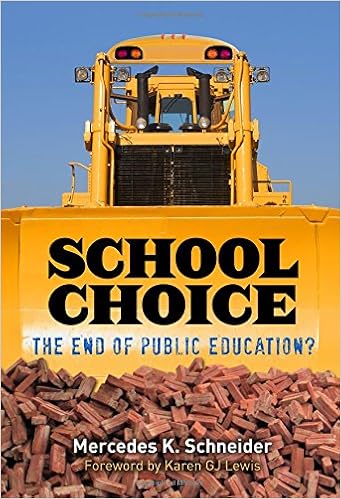
As I detail in my book, School Choice: The End of Public Education?, school voucher choice was put into practice to expressly to evade the 1954 Supreme CONTINUE READING: No Matter Who Gets Credit for the Original Idea, School Vouchers Have Yet to Shake a Racist History | deutsch29
Amazon.com: School Choice: The End of Public Education? (9780807757253): Mercedes K. Schneider, Karen GJ Lewis: Books - https://www.amazon.com/School-Choice-End-Public-Education/dp/080775725X/ref=sr_1_3?s=books&ie=UTF8&qid=1462599048&sr=1-3


Learning and Earning In This Era of Education Justice | The Jose Vilson

Learning and Earning In This Era of Education Justice | The Jose Vilson

LEARNING AND EARNING IN THIS ERA OF EDUCATION JUSTICE

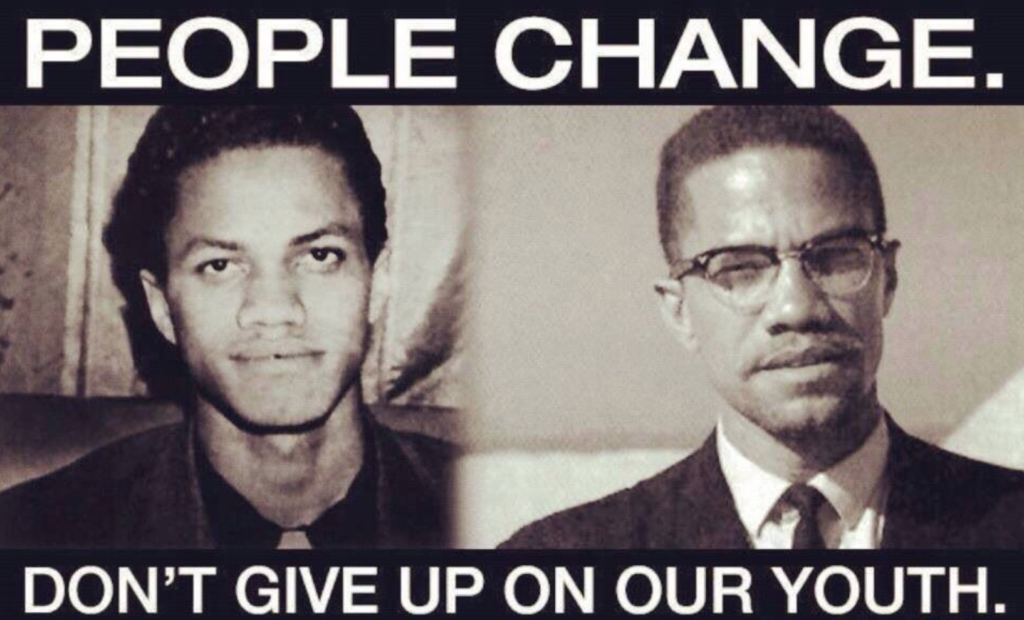
This year, as with every year, I’ve hung a little poster of both Malcolm Little to Malcolm X / el-Hajj Malik el-Shabazz with the tagline “People Change: Don’t Give Up On Our Youth.”

When I’m seated at my desk in the morning, it’s positioned so it’s slightly above my head. Curious students ask who the boy and the man are and why I decided to buy that poster. A student might chime in “That’s Malcolm X” while other students might not chime in at all.
The grumpy old man in me, trained in black liberation thought back in college and exposed to so many of the greats of the Civil Rights era, might have belted out a “YOU DON’T KNOW WHO THAT IS?” The teacher in me said, “Well, he was someone special” and build my case accordingly. 
Suppressing the urge to not do as some of my elders did has gotten exponentially easier over time, a function of empathy and actual social justice. Another part of it is knowing that students need the time to let these ideas and people foment before actualizing knowledge of the struggles to win the rights they may not fully comprehend. For adults, it also means that we understand that the work for justice did not find its genesis in us. We’re stewards for the movement forward and we hold the past for lessons and guidance. 
Learning and earning in education has so many implications for our students and their schools, but we’re reluctant to use over-abused words like status quo
The current era of what we consider justice work has proven even more perilous with the economic shift towards neoliberalism and individualism. Neoliberalism has been defined a billion different CONTINUE READING:Learning and Earning In This Era of Education Justice | The Jose Vilson 

CPS Considers Closing An Urban Prep Campus For Poor Performance | Gary Rubinstein's Blog

CPS Considers Closing An Urban Prep Campus For Poor Performance | Gary Rubinstein's Blog

CPS Considers Closing An Urban Prep Campus For Poor Performance


After the New York Times debunked the success of the T. M. Landry school in Louisiana, some very prominent reform cheerleaders have been writing about how the media needs to be more skeptical of stories in education that seem too good to be true.  Alexander Russo, for example, wrote about it in Phi Delta Kappan.
However, the ground rules for reporting on miracle schools should be clear by now: No passing along a school’s claims of test scores or graduation or college acceptance claims without independent verification. At this point, claims of 100 percent graduation rates should raise immediate red flags.
Considering the constant trolling I’ve endured over the years by reform body guards anytime I’ve uncovered a 100% college success that was worthy of further scrutiny, this is quite an admission.
Urban Prep Charter School in Chicago is the original ‘miracle school.’  Seven years ago at the Teach For America 20th anniversary alumni summit, I heard Arne Duncan talk about how they had 100% of their senior class graduate and how 100% of them went on to college after they shut down the public school in that building and replaced it with a charter school.
In my very first school policy blog post in March of 2011, I wrote about how that school had a very high attrition rate since 166 freshmen three years before had shrunk to 107  CONTINUE READING: CPS Considers Closing An Urban Prep Campus For Poor Performance | Gary Rubinstein's Blog