We Discover Outstanding Candidates That Support Our Public Schools - NPE Action Endorsements - NPE Action
NPE Action Endorsements
NPE Action Endorsements
When we discover outstanding candidates that support our issues, and it is a race that we are able to support, we endorse. Candidates must complete a questionnaire and have the support of our supporters in the area. We do our best to contact all candidates in the race. For more information contact carol@npeaction.org.
The "report," "Show What You Know: A Landscape Analysis of Competency-Based Education" is one more sign that A) Reformsters are betting on CBE as the Next Big Thing and B) they don't really know what they're talking about and C) they are crafting some careful PR to push this business. It was commissioned by XQ and produced by Getting Smart, a website/organization under CEO Tom Vander Ark, a guy who has been pushing ed tech and privatization since even before his days at the Gates Foundation.
Who else is here? Russlynn Ali, a co-founder and CEO of XQ, manager of education fund at Emerson, former assistant secretary for civil rights at USED under Duncan, chief of staff to president of LAUSD board, vice-president of Education Trust, and assistant director of policy and research at Broad Foundation.
All told, there's a lot of privatizing reformster love in this room.
Apps for preschoolers are flooded with manipulative ads, according to a new study New research looks at how gaming apps ads are pushing very young children to spend money.
In the children’s gaming app Doctor Kids, a popular purchase in the Google and Amazon app stores, kids get to play doctor in a children’s hospital. They clean patients’ teeth as a dentist, straighten crooked bones inside an X-ray scan, and play optometrist by helping kids with blurry vision find the right prescription glasses, all against a backdrop of brightly colored characters and a twinkling soundtrack.
Until suddenly, the game is interrupted. A bubble pops up with a new mini game idea, and when a child clicks on the bubble, they are invited to purchase it for $1.99, or unlock all new games for $3.99. There’s a red X button to cancel the pop-up, but if the child clicks on it, the character on the screen shakes its head, looks sad, and even begins to cry.
The Doctor Kids app cries when a child clicks away from the ad. Bubadu/Campaign for a Commercial-Free Childhood
The game, developed by the Slovenian software company Bubadu and intended for kids as young as 6, is marketed as “educational” because it teaches kids about different types of medical treatments.
But it’s structured so that the decision to notbuy anything from the game is wrong; the child is shamed into thinking they’ve done something wrong. Pulling such a move on a young gamer raises troubling ethical questions, especially as children’s gaming apps — and advertising within them — have become increasingly popular.
On Tuesday, a group of 22 consumer and public health advocacy groups sent a letter to the Federal Trade Commission calling on the organization to look into the questionable practicesof the children’s app market. The letter asks the FTC to investigate apps that “routinely lure young children to make purchases and watch ads” and hold the developers of these games accountable.
Teachers Are Testing Us: In State Elections, Will We Reject the Anti-Tax, Pro-Privatization Orthodoxy of the Far Right?
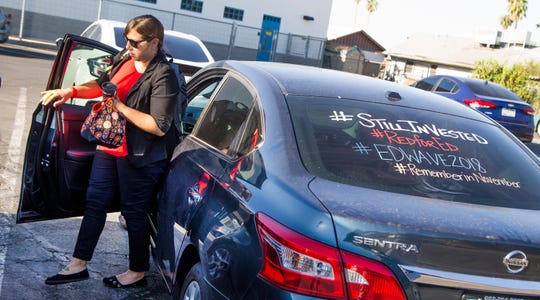
In an extraordinary photo essay, USA Today profiled a day in the life of 15 teachers who work in public schools across the United States. As we approach election day next week, here is how that report concludes: “Teachers hold our hands and wipe our noses, tell us we can be more than we are, maybe more then we think we can be. In return, we tell pollsters that they’re underpaid, without being sure what they actually make; that we endorse collective bargaining, yet often resist higher taxes, that we even support their right to strike, preferably in someone else’s district. A day with American public school teachers ends with this irony: These people, whom opinion polls show to be among the nation’s most respected, feel disrespected. This year, that dichotomy led to revolt. Where it leads next is a matter for speculation….”
One indicator of what to watch is how teachers running for office fare in next Tuesday’s election. A week ago, Huffington Post‘s Travis Waldron updated figures released from the National Education Association: “The widespread teacher protests that swept through states like Kentucky and West Virginia this spring have given way to an unprecedented wave of educators pursuing political office in November’s election…. Nearly 1,500 current or former teachers and other education professionals are running for elected offices across the country…. The new figure includes at least 1,455 teachers and educators who are seeking state legislative seats, and counts current and former teachers from K-12 and higher education, as well as administrative and support staff… The bulk of teachers seeking office are doing so in the states that experienced protests….”
Whether or not educators win in specific races, their spontaneous, mass walkouts last spring to protest the unspeakable conditions in their schools and their rock-bottom salaries have changed the political debate in a number of states and elevated public education higher on the Continue reading: No School Is “Doomed.” Continuous Improvement, Not School Closure, Must Be the Goal | janresseger
Chicago Teachers Union educators at Acero/UNO vote overwhelmingly to strike.
CHICAGO, Oct. 30, 2018—Chicago Teachers Union educators at Acero/UNO charter schools voted overwhelmingly today to strike. 96% of Acero CTU members turned out to vote, and of those voting, 98% voted to strike. Of the CTU’s 536 members at Acero’s 15 schools, 512 voted—and of those, 503 voted YES on the strike ballot.
Educators at four unionized CICS charter schools will also take a strike vote Friday. Roughly a thousand CTU charter educators are currently negotiating contracts with eleven charter operators.
If CTU members in charters hit the picket lines, it will be the first strike of a charter operator in U.S. history.
Watch your email and the CTU website for news about how you can support fellow union members—and how you can get involved in contract fights at both CTU district and charter schools. Check out the livestream of this evening’s press conference at this link.
Halloween and The Value of Make-Believe to Reading and Emotional Development
It is not mere childish escapism. There is a political aspect to it – we won’t try to change this world unless we are able to imagine another reality. One could say all change starts with fantasy.
Parents and teachers sometimes dread Halloween, the candy indulgence, the gross costumes, the fear of pranks (vandalism is never acceptable), and numerous other hyper antics that seem to take children off their usual track of learning in school.
Some dislike Halloween because of their religion, or they fear it is unsafe. I hope children still get to play and dress up. Many fun Harvest Festivals encourage children to do this.
Billionaires are spending their fortunes reshaping America’s schools. It isn’t working. Here’s the problem with education philanthropy.
Philanthropists need to take a step back from the American education system before it ruins them, they ruin it, or both.
Major philanthropies like the Gates, Walton Family, and Broad Foundations are spending hundreds of millions of dollars annually in an attempt to transform American K-12 education. Gates alone reported spending nearly $390 million in 2017; the Waltons spent more than $190 million. That’s a non-trivial chunk of the $67 billion all US foundations spent on all projects that year.
Such contributions have come under fire in recent years. The big foundations promote a particular set of K-12 education policies — including increased accountability for teachers, more school choice, and higher-stakes testing — that are profoundly controversial, and that teachers unions and skeptical education researchers have spent years questioning and resisting. The foundations’ use of billions in spending to change public policy on education raises troubling questions about democratic accountability and the role of money in politics (questions given new prominence when a major conservative education funder became US secretary of education).
Those are both valid lines of critique, but they’re not the ones I’m going to pursue here. (I am frankly more sympathetic to the Gates/Walton/Broad education reform agenda than a lot of my left-leaning friends.)
My beef, rather, is that improving the American education system, while important, is neither a neglected cause nor a tractable one. It is a system on which hundreds of billions of dollars are spent annually by diffuse governments whose policies are difficult and expensive to change, where matters of importance are intensely contested, and where interest groups tend to fight each other to a standstill.
And it’s a system where, even after investing millions if not billions in research, we still don’t have a lot of confidence as to which interventions are helpful and which are not. The views of Continue reading: Education philanthropy: why the billions spent aren’t working - Vox
The ultimate dream of public education is incredibly simple. Students, ideally, would go to a classroom, receive top-notch instruction from a passionate, well-informed teacher, would work hard in their class, and would come away with a new set of skills, talents, interests, and capabilities. Over the past few decades in the United States, a number of education reforms have been enacted, designed to measure and improve student learning outcomes, holding teachers accountable for their students' performances. Despite these well-intentioned programs, including No Child Left Behind, Race To The Top, and the Every Student Succeeds Act, public education is more broken than ever. The reason, as much as we hate to admit it, is that we've disobeyed the cardinal rule of success in any industry: treating your workers like professionals.
Everyone who's been through school has had experiences with a wide variety of teachers, ranging from the colossally bad to the spectacularly good. There are a few qualities universally ascribed to the best teachers, and the lists almost always include the following traits:
a passion for their chosen subject,
a deep, expert-level knowledge of the subject matter they're teaching,
a willingness to cater to a variety of learning styles and to employ a variety of educational techniques,
and a vision for what a class of properly educated students would be able to know and demonstrate at the end of the academic year.
Yet despite knowing what a spectacular teacher looks like, the educational models we have in place actively discourage every one of Continue reading:How America Is Breaking Public Education
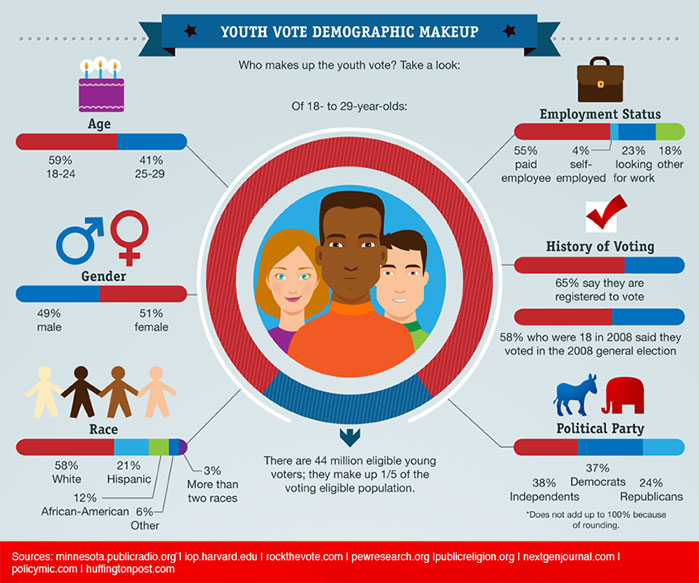
Youth will determine the outcome of the 2018 midterms
That’s why Republicans are trying to stop them
The stakes are high in the upcoming midterm elections, but few races have commanded as much national attention as the one for Texas senator between Republican incumbent Ted Cruz and Democratic U.S. Rep. Beto O’Rourke of El Paso. O’Rourke’s commitment to stricter gun laws, universal healthcare, and debt-free college has mobilized young people across the state and the country.
Last week, five students from Prairie View A&M University, an HBCU (historically black colleges and universities) outside of Houston, filed a lawsuit in federal court against Waller County, where the university is located. It alleged that the county violated students’ voting rights by not providing early voting stations on campus and in the city of Prairie View in the first week of Texas’ early voting period — though stations were available in other parts of the mostly rural county. Just two days after the suit was filed, the county opened a polling place at Prairie View City Hall, and expanded voting hours at the university’s campus center.
Voter suppression and intimidation has been a time-honored tactic in America, and in the run-up to the midterms next week, complaints have been reported from Georgia to Texas. The party in power can only maintain it by curtailing the rights of Continue reading: Young voters will determine the outcome of the 2018 midterms
No School Is “Doomed.” Continuous Improvement, Not School Closure, Must Be the Goal
I have read Eliza Shapiro’s reporting in POLITICO for years and I respect her as a reporter, but her story in Friday’s NY Times baffles me: New York Knew Some Schools In Its $773 Million Plan Were Doomed, They Kept Children in Them Anyway. The story raises a thousand questions and answers none of them. It fails to consider realities, which Shapiro surely knows, affect any child’s experience at school.
In Shapiro’s piece last Friday, we learn that the future of NYC’s Renewal Schools plan is in jeopardy. And we learn that one of the interventions made in these, NYC’s lowest performing schools, as part of the Renewal Schools plan was their transformation into full-service, wraparound Community Schools. We are not told, however, what other interventions have been tried or how widely any intervention has been taken across the schools. Over the weekend, in the blog of her organization, Class Size Matters, Leonie Haimson explains that one improvement which would have been likely to support students was not tried. Children were still assigned to classes of over 30 students. Shapiro tells us that the Renewal Schools program has cost $773 million but not how the money was spent.
Here is how Shapiro begins last week’s report on the failure of Mayor Bill de Blasio and then-Chancellor Carmen Farina’s Renewal Schools program: “Mayor Bill de Blasio promised to ‘shake the foundations of New York City education’ in 2014 with a new program called Renewal, a signature effort to improve the city’s 94 poorest-performing schools by showering them with millions of dollars in social services and teacher training. A year later, aides raised a confidential alarm: about a third of those schools were likely to fail. The schools were not meeting goals that the city set for higher test scores, increased graduation rates and other academic measures—and probably never would… ‘In order for these schools to reach their targets for 2017, the interventions would need to produce truly exceptional improvements,’ read the December 2015 memo, a copy of which was obtained by the New York Times. ‘Historically, it has been quite rare for schools to improve that much in two years.’ Mr. de Blasio kept most of the schools open. Now, after sending thousands of children into Continue reading: No School Is “Doomed.” Continuous Improvement, Not School Closure, Must Be the Goal | janresseger
Diane Ravitch opened the fifth Network for Public Education (NPE) conference stating, “We are the resistance and we are winning!” She noted that “reformers” were envious of our domination of social media. When they hired mercenaries to staff their own multimillion dollar web-publications to counter us; they failed. We still dominate social media.
Ravitch listed a long string of victories including:
Leonie Haimson and her Class Sizes Matters organization successfully fought Bill Gates’ $100,000,000 Inbloom data base project that would have abrogated the privacy rights of countless children and their parents.
Jitu Brown led a thirty-two day hunger strike that saved the Walter Dyett high school, the only open enrollment high school in the Bronzeville community of Chicago.
Charter school growth has slowed significantly. Without the literally billions of dollars from “fauxlanthropists” and the federal government these often corrupt private businesses would have gone the way of the Edsel.
Diane concluded, “We’re winning. David is beating Goliath.”
Ravitch then introduced the famed Finish educator, Pasi Sahlberg, who coined the apt acronym for the worldwide school privatization phenomena by calling it the Global Education Reform Movement (GERM). Sahlberg began with stressing that what happens in the United States is extremely important because Continue reading: NPE Indianapolis: “We Are Winning!” | tultican
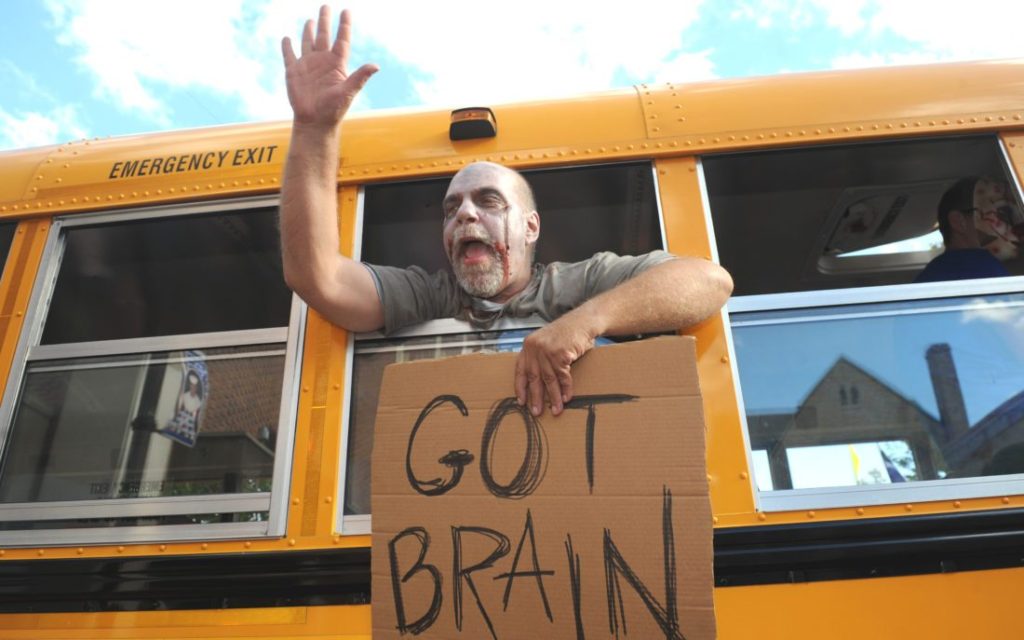
“Zombie ideas … are policy ideas that keep being killed by evidence, but nonetheless shamble relentlessly forward, essentially because they suit a political agenda.” Paul Krugman
Zombie Ideas!?!
Exactly! Policymakers have been using zombie ideas to dismantle, transform, and restructure the public education system. So with a mountain of evidence that the zombie ideas in No Child Left Behind didn’t show any appreciable improvement in student achievement, now is the time to end the zombie invasion killing our public schools.
Zombie Ideas in Education?
The test-based, metric-driven accountability of the No Child Left Behind (NCLB) law is based on a political agenda, not proven education reforms. NCLB is now called the Every Student Succeeds Act (ESSA) but the same policy ideas and political agenda remain in place. The same detrimental consequences persist because the aim and purpose of the law did not change.
Zombie Ideas in Education: High-Stakes Testing and Graduation Policies*
Solórzano (2008) found that the results of high-stakes tests used as a high school diploma requirement “show quite clearly that Blacks and Latinos (and English Language Learners) are disproportionately failing them, whether enrolled in Texas, New York, California, or Minnesota” (p. 312).


:format(webp):no_upscale()/cdn.vox-cdn.com/uploads/chorus_asset/file/13360769/_104102621_b2665878_8b88_4b21_a6a7_39a37ff626a6.jpg)