Latest News and Comment from Education

Wednesday, December 7, 2016

Take the TWO TOUR Pledge! – Cloaking Inequity

Take the TWO TOUR Pledge! – Cloaking Inequity:

Take the TWO TOUR Pledge! 


I received this interesting letter about the Two Tour pledge from a Cloaking Inequity reader.
The Two Tour Pledge
Now that the presidential election is over and a new secretary of education has been named, it appears that school segregation will only continue down its ugly path – unless…
Unless we CHOOSE otherwise. Unless we parents make a different kind of commitment for our children. Unless we come to grips with the reality that the schools we choose for our children actually build the world they will live in as adults.
And since many of us are in the midst of deciding where our kids will attend school next Autumn, here is one tiny thing we can do.
Take the TWO TOUR Pledge!
The pledge reads:
As a Parent-with-Choice in support of the fundamental premise that all children have the right to a quality education, and with the belief that in choosing a school for my child I am also building the world they will live in as an adult,
  • I pledge to tour 2 schools that serve a majority of students from different racial/socioeconomic backgrounds than my family. I will tour these two schools regardless of their test scores, reputation or any “bad/scary” stories I have heard about them.  I will tour these two schools with an open mind and heart.
  • I will find at least 2 positive things to say about each.
  • I will tell 2 parent-friends about those tours & the nice things I found.
  • I will encourage 2 parent-friends to also take this pledge.
  • Furthermore, I pledge to ask 2 questions (or more!) about socioeconomic, racial/ethnic and linguistic diversity at all the schools I tour/consider for my child (and register your pledge at IntegratedSchools).
That’s it. The pledge isn’t asking you to enroll your children at either of these schools, or zealously recruit your friends to enroll their kids there. It’s simply inviting you to check out two schools that you weren’t considering – schools that might have a reputation that caused you to dismiss them as not the “right fit” for your family – and ask yourself if you could envision your child there. Ask yourself if maybe this school could be good.
As for that last item… when you are touring the schools that were already on the top of your list, the schools with the robotics labs and the PTA sponsored Musical Theatre club, and all the fancy programs that affluent-segregated schools provide… ask them two questions about the socioeconomic AND racial-ethnic diversity at that school. (Here is a sample of some questions to ask and here is a resource if the school doesn’t give tours)
How does this help build a more unified future for our country?
Our public schools are more segregated than ever before and unless we make conscious and deliberate decisions, our children will most likely attend school with kids just like them. While that might feel “safe” and comfortable now, the world that prepares them for is a continuation of the polarization that our country is currently experiencing.
There are piles of research showing that middle class kids are not academically harmed by attending a high-free/reduced-lunch school, and the benefits for kids of all backgrounds being educated together are transformational for kid and country, now and in the future. All children win when all children are together.
Read the research, hear the stories (we have compiled some resources here).  Integration doesn’t have to be sacrifice.
Because YOU – not any school – are the most influential thing in your child’s life, because you are not only choosing the school that will help your kid become a successful, empathetic and well-adjusted adult, you are building the world they will live in.
What do you want that world to look like?
Take the pledge.
Courtney Everts Mykytyn, Ph.D,  Founder IntegratedSchools.org   Take the TWO TOUR Pledge! – Cloaking Inequity:


Privatize, Monetize, Weaponize: How the DeVos family devoured Michigan’s schools | Eclectablog

Privatize, Monetize, Weaponize: How the DeVos family devoured Michigan’s schools | Eclectablog:

Privatize, Monetize, Weaponize: How the DeVos family devoured Michigan’s schools


NOTE: This post is a companion piece to this week’s episode of The Sit and Spin Room podcast. Click HERE or scroll to the bottom of the post to listen to the podcast or find it wherever you get your podcasts by searching for “Sit and Spin Room” on iTunes, Stitcher, etc.
The news that President-elect Donald Trump had nominated Michigan billionaire and school choice advocate Betsy DeVos as our next Secretary of Education seemed to take the educational establishment by surprise. But public school teachers and supporters in Michigan weren’t surprised at all. They saw Ms. DeVos’ ascendancy to this lofty position as the final piece in an elaborately constructed jig saw puzzle that the DeVos family has been patiently working on, at their opulent vacation homes and on their luxury yacht, for the last couple of decades. And now that the final piece has been added, we will all soon see the “big picture” of the DeVos’ vision for the future of American education: Privatize, Monetize, Weaponize.
As Michiganders know, Betsy and Dick DeVos are religious and school privatization/choice/voucher zealots. They were humiliated by the twin failures of voucher legislation in 2000 and Dick’s loss in the Michigan governor’s race to Jennifer Granholm in 2006, and these dual humiliations resulted in the development of the DeVos’ “long-game” strategy to achieve their goals of privatizing public education:
  1. destroy the Democrats biggest single source of financial support by gutting teacher unions via Right to Work legislation
  2. capitalize on the elimination of the charter school “cap” to explode the number of non-regulated and for-profit charter schools in the state
  3. use charter schools as the mechanism to “blur the lines” between public and private/religious schools
  4. use this “blurring” of boundaries between church and state to build public support for the redistribution of public funds to religious and private schools
Based on what we know about her beliefs regarding education, Ms. DeVos’ ultimate goal, as I wrote about in a recent Eclectablog post, appears to be:
a two-tiered educational system:
One, a system of elite private and religious schools for well-to-do, mostly White parents with the means to afford expensive tuition payments, staffed by qualified, certified teachers, with a rich curriculum based on face-to-face instruction in clean, safe, well-maintained schools…
The other, a parallel system of “fly by night” virtual and online “schools” that open and close seemingly at random, and for-profit charters operated by scam artists like Northern Michigan’s Dr. Steve Ingersoll, with little to no state or federal regulation or oversight, and a bare bones, “back to the basics” curriculum delivered by unqualified and uncertified “teachers”.
The timeline below offers a narrative sketch of some of the pivotal events and influences that have shaped Ms. DeVos’ views on education over the years, and provides a context for what her policy Privatize, Monetize, Weaponize: How the DeVos family devoured Michigan’s schools | Eclectablog:


Yong Zhao: Did the Shift from Paper to Computer Bring Down East Asia’s (China’s) PISA Performance?

Education in the Age of Globalization » Blog Archive » Did the Shift from Paper to Computer Bring Down East Asia’s (China’s) PISA Performance?:

Did the Shift from Paper to Computer Bring Down East Asia’s (China’s) PISA Performance?


I was surprised by China’s 2015 PISA performance, particularly in reading. I was confident that even the expansion beyond Shanghai would not cause a significant decline based on my understanding of the Chinese education system. And Beijing, Jiangsu, and Guangdong are traditionally strong performers in China, and among the most developed provinces, although behind Shanghai.
While I don’t believe PISA scores mean anything beyond the ability to perform on PISA tests, I wanted to see if I needed to change my thinking. Perhaps Chinese students are not as good at taking tests as I had thought? Perhaps students in Shanghai are drastically different from the rest of China? Perhaps China’s education system is changing very fast that they have truly moved away from test preparation? I am willing to consider any possibilities in the face of evidence.
I found a news article from Chinese Taipei (Taiwan), whose reading performance has declined significantly as well, although not as much as China (Shanghai to BSJG). Chinese Taipei’s reading ranking dropped from #8 in 2012 to #23 in 2015. According to the report from Chinese Taipei’s Central News Agency, a high-level official of its Ministry of Education attributed the decline to students’ unfamiliarity with reading on a computer. Because PISA changed from paper-based to computer-based tests. Although students in Taiwan may use smart devices for other purposes, they are not used to reading large amount of text, diagrams, and graphics on a computer screen. The official said in addition to improve reading in general, Taiwan would increase computers to support reading and adding computer-based tests to important exams in the future.
Seems a reasonable hypothesis.  PISA shifted from paper-based tests to computer-based tests from 2012 to 2015 for most participants.
So I dug a little bit deeper. First I verified that indeed all students in China (BSJG) took the PISA on computers (looks like Windows-based laptops), which are very different from what most young students are using today (hand held devices), if they had access to digital devices. Second, I confirmed that the percentages of students categorized as rural are much higher in Beijing, Jiangsu, and Guangdong than Shanghai. That rural students have less access to technology is a safe assumption. So these students would be less familiar with computers. Finally, it is also common in China that many parents and teachers do not Education in the Age of Globalization » Blog Archive » Did the Shift from Paper to Computer Bring Down East Asia’s (China’s) PISA Performance?:


The big burden of charter school oversight | EdSource

The big burden of charter school oversight | EdSource:

The big burden of charter school oversight


With the California Charter Schools Association’s goal of serving a million students – a nearly 75 percent increase – within six years, charter school growth is raising the stakes for effective monitoring.
But there’s a sharp contrast in charter oversight capacity between California’s largest district and other districts. With nearly a quarter of the state’s 1,200 charter schools, Los Angeles Unified’s Charter Schools Division is a regulatory behemoth, with 50 employees and the district’s muscular Office of Inspector General at its disposal. Offices in most of the other 320-plus districts that have granted charter schools, however, usually consist of one undertrained, understaffed assistant superintendent frustrated by the complexity of the job. About 90 percent of the state’s districts have issued six or fewer charters; two-thirds have issued only one or two.
The disparity in resources is one factor that led Gail Greely to form the Charter Authorizers Regional Support Network, or CARSNet, a statewide help and training organization focusing on districts with a handful of charters. Recognition that a lack of on-the-job training contributed to a high turnover rate among administrators was another.
The role of point person in disagreements between charters and districts “was not a coveted job,” she acknowledged.
Greely was the administrator of the Alameda County Office of Education’s charter schools before obtaining a three-year, $2.4 million federal grant to establish CARSNet. The organization is based at the Alameda County office.
More than 100 administrators from districts and county offices attended an annual conference in September in Oakland. The network runs three-day boot camps and master classes; two dozen administrators have signed up for one next month in Sacramento. The network plans to train at least 150 charter administrators and to connect with all of them The big burden of charter school oversight | EdSource:


Betsy DeVos and the twilight of public education

Betsy DeVos and the twilight of public education:

Betsy DeVos and the twilight of public education


In Detroit, parents of school-age children have plenty of choices, thanks to the nation's largest urban network of charter schools.
What remains in short supply is quality.
In Brightmoor, the only high school left is Detroit Community Schools, a charter boasting more than a decade of abysmal test scores and, until recently, a superintendent who earned $130,000 a year despite a dearth of educational experience or credentials.
On the west side, another charter school, Hope Academy, has been serving the community around Grand River and Livernois for 20 years. Its test scores have been among the lowest in the state throughout those two decades; in 2013 the school ranked in the first percentile, the absolute bottom for academic performance. Two years later, its charter was renewed.
Or if you live downtown, you could try Woodward Academy, a charter that has limped along near the bottom of school achievement since 1998, while its operator has been allowed to expand into other communities.
For students enrolled in schools of choice — that is, schools in nearby districts who have opened their doors to children who live outside district boundaries — it's not much better. Kids who depend on Detroit's problematic public transit are too far away from the state's top-performing school districts — and most of those districts don't participate in the schools of choice program, anyway.
This deeply dysfunctional educational landscape — where failure is rewarded with opportunities for expansion and "choice" means the opposite for tens of thousands of children — is no accident. It was created by an ideological lobby that has zealously championed free-market education reform for decades, with little regard for the outcome.
And at the center of that lobby is Betsy DeVos, the west Michigan advocate whose family has contributed millions of dollars to the cause of school choice and unregulated charter expansion throughout Michigan.

Unqualified

President-elect Donald Trump has made a number of controversial cabinet nominations already. But none seems more inappropriate, or more contrary to reason, than his choice of DeVos to lead the Department of Education.
DeVos isn’t an educator, or an education leader. She’s not an expert in pedagogy or curriculum or school governance. In fact, she has no relevant credentials or Betsy DeVos and the twilight of public education:


National universities plead to Trump on behalf of DACA, but… | Fred Klonsky

National universities plead to Trump on behalf of DACA, but… | Fred Klonsky:

National universities plead to Trump on behalf of DACA, but…

gomez

Luis Gomez, a 21-year-old senior at the Illinois Institute of Technology.
Following up on the previous post.
While the University of Illinois has turned a deaf ear to faculty, student and alumni calls for undocumented student sanctuary, Muriel A. Howard, the president of the American Association of State Colleges & Universities, voiced support for these students.
DACA is the Deferred Action for Childhood Arrivals, which Trump vowed to rescind as he campaigned for the presidency. DACA is the 2012 Obama directive that gave undocumented immigrants brought to the U.S. as children a chance to work and study legally, without getting deported.
Howard sent a letter to Trump this week in support of the program. “Only through such a robust and accessible infrastructure for all of our people can America compete on the global stage,” she wrote.
However, after congratulating Trump on his election, the letter included this:
“We appreciate your most recent comments that immigration enforcement should focus on undocumented immigrants who have committed serious crimes.”
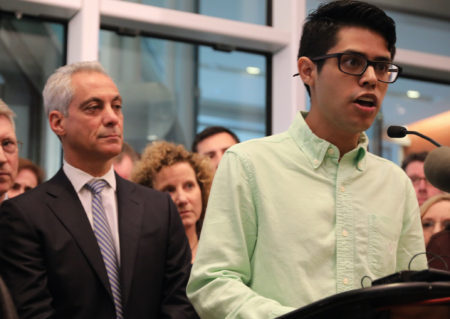
Reading this, I recalled the comments of Luis Gomez, a 21-year-old senior at the Illinois Institute of Technology.
Gomez had been invited to join Mayor Rahm Emanuel and my Congressman Luis Gutierrez for a press conference on National universities plead to Trump on behalf of DACA, but… | Fred Klonsky:

For students worried about Trump, Los Angeles school district opens hotline, support sites - The Washington Post

For students worried about Trump, Los Angeles school district opens hotline, support sites - The Washington Post:

For students worried about Trump, Los Angeles school district opens hotline, support sites


The Los Angeles Unified School District — the nation’s second largest public school system — is about 75 percent Latino. That helps explain why a month after Donald Trump won the presidential election, many students are still frightened by the incendiary statements he made about illegal immigration and Hispanics during the campaign — and why district officials are taking steps to help them.
This story in the Los Angeles Times reports that the district has started a support hotline and opened extended support sites, which was detailed in a recorded call — in English and Spanish — to teachers and parents from Superintendent Michelle King. She said students could get “emotional support” for any concerns they have about the impact on their families of potential Trump-ordered anti-immigration actions. The district has also provided a list of resources for educators and parents who want to talk to young people about these issues.
During the campaign, Trump repeatedly expressed anti-immigrant sentiment, promised to build a wall between the United States and Mexico, labeled Mexican immigrants “rapists” and “criminals” and said he would force all undocumented immigrants to leave the country.
He also suggested that a U.S. District Court judge who was born in Indiana to Mexican immigrants couldn’t be fair in a hearing of a class-action suit against Trump over Trump University.
California officials have gone out of their way to attempt to reassure students that they are safe. Shortly after the election, the Los Angeles Board of Education approved a resolution upholding its policy that federal immigration agents cannot enter a school campus without permission.
And California’s state superintendent of education, Tom Torlakson, issued a statement last month telling all 6.2 million public school students that they are safe from discrimination at school — and he made a point of telling “young women and girls that they will always be safe, be respected and be protected at school.”For students worried about Trump, Los Angeles school district opens hotline, support sites - The Washington Post:

Schools Matter: Sister Betsy Will Be Puppet of Walton Clan

Schools Matter: Sister Betsy Will Be Puppet of Walton Clan:

Sister Betsy Will Be Puppet of Walton Clan


The Detroit Free Press has a scathing assessment of Sister Betsy Devos's involvement in education matters (see below).  What is missing in this and other discussions of Sister Betsy's ranking of ideological devotion over educational quality is the DeVos link to the Walton clan.  If Sister Betsy is confirmed as Secretary, she will serve as as a functionary of the Walton agenda, which is the Gates agenda and the Broad agenda.  

The value of pieces like the one below is the evidence it provides for assessing the educational worth of ideological agendas.  Personalities are much less important than the policies.  Personalities come and go (from Rod Paige through John King), but educational policy in DC has not changed since 2001, except to become more openly corrupt and ideologically driven. Actions that would have resulted in shame and/or indictments fifteen years ago are now promoted as standard operating procedure.  

Editorial excerpts below are from Free-Press opinion piece by Stephen Henderson.


In Detroit, parents of school-age children have plenty of choices, thanks to the nation's largest urban network of charter schools. What remains in short supply is quality. In Brightmoor, the only high school left is Detroit Community Schools, a charter boasting more than a decade of abysmal test scores and, until recently, a superintendent who earned $130,000 a year despite a dearth of educational experience or credentials. On the west side, another charter school, Hope Academy, has been serving the community around Grand River and Livernois for 20 years. Its test scores have been among the lowest in the state throughout those two decades; in 2013 the school ranked in the first percentile, the absolute bottom for academic performance. Two years later, its charter was renewed. The DeVoses have helped private interests commandeer public money that was intended to fulfill the state's mandate to provide compulsory education. The family started the Great Lakes Education Project, whose political action committee does the most prolific and aggressive lobbying for charter schools. Betsy DeVos and other family members have given more than $2 million to the PAC since 2001. GLEP has spent that money essentially buying policy Schools Matter: Sister Betsy Will Be Puppet of Walton Clan:


Bruce Baker: How Do Charter Schools Affect Public Schools in Urban Districts | Diane Ravitch's blog

Bruce Baker: How Do Charter Schools Affect Public Schools in Urban Districts | Diane Ravitch's blog:

Bruce Baker: How Do Charter Schools Affect Public Schools in Urban Districts


Bruce Baker is a professor of education at the Graduate School of Education at Rutgers; his area of specialization is school finance and the economics of education.
This new paper is a major analysis of the effects of charter schools on their host districts. Until now, there has been little attention paid to the ways that the expansion of charter schools affects the budget and policies of the district in which the charters open. Over the past twenty years, the United States has been developing a dual school system of public schools, open to all and responsible for all students who enroll, and charter schools, which are free of most state regulations and free to remove students they don’t want.
Baker is interested primarily in the fiscal impact of charters but he does consider the disciplinary policies of charters and also their segregating effects.
Here is his summary of his findings. I urge you to read the paper in its entirety to understand how charters are depleting the resources of public schools without necessarily providing a better quality of education.
Effects of charter expansion
District schools are surviving but under increased stress
In some urban districts, charter schools are serving 20 percent or more of the city or districtwide student population. These host districts have experienced the following effects in common:
*While total enrollment in district schools (the noncharter, traditional public schools) has dropped, districts have largely been able to achieve and maintain reasonable minimum school sizes, with only modest increases in the shares of children served in inefficiently small schools.
*While resources (total available revenues to district schools) have declined, districts have reduced overhead expenditures enough to avoid consuming disproportionate shares of operating spending and increasing pupil/teacher ratios.
*Despite expenditure cutting measures, districts simultaneously facing rapid student population decline and/or operating in states with particularly inequitable, under-resourced school finance systems have faced substantial annual deficits.
Charter expansion is not driven by well-known, high-profile operators
Most charter expansion in these cities has occurred among independently operated charter schools.
*High profile, frequently researched nonprofit charter school operators including the Knowledge is Power Program (KIPP) have relatively small shares of the charter school market in all cities except Newark.
*In many of these cities, some of the leading charter operators (those with the most market share) have been the subject of federal and state investigations and judicial orders regarding conflicts of interest (self-dealing) and financial malfeasance. These operators include Imagine Schools, Inc., White Hat Management, National Heritage Academies, and Concept Schools.
*The varied and often opaque financial practices across charter school management companies, while fitting with a competitive portfolio conception, leads to increased disparities across students, irregularities in the accumulation of additional public (publicly obligated) debt, and inequities and irregularities in the ownership and distribution of what were once commonly considered public assets—from buildings and vehicles right down to desks, chairs, and computers.
Charter schools are expanding in predominantly low-income, predominantly minority urban settings
Few are paying attention to the breaches of legal rights of students, parents, taxpayers, and employees under the increasingly opaque Bruce Baker: How Do Charter Schools Affect Public Schools in Urban Districts | Diane Ravitch's blog:

What Betsy DeVos Does Not Know About Public Schools and Probably Assumes About Private Ones - Education Law Prof Blog

Education Law Prof Blog:

What Betsy DeVos Does Not Know About Public Schools and Probably Assumes About Private Ones


Yesterday, Alyson Klein, pointed out that Betsy DeVos, the nominee for Secretary of Education, 
would be the first person to head the department in its more than 35-year history who hasn't either attended public schools or sent her own children to them. . . . And DeVos, a school choice and voucher advocate, sent each of her own children to private schools as well, Truscott said. . . . "She believes all parents should have access to the same choices her children had," said Matt Frendewey, a spokesman for the American Federation for Children, a school choice advocacy organization that DeVos chaired until recently. . . . She'd also be one of only a few secretaries entering the job without experience teaching in a K-12 school, or college; running a university, school system or state education agency, or overseeing public education as a governor, or governor's education aide. 
As a counter, some have pointed out that President Obama is primarily a product of private schools and has sent his daughters to private schools.  From my perspective, this counter does not help DeVos much.  First, Obama's two Secretary of Education appointment did have significant experience in public schools, which shaped their views tremendously.  Second, there are plenty of critiques of Obama's education policy to go around.  Obama's first term may have fractured support for traditional public schools more than any before, although I do not believe that was necessarily the intent.
Regardless, DeVos vision for education and her general operating principle of expanding choice are private market ideas.  These ideas, if not properly tailored to public values, are antithetical to public education itself.  As I argue here, these private ideas undermine the very justification for public education itself if pursued to their logical conclusions.  Public education is not a private commodity and it serves ends well beyond the interests of individual parents or students.  Public education, of course, would be of little good if it did not also produce significant benefits for individuals, but it also produces benefits for overall communities, states, and societies.  Hence,  we all pay taxes and all have a voice in the ends and values it should pursue.  If that balance shifts too far to individuals, it ceases to be public education and worthy of the same level of public support.  It begins to look more like housing, transportation, and other aspects of society.  In these areas, government support and regulation is more limited.  Public policy supporting them comes from a confluence of interests between the public and private, not from a public interest per se. 
DeVos' ideas threaten to move us in this direction.  Her lack of public school experience may, moreover, lead her to discount the distinction between private and public education, not out of malevolence but ignorance or naivete.  Because private choice has worked for her and those who can afford to carry its burdens, she may incorrectly Education Law Prof Blog:


CURMUDGUCATION: ESSA Won't Spur "Best Practices"

CURMUDGUCATION: ESSA Won't Spur "Best Practices":

ESSA Won't Spur "Best Practices"


Eric Kalenze, Director of Education Solutions at the Search Institute, is guest-blogging at Rick Hess's EdWeek spot this week. His interest leans towards questions of research and best practices and how any of those things ever hope to line up with actual classrooms. Today he's asking one particularly interesting question--


Will ESSA's Evidence Requirements Spur Actual Best Practices? comes with its own answer included-- no. Kalenze wants to jump ahead to the answer.

His premise itself is a bit faulty-- he concludes that best practices are not in use in classrooms because of this:

If the practices and ideals that feel right and we continually work to execute are indeed 'best', how can we continue to show weakly in international comparisonsleave scores of the same populations behind, and not see progress jump more steeply over time on internal measurements?

He's missing the more obvious answer. If everything I know tells me that my Big Stick is three feet long, and I pull out a tape measure and that tape measure tells me it's not three feet long at all, I should be looking at the tape measure. Kalenze is starting with the premise that things like PISA and Big Standardized Tests scores are an accurate and complete measure of student achievement and educational attainment. There is no reason to believe that they are such a measure, and in fact the discontinuity that Kalenze brings up is one more reason to suspect that they are NOT a good measure 
CURMUDGUCATION: ESSA Won't Spur "Best Practices":

Michigan Commentators Fill in the Gaps about Michigan’s Betsy DeVos | janresseger

Michigan Commentators Fill in the Gaps about Michigan’s Betsy DeVos | janresseger:

Michigan Commentators Fill in the Gaps about Michigan’s Betsy DeVos


When someone like Betsy DeVos, who has been active for years in Michigan state politics emerges on the national stage, it is worth paying careful attention to what Michigan insiders have to say. DeVos is President-elect Donald Trump’s nominee for Secretary of Education; her record in Michigan will prepare us for what she will bring to the U.S. Department of Education. Michigan’s investigative EclectaBlog just published Mitchell Robinson’s history of two decades’ of advocacy for school privatization by Betsy DeVos and her husband Dick, the Grand Rapids, Amway heir.
While school vouchers had been defeated at Michigan’s polls in 1972 and 1978,  in 2000 Dick and Betsy DeVos backed an amendment to change the following constitutional language: “No public monies or property shall be appropriated or paid or any public credit utilized… to add or maintain any private, denominational or other nonpublic, pre-elementary, elementary, or secondary school.”  Robinson explains that after Michigan voters rejected the DeVos-backed measure in 2000 by a 69 percent margin, the DeVoses settled on a stealth lobbying campaign to accomplish their long goal of marketplace school choice.
In 2001, they founded the Great Lakes Education Project “to fight against public schools, teacher unions, and teachers.” They also invested to gain control of the Mackinac Center for Public Policy. Philanthropy through their private family foundation is driven by the organization’s mission statement: “Our faith motivates our giving; it is integral to who we are and what we do.”  The DeVos Family Foundation has made grants to the Foundation for Traditional Values which sponsors the Student Statesmanship Institute that, “Equips teenagers to distinguish between secular and Biblical approaches to life and motivates them to shine for Christ in their generation without compromising their values.”  Robinson also ties Dick and Betsy DeVos to the Michigan Family Forum, the state branch of Focus on the Family. In 2010, Betsy DeVos formed the American Federation for Children, which grew out of an older organization, Advocates for School Choice, to work for school privatization across the country.
Finally there was last summer’s enormous lobbying campaign in Michigan’s House of Representatives to kill the Detroit Education Commission, which was to have been part of the Michigan Commentators Fill in the Gaps about Michigan’s Betsy DeVos | janresseger:


Seattle Schools Community Forum: Washington State Charter School Updates

Seattle Schools Community Forum: Washington State Charter School Updates:

Washington State Charter School Updates


With the Growth Boundaries, 20-Minutes added to the school day, changes to the Student Assignment Plan, Cedar Park, etc, I have found nary the time to write about charter schools in Washington State.  But finally, here it is.
Washington State Charter School Commission
Today, the Commission issued the annual New Charter School application for schools that wish to open in Fall 2018.


The Washington State Charter School Commission begins its new round of charter school authorization with the release of the New Charter School Application on Tuesday, December 6, 2016. This year, successful applicants will have the opportunity to access U.S. Department of Education Charter School Program (CSP) grant, a grant administered through the Office of Superintendent of Public Instruction (OSPI). CSP grant funds are designed to support the development and growth of new, high-quality charter public schools across the state. 
Oh right, that would be the huge kiss of money that got put into ESSA for charter schools.  It will be interesting if that money gets sustained as the voucher crowd jockeys for money.  (To note the voucher crowd would also like to take money from Title One dollars.)

The WSCSC process is a six-month one that ends on June 29, 2017 with the announcement of authorization of new charter schools.  The Notice of Intent to Apply is Feb. 17, 2017. 

Charter School law lawsuit
In August, 2016, a lawsuit was brought against the new charter school law approved by the Legislature in the spring.  Those suing included the WEA, the League of Women Voters, El Centro de la Raza and other labor groups like the Washington State Labor Council.  The lawsuit also includes Washington state public school parents.

The plaintiffs say that the new law does not really address the underlying issue of funding that was used when the Washington State Supreme Court threw out the first charter school law.  Namely, that public dollars are still being used for 
Seattle Schools Community Forum: Washington State Charter School Updates:


'We need to get moving': LAUSD's King urges school board to approve retooled 3-year plan | 89.3 KPCC

'We need to get moving': LAUSD's King urges school board to approve retooled 3-year plan | 89.3 KPCC:

'We need to get moving': LAUSD's King urges school board to approve retooled 3-year plan

136199 full

After months of back-and-forth, Los Angeles Unified school board members finally appear poised to sign off on superintendent Michelle King's strategic plan, a crucial visioning document school district leaders will use to chart a course for the next three years.
King finished a draft of the plan back in August and had initially envisioned getting the school board's approval sometime in the fall. In September, though, board members asked King to retool her plan to emphasize their longstanding priority of boosting L.A. Unified's high school graduation rate.
The superintendent unveiled her re-written draft at a school board retreat Tuesday afternoon. Board members indicated that they will take up the document for a formal vote of approval at their regular meeting next week — and King, whose one-year anniversary in office is fast approaching, urged them to give it their blessing.
"We … need to get people moving," the superintendent said. "We have to align the resources. These schools that are underperforming — if I’m going to differentiate resources, I need to do that as I prepare for the budget process," which kicks off in earnest in the spring.
The headline goal in the new draft was the same as in the old draft: King called for increasing the high school graduation rate to 81 percent by 2018-19 — a six-point increase from the current mark — as part of the district's effort to one day ensure every L.A. Unified high schooler earns a diploma. Many other goals from the old draft were carried forward to the new one.
But the draft King unveiled Tuesday was not only a repackaging of the old draft's goals; new initiatives were outlined as well:
  • 'Milestones for Graduation.' As part of their 100 percent graduation goal, King specified ten benchmarks district officials will use to ensure schools are keeping their students on-track from preschool — they will measure students' mastery of the California Preschool Learning Foundations Language and Literacy Benchmarks, for instance — through graduation. In early elementary school, L.A. Unified officials will track whether students are reading at grade level. In high school, they'll track grade point average, completion of the ACT or SAT exams and student surveys about their college plans. Throughout, officials will track state test scores to determine how many students are "meeting standards."
  • Early childhood education. This section, a commitment to "reduce the achievement gap in the early years," was a wholesale addition to the strategic plan draft. The draft said by 2019, three-quarters of the district's preschool programs would receive a four-star rating on the state's five-star scale for assessing early childhood education programs. The draft also said L.A. Unified will boost parent involvement around preschool programs.
  • 'Raising achievement in persistently underperforming schools.' Another entirely new section: L.A. Unified will "strengthen the manner of teaching and learning" at struggling campuses by offering "technical support teams," expanded training opportunities and additional counselors and coaches for students.
  • Replacing 'TBD's' with specific goals. For instance, the old draft said the district would increase the number of "bilingual, bi-literate" high school graduates, but didn't specify by how much; the new draft said L.A. Unified would increase this number by 60 percent by 2018-19. The new draft also said by 2018-19, 100 percent of high school students would concurrently enroll in at least one community college course — another goal that the old draft had listed as "TBD."
At a meeting held away from the district's headquarters on Tuesday, facilitator Jeff Nelson asked board members for their reactions to the latest draft of the strategic plan. One board member, Scott Schmerelson, offered his unqualified support.
Board president Steve Zimmer made a more tepid expression of support, saying that while he had no objections to any specific goal in the plan and is fully supportive of 'We need to get moving': LAUSD's King urges school board to approve retooled 3-year plan | 89.3 KPCC: