Sunday, July 31, 2016

In Defense of the Advocates of the Teacher Caucus | okeducationtruths

In Defense of the Advocates of the Teacher Caucus | okeducationtruths:

In Defense of the Advocates of the Teacher Caucus


We’ve spent countless years and dollars in this state trying to measure educator and school effectiveness. It usually comes down to a menu of test scores. If we have more kids passing than those other guys, then we must be better at our jobs than they are.
If only it were that clean.
Unfortunately, variables such as socio-economic status, student mobility, and a district’s ability to generate funding intervene from time-to-time. The fact that our state hasn’t demonstrably shown support for public education in about 10 years doesn’t help either.
Because of these facts, and the reality that tests don’t even come close to measuring all of the things that matter in a school, Oklahoma issues horribly misleading A-F Report Cards to the public. Some who ascribe to the measure it if it matters mindset are content with this. We’re not. We see schools making an impact that their grade doesn’t showcase. We see it frequently.
Some things are easier to measure, however, like the impact of public education advocacy. We can look at the number of legislative races contested and won, bills filed and passed (or defeated), or the percentage of votes it takes for an incumbent to finish third in her own primary. Those are quantifiable.
We’re about at the point now that we can also start counting the number of editorials written by the Oklahoman attempting to discredit those of us pushing for more candidates who will promote a pro-public education agenda. (We would also count blogs opposing us, but we’ve yet to find one that is coherent.)
The Oklahoman has close ties to the former state superintendent. Their editorial board promotes candidates who favor all forms of school choice. They favor the concept of sending tax dollars to private schools and asking for no accountability in return. They favor more state testing and jeer legislative measures aimed at curbing unnecessary tests. They deride calls for adequate public school funding. They think the school report cards mean something.
To be fair, though, when I reached out to them and asked them to publish opposing thoughts on A-F Report Cards (along with another superintendent), they did.
That said, on more than one occasion, they’ve questioned the honesty and ethics of our group – A Facebook group – Oklahomans for Public Education. Yes, the Oklahoman is now writing editorials about Facebook groups.
Our group is led by a board that includes superintendents, principals, teachers, and parents. We picked candidates to support based on the information available to us. In some cases, we have disagreed. Over 2,000 people like the page, but even among the board members we have differences. Politically, we are all over the place. Democrats, Republicans, and Independents are all part of the group.
We are not single-issue voters, which is one reason that we’ve identified multiple candidates in In Defense of the Advocates of the Teacher Caucus | okeducationtruths:

Report on PAA conference | Parents Across America

Report on PAA conference | Parents Across America:

Report on PAA conference

PAARevolution2
 Summary report – PAA Leadership Conference 2016

Parents Across America held our fourth annual leadership conference in Philadelphia PA from July 18-20, with twenty great leaders from twelve states. Most were in the room and some joined us online. We had an excellent mix of new and returning leaders and of geography, cultural background, age, and gender (three men!!!).
What we discussed, experienced, and learned
We had a rich program of discussion, sharing, learning and planning over one full and two half days. The details of each session are below, along with links to the recording and slide show for most sessions.
But first, here are some key “take-aways” from our time together:
BenitaThe value of the PAA annual meeting: We all agreed that it is very important and meaningful to get together at least once a year. We all bring to the table an intense passion for public education and for children which we clearly recognize in each other. This helps us trust each other enough to share the honest, deep and often painful emotions that go along with our work. It is also a good way of bringing together people from diverse backgrounds in a group that’s small enough for us to really listen to each other and feel comfortable sharing our thoughts and ideas.
ESSA changes: We had a good discussion about ESSA including reviewing the comments Julie had prepared for submission to the Department of Education on its proposed regulations for implementing the new ESSA. The proposed comments were agreed to with the addition of a statement encouraging a school curriculum that is culturally relevant to diverse communities and programs which are responsive to the real life conditions of students and their families. The group would also like to require much stronger, more inclusive steps before any school is closed, and requested that our policy paper, “What is a Quality Education,” be attached. This will be done in time for the August 1 deadline.
Ed Tech and real personalized learning: We started out this session by asking people what they think of Report on PAA conference | Parents Across America:

With A Brooklyn Accent: THE REAL OPT OUT STORY IN NEW YORK STATE!

With A Brooklyn Accent: THE REAL OPT OUT STORY IN NEW YORK STATE!:

THE REAL OPT OUT STORY IN NEW YORK STATE!


Let's keep it real. Despite a huge propoganda/misinformation campaign by NY State Education Commissioner Mary Ellen Elia, despite selective refusal on the part of NY School Chancellor Carmen Farina to release Opt-Out information to parents; and despite threats of funding cut offs coming from US Education Commissioner John King, Opt Out numbers ACTUALLY INCREASED in New York State!! That is a HUGE STORY. 

Parents in NY State cannot be bamboozled, intimidated, or confused by public officials. Until the amount of testing in the state is drastically reduced, until the stakes attached to the tests are removed, and until the specter of Common Core is put to rest once and for all, the Opt Out movement will continue to gain momentum and will move into school districts, especially high poverty districts, where it previously had limited support

This is a great example of Popular Democracy at work. Congratulations NY Parents Students and Families. You are setting a great example for the entire nation.
With A Brooklyn Accent: THE REAL OPT OUT STORY IN NEW YORK STATE!:


Affluent Kansas City suburbs at center of political backlash

Affluent Kansas City suburbs at center of political backlash:

Affluent Kansas City suburbs at center of political backlash


 SHAWNEE, Kan. (AP) — Small-government Republican conservatives face a political backlash in Kansas because of the state's budget problems and battles over education funding, and the epicenter is in sprawling Kansas City suburbs where residents have cherished public schools for decades.

But the Democrats and GOP moderates hoping to lessen the grip Republican Gov. Sam Brownback's allies have on the Legislature must contend with a political paradox in Johnson County, home to those affluent suburbs. Its voters regularly approve bonds and property tax increases for schools while electing conservative legislators who've backed the governor's experiment in slashing state income taxes.
More than two dozen conservative Republican legislators face challengers in Tuesday's primary, including 11 in Johnson County, the state's most populous. Challengers there have made education funding a key issue.
"You could rely on one thing, and that was public education," said Gretchen Gradinger, a lawyer and Johnson County native who moved back from Missouri two years ago so her young son could attend the public schools she knew growing up. "For 60 years, you could rely on one thing."
Kansas has struggled to balance its budget since the Republican-dominated Legislature heeded Brownback's call in 2012 and 2013 to cut personal income taxes as an economic stimulus. He won a tough re-election race in 2014, but his popularity has waned with the state's ongoing budget woes.
Meanwhile, the Kansas Supreme Court could rule by the end of the year in an education funding lawsuit on whether legislators provide enough money to schools to fulfill a duty under the state constitution to finance a suitable education for every child. The State Board of Education is recommending phasing in an $893 million increase in aid over two years.
Johnson County is seeing an effort to oust conservatives because strong public schools have been crucial to the post World War II population boom that has never stopped. The population has doubled over the past generation, to about 580,000 — 20 percent of the state's total.
Yet the county also is a business-friendly Republican stronghold that's key to the right's strength statewide. Affluent communities where parents worry that their schools are slipping also have plenty of Republican-leaning residents skeptical that government runs efficiently enough.
Kim Stevermer, a contractor, lives a few minutes' drive from Shawnee Mission Northwest High School , from which he graduated in the 1970s. He said strong schools are vital — "bad schools, bad neighborhood, you know?" — but generally supports Republicans because he sees them as more entrepreneurial and closer to Thomas Jefferson's vision of limited government.
Recently, Tom Cox , running in the GOP primary against conservative state Rep. Brett Hildabrand , of Shawnee, visited Stevermer and talked about education funding. Stevermer told him, "Maybe we should look at administrative costs of running the schools."
Other voters expressed similar sentiments. Cox stressed that he would look for ways to make state government more efficient and considers himself fiscally conservative.
Hildabrand is running both on his conservative voting record and as a supporter of local schools. The state's aid to its 286 school districts exceeds $4 billion a year — more than half of the tax dollars it collects — and Hildabrand contends an infusion of hundreds of millions of dollars isn't required. He said voters don't see legislators or candidates as anti-education for holding that view.
Conservatives in Johnson County also bolster their argument that legislators adequately fund schools by pointing to their local schools.
The Shawnee Mission district , with nearly 28,000 students, provides MacBook Air laptops to all middle and high schoolers and iPads to every elementary school student starting in kindergarten. High school sophomores can enroll in a culinary arts program that has its own bistro.
Both it and the neighboring Blue Valley district , with more than 22,000 students, have advanced programs for students aspiring to careers in medicine or engineering.
Such examples prompt Dan Kirton, an ex-Marine and grandfather from Shawnee, to ask, "Is the sky falling?"
Yet Kirton acknowledged feeling that the state is on the wrong course. There's also no denying some parents' concerns about what the future holds for their children's schools amid the state's financial problems.
Amber Clark said her parent-teacher association at Prairijdhe Elementary in Overland Park raised about $60,000 during the last school year to ensure that teachers had enough aides and that speech therapy was available for students like her 7-year-old son, Oscar.
"Every year, we seem to be losing a little," she said.
___
Follow John Hanna on Twitter at https://twitter.com/apjdhanna Affluent Kansas City suburbs at center of political backlash:

At DNC, Democrats Spoke Out On A Topic That Republicans Mostly Avoided

At DNC, Democrats Spoke Out On A Topic That Republicans Mostly Avoided:

At DNC, Democrats Spoke Out On A Topic That Republicans Mostly Avoided
Still, they dodged the most controversial issues.


During the Republican and Democratic conventions, The Hechinger Report will publish a new story each day, examining what the party proposals might mean for the future of education. Our staff reporters will provide education coverage from Cleveland and Philadelphia. 
In her acceptance speech at the Democratic national convention in Philadelphia Thursday night, Hillary Clinton pledged to create new economic opportunities for all Americans by generating more and better jobs; expanding affordable childcare and preschool programs, and making higher education “debt-free for all.”
Like other convention speakers, she spoke mostly about the bookend age groups of the education spectrum – very young children at one end, young adults at the other.
“Bernie Sanders and I will work together to make college tuition-free for the middle class and debt-free for all,” she said. But she also said, “Here’s something we don’t say enough: college is crucial, but a four-year degree should not be the only path to a good job. We’re going to help more people learn a skill or practice a trade and make a good living doing it.”
In striking contrast to the Republican convention, where education got cursory mention, the Democrats talked about it every night – although mostly in platitudes. Give all children a fair start with free preschool? Check. Help struggling learners stay in class and out of jail? Check. Crack down on crooked for-profit universities? Make college tuition free for most families, and reduce crushing college-loan burdens? Check, check.
Absent were specific policy proposals about the K-12 education system. Almost no speaker, including Clinton, addressed such contentious issues as charter schools, excessive testing, the achievement gap, the technology-access gap, Common Core standards and the current racial segregation in so many of the nation’s schools.
What is her vision? How are we going to help keep education, schools moving into the right direction and not looking back?
“This is an event that is designed to bring the party together, and there are these sharp divisions between the education reform folks and traditional education people, so it makes sense that they would avoid talking about them beyond generalities,” said Michael  Petrilli, president of the Thomas B. Fordham Institute, an education policy think tank.
School choice and charter schools tend to be the divisive issues in the Democratic Party. Many unions – traditional bulwarks of Democratic get-out-the-vote efforts – At DNC, Democrats Spoke Out On A Topic That Republicans Mostly Avoided: 

How beneficial are 'one-to-one' laptop programs in schools? - CSMonitor.com

How beneficial are 'one-to-one' laptop programs in schools? - CSMonitor.com:

How beneficial are 'one-to-one' laptop programs in schools?

Drawing on 15 years of observations, two researchers find that test scores improved significantly and that students exhibited a variety of other skills when they used laptops.


 An international study by the Organization for Economic Cooperation and Development found no positive evidence of impact of educational technology on student performance.

It did not find any significant improvement in reading, math or science in countries that heavily invested in technology to improve student achievement. In fact, the report found that technology perhaps even widened the achievement gaps.
Does this mean we should abandon attempts to integrate technology in schools?
We are researchers of technology and learning in K-12 environments, and our research suggests this would be shortsighted.
For the last 10 years, our research team has been investigating what are called “one-to-one” programs, where all the students in a classroom, grade, school or district are provided laptop computers for use throughout the school day, and often at home, in different school districts across the United States.
The largest one-to-one laptop program in the world is OLPC (One Laptop per Child), which mainly targets developing countries, with the mission “to create educational opportunities for the world’s poorest children.” In the United States, the Maine Learning Technology Initiative (MLTI) launched a one-to-one laptop initiative in fall 2002, which made Maine the first state to use technology to transform teaching and learning in classrooms statewide. Later, these programs were extended to other school districts as well.
In addition to our own extensive observations, we conducted a synthesis of the results of 96 published global studies on these programs in K-12 schools during 2001-2015. Among them, 10 rigorously designed studies, mostly from the U.S., were included, to examine the relationship between these programs and academic achievement. We found significant benefits.
We found students' test scores in science, writing, math and English How beneficial are 'one-to-one' laptop programs in schools? - CSMonitor.com:

Wiped out? What's next for the Common Core

Wiped out? What's next for the Common Core:

Wiped out? What's next for the Common Core

Across the nation, parents, teachers and children are objecting to the educational reform of the Common Core, creating a trend of opting out and raising serious questions about its future.
The Common Core is a set of ambitious standards, the knowledge and skills that students will need to master by the end of a given school year, said Jonathan Supovitz, professor of leadership and public policy and co-director of the Consortium for Policy Research in Education at the University of Pennsylvania Graduate School of Education.
The goal of Common Core is for students to master what they will need to know so they will be able to attend college without taking any remedial classes, said Mindy Kornhaber, associate professor of education in educational theory and policy at Penn State College of Education.
A brief history
Adopted in 2010, Common Core peaked initially with 46 out of 50 states jumping on board but went downhill after that. Early adopter Indiana along with South Carolina and Oklahoma repealed the standards in 2014 and replaced them with a new ones, Supovitz said.
Only 32 percent of public school students live in states that are using the federally funded tests (called PARCC or Smarter Balanced) statewide, a drop from 46 percent a year ago, according to Education Week.
In spring 2015, when the first Common Core “tests were applied, opting out was a big phenomenon. There was a big outpouring of parents who chose to withhold their children” from testing, he said.
Why people opt out
The trend of opting out was triggered by a combination of reasons, both educators said.
First, many people think education should be a local issue, Supovitz said. They feel that the government is strong-arming local school districts into adopting national educational standards.
It became a political issue with people on both the right and left finding fault. The Right felt it was government overreach, while the Left felt wary of the foundations and private people that were contributing to public policy without any oversight, Kornhaber said.
“The Common Core has turned into a political hot potato,” Supovitz said. “It became a proxy issue for people who were opposed to educational reform.”
Others objected to the testing itself. Common Core’s “high-stakes testing” is testing with consequence, Kornhaber said, and some people object to having their teachers evaluated this way. If too many students opt out, a school’s state report card could go down, and it might not be eligible for federal grant money.
“Testing is the linchpin of this entire system,” Kornhaber said.
Others find fault with the technology. When the first tests were administered in 2015, many school districts had infrastructure problems.
“There was not enough bandwidth to give all students the tests,” Kornhaber said. Plus there are “technical equity issues,” Supovitz said. Poorer school districts may not have the technology available to them and some children may not have regular access to the technology at home, he said.
Additionally, the “test materials were rolled out too quickly, and teachers didn’t have good professional development,” Kornhaber said. “Teachers were required to start teaching things that they would be judged on before they were ready to.”
What’s next
Some states are balking at the cost associated with administering standardized testing.
“Billions were spent on No Child Left Behind, but we saw minimal educational gains,” Kornhaber said.
“The opt-out movement was a wake-up call,” said Supovitz. “It’s clearly a signal that the system has prioritized testing too much. We have to reposition testing. It has value but we need to recalibrate and find its appropriate role.”
“Whether Common Core could have done better, I don’t think we’ll ever know because the system was never really implemented they way it was supposed to be,” Kornhaber said. “Common Core hasn’t been wiped out, but it’s severely injured.”Wiped out? What's next for the Common Core:
 

Once, Students in the US Were Punished for Speaking Spanish. Here, They Are Honored. · Global Voices

Once, Students in the US Were Punished for Speaking Spanish. Here, They Are Honored. · Global Voices:

Once, Students in the US Were Punished for Speaking Spanish. Here, They Are Honored.

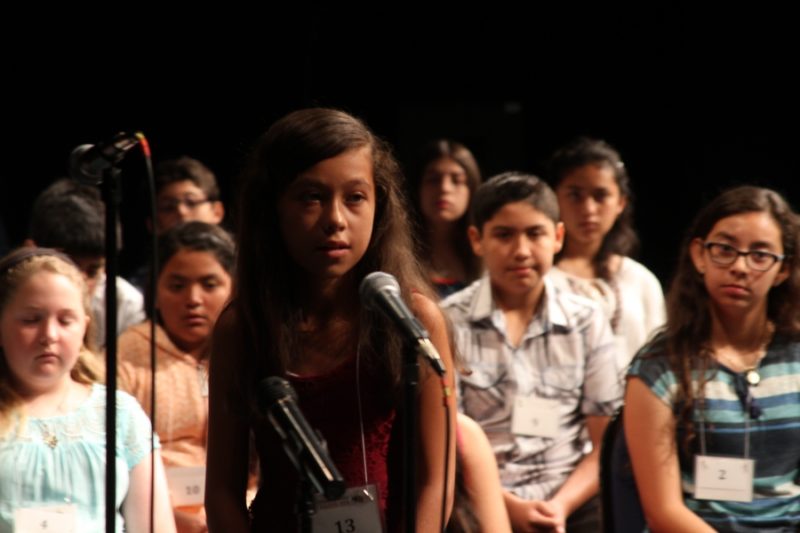
Kiara Rivas-Vasquez, a sixth-grader from Oregon, gives a confident smile to her mother who is watching on from the front row. Credit: Simon Thompson/PRI


This article by Simon Thompson originally appeared on PRI.org on July 27, 2016. It is republished here as part of a content-sharing agreement.
The amphitheater is humming: teachers hover, students murmur over spelling sheets and proud parents deliver the last gasps of pep talks. After final embraces and a tear or two, the spelling competitors are swept backstage.
It is sixth grader Jybr Reynoso Hidrogos’ second time competing. He made the top five last year, but fell short of a trophy. Every day since, he’s spent two hours or more practicing spelling. That’s what helped him beat out his classmates and win a preliminary contest to wind up here today.
“It seemed impossible and I am actually here. It is like a dream,” Jybr says.
This isn’t the Scripps National Spelling Bee that you watch on ESPN. This is Concurso Nacional de Deletreo en Espaรฑol, the National Spanish Spelling Bee, held this month in San Antonio, Texas.
Words are drawn from the “Lista de Palabras,” a 1,448-long list of Spanish words. When contestants need a word repeated, defined or used in a sentence, they are encouraged to ask the judges in Spanish. They also have to correctly place any diacritical marks, like the tilde in artimaรฑa (trick), the dieresis in ungรผento (ointment) or the accent in constelaciรณn (constellation).
“It makes it hard sometimes,” says Jybr. “There some words where it seems like there is no accent — maybe you can’t hear it — but actually it is there.”
Jybr has been learning Spanish from the cradle. Though he is in the bilingual track at Bradley Middle School in San Antonio’s North East Independent School District, he mainly speaks English with his school friends.
His parents came to the US from Mexico before he was born. His father, Liborio Reynoso, says seeing his son compete in their native language is a massive point of pride.
“Oh man!” he says. “My first language, my native language. We want our language to grow up here in this country.”
It wasn’t that long ago that first-generation American citizens like Jybr were scolded for speaking Spanish at school and encouraged to abandon their native language.
The director of the Spanish spelling bee, David Briseรฑo, grew up in the US state of New Mexico where his Spanish-speaking parents were convinced that teaching their children the language would hold them back. Now 60, he says he still hasn’t quite mastered Spanish.
“My parents went through the time when you were punished in school for speaking Spanish,” he says. “They wanted to make sure we weren’t getting punished.”
His parents, he says, were belittled, spanked or could have their mouths washed out with soap if teachers caught them speaking their native language. Many people don’t like to talk about this painful history, but another school administrator at the spelling bee tells me the same thing happened to her parents. At last year’s bee, Josรฉ Reyes, a bilingual instructor from Gadsden Independent School District in New Mexico, told me that a teacher punished him for speaking in Spanish. He went to school in El Paso, Texas, in the 1960s and 70s.
“I used Spanish and I remember her taking me to the sink in the corner and washed my mouth with Borax, with soap. And she said, ‘You won’t use this language again.’”
Fifth-grader Mariana Moya-Rubiano from Thomas Harrison Middle School, Harrisburg, Virginia, correctly spells her first word in the competition. 27 students competed — accents, tildes and all — in the bee this year. Credit: Simon Thompson/PRI
Briseรฑo founded the National Spanish Spelling Bee six years ago to change these attitudes and to raise the status of the Spanish language in the US.
Efforts like his are making a difference. The benefits of bilingual learning gained Once, Students in the US Were Punished for Speaking Spanish. Here, They Are Honored. · Global Voices:


United States must extradite Fethullah Gulen to Turkey: Ankara mayor | The Indian Express

United States must extradite Fethullah Gulen to Turkey: Ankara mayor | The Indian Express:

United States must extradite Fethullah Gulen to Turkey: Ankara mayor

Turkish authorities have launched a sweeping nationwide purge of suspected Gulen supporters since the coup.

Turkey, Turkey Coup attempt, Turkey Coup, Gulen, Fetullah Gulen, Melih Gokcek, Tayyip Erdogan, World news, International news, Turkey news,
A man attaches a mask with the image of United States extradite Fethullah Gulen, who is accused of being behind the violent July 15 coup, by a makeshift gallows at the Kizilay square in Ankara. (AP Photo|Ali Unal)
The United States must extradite Islamic preacher Fethullah Gulen to Turkey to remove any suspicion that Washington was involved in the failed July 15 coup, the mayor of Ankara Melih Gokcek said.
Gokcek, mayor for over 22 years and one of the most senior figures in the ruling Justice and Development Party (AKP) of President Recep Tayyip Erdogan, also told AFP in an interview he feared Turkey was entering a period where top officials could be at risk of assassination.
Turkey has squarely blamed Gulen for masterminding the rebellion, saying he assiduously built up a “parallel state” with followers in all institutions. From his secluded compound in Pennsylvania, the preacher has denied the charges.
Turkish authorities have launched a sweeping nationwide purge of suspected Gulen supporters since the coup, dismissing more than 50,000 people from their jobs and detaining more than 18,000.
With some officials now even alleging that Washington could have had a hand in the putsch, Ankara wants the United States to send back Gulen to face trial in the country he left in 1999.
“For America to prove it is not behind the coup, there is only one thing to do, deliver (him) to Turkey,” Gokcek told AFP in the capital.
He claimed that the US had already given “signals” it was involved in the coup after a top American general expressed concern that many of Washington’s former Turkish military interlocutors were now in jail.
“How will it be known whether America is or is not involved in this business? If they deliver (Gulen) there is no problem. But if they don’t the United States will not escape from the dock.”
Watch Video: What’s making news

Gokcek, who had previously suggested Gulen was hypnotising people, expressed bewilderment that Washington had tolerated the cleric’s presence and allowed his foundations to open up schools in the US.
“For America to tolerate this, it seems there are connections to FETO,” he said, referring to what Turkey calls the Fethullah Terror Organisation (FETO).
The US State Department has rejected suggestions it had any hand in the coup as “ludicrous”. Gokcek said Gulen’s role in Turkey went back to the premierships of Bulent Ecevit in the 1970s and admitted the AKP had mistakenly formed an alliance with his similarly Islamic-leaning supporters when it first came to power in 2002.
“But their biggest aim was to use us and to get their own people inside the army,” he said. Gokcek, one of the most outspoken senior figures in the AKP who regularly updates 3.4 million followers on Twitter with his views, said there would no longer be a risk of coups in Turkey but rather of assassinations.
“Politicians will be at risk of assassinations… of course I have increased my security,” he said.United States must extradite Fethullah Gulen to Turkey: Ankara mayor | The Indian Express:
Big Education Ape: Texas Opens Probe Into Gulen Connection to Charter Schools - WSJ - http://bigeducationape.blogspot.com/2016/07/texas-opens-probe-into-gulen-connection.html

Saturday, July 30, 2016

Where Clinton and Trump Stand on Education - The Atlantic

Where Clinton and Trump Stand on Education - The Atlantic:

Where Clinton and Trump Stand on Education

The convention dust has settled, and it’s back to the chalkboard.


When compared to Donald Trump’s single education policy-related sentence in his acceptance speech at the Republican convention, Hillary Clinton’s remarks on the subject Thursday night were certainly more extensive, as she sought to emphasize a track record of making schools, teachers, families, and students her political—and personal—priorities.
In accepting the Democratic Party’s nomination for president, Clinton touched repeatedly on education, from her work years ago supporting legislation on educating students with disabilities to her recently announced plans to make college “tuition-free” for low- and middle-income families at public universities. She also vowed to work toward a future where “you can get a good job and send your kids to a good school no matter what zip code you live in.”
Trump said much less much about education in his Cleveland address, although he did manage to fit a handful of buzzwordsinto one sentence: “We will rescue kids from failing schools by helping their parents send them to a safe school of their choice,” he said.

How the Republican presidential nominee will accomplish this, or what he would use as the barometer for a failing school, isn’t clear. His campaign, so far, has been very short on policy details. (In the meantime, the Obama administration continues to work on regulations and guidance to flesh out the Every Student Succeeds Act, the legislative successor to No Child Left Behind.)
The Republican Party’s platform is more detailed on education. Politico’s Michael Stratford noted that it includes a direct rebuke of a recent White House directive urging states to uphold the civil rights of transgender students. (Republicans said they “salute the several states which have filed suit against it.”)

As Dana Goldstein wrote earlier this month for Slate, Hillary Clinton is reshaping the Democratic Party’s relationship with the so-called “school-reform” movement:

Following eight years of federally driven closures and turnarounds of schools with low test scores, which have put union jobs at risk, it was music to the [National Education Association’s] ears when the presumptive Democratic nominee promised to end “the education wars” and stop focusing only on quote, “failing schools.” Let’s focus on all our great schools, too.
At the same time, a common thread in media coverage of the National Education Association’s recent convention was the overall strong support for Clinton’s platform—and the boos that followed her brief, supportive remarks about charter schools.

For an update on where the two presidential candidates stand on education Where Clinton and Trump Stand on Education - The Atlantic:


Insiders or outsiders: who runs public school districts better? - The Washington Post

Insiders or outsiders: who runs public school districts better? - The Washington Post:

Insiders or outsiders: who runs public school districts better?


Muriel Bowser, the mayor of Washington D.C., is in the market for a new leader of the city’s public school system. The current occupant of the job, Kaya Henderson, is leaving in a few months and Bowser has launched a nationwide search for a successor. Who and what should she be looking for? Someone from inside the district? Outside?
In this post, education historian Larry Cuban looks at the historical trends of district leadership — and offers the D.C. mayor some advice about how to make a solid decision. Cuban is as qualified as anyone to write about the subject. He was a high school social studies teacher for 14 years, a district superintendent (seven years in Arlington, VA), and is professor emeritus of education at Stanford University, where he has taught for more than two decades. He is the author of numerous books, including “Inside the Black Box of Classroom Practice: Change without Reform in American Education.” This appeared on his education blog and he gave me permission to republish.
https://larrycuban.wordpress.com/2016/07/25/insider-or-outsider-superintendents-in-big-cities/
By Larry Cuban
In Los Angeles Unified School District, the school board appointed an insider — Michelle King — superintendent earlier this year after a string of prior superintendents came from outside the district.
In New York City, Mayor Bill De Blasio appointed an insider – Carmen Farina –   as chancellor in 2014 after then Mayor Michael Bloomberg had appointed three outsiders since 2000.
These appointments of insiders to big-city districts, people who spent their careers within the district as teachers, principals, and district office administrators, are the exception, not the rule. For large urban districts, the rule has been to appoint outsiders who promise major changes in course to solve serious problems.
Why is that?
Outsiders have been appointed time and again in these districts because the unspoken and strong belief was that the serious educational, social, and political problems besetting the schools needed an innovative, energetic outsider, someone supposedly unbeholden to those inside the district.
An outsider, policy elites assumed, would shake the system by the scruff of its neck in turning around a failing district – “disrupt” is the fashionable word today. Insiders who had risen through the ranks would prize stability while looking for incremental improvements. Insiders  immersed in a network of relationships with peers and subordinates would supposedly be reluctant to disturb bureaucratic procedures, rules in effect for decades, and bonds of affection and respect for long-time peers and subordinates. Insiders would be loath to importing new staff and  innovations from elsewhere. They would rather seek new ideas and programs from sharp, knowledgeable insiders.
These strongly held beliefs about insiders and outsiders have shaped the appointment of superintendents to big city posts for well over a half-century.
In brief, the folk wisdom surrounding superintendents or chancellors heading urban districts says to appoint insiders if you like what has been happening in the system under the exiting superintendent in order to extend and protect what is working well for students, teachers, and the community. Stability and tweaking what works is the order of the day when insiders are Insiders or outsiders: who runs public school districts better? - The Washington Post:

What I didn’t hear in Hillary Clinton’s speech |

What I didn’t hear in HIllary Clinton’s speech |:

What I didn’t hear in Hillary Clinton’s speech

hillaryclinton


What concerns me most about Hillary Clinton’s speech is I what I didn’t hear.
I heard no mention of unions. Public sector or private. How strange. The omission suggests one of the traditional pillars of the Democratic Party, labor, is no longer even worthy of mention.
When Barack Obama was elected, he went to Washington promising to press for the union “check-off” provision that would have made it easier (and safer) for working men and women to vote for union representation. He gave up on the idea when he ahd the chance to save another priority, health care.
I heard no mention of traditional public schools. Oh, sure, there was talk about schools and even a nice story about a kind first grade teacher.  But public schools throughout the nation are under siege by so-called “reformers”–supported by Clinton– who want to privatize education, turn it into a profit-making industry. Clinton missed a chance to bring many Sanders’s supporters to her side.
Of course, the assault on public education is part of the assault on public sector unions. Democrats for Education Reform (DFER), led by Newark’s own Shavar Jeffries, has called teacher unions the “dam” that must be “burst” in order to improve public education.  Isn’t it strange that both the N EA and the AFT rushed to endorse Clinton before the primaries? Why do I hear the old union refrain, “Which side are you on, boys (girls?)…which side are you on?”
I heard no mention of standardized testing. Or Common Core.  Does Clinton endorse the infamous words of former US Education Secretary Arne Duncan that parents are opposed to punitive testing because they will learn their children aren’t as smart as they thought they were?
I heard no mention of PARCC or Pearson. We’re all supposed to get into an uproar about the hacking of the Democratic National Committee’s computers, but no one at the top of the Democratic leadership is complaining about cyber-spying on our children while they are taking tests that provide profits to testing companies from public tax money.
I heard no mention of racial isolation. Without racial segregation enforced by housing laws—a segregation now as bad as it ever was, especially in major cities—the desperate problems in the streets would not be so tragic. Schools would not be such instruments of  American apartheid. Violence could be countered.
I heard no mention of  crackdowns on Wall Street excesses. Including limits What I didn’t hear in HIllary Clinton’s speech |: