Latest News and Comment from Education

Wednesday, July 20, 2016

The Man Accused of Inspiring Turkey’s Coup Is Behind the Largest Charter-School Chain in America | The Nation

The Man Accused of Inspiring Turkey’s Coup Is Behind the Largest Charter-School Chain in America | The Nation:

The Man Accused of Inspiring Turkey’s Coup Is Behind the Largest Charter-School Chain in America

The schools have been investigated for corruption.


Until last Friday, most Americans had probably never heard of Fethullah Gülen—the controversial Sunni cleric now accused of fomenting a coup attempt in Turkey. But the aged cleric, currently exiled in the Poconos, Pennsylvania, has far greater influence on US society than most realize.
Since 2002, Gülen-affiliated foundations have quietly built up the largest charter-school network in America, with over 130 schools in 26 different states nationwide. This rapid buildup is troubling, however, since financial records suggest the cleric’s charter-school network has routinely funneled public-education dollars to its own members, often with unclear benefit to students.
The last time the Gülen movement made national news was in the summer of 2014, after the FBI raided the offices of a Gülen-linked charter operator, Concept Schools, seeking information about companies it had contracted with under the federal E-Rate program for its schools across the Midwest.
The charter operator’s disbursal of E-Rate dollars for school-technology installation was highly suspect, since the service provider in question, Core Group, had E-rate contracts, amounting to over $2.87 million, only from these Gülen-linked charter schools. According to the Chicago Sun-Times, Department of Education investigators claimed that the Gülen charter operator, Concept Schools, had violated government bidding rules, funneling over $5 million in E-Rate funds to firms with ties to the operator.
The last time the Gülen movement made national news was the 2014 FBI raid of a Gülen-linked charter school operator. 
FBI investigation notwithstanding, an analysis of E-Rate records suggests that similar funneling schemes continue to to this day in Gülen-linked schools across the country.
Between 2012 and 2015, Apex Educational Services, Inc. applied for 18 E-Rate contracts. All were from Gülen-linked charter-school chains in California andColorado. While Apex Educational Services, Inc.presents itself as an independent education-technology firm, according to a 2013 IRS filing, Apex is listed as a property of the Gülen-affiliated Sonoran Science Academy in Chandler, Arizona. Furthermore, the contact provided for Apex Educational Services, according to the USAC federal contract database, is Nuriles Sopolov, a former IT manager at another Gülen-linked charter school in Las Vegas.
Similarly, between 2010 to 2014 Brighten Technologies earned roughly $670,000 from 23 E-Rate contracts from the Gülen-linked Texas charter chain Harmony Public Schools. Founded and staffed by former Harmony computer-science teachers, 94 percent of Brighten Technologies’ E-Rate applications were for Harmony Public Schools’ contracts, as of 2014. And across the country, tech and construction firms tied to the Gülen movementhave made millions from contracts from the generous contracts of Gülen-The Man Accused of Inspiring Turkey’s Coup Is Behind the Largest Charter-School Chain in America | The Nation:


Big Education Ape: What Do the Corporate Reformers and Campbell Brown Have to Say about The Gulen Charter School Scandal - http://bigeducationape.blogspot.com/2016/07/what-do-corporate-reformers-and.html

Big Education Ape: Turkish exile sparks questions about Congress travel, charter schools - http://bigeducationape.blogspot.com/2016/07/turkish-exile-sparks-questions-about.html
Big Education Ape: Turkey widens post-coup purge, demands Washington hand over cleric | Reuters -http://bigeducationape.blogspot.com/2016/07/turkey-widens-post-coup-purge-demands.html

Big Education Ape: Fethullah Gulen Should Not Be Operating American Charter Schools. | deutsch29 -http://bigeducationape.blogspot.com/2016/07/fethullah-gulen-should-not-be-operating.html
Big Education Ape: Reclusive Muslim cleric Fethullah Gulen, who lives in Pennsylvania, blamed for failed coup in Turkey - LA Times -http://bigeducationape.blogspot.com/2016/07/reclusive-muslim-cleric-fethullah-gulen.html

Big Education Ape: US would consider extradition request for exiled cleric -http://bigeducationape.blogspot.com/2016/07/us-would-consider-extradition-request.html

 Big Education Ape: Fethullah Gulen: The Islamic scholar Turkey blames for the failed coup - The Washington Post - http://bigeducationape.blogspot.com/2016/07/fethullah-gulen-islamic-scholar-turkey.html

Big Education Ape: Jersey Jazzman: What We Don't Know About Gulen-Linked Charter Schools, And Why That's a Problem - http://bigeducationape.blogspot.com/2016/07/jersey-jazzman-what-we-dont-know-about.html

Big Education Ape: Coup in Turkey: Is Fetullah Gulen Behind It? | Diane Ravitch's blog - http://bigeducationape.blogspot.com/2016/07/coup-in-turkey-is-fetullah-gulen-behind.html

Big Education Ape: KILLING ED: 120 American Charter Schools and One Secretive Turkish Cleric -http://bigeducationape.blogspot.com/2016/01/killing-ed-120-american-charter-schools.html

 Big Education Ape: Update: Gulen Harmony charter school network accused of bias and self-dealing Dallas Morning News - http://go.shr.lc/1qV85Hm

Big Education Ape: Turkey Links Texas Charter Schools to Dissident - WSJ - http://go.shr.lc/1OW1ZfV
Big Education Ape: Magnolia Science Academy - A Gulen Charter School: Gulen Magnolia Science Academy links discussed at LAUSD board meeting -http://bigeducationape.blogspot.com/2016/06/magnolia-science-academy-gulen-charter.html

Charter Schools and the Waltons Take Little Rock Back to its Segregated Past | Alternet

Charter Schools and the Waltons Take Little Rock Back to its Segregated Past | Alternet:

Charter Schools and the Waltons Take Little Rock Back to its Segregated Past

In many ways, it's 1957 all over again.

Stories about historic efforts to address racial segregation in American public education often start with Central High School in Little Rock, Arkansas in 1957. But the story of Little Rock and segregation badly needs updating.
Central High became one of the first practical tests of principles established in Brown v. Board of Education, the Supreme Court ruling that overturned racially separate public schools. When nine black students showed up for opening day of the historically all-white school, Arkansas Governor Orval Faubus called in the National Guard to prevent them from entering. President Dwight Eisenhower responded by calling in federal troops to escort the students into the school, and Faubus eventually backed down.
But the story of racial integration in Little Rock shouldn't be confined to Central High. The same year Central was integrated, another school, Hall High, opened in the all-white part of town with an all white student body. Hall would not integrate until 1959 (Faubus closed all Little Rock high schools in school year 1958-59 to protest federal intervention), when three black girls were allowed to attend.
By the late 1960s, through busing and other efforts, Hall had been transformed into a much more racially diverse school, according to Kathy Webb, who graduated from Hall in 1967. Webb, who is white, currently represents Ward 3 on the Little Rock City Board and has served in the Arkansas state legislature.
In a phone conversation, Webb tells me that she remembers Hall High as a racially diverse school with an academically solid reputation and a relatively high graduation rate. But then, she notes, something happened: Hall High underwent a profound change.
By 2002, when Webb returned to live in Little Rock after decades away, Hall looked more like a school from the segregationist past than the model of Charter Schools and the Waltons Take Little Rock Back to its Segregated Past | Alternet:
 

Tuesday, July 19, 2016

Hillary Clinton and Charter School Myths

Hillary Clinton and Charter School Myths:

Hillary Clinton and Charter School Myths

cloud of words or tags related to myth and reality, fiction and facts
Last night the report from the AFT convention was that Hillary Clinton once again spoke about how charter schools provided traditional public schools with innovation. This is a recurring theme with her—one that has already drawn boos from teachers in the NEA. As one teacher put it last night, is she tone deaf?
Charter schools are responsible for shutting down hundreds of schools. They don’t do anything particularly innovative, or if they do it is because they are given the luxury of having smaller classes or special circumstances which are not afforded real public schools. But charter chains often don’t do better on tests than traditional public schools.
And I know of nothing unique that charter schools do that would qualify as innovative.
So many educators and parents know this that it is an embarrassment, really, that Clinton still clings to this mantra of charter innovation. Is it because of her connection Hillary Clinton and Charter School Myths:


What If Everything You Thought You Knew About Teachers Unions Turned Out to be Wrong? – EduShyster

What If Everything You Thought You Knew About Teachers Unions Turned Out to be Wrong? – EduShyster:

What If Everything You Thought You Knew About Teachers Unions Turned Out to be Wrong?

An economist finds that teachers unions raise teacher quality and increase kids’ educational attainment… 
EduShyster: It’s a well-known true fact that teachers unions make it much harder to get rid of bad teachers. But you conducted a study for the National Bureau of Economic Research that purports to find the opposite. In fact, you titled your study The Myth of Unions’ Overprotection of Bad Teachers. Tell us about what you found.
Eunice Han: What I found is that the facts are the opposite of what people think: that highly unionized districts actually fire more bad teachers.
EduShyster: That sound you just heard was of jaws collectively dropping. While we give readers a chance to re-combombulate themselves (and arm themselves anew with anecdotes), can you walk us through your argument? And feel free to use a formula. 
Han: It’s pretty simple, really. By demanding higher salaries for teachers, unions give school districts a strong incentive to dismiss ineffective teachers before they get tenure. Highly unionized districts dismiss more bad teachers because it costs more to keep them. Using three different kinds of survey data from the National Center for Education Statistics, I confirmed that unionized districts dismiss more low-quality teachers than those with weak unions formula2or no unions. Unionized districts also retain more high-quality teachers relative to district with weak unionism. No matter how and when I measured unionism I found that unions What If Everything You Thought You Knew About Teachers Unions Turned Out to be Wrong? – EduShyster:

With A Brooklyn Accent: We Have Seen This Bitterness Before: Reflections on 1968 and Now

With A Brooklyn Accent: We Have Seen This Bitterness Before: Reflections on 1968 and Now:

We Have Seen This Bitterness Before: Reflections on 1968 and Now

I have many friends, most of them younger than me, who are terrified by the divisions in the country, by the violent acts that periodically add to the tension, and by an election which brings out a level of fear and anger they have never seen before.
Unfortunately, this is not new to me. I have vivid memories of the year 1968 and that Presidential election. We had a terrible war. Assasinations. Riots in every major city. Campus take overs. And a country divided down the middle over race and politics
I will give you snippets of this to put things in perspective. Race was a huge divider. There was bitter white resentment of Black urban uprisings and campus protests, fueled by a third party candidate named George Wallace, and used as a political platform in somewhat less visceral ways by the Republican candidate Richard Nixon. You could feel the tension on the streets, especially in neighborhoods which were undergoing rapid racial change. I vividly remember signs along the Cross Bronx Expressway which said "This is Wallace Country" as the line separating whites from Blacks and Latinos quickly moved from Tremont Avenue to Fordham Road. It also divided families. I was basically kicked out of my family for falling in love with a Black woman and adopted by her extended family, which had a base in the Bronx. Walking hand in hand through the city was like maneuvering a minefield. You never knew who was going to blow up at us
But it wasn't just race. It was the war, drugs and the "hippie youth culture too." I vividly remember driving through the With A Brooklyn Accent: We Have Seen This Bitterness Before: Reflections on 1968 and Now:


AFT convention celebrates history, vision for future | Workday Minnesota #AFT100 #AFT16

AFT convention celebrates history, vision for future | Workday Minnesota:

AFT convention celebrates history, vision for future

Photo of Denise Specht
Denise Specht, president of Education Minnesota, welcome delegates to the American Federation of Teachers national convention in Minneapolis. Photo courtesy AFT


 MINNEAPOLIS

More than 3,000 delegates convened Monday at the Minneapolis Convention Center to celebrate 100 years of the American Federation of Teachers(link is external) – and lay out a vision for the future of the 1.6-million-member union.
President Randi Weingarten gave the keynote address. Democratic presidential candidate Hillary Clinton, who has been endorsed by AFT, addressed the convention Monday evening.
Delegates were welcomed by Denise Specht, president ofEducation Minnesota(link is external), whose 70,000 members work in every aspect of public education in the state, from pre-kindergarten through higher education.
Throughout its history, the AFT has been at the juncture of key social, economic and civil rights movements, Weingarten said. “Democracy and fairness, education and economic prosperity … racial and social justice for all …”
She recalled the founding of the organization in 1916 in Chicago, where “union headquarters was a spare room in the financial secretary’s house.”
One hundred years ago, women didn’t have the right to vote. Legislation to outlaw lynching was routinely blocked. Child labor was legal. Teachers were forced to sign ‘yellow dog’ contracts promising they’d never join a union.
“So much of what we take for granted today took the work of people just like you, coming together demanding better,” Weingarten said. “We have done a lot, that to our founders would be inconceivable, but we made inevitable.”
The AFT grew from its original eight locals to 3,500 local unions with more than 1.6 million members.
While reflecting on the union’s success in promoting public education and raising the standards for educators and students, Weingarten said many challenges exist, including divisions and violence in American society.
“There are 33,000 gun deaths in the United States each year …” Weingarten said, then added, to loud applause, “Should it really be easier to get an assault weapon than to get a driver’s license or to register to vote? We should never accept that mass murder and indiscriminate killing are the new normal.”
Many Americans are struggling economically and looking for solutions, Weingarten said.
“Underlying the anger that people are feeling are aspirations for a better life and those aspirations compel us to act.”
Clinton arrived at the convention to a thunderous ovation. She praised the work of the AFT and of educators in general.
"Thank you for caring for all children - no matter what they look like, where they come from or who they are," she said. Clinton also expressed her support for unions, adding, "We need to be serious about raising wages for teachers and support staff."AFT convention celebrates history, vision for future | Workday Minnesota:
Photo of Randi Weingarten
AFT President Randi Weingarten said the union will build on a 100-year legacy of activism. Photo courtesy of AFT

Saving CPE I | Deborah Meier on Education

Saving CPE I | Deborah Meier on Education:

Saving CPE I

Deborah-Meier650x400
Dear friends,
I am frequently asked about the situation at Central Park East I that has recently made the news. Which side am I on, I’m asked.
I am unequivocally on the side of those who wisely have concluded that the current principal must move on. She cannot do the job required. Bringing in someone to “help” her where she is weak is not a solution, but merely a postponing of the inevitable drift into more “standardized” practice and a more hierarchical school structure.
What is needed is an interim solution that helps pull the school together, hire new staff, set the tone and continue to improve the practices and approach that has marked CPE I’s 43 year history.
These include: staff governance, choice for families and staff, strong parental voice and advice, substantial teacher autonomy to develop curriculum, no admissions requirements re academic or social “fitness.” dedicated to serving predominantly low-income students of color, and the belief that a good open, progressive school should be able to serve all children together without separating them by so-called ability—by tracking in any form including social or racial indicators. CPE I’s form of progressivism was, on the spectrum, perhaps more inclined to emphasizing “play”—self-initiated cognitive activity—which often includes physical movement, as well as choice, sustained periods for uninterrupted work, peer collaboration, and demonstration versus standardized testing. Work and Play share common purposes and are, in fact, hard to distinguish. Play is at the heart of serious intellectual work, and observation provides teachers with the best means of support for further growth which rests, in professional jargon, in something called self “agency”.
CPE was dedicated to the task of creating a democratic community of citizens with different roles to play—students playing the role of citizens-to-be in some areas and equal citizens in others. It was based on substantial time set aside for children and their families to meet with their teachers, and open access to classrooms by family members.
It was also based on an agreement between the staff to meet together several hours a week, mostly during the school day, as well as before and after the school year—plus a planning meeting for the fulltime professional staff in mid-winter. If the faculty was responsible for the school’s work it needed time to effectively play such a role—on matters great and small.
For 32 years this process worked—serving largely District 4 families, plus a very small number of District 5 and others. We had a commitment not to seek a waiting list! When we had more applicants than spaces the District agreed to start other schools that worked together with us and had a single application process—thus CPE II and River East. The teacher-directors (and later principals) of these schools were almost always former teachers in the same or similar schools.
We were just three out of what became a District of 50 small schools during that same period, all with far more autonomy than generally found in urban public schools—including the neighborhood schools (only one was closed due to low enrollment in the district) and the new schools of choice.
A few years after we opened the District asked us to add white students to help the 
Saving CPE I | Deborah Meier on Education:

City attorney releases emails and documents to SN&R - Sacramento News & Review

City attorney releases emails and documents to SN&R - Page Burner - July 18, 2016 - Blogs - Sacramento News & Review:

City attorney releases emails and documents to SN&R


More than 16 months after former SN&R contributing editor Cosmo Garvin filed a Public Records Request and just over a year after Kevin Johnson sued SN&R and the city of Sacramento to block their release, 70 emails and documents were finally released today.
The move came 10 days after judge ruled the documents were not protected by attorney-client privilege and must be released. The documents were released on a CD and the files included four blank documents for a total of 74 files in all.
The emails between Johnson, city staff and other associates detail the mayor’s attempt to force out leaders of the National Conference of Black Mayors and date as far back as June 2013. Some of the information remains redacted, pursuant to the court order.
Many of the emails were sent using Johnson’s OMKJ (Office of Kevin Johnson) Gmail account and some bear a letterhead that reads “Office of the Mayor: The City That Works for Everyone.” While the letterhead may seem official, however, it is not the City of Sacramento’s.
The messages and documents here connect the dots on Johnson’s attempt to stage a takeover of the NCBM and include some messages and documents directly from the NCBM.
One document, dated July 8, 2013, for example, was sent to the judge in a dispute between the NCBM and Johnson. The letter, on NCBM letterhead, described itself as “representing the majority of the Board of Directors for the National Conference of Black Mayors” and contested Johnson’s claim that he had been properly elected as president of that organization:
“Despite failing to meet certain requirements such as the proper formation of a Nominating Committee, holding a secret vote, and ensuring that all voting parties were members in good standing, Mayor Johnson claimed he was properly elected. This is not true."


The judge eventually ruled in Johnson’s favor.
Meanwhile, a September 13 email from Johnson to the email address “ncbmlitigation@gmail.com”,  detailed the mayor’s attempt to oust NCBM executive director Vanessa Williams with Johnson writing “we are cautiously optimistic that there will be an agreed upon settlement in the near future” in regards to William’s “possible … resignation.”
In addition, the documents contain meeting agendas and a list of possible replacements for Williams’ position.
Other documents point to external dissatisfaction with Johnson’s legal firm Ballard Spar.
A July 10, 2013 email chain revealed that Williams tried to deny access to Ballard Spahr because “the Board of Directors has not approved the use of Ballard Spahr, nor has it given the authority of the board to the said special task force per the request of the Board of Directors.”
In an interview the Sacramento Bee today, Johnson’s spokeswoman Crystal Strait explained that the mayor fought to keep the documents hidden for more than a year because of ongoing legal entanglements  and on the advice of his legal counsel.


GOP vows to ‘take America back’ — but race tension, cop killings suggest we’re already there | The Lens

GOP vows to ‘take America back’ — but race tension, cop killings suggest we’re already there | The Lens:

GOP vows to ‘take America back’ — but race tension, cop killings suggest we’re already there

Mark Essex, the cop killer who terrorized New Orleans from the top of a downtown hotel in 1973.
U.S. Navy
Mark Essex, the cop killer who terrorized New Orleans from the top of a downtown hotel in 1973.


Shots rang out from a downtown high-rise. An African-American sniper targeted police officers in retaliation for what he believed was their role as enforcers of white supremacy in black neighborhoods. No, I’m not referring to Dallas in 2016, or Baton Rouge on Sunday, but New Orleans in 1973. Navy veteran Mark Essex shot and killed five police officers before he was shot to death on the roof of the Howard Johnson’s hotel on Loyola Avenue.
In both 1973 and 2016, rage at racist police wasn’t unfounded, even though we rightly excoriate the counter-productive method of redress chosen by the angry black men. Racial strife erupting into gunfire isn’t the only déjà vu of 2016, though. The predictable way that American conservatives pour gasoline on the fire for political expediency is also a familiar script.
“Law and order” is the answer, said Nixon in 1968 and now Trump in 2016. Out-of-control law and order is what led police to kill Alton Sterling and Philando Castile, yes, and to beat thousands of Civil Rights protesters throughout the South in the 1960s. Despite the obvious logical contradictions, the GOP’s racially tinged fear mongering worked great in 1968. So, with the party convening this week in Cleveland to nominate Trump for president, here we go again.
The question of why innocent black men are still disproportionately killed by police, with predictable (but occasional) eye-for-an-eye retaliations, is inevitable, the answer disheartening. Racism and, more specifically, anti-black racism (the mother of all- American racism) doesn’t seem to want to go away.
Nietzsche wrote about “eternal return,” the idea that history is tediously and often violently repetitive, making the notion of historical “progress” a vain ideal with little basis in reality. I used to like Marx more than Nietzsche, because of his dogged faith in the ability of human beings to shape a more just society through struggle. I suppose they’re both right to a certain extent. There’s no question that black lives are valued more today than they were 50 years ago. The chances of a police officer dying in the line of duty are also much reduced since 1980. Violent crime in general is way down since a deadly peak a generation ago.
But pointing out how things are better has a way of sounding like an apology for the status quo. The Rev. Martin Luther King Jr. spoke of “the mythical concept of time” — rejecting the idea that mistreated people should settle for rejoicing that their descendants will probably (maybe) get treated better.
And then, of course, we have problems other than race. This violent July calls our attention to continuing racial strife, but also to the problems of an over-armed as well as over-policed society. The costly and painful foreign wars that Republicans have insisted will “make us safer” may also be implicated, since the men who fired on police in Dallas and Baton Rouge (and in New Orleans in 1973) were all recently discharged veterans who had been deployed overseas.
What’s sad is how the other serious problems we face — easy access to killing machines, zero-tolerance policing, 10 years of repeated deployments for military families, declining incomes for the vast majority of Americans — are too often used as diversions. They are mustered rhetorically as reasons to downplay the force of persistent racism, when instead they should be recognized as accessories to or enablers of it. The very normal social mess of American society is best described by both/and rather than either/or terms.
But people who stress that our society is over-policed for all races shouldn’t be on a different team than Black Lives Matter. The Washington Post has recently compiled data on people killed by police across the country. The data should alarm us, no matter how the numbers are diced. More white people were killed by police in 2015 than any other race, but the percentage of murdered black citizens is far higher. The same holds true for stats on poverty, government assistance, etc.
These numbers mean that black people continue to be disproportionately victimized by our economy and by the laws meant to enforce the economic status quo, but that, yes, there are significant numbers of white losers, too. Putting these numbers in perspective should in no way be spun as a denial of the continuing existence of racial disparities — how could they be?
The argument over whether “black lives matter” or “all lives matter” is part of the same pointless shouting match. All lives matter, yes, but black lives are the ones that have been disproportionately devalued. I don’t understand why that formula is so difficult for people to grasp and agree on. Oppression takes place on multiple fronts. Reducing everything to race alone is almost as crazy as the familiar conservative refrain that “race has nothing to do with it.”
One of the most baffling responses to the persistence of racism is the formalized confession of white cluelessness. Blog posts crop up instructing white people how they should respond, how they should speak to black people about these issues, and, most pointedly, what they are NOT to say. Facebook is filled with protestations by well-meaning white people that until just now — Eureka! — they have had no understanding of the black experience.
One of the most embarrassing installments of this genre came from the guy I voted for in the presidential primary, Bernie Sanders. GOP vows to ‘take America back’ — but race tension, cop killings suggest we’re already there | The Lens:

A Running Mate to Run From - Lily's Blackboard

A Running Mate to Run From - Lily's Blackboard:

A Running Mate to Run From


Now we know who Donald Trump’s vice president will be: Mike Pence, governor of Indiana. And considering Pence’s political career, we can bet that he won’t be a champion for ensuring that all students, regardless of ZIP code, have access to an inspiring education that helps them reach their potential.
Throughout the presidential campaign, Trump’s judgment has been repeatedly – and rightfully – called into question.  The fact that Pence would accept the billionaire bully’s invitation to join the ticket makes his judgment suspect, too.
Who is Mike Pence, other than someone who describes himself as “Rush Limbaugh on decaf”?
 He’s a former six-term Congressman who has been Indiana’s governor since 2013. While in Congress he: opposed the Affordable Care Act; voted against expanding the Children’s Health Insurance Program; voted against expanding grants for low-income college students; voted to make same-sex marriage illegal; opposed a prohibition on job discrimination based on sexual orientation; voted against additional support for those living in poverty; voted against increasing the minimum wage; supported building a fence on the Mexican border; voted in favor of turning in illegal immigrants who show up in emergency rooms.

Many know of the governor from his controversial Religious Freedom Restoration Act, which gave any Indiana businesses the right to discriminate against lesbian, gay, bisexual and transgender individuals.  (The subsequent uproar caused Pence to sign a revised version of the law that explicitly bars a business from denying services to someone on the basis of categories that include sexual orientation and gender identity.) Here are some other highlights – or rather, lowlights – from Governor Pence’s tenure:


Big Education Ape: Koch Brothers’ Friends Funding Mike Pence | Hoosier School Heist Blog -http://bigeducationape.blogspot.com/2015/07/koch-brothers-friends-funding-mike.html
Big Education Ape: Schools Matter: The Real Story Behind Mike Pence’s Charter School Speech -http://bigeducationape.blogspot.com/2015/07/schools-matter-real-story-behind-mike.html
Big Education Ape: The bigot Mike Pence and his neighbor Bruce Rauner. | Fred Klonsky -http://bigeducationape.blogspot.com/2016/07/the-bigot-mike-pence-and-his-neighbor.html
Big Education Ape: BREAKING NEWS - Trump goes with anti-public education running mate - Wait What? -http://bigeducationape.blogspot.com/2016/07/breaking-news-trump-goes-with-anti.html
Big Education Ape: The big trouble in Indiana public schools, as explained by a troubled educator - The Washington Post - http://bigeducationape.blogspot.com/2016/02/the-big-trouble-in-indiana-public.html

Hoosier School Heist TV is Doug Martin's channel featuring videos of his book tour across Indiana speaking on the corporate takeover of public education. Order Hoosier School Heist at http://hoosierschoolheist.com/.
Follow Hoosier School Heist on Facebook: https://www.facebook.com/HoosierSchoolHeist
Tweet with Doug Martin at: https://twitter.com/DougMartinED

Choice and Walling Off Poverty | the becoming radical

Choice and Walling Off Poverty | the becoming radical:

Choice and Walling Off Poverty

Just Released:

School Choice: The End of Public Education? 


School choice has remained a compelling part of education reform discourse and policy into the twenty-first century—but not simply among conservative politicians and stakeholders.
For example, despite growing evidence that charter schools are essentially no better or worse than traditional public schools, political and public support for charter schools remains robust primarily because they are touted as parental choice.
And especially in the good ol’ U.S. of A., what could be wrong with all parents having the same choices that wealthy parents have?
Except, that bromide is compelling only within the context of idealizing choice—ignoring that parents make all sorts of horrible choices daily, negatively impacting their children, ignoring that parents tend to choose schools for socio-political reasons that have little to do with academic quality, and thus, that choice isn’t a positive market force for education reform but for one of the greatest ills to ever impact society and education in the U.S.: segregation by race and class.
While the talking points for school choice advocates have shifted over the last few decades, “all parents should have the same choices that wealthy parents have” drives the essence of their advocacy, and allows this ideology to skirt the overwhelming evidence against school choice as a positive mechanism for education or social reform addressing inequity.
During this presidential election season, amid rising social tensions, there is renewed calls for building a wall between the U.S. and Mexico. Like school choice, this plan is compelling along extreme ideological lines only; in practice, both are unwarranted and even incendiary.
Yet, what we are failing to acknowledge is the act of walling is already in place in the U.S.—the wealthy Choice and Walling Off Poverty | the becoming radical:

The First Lady of Plagiarism: Melania receives an F | Reclaim Reform

The First Lady of Plagiarism: Melania receives an F | Reclaim Reform:

The First Lady of Plagiarism: Melania receives an F


 As a retired teacher of English/Language Arts, there have unfortunately been many instances of plagiarism by students that had to be addressed in which consequences had to be given. Now the prospective First Lady, Melania Trump, has been caught bare handed in the same nasty situation during the first night of the Republican National Convention.

“… you work hard for what you want in life. That your word is your bond and you do what you say and keep your promise. That you treat people with respect.”
– Melania Trump 2016
“that you work hard for what you want in life; that your word is your bond and you do what you say you’re going to do; that you treat people with dignity and respect. ”
– Michelle Obama 2008
Since no coherent Republican platform has been established which addresses educational issues, it seems bizarre to have plagiarism, which is an ongoing education problem, become the first example of what to expect from the Trump campaign. The First Lady of Plagiarism.
Oddly, even during a night of oddities, Melania’s recital was the least offensive discourse of a hate filled night. A recitation of platitudes from an eye-candy professional model. BlahThe First Lady of Plagiarism: Melania receives an F | Reclaim Reform:


How Has Opposition to Corporate School Reform Evolved? | janresseger

How Has Opposition to Corporate School Reform Evolved? | janresseger:

How Has Opposition to Corporate School Reform Evolved?


The Republicans began their convention here in Cleveland yesterday, and the Democrats will meet soon in Philadelphia. The political season is upon us, with not much attention to the policies that affect our public schools. But I believe support for important reform in public schools has evolved considerably over the past couple of decades, despite that we still see intense advocacy for corporate reform supported by philanthropists and think tanks promoting the supposed efficiency of markets.
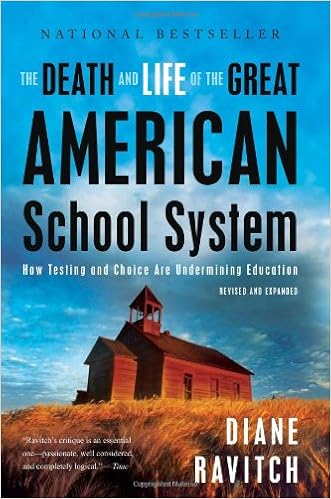
In 2010, Diane Ravitch, the education historian who had supported corporate reform as a fellow at the Hoover Institution and an assistant secretary of education under President George H.W. Bush, did an about face in The Death and Life of the Great American School System.  Basic Books has recently published a revised edition. To mark the new edition of Ravitch’s important book, Valerie Strauss in the Washington Post recently published an interview with Ravitch and in a subsequent column an excerpt from the revised edition. Ravitch’s description of the evolution of her own thinking seems to me a good summary of the developing consensus of today’s thoughtful advocates who want to preserve a strong system of public education that serves all children and protects their rights.
When she published The Death and Life of the Great American School System in 2010, Ravitch rejected her previous support for the kind of accountability-based school “reform” defined by the 2002 No Child Left Behind Act because, she said, she had discovered it didn’t work.  It neither raised overall school achievement nor closed gaps in scores among racial and economic groups of children. In her 2010 book, Ravitch also categorically rejected the Obama-Duncan philosophy of education epitomized by Race to the Top and the Bloomberg-Klein commitment to the explosive growth of charter schools that dominated the enormous New York City school district at the time.  She castigated the ideas of a group of super-wealthy philanthropists she called The Billionaire Boys Club: Bill Gates, Eli Broad, and the Waltons.
In her interview last month with Strauss, Ravitch describes her delight when Basic Books invited her to publish a revised edition, because over time her thinking has continued to develop: “As time passed, I realized that there was one key point in the book that I found embarrassing. In the final chapter, I reiterated my long-standing support for national standards and a national curriculum… The more I thought about it, the more I became convinced that national standards and a national curriculum was another truly bad idea.” Ravitch describes the new edition in which: “I quite bluntly admit… that the pursuit of national standards, national curriculum and national tests is a dead end… Even in states that have the same standards and tests, there are achievement gaps, reflecting wealth and poverty. Politicians continue to claim that making tests harder will make students smarter. But tests are not an instructional method; they are a measure… What we now know, because of the failure of the Common Core, is that increasing the difficulty of the material to be learned and the rigor of the tests widens the achievement gaps. Children who are already struggling to keep up will fall farther behind.”
When Strauss asks how Ravitch believes the anti-corporate-reform movement, of which Ravitch has been a leader, has changed the conversation, Ravitch answers: “Fewer people today believe that charters have some special magic; more people understand now that those with the highest scores exclude low-performing students or push them out.  The virtual How Has Opposition to Corporate School Reform Evolved? | janresseger:

Pelto Slams Every Student Succeeds Act - Calls on Obama and Congress to postpone adoption of ESSA Regulations - Wait What?

Pelto Slams Every Student Succeeds Act - Calls on Obama and Congress to postpone adoption of ESSA Regulations - Wait What?:

Pelto Slams Every Student Succeeds Act – Calls on Obama and Congress to postpone adoption of ESSA Regulations


Jonathan Pelto, Green Party candidate for Congress in Connecticut’s 2nd Congressional District, is calling on President Obama and Congress to postpone adoption of the Every Student Succeeds (ESSA) Regulations until the new President and Congress take office in January, 2017.
“Limiting a parents’ fundamental right to opt their children out of the unfair, inappropriate and discriminatory standardized testing scheme and mandating that every child must take a standardized test ever year are just two of the damaging provisions of the ESSA draft regulations being proposed by the Obama Administration,” Pelto said.  “As presently written, the Every Student Succeeds Act (ESSA) regulations continue many of the failed education policies of the federal government.  The President and Congress should, at the very least, postpone action on those regulations until the new president and new congress take office in 2017.”
Pelto condemned the legislation and new regulations explaining;
  • The ESSA regulations inappropriately require that ALL students take a standardized test every year. The most successful public education systems in the world DO NOT utilize mandatory annual testing.  Requiring such a practice is a huge waste of scarce public funds and valuable student instructional time.
  • The ESSA regulations do not provide clear concise language guaranteeing a parent’s’ fundamental and inalienable right to opt their child or children out of the annual standardized testing program. Failure to recognize a parents opt out right is a fatal flaw in the regulations and this issue must be corrected before any meaningful statute and regulation can move forward.
  • The ESSA regulations require that standardized assessments be focused exclusively on Math and English, thereby narrowing the curriculum and failing to provide the framework for the type of comprehensive education that all students need to compete and proposer in the 21st
As the Vermont State Board of Education noted in their recent testimony in opposition to the regulations;
‘By requiring that test scores in two subjects and graduation rates be given preferential weight, [the regulations] discourage schools from supporting truly broad opportunities to learn and the skills necessary for a healthy society.  In a world where violence and terrorism command the news, the education of our youth to participate in a strong civic life in a democracy is a fundamental skill. Similarly, we must equip students with the capabilities to address critical imperatives like global warming, environmental degradation and growing global inequality.’