Latest News and Comment from Education

Thursday, May 12, 2016

Whitney Tilson and I Debate Education Reform and the Billionaires’ Role, Part 2 | Diane Ravitch's blog

Whitney Tilson and I Debate Education Reform and the Billionaires’ Role, Part 2 | Diane Ravitch's blog:

Whitney Tilson and I Debate Education Reform and the Billionaires’ Role, Part 2


Whitney Tilson, a key figure in the corporate reform movement, and I have continued an exchange about the teaching, charters, and the movement he represents. He was among the founders of Democrats for Education Reform and Teach for America; he is also involved in Bridge International Academies, which opens low-cost, for-profit schools in poor countries. Another in this series will appear soon. He posted this on his blog this morning. You can read it there to see my remarks are in blue; when I copied and pasted to my site, all the blue disappeared, and I didn’t have time to recolor them. My comments are marked DR, his are WT. I am engaging in this dialogue so that his readers can learn what their critics say, not filtered but straight.
From: Whitney Tilson 
Sent: Thursday, May 12, 2016 9:00 AM
Subject: Round 2 of my discussion with Diane Ravitch, on who’s the status quo, charter schools, and testing
If someone forwarded you this email and you would like to be added to my email list to receive emails like this one roughly once a week, please email Leila at leilajt2+edreform@gmail.com. You can also email her if you’d like to unsubscribe. Lastly, in between emails I send out links to articles of interest via Twitter (I’m #arightdenied) so, to get them, you must sign up to follow me at: https://twitter.com/arightdenied.
———————
STOP THE PRESSES AGAIN!!!
My new BFF, Diane Ravitch, and I have continued our conversation and it’s gotten even more interesting, as we’ve moved past the high-level principles we mostly agreed on in our first exchange of emails (sent a couple of weeks ago and posted on her blog here and my blog here) and started engaging on the many issues on which we disagree.
Our ongoing discussion covers many topics:
1) Whether reformers are now the status quo
2) Charter schools
3) Tests and how they should (and shouldn’t) be used
4) Who is the underdog in this battle
5) The tone of the debate and our shared desire to focus more on the issues and less on personal attacks
6) The details of the Vergara case – namely, a) the amount of time it takes teachers to earn tenure; b) how difficult it is for administrators to fire a tenured teacher; and c) whether layoffs should be done strictly by seniority
Because of its length, we’ve agreed to break it into two parts: Round 2 is below and will cover the first three topics. Tomorrow we’ll release Round 3, covering the remaining three.
My original email is in italics, Diane’s comments are in blue (beginning with “DR:”), and my responses are in black (beginning with “WT:”).
Enjoy!
Whitney
Hi Diane,
I really enjoyed our first exchange of ideas. Thank you for engaging.
Since you had the last word, the onus is on me to respond – which, frankly, makes me feel overwhelmed because we’ve already touched on so many enormously complex and difficult issues that we could spend weeks discussing just one of them.
So, I’m going to approach this following the old maxim, “How do you eat an elephant? One bite at a time.” I’m not going to try to respond to everything, but rather just a few things and hopefully we can build from there.
So let’s talk about two things, one high-level and one nitty-gritty: 1) tone, language and motivations; and 2) the Vergara case.
Tone, Language and Motivations
Here’s another thing we can surely agree on: we (and our allies) have Whitney Tilson and I Debate Education Reform and the Billionaires’ Role, Part 2 | Diane Ravitch's blog:

Internal documents lay out threats to the Success Academy model | POLITICO

Internal documents lay out threats to the Success Academy model | POLITICO:
Internal documents lay out threats to the Success Academy model


 Success Academy, New York City’s largest and most influential charter network, faces multiple potential crises as it attempts to triple in size over the next decade, according to a series of internal documents obtained by POLITICO New York.

The documents, which include memos, financial documents and a comprehensive draft risk assessment, show anxiety among Success executives over a variety of external threats to the network, including a “less than friendly press corps,” a “politically dynamic environment” that could stall the network’s growth, and rising real estate costs that threaten to “destroy our financial model.”
But the documents also provide an unprecedented glimpse into the internal struggles at the network, which has received national attention for the high test scores of its students, most of whom are black or Latino and come from poor neighborhoods. 
The documents reveal uneven returns on political spending, including more than $700,000 on a pro-charter rally last year in Albany, and concerns about a pressure-filled environment that has led to high turnover and the possibility of cheating. High-ranking Success employees also expressed dismay over a major technology investment that has yet to pay dividends, and worried over the pace and direction of the organization’s expansion.
“I don’t think the question is fully answered on how we can maintain high education quality while we scale up,” said one Success executive, as quoted in a 40-page draft of a risk assessment prepared by network staff and circulated among network executives in December 2014.
Risk assessments, sometimes required for insurance purposes, are designed to predict worst-case scenarios.
The “Enterprise Risk Assessment,” based on 14 interviews with members of the network’s senior leadership team, is dominated by concerns about the organization’s inner workings, including a disappointing $20 million student data tracking system, an uncertain talent pipeline, and the lack of a clear successor to the network’s high-profile founder and CEO, Eva Moskowitz.
“This is our single point of failure and an existential risk,” said one executive, referring to the potential leadership vacuum. (This risk assessment includes “selected comments by interviewees” for each section, but does not identify them by name.)
The expressions of concern come as Moskowitz aims to harness tens of millions of dollars in public and private funds to expand the network from its current 34 schools, serving 11,000 students, to 100 schools and 50,000 students over the next decade. That ambitious plan is key to her broader aim of establishing Success as what the network describes as a “catalyst and national model for education reform efforts,” and a legitimate citywide competitor to the incumbent public school system.
Stefan Friedman, a spokesman for Success, noted in an emailed response to a series of questions that the risk assessment was compiled in 2014, when the network underwent its largest-ever period of growth, opening ten schools in a single year. 
"Whether its opening 100 schools total or 100 additional schools, we will not rest until we are able to provide a high-quality education not only to our current student population, but to the tens of the thousands of children on our waiting lists who have been banished to low-performing district schools due to nothing more than political gamesmanship,” he said.
MOSKOWITZ, A FORMER DEMOCRATIC CITY COUNCILWOMAN who made a reputation for herself with stinging critiques of the powerful city teachers’ union, has long criticized New York City’s sprawling, unionized public school system for its relative rigidity and inability to respond promptly to students’ needs. She has offered her rapidly expanding network as a counterpoint to that system, and aims to grow it to a size that Internal documents lay out threats to the Success Academy model | POLITICO:

CURMUDGUCATION: Better Schools Dialogue Part III: Three Guiding Questions

CURMUDGUCATION: Better Schools Dialogue Part III: Three Guiding Questions:

Better Schools Dialogue Part III: Three Guiding Questions


I'm running a dialogue with Dmitri Mehlhorn in which we are looking for any common ground we might share on the topic of better schools. Here are links to Part I and Part II. I'll be along with my next response shortly, but in the meantime, feel free to speak up in the comments section.

Dear Curmudgucation,   

Thank you for engaging.  In response to my vision for public schools, you and your followers have raised three basic questions: (1) are these schools desirable, (2) are they possible, and (3) how can we get them?   

Are these schools desirable?   

My first post suggested that teachers should be paid more; freed from standardized testing and administrative choresand allowed to focus on their students. Studentsshould learn from each other and on their own, using Montessori methods andoutdoor activities, in learning communities that span different ages and ability levels.They should eat healthy foods. Both content and pedagogy should be personalized to their needs. I cross-posted this vision on other sites (including Medium and Citizen Ed), and received positive feedback from parents and educators.  Given the choice, I’m confident most of America, its teachers, and its students would prefer this vision to the status quo.  

You and your audience raised concerns: that by relying upon mobile computingthis vision elevates technology at the expense of humanity; and that competency-based CURMUDGUCATION: Better Schools Dialogue Part III: Three Guiding Questions:


A 'borderless' school district with lots of choices: LA's superintendent outlines priorities | 89.3 KPCC

A 'borderless' school district with lots of choices: LA's superintendent outlines priorities | 89.3 KPCC:
A 'borderless' school district with lots of choices: LA's superintendent outlines priorities


In a decade, if Los Angeles Unified School District Superintendent Michelle King has her way, she would run a “borderless district” where students can choose any school in the city they wish to attend.
In the nearer term, King said Wednesday, she wants L.A. Unified to focus on offering an expanded portfolio of school choices, from magnet programs to dual language immersion schools — and yes, charter schools must also play a role, King reiterated.
King has kept a low profile during her first five months on the job, doing as much listening as agenda-setting in her public appearances.
While still light on specific policy details, the list of priorities King shared at a town hall for parents at Gage Middle School in Huntington Park on Wednesday reflects broadly how the new superintendent hopes to make her mark on the district. 
  • Decentralization. "We can't run it all," King said, "from where I sit at Beaudry [the district headquarters] … Shifting the power, the control, the resources, down to the school level." The idea is not necessarily new; King's predecessor, Ramón Cortines, proposed a similar idea during his first stint as superintendent in 2000. This year, King said individual principals received a little more discretion about how to spend some of their funding. "You'll start to see that happening more and more," she said.
  • School choices. King said parents want to have the option to send their kids to "theme-based magnet" schools, as well as other options, like dual immersion, pilot programs and even single-gender schools. This has become a priority for L.A. school board members, who've urged King to develop a strategy to expand these programs. In the long term, she said she envisioned the weakening of A 'borderless' school district with lots of choices: LA's superintendent outlines priorities | 89.3 KPCC:

Everything You Need To Know About Publishing My Book | The Jose Vilson

Everything You Need To Know About Publishing My Book | The Jose Vilson:

Everything You Need To Know About Publishing My Book


In the summer of 2011, I stared at my blog and wondered if I could make a book of it. The wall I kept banging my head against was the idea that I’d get fired, piss every current and future employer with my critiques, and, offer no apology for the forthcoming expressions of passion for the work I do. By the time I set my heart to a manuscript, I partook in meetings that tested every limit of mine from a professional standpoint. As a teacher, I could close the doors shut (though I rarely did) and focus 150% of my attentions on my students and their needs (sometimes to the detriment of my own body). As a math coach, I had no choice but to listen to DOE rhetoric and the ways our system continued to perpetuate inequity through complex accountability schemes, the decimation of teacher morale, and the stunted voices of students and parents writ large.
The rest of the country was still catching up to the swindle, and I didn’t think the world would catch up fast enough.
Fast forward passed the thousands and thousands of words typed on this very keyboard, the plethora of friends and family who read over at least five different revisions of my first manuscript, the dozens of query letters I first wrote, the dozens of agents and publishing houses who rejected me, the tens of revised query letters I then wrote, the dozens of quasi-rejections under the guise of not knowing how to advertise these works, the eventual investigation into self-publishing, and the Hail Mary to Haymarket Books that eventually landed me a book deal. The first team phone call had me listening to the book’s promotion in a hotel. A few hours later, I was listening to David Coleman, Sue Pimentel, and Jason Zimba sell a handful of major districts the Common Core.
This is happening.
The meeting with my first editor Liliana Segura, the red marks scribbled all over my manuscript, the 15-minute walks telling myself “this is just part of the process, my man,” the forceful process of making myself a better writer while writing, the Anzalduas, Baldwins, Freires, Galeanos, and S. Carters-[Hamptons] I read while wrestling with my own experiences, my father passing as I almost tossed my laptop from tight deadlines, my quiet tears and rum and cokes while I reconsidered all this, and my bringing it all back to knowing I had to make Chicago Teachers Union Karen Lewis, NYU Professor Pedro Noguera, and my momma proud because these words will manifest regardless.
I was still teaching middle schoolers math 7:30am – 4pm, but don’t tell nobody because people of color aren’t supposed to work twice as hard at anything.
In 2014, when I held the first copy of my book, I didn’t want to hear anymore about my complicity Everything You Need To Know About Publishing My Book | The Jose Vilson:


Arne Duncan, Priscilla Chan Discuss Next Steps for K-12 Education - Politics K-12 - Education Week

Arne Duncan, Priscilla Chan Discuss Next Steps for K-12 Education - Politics K-12 - Education Week:

Arne Duncan, Priscilla Chan Discuss Next Steps for K-12 Education


Former U.S. Secretary of Education Arne Duncan has been out of office for months and is now working for the Emerson Collective, a philanthropic and advocacy organization. But on Wednesday, he sat down for an exit interview at the NewSchools Venture Summit here, with Jim Shelton, his former deputy. (Shelton was recently tapped to run the Chan Zuckerberg Initiative, the Facebook-fueled education philanthropy. More on what they're up to these days below.)
Shelton started with an easy question: What is Duncan most proud of his over his seven-year tenure as secretary?
Duncan ticked off three things: pouring $1 billion into early childhood education, an all-time high graduation rate (fact check on administration's role in making that happen here), and increasing Pell Grants. Not on the list: The two K-12 initiatives he's best known for, the $4 billion into Race to the Top initiative and the $3 billion School Improvement Grant, both of which have yielded mixed results so far.
Shelton also wanted to know what Duncan sees as his three biggest failures.
Duncan ticked off one he's mentioned a number of times before—not being able to get Congress to go along with an even bigger investment on early childhood education. The fact that so many of our children enter kindergarten behind means "we're just setting our kids up for failure from the start," he said.  
He also mentioned that the Obama administration failed to get immigration overhaul done and, therefore, didn't give immigrant kids a path to citizenship. "We could not get our Republican friends to back that," he said.
And he brought up another missed opportunity, the failure to get meaningful gun control legislation done: "In our worst nightmare we never imagined we'd have 20 babies killed and five teachers and a principal."
Not on Duncan's list of failures? Two things that many other folks would probably cite: requiring Arne Duncan, Priscilla Chan Discuss Next Steps for K-12 Education - Politics K-12 - Education Week:


California's schools will soon be on the hook for things like suspensions, attendance and graduation rates - LA Times

California's schools will soon be on the hook for things like suspensions, attendance and graduation rates - LA Times:

California's schools will soon be on the hook for things like suspensions, attendance and graduation rates


lifornia's schools are going to have to answer for more than just test scores, by the year after next. The state may also judge them on suspension rates, graduation rates, attendance and the rate at which students who are still learning English are becoming proficient.
Those are the measures the California State Board of Education voted on Wednesday to include in its new school ratings system. The vote came after more than 100 members of the public spoke about what they think a good school looks like. They pressed the board to include non-academic factors, such as surveys on school climate — a measure of how safe a school feels — parental engagement and suspension rates. 
Draquari McGhee, a Fresno high school student, told the board he could remember the moment he nearly gave up on school. It was earlier this year, when, he said, he was suspended for three days for being on his phone while walking to class. The vice principal told him he would be arrested for trespassing if he didn’t leave class, he said, and the experience left him feeling like he couldn't excel.
“My engagement deteriorated overall,” he said. “I felt like I was a bad student.” That’s why, he told the board, the state should use suspension rates as a key metric for schools.
A teacher known as “Mama B” supported McGhee and helped him get back on track. But the suspension almost derailed him, he said, as it could other students.
School discipline rates, and particularly the disproportionate numbers of students of color being punished at school, have faced recent scrutiny. Los Angeles Unified, for example, California's schools will soon be on the hook for things like suspensions, attendance and graduation rates - LA Times:
 Big Education Ape: Accountability and Continuous Improvement Report - Year 2016 (CA Dept of Education) http://bit.ly/1T7FXw3

Big Education Ape: State board to choose school improvement metrics | EdSource http://bit.ly/1rDFckb

Wednesday, May 11, 2016

Demographic and Social Change ‘Belongs to the Young’ — Medium

Demographic and Social Change ‘Belongs to the Young’ — Medium:

Demographic and Social Change ‘Belongs to the Young’

“Change is the law of life. And those who only look to the past or present are certain to miss the future.” — John F. Kennedy, June 1963


Children in our nation face an uncertain future that depends, in large part, on the decisions that adults make on their behalf. Their future is in peril because, even today, children are not faring well in America. For example, the U.S. Census Bureau finds 21.1 percent of our nation’s children were living in poverty in 2014 — a disadvantage that research has shown to have lifelong consequences for their education, income, health, and well-being. This is a profound tragedy that our nation is largely ignoring and we will reap negative repercussions for generations to come unless we take action in the near future.
Changing demographics and its implications for American politics and public policy will undoubtedly play an important role in either improving the status of our nation’s children or in leading to further declines. In a recent paper by First Focus, we outline some major demographic trends that will have profound implications on our nation for decades to come.
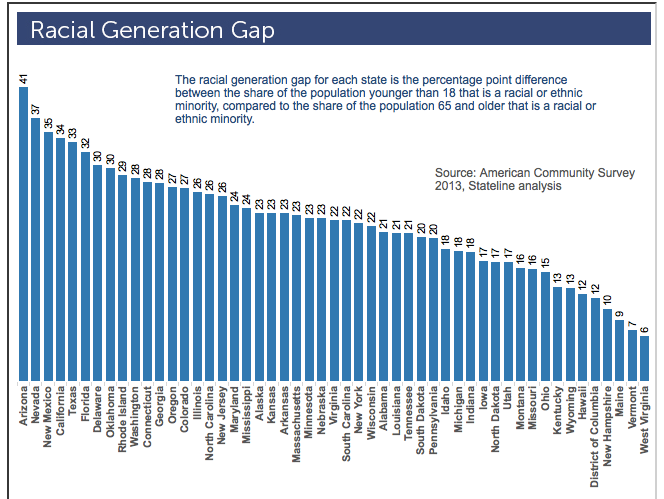
The first demographic change of significance is that, for the first time in 2011,babies born in America were “majority-minority”. As political commentatorRonald Brownstein puts it, “The demographic revolution transforming the U.S. belongs to the young.”
If we want a country that will continue to be strong and successfully compete with other nation’s across the world, we must make needed investments to improve the lives and outcomes for all of our children and make significant efforts to eliminate racial disparities.
Fortunately, the American people are concerned about the future of children. According to a Battleground Poll by the Tarrance Group and Lake Research this past May, the American people believe, by a 69–25 percent margin, that they do not believe the next generation will be better off economically than the current generation.
However, despite such concerns, the Congress has chosen to disproportionately cut funding to children’s programs rather than protect them. In fact, our nation’s elected federal leaders have chosen to shrink the share of federal spending dedicated to children to less than 8 percent.
Although some might point to the fact that overall federal spending is down Demographic and Social Change ‘Belongs to the Young’ — Medium:


Accountability and Continuous Improvement Report - Year 2016 (CA Dept of Education)

Accountability and Continuous Improvement Report - Year 2016 (CA Dept of Education):

Superintendent Torlakson Releases Report by the Accountability and Continuous Improvement Task Force


 SACRAMENTO—State Superintendent of Public Instruction Tom Torlakson announced the release of his Accountability and Continuous Improvement Task Force report today, which calls for an accountability system organized around three imperatives: performance, equity, and improvement.

The report was developed by a diverse, 30-member task force composed of leaders in many fields—teaching, administration, business, higher education, and philanthropy—as well as students, parents, and school board members. The task force was co-chaired by Wes Smith, Executive Director of the Association of California School Administrators, and Eric Heins, President of the California Teachers Association.
"This report contains many exciting ideas about how to build an accountability and continuous improvement system that works for students, parents, teachers, districts, and the entire community," said Torlakson. "It will add to the already rich dialogue taking place in California, which is leading the way in the development of a groundbreaking new accountability and continuous improvement system."
Torlakson thanked the task force for its hard work, insights, and commitment to collaboration. He said the cooperation was a great example of the California Way, working together to create positive change in education.
"I'm pleased our task force, after intensive study and discussion, could come together to produce a report that has many innovative concepts that can help develop a new, more useful accountability system," said Smith.
Heins agreed: "The task force brought together people from differing perspectives all united around the same goal: improving our education system by developing an accountability system that gives our schools, districts, and communities the broad view of how our schools and the systems that support them are doing, rather than focusing on one narrow, incomplete view."
The report (PDF; 1MB) calls for aligning (to the extent possible) local, state, and federal accountability and continuous improvement systems to create one integrated system. It also reinforces the concept of multiple measures that will look at a variety of indicators, such as high school graduation rates, chronic absenteeism, college and career readiness, school climate, and standardized test scores.
The task force report places top priority on identifying and closing the achievement gap, not only with regard to test scores, but also to ensure equitable access to educational resources and opportunities.
It also makes the following recommendations:
  • Connecting the accountability system to a system of continuous improvement for all districts and schools that relies on sharing best practices, supporting the intrinsic motivation of teachers and educators, and encouraging innovation.
  • Using a dashboard of measures to identify districts that need focused improvement support and intensive improvement support.
  • Continually monitoring, refining, and improving the system.
The Task Force report can be found on the CDE Web site (PDF: 1MB).
# # # #
Tom Torlakson — State Superintendent of Public Instruction
Communications Division, Room 5206, 916-319-0818, Fax 916-319-0100

New Orleans tries to mix charter schools with democracy: Is this the district of the future? - The Washington Post

New Orleans tries to mix charter schools with democracy: Is this the district of the future? - The Washington Post:
New Orleans tries to mix charter schools with democracy: Is this the district of the future?


In the decade since Hurricane Katrina hit New Orleans and swept away its public school system, the city has become a closely watched experiment in whether untethering schools from local politics could fix the problems that have long ailed urban education.
Louisiana seized control of most New Orleans schools and turned them into charter schools after the devastating storm in 2005. More than 90 percent of the city’s children now attend charters, which are publicly funded but privately run by unelected officials who have complete freedom to decide how to organize their programs, schedules, teachers and curriculum.
The schools, on the whole, are still far from excellent, and there are lingering questions about whether and how a bunch of independent schools — which are under pressure to meet academic targets to continue operating — can ensure access to education for all students, especially those with the greatest needs.
But test scores and graduation rates have risen. And now the state is poised to relinquish its oversight: The Louisiana legislature has passed a bill that would return the 52 schools it oversees to a measure of local control, testing whether independent charter schools and democracy can coexist.
Many charter-school advocates describe it as an inevitable next step in the city’s bold education experiment, and one that could serve as a road map for other cities grappling with how to manage and coordinate a large number of charter schools.
“If they can get that right, it will be really important for New Orleans and for the country,” said Neerav Kingsland, who worked for New Schools for New Orleans from 2006 to 2014, when it started dozens of new charter schools. “You can’t avoid democracy forever, nor should you.”
Proponents of the bill, including many charter-school advocates, are calling it a “reunification” of New Orleans schools, putting the locally elected Orleans Parish School Board back in charge of the city’s schools but leaving actual control of individual operations in the hands of school leaders. They say it is an important step in closing the wounds left by the state takeover without sacrificing the autonomies that they say have been essential for driving academic progress.
“I do think this is the start of a healing process for a lot of individuals, to realize that the city is coming back together,” said Jamar McKneely, the chief executive of InspireNOLA Charter Schools, who helped negotiate the bill.
But some critics say it is a whitewash, written to appear as if local control over public education will be restored when the bill really leaves most of the power in the hands of the unelected boards of directors who run each of the city’s charter schools.
Karran Harper Royal, an advocate for special-education students and their families, called it a “Trojan horse.”
“This is the kind of bill you get when the charter schools want to give the impression that schools are returning to local governance,” she said. “It feels like a very patriarchal view of communities of color, and white people deciding that black people, or people of color, don’t deserve democracy.”
Gov. John Bel Edwards (D) is widely expected to sign the bill, which was introduced by Sen. Karen Carter Peterson (D) of New Orleans and was supported by the majority of the New Orleans state delegation. It outlines the transfer of schools from the state-run Recovery School District to the locally elected school board by 2019 at the latest.
But the parish school board — which already runs a half-dozen schools and oversees more than a dozen charter schools — would be prohibited from interfering with school-level decisions New Orleans tries to mix charter schools with democracy: Is this the district of the future? - The Washington Post:
Questions remain as New Orleans schools prepare to return to local control | The Advocate — Baton Rouge, Louisiana http://bit.ly/1Ois51G

Effect of standardized testing on children - Business Insider

Effect of standardized testing on children - Business Insider:

This is the psychological effect standardized testing has on children


Some parents are so angry with the testing regime facing their children that they have come together in an attempt to boycott primary school exams.
Preparation by teachers for these standardized achievement tests (SATs) in England have involved a narrowing of the curriculum, including a specific focus on spelling, punctuation and grammar.
Parents believe that their children should be stimulated instead by more enriching activities and projects. There is also a worry that the tests may cause undue stress and pressure on their young children to perform well. These beliefs are widespread: more than 49,000 parents have signed a petition to abolish SATs altogether.

An awareness of pressure

Teachers are under considerable pressure for pupils to perform well on SATs. Performance-related pay and position in school league tables depend on test results. Parents believe that exam results will have a bearing on their young child’s future and understandably want them to do well.
But the children are also well-aware that their performance on the SATs is important to their teachers and parents. Teachers may unwittingly transmit the stress they are under to their pupils. Children can also pick up on their parents’ attitudes and associated behavior and feelunder pressure to make them proud.
This pressure from parents is perhaps the largest source of stress for children aged ten to 11 who are working towards their Key Stage 2 exams. One Year 6 pupil my colleagues and I interviewed described the source of the pressure he felt:
You want to get them [SATS questions] right because other people want you to get them right and, like, you don’t want to disappoint people.
 Stress and pressure about forthcoming exams can result in what education researchers have termed “test anxiety”. This can present itself via a number of symptoms.

Children can suffer from negative thoughts such as: “If I don’t pass this test, I will never get a good job”. They can also suffer physiological symptoms such as tight muscles or trembling and distracting behaviors such as playing with a pencil. The effects of anxiety during a test can influence the child’s ability to process and understand test questions and perform at their best.
It is well established that pupils with high levels of test anxiety perform more poorly in their exams. The overall prevalence of test anxiety in primary school children is on the increase and it is fairly common for children at the end of primary school. Year 6 pupils report experiencing anxiety either some or most of the time when asked two weeks prior to their exams.
But there are differences in how SATs are viewed by different children. Some perceive them to be stressful, while others view them as a challenge. As well as pressure from parents, pupils in Year 6 have cited the demands of the testing situation as a cause of stress. This includes 
 Effect of standardized testing on children - Business Insider:

Speaker: Charter schools take money from public schools - LimaOhio.com - limaohio.com

Speaker: Charter schools take money from public schools - LimaOhio.com - limaohio.com:

Speaker: Charter schools take money from public schools


ELIDA — William Phillis, executive director of the Ohio Coalition for Equity and Adequacy of School Funding executive director, said it is time for the state to end a failed attempt at charter schools.
Phillis was the guest speaker Tuesday at a school funding forum held at Elida High School. The crowd of about 30 was well represented by administration and staff from local school districts.
Phillis said the original concept of charter schools was for more school choice and to free schools from regulations in order to be more creative and innovative. However, he said a lack of oversight has turned charter schools into nothing more than money-making machines.
“It has rapidly expanded in Ohio, Phillis said. “The $10 million experiment become operational in Ohio in fiscal year 1999,” Phillis said. It expanded to a $50 million project in 2000 and $91 million in 2001.”
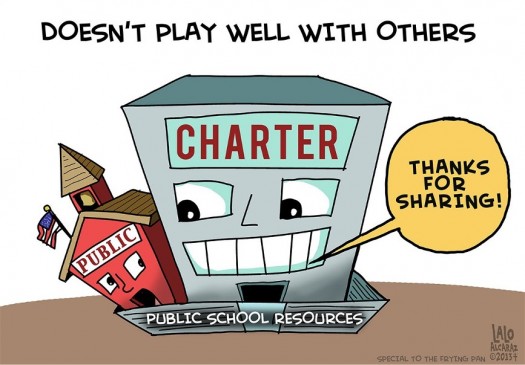
Phillis said it has now turned into a $1 billion enterprise in Ohio. He said they are sucking money out of public schools, that have proved to have a much better track record.
Phillis, who spent much of his career as an educator and and school administrator, said charter schools falsely sell themselves as good alternatives.
“You hear them referred to as a “community school,” Phillis said. “That is a bunch of baloney. Elida Schools are a community school. I love the public schools because they develop a sense of community and country.”
Elida schools Treasurer Joel Parker pointed out several interesting facts about the effect of charter schools locally. In Allen County, he said Lima City Schools loses about $2.9 million to charter schools and Elida loses about $1.1 million. Shawnee loses $426,000 and Bath loses $307,000. Parker said with the Elida district receiving an average of $3,556 per pupil in state funding, it means the district loses about $2,344 for each student that goes to a charter school.
He pointed out two charter schools in particular, ECOT and the Ohio Virtual Academy. The Elida district loses about $178,000 to ECOT and $172,000 to the Virtual Learning Academy.
“The graduation rate at ECOT is 35 percent and they gave out $1.3 million to political campaigns,” Parker said. “The Ohio Virtual Academy was founded by junk bond dealer Michael Milken. I think that says a lot right there.”
Phillis said school districts and their supporting taxpayers need to be more active on the subject.
Initially, he said funding needs corrected so public districts are not subsidizing charters. He also said districts should also develop and implement plans to recover charter students. Elida plans on discussing the addition of online schooling at its next board meeting in an effort to recover some of those lost students.
He also called on school districts to start billing the Ohio Department of Education for local money lost to charter schools, a practice that many school districts have already picked up on. He also encouraged support for Senate Bill 298, legislation that would force more accountability on charter schools.
“Tethullah Gulen, who is connected to 19 charter schools in Ohio, is worth $25 billion,” Phillis said. “He is using Ohio charter schools to fund the Turkish uprising. It is ludicrous, it is amazing. Where is the outrage. It needs to be discussed.”
Reach Lance Mihm at 567-242-0409 or at Twitter @LanceMihm.Speaker: Charter schools take money from public schools - LimaOhio.com - limaohio.com:
Big Education Ape: Union-commissioned report says charter schools are bleeding money from traditional ones - LA Times http://bit.ly/1rQn0DB

NC vouchers shrink opportunity for public school students | News & Observer

NC vouchers shrink opportunity for public school students | News & Observer:
NC vouchers shrink opportunity for public school students


BY THE EDITORIAL BOARD

The ill-conceived voucher program pushed through the General Assembly by Republicans is working just as advocates expected. Yes, they greased the skids for the program by targeting it for lower-income people, dubbing the millions of dollars in public funds that would help them send their kids to private schools as “Opportunity Scholarships.” The name, and the eligibility requirements, conjured a vision of a benevolent Republican Party trying to help the poor.
What the program really does is drain funds from what best serves the poor – free public schools.
Some numbers are in. They show the state has spent $12 million on the “scholarships” this year. Not surprisingly, $11 million of that went to Christian, Islamic and other faith-based schools. While there is legitimate concern that public spending on schools with religious affiliations violates the church-state separation principle of American government, the voucher system has passed muster with the courts.
The scholarships provide a maximum of $4,200 per pupil. That, voucher advocates say, shows the program is a bargain because the per-pupil cost of a public education is over $8,000 per student per year.
But Republicans knew full well when they passed the program that $4,200 wouldn’t cover the cost of the state’s most exclusive private schools. Schools like Cary Academy, Durham Academy and Raleigh’s Ravenscroft don’t have any Opportunity Scholarship students. So the students with vouchers are going to lower-cost schools.
Are they good schools? It’s hard to say, since private schools don’t have to disclose much about their operations publicly. They don’t have to give state exams or have state ratings and report cards. Teachers don’t have to be licensed or paid on the state scale. Public schools have all sorts of accountability requirements, including an ill-conceived letter-grade rating system.
State Rep. Skip Stam of Apex, a vociferous backer of vouchers, seems delighted with the lack of regulation, and he and other advocates of private schools want to expand the scholarship program to include more families.
The lack of accountability and the limited number of choices parents face given the size of the scholarships are troubling. But just as troubling is the body blow from the drain of money from public schools that results from the voucher system.
Public education in North Carolina is under attack. That is simply wrong for a system that offers true opportunity with a “scholarship” for all.