Latest News and Comment from Education

Thursday, February 18, 2016

Gates: Funding Reform for Longer Than You Think – Save Maine Schools

Gates: Funding Reform for Longer Than You Think – Save Maine Schools:

Gates: Funding Reform for Longer Than You Think


In “How Bill Gates Funded the Swift Common Core Revolution,” journalist Lyndsey Layton tells the story of how David Coleman, CEO of College Board, and Gene Wilhoit, Executive Director of the Council for Chief State School Officers, approached Bill Gates with a “new approach to transform every school in America.”
The “new approach,” of course, was the Common Core State Standards.
“The duo needed money,” writes Layton,“[and] a champion who could overcome the politics that had thwarted every previous attempt to institute national standards.”
According to the article, Gates deliberated for weeks before at last coming back with his answer: he was in.
What followed was the swift Gates takeover of our public schools.
bill-gates-money.jpg
Would that it were so simple!
The truth is that Gates has been funding a much broader effort to fundamentally remake our public education system for far longer Gates: Funding Reform for Longer Than You Think – Save Maine Schools:

What School Walk-Ins Teach Us

2/18/2016 – What School Walk-Ins Teach Us:

Education Opportunity Network -


What School Walk-Ins Teach Us

THIS WEEK: Doing Pre-K Wrong … Viral Video Stokes Democratic Party Division … Segregation Produces Criminals … How Basics Improve Schools … New Crackdown On For-Profits

TOP STORY

What School Walk-Ins Teach Us

By Jeff Bryant

“This week, thousands of teachers, parents, students, and community supporters of public education demonstrated nothing could be further from the truth in a series of “walk-in” protests in over 30 cities involving 900 schools … What’s important … is to hear why the walk-ins are happening and what protestors are saying.”
Read more …

NEWS AND VIEWS

We’re Doing Preschool All Wrong, Says New Book

Huffington Post

“A childhood development specialist at Yale University … argues that preschools are no longer giving children enough room to play, leading them to become less inquisitive, curious thinkers … One culprit is the accountability movement in K-12 education … Preschool has become more focused on academics, but not necessarily more effective in nurturing a child’s cognitive development.”
Read more …

This Viral Video Of A Teacher Berating A Student Is A Window On The Charter School Debate

Vox

Education reporter Libby Nelson writes, “A secretly recorded video of a teacher at a well-known New York charter school berating a first-grader … is getting a lot of attention … But the fight over charter schools is also bigger than New York – it’s part of a broader division within the Democratic Party on education.”
Read more …

How Segregated Schools Turn Kids Into Criminals

The Washington Post

“Resegregation caused the test score gap … to widen between white kids and black kids, as well as between poor kids and rich kids. Now, an even more troubling lesson has emerged. It turns out that segregated schools can become potent incubators of crime.”
Read more …

Learning From London About School Improvement

The News And Observer

Former New York Times education editor Edward Fiske and Duke University professor Helen Ladd write, ” Since the late 1990s, the academic performance of elementary and secondary school students in London has risen dramatically … due largely to significant gains in the 13 boroughs … that have the greatest concentrations of low-income and ethnic-minority students … English educators … rather than experimenting with governance or structural changes … focused their attention on time-honored fundamentals.”
Read more …

Education Department Takes Aim At Errant For-Profits

US News & World Report

“The Department of Education is creating a Student Aid Enforcement Unit to respond more quickly to allegations of illegal actions by higher education institutions … The announcement of the enforcement unit is the latest in a series of steps taken by the Obama administration over the last seven years aimed at more tightly regulating the for-profit college industry.”
Read more …
 2/18/2016 – What School Walk-Ins Teach Us:

Why Most State Education Report Cards are Like Cookies Without the Sugar – Cloaking Inequity

Why Most State Education Report Cards are Like Cookies Without the Sugar – Cloaking Inequity:

Why Most State Education Report Cards are Like Cookies Without the Sugar

Once when I was in high school, a friend handed me a plate of chocolate chip cookies. They looked delicious! But just as I was about to eat one, she snatched them back. They looked great on the outside, she told me, but they tasted terrible.  She had left out a key ingredient—sugar.
This story is exactly how I think about the numerous state education report cards making the rounds.  Instead of  filling you with great, inspiring information, most of these glossy, colorful reports are misleading and ideological. They are basically not worth consuming.
One of the mechanisms so-called education “reformers” have used to promote their top-down, privatization agenda for public education is the state-by-state education report card. Organizations such as Students FirstAmerican Legislative Exchange Council (ALEC), Thomas B. Fordham Institute, and Education Next have recently released report cards for each of the fifty states.
2ChocolateChipCookies.jpgWhat’s wrong with these state report cards? Most state-by-state ratings focus primarily on outcomes, such as state standardized test scores, and basically ignore educational inputs—the ingredients—that make public education successful. These report cards are obsessed with accountability systems that look like bold education “reform,” but that favor top-down, private control of public schools, with dubious results for kids.
Take just two examples.
Students First, an organization started by the controversial District of Columbia education reformer Michelle Rhee, issued report cards giving positive ratings to states if they allowed for parent trigger. Parent trigger is a policy that allows parents (in any given year) to vote to turn over a school and all of its public property to a corporation with a simple majority vote. The Students First report also gave states favorable ratings for prioritizing states’ and mayor’s’ ability to take over school districts. Top-down hostile takeovers of schools by states and mayors have a long and documented history of underwhelming performance and failure.
The state education reports issued by ALEC, a prominent corporate lobbying group that promotes neoliberal model legislation across public Why Most State Education Report Cards are Like Cookies Without the Sugar – Cloaking Inequity:


What out Washington State legislators CAN do to equitably fund educaton | Seattle Education

What out Washington State legislators CAN do to equitably fund educaton | Seattle Education:

What out Washington State legislators CAN do to equitably fund educaton

its-time


 I’ve seen enough dancing around the real issues of funding education in Washington State by our legislators and it’s time  for them to get serious or get another job.

From the Washington Budget Policy Center (who made a great presentation at the Stanford Center last year about funding education in our state hosted by the Seattle PTSA and the League of Women Voters):

Declining Revenue Projections Show It’s Time for Policymakers to Get Serious about Meeting Washington’s Needs

The new forecast of Washington state tax collections makes it clear that lawmakers can no longer assume the growing economy will automatically generate the resources needed to fund court-mandated improvements to schools, mental health, and other important priorities for our state.
The Washington State Economic and Revenue Forecast Council’s projection that state tax resources will be more than $500 million lower than previously forecasted over the next four years means policymakers must get serious about generating new revenue to invest in the progress and well-being of our state and its people.
The diminished tax resources ($78.2 million lower for the current 2015-17 budget cycle; $435.6 million lower in the 2017-19 budget cycle) present a significant challenge to House and Senate budget writers. The writers should be cautious about tapping budget What out Washington State legislators CAN do to equitably fund educaton | Seattle Education:

How Habits Support Democratic Schooling - Bridging Differences - Education Week

How Habits Support Democratic Schooling - Bridging Differences - Education Week:

How Habits Support Democratic Schooling

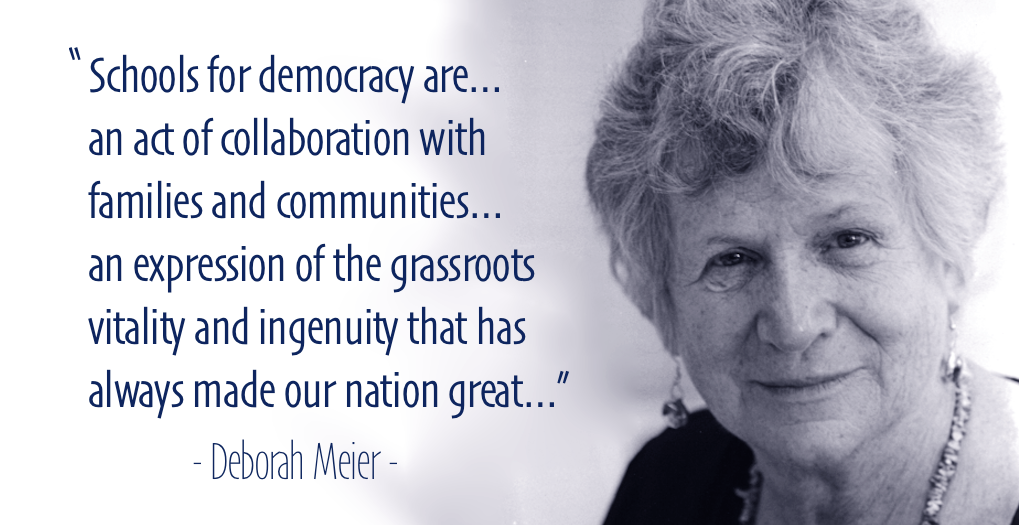
Deborah Meier continues her conversation with Harry Boyte. To read their full exchange, please visit here.
Dear Harry and friends,
Thinking about "habits of mind"—as you take it up in your final paragraph—is a good reminder that schools serve purposes beyond those of the school itself. Public schools serve ends that being raised just at home, church, or other personally chosen private institutions may not serve. If we tax "the people" to educate other people's children as well as their own, the process must serve the common good, to pass on those underlying understandings that hold us together. It gets complicated!
When we started Central Park East Secondary School in 1995, we faced a huge task. CPESS was to be a public East Harlem school with an incredible amount of promised independence—including devising our own definition of what a graduate should be able to demonstrate publicly in order to receive our state-endorsed diploma.
It was a weighty responsibility, blessed by a surprising number of powerful people, including the New York state superintendent of schools, Tom Sobol. The opening staff, about eight of us, met together to tackle these issues in 1995 and every year after to tinker and revise as we went along. But we held on to a few essentials decided on that very first year.
The "Five Habits of Mind" (and heart) were never codified into one particular wording. Over the years we, the kids, and our admirers tinkered with them, expressing them in many different ways that seemed to add rather than take away from our original thinking. I liked that fact.
The first was kind of old-fashioned: "How do we know what we know? Or: What's the evidence?"
The second—although the order in which we developed them wasn't intended to claim any special rank—was something like: "Could it have been different? How else, supposing that?"
The third was: "Is there another viewpoint—in fact, viewpoints? Who and why?"
The fourth was: "Is there a pattern? How are things related to each other? What are the connections?"
And finally, fifth: "Who cares? Why does it matter and to whom?"
We sometimes summarized the five as "habits of the heart": "open," "skeptical," and "empathetic."
We agreed that all the "stuff" we tackled in our curriculum would be subject to these five habits of mind, defining the themes we developed for the six years or more students typically spent at our school (grades 7-12).
We added some "habits of work"—like being reliable ("I can count on you"), collaborative, and committed to each other.
The focus was on "habits"—mind or heart—not just "knowing how." E.g., I know how to put my keys in the designated place every evening when I come home, but I'm not in the habit of doing so.
It's precisely in times of stress and crisis that we most need to have good habits. Democracy is a messy idea, and in practice it's messier still. It's precisely in states of crisis that we count on such habits. We wanted the number to be small and open to many ways of saying and seeing them. We wanted them to fit our different academic disciplines, but we wanted them to apply beyond the classroom—to the playground, our neighborhoods, and our society at large.
The math teachers, the science teachers, the English teachers, and the history teachers all felt very comfortable with the five. "Does it matter?," for example, can apply narrowly to our particular academic discipline, as well as to ordinary and extraordinary civic and personal endeavors. We avoided "cause-and-effect" language on purpose for the broader term of "connections and patterns."
We rejected the term "academic" as having a very questionable popular meaning—irrelevant, dull—quite the opposite of our intent. We liked the term "intellectual"—as a term that could and should be applied to the work of all citizens.
These five served us well and, 12 years later, were the basis for Mission Hill, a K-8 school in Boston. But, good as they are, I'd not favor mandating them. We may not have to always reinvent the wheel, but "buying in" is not sufficient either. It turns out that democracy itself must be reinvented over and over as contexts change and words come to take on different meanings and importance.
Does this make any sense for graduate study, Harry? Or citizen education? What's missing?
Deb
 How Habits Support Democratic Schooling - Bridging Differences - Education Week:

Thomas B. Fordham Releases a Report on Quality of Common Core Tests, ACT, and MCAS: A Debate | Diane Ravitch's blog

Thomas B. Fordham Releases a Report on Quality of Common Core Tests, ACT, and MCAS: A Debate | Diane Ravitch's blog:
Thomas B. Fordham Releases a Report on Quality of Common Core Tests, ACT, and MCAS: A Debate


The Thomas B. Fordham Institute commissioned and published an evaluation of the “content and quality of the next generation assessments,” specifically, the Common Core assessments (PARCC and SBAC), as well as ACT Aspire, and the Massachusetts Comprehensive Assessment System (MCAS). The report’s introduction was written by Michael Petrilli and Amber Northern of the Institute; the report itself was written by researchers Nancy Doorey and Morgan Polikoff. The introduction and link to the report appear in this post; the following posts will debate the study and its findings.
The authors of the report concluded that the Common Core assessments (PARCC and SBAC) were superior to the ACT Aspire and the MCAS.
This is the central finding:
Here’s just a sampling of what we found:
Overall, PARCC and Smarter Balanced assessments had the strongest matches to the CCSSO Criteria.
ACT Aspire and MCAS both did well regarding the quality of their items and the depth of knowledge they assessed.
Still, panelists found that ACT Aspire and MCAS did not adequately assess—or may not assess at all—some of the priority content reflected in the Common Core standards in both ELA/Literacy and mathematics.
The report is long, but the meat of the report can be easily accessed. It is important that you wrap your mind around the report because the next post will challenge its findings.
Since many of you are teachers and have administered some of these tests, feel free to add your voice to the debate.Thomas B. Fordham Releases a Report on Quality of Common Core Tests, ACT, and MCAS: A Debate | Diane Ravitch's blog:


 Richard Phelps, a testing expert, believes in the value of standardized testing but he does not like the Thomas B. Fordham Institute’s report on “next generation assessments.” To put it mildly. He calls it “pretend research.”

Phelps long ago wrote a report for the Thomas B. Fordham Institute, defending standardized testing. But in this case, he excoriates the TBF study. To begin with, he points out the TBF has received millions of dollars from the Gates Foundation to promote the Common Core standards, so he questions its objectivity as a funder of research.
Here are his main objections:
This latest Fordham Institute Common Core apologia is not so much research as a caricature of it.

Instead of referencing a wide range of relevant research, Fordham references only friends from inside their echo chamber and others paid by the Common Core’s wealthy benefactors. But, they imply that they have covered a relevant and adequately wide range of sources.
Instead of evaluating tests according to the industry standard Standards for Educational and Psychological Testing, or any of dozens of other freely-available and well-vetted test evaluation standards, guidelines, or protocols used around the world by testing experts, they employ “a  Richard Phelps: The Fordham Report on Assessments is “Pretend Research” | Diane Ravitch's blog 

Will Salary Increases Solve the Teacher Shortages? - The Atlantic

Will Salary Increases Solve the Teacher Shortages? - The Atlantic:

What If America’s Teachers Made More Money?

A number of states want to raise their salaries, but it’s unclear whether the increases will do much to solve schools’ staffing problems.

Tia Martin, a long-term substitute teacher, leads a third-grade class at an elementary school in Nevada, one of many states struggling with teacher shortages.John Locher / AP
As districts in certain parts of the country battle staffing shortages and schools nationwide seek to overcome a general sense of dissatisfaction among faculty, several states are considering proposals to pay their public-school teachers more money. The average public-school teacher salary in the United States in the 2012-13 academic year was $56,000, versus roughly $69,000 for nurses and$83,000 for programmers. Experts say raising that threshold could help improvethe profession’s lackluster reputation and encourage more high-achieving college students to pursue the career—especially in less-than-desirable schools and districts. The ultimate goal, of course, is to improve the quality of kids’ education: A recent report from the OECD found that students are more likely to be low-performers if they attend schools that struggle with shortages and low teacher morale.

In Oklahoma, Governor Mary Fallin’s proposed budget would allocate $178 million in new money to support a $3,000 raise for every teacher in the state, where teachers earned about $44,000 on average in 2012. “In this unprecedented teacher shortage, it is absolutely critical that we as a state address teacher compensation and give teachers a stronger reason to stay in Oklahoma classrooms,” state schools Superintendent Joy Hofmeister was quoted as sayingin response to the plan. In South Dakota, home to the country’s lowest teacher salaries, Governor Dennis Daugaard wants to raise the sales tax by half a cent in an effort to increase teacher pay to $48,500Tennessee and New Mexico are considering similar proposals, and a controversial bill is making its way throughIndiana’s legislature that would in part allow teachers to negotiate extra pay.
There’s a chance these plans will see results: A number of studies—including one on a program in North Carolina that offered a bonus of $1,800 to only math, science, and special-education teachers working in struggling public schools—have shown that modest salary increases can help stem turnover. But it’s hard to say whether such proposals will ultimately have long-lasting impact on the general teacher shortage. Surveys suggest that although teachers’ job satisfactionhas declined significantly in recent years, their perceptions about pay have hardly changed; factors beyond money contribute to the recruitment-and-turnover problems.

In places already struggling with shortages and those resorting to mass emergency certifications, the challenge is finding new teachers who are qualified, competent, and dedicated to the profession. Achieving this goal, researchers say, is complicated—something that a few extra hundred, or even thousand, dollars alone won’t solve. “If you want to improve the pipeline of new teachers, you have to start early,” said Sean Corcoran, an associate professor of educational Will Salary Increases Solve the Teacher Shortages? - The Atlantic:

Alabama places 'failing' label on majority black schools only | AL.com

Alabama places 'failing' label on majority black schools only | AL.com:

Alabama places 'failing' label on majority black schools only

 Alabama last week received a new list of failing schools, a two-page memo slipped under the door without explanation from the educators who prepared it.

What does it mean? Why these 76 schools? Why "failing"? 
The measure is straightforward. These are the state's lowest ranking schools on state tests of reading and math.
The larger meaning, the one that defies any safe bureaucratic commentary, is that Alabama continues to fail to educate black students who are schooled in relative isolation.
Look at the numbers. There are just under 37,000 children in failing schools in Alabama. More than 34,000 of those children are African American.
These 76 "failing" schools are the modern face of a legacy of segregation followed by desegregation followed by white flight followed by resegregation.
At three of the schools, every single child is African American this school year. Most of the schools are predominantly black. What's predominantly mean? At Hatch High in Perry County, 688 of the 689 students are black. At Hudson Middle in Selma, 465 of the 469 students are black.
There are no exceptions. Goodwyn Middle is the by far most "diverse" school on the list, and its student body is 72 percent African American.
All of these schools also serve poor families.
At half of the "failing" schools, three quarters or more of the children qualify for free or reduced-price lunch. At all of the schools, more than half of the students get subsidized lunch.
To spell that out plainly, every single one of the newly announced "failing" schools is both majority black and majority poor. 


The point of it all is not so plain.
The current accountability rules label as "failing" any school scoring in the bottom 6 percent on standardized tests for reading and math. That means Alabama lawmakers have guaranteed that the state will always have "failing" schools, same as in a football division. Someone has to finish last.
There are more useful options. The state could control for poverty levels to see which schools do the best with the students in their zone. This would be a better Alabama places 'failing' label on majority black schools only | AL.com:

Seattle Schools Community Forum: McCleary; It's Not Over

Seattle Schools Community Forum: McCleary; It's Not Over:

McCleary; It's Not Over


 It may appear that way to legislators and their big "whew, we got something done" but until we hear  the Supreme Court's weigh in, the issue is not done.


I just spoke to teachers at Roosevelt at the Red for Ed day.  My main message to them and to you is to keep the heat on.

Legislators need to hear that YOU are not happy.  They need to feel that pressure.

They also need to hear that you VOTE.  There is nothing like a voter to put the fear of God into an elected officials.  Certainly, if you are not their constituent, you might think they can brush it off but the power of saying you vote - out loud - surely gives all of them pause.

Here's the link to finding your legislator.  Once you get there, it's a pretty easy process with a fill-in e-mail form that can go to all your reps.

Also, I know many of you have probably heard about the "Breakfast After the Bell" program; we have two schools, Aki Kurose and Rainier Beach, currently doing this.  As well, four more are slated to come on-board - Roxhill, Dunlap, West Seattle elementary and the World School.)  There's a bill in support of this idea, it's HB1295.

Washington State ranks 45th for school breakfast participation (and that's probably not because we are a low-poverty state.)  

The legislation affects only high poverty schools where at least 70% of students 
Seattle Schools Community Forum: McCleary; It's Not Over:

CURMUDGUCATION: PA: Philly School Commission Gets Spanked

CURMUDGUCATION: PA: Philly School Commission Gets Spanked:

PA: Philly School Commission Gets Spanked


 Philly schools are, by any measure, a mess. And after almost two decades, they are a prime example of how badly state takeover districts fail.


In the nineties, the school gave up lost local control in exchange for enough funding to survive. In 2001, the state installed the School Reform Commission, a board created by the legislature and  made out of politicians appointed at the state and city level. Of course, the advantage is that politically appointed boards know secrets to effectively running school districts that locally elected boards do not. Ha! Just kidding. Despite its insistence that it could do better, the SRC doesn't know a damn thing about running school systems-- but they have certainly learned a lot. And the states supreme court just delivered another lesson.

In the process of gaining an education, the SRC has managed to anger just about everybody on every side of the education debates. Their overwhelming concern became coming up with more money because, shockingly, it turns out you can't just reverse the effects of Pennsylvania's cockamamie inadequate funding system just by Tightening Your Belt and Being More Efficient. So the SRC went looking for money everywhere.

They angered teachers by finding money in staffing. They found this money by unilaterally declaring that they would honor neither their contract nor state law. They declared for themselves the power that reformsters like TNTP dream of-- the power to ignore seniority in staffing choices. This power 
CURMUDGUCATION: PA: Philly School Commission Gets Spanked:

Stunning New Report Shows Power of Wraparound Community Schools | janresseger

Stunning New Report Shows Power of Wraparound Community Schools | janresseger:

Stunning New Report Shows Power of Wraparound Community Schools

Three organizations, the Center for Popular Democracythe Coalition for Community Schools, and the Southern Education Foundation have released an in-depth and very significant report: Community Schools: Transforming Struggling Schools into Thriving Schools.  It is a primer for those who want to understand what a full-service Community School is and who want to know why such schools are today’s most significant policy development. The new report can also serve as a beginning guide for school districts that seek to transform their schools into Community Schools.
The new report profiles elementary, middle and high schools that are currently implementing a variety of strategies of successful Community Schools. “Their stories describe what these schools and districts were grappling with prior to becoming Community Schools, how they began to use a transformational strategy, what elements were implemented in what specific ways, and the amazing results that accrued.”
The essence of a Community School, according to the new report, is its whole child strategy—that schooling cannot be conceptualized or measured with a mere test score.  Community Schools are described as increasing attendance, decreasing suspensions and expulsions, creating healthy and safe communities, as well as improving academic outcomes.
A Community School is a set of formal partnerships with “the Community School Coordinator… part of the leadership team” and a Community School Committee including “parents, community partners, school staff, youth and other stakeholders.”  Such partnerships can be sustained by patching together a number of readily available funding streams, but the coordination and administration of the funding partnership must be sustainable for a Stunning New Report Shows Power of Wraparound Community Schools | janresseger:

Chetty et al. v. Rothstein on VAM-Based Bias, Again | VAMboozled!

Chetty et al. v. Rothstein on VAM-Based Bias, Again | VAMboozled!:

Chetty et al. v. Rothstein on VAM-Based Bias, Again

VAMboozled!


 Recall the Chetty, Friedman, and Rockoff studies at focus of many posts on this blog in the past (see for example here, here, and here)? These studies were cited in President Obama’s 2012 State of the Union address. Since, they have been cited by every VAM proponent as the key set of studies to which others should defer, especially when advancing, or defending in court, the large- and small-scale educational policies bent on VAM-based accountability for educational reform.

In a newly released working, not-yet-peer-reviewed, National Bureau of Economic Research (NBER) paper, Chetty, Friedman, and Rockoff attempt to assess how “Using Lagged Outcomes to Evaluate Bias in Value-Added Models [VAMs]” might better address the amount of bias in VAM-based estimates due to the non-random assignment of students to teachers (a.k.a. sorting). Accordingly, Chetty et al. argue that the famous “Rothstein” falsification test (a.k.a. the Jesse Rothstein — Associate Professor of Economics at University of California – Berkeley — falsification test) that is oft-referenced/used to test for the presence of bias in VAM-based estimates might not be the most effective approach. This is the second time this set of researchers have  argued with Rothstein about the merits of his falsification test (see prior posts about these debateshere and here).
In short, at question is the extent to which teacher-level VAM-based estimates might be influenced by the groups of students a teacher is assigned to teach. If biased, the value-added estimates are said to be biased or markedly different from the actual parameter of Chetty et al. v. Rothstein on VAM-Based Bias, Again | VAMboozled!: