Latest News and Comment from Education

Thursday, December 31, 2015

Russ on Reading: The Best Education Books of 2015

Russ on Reading: The Best Education Books of 2015:

The Best Education Books of 2015


Here is my year-end list of books that every well-informed educator and public education advocate should read. The list is not all-inclusive; it includes only books that came to my attention and it certainly reflects my personal tastes and biases.  I think, however, you will find these books important, informative and written with heart, passion, style, intelligence and commitment.

Please support these authors and the often small publishing houses who get these books made.

In Praise of American Educators: And How they Can Become Even Better,by Dr. Richard Dufour, Bloomington, IN: Solution Tree Press.

Former teacher and principal, Rick DuFour, offers both a spirited defense of public school teachers against the slings and arrows of corporate education reformers and a prescription for the continuing improvement of the profession. DuFour's concept of the professional learning community was very influential in my own administrative work over the last 10 years. His faith in teachers and in teacher's ability to improve their own practice through a culture of collaboration seems to me to be a major contribution to the field of teaching and learning.

In his current book, DuFour takes on every criticism of the American public school teacher and shows conclusively through thoroughgoing documentation and evidence, that teachers are not the problem and that indeed the current generation of American educators is the best we have ever seen. After analyzing all the "schools are failing" rhetoric in detail, DuFour concludes that "a fair and balanced analysis of the evidence can only lead to the conclusion that American schools and the educators within them are not failing, and are, in fact, achieving some of the best result's in our nation's history."

DuDour then takes on every proposed reform measure for improving 
Russ on Reading: The Best Education Books of 2015:

Some Good Education News from 2015

Some Good Education News from 2015:

Some Good Education News from 2015

2015 review - year summary concept on a vintage slate blackboard


Writing about education is interesting, but it can also be depressing. Sometimes it feels like being a hamster on one of those wheels. So as we close out 2015, here is a list of some good news that happened in 2015. If you have something to add, let me know!
Happy New Year!
These are in no special order.
Michigan and Special Education. In Michigan, where crummy school reform has plagued the state for years, Lt. Governor Brian Calley called for a special task force to look at special education. Calley has a daughter with autism, so he is most likely sincere in this effort. Also, tireless champion for students with special needs Marcie Lipsitt, who is also the founder of the Michigan Alliance for Special Education, was appointed to this group.
Pediatricians and Special Education. Pediatricians are learning about IDEA to assist students with disabilities. Maybe they can convince school reformers, who push one-size-fits-all standards like Common Core, that students with disabilities need an Individual Education Plan and qualified teachers.
Courageous Chicago Teachers. Chicago public school teachers appear to be considering another strike to stand for what’s best for students. And, although I don’t know CPS union leader Karen Lewis personally, it is wonderful to see her looking so radiant and strong.
New York is the Big Apple! Parents are forcing Governor Cuomo to reverse his stance on Common Core testing and teacher evaluations.
Testing Opt Out in New York. Speaking of New York, this past year 20% of New Some Good Education News from 2015:

With A Brooklyn Accent: "We Are Not Alone" a Guest Post by Pamela Lewis

With A Brooklyn Accent: "We Are Not Alone" a Guest Post by Pamela Lewis:

"We Are Not Alone" a Guest Post by Pamela Lewis


It’s a few days after Christmas.  Videos of children frenziedly shucking wrapping paper, ribbon and boxes for the gifts held inside fill my Facebook and Instagram feed with intentions to warm hearts and elicit joy.  My heart yields to the endearing spectacles of cuteness overload, temporarily anesthetizing the nagging ache in my soul that subsides only in moments like this.  Just yesterday, after having had a few days to nurse the feeling almost away, as I had chosen to not spend my well-deserved teacher holiday break thinking about the many instances that would cause such a flare up, it was back at it again.  Tamir Rice’s killer would not be indicted.  I knew I shouldn’t have been surprised, but with all the media attention, the protests, somehow I had been fooled into believing in a different outcome.  Beautifully wrapped presents can be deceiving.  I had been expecting something sparkly, but unwrapped dirt-tasting chewing gum instead. 
Annoyed that I had been forced to confront our nation’s ugliest scar during the most wonderful time of the year, I took to Facebook to bask in some holiday cheer, and as I already reported, the beauty of innocent children prevailed, and my heartache waned temporarily.  Until—yep, there had to be an “until.”  Until, I watched a video of two adorable little white girls unwrapping gifts from “Uncle Seth and Aunt Cynthia,” as their mother stated on the video.  All hope of something sparkly gone at the sight of two brown baby doll faces staring back at them.  The older girl, first genuinely confused, then, obviously irritated at the thought of a black doll as a gift.  Showing the gift to her mother, she tilts her little head, giving her mom a face as if to say, “Seriously, mom?”  When her mom continues with a straight face, she immediately puts on her big girl britches and feigns gratitude, though her disgust makes her portrayal hardly believable.  Her baby sister on the other hand, makes no qualms about her repulsion.  She begins to cry white tears of self-pity, which soon become fury, rejecting the doll all together by throwing it back into the bag.  Included in this video are the sounds of their mother’s guffaws, suggesting that despite Uncle Seth’s and Aunt Cynthia’s attempt toward teaching tolerance, she would use their gift as a gag, a trick: dirt-tasting chewing gum.  Her decision to film their reaction, indicative of her expectation of let down, spoke volumes as to what she taught and didn’t teach her children; her choice to laugh rather than to use their response as a teachable moment toward tolerance and inclusion suggestive of her own belief in white supremacy.   It seemed Uncle Seth and Aunt Cynthia   were well aware of their sister’s archaic ideologies, and decided to confront it, once and for all. 
It had only been the second time I had ever even heard of a white person giving a black doll to a white little girl, yet within that same hour, I’d spotted in my news feed several white dolls under trees With A Brooklyn Accent: "We Are Not Alone" a Guest Post by Pamela Lewis:

The Importance of the Arts to Students with Disabilities - Living in Dialogue

The Importance of the Arts to Students with Disabilities - Living in Dialogue:

The Importance of the Arts to Students with Disabilities 

This is the sixth in a series of blog posts focused on the value of art in our lives, and the role art can play in resisting the test and punish model of education.  See the intro and links to other posts in the series here.
By Nancy Bailey.
If inclusion is the goal for students with disabilities, as has been described in the Individuals with Disabilities Education Act, then art classes should be a high priority. The arts can level the playing field, because children with difficulties in academic subjects might excel at drawing, painting, acting or dancing and singing.
Not only will the arts provide necessary skills for students with disabilities to express themselves, good art programs can lead to jobs in the arts industry.
More importantly, the arts bring children and teens with disabilities great joy and build high self-esteem. The arts might keep a disengaged student from dropping out of school—and help them to improve in academic areas.
bailey4
Even the most severely disabled student can, through their senses, appreciate the joy of the arts.
Students of all ages and abilities are shortchanged when they don’t have access to the arts. No public school in America should deny children art or music classes. But, for students with disabilities, the loss of art programs is especially stifling.
Due to many of the school reforms affecting education, many public schools have discontinued art programs. Charter schools marginalize students with disabilities, and who knows what kind of art programs are provided in such schools?
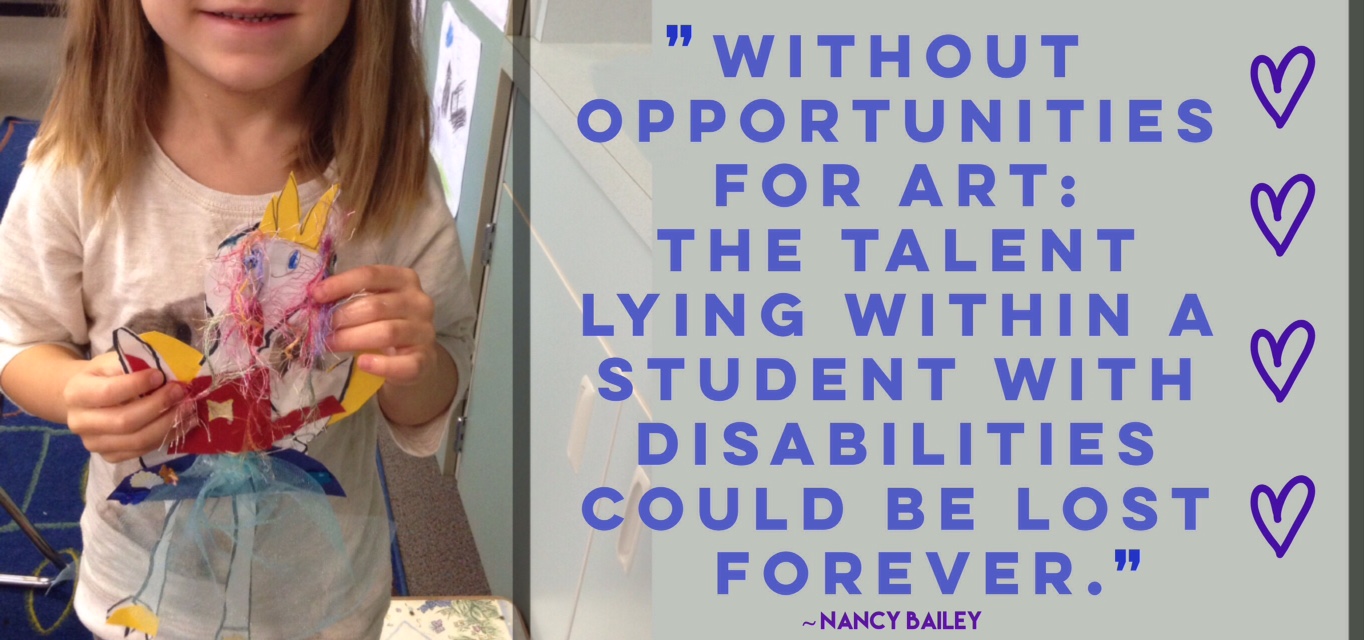
Students with disabilities may or may not get to experience the arts, especially if the school they attend obsesses over high-stakes testing. Because the arts cannot be tested, schools don’t make the arts a priority. The talent lying within a student with disabilities could be lost forever.
Examples of Well-Known Artists with Disabilities
What does the world miss when the arts are ignored in our public schools? There are fine online sites that tell about artists with disabilities. Here are a few of my favorites:
  • Alonzo Clemons is a U.S. clay sculptor. He developed disabilities when he was young.
  • Buckley Moss is called “The People’s Artist” for her pictures of Amish and Mennonite lifestyles. Moss has dyslexia and had difficulty learning to read in school.
  • Tony Deblois, a blind student with autism, is a pianist of musical genius.
  • Tom Cruise is one example of many actors living with dyslexia.
  • George Lucas was a bored in school. How many Lucases sit in classrooms today with no access to the arts?
Qualified Teachers
Sometimes schools attempt to provide the arts, but they rely on partnerships with outside artistic or performing arts programs. This is not a legitimate school art program, nor is it usually a consistent program. The Importance of the Arts to Students with Disabilities - Living in Dialogue:

Schools Matter: THE REAL “COMMON CORE” OF TEACHING

Schools Matter: THE REAL “COMMON CORE” OF TEACHING:

THE REAL “COMMON CORE” OF TEACHING

Yes. I used the forbidden phrase. But let’s use those two words as if CCSS had never existed. In fact let’s ask what the true common core of teaching should be.

Young children, as in the forest schools covered in this NYT article (http://www.nytimes.com/2015/12/31/fashion/outdoor-preschool-in-nature.html?login=email&_r=0&mtrref=query.nytimes.com), are free to ask and discover as their natural curiosity drives them.

Shouldn’t that be at the common core of teaching from pre K all the way through grad school? I am not advocating living in the forest all ones life.  I am advocating that we already know how to make that natural curiosity work in all learning environments, including the classroom. Curiosity revolves around questions.

Imagine instead of memorizing or preparing for tests, regardless of what technology is available, and at any age, we consider how to get all children to learn how to learn and love it by doing the following. If they can do these, then I propose they will be college, career, and life ready.

How do we build on their natural curiosity, not destroy it? To what extent do we use both intrinsic and /or extrinsic motivation?

ASK:
What is the big question they want to know? These can range from why is the sky blue to… how can I build the tallest tower using the 25 blocks on the rug to ...  to what extent is the 2016 presidential race different from or Schools Matter: THE REAL “COMMON CORE” OF TEACHING:


The underlying problem with teacher diversity initiatives | @ THE CHALKFACE

The underlying problem with teacher diversity initiatives | @ THE CHALKFACE:

The underlying problem with teacher diversity initiatives


There is a great deal now being written about the lack of diversity in the teacher workforce. It is typically boiled down to a black-white issue even though “teachers of color” can be defined more broadly to include other races and/or ethnicities. The simple binary of this debate also does not include the intersectionalities of social class, gender, and sexual orientation, for instance.
But this isn’t the issue I’m going to address.
When I wrote my dissertation on the lack of males in teaching, particularly at the elementary level, one of my primary goals was to justify the lack of teacher gender diversity as a problem worth solving. I’ve never been a huge proponent of using test scores to evaluate teachers; yet, I needed to investigate if there were any appreciable gains in student achievement as a result of more male teachers, or better outcomes if the student’s and the teacher’s gender matched. There were a lot of arguments being made that male teachers could squeeze better performance out of male students simply by being male.
I spoke with dozens of male teachers for the project. They all thought the issue was important, but none wanted to be the “male” teacher. They wanted to be “good” teachers. Very few actually took the issue seriously. And not one could come up with a common definition of what it meant to role model or teach specifically to male students. Implicitly, however, it seemed like a good idea to offer students a variety of life experiences throughout the course of their educational careers, which could mean increasing the diversity of teachers.
In my investigation of the research literature, I couldn’t find anything that definitively stated that matching teacher and student identity characteristics actually improved student outcomes. There was some modest improvements in student satisfaction, but nothing that stated that any student growth was attributable to a The underlying problem with teacher diversity initiatives | @ THE CHALKFACE:

The message our children need to hear but almost never do - The Washington Post

The message our children need to hear but almost never do - The Washington Post:

The message our children need to hear but almost never do


Peter Greene, a veteran teacher of English in a small town in Pennsylvania, wrote the following post about how hard it is to be young today. The moving piece describes the “One Wrong Move” syndrome and how scared children are of making a mistake for fear of ruining their lives because that’s the message that society sends them. He ends the post with a moving description of a class he once taught, what he told his students and how they reacted. This appeared on his Curmudgucation blog, and I am republishing it with permission.
By Peter Greene
Back in November, writer Hanna Rosin started a ball rolling with her Atlantic magazine cover story aboutthe high rate of student suicides in Silicon Valley. Two high schools in Palo Alto have a 10-year suicide rate between four and five times the national average.
If students from wealthy families in one of the most affluent communities in the country are feeling driven to these sort of extremes– what the heck can that mean? And it’s not just the issue of suicide. Rosin writes:
The rich middle- and high-school kids [Arizona State professor Suniya] Luthar and her collaborators have studied show higher rates of alcohol and drug abuse on average than poor kids, and much higher rates than the national norm.* They report clinically significant depression or anxiety or delinquent behaviors at a rate two to three times the national average. Starting in seventh grade, the rich cohort includes just as many kids who display troubling levels of delinquency as the poor cohort, although the rule-breaking takes different forms. The poor kids, for example, fight and carry weapons more frequently, which Luthar explains as possibly self-protective. The rich kids, meanwhile, report higher levels of lying, cheating, and theft.
Rosin pointed to huge pressure put on kids by their families, and Rebecca Rosen followed up with her piece, also at the Atlantic, “Why Affluent Professionals Put So Much Pressure on Their Kids.
Rosen’s conclusion is that affluent professionals find their own position fragile, and their ability to pass that position on to their children non-existent.
All of this results in what the economists Garey and Valerie Ramey of the University of California, San Diego, brilliantly termed “the rug rat race.” As they wrote in a 2010 paper, “The increased scarcity of college slots appears to have heightened rivalry among parents, which takes the form of more hours spent on college preparatory activities.” In their findings, the rug rat race takes place primarily among the most educated parents, because there simply aren’t enough spots at elite schools for less-educated parents to even really have a shot, especially as the competition accelerates. It’s for this reason that the most educated parents spend the most hours parenting, even though they are giving up the most in wages by doing so.
If you’re looking for one of the sources of the idealization of competitiveness The message our children need to hear but almost never do - The Washington Post:

Why Growth Mindsets Are Necessary to Save Math Class - The Atlantic

Why Growth Mindsets Are Necessary to Save Math Class - The Atlantic:

The Math Class Paradox

Mastering the subject has become less about learning and more about performance.


Why do so many students either hate math, fear it or both?
If you ask most students what they think their role is in math classrooms, they will tell you it is to get questions right. Students rarely think that they are in math classrooms to appreciate the beauty of mathematics, to ask deep questions, to explore the rich set of connections that make up the subject, or even to learn about the applicability of the subject; they think they are in math classrooms to perform. This was brought home to me recently when a colleague, Rachel Lambert, told me that her 6-year-old son had come home saying he didn’t like math; when she asked him why, he said that math was “too much answer time and not enough learning time.”
Students from an early age realize that math is different from other subjects. In many schools across the U.S., math is less about learning than it is about answering questions and taking tests—performing.
The testing culture in the U.S., which is more pervasive in math than other subjects, is a large part of the problem. When sixth-graders in my local district came home saying that they had a test on the first day of middle school, it was in one subject only: math. Most students and parents didn’t question whether a test was the right way to introduce a new year of mathematics. As one girl said to me, “Well, the teacher was just finding out what we know.” But why does this only happen in math? Teachers in history or English don’t give tests on the first day to find out what students know. And why do so many math teachers boil the subject down to producing short answers to narrow questions under pressure? It is no wonder that so many students decide mathematics is not for them.
In fact, it is not surprising that teachers test math all the time—in the last decade teachers’ jobs have come to depend on student performance on narrow state tests. The Common Core promises an improvement in the types of tests used—with questions that are less narrow and require thinking, instead of choosing a letter (A, B, C or D)—but the bigger problem is the testing culture in classrooms. It is not unusual for high-school math teachers to test children every week, communicating to students that they are constantly being evaluated.
Educators know that the most productive math-learning environments are those in which students receive positive messages about their unlimited potential and work on interesting and complex problems; in which they feel free to try ideas, fail, and revise their thinking. Students with a “growth” mindset are those who believe that their ability is not “fixed” and that failure is a natural part of learning. These are the students who perform at higher levels in math and in life. But students don’t get the opportunity to see math as a growth subject if they mainly work on short, closed questions accompanied by frequent tests that communicate to them that math is all about performance and there is no room for failure. When students inevitably struggle, most decide they are not a “math person.” The last decade has seen a nation of children emerge from our schools terrified of failing in math and believing that only some students can be good at it—those who can effortlessly achieve on narrow tests.
Teachers see some of the damage caused by our nation’s procedural and over-Why Growth Mindsets Are Necessary to Save Math Class - The Atlantic:

The Teaching Profession in 2015 (in Charts) - Teaching Now - Education Week Teacher

The Teaching Profession in 2015 (in Charts) - Teaching Now - Education Week Teacher:

The Teaching Profession in 2015 (in Charts)

At the end of every year (now for a record two years!), we dig through all the white papers and research findings and think tank reports sent to Education Week, as well as a few in-house originals, to find some useful nuggets of visual information that may have escaped people's notice and that help capture the state of teaching.
If not all groundbreaking, the data and graphs and statistics below serve as a reminder about some of the struggles educators face on a frequent basis that may not garner as much attention as perhaps deserved.
Last year's edition of this post focused a lot on the teaching profession itself: Composition, salary, benefits, etc. This year's edition looks at teaching largely through a student lens, because ultimately, how students perform in life after school comes to shape the teaching profession; schools are often a mirror for the communities surrounding them. When teachers get training in cultural competency, for instance, it's often not because that's just a nice thing to learn; it's because a lot of students of color are failed by the system, and that perpetuates economic inequalities, which drive demand for school solutions, which are implemented by teachers. One big cycle.
Now here are some graphs.
Chart #1: How Many New Teachers Stay?
For a decade or so, the de facto statistic about new teachers was that almost half of them leave the teaching profession within five years. But a longitudinal study conducted by the Institute for Education Sciences, published in April, found that statistic to be very different by 2012: Only 17 percent of new teachers are now believed to leave the profession within five years:
Thumbnail image for teacher-retention-2015-nces.jpg
Even if future studies find that the measurement has moved again, the change documented is a little shocking, and shows that it takes a long time and a lot of effort to understand where and when and how teachers move. The new data don't necessarily reduce the need to understand and address teacher attrition, but it does help clear up what turned out to be a major misconception.
Chart #2: Teacher Shortages
This summer, as schools looked to fill teacher vacancies, some folks looked at teacher-prep enrollment numbers and came to a conclusion: That there is a national teacher shortage, and ______ is to blame for it. Subsequent examinations, both here and in other outlets, have shown that"national teacher shortage" is a red herring, indifferent to the reality that education is still very local and  reasons for shortages of any one kind may vary.
There are persistent teacher shortages in some forms, such as in certain subject areas, in rural locations, and in non-white demographics, among others. But in terms of sheer quantity? The teacher-to-student ratio is about as good as it's ever been, as you can see in this chart published inEducation Week this past August based on data from the National Center for Education Statistics:
teach-to-student.PNG
Teacher-prep numbers aren't the same as the overall teaching supply. An important part, yes, but not the whole story.
Chart #3: Student Poverty
In a study released last January, the National Center for Education Statistics published a sobering statistic: As of 2013, 51 percent of public school students qualified for free-and-reduced-price meals, a common indicator of low-income families. That's up from 32 percent in 1989. Here's a state breakdown:
Percent-of-Low-Income-Students-in-PS-2015.png

The stressors that come from low-income life—worries about security, mental and physical health, etc.—affect instruction every day. For teachers, this chart represents a frank assessment that those The Teaching Profession in 2015 (in Charts) - Teaching Now - Education Week Teacher:


In farewell, Duncan chides 'collective failure' to protect kids

In farewell, Duncan chides 'collective failure' to protect kids:

In farewell, Duncan chides 'collective failure' to protect kids


 Arne Duncan did not go quietly.

In his final speech as U. S. Education Secretary, Duncan on Wednesday delivered a blunt, sometimes unsparing address that challenged adults to help restore safety and a basic sense of hope to millions of young people — many of whom, he said, don't expect to make it to adulthood.
Speaking from the basement of a church onChicago's South Side, Duncan directly linked the U.S. high school dropout rate with its youth homicide rate, saying both problems spring from the same "collective failure as adults" to nurture and protect children.
"Dropping out is one level of hopelessness," he said. "And picking up a gun and shooting someone is just that in the extreme."
Moments into the speech, Duncan's voice shook as he recounted one grim statistic: About 16,000 young people had been killed, he said, in his first six years in Washington.
The total after seven years was likely "north of 18,000," or an average of seven children killed every day, he said. "It's a crisis that we have to come together to work on."
The idea of making a church basement the location of his 257th and final speech as secretary was no accident. Duncan, 51, said his "life's work" began in a similar basement with his mother's after-school program. And he noted, "Movements have started in church basements. We could have been in a fancy hotel downtown, we could have done something else, but that didn't feel right. This feels like home."
More than any other education secretary in recent memory, Duncan has pushed to give the federal government a larger role in schools' day-to-day workings, using much-needed federal funding during the recession to entice states to turn around struggling schools and to pay more attention to teacher ratings, among other measures.
He noted a few key accomplishments as a result, including an all-time high 82% high school graduation rate, as well as large reductions in African-American and Latino students' dropout rates — 1.1 million more students of color are now graduating from high school and going on to college, he said, "so the progress is real."
But he warned that his departure on Wednesday "is not some 'Mission Accomplished' moment. Not by any stretch."
Schools still suspend too many minority students, putting them on a path to run-ins with police and perpetuating the so-called school-to-prison pipeline. "We are part of the problem," he said.
Most pointedly, Duncan recounted several conversations he'd had recently with young people who told him that gangs and gun violence in their communities meant they simply didn't expect to live very long. He said a young woman in Ferguson, Mo., told him, "I'd consider it a blessing if I live to be 16."
A few weeks ago, Duncan said, he met a young woman in Baltimore who estimated In farewell, Duncan chides 'collective failure' to protect kids:


State funded K-12 education vs. corporate tax cuts

State funded K-12 education vs. corporate tax cuts:

State funded K-12 education vs. corporate tax cuts


Again, thank you, Gov. Rick Scott. Seems he wants to hold back on state funded K-12 education, instead reduce corporate taxes in the hope of inducing more businesses to come to Florida and keep current Florida corporations happy with our state’s tax structure and, more importantly, with Rick Scott.
The governor will not be running for reelection; he is termed out of that office. Be careful, if he decides to run for the U.S. Senate, he will be looking for financial support from our state’s business community.
However, members of the Florida House and Senate will be running for reelection and I know they will not want the deflection of future student school financial help from the state redirected to reduce corporate taxes and imposing most educational increases on local governments.
Most members up for reelection are Republican and understandingly favor big business. However the state not advancing funds for K-12 education hits everyone, both Democrat and Republican, and can definitely affect voter support at election time.
So what does the governor support and how does the legislature feel about his position? First the governor: Scott proposes increasing K-12 funding by $500 million. A big surprise. Thank you.
But, and it is a big but, only $80 million of the $500 million will come from state funding. The balance would come from property taxes that homeowners and businesses pay. His logic: The increased value in Florida real estate will cover the educational contribution. In other words the increase in revenues, county and municipalities anticipated, would be diverted to cover the state’s proposed increase in education funding
The governor must think we Florida taxpayers are stupid when he stated that it would not be an increase to the taxpayer as the tax “rate” will not go up because of the educational funding increase. Sen. Don Gaetz, R-Niceville, a former Okaloosa County School Board member and the senator now responsible for the Senate’s education budget, thinks otherwise. His question: Will the taxpayers of Florida consider having to pay more in taxes to be a tax increase?
Gaetz makes several recommendations to the legislature including a 50/50 split in the increase in education funding. He points out that here in Miami-Dade a home with a $300,000 assessed value would see a $10.61 increase or a $120 increase on $300,000 non-homestead property.
The governor wants to take credit for a state-funded increase of a half billion dollars in education funding while only absorbing $80 million from state funding. He is denying county and municipalities the ability to benefit from their increased ad valorem taxes to cover needed expenses that have been deferred due to reduced revenues over the past few years.
Yet, the governor wants to be able to say, “Look at me, I am funding your kid’s public school education a half a billion dollars more than last year. Aren’t I great?” I don’t think so.
Why is this so important? Not that that question must be asked. But Florida has nothing to crow about when it comes to public school spending. Here are some statics: Florida spent, in 2013, $8,433 per student. As an example, states spending much high amounts are: New York, $19,818; the District of Columbia, $17,953, and Connecticut, $16,831.
Our children’s’ preparation for the future will determine the future of America. Without an educated population our country has nowhere to go but down. I recently read an article on foreign national students at our major universities and learned that my old alma mater, Wharton, has as many foreign national students in graduate school as American born. Everyone, worldwide, is in competition for well-paying jobs which demands educated applicants. Let’s not let other states continue to get the jump on our kids.
State funded K-12 education vs. corporate tax cuts — which do you prefer?
We appreciate your opinions on this column whether in agreement or disagreement. Send your comments to (fax number) 305-662-6980 or email to MCMHoldingsInc.com. The opinions expressed in this column are not necessarily those of this newspaper, its editors or publisher.State funded K-12 education vs. corporate tax cuts:

California’s fiscally reckless restraint on schools - San Francisco Chronicle

California’s fiscally reckless restraint on schools - San Francisco Chronicle:

California’s fiscally reckless restraint on schools


The California Legislature adjourned for the year without reversing one of the more fiscally reckless moves against local school districts in recent memory. Under a provision in a 2014 budget deal, local districts across the state would be forced to exhaust their reserve funds down to an average 6 percent if the state puts even $1 into its rainy-day fund. The source and motives of this insidious provision are obvious: It was pushed by teachers unions that wanted to compel local districts to spend more money.
Fixing this irresponsible act should be high on the Legislature’s priority list going into the new year.
In our view, the ideal solution would be to lift the cap on reserves altogether. Local districts should have the ability to determine for themselves the level of cushion they need to build into their budgets. In fact, rural and lower-income districts, which have fewer resources and are more vulnerable to revenue swings, typically carry higher levels of reserves. In the 2013-14 school year, for example, smaller districts had a median reserve of 66 percent, compared with 21 percent for midsize districts and 15 percent for large districts.
However, as a practical matter, repeal of the reserve cap is simply not going to happen in a Democrat-controlled Legislature where so many members are beholden to the California Teachers Association.
So the urgent task at hand is to raise the 6 percent cap to a level that is both reasonable to the majority of districts and capable of securing the votes needed for passage.
Sen. Jerry Hill, D-San Mateo, forged such a compromise last session with SB799, which would increase the cap to a more manageable 17 percent. His bill secured the support of 16 lawmakers in a refreshingly rare example of bipartisan cooperation on a significant public policy matter.
It also includes the following reforms:
•Clarifies that the reserve cap covers unassigned balances but does not affect money set aside by districts for emergencies or large future purchases, such as technology, instructional materials or school buses.
•Exempts districts with fewer than 2,500 students and basic-aid districts from the cap because of their distinct cash-flow needs.
Without these reforms, school districts at all levels would be in a precarious situation. The school reserve cap is linked with Proposition 2, the state rainy-day fund approved by voters in November 2014. Once the state begins to put money into that rainy-day fund — no matter the amount — the California’s fiscally reckless restraint on schools - San Francisco Chronicle:

The End Of Unions? Upcoming Supreme Court Case Could Overturn Power To Collect Fees

The End Of Unions? Upcoming Supreme Court Case Could Overturn Power To Collect Fees:

The End Of Unions? Upcoming Supreme Court Case Could Overturn Power To Collect Fees


When Marc Williams greets his high school students every morning, the last thing he wants to worry about is his upcoming teacher evaluation. Or what new regulations could be in store for next year, or how he will negotiate with the school’s administration should any issues arise in his classroom. He’s there to teach kids, not worry about his job.
It’s his union that takes on the brunt of the big issues affecting his Indianapolis school, and lobbies on behalf of his colleagues on their working conditions, he said. “All those different things that can get in the way of what we’re really there for, which is our students, to make sure they can be world-class citizens and lifelong learners. It's hard to do that when you're concerned about your working conditions,” Williams said.
But a Supreme Court case beginning Jan. 11 has union members like Williams wondering if a ruling could sound a death knell on labor organizations that have grown accustomed to heightened limitations and declining memberships in recent years. Friedrichs v. California Teachers Association will determine whether mandatory union dues violate workers' freedom of speech, and experts say a ruling could dictate the future of unions' ability to collect fees from their memberships in what plaintiffs hope will be a win for individual rights and defendants fear is an attack on collective bargaining. 
A decision swaying against unions, experts say, could effectively implement a national right-to-work policy that secures the right of workers to choose not to pay agency fees and therefore guts unions’ power to finance themselves. Union leaders have warned that the plaintiffs' First Amendment argument at the root of the case is being dishonestly presented, framing the issue as one of individual rights and freedom of speech rather than a direct assault on unions and the fees they collect.
“Let's just talk about what's really going on here,” said Michael Mulgrew, president of the New York-based United Teachers Federation. “The membership is becoming more aware of it now ... they've all said, ‘We know what this is about. It's a way to attack unions.’ ”


The plaintiffs seek to overturn a 1977 Supreme Court ruling that upheld a Michigan law requiring public workers represented by unions to pay “agency fees” or “fair-share fees” — which go toward the unions’ chargeable costs of collective bargaining and representation, but not the costs of their political activity or lobbying. In effect, Abood v. Detroit Board of Education protected against “free riding,” a reality where workers may reap the benefits of union representation while forgoing the payments needed to keep the organizations afloat.
The lawsuit has been brought forward by Rebecca Friedrichs and nine other California schoolteachers, who have argued that unions are political bodies by nature and their agency fees are funding causes they disagree with. The plaintiffs, and other collective bargaining critics, have argued that if the country’s unions are truly representative of their membership, workers will still opt to pay the fees.
“We’re being asked to fund collective bargaining that’s highly political using taxpayer money and I don’t have a choice,” Friedrichs told the Washington Post in an August interview. “The official you put into office is on one side [of the table] and the union is on the other side and you’re bargaining for taxpayer money, only the taxpayer doesn’t get invited to the table. That’s political, in my opinion.”
But some labor experts say the ruling’s effects could go far beyond political speech ramifications: If agency fees The End Of Unions? Upcoming Supreme Court Case Could Overturn Power To Collect Fees:

Both traditional and charter schools in L.A. Unified could learn from this study - LA Times

Both traditional and charter schools in L.A. Unified could learn from this study - LA Times:

Both traditional and charter schools in L.A. Unified could learn from this study


arter schools: good or bad? There are few subjects on which school officials, parents and advocates for students are more impassioned and divided, which is why the proposal to open hundreds of new charter schools for Los Angeles' students is shaping up as an epic education battle. But now a new study out of UC Berkeley— looking specifically at charter school performance in the Los Angeles Unified School District — provides a more nuanced view, showing that the yes-no, either-or attitude that tends to dominate the debate is not only misguided but also counterproductive.
The study found that students who enter charter high schools within the district are already higher achievers than those entering traditional public schools. The same was true of elementary schools, though it's harder to estimate the differences there. Middle school students started out no more advanced.
Once students are enrolled in charter schools, their academic growth was slightly steeper in elementary schools than it would have been in a traditional L.A. Unified school; far steeper in middle school; but not better at all in high school.
What does all this mean? Most importantly, it says wonderful things about the work that independent charter schools are doing with middle schoolers. Those students are at the same level as their district school counterparts when they enter sixth grade, but surge ahead of them over the next three years. Less happily, the research suggests that charter schools haven't managed to follow that act in high school.
The Berkeley study also backs up a long-held contention of charter opponents: Simplistic comparisons of student test scores from both kinds of schools, charter and district, don't necessarily give the public useful information — because the students begin at different levels of achievement. Most likely that's because parents who are savvy and proactive about their children's education — the kinds of parents who give their kids a head start on their schooling — are more likely to find out about charter schools in the first place, attend their meetings, enter the lotteries for admission and then help their children succeed at those schools.
Policymakers, school officials and charter supporters should all be paying attention to the new research. There have been previous studies on L.A. Unified's charter schools, the most important of which came from Stanford University and found that when similar students attended charter and district schools, the charter students learned more. What the Berkeley study adds is a first look at differences between students when they arrive at the schools and at which grade levels charters offer the most advantage. This information can help educators determine which kinds of schools will do the most good. L.A. Unified leaders, rather than viewing the charter push with dismay, should be figuring out what Both traditional and charter schools in L.A. Unified could learn from this study - LA Times:
 

Big Education Ape: Berkeley Study of Charter Schools in Los Angeles | UC Berkeley - Graduate School of Education http://bit.ly/1TZUtUm

Big Education Ape: LA charter school study: who benefits? | Berkeley News http://bit.ly/1TZUrM4


The Counterfeit High School Diploma - The New York Times

The Counterfeit High School Diploma - The New York Times:

The Counterfeit High School Diploma

CreditCaroline Gamon


Teachers unions and other critics of federally required standardized tests have behaved in recent years as though killing the testing mandate would magically remedy everything that ails education in the United States. In reality, getting rid of the testing requirement in the early grades would make it impossible for the country to know what if anything children were learning from year to year.
Congress understood this fundamental point, and kept the testing requirement, when it reauthorized the No Child Left Behind Act — now called the Every Student Succeeds Act — last month. But lawmakers ducked the most important problem: the fact that most states still have weak curriculums and graduation requirements that make high school diplomas useless and that leave graduates unprepared for college, the job market or even meeting entry requirements for the Army.
The costs associated with this problem are demonstrated in a recent report by Motoko Rich in The Times, which focused on Berea High School in Greenville, S.C., where the graduation rate has risen to 80 percent, from under 65 percent just four years ago. But college entrance exams given to 11th graders last year showed that only one in 10 students were ready for college-level reading and only about one in 14 were prepared for entry-level college math. On a separate job skills test, only about half of students demonstrated the math proficiency needed to succeed at most jobs.
With results like that, it’s no wonder some South Carolina business leaders are worried that the state is producing high school graduates who are not qualified to compete for higher-skilled jobs at companies like Boeing, Volvo and BMW.
This is a national problem. A recent study from Achieve, a nonpartisan organization that works with the states to raise academic standards, showed that only 18 states and the District of Columbia required all graduates in the class of 2014 to meet the minimum preparation requirements for college — four years of English and math through Algebra II, or its equivalent.
Nationally, graduation rates are rising — yet less than 40 percent of 12th graders are ready for math and reading at the college level. An alarming study by the Education Trust, a nonpartisan foundation, found that more than one in five recent high school graduates could not meet minimum entry test standards to enlist in the Army. Despite this problem, the states The Counterfeit High School Diploma - The New York Times: