Latest News and Comment from Education

Sunday, December 20, 2015

Weird Words and Phrases about Schools and Common Core

Weird Words and Phrases about Schools and Common Core:

Weird Words and Phrases about Schools and Common Core

William Shakespeare in period clothing sitting in school desk with laptop computer and hand to head looking perplexed.
Omit needless words.
EB White The Elements of Style (p.23)
It is time to revisit my list of weird education terminology. I have added some new words and phrases from Common Core State Standards, and provide links to other lists and explanations.
Education jargon has always been confusing, but it is even more so today. I think education reformers try to impress with words and wordiness. Mostly, it looks odd. A lot of it also sounds like its purpose is to be confusing, or intent on getting tough on students.
One of my favorite lists is the Educational Jargon G from the science geek. HERE.
Marilee Sprenger lists critical Common Core words. I find it interesting that without Common Core these words probably wouldn’t be critical. HERE.
Here is what’s called Source Coding from Vocabulary for Common Core, 2013 Marzo Weird Words and Phrases about Schools and Common Core:

‘It’s hard to educate a kid that’s dead’ — Education Secretary Arne Duncan - The Washington Post

‘It’s hard to educate a kid that’s dead’ — Education Secretary Arne Duncan - The Washington Post:

‘It’s hard to educate a kid that’s dead’ — Education Secretary Arne Duncan

“It’s hard to educate a kid that’s dead.” — Arne Duncan
I point out this quote, from an interview that Education Secretary Arne Duncan gave to my Post colleague Emma Brown, not for any profound insight that it offers but as a suggestion of what he may be doing when he leaves his post on Dec. 31.
Duncan, who is returning to Chicago, has long been an advocate of stricter gun laws. Speaking with PBS’s Gwen Ifill in December 2012, just after the massacre at Sandy Hook Elementary School in Newtown, Conn., that left 26 children and adult staff members dead, his eyes teared as he recalled people he knew from his past who had died from gunshot wounds. He then joined more than 350 university presidents to collectively urged Congress to approve stronger gun-control measures — and said he believed that federal lawmakers won’t take such action unless Americans from outside Washington apply the pressure.
In his interview with Brown, Duncan made clear that he will work on gun control in some way after he officially vacates the post he has held for seven years. He told Brown:
Education’s always going to be my life’s passion, I’m going to keep finding ways to do education, but it’s hard to educate a kid that’s dead. It’s hard to educate a kid that’s living in constant fear. So will this be a piece of what I work on? Absolutely. It’s a national issue, and, obviously, it’s particularly acute back home in Chicago. I can’t go home and not try and help. I don’t have easy answers, but I’m sure going to try.
There is no doubt that Duncan was the most powerful education secretary in ‘It’s hard to educate a kid that’s dead’ — Education Secretary Arne Duncan - The Washington Post:


Worst and Dumbest, the Sequel | accountabaloney

Worst and Dumbest, the Sequel | accountabaloney:

Worst and Dumbest, the Sequel


Representative Eric Fresen’s (District 114, Miami) much maligned “Best and Brightest Scholarship” program, which snuck into Florida statute during last summer’s extra budget session, is back and it is apparently worse than we originally knew and it’s about to get a whole lot dumber. It is the perfect example of Accountabaloney.
The bill, which Fresen claimed he dreamed up after reading a book purchased at the airport, provided bonuses of up to $10,000 to be paid to Florida public school teachers who scored in the 80% on the ACT or SAT tests they took in high school.  Current teachers also were required to be rated “highly effective” under the state’s teacher evaluation system but new teachers (who had not yet been rated for effectiveness in the classroom) could qualify for the bonus on the basis of their exam scores alone.
In March, Fresen filed HB 5011, the bill proposing the bonus, it passed the House but died in the Senate before being heard in committee. During the special session in June, it was quietly added into the budget where it escaped Gov. Rick Scott’s veto pen.
After the bill’s passage, legislators were “shocked” to learn the budget bill they had passed included $44 million for the scholarships (link here)
“State Sen. Nancy Detert, R-Venice, called the legislation the “worst bill of the year” and an example of how the legislative process has broken down
“The bill went through absolutely no process,” Detert said. “Never got a hearing in the Senate. We refused to hear it because it’s stupid.”
Other Senate Education Committee members, also, questioned the bill’s wisdom.  (read entire article here)
“There are a lot of questions about the implementation and the wisdom of 
Worst and Dumbest, the Sequel | accountabaloney:

CURMUDGUCATION: ICYMI: December 20

CURMUDGUCATION: ICYMI: December 20:

ICYMI: December 20


This week was a full assortment of rehearsals for a local performance of The Messiah, and this weekend is the first time my entire family has gathered in one place for a long time, so if I've seemed a little distant and busy, dear reader, that's why. But I do have a whole stack of things for you to check out today while my family is opening presents and we're singing the Messiah matinee.


The New Preschool Is Crushing Kids

The genre of "here's how ugly and awful early childhood ed has become under the test-and-punish era of education" articles is crowded, but everybody needs to be reminded that this is happening and that it sucks. They need to be reminded repeatedly until we put an end to it. Here's one more stark and painful example.

For Profit Charter Schools Are Fading and Failing

Jessica Huseman misses a few of the finer points (particularly the ways in which non-profits mirror for-profits), but on balance this is a good analysis of why the For Profit charter industry is turning out to be (surprise) a failed experiment.

Worst and Dumbest: The Sequel


Florida's remarkably idiotic plan to give teachers a bonus for their high school SAT scores is back-- and this time it wants to be permanent. A good study in how a bill that nobody thinks is smart can still end up becoming a law.

Stand for Children Louisiana Is an Evil and Malicious Corporate Front Group for Evil People and Organizations 

Crazy Crawfish tells us what he really thinks. Because while some reformsters are folks with a different perspective or different understandings of how schools can best serve students, some are just scruples-free rotters trying to get their hands on money and power.

Ethical ELA

I'm always amazed how, no matter how much I've read and explored, there are still chunks of the interwebs that I've never stumbled into. This is an entire website dedicated to discussing issues of how to ethically teach all the various aspects of language. Worth a look.

This week the Edublog Awards were unveiled and this post of mine about music won an award for being one of the most influential posts of the year. Like most of these sorts of awardy things, it's a nice selection of sites and posts with which you may not be familiar. In particular I was struck by this post:

What Being Gay Has Taught Me About White Privilege 

You may or may not agree with everything that the blogger at Crawling out of the Classroom has to say, but her level of honesty and openness is impressive.

Creativity Is the Key to Happiness

If you're not familiar with the concept of "flow," this is a simple and accessible look at it and the idea that creativity is the key to a happy life.
CURMUDGUCATION: ICYMI: December 20:

Juvenile injustice?: Kids in San Bernardino County pay the price with overzealous school cops - Salon.com

Juvenile injustice?: Kids in San Bernardino County pay the price with overzealous school cops - Salon.com:

San Bernardino County pay the price with overzealous school cops

San Bernardino school police arrested more kids than cops in Sacramento, Oakland or San Francisco. What gives?


SAN BERNARDINO, Calif. — Josue “Josh” Muniz admits that he embraced his girlfriend during lunch, while the pair was out on the quad at Arroyo Valley High School in this city east of Los Angeles.
He admits that after a school cop ordered him to step away, he did, but lightly hugged his girlfriend again, minutes later, because she was upset.
But Muniz won’t agree that he deserved what happened next.
His girlfriend walked off, and Muniz saw the officer approaching again and directing him to go with him. The cop reached out and “put his hand on my throat,” Muniz said. “That’s when I start freaking out. He tells me to stand up. And that’s when his grip on my throat got a little stronger and when I started really panicking.”
Alarmed, Muniz pushed at the officer to get him “just a little bit off me,” he said. They tumbled to the ground and the officer “showered” the student with pepper spray, Muniz alleges in a civil lawsuit that’s still pending. The cop handcuffed him, he said, dragged him into a nearby security office by the cuffs and planted a knee in between his shoulder blades while delivering “multiple blows” as Muniz lay face down on a carpet.
After it was over, the officer read the 17-year-old junior his rights and placed Muniz under arrest — for alleged misdemeanor assault on an officer.
“He told me that I had ‘f’d up,’” Muniz said. “But I never wanted to fight.”
In an initial substantive response in court, the school district claims that Muniz was “careless, reckless, and negligent,” and is the one to blame for any alleged injuries he suffered during the altercation.
Muniz’s arrest in November 2012 sounds extreme, but it was hardly isolated.
In fact, he was one of tens of thousands of juveniles arrested by school police in San Bernardino County over the last decade. The arrests were so numerous in this high-desert region known as the Inland Empire that they surpassed arrests of juveniles by municipal police in some of California’s biggest cities.
The San Bernardino City Unified School District, where Muniz was a student, has its own police department, with 28 sworn officers, eight support staff and more than 50 campus security officers trained in handcuffing and baton use.
The department made more than 30,000 arrests of minors between 2005 and 2014. The area has a reputation for youth-gang crime, but only about 9 percent of those arrests were for alleged felonies. Instead, the vast majority of arrests were for minors violating a variety of city ordinances — such as graffiti violations or daytime curfews — and for nearly 9,900 allegations of disturbing the peace. That’s a frequently-used catchall that raises questions among critics about whether most of these arrests were necessary for public safety.
The bulk of the minors arrested or referred to school police represent some of the most academically vulnerable demographics in the state: low-income Latino and black kids, as well as kids with disabilities, in disproportionate numbers, according to California arrest statistics and national education data examined by the Center for Public Integrity.
Based on 2011-2012 data collected from U.S. schools by the U.S. Department of Education, the latest available, Muniz’s Arroyo Valley High referred students to law enforcement at a rate of 65 for every 1,000 students. That was more than 10 times the national and California state rate of 6 per 1,000.
Those kinds of statistics raise red flags for critics who charge that school officers in some districts, especially those with substantial minority and special-needs populations, are turning what should be minor disciplinary indiscretions into criminal justice matters that put kids on a road to bigger problems — the so-called ‘school-to-prison pipeline.” In San Bernardino, cops, school officials, parents and community groups have started wrestling with how to balance demands for order — and security — without criminalizing kids.
There’s no state rule to define the role of school police, but some California districts have already taken steps to do that by imposing formal limits on police powers in school, and detailing what situations should require police involvement and what should be handled exclusively by educators.
This story is part of Criminalizing kids. Scrutinizing the use of law enforcement and courts to respond to kids’ conduct at school or other circumstances. . Click here to read more stories in this series.
Don’t miss another Juvenile Justice investigation: Sign up for the Center for Public Integrity’s Watchdog email.
The roots of a trend
The ranks of school cops have grown nationally since the 1999 massacre of students Juvenile injustice?: Kids in San Bernardino County pay the price with overzealous school cops - Salon.com:

How the Movement to Teach Creationism in Public Schools Has Lived On and Evolved - The Atlantic

How the Movement to Teach Creationism in Public Schools Has Lived On and Evolved - The Atlantic:

The Evolution of Teaching Creationism in Public Schools

A new study shows that anti-evolution lessons have become more stealthily integrated into curricula.


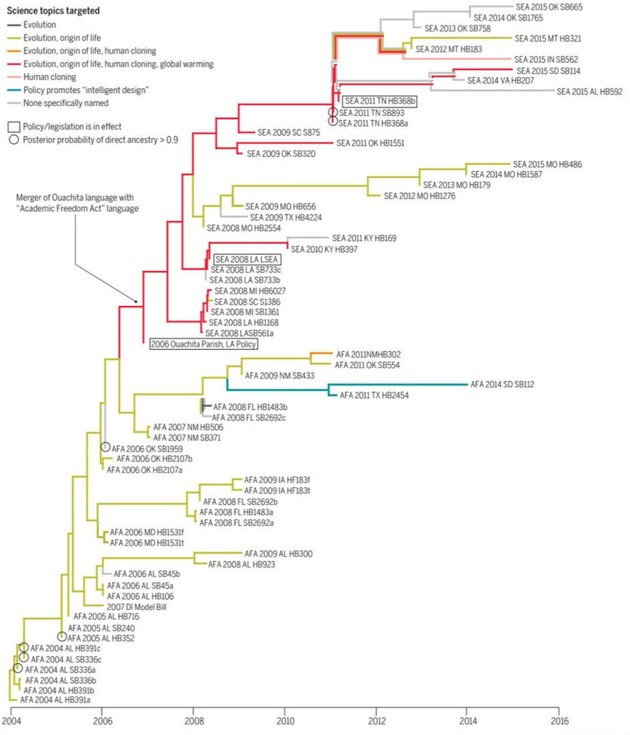
Some 90 years out from the Scopes Monkey Trial, and a full decade after the legal defeat of “intelligent design” in Kitzmiller v. Dover, the fight to teach creationism alongside evolution in American public schools has yet to go extinct. On the contrary, a new analysis in the journal Science suggests that such efforts have themselves evolved over time—adapting into a complex form of “stealth creationism” that’s steadily tougher to detect.

Call it survival of the fittest policy.
“It is one thing to say that two bills have some resemblances, and another thing to say that bill X was copied from bill Y with greater than 90 percent probability,” Nick Matzke, a researcher at the Australian National University and author of the new paper, tells CityLab via email. “I do think this research strengthens the case that all of these bills are of a piece—they are all ‘stealth creationism,’ and they all have either clear fundamentalist motivations, or are close copies of bills with such motivations.”

* * *

Matzke performed a close textual analysis of 67 anti-evolution education bills proposed by local government since 2004. (Three U.S. states have signed them into law during this time: Mississippi, Louisiana, and Tennessee.) The result was a phylogenic tree—in effect a developmental history—tracing these policies to two main legislative roots: so-called “academic freedom acts,” and “science education acts.”
This phylogenetic tree traces most of the 67 anti-evolution education policies proposed in U.S. states since 2004 to two main roots: one group of “academic freedom acts,” and another as “scientific education acts.” (Nicholas J. Matzke / via Science)
Matzke's analysis shows that academic-freedom acts were popular in 2004 and 2005 but have since been “almost completely replaced” with science-education acts, which emerged as the strategy of choice after the adoption of a 2006 anti-evolution policy in Ouachita Parish, Louisiana. (That policy’s lingering impact on creationist teaching was thoroughly exposed by Zack Kopplin in Slate earlier this year.) These acts tend to call for “critical analysis” of scientific topics that are supposedly controversial among experts. They often lump evolution alongside How the Movement to Teach Creationism in Public Schools Has Lived On and Evolved - The Atlantic:

L.A. Unified officials unable to finish work of picking next schools leader after marathon session - LA Times

L.A. Unified officials unable to finish work of picking next schools leader after marathon session - LA Times:

Marathon session yields no pick for L.A. Unified chief; next meeting in 2016

Ramon C. Cortines, left, and Steve Zimmer
The Los Angeles Board of Education met behind closed doors for 13 hours Saturday but did not announce a new superintendent for the nation’s second-largest school system.
Instead, the seven-member board scheduled another meeting for Jan. 5.
Board President Steve Zimmer, hoarse from a cold, offered an upbeat message shortly after 9:30 p.m.
"The board is absolutely on track, working extremely hard and I am confident that we will be able to reach a decision within the first month of the school year," Zimmer said. "And the conversations are absolutely appropriate to the weight and significance of the decision."
He added: "I am very proud of this board. Every one has brought their best selves and kept their best selves even through these marathon sessions.”
The board has held four lengthy meetings over the last seven days as it tried to make its most important hire. Supt. Ramon C. Cortines, 83, left the school system Dec. 11 but is reachable on an emergency basis until Jan. 


The district's No. 2 administrator, Michelle King, will serve in place of Cortines, but will not receive the title of interim superintendent. King already effectively has those duties because Cortines is on vacation until his retirement.
No board action is required for King to take on the senior leadership role on a temporary basis, said district general counsel David Holmquist.
Holmquist too seemed to be suffering from the long sessions and the stress of the task. He attended Saturday's session despite a case of pneumonia, against doctor's orders.
King has experience serving for short periods as acting superintendent, especially when she worked under Cortines' predecessor, John Deasy, who was frequently out of town.
Last week, she oversaw the staff presentation at a board meeting over a sensitive topic: the temporary closing of two schools because of a natural gas leak in the northwest San Fernando Valley.
King is among the finalists for the job of schools chief. Other names that have emerged as under consideration or who have been recruited are: Fremont Unified Supt. Jim Morris, a longtime L.A. Unified senior administrator; San Francisco Supt. Richard Carranza; and Miami-Dade County Supt. Alberto Carvalho, who said publicly that he did not want the L.A. job.
Other individuals have been under serious consideration as well.
Cortines came out of retirement after Deasy resigned under pressure 14 months ago. A veteran administrator who ran the district twice previously, Cortines had agreed to serve only until a permanent replacement could be found.
The board had divided sharply over the type of leader needed for this watershed moment, L.A. Unified officials unable to finish work of picking next schools leader after marathon session - LA Times:

BESE President Chas Roemer Pulls a Bill Clinton | Crazy Crawfish

BESE President Chas Roemer Pulls a Bill Clinton | Crazy Crawfish:

BESE President Chas Roemer Pulls a Bill Clinton


I was not able to attend the December 1st BESE meeting, but I have been able to review some of the footage.  Had I been elected to BESE this fall I might have had a chance to respond to some of the inane/insane comments nonchalantly being spewed from the mouths of raving idiots, like BESE President Chas Roemer, in person.  However billionaires from out of state were terrified of me speaking the truth in public.  They spent millions of dollars in this year’s elections to keep that from happening.
I’m flattered, but undeterred.  Even billionaires will run out of money eventually if they keep spending millions of dollars each month to shut me up, and they won’t be successful in the end, just poorer and most desperate seeming.
And, as it turns out, it might be more fun for me to simply quote the idiots they backed in these elections and have backed in previous ones.  As those billionaires are probably finding out across the country, the problem with buying fools like Roemer is, well, that they are fools.  Fools usually don’t know they are fools, but they do like to show it.
Unlike what Lane Grigsby did with his Empower PAC, and Stand For Children Louisiana did with theirs this year, I don’t have to splice or misrepresent video together to make my points.  I don’t have to lie or deceive people to agree with me or invent phone news broadcasts, all I have to do is show the truth and let people decide what and who to believe.
The charter school law in Louisiana was written to encourage the implementation BESE President Chas Roemer Pulls a Bill Clinton | Crazy Crawfish:

Education Policies Worthy of the Name 'Reform' | Randi Weingarten

Education Policies Worthy of the Name 'Reform' | Randi Weingarten:

Education Policies Worthy of the Name 'Reform'


The month before standardized tests begin each school year, Stephen Lazar, a National Board-certified history and English teacher at Harvest Collegiate High School in New York City, tells his students that he is going to "turn into a bad teacher. ... No more research, no more discussion, no more dealing with complexity, no more developing as writers with voice and style." Instead, they practice mindless repetition of facts so they can perform well on a standardized test that, in its perverse way, Stephen says, "works."
But he knows it doesn't really work--that is, if we want to equip our kids with the skills and knowledge they need to be successful in life, college and career. When Stephen testified before Congress earlier this year, he told lawmakers that top-down, test-based accountability, which "values three hours of testing over a year of learning and development," should be replaced with more valid and useful measures of student achievement.
Stephen is one of thousands of educators, union leaders, parents and students who have called for changes to policies that essentially reduced kids to test scores and teachers to algorithms. AFT members alone took more than 100,000 actions online, submitted 20,000 comments to Congress, and met with numerous congressional leaders and staff. After all these years of test-and-sanction policies, Congress listened and acted.
In a rare display of finding common ground, Congress recently passed the Every Student Succeeds Act by overwhelming majorities. ESSA replaces the broadly discredited No Child Left Behind Act, a law whose test-punish-repeat approach has left students alternately stressed or bored, has frustrated parents, and has deprofessionalized and demoralized teachers.
Under the newly passed ESSA, high-stakes testing and sanctions are no longer the be-all and end-all in education. States still will administer standardized tests, but they can now limit the consequences of these tests and the time students spend taking them, and eliminate unnecessary or poor-quality tests. States have an explicit Education Policies Worthy of the Name 'Reform' | Randi Weingarten:

So far, none of the presidential debates have asked about K-12 education - Vox

The debate moderators missed the opportunity to ask about a real Democratic divide - Vox:

The debate moderators missed the opportunity to ask about a real Democratic divide


So far, none of the presidential debates — Democratic or Republican — have asked about K-12 education. That's a huge missed opportunity.
Education really is a divisive issue within the Democratic Party, and one where Hillary Clinton has indicated she might take a different tack than President Obama.
Last week, Obama signed a new federal education law, the Every Student Succeeds Act. For the first time in more than two decades, it will scale back the federal government's role in education. While teachers unions and congressional Republicans both like the new law, it's received criticism from the left from those who say that states can't be trusted to safeguard the well-being of poor and minority students. (Clinton said in a statement that she supports the law, although it's not perfect.)
This would have been the ideal jumping-off point for a question about education policy:
President Obama just signed the Every Student Succeeds Act, which keeps the standardized testing requirement from No Child Left Behind but gives states more freedom to decide which schools are succeeding, and what to do about the ones that aren't. Do you trust states to make the right decisions without federal oversight? And how would you work within the constraints of the law to improve education in the US?

Clinton has suggested she'll be closer to teachers unions than Obama

K-12 education has been almost entirely absent from the 2016 campaign trail so far. But Clinton's few public statements suggest that she might be friendlier to teachers unions than President Obama, who often antagonized unions with his competitive grant programs, support for charter schools, and push to evaluate teachers based in part on their students' test scores.
Clinton, who has been endorsed by both major teachers unions, has suggested charter schools cherry-pick their students. She opposes tying teacher pay to their students' test scores, saying there's "no evidence" that approach works. And she's said that getting more funding for traditional federal education programs, such as federal money to educate poor students and students with disabilities, would be a top priority.
Sen. Bernie Sanders, meanwhile, has hardly talked about K-12 eduction at all. And former Maryland Gov. Martin O'Malley was a strong supporter of charter schools while in office. This is a big and important division within the Democratic Party, one that debates repeatedly miss their chance to highlight.
The debate moderators missed the opportunity to ask about a real Democratic divide - Vox:


State's charter schools struggle to meet targets for serving high-needs students - News - telegram.com - Worcester, MA

State's charter schools struggle to meet targets for serving high-needs students - News - telegram.com - Worcester, MA:
State's charter schools struggle to meet targets for serving high-needs students

Charter schools in Massachusetts are having mixed success meeting the state’s expectations for admitting English language learners and students with disabilities, an area where most charters have long lagged behind regular public schools.
According to the state Department of Elementary and Secondary Education’s data, only one of the region’s four charters – Fitchburg’s Sizer School, A North Central Charter Essential School – has exceeded the state’s target in both student categories the past five years. Marlboro’s Advanced Math & Science Academy Charter School, one of the region’s top performing schools, meanwhile, is trailing well behind its targets over that span.
The data fall somewhere in between conflicting recent reports of how well charter schools are doing enrolling high-needs children. A state report earlier this fall found charters are approaching regular public schools in their rates of accepting new students who have disabilities, and even surpassing them in their rates of accepting new students who are English language learners. A Massachusetts Institute of Technology study released last week found that Boston charters in particular are attracting students in those subgroups in similar numbers to the city’s public schools.
But an October report by the Massachusetts Association of School Committees makes the case those positive reports don’t tell the full story. The organization suggests that a couple of charters in Boston and Lawrence are skewing the overall data by enrolling large numbers of English language learners, for example. Glenn Koocher, the association’s executive director, said charters also tend to not enroll students with severe disabilities at the same rate as public school districts, which is not reflected in the state’s data.
“We’re not talking about kids with mild learning disabilities,” he said. “We’re talking about kids with significant levels of disability who the public schools then have to deal with in their own budgets.”
Mr. Koocher argues the education achievement gap bill passed in 2010 has largely been State's charter schools struggle to meet targets for serving high-needs students - News - telegram.com - Worcester, MA:


Chris Fitzsimon: What's wrong with virtual charter schools - Winston-Salem Journal

Chris Fitzsimon: What's wrong with virtual charter schools - Winston-Salem Journal: Columnists:

 What's wrong with virtual charter schools


The education of thousands of North Carolina students and millions of taxpayer dollars are currently at risk in the latest school privatization scheme that continues to draw far too little attention from the media and even many education advocates.
Two online charter schools opened in the state this fall, operated by two different for-profit companies, one of which, K12 Inc., has a scandal-plagued record in other states.
A provision snuck into the budget in the 2014 legislative session ordered the State Board of Education to approve two virtual charters as pilot programs. Only two companies applied to run the online schools, guaranteeing they would both be selected.
Numerous studies have raised serious questions about the performance of virtual charters and K12 schools in particular.
A report by a Washington think tank about a California virtual charter run by the company found dramatically lower test scores than traditional public schools, startling high dropout rates, questionable attendance figures and a host of other problems.
Two months ago a report from the Center for Research on Education Outcomes at Stanford found that there are problems with online charters in general, not just the ones run by K12.
The report was funded by the Walton Family Foundation, a strong advocate for the charter school movement, and found that students in online charters made far less progress than their counterparts in traditional public schools.
One of the authors of the report said the gains in math were so small that it was “literally as though the student did not go to school for the entire year.”
Last week brought maybe the most compelling evidence of all that the General Assembly made a terrible decision in ordering the state board to approve the schools.
The former education commissioner of Tennessee, Kevin Huffman, described his experience of the last four years overseeing the virtual charter in his state, also operated by K12, on the education blog The Seventy Four.
Huffman, himself a strong pro-charter and school-choice advocate appointed by conservative Republican Gov. Bill Haslam, pulls few punches in his essay that includes this summary.
“From these modest beginnings and with the help of an unscrupulous operator, an inept school district, and the generally screwed-up politics of education, the worst-performing school in Tennessee opened and remains open to this day,” Huffman says.
Huffman goes on to describe how the virtual school was plagued by operational problems Chris Fitzsimon: What's wrong with virtual charter schools - Winston-Salem Journal: Columnists:

In at least one huge deal in L.A., Trump got schooled - LA Times

In at least one huge deal in L.A., Trump got schooled - LA Times:

In at least one huge deal in L.A., Trump got schooled

Fight over Ambassador Hotel property
The Ambassador Hotel site, more than 23 acres near downtown Los Angeles, was bought by Trump Wilshire Associates in 1989. Now it's an LAUSD campus. (Damon Winter / Los Angeles Times)
 one side was the alpha male of New York developers who burst into town with pockets full of money, a legion of lobbyists and lawyers and an audacious plan to build the nation's tallest building.
Opposing was a tag team Donald Trump would have little reason to fear: Jackie Goldberg and Jeff Horton, two rumpled progressives on the Los Angeles Board of Education.
Long before his run for president and his reality TV career as the ruthless boss, Trump fought an ugly decade-long battle over a Los Angeles landmark.
It's not an exploit he's bragging about on the campaign trail.
The prize was the Ambassador Hotel. A legendary Hollywood celebrity hangout and the site of the 1968 assassination of Sen. Robert F. Kennedy, it had endured a long downward spiral before closing in 1989.
The 23.5-acre property, much of it open space, became a rare object of desire in a densely built part of the city.
The Board of Education already had its eye on the property for a badly needed high school when a Trump syndicate swooped it up for $64 million in 1989 and announced plans to erect a 125-story office tower.
The school board countered with a 7-0 vote to take the property from Trump via eminent domain.
Usually that would start a process in which the parties and their appraisers, or a court, would settle on a price.
But not when one of the parties was Trump.
His team launched a fierce lobbying campaign to block a $50-million state allocation to help the district buy the property.
Goldberg, then the president of the school board, took on the notoriously tough negotiator.
"They simply have enough money to buy enough lobbyists to go absolutely everywhere and talk to as many people as need to be talked to until they get what they want," she said.
The district mounted its own lobbying effort and got the state allocation restored.
Talks on a possible sale price ensued but then broke down.
Roused by Goldberg, protesters outside the Ambassador chanted "Dump Trump" and carried signs saying, "Public need over private greed."
Barbara Res, executive vice president for Trump Wilshire Associates, accused the board of "fiscal irresponsibility" for choosing to build a school on "some of the world's most expensive property."
The $73 million that the district was offering for 17 acres of the site was far below the In at least one huge deal in L.A., Trump got schooled - LA Times:

Saturday, December 19, 2015

Louisiana’s Standards Review: Common Core Writers and Eureka Math Developers Invited | deutsch29

Louisiana’s Standards Review: Common Core Writers and Eureka Math Developers Invited | deutsch29:

Louisiana’s Standards Review: Common Core Writers and Eureka Math Developers Invited


The Common Core in Louisiana is supposedly under review based on legislation passed in the 2015 session.
However, the alleged review is Common-Core-centered and is transpiring at warp speed.
Practically speaking, the resulting changes will only be cosmetic.
Even so, at least some individuals initially involved in this review intended to thoroughly review Common Core– and to propose significant changes because, in their professional opinions, such changes are necessary.
One of those individuals was Brenda DeFelice. DeFelice was a member of the math standards subcommittee, and her task was to examine and offer suggested revisions for the Common Core geometry standards.
Brenda DeFelice  
Brenda DeFelice
On December 02, 2015, DeFelice was told that she needed to attend an extra meeting– a meeting-before-the-meeting– with an individual from the Louisiana Department of Education (LDOE) and who served on the Common Core math work group (read about it here) and others connected to Eureka Math, a Common-Core-aligned product over which Common Core math work group lead member Phil Daro had the final say (read the background on Eureka math here).
Prior to that extra meeting, LDOE Common Core writers had once before been involved in a Louisiana standards review committee meeting.
After the geometry meeting-before-the-meeting, on December 02, 2015, DeFelice quit the Louisiana Common Core review farce.
Here is her resignation letter, in full:
December 2, 2015
Dear Ms. Sanford, Ms. Boothe, and Math Standards Review Sub-Committee Members:
Please accept my resignation from the Math Standards Review Sub-
Louisiana’s Standards Review: Common Core Writers and Eureka Math Developers Invited | deutsch29: