Friday, November 20, 2015

Schools Matter: Call Congress to Say NO to New Corporate ESEA

Schools Matter: Call Congress to Say NO to New Corporate ESEA:

Call Congress to Say NO to New Corporate ESEA


This is a good, principled bill; it’s a notable conservative victory, and it’s the best deal to be had. It deserves conservative support. — Frederick M. Hess is director of education policy at the American Enterprise Institute. Max Eden is program manager for education policy at AEI.


One may quibble with details, but the bottom line is that this bill defangs the U.S. Department of Education; it no longer will exert control over every school with mandates. . . .This is a far better bill than I had hoped or feared. --Diane Ravitch, conservative historian and leader of NPE, the #1 testing resistance containment organization.

With both sides of the aisle of the corporate Congress supporting ESEA's corporate welfare program to hand out billions in Federal grants to charter operators, testing companies, connected technocrats, and corporate union enablers, it is time for parents, teachers, and students to call your government and let your reps know that you do not support another generation of failed corporate education reform.  

Call and tell your Senators and Representatives to say NO to the new ESEA.  Numbers available here:


Schools Matter: Call Congress to Say NO to New Corporate ESEA:

Transforming Teacher Preparation—Gates Style

Transforming Teacher Preparation—Gates Style:

Transforming Teacher Preparation—Gates Style

photodune-3458394-teacher-xs(1)


The Bill and Melinda Gates Foundation have a quote on their website that says“Nobody knows teaching like teachers.” If they believe that, why don’t they let teachers teach the way they know best? Or, why don’t they ask them what they needto teach better?
Instead, Mr. and Mrs. Gates are going to now transform how teachers are made, because they obviously don’t think teachers really know teaching.
The other day I wrote about how we are losing a true profession of teaching—a profession that looks at children, and not just high-stakes test scores and keeping students marching in a straight line.
It is common knowledge that the Gates Foundation has not done well in many of their endeavors—see HERE and HERE for a few examples. We also know that there were problems in Tampa with the Gates and their efforts to make teachers over with their style of what they call teacher effectiveness. Tax dollars also pay for these programs when they don’t live up to their hype.
Now, the Gates are moving into the university arena. They are permitted to spend $34 million on competitive grants on a variety of programs to transform how teachers learn Transforming Teacher Preparation—Gates Style:

Why today’s college students don’t want to be teachers - The Washington Post

Why today’s college students don’t want to be teachers - The Washington Post:

Why today’s college students don’t want to be teachers


Teacher shortages around the country have been big news in the education world this year, as has Teach For America’s recruitment issues and stories about fewer applicants to some college of education. What’s going on? In this post, Stephen Mulcher, who directs the Bard College Master of Arts Teaching Program in Los Angeles, looks at the declining interest among college students in going into the teaching profession and suggests how to turn that around. He assesses the impact that the modern school reform movement — which has put teachers in the crosshairs — is having on this dynamic and makes suggestions about how to turn it around.
Mulcher’s research interests include history education, history of American education, the development of historical thinking processes in adolescents, historiography and disciplined inquiry in secondary classrooms, urban education, the history of teacher preparation, progressivism, and Americanization.

By Stephen Mucher
Campus activism is back in the news.
From Missouri to Yale to Claremont McKenna, protests have drawn attention, not only to historic inequities, but also to the dramatically different ways students experience race and ethnicity in the classroom and on the quad.
As someone who visited over two dozen campuses last year, I am not surprised by these developments. The protests, as well as their critics, say a lot about the state of American university. But this unrest may say even more about K-12 schooling.
My purpose for visiting colleges was simple: To identify and recruit the best graduating seniors to teach in public schools. In the past, my appeal to youthful idealism and meaningful work would have generated some significant career enthusiasm. But over the past several years my recruitment efforts, by most any measure, has fallen flat.
Critics like to argue that today’s generation is too selfish, impatient, apathetic, or distracted for the kind of committed public service required of teaching professionals. I am unconvinced.  From M.I.T. to U.S.C., Appalachian State to Cal State, Michigan to Berkeley, Amherst to Occidental, I still meet brilliant, dedicated, inspired young people who are ready and willing to serve. Many are politically engaged. Many are active in projects that range from mentoring youth in under-resourced neighborhoods to creating ambitious non-profits that address real world social need. Many will willingly accept unpaid internships or join national service organizations upon graduation.  And until recently, many flocked to Teach For America. What I routinely see is a generation that needs to make a difference.
Calling today’s undergraduates privileged or spoiled is similarly reductionistic.  Certainly, economic diversity remains a persistent problem in American higher education. But one can find numerous examples of students who, despite growing up in poverty and navigating tragically under-resourced schools, persevere to become the first in their family to attend college. These remarkable individuals are among the most likely to pursue careers in social work, community organizing, or public health with plans to return home and Why today’s college students don’t want to be teachers - The Washington Post:

America is wrong to think reducing kids’ playtime will improve academic performance - Quartz

America is wrong to think reducing kids’ playtime will improve academic performance - Quartz:

America is wrong to think reducing kids’ playtime will improve academic performance


You would think that students from Shanghai, who routinely trounceAmericans (and everyone else) in tests of proficiency in math, reading, and science, are tethered to their desks all day, deprived of the freedom to frolic and play.

You would be wrong.
In Shanghai, 40% of the day in elementary school is spent playing, some of it structured but more of it unstructured. That’s nearly double the US, where 22% of the day for elementary school kids is spent on recess. At every grade level, students in Shanghai spend almost twice as much of the school day at play than their American counterparts:

Rong Chang and Fanni Liu Coward of Texas Tech University compared six schools in China and three in the US for their research in Phi Delta Kappan magazine.

They list the numerous benefits of recess, underpinned by science: physical activity can help kids to learn; teachers can better manage their classrooms because children are more focused; play fosters social development; and being active promotes physical well-being, which is helpful in battling childhood obesity.

In 2010, the US Centers for Disease Control reviewed 50 studies on the connection between physical activity and academic performance. It found positive associations in more than half of the studies and concluded that increasing physical activity in school would not detract from academic performance.

But the average recess in the US is 26 minutes per day, with schools that teach poorer children and have higher minority enrollments providing significantly less time for play.

Shanghai is not the only high-achieving system that sees the benefit of kids having playtime. In Finland, kids get 75 minutes of recess a day and a 15-minute break after every class (go here for more on Finland’s utopian education system).

In 2012, students in Shanghai topped every single category of PISA, the OECD’s global test of 15-year olds, by ridiculous margins—Chang and Coward note that kids in Shanghai were up to two years ahead in math compared with students in Massachusetts, the highest ranking US state. Finland did pretty well, too, while the US ranked 36th in math and not much better in reading and science.

To be sure, by middle school students in Shanghai spend a lot more time in the classroom than their US counterparts:

And as they get older, Chinese kids also spend a few hours every night in “self-study courses,” leaving the school day for teaching and instruction (and recess).

But Chang and Coward point outs that as kids in Shanghai get older and spend more time at school, they are also given more time for recess. In the US, it is the opposite. Chinese students also get more time for lunch—an hour in elementary school and half an hour in upper grades. And there is a 30-minute noon break at noon, in which some kids catch up on sleep.

The US seems to think that reducing recess will help to increase academic performance. Evidence from Shanghai’s playful brainiacs suggests otherwise.America is wrong to think reducing kids’ playtime will improve academic performance - Quartz:

State Supreme Court says no — again — to Washington charter schools | The News Tribune

State Supreme Court says no — again — to Washington charter schools | The News Tribune:

State Supreme Court says no — again — to Washington charter schools


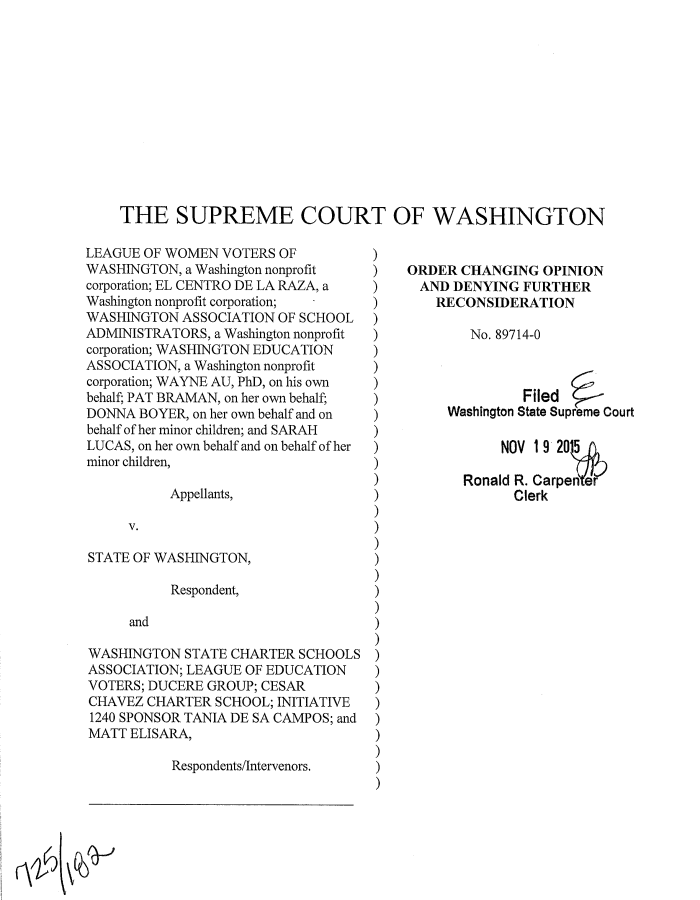
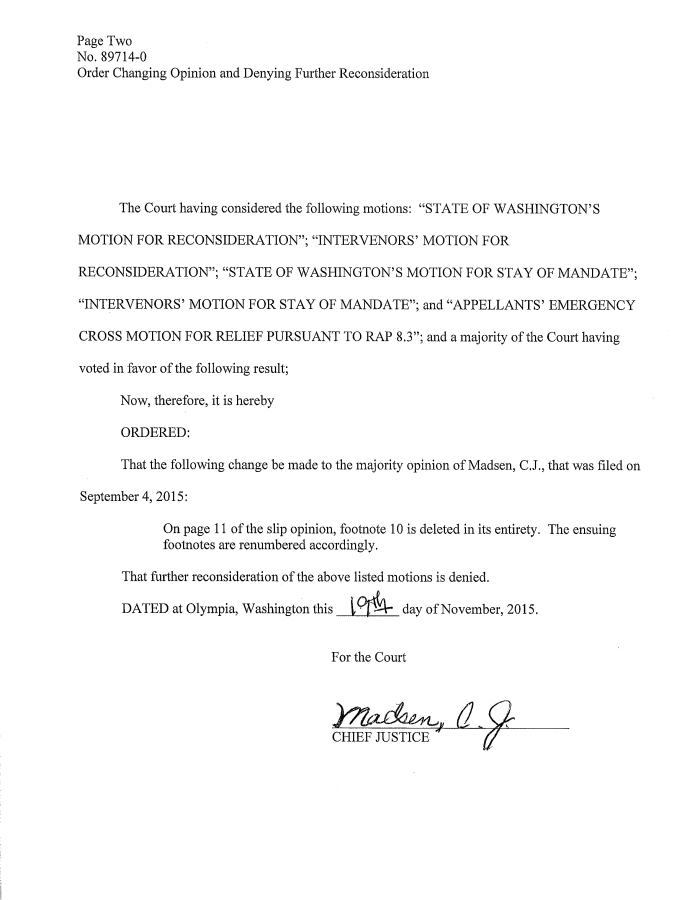
The Washington State Supreme Court announced Thursday that it will not reconsider its September decision declaring the state’s voter-approved law establishing charter schools was unconstitutional.
The high court had been asked to reconsider its decision by several parties, including the state charter school association, state Attorney General Bob Ferguson, a bipartisan group of 10 legislators and four former state attorneys general.
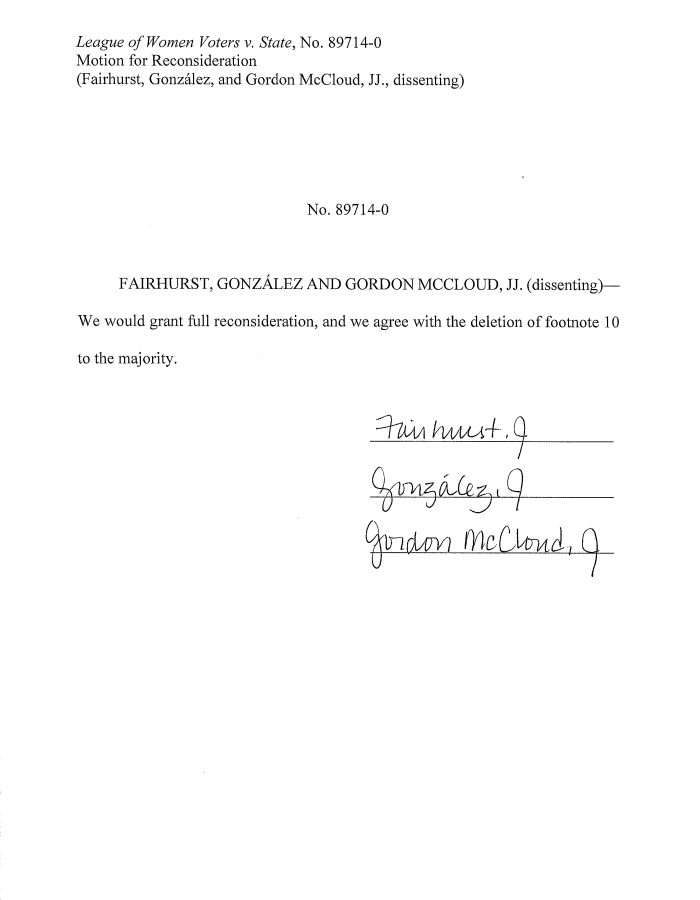
A slim majority — five of the nine justices — said the court should deny the request for reconsideration. Three justices dissented, saying they would have revisited the decision in full.
Additionally, Justice Mary Yu said she would have been willing to reconsider the portion of the decision invalidating charter school funding.
The court ruled Sept. 4 that the state’s voter-approved charter school law is unconstitutional, mainly because the schools are overseen by boards that are appointed rather than elected.
The state’s nine charter schools — all but one newly opened in August — have continued to stay open as they waited to see whether the court would reconsider its ruling.
Three of the charter schools are in Tacoma.
The ruling came on a day when buses from Tacoma and elsewhere in the state ferried more than 400 students and parents from charter schools to Olympia, where they rallied at the Capitol, testified before a joint Senate committee meeting and met with legislators.
Sen. Mark Mullet, a Democrat from Issaquah who met with charter school families at the Capitol, called the timing of the decision “horrible.”
“There are 300 students here who were really happy with their schools,” Mullet said. “What a bad day for the court to tell them that they’re not going to reconsider.”
Katie Wilton, a ninth-grade student at Summit Olympus in Tacoma, called the ruling unfair and asked lawmakers to be courageous and do whatever they can to save her school.
“This goes against the will of Washington state voters,” Wilton said. “This is not how democracy is supposed to work.”
A change in state law now appears to be the last hope charter supporters have for maintaining public funding for the privately managed schools. The schools had been receiving public funds while the court reconsideration loomed.
What will happen on the funding front is still to be determined, said Cynara Lilly, spokeswoman for the newly formed Act Now for Washington Students, which backs charters.
NOW IT'S TIME FOR THE LEGISLATURE TO FOCUS ON ITS PARAMOUNT DUTY... AND FULLY FUND K-12 SCHOOLS FOR ALL OF OUR STATE'S KIDS.
Rich Wood, Washington Education Association spokesman
“We are disappointed that the Supreme Court hasn’t ruled in favor of our families who are crying out for these great public schools,” said Maggie Myers, spokeswoman for the Washington State Charter Schools Association. “What this means is that we will shift our attention to the Legislature.”
“This adds a sense of urgency to what kids and parents were asking for today,” Lilly added.
Sen. Bruce Dammeier, a Puyallup Republican who is one of the Senate Republicans’ leaders on education issues, said the court’s decision was disappointing, especially considering how many stories lawmakers heard Thursday about how charter schools were benefiting students.
“Many students of poverty and color, who have felt disenfranchised and disconnected by our traditional schools, are seeing tremendous results at these schools,” Dammeier said. “Why the Supreme Court would be using arcane legal arguments and technicalities to deny these 1,200 students the education that they choose and is successful for them is beyond comprehension.”
Others said the Supreme Court was correct to stand by its September ruling. State Rep. Chris Reykdal, D-Tumwater, said charter schools — like traditional public schools — need to be accountable to local voters and taxpayers.
THIS ADDS A SENSE OF URGENCY TO WHAT KIDS AND PARENTS WERE ASKING FOR TODAY.
Cynara Lilly, charter school spokeswoman
The court’s announcement Thursday should help refocus the Legislature’s attention on boosting funding for K-12 public schools, said Rich Wood, a spokesman for the statewide teacher’s union that challenged the charter law.
In the case known as McCleary, the Supreme Court has held the Legislature in contempt for its failure to come up with a plan to fully fund basic education by 2018.
“Now it’s time for the Legislature to focus on its paramount duty ... and fully fund K-12 schools for all of our state’s kids,” said Wood, of the Washington Education Association. “That's what we expect lawmakers to do when they return in January.”
The Associated Press contributed to this report.
DOCUMENT
PAGES
Zoom

Teachers union allies demand Kevin Johnson resign over sex allegations | The Sacramento Bee

Teachers union allies demand Kevin Johnson resign over sex allegations | The Sacramento Bee:

Teachers union allies demand Kevin Johnson resign over sex allegations


A Los Angeles-based organization and local activists want Sacramento Mayor Kevin Johnson to resign in light of resurfaced allegations of sexual misconduct against him.
The Courage Campaign, a group tied to teachers unions that uses an online mailing list to advocate for liberal causes, released a video Thursday featuring television news reports and police recordings on the allegations against Johnson. The video does not include new allegations and as of Thursday afternoon had been viewed 1,600 times on Facebook. Another 122 had seen it on YouTube.
The Courage Campaign launched the video with a new group called the Sacramento Collective for Women’s Rights. The group of about a dozen women formed last month after a 1996 police video surfaced showing a teenage Phoenix girl accusing Johnson of molestation, said Michelle Pariset, a coalition member.
The video’s release was coordinated with an online petition seeking Johnson’s resignation. Laura Leavitt, a campaign manager for the Courage Campaign, said more than 9,000 people had signed the petition nationwide since the group launched it last month. It’s unclear how many of those signers live in Sacramento.
Johnson last month said he will not seek a third term next year. He has said past allegations against him of sexual misconduct did not play a role in his decision.
Ben Sosenko, the mayor’s spokesman, said Johnson will not resign before the end of his term and that the Courage Campaign’s effort “hasn’t gained any traction.”
“The mayor is focused on creating jobs and moving the city forward,” Sosenko said. “Piling on by an extreme, Santa Monica-based group desperately trying to build its email list with a low-budget video based on old allegations … will not change that.”
Leavitt said the Courage Campaign had launched the campaign because it is “especially interested in California politics and holding California politicians accountable.”
“It’s unacceptable for people in power with a long history of allegations to stay in power,” she said.
Courage Campaign’s political issues committee has raised just over $100,000 since 2013, according to the secretary of state’s website. Of that, $51,000 came from the California Federation of Teachers. The California Teachers Association is listed as a partner on the Courage Campaign’s website, along with the American Civil Liberties Union, the California Nurses Association and Planned Parenthood, among other groups.
Teachers unions in Sacramento and in California have battled Johnson, an advocate for charter schools. Johnson’s St. Hope organization operates Sacramento High School as a charter employing nonunion teachers.
Last month, the website Deadspin posted the 1996 police video. Last week, The Sacramento Bee obtained an audio recording of Johnson and his accuser in a conversation recorded by police. Johnson was not charged in the case.
Snippets of the video and audio recordings were included in the Courage Campaign video.
Johnson was accused by a Sacramento City Hall staffer of sexual harassment earlier this year. The allegations were not substantiated by the city attorney or an outside law firm.
He was also the subject of harassment claims that became public during his first run for mayor in 2008. In 2007, Sacramento police investigated a Sacramento High School teacher’s report that a 17-year-old girl told him Johnson had fondled her, but police found “no merit” in the case. The teacher also alleged that Johnson tried to engage inTeachers union allies demand Kevin Johnson resign over sex allegations | The Sacramento Bee:


Read more here: http://www.sacbee.com/news/local/news-columns-blogs/city-beat/article45572865.html#storylink=cpy

Is an upcoming Supreme Court case a strike for individual rights or a deceptive attack on teachers unions? - The Washington Post

Is an upcoming Supreme Court case a strike for individual rights or a deceptive attack on teachers unions? - The Washington Post:

Is an upcoming Supreme Court case a strike for individual rights or a deceptive attack on teachers unions?


Sometime in the next few months, the Supreme Court will hear arguments in Friedrichs v. California Teachers Association (CTA), a lawsuit with major implications for the future of organized labor. Those pushing the lawsuit say it is about individual rights. In this post, the author argues that both Friedrichs and a related case, Bain v. California Teachers Association, are deceptive attacks on unions.  In the article below, Ben Spielberg — a Teach For America alum and former member of the Executive Board of the San Jose Teachers Association (a CTA affiliate) — explains how union dues and spending work in California and why he thinks both lawsuits are misleading.  Spielberg blogs about a variety of social justice issues at34justice.com and has contributed previous articles about teacher evaluationand Vergara v. California to The Answer Sheet.

By Ben Spielberg
California public school teachers working in traditional school districts are by default members of their local teachers associations, which may be affiliates of either the California Teachers Association (CTA), which is the state branch of the National Education Association (NEA), or the California Federation of Teachers (CFT), the state branch of the American Federation of Teachers (AFT). While teachers unions, like all other organizations, certainly aren’t perfect, they fulfill several roles that benefit students and teachers alike and are important, powerful advocates for low- and middle-income populations in general.
Despite these facts (or, perhaps, because of them), teachers unions have been under attack for quite some time. And the anti-labor movement, fueled by wealthy individuals and groups like the American Legislative Exchange Council (ALEC), has been alarmingly successful. Union membership reached a historic low of 11.1 percent in 2014 (6.6 percent in the private sector and 35.7 percent in the public sector), 25 states have adopted inappropriately-named “right to work” laws that deprive workers of bargaining power, and an inaccurate, misleading anti-union narrative has permeated public discourse.
Unions won a major victory in California in 2012 when we (I was a CTA election campaign lead at the time) beat back Proposition 32, but the news has been less stellar since, particularly for teachers unions. In 2014, Judge Rolf Treu sided in favor of the plaintiffs in Vergara v. California, amisleading lawsuit that attacked various aspects of teacher employment law. Though the weakness of both the plaintiffs’ argument and the decision suggests that the case may be overturned on appeal, it still represents a dangerous threat to important employee protections that could reverberate beyond education. Two more recent California cases, Friedrichs v. California Teachers Association and Bain v. California Teachers Association, present related dangers for labor more generally, especially because the Supreme Court will hear oral arguments in Friedrichs early next year.
As was the case with Vergara, there’s a lot of misinformation floating around about both Friedrichs and Bain. The discussion below thus sets the record Is an upcoming Supreme Court case a strike for individual rights or a deceptive attack on teachers unions? - The Washington Post: