Latest News and Comment from Education

Thursday, November 19, 2015

FairTest’s “Testing Reform Victories 2015” Report: The uprising against the testocracy takes off! | I AM AN EDUCATOR

FairTest’s “Testing Reform Victories 2015” Report: The uprising against the testocracy takes off! | I AM AN EDUCATOR:

FairTest’s “Testing Reform Victories 2015” Report: The uprising against the testocracy takes off!
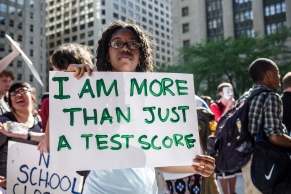
5-20-2013 protest school closures More than just a test score Sarah-jiThe National Center for Fair & Open Testing, know as FairTest, just released its wonderfulreport on the immense growth around the country of the movement in opposition to the abuses of standardized testing.  The victories included universities getting rid of their SAT/ACT requirement, states dropping the requirement for an exit exam to graduate from high school, and hundreds of thousands of families opting their children out of harmful high-stakes tests.  As Fair Test revealed in a press release today,
Around the U.S., well over half a million public school students refused to take standardized exams during the 2015 testing season, according to a preliminary tally released today. The count by the National Center for Fair & Open Testing (FairTest), a leader of the national assessment reform movement, is based on news reports and detailed surveys by local activists.
Among the largest state opt-out figures (with sources):
–  240,000   New York (news reports and New York State Allies for Public Education counts)
–  110,000+ New Jersey (Save Our Schools New Jersey)
–  100,000   Colorado (Chalkbeat Colorado and SEEK for Cherry Creek)
–    50,000+ Washington State (news reports)
–  ~20,000   Oregon (news reports)
–  ~20,000   Illinois (More Than a Score)
–    10,000   New Mexico (news reports)
–       ?  ?     Other states not yet reporting

“The opt-out movement and other assessment reform initiatives exploded across the country this year as more parents said ‘enough is enough’ to high-stakes testing overkill,” explained FairTest Executive Director Monty Neill. “If anything, the estimate of half a million opt-outs in 2015 is low because many states have denied requests to make test refusal data public. This intense grassroots pressure is beginning to force policymakers to roll back standardized exam misuse and overuse.”

It’s hard to describe the elation I experienced as I read in the FairTest report about one victory after another for communities around the nation in the struggle to demand that education is more than a score.
Over the past several years I been writing, speaking, organizing, and doing everything I could think of to demand that critical thinking and creativity be allowed back into our schools.  Ever since my colleagues at Garfield High School boycotted the MAP test in 2013 and helped to inspire this uprising, much of my life has been given to this great struggle against the testocracy–and it is beyond words for me to see these standardizing despots now on the run as families around the nation stand up to defend their children and public education.
Best of all is the educated prediction that  FairTest Public Education Director Bob Schaeffer made today: “In the 2016 testing season, we expect many more families to refuse to take part in FairTest’s “Testing Reform Victories 2015” Report: The uprising against the testocracy takes off! | I AM AN EDUCATOR:

Yes, Hillary Clinton supports charter schools. She also supports equity and inclusion. — Medium

Yes, Hillary Clinton supports charter schools. She also supports equity and inclusion. — Medium:

Yes, Hillary Clinton supports charter schools. She also supports equity and inclusion.


Hillary’s recent comments about charter school equity and inclusion have sparked a conversation about America’s public schools. It’s an important debate — one we should be having — for our kids’ futures and for our country’s future.
So let’s cut right to the chase: For decades, Hillary Clinton has been a strong supporter of both public charter schools and an unflinching advocate for traditional public schools, their teachers and their students. She knows that all public schools play a role in providing pathways for every child to live up to their potential. This isn’t anything new. She’s been saying it for decades.
Just a few months ago:
“The original idea behind charter schools was that they would be kind of laboratories for the public schools. And I go back to supporting that idea to the 1980s. Because anything that can get us better focused on what works in teaching different kinds of kids, we should be open to.”
Hillary — Glen, New Hampshire, 7/4/15
A few years ago:
“Well I believe in public school choice, and I’ve been a long supporter of charter schools, which is one of the reasons why I was pleased that our Greenville event was in a charter school.”
Hillary — Interview with the Spartanbeurg Herald Journal, 5/10/07
More than a decade ago:
“I do support charter schools that are done the right way. Accountable public schools with well-trained teachers. I believe in giving parents more choices in selecting from among public schools. I’ve seen what can happen when citizens and teachers are empowered, and when people feel obligated to be a part of the school and the community. If we want every child to learn, than every adult must share the same goal, to raise up our public schools, not tear them down. I have been committed to public education my entire life.”
Hillary — Syracuse University, 2/9/00
Hillary’s support of quality charter schools goes hand-in-hand with her call for equity and inclusion — for all public schools. We owe our kids a debate, but we also owe our kids solutions. As Secretary of Education Arne Duncan has said, “The bottom line is that the charter school brand has to stand for quality, accountability, cost-efficiency, and transparency.” Not addressing difficult questions (or simply trying to score political points) does not serve our charter schools or our students. The issues that Hillary has raised are issues that all of us should care about. Here they are:

Charter accountability

Hillary believes that every public school should be serving our students and supporting our teachers. And when charter schools are producing results, she believes we should double down on their success by scaling the model and ensure that their innovations are widely disseminated throughout our traditional public schools. That was the original bargain of charter schools.
At the same time, we must also have the courage to shut down charters that are failing our kids. And don’t just take this from me, or Hillary, for that matter. Take it from Geoffrey Canada:
“You know, people tell me, ‘Yeah, those charter schools, a lot of them don’t work.’ A Yes, Hillary Clinton supports charter schools. She also supports equity and inclusion. — Medium:


Congress blasts U.S. Education Department for vulnerabilities in data bases - The Washington Post

Congress blasts U.S. Education Department for vulnerabilities in data bases - The Washington Post:

Congress blasts U.S. Education Department for vulnerabilities in data bases


The U.S. Education Department came under withering criticism — from Republicans and Democrats — at a House oversight hearing about just how vulnerable its information systems are to security threats.
Lawmakers at the hearing, held on Tuesday by the full House Oversight and Government Reform Committee, took Danny Harris, the chief information officer of the Education Department, to task for the way data is handled for more than 40 million federal student loan borrowers as well as other aid programs that serve millions more students.
The department maintains 184 information systems, with 120 managed by outside contractors, and 29 are valued by the Office of Management and Budget as “high asset,” according to the committee. In 2014, the department’s Inspector General’s Office found in a report that:
While the Department made progress in strengthening its information security program, many longstanding weaknesses remain and the Department’s information systems continue to be vulnerable to serious security threats.
Inspector General Kathleen Tighe testified that serious deficiencies remain. She said that her office had been able to penetrate some department systems without being detected. “We could have really done anything in there,” she said, saying that “outsiders” could find their way in too. She also said, “I am still concerned about the potential for breaches in the department.”
A congressional scorecard issued this month on how well federal agencies were implementing four key areas of the Federal Information Technology Acquisition Reform Act, or FITARA, gave the Education Department three Fs and one D. Harris, asked about the failing grades, said he thinks the department should have received a C — but both Democratic and Republican lawmakers made clear they didn’t agree.
On Tuesday, Harris engaged in some testy back-and-forth with lawmakers about just how secure the systems really are. Asked by North Carolina Republican Rep. Mark Meadows  if he would stake his reputation on there not being a breach of department education systems, he said he would, and then said that on a scale of 1 to 10, he would rank his confidence at a 7. Georgia Republican Rep. Jody Hice responded:
“How in the world can you give yourself a 7 out of 10 when you’re using technology that isn’t even supported?…When can we expect the system to be secure?…This is an issue, Mr. Chairman, that hits every district in this country.”
Utah Republican Rep. Jason Chaffetz, the chairman of the committee, said that the department has at least 139 million unique Social Security numbers Congress blasts U.S. Education Department for vulnerabilities in data bases - The Washington Post:


What Education Policy Makers Can Learn From A ‘Failing School’ - Education Opportunity Network

Education Opportunity Network:

What Education Policy Makers Can Learn From A ‘Failing School’


“How can someone make a decision about a school they’ve never even walked into?”
That question is at the heart of Kristina Rizga’s terrific new book Mission HighOne school, how experts tried to fail it, and the students and teachers who made it triumph.
Rizga uses her considerable journalistic skills—honed as the education writer for Mother Jones—to involve readers in the lives of students and educators at Mission High, a San Francisco public school with a proud history but a “failing school” label.
The school, where Rizga spent four years as an embedded reporter, serves a student body of mostly low-income kids, many from households where the first language isn’t English, and which ranks among the lowest-performing 5 percent of schools in the country. Only 30 percent of the school’s students score at proficient or above on the state standardized tests in English, and only 40 percent score proficient in math.
But in looking more closely at the school, Rizga discovered that other data—college acceptance and teacher retention—didn’t align with the school’s “failing” label.
When Mission High principal Eric Guthertz welcomed Rizga into his school, she observed something that frustrates students, parents, and educators across the country: As these schools do everything in their power to serve their students, they continue to be judged as failures by a process that seems completely remote and disconnected from the school.
As she walked the halls of Mission High, observed classes, and spoke with the students and their teachers, Rizga came to see a very different story about the school—one of committed educators and persevering learners Education Opportunity Network:

Youngstown Legislators Engage Community to Push Back Against Youngstown Takeover | janresseger

Youngstown Legislators Engage Community to Push Back Against Youngstown Takeover | janresseger:

Youngstown Legislators Engage Community to Push Back Against Youngstown Takeover


Senator Joe Schiavoni, Ohio’s Senate Minority Leader, and State Representative Michele Lepore-Hagan spent the summer holding community meetings throughout Youngstown, Ohio to develop strategies to amend the Ohio legislature’s autocratically imposed Youngstown school takeover.  Their goal: develop political will in Youngstown to demand that the Youngstown plan be bent to support the needs of Youngstown’s children and families.  I had the privilege of talking with these two community leaders last week.
The new Youngstown takeover, which expands what has for 10 years been state involvement in the Youngstown City Schools, prescribes that the district be managed by an appointed Distress Commission instead of the local school board.  The takeover was sprung on an unsuspecting public at an afternoon hearing in late June when Senate Education Committee chair Peggy Lehner introduced a 66-page amendment to a bill with widespread popular support—to expand Community Learning Centers in Ohio. (“Community Learning Center” is Ohio’s term for what the rest of the country calls full-service, wraparound “Community Schools” that locate health and dental clinics, social service coordination, afterschool programs, Head Start and Early Head Start, and summer enrichment programs right in school buildings. Cincinnati has been experimenting very successfully with expanding the number of these schools. The Children’s Aid Society in New York City has been developing this model for 20 years now.)  When Senator Lehner introduced to the Community Learning Center bill her amendment  for the Youngstown takeover—along with the state takeover in the future of any school district with three years of “F” school ratings—the amendment had been written and polished for several months by staff in Governor John Kasich’s office and the Ohio Department of Education, working secretly with a handful of carefully selected community “leaders” from Youngstown.
The goal of the takeover was always to turn the district or particular schools over to a charter management organization.  Not coincidentally, the Youngstown takeover was the centerpiece of a charter school expansion grant proposal submitted by the Ohio Department of Education in July to the U.S. Department of Education and subsequently funded. The Youngstown takeover amendment states that an Academic Distress Commission, in consultation with the Youngstown Legislators Engage Community to Push Back Against Youngstown Takeover | janresseger:

Mike Klonsky's SmallTalk Blog: Former CPS liar-in-chief, leaves Rahm's Super PAC to start her own biz.

Mike Klonsky's SmallTalk Blog: Former CPS liar-in-chief, leaves Rahm's Super PAC to start her own biz.:

Former CPS liar-in-chief, leaves Rahm's Super PAC to start her own biz.


"She will be a real asset to those that work with her", says Michael Sacks, CEO of Grosvenor Capital Management . --Crain's
Becky Carroll, served as J.C. Brizard's andByrd-Bennett's liar-in-chief at CPS before moving over to run Rahm's campaign Super PAC. Now, after a year and a half at Chicago Forward, Carroll is setting out on her own. Her new money-making venture is called Chicago Backward (just kidding) C-Strategies LLC and I assume her specialty will be union-busting, school privatization, and attacking progressive political candidates, as always.

Carroll's time at CPS was mostly spent trying to cover up Brizard's ineptness (admittedly an impossible job) and then keep a lid on the BBB/SUPES affair and the UNO corruption scandals. Then there was her CPS budget deception and her selling of the school closings (she named it, "right sizing"). 

Oh, I almost forgot her efforts to spread dis-information about the Chicago Mike Klonsky's SmallTalk Blog: Former CPS liar-in-chief, leaves Rahm's Super PAC to start her own biz.:

What Will It Take to Build a Democratic Movement? - Bridging Differences - Education Week

What Will It Take to Build a Democratic Movement? - Bridging Differences - Education Week:

What Will It Take to Build a Democratic Movement?


Deborah Meier continues her conversation with Harry Boyte. To read their full exchange, please visit here.
Dear Harry and friends,
Yes, yes, yes, Harry. You ask: What's it all about—given the number of years that the young must spend in school and the money taxpayers are required to pay for schooling, you'd think we might ask that.
Nearly 50 years ago I asked my kindergarteners the same question. Their answers?
"To learn to put your hand up, to sit quietly, to walk in line," etc. And then? "To move on to the next grade." "But," I pressed, "what's the purpose of moving on?" They finally mentioned learning to read. "And why learn to read?" "So you won't be left back." We got all the way up to graduating from high school so you can get a job. "And then why is it so important to learn to read?" "So when you have kids you can help them learn to read" was the happily agreed upon end of it all.
We now are telling them over and over: If you do right in school—work hard and be nice—every last one of you will individually succeed. Make money.
What I want to encourage is for every community to discuss what they want for themselves, their neighbors, and the world that schools might be the appropriate vehicle for. But that leads me to "structure" vs. "culture." Of course, we'd both agree that they go together in some way, I suspect. A culture of participation, empathy, solidarity, and hopefulness doesn't materialize because we teach it.
First we need to describe what such words might look like in practice and then share this with teachers and students, who are able to revise their ideas as they try them out. Powerless people rightly shy away from once again being reminded of their powerlessness by going to another meeting. Some "structures" make it harder to experience power and some make it easier to experience it and to sustain it. Like being rewarded and humiliated for being quiet and punished for being outspoken. Fear works. But then, for some inexplicable reason (that you may call "culture"?) it doesn't work anymore, or at least not often enough to squash the rebelliousness altogether. What we are seeing today everywhere is that young black students and young black people in the cities and towns of America are also beginning to say "enough"! That depends on how we respond.
Actually, when I got into this "business" of schooling I didn't picture it changing the world. I still don't. It can play a role, of course. It can promote a cultural shift. But I loved it because it was a place where I could play it out on a small scale, both intellectually, interpersonally, and socially. And I thought, as an aside, that if "we" ever came to power (a phrase I was once comfortable with) we'd know what kind of experience, i.e., education, the young needed to help sustain a more democratic culture.
What is it that you think changes "culture"? The fight for the eight-hour day, for example, helped as means and end. What we still don't know how to do is sustain these heroic moments, to build a movement that is lively and inclusive enough to experience democracy on a daily basis—even within a less than democratic social system. Ideas?

Perdido Street School: Campbell Brown Surfaces In Dean/Adam Skelos Corruption Case Wiretaps

Perdido Street School: Campbell Brown Surfaces In Dean/Adam Skelos Corruption Case Wiretaps:

Campbell Brown Surfaces In Dean/Adam Skelos Corruption Case Wiretaps


From the Politico NY morning email update on education:


SURPRISE GUEST IN THE DEAN SKELOS TAPES: CAMPBELL BROWN: 
From phone call between Adam and Dean Skelos Dec. 14. 2014:  
“AS: What are you up to?  
DS: Um going into the city. Meeting with some billionaires.  
AS: Who are you meeting with?  
DS: On school tax credit stuff. Campbell Brown.  
AS: Oh. Ok.  
DS. A reporter, former reporter. 
AS: Dad, you gotta take these names down….All I need is contacts. I’ll take care of the rest.” 
(Dean laughs)

Some billionaires and Campbell Brown meet with crooked Dean Skelos over "school tax credit stuff".

Love it.

Maybe they could have gotten exactly what they wanted on the "school tax credit stuff"" if they had provided Adam Skelos with a no-show job at Families for Excellent Schools.

Just so long as they didn't ask him to, you know, show up for work. Perdido Street School: Campbell Brown Surfaces In Dean/Adam Skelos Corruption Case Wiretaps:

Connecticut's Democratic Legislative Leaders call for suspending elections to save money... - Wait What?

Connecticut's Democratic Legislative Leaders call for suspending elections to save money... - Wait What?:

Connecticut’s Democratic Legislative Leaders call for suspending elections to save money…


Well, their proposal is pretty damn close to that…
Earlier this week, the Democratic leaders of the Connecticut General Assembly proposed suspending Connecticut’s public financing system, thereby allowing legislators to transfer about $11 million toward the $254 million budget deficit in this year’s state budget.
Their plan would roll back the campaign finance system that Connecticut adopted after former Governor John Rowland resigned in disgrace and was sent to prison.
Instead of keeping Connecticut’s Clean Election Program in place, Democratic leaders would return the state to the “wild-west” campaign fundraising system that favored incumbents and ensured that campaigns for the legislature were primarily financed by political action committees, lobbyists and those who benefit financially from state contracts.
Without consulting the members of the Senate or House Democratic Caucuses, the plan to suspend Connecticut’s campaign finance system was announced by Democratic Senate President Pro Tempore Martin M. Looney, Democratic Senate Majority Leader Bob Duff, Democratic Speaker of the House Brendon Sharkey and Democratic House Majority Leader Joe Aresimowicz.
The 2006 campaign cycle was the last time Connecticut incumbents enjoyed the full pay-to-play campaign finance game that ensured that most campaign donations went to incumbents and that those funds came from state contractors, lobbyist and political actions committees.
In fact, the old “incumbent protection” system was working so well that neither Senator Martin Looney nor Representative Brendon Sharkey even had opponents, while Senator Bob Duff and Representative Joe Aresimowicz were able to easily raise far more campaign money than their challenges.
Although Senator Looney didn’t even have an that year, he raised more than $43,000 for his campaign, nearly 60 percent coming from PACS and a large percentage of his individual contributions from lobbyists and state contractors.
Senator Duff raised over $100,000 in 2006, with well over 60 percent coming from PACS, Lobbyists and state contractors, while Representative Aresimowicz collected over $40,000 with more than 70 percent coming from PACS, lobbyists and state contractors.
The leadership proposal designed to return Connecticut campaign finance system and Connecticut's Democratic Legislative Leaders call for suspending elections to save money... - Wait What?:

For Millions of Kids, After-School Programs Light the Way | Ben Paul

For Millions of Kids, After-School Programs Light the Way | Ben Paul:

For Millions of Kids, After-School Programs Light the Way

ALEXANDRO ZAMORA


For millions of children, the bell at the end of school only signals a pause in their daily education. In after-school programs around the country, millions of children close their textbooks and put away their pencils, but instead of going home, they build robots, practice Tae Kwon Do, play in a band, receive homework support or participate in community service.
Whatever the activity, countless families who rely on after-school programing agree: the programs fill a much-needed gap between the ringing school bell at 3pm and the time mom and dad head home at 6pm.
Sadly, after-school programs aren't available everywhere. While millions of children attend, many more are denied the opportunity.
Ivonne Gonzales was one such kid left on her own after school until her parents enrolled her in an After-School All-Stars program. Before long, she learned to play the guitar, and soon, the East LA native was writing and recording her own music, and even performed at the Hollywood Bowl. She summed her after-school experience up in one word: "transformative."
"A lot of children have that voice, a voice to show the best of themselves to the world and change their communities, but they don't get a chance to develop that voice," she told me recently. "My after-school program was a way for me to develop that inner-spark that I had."
While participation in after-school programs has increased, the demand for after-school continues to rise at a pace that outstrips the growth of new programs. Currently, two in five children -- 19.8 million in all -- would participate in after-school if programs were available. Moreover, 11.3 million of those children don't have another option, and spend time alone and unsupervised during the after school hours. When I told this to Ivonne, I could hear the sadness in her voice.
"You grow up in a world of the American dream," she said before hesitating. "But there are still a lot of gaps in opportunity, which is where these programs have to come in."
Far too often, the American dream leaves some groups -- namely minorities and the poor -- behind. After-school programs are a critical way to combat this: research shows that participation in, and demand for, after-school programs are much higher among African American and Latino children from low-income households. Half of children from low-income households not participating in an after-school program would be enrolled in one if one were available to them.
While new after-school opportunities gradually open up for children, there is a long way to go for the 11.3 million students who are unsupervised after school and the millions more who would take advantage of the programs if given the chance. I spend a lot of time thinking about these numbers and citing research that highlights the positive impact after-school programs provide but I find that one of the strongest arguments is the simplest: when I am not with my kids, I worry about them. If I can't watch them myself, I want to know they are being looked after and using their time productively. After-school programs provide all parents, including me, a peace of mind.
The mission of After-School All-Stars is to provide free, comprehensive after-school For Millions of Kids, After-School Programs Light the Way | Ben Paul:
Image result for sacramento  start 4th r after school programs

41 years. $3 billion. Inside the Clinton donor network. - Washington Post

41 years. $3 billion. Inside the Clinton donor network. - Washington Post:

41 years. $3 billion. Inside the Clinton donor network

A Washington Post investigation reveals how Bill and Hillary Clinton have methodically cultivated donors over 40 years, from Little Rock to Washington and then across the globe. Their fundraising methods have created a new blueprint for politicians and their donors.


Today, the two major national teachers’ unions rank among the Clintons’ biggest supporters. The National Education Association has contributed at least $1.3 million to bolster their races, while theAmerican Federation of Teachers has given more than $756,000 to support them politically and at least $1 million to their foundation.
In July, AFT endorsed Hillary Clinton’s 2016 presidential bid — the first national union to do so.


 Over four decades of public life, Bill and Hillary Clinton have built an unrivaled global network of donors while pioneering fundraising techniques that have transformed modern politics and paved the way for them to potentially become the first husband and wife to win the White House.
The grand total raised for all of their political campaigns and their family’s charitable foundation reaches at least $3 billion, according to a Washington Post investigation.
Their fundraising haul, which began with $178,000 that Bill Clinton raised for his long-shot 1974 congressional bid, is on track to expand substantially with Hillary Clinton’s 2016 White House run, which has already drawn $110 million in support.
The Post identified donations from roughly 336,000 individuals, corporations, unions and foreign governments in support of their political or philanthropic endeavors — a list that includes top patrons such asSteven Spielberg and George Soros, as well as lesser-known backers who have given smaller amounts dozens of times. Not included in the count are an untold number of small donors whose names are not identified in campaign finance reports but together have given millions to the Clintons over the years.
The majority of the money — $2 billion — has gone to the Clinton Foundation, one of the world’s fastest-growing charities, which supports health, education and economic development initiatives around the globe. A handful of elite givers have contributed more than $25 million to the foundation, including Canadian mining magnate Frank Giustra,who is among the wealthy foreign donors who have given tens of millions.
Separately, donors have given $1 billion to support the Clintons’ political races and legal defense fund, making capped contributions to their campaigns and writing six-figure checks to the Democratic National Committee and allied super PACs.
The Post investigation found that many top Clinton patrons supported them in multiple ways, helping finance their political causes, their legal needs, their philanthropy and their personal bank accounts. In some cases, companies connected to their donors hired the Clintons as paid speakers, helping them collect more than $150 million on the lecture circuit in the past 15 years.
The couple’s biggest individual political benefactors are Univision chairman Haim Saban and his wife, Cheryl, who have made 39 contributions totaling $2.4 million to support the Clintons’ races since 1992. The Sabans have also donated at least $10 million to the foundation.
The Clintons kept big contributors in their orbit for decades by methodically wooing competing interest groups — toggling between their liberal base and powerful constituencies, according to donors, friends and aides who have known the couple since their Arkansas days.
They made historic inroads on Wall Street, pulling in at least $69 million in political contributions from the employees and PACs of banks, insurance companies, and securities and investment firms. Wealthy hedge fund managers S. Donald Sussman and David E. Shaware among their top campaign supporters, having given more than $1 million each.
The Clintons’ ties to the financial sector strained their bonds with the left, particularly organized labor. But unions repeatedly shook off their disappointment, giving at least $21 million to support their races. The public employees union AFSCME has been their top labor backer, giving nearly $1.7 million for their campaigns.
The Clintons’ fundraising operation — $3 billion amassed by one couple, 41 years. $3 billion. Inside the Clinton donor network. - Washington Post: