Latest News and Comment from Education

Friday, November 6, 2015

Children's books by and about Native Americans | Philadelphia Public School Notebook

Children's books by and about Native Americans | Philadelphia Public School Notebook:

Children's books by and about Native Americans


Almost 100 years ago, the first attempts were made to establish a holiday honoring American Indians. These days, some state and local governments have replaced Columbus Day with Indigenous Peoples Day and, since 1990, November has been widely recognized as Native American Heritage Month. This November, encourage the children in your life to learn more about American Indian cultures.*
In the world of children’s and teen books, American Indians have long been represented as strange, savage, and dangerous. Remember The Little House on the Prairie? Books about Thanksgiving are especially problematic. Many books, while attempting to celebrate the friendship between European settlers and American Indians, contain nothing more than caricatures and stereotypes of a variety of cultures that are very much alive today. To balance this inequity, here are three books for youth that are written by American Indians, with contemporary American Indian characters.
In Jingle Dancer, by Cynthia Leitich Smith, young Jenna, a member of the Muscogee (Creek) Nation in contemporary Oklahoma, watches footage of her Grandma Wolfe performing a jingle dance. She too wants to dance at the upcoming powwow and hopes she will be able to gather enough cone-shaped tin pieces to make her dress sing. Jenna visits four women in her community who all contribute to making her dance a success. Set in a contemporary suburban neighborhood, Jingle Dancer offers a great counterpoint to the notion that American Indians are a culture of the past.
Virginia Driving Hawk Sneve has written countless nonfiction books about American Indians for children. She turns the focus to her own childhood in her picture book The Christmas Coat: Memories of My Sioux Childhood. The daughter of an Episcopal minister father and Lakota Sioux mother, Virginia grew up on the Rosebud Reservation in South Dakota. In this story, she recalls the cold winters on the reservation and how she longed for a new, warm coat. As the minister’s daughter, though, any charity donations went first to more needy children. After a long wait, Virginia finally gets a beautiful red coat for Christmas. The Christmas Coat is a great story of family and generosity.
For older readers, Sherman Alexie has written the story of the average teen in The Absolutely True Diary of a Part-Time Indian. That is, if that teen is a gawky, artistic outcast who is routinely bullied, prone to seizures, and lives on a reservation. Although life on the "rez" is rough, Junior bands together with his aptly named best friend, Rowdy. But when he transfers to a rich, white school, he finds himself a different kind of outcast among his reservation friends and family. When tragedy strikes his family in the form of death and alcoholism, Junior must cope with loss along with the growing pains of a teen who is trying to find his identity. Alexie, who grew up on the Spokane Indian Reservation, using biting wit and plenty of humor to face down the complex realities of a kid growing up as a modern-day American Indian.
For more great children’s books by and about American Indians, check out Debbie Reese’s blog, “American Indians in Children’s Literature.” She is a tribally enrolled Nambe Pueblo teacher and children’s literature professor. 

Author’s note: American Indian or Native American? Indigenous peoples or First Nations? You may have noticed that throughout these reviews, I have used the term “American Indian.” This term is sometimes used interchangeably with “Native American,” but they are not without controversy. Whenever possible, I have used the author’s preferred term, and/or their accurate tribal affiliations. To learn more, read Amanda Blackhorse’s article“Blackhorse: Do You Prefer ‘Native American’ or ‘American Indian’? 6 Prominent Voices Respond.”

Sarah Stippich is a Children’s Librarian and the Early Literacy Coordinator for the Free Library of Philadelphia.

Jingle Dancer
By Cynthia Leitich Smith, illustrated by Cornelius Van Wright and Ying-Hwa Hu
2000
New York: Morrow Junior Books
The Christmas Coat: Memories of My Sioux Childhood
By Virginia Driving Hawk Sneve, illustrated by Ellen Beier
2011
New York: Holiday House
The Absolutely True Diary of a Part-Time Indian
By Sherman Alexie, illustrated by Ellen Forney
2007
New York: Little, Brown and Company

Something Important Happens Here - Lily's Blackboard

Something Important Happens Here - Lily's Blackboard:

Something Important Happens Here


So here’s the thing. Everywhere I go I tell people about the amazing educators I serve. I tell the people I sit next to on airplanes. I tell taxi drivers. I tell my friends and family probably way too much.
I tell people who already know and I tell people who don’t want to hear it. That’s because you all truly are amazing. You make me proud. You make me humble (and if you know me at all, you know that’s very hard to do).
Everywhere I go I hear stories of how you are transforming students’ lives with the power of a great education. You are the best of the best.
I met a librarian in Mississippi who created the most magical reading oasis you could ever imagine; who put off retirement for an extra year so she could keep teaching her little ones the joy of reading; who considers herself theteacher of all students in the school.
I met a teacher in Florida who bravely stood up for her student when the state declared he had to take a mandatory standardized test – despite the fact he was in hospice care and couldn’t even hold a #2 pencil in his hand, let alone take a test.
I met a custodian in Illinois who comes in at 4 a.m. on winter’s snowiest days (winter! In Illinois!) to get the school ready for students. He told me, “The kids know that somebody cares about them when they see a place like this.”
I met a secretary in Utah who sat with a distraught student when her parents were late picking her up from school. When the parents sent her flowers the next day to say thank you, she told me, “They didn’t have to do that. I mean, it was nothing. It’s all just part of the job.”
And it doesn’t matter at all where I go, because you are the same everywhere: you are fearless and hardworking and wonderful. I know you are also tired, and stressed, and most of all worried about those students in your schools who need the extra help.
We are 3 million strong. We are teachers, cafeteria workers, para-educators, custodians, secretaries, bus drivers, school security officers, higher education faculty and staff, administrators, substitute educators, retired educators, and future educators.
I’m so proud of you that I want the whole country to know what you do for students.
That’s why I am so excited to announce a shiny new campaign that people all over the country will see. And, of course, they will all hear about it from me. That goes for seatmates, taxi drivers, friends, family, and everyone else I can get to listen.
Check it out for yourself; I think it’s pretty amazing. And it’s because it’s the story of you.

New York’s baffling response to parents who didn’t let their kids take Common Core tests - The Washington Post

New York’s baffling response to parents who didn’t let their kids take Common Core tests - The Washington Post:

New York’s baffling response to parents who didn’t let their kids take Common Core tests


This belongs in the you-can’t-make-up-this-stuff category. Also in the someone-is-actually-getting-paid-to-do-this category.
In New York State this past spring, some 20 percent of students refused to take high-stakes Common Core standardized tests.  Parents and students who did had various reasons, including as a protest against the tests themselves and the invalid use of student scores on the tests to evaluate teachers.
Instead of taking a hard look at the evaluation system or the tests, the New York State Education Department has put together an “Assessments Toolkit”for superintendents to try to lure back the opt-outs.The Web site says:
This toolkit is intended to help superintendents communicate with parents and educators in their districts about the value and importance of the annual Grades 3-8 English Language Arts and Math Tests. The toolkit is completely optional and contains customizable materials such as a letter to parents, a PowerPoint presentation about the higher learnings standards and assessments, and sample Twitter and Facebook posts. Superintendents are encouraged to check out these materials and use them if they would be an effective way to reach their parents and educators. Additional resources will be added in the coming weeks and months, so please check back often.
Yes, folks in the NYSED apparently think that an assessment toolkit can win over parents so opposed to the administration of the tests and use of the scores that they didn’t let their children take them despite threats that schools could lose funding.
As noted above, the toolkit consists of sample letters and (my favorite) sample social media posts, complete with the best times to send them and guidance New York’s baffling response to parents who didn’t let their kids take Common Core tests - The Washington Post:

CURMUDGUCATION: CAP & Common Core Whack-a-mole

CURMUDGUCATION: CAP & Common Core Whack-a-mole:

CAP & Common Core Whack-a-mole


I have decided that the Center for American Promise has based its relentless (and senseless) Common Core promotional campaign on a game of whack-a-mole in which they play the part of the mole.

Here comes Carmel Martin, executive vice-president of policy at CAP (previously employed by the US Department of Education-- you can view her revolving door history here), writing a piece for Inside Sources, a website that seems to be a sort of clearing house for news from "policy and industry experts" aka "people who have a news story they want to have placed." But it totally worked, because the piece was picked up by Newsday.

Martin announces her intent with her lede:

The irony of the controversy over the Common Core is that proponents and opponents actually agree on much more than we disagree on.

I'm not sure what the "irony" of the controversy is, really. That Common Core backers never thought anyone would argue with them or resist? That they are being sold as higher standards that will prepare students for college and career when there's no actual evidence they do either? But hey-- let's hold hands, start strumming our ukelele, and see what it is that we all agree on.

First, "we all agree" that America's students must be prepared to thrive in today's competitive global 
CURMUDGUCATION: CAP & Common Core Whack-a-mole:


Black, Latino Students Continue to Fall Behind White, Asian Counterparts

Black, Latino Students Continue to Fall Behind White, Asian Counterparts:

Black, Latino Students Continue to Fall Behind White, Asian Counterparts


White and Asian students in the United States continue to out perform their black and Latino counterparts nationwide, according to the  U.S. Department of Education's 2015 Nation’s Report Card that assesses nationwide student achievement.  
High school students Robin Choi and Jewell Prim share one key ingredient that makes them academically successful.
“Every since I can remember, college has never been a choice, it is something that is essential," said Prim.
“My parents have always told me since I was a child that education was an investment to my career," said Choi.
Both students attend Harbor Teacher Preparation Academy, a school that gives them as much support as they get at home.  But not every school presents this type of experience.  
English teacher Natalie Collier says if students do not get basic academic skills by the time they reach high school, many of them become disinterested.  And that is just one challenge.  
“The lack of motivation also comes from outside the environment.  If the critical mass is not focused on education then I believe it kind of trickles down Black, Latino Students Continue to Fall Behind White, Asian Counterparts:

Mike Petrilli and I Have a Brief Exchange about International Test Scores | Diane Ravitch's blog

Mike Petrilli and I Have a Brief Exchange about International Test Scores | Diane Ravitch's blog:

Mike Petrilli and I Have a Brief Exchange about International Test Scores


I knew Mike Petrilli well, back when I was a trustee of the Thomas B. Fordham Foundation and Institute in D.C. But after I became disillusioned with testing and school choice, I didn’t see much of him anymore. We occasionally trade emails. I have a certain residual fondness for him. But I nonetheless think he is wrong and hold out hope that he will one day realize it.
But he is not ready.
He sent me this note recently:
Joanne gets it exactly right. Ready to concede a few points?
—-
Mediocre U.S. scores: Don’t blame poverty
// Joanne Jacobs — Thinking and Linking by Joanne Jacobs
When U.S. students post mediocre scores on international tests, poverty is “the elephant in the room,” says American Federation of Teachers president Randi Weingarten. Others point to a “poverty crisis” rather than an “education crisis.”
The elephant is not in the room, write Michael Petrilli and Brandon Wright in Education Next. U.S. schools do as well — or poorly — educating low-income students as other countries. Furthermore, U.S. children aren’t more likely to be poor: Those sky-high child poverty rates really are measuring inequality rather than absolute poverty.
Overall, the U.S. rates 28th in math proficiency for advantaged students among the 34 countries in the Program for International Student Assessment (PISA). Disadvantaged U.S. students rank 20th compared to similar students in other PISA countries.
Our advantaged students may do better than poor kids here, but they don’t outperform similar students in developed countries.


While income inequality is high in the U.S., absolute poverty is not especially high, Petrilli and Wright argue. Including all forms of income, Mike Petrilli and I Have a Brief Exchange about International Test Scores | Diane Ravitch's blog:

Study Highlights Little State Oversight of Educational Services Provided to Incarcerated Youth | CSG Justice Center

Study Highlights Little State Oversight of Educational Services Provided to Incarcerated Youth | CSG Justice Center:

Study Highlights Little State Oversight of Educational Services Provided to Incarcerated Youth


A first-of-its-kind report released today by The Council of State Governments (CSG) Justice Center found that most incarcerated youth do not have access to the same educational services as their peers in the community, and little accountability exists to ensure educational standards are met in lock-up.
The report, “Locked Out: Improving Educational and Vocational Outcomes for Incarcerated Youth,”reveals that despite spending between $100,000 to $300,000 per incarcerated child in secure facilities, only 13 states provide all incarcerated youth with access to the same types of educational services that students have in the community. Meanwhile, only nine states offer community-equivalent vocational services to all kids in lock-up.
MikeT“On average, what states spend on these kids while they are locked up is at least three times the cost of a Harvard tuition,” said Michael Thompson (pictured left), director of the CSG Justice Center. “Policymakers making this level of investment should be asking what type of education they expect to be provided to these youth.”
While most youth incarcerated 10 years ago were in facilities operated by state government, nearly two-thirds of youth locked up in the U.S. today are held in facilities operated by local government agencies or nonprofit or for-profit organizations.
The survey, conducted by the CSG Justice Center and in partnership with the Council of Juvenile Correctional Administrators, asked leaders in each state: Who is responsible for educating kids incarcerated in this patchwork of institutions? The report found that in more than 80 percent of states, no single state agency is charged with this authority, leaving an absence of leadership and, ultimately, accountability for ensuring youth make sufficient progress towards college and career readiness. The report also found:
  • Fewer than one in three states is able to document what percentage of youth released from a juvenile correctional facility subsequently obtain a high school diploma;
  • In nearly half of the states, it is up to the parent or guardian of the youth, or perhaps a community-based organization advocating on his or her behalf, to get that young person enrolled in a public school or another educational setting after his/her release from a correctional facility;
  • In more than one-third of states, youth released from a facility are automatically enrolled in an alternative educational setting, which often do not meet state curricular and performance standards and suffer from lower graduation rates that traditional public schools.
aefcb20a-df40-44b8-afaa-52d1b3e78b55“This report shines a light on a group of youth who, for most people, are out-of-sight, out-of-mind,” said Susan Burke (pictured right), director of Utah’s Juvenile Justice Services. “For the first time, it’s clear that more state oversight is warranted to ensure all youth receive the necessary educational services they need to succeed later in life. I’m looking forward to working with leaders in the education community to figure out what we do about this important problem.”
On any given day, there are about 60,000 youth incarcerated in the U.S. This report examines the more than half of these young people—two-thirds of whom are black or Latino—who have been committed to the custody of the state, on average for three to 12 months. Incarcerated youth overall tend to be several grade levels behind their peers, more likely to have an educational disability, and have been suspended multiple times and/or expelled from local schools.
“Measurement and accountability have been the hallmarks of the public education system,” said Kent Study Highlights Little State Oversight of Educational Services Provided to Incarcerated Youth | CSG Justice Center:

CURMUDGUCATION: Cheating the NAEP

CURMUDGUCATION: Cheating the NAEP:

Cheating the NAEP


We've had our giant round of reaction to the NAEP test results, and their woeful failure to showAmerican school children being propelled forward into a wonderland of learning by over a decade of reformster policies. I'm not sure there's any reason to get excited about NAEP results at all, but test-loving folks do, and there's really no denying that this round of NAEP results were Just Not Good.

Oh, but what if it turned out that they were actually even worse?

RaShawn Biddle may not be familiar to you; Biddle runs a one-man media empire parked firmly in reformsterland. But his blog Dropout Nation ran some interesting analysis of some NAEP numbers.

To understand what he's about, you need to know that NAEP allows states to opt out up to 15% of their student special population-- typically students with special needs and English Language Learners. But Biddle is a good reformster, and so he believes in the simple two-step proposition:

1) Public schools are failing. We just need to prove it so we can get support for dismantling them.
2) Making students take Big Standardized Tests who can't possible pass them-- that will help with #1.

Biddle likes to talk about "special ed ghettos" and he's a huge supporter of having all the students there fail BS Tests so we can prove that their school districts suck. But he's not wrong when he points out that some states and cities are gaming their NAEP stats by controlling who actually takes the test. Biddle has assembled two Dishonor Rolls.

On the state level, the big loser is Georgia.

The Peach State was the worst in the nation in excluding fourth- and eighth-grade kids in special ed, keeping 25 percent of each group of students from taking NAEP this year. Although the levels of exclusion declined by, respectively, six and seven percentage points from levels two years ago, 
CURMUDGUCATION: Cheating the NAEP:

Groundbreaking Approach to English Learners - Year 2015 (CA Dept of Education)

Groundbreaking Approach to English Learners - Year 2015 (CA Dept of Education):

State Schools Chief Tom Torlakson Announces Next Step in Implementing Groundbreaking Approach to Teaching English Learners


SACRAMENTO— State Superintendent of Public Instruction Tom Torlakson announced today that California has taken the next step in implementing its groundbreaking approach to teaching English learners.
On Wednesday, the State Board of Education voted to approve instructional materials for kindergarten through grade eight that are aligned to the California Standards for English Language Arts and Literacy in Science, History-Social Studies and Technical Subjects, that were based on the Common Core, and the California English Language Development Standards.
California is the first state to integrate English language arts/literacy (ELA) and English Language Development (ELD), which helps English learners by making their language development a core part of the curriculum and not a separate, isolated part of the school day.
"This is a big step because these instructional materials can help teachers develop the language skills of English learners throughout the school day," said Torlakson. "I'm proud California is a leader in this area.  We will continue to welcome all students to our classrooms and work with them to inspire learning. The one-quarter of our students who are English learners are an asset to our state and will continue to foster growth for all of us."
Of the 27 instructional materials programs submitted for consideration from 10 publishers, the State Board of Education approved 25. Reviewing the materials were nearly 200 educators and the Instructional Quality Commission. Among the 25 adopted programs, 17 were basic grade-level programs, and eight were intervention programs.
Local school districts may now begin their own process of reviewing the materials to determine which of the adopted programs best meet the needs of their students. With such a wide variety of choices, including a number of technology-based programs, districts have greater flexibility when designing and implementing a curriculum that will help their students achieve academically.
The adopted programs are on display for public review at Learning Resources Display Centers across the state. For more information about the 2015 ELA/ELD Adoption process, visit the California Department of Education English Language Arts Instructional Materials Web page.
# # # #

Attachment

2015 ELA/ELD Instructional Materials Adoption

Program 1 Basic ELA

Publisher
Program Title
Grade Level(s)
Amplify Education, Inc.
Amplify ELA: California Edition
6–8
EMC Publishing, LLC
Mirrors & Windows: Connecting with Literature
6–8
McGraw-Hill School Education
Reading Wonders
K–6
McGraw-Hill School Education
StudySync
6–8
Pearson Education, Inc., p.a. Scott Foresman and Prentice Hall
CA Pearson System of Courses
K–8
The College Board – SpringBoard
SpringBoard, English Language Arts
7–8
Program 2 Basic ELA/ELD
Publisher
Program Title
Grade Level(s)
Amplify Education, Inc.
Amplify ELA: California Edition and Amplify ELD: California Edition
6–8
Benchmark Education Company
Benchmark Advance
K–6
Houghton Mifflin Harcourt
Houghton Mifflin Harcourt California Journeys ©2017
K–5
Houghton Mifflin Harcourt
Houghton Mifflin Harcourt California Journeys-Collections ©2017
6–8
Houghton Mifflin Harcourt
Houghton Mifflin Harcourt California Collections ©2017
6–8
McGraw-Hill School Education
Reading Wonders
K–6
McGraw-Hill School Education
StudySync
6–8
National Geographic Learning/Cengage Learning
Reach for Reading
K–6
The College Board – SpringBoard
SpringBoard, English Language Arts & English Language Development
7–8
Program 3 Basic Biliteracy
Publisher
Program Title
Grade Level(s)
Benchmark Education Company
Benchmark Adelante
K–6
McGraw-Hill School Education
Lectura Maravillas
K–6
Program 4 Intensive Intervention
Publisher
Program Title
Grade Level(s)
McGraw-Hill School Education
FLEX Literacy
4–8
National Geographic Learning/Cengage Learning
Inside
4–8
Pearson Education, Inc., p.a. Scott Foresman and Prentice Hall
CA Pearson iLit
4–8
Scholastic Inc.
California Read 180 Universal System
4–8
Voyager Sopris Learning, Inc.
LANGUAGE! Live California
4–8
Program 5 Specialized ELD
Publisher
Program Title
Grade Level(s)
Houghton Mifflin Harcourt
Houghton Mifflin Harcourt California Escalate English ©2017
4–8
Pearson Education, Inc., p.a. Scott Foresman and Prentice Hall.
CA Pearson iLit ELL
4–8
Scholastic Inc.
California English 3D Course A and Course I System
4–8
These Programs Are Not Adopted
Program 1 Basic ELA
Publisher
Program Title
Grade Level(s)
Amplify Education, Inc.
Core Knowledge Language Arts California Edition (CKLA CA)
K–5
The College Board – SpringBoard
SpringBoard, English Language Arts
6
Program 2 Basic ELA/ELD
Publisher
Program Title
Grade Level(s)
Amplify Education, Inc.
Core Knowledge Language Arts with Language Studio: California Edition (CKLA/LS CA)
K–5
The College Board – SpringBoard
SpringBoard, English Language Arts & English Language Development
6
# # # #
Tom Torlakson — State Superintendent of Public Instruction
Communications Division, Room 5206, 916-319-0818, Fax 916-319-0100
Last Reviewed: Thursday, November 5, 2015

Study: Black Students—Not Crime—Determine If Schools Get Security

Study: Black Students—Not Crime—Determine If Schools Get Security:

Study: Black Students—Not Crime—Determine If Schools Get Security

Nwtjoj5dyov7wrdr5zjs


“To the extent that police in schools may contribute to the disproportionate arrest of African-American students, the use and/or role of police in schools should require careful reexamination,” an overview of the study provided to TPM said.

The study was conducted by Tim Servoss, a professor of pyschology at Canisius College in New York, and Jeremy Finn, a professor of education at the State University of New York at Buffalo. The results of the study are scheduled to be presented in full at April’s American Educational Research Association conference in Washington, DC.

Servoss and Finn relied on a sample of about 700 high schools, drawing from the data of three national surveys. Three-quarters of those schools employed at least one part-time police officer. Fifty-seven percent of the schools with an officer present had no student arrests, a point Servoss Study: Black Students—Not Crime—Determine If Schools Get Security:

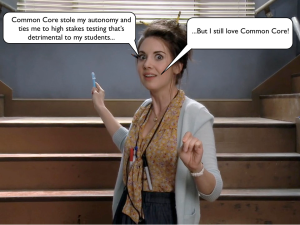
Stockholm Syndrome – The Only Reason Any Teachers Still Support Common Core | gadflyonthewallblog

Stockholm Syndrome – The Only Reason Any Teachers Still Support Common Core | gadflyonthewallblog:

Stockholm Syndrome – The Only Reason Any Teachers Still Support Common Core

Screen shot 2015-11-05 at 11.06.26 PM


Common Core is dying a well-deserved death.
The very idea that we need the same academic standards in public schools from coast-to-coast is unpopular, expensive, ineffective and politically suicidal.
The Wall Street Journal reports at least $7 billion taxpayer dollars have been wasted implementing this plan, and it would cost significantly more to finish the job.
“Five years into the biggest transformation of U.S. public education in recent history, Common Core is far from common. Though 45 states initially adopted the shared academic standards in English and math, seven have since repealed or amended them. Among the remaining 38, big disparities remain in what and how students are taught, the materials and technology they use, the preparation of teachers and the tests they are given. A dozen more states are considering revising or abandoning Common Core.”
Meanwhile public support drops precipitously with each passing year. Less than half of all Americans – 49% – and only 40% of teachers now favor the policy. That’s a drop Stockholm Syndrome – The Only Reason Any Teachers Still Support Common Core | gadflyonthewallblog:

More Magical Thinking about Technology in Schools | Larry Cuban on School Reform and Classroom Practice

More Magical Thinking about Technology in Schools | Larry Cuban on School Reform and Classroom Practice: " "

More Magical Thinking about Technology in Schools


I watched the World Series and saw both New York Mets and Kansas City Royal fans wearing hats, shirts, and displaying signs designed to get their teams to win. I saw similar clothes and painted faces on soccer fans during the World Cup. The belief, the intuition that these caps and jerseys would get their teams to win borders on superstition. And most fans would agree. Yet, yet, yet just maybe wearing the stuff, painting the face, and holding signs aloft would be just the thing that would snatch defeat from the other team. As a recent op-ed put it: fans “have an powerful intuition and, despite its utter implausibility, they can’t just shake it.”  The contradiction is aptly caught in the title of the opinion piece: “Believing What You Don’t Believe.”
This is no rant, however, about how emotion trumps reason or how thinking thoughts (or fans waving signs) will produce the desired outcome. Nor will this post elaborate how our cognitive “slow” and “fast” thinking ways do not always work in sync or that our “slow thinking” will correct the impulsive move where we have “trusted our gut. ” In this post, I again look at how local, state, and federal policymakers, high-tech entrepreneurs, and CEOs of major corporations engage in “magical thinking.” Inhabiting a technocratic mind-set, these leaders who rely on experts  believe that more and more use of high-tech tools will provide the adrenaline shot for U.S. schools to match international rivals’ test scores and lead ultimately to a larger share of the global market for U.S. goods and services.
I offer two examples of high-tech industry and civic leader aspirations to link all More Magical Thinking about Technology in Schools | Larry Cuban on School Reform and Classroom Practice: " "