Latest News and Comment from Education

Friday, November 6, 2015

Perdido Street School: NYSED Commissioner MaryEllen Elia Declares War On Opt Out Movement

Perdido Street School: NYSED Commissioner MaryEllen Elia Declares War On Opt Out Movement:

NYSED Commissioner MaryEllen Elia Declares War On Opt Out Movement


NYSED Commissioner MaryEllen Elia sent out a letter to superintendents around the state touting an NYSED "toolkit" for districts to use to "educate" parents about the wonders of the Endless Testing regime.

The toolkit amounts to a lame PR campaign that tries to sell the same old pro-testing talking points we've heard from ed deformers and educrats before.

To say the toolkit was not well-received by superintendents and parents is an understatement.

This is from this morning's Politico NY education email:


“One anti-testing group believes this will only ‘fuel’ the movement. ‘It’s a declaration of war,’ said Jeanette Deutermann, co-founder of anti-testing group New York State Allies for Public Education and administrator of Long Island Opt Out. ‘This is a marketing strategy they’re using …This is insane...’...  
When Patchogue-Medford schools superintendent Michael Hynes received the email and kit he said he felt ‘embarrassed’ and then ‘angry.’ ‘I was embarrassed for the state education department because to me it’s a waste of time and it’s a waste of money from their vantage point, a waste of energy to Perdido Street School: NYSED Commissioner MaryEllen Elia Declares War On Opt Out Movement:

Are parent behaviours with their use of technology having an impact on their child’s development? | Connected Principals

Are parent behaviours with their use of technology having an impact on their child’s development? | Connected Principals:

Are parent behaviours with their use of technology having an impact on their child’s development?


I recently attended a very intriguing keynote presentation from Dr. Catherine Steiner-Adair titled: Lost in Connection: How The Tech Effect Puts Children’s Development at Risk
I was preparing to listen to more information about how children are using technology and the negative effect of this on their development. Certainly, this would fit with some of the concerns that parents raise about their children and how technology is impacting upon their lives. There is, perhaps, even more concern given that many schools use 1 to 1 laptop programs and iPads are also rapidly being introduced to compliment classroom instruction from teachers.
I was, therefore, pleasantly surprised that the presentation that Dr. Steiner-Adair gave was not about this at all. It was, in fact, about the behaviours of parents with technology and the impact that these behaviours are having on children.
While I certainly did not agree with every aspect of her talk, some excellent points were made for us to consider in our role as parents and, for that matter, as teachers:
  • How attached are we to our mobile devices?
  • How often are we checking for emails, messages and notifications?
  • How we are using mobile technology to record many aspects of our lives and also those of our children?
Three things really stuck in my mind. Firstly, when we hear a notification alert on our mobile device and how that makes us feel. For many of us, there is that instant need to break free of what we are currently doing to attend to that notification. So many important moments that we spend with our children can be interrupted by our mobile devices, that when we try to return to the conversation, the moment, it has passed, we cannot recapture it and children see that.Are parent behaviours with their use of technology having an impact on their child’s development? | Connected Principals:

Malloy Administration ushering in a “Wisconsin Moment” at UConn and CSU - Wait What?

Malloy Administration ushering in a “Wisconsin Moment” at UConn and CSU - Wait What?:

Malloy Administration ushering in a “Wisconsin Moment” at UConn and CSU


During last year’s gubernatorial campaign, Connecticut’s state employee unions mobilized their members with the powerful message that a vote for Democrat Dannel Malloy was the only way to prevent Connecticut from having a “Wisconsin Moment,” a reference to Republican Tom Foley’s comments in support of Wisconsin Governor Scott Walker’s unprecedented attack on public employees and their rights.
As the state employee unions wrote in a commentary piece that appeared in a summer 2014 on CT Newsjunkie entitled Union Members Not Interested in ‘Wisconsin Moment’
The last thing we need is a Koch Brothers-funded campaign to transform Connecticut into Walker’s Wisconsin.
AFSCME’s newsletter further explained,
“Preventing a “Wisconsin moment” from taking place in Connecticut was the prevailing theme of the Connecticut AFL-CIO’s 10th biennial political convention that took place June 16-17 in New Haven.
AFSCME President Lee Saunders electrified the more than 300 union delegates to the convention with his keynote address on June 16. “We can’t afford Connecticut to become another Wisconsin.”
[…]
Hours after Saunders’ speech, Gov. Malloy declared “We’re going to have a 
Malloy Administration ushering in a “Wisconsin Moment” at UConn and CSU - Wait What?:


 State Treasurer Denise Nappier’s powerful statement about Malloy’s State Employee Pension Proposal
Connecticut’s State Treasurer Denise Nappier deserves significant praise for stepping forward and having the courage and conviction to speak the truth about the legitimate concerns surrounding Governor Dannel Malloy’s proposal to fundamentally change the way Connecticut funds is massively underfunded State’s Employee Pension Fund.
Just three years ago, Malloy called on Connecticut to aggressively resolve the state’s historic unwillingness to properly fund its State Employee Pension Fund (See January 2012 Wait, What? post  Malloy Takes Bold Step – Proposes Paying for State Pension Fund the Right Way.)
However, Malloy recently reversed his previous position and rather than focusing on making the State Employee Pension Fund more financially sounds, Malloy proposed shifting a significant portion of the shortfall onto the backs of our children and grandchildren.
The voters of Connecticut need to pay special attention to Governor Dannel Malloy’s irresponsible proposal to change the way that Connecticut funds its pension program for state employees.
Governor Malloy’s plan is nothing more than an outrageous maneuver to balance his failed state budgets on the backs of our children and their future.  As the title of yesterday’s Wait, What? blog stated – Connecticut: BEWARE of Governor Malloy’s most fiscally irresponsible budget proposal yet.
The CT Mirror’s Keith Phaneuf provides more information about Malloy’s 
 State Treasurer Denise Nappier’s powerful statement about Malloy’s State Employee Pension Proposal

U.S. Dept. of Ed. Acknowledges Flawed Charter School Grant Review Process | janresseger

U.S. Dept. of Ed. Acknowledges Flawed Charter School Grant Review Process | janresseger:

U.S. Dept. of Ed. Acknowledges Flawed Charter School Grant Review Process


The U.S. Department of Education sent a letter (Scroll to the end of the news story to see the letter itself.) on Wednesday to Richard Ross, Ohio’s Superintendent of Public Instruction, to inform Ross that, despite the Department’s huge grant—$71 million to Ohio (the largest of any of this year’s five-year, federal Charter School Program grants to seven winning states) to expand charter schools and take over and charterize the Youngstown School District, the Department has decided to withhold the money until Ohio does a better job of explaining what journalists have shown to be mistakes and lies in the grant application submitted last summer by the Ohio Department of Education (ODE) for federal  dollars.
The letter explains: “(A)t various stages during and after the competition, the Department became aware of various concerns regarding ODE’s Office of Quality School Choice and the circumstances surrounding the resignation of the director of that office… [I]n making the original grant award, the Department conducted an expedited review of information available at that time and made a preliminary determination that these concerns and issues should not disqualify ODE from the FY 2015 CSP SEA competition. The Department took such concerns into consideration when awarding ODE’s grant, however, and placed special conditions on the grant, pending receipt of more information regarding these matters. Since awarding the grant to ODE, the Department has received additional information that raises continuing concerns regarding ODE’s ability to administer its CSP SEA grant properly, particularly in the areas of oversight and accountability with respect to Ohio’s charter schools.”
So what are the concerns of which the U.S. Department of Education has recently become aware—the concerns missed by the grant reviewers the federal government brought in to read and evaluate the proposals?  Well, David Hansen, head of Ohio’s charter school program for the ODE, was the person who prepared the federal grant proposal along with designing U.S. Dept. of Ed. Acknowledges Flawed Charter School Grant Review Process | janresseger:

Mike Klonsky's SmallTalk Blog: The proper response to Rahm's plea for help. Prepare for a strike.

Mike Klonsky's SmallTalk Blog: The proper response to Rahm's plea for help. Prepare for a strike.:

The proper response to Rahm's plea for help. Prepare for a strike.


"Look, we all want the same thing..." -- Rahm Emanuel
 "We cannot blow up schools because you don't have any money. You have to figure out some other way to do this." -- CTU Pres. Karen Lewis
On Tuesday the Mayor, with his poll ratings sinking like a stone, called on the CTU to drop talk of a strike and get behind him and House Speaker Madigan, in their so-far-futile attempt to get the governor to stop holding the state budget hostage.

Rahm & Madigan
His plea for help came one day after CTU leaders responded to the mayor's threats to fire 5,000 more teachers and staff by calling on the membership to get prepared for a "protracted strike." Yesterday, teachers were given, what was called a "practice strike vote." I'm waiting for the votes to be counted, but it's not that they need any practice. Last time around, CTU members responded to the leadership's call with a 95% yes vote. When pushed to the wall, Chicago teachers have shown their heart for the struggle and support for their leaders.

What Rahm is doing is using his threat of mass teacher firings to signal pal Rauner Mike Klonsky's SmallTalk Blog: The proper response to Rahm's plea for help. Prepare for a strike.:

With A Brooklyn Accent: How Do I Explain "Gentrification?"

With A Brooklyn Accent: How Do I Explain "Gentrification?":

How Do I Explain "Gentrification?"


Imagine you and your family have been living in a neighborhood for decades. It's not perfect but its home. You have neighbors who are also friends. Stores that you feel comfortable in; Inexpensive restaurants that serve your favorite ethnic foods There is crime, but not as much as 20 years ago when you and your neighbors organized.to push the drug gangs out , get more police patroling during daylight hours and get the abandoned buildings knocked down and replaced with affordable housing.


Now after all that work you put into make the neighborhood safer and more livable, everything starts to change before your eyes. New people start moving in who never look at you when they pass you or when they do, look at you with pity and contempt, New buildings start going up, on the few remaining vacant lots, that none of your longtime neighbors can afford. Rents start creeping up, and then skyrocketing not only in apartments but in the commercial districts. Soon, the stores you have shopped in for years start closing, replaced by establishments which sell products you don't want at prices you can't afford.

And then the exodus begins. Friends and neighbors moving, not only out of the neighborhood, but out of the city, because it has become impossible for them to afford. After five years, you look around and you are a stranger where you once felt at home. None of the people who worked to bring back the neighborhood from crime and violence and With A Brooklyn Accent: How Do I Explain "Gentrification?":

Schools Matter: Detailing Eli Broad's Efforts to Take Over Los Angles Times

Schools Matter: Detailing Eli Broad's Efforts to Take Over Los Angles Times:

Detailing Eli Broad's Efforts to Take Over Los Angles Times


Anyone who has read the LA Times on education knows that they are just as cozy with CorpEd as WaPo, the NYTimes, or even the Nashville Tennessean.  For Eli Broad, however, coziness is not enough. He wants total control.  

The Columbia Journalism Review looks inside the ongoing efforts by Eli Broad to buy the print media in Los Angeles, where he has boasted of his plans to have half of LA's public school children attending charter chain gangs by 2023.  

The clip below indicates what Southern California readers will contend with if Broad succeeds.  It pinpoints what occurred in the recent past with Broad's hand-picked editor's effort to provide a special corporate ed news section.  This clown, Austin Beutner, was fired when Broad's first takeover failed:


For those in the newsroom, more concerns had surfaced. While current and former Times staffers spoke in support of Beutner’s local-first sales pitch, several expressed consternation that the former publisher’s influence was also seeping into the news pages. But they declined to go on the record with specific examples. 
“He didn’t want a newspaper that was edited from Chicago,” Newton says. “All of that was good on paper. In practice, it’s difficult to have a publisher who’s so immersed in the politics of the place. It’s difficult to say whether some of these initiatives were made for the good of the region or a manifestation of the publisher’s politics. Inevitably, with pluses come complications.” 
Take Beutner’s August launch of a single-subject education verticle, an effort backed by pro-charter nonprofits including the Broad Foundation. “We didn’t have a revenue model to support education coverage,” Beutner says. “I said [to the foundations], You guys spend a ton of money on advocacy to help inform people, but if you give us money, we can help you reach those people who aren’t informed.” 
Broad’s money, in addition to other foundation funding, allowed the Times to hire two full-time Schools Matter: Detailing Eli Broad's Efforts to Take Over Los Angles Times:

No Child Left Behind and unequal opportunities are the target of NEA President Garcia at City Club today | cleveland.com

No Child Left Behind and unequal opportunities are the target of NEA President Garcia at City Club today | cleveland.com:

No Child Left Behind and unequal opportunities are the target of NEA President Garcia at City Club today

Lily Eskelsen Garcia
National Education Association (NEA) President Lily Eskelsen Garcia will ask business leaders to support her union's push for Congress to report educational opportunities for each school and district, not just test scores. (AP/J. David Ake)


CLEVELAND, Ohio – All students need to have the same chances for a good education, says National Education Association President Lily Eskelen Garcia, and that can't happen until we know just how unequal the opportunities are between rich schools and poor ones.
That's why Garcia is in Cleveland this week to promote the "opportunity dashboard" that she hopes Congress will include as it updates the No Child Left Behind program.
Garcia will talk about the NEA's desire for education equity at noon today at theCity Club of Cleveland.
In a conversation with The Plain Dealer Thursday, Garcia outlined her hopes for the "dashboard," the bill and how she hopes her talk today will convince business leaders to back the NEA's plan.
See a full description of the "dashboard" below.
She also had sharp criticisms of charter schools, of the amount of standardized testing in schools, of the national focus on meeting test score targets and of schools cutting arts and afterschool programs to spend money on test preparation instead.
Garcia said No Child Left Behind program created by President George W. Bush in 2002 was a valuable one because it forced states and school districts to break apart its test scores and show how racial and economic subgroups were regularly lagging behind white and affluent students.
But she said "No Child Left Untested" and other school "reform" plans have brought "13 painful years" in other ways.
"What we have seen in these 13 years has been fraud and mismanagement, schools that were rewarded by test scores that didn't deserve it and schools that have been punished that didn't deserve it," she said.
She said the worst failure of No Child Left Behind is that it expected all students to meet test score targets, without paying any attention to how poverty affects how much kids learn. Expecting scores to rise without solving underlying socioeconomic issues was never realistic.
The "opportunity dashboard" that was included in the Senate's version of the new No Child Left Behind bill, but not the House version, is a first step in making the challenges of poor districts clear, Garcia said. She is hoping that business leaders will put pressure on Congressional leaders to keep the dashboard and reduce the penalties for low test scores as they negotiate a compromise bill.
Garcia wants the federal government to report things like student access to Advanced Placement classes, kindergarten, nurses and arts or foreign language No Child Left Behind and unequal opportunities are the target of NEA President Garcia at City Club today | cleveland.com:

Why Common Core Is Cracking Up | The American Spectator

Why Common Core Is Cracking Up | The American Spectator:

WHY COMMON CORE IS CRACKING UP

Bill Gates’s earnest help hasn’t helped.


After a decade in the making, the Common Core State Standards are on track to replace uneven state standards in English, mathematics, and other basic academic subjects. But as a rising number of parents and elected officials question this emerging national catechism, the program is meeting new resistance.
First proposed by a coalition of governors and state school superintendents, Common Core codifies what elementary and high school students should study and know after completing each grade.
Strictly speaking, the standards are not a curriculum. Nominally, how subjects are taught and the materials used are decisions left to individual states and school districts. Supporters insist they will raise academic proficiency and ensure uniformly high standards across the nation.
The truth is: Common Core ratifies the federal takeover of elementary and high school instruction. In spite of disclaimers, it promotes a national syllabus. Testing for national standards will indirectly dictate what is taught and undermine local control of education.
Technology and testing corporations stand to be the big winners. The president of the College Board — the nation’s premier gatekeeper of admissions to higher education — is David Coleman, who is Common Core’s chief designer and first advocate.
What Common Core vividly demonstrates is the nature of contemporary political power and formation of education policy.
The Bill and Melinda Gates Foundation is Common Core’s leading force. Gates created the world’s dominant computer operating system, and he is by all accounts a technocratic genius. But his failed effort to beat back non-performance in education through state of the art facilities and smaller classes illustrates his profound naïveté in matters of culture. His foundation has spent approximately $3.4 billion since 1999 on an array of measures to try to improve public education.
Admitting defeat six years ago, the foundation subsequently turned to developing Common Core standards, spending some $250 million on their development and promotion.
As reported in an exceptional 2014 Washington Post article, the foundation then acted strategically to solidify Common Core support. Sidestepping prohibitions on political activism, it staged a stunning policy coup in education.
The Gates Foundation aggressively targeted state legislators and business leaders, the American Federation of Teachers and the National Education Association, private institutes and schools of educations, and the Obama administration.
Gates did not forget what passes for conservative voices in the education establishment. The American Enterprise Institute has received $4 million from the foundation since 2007. The Fordham Foundation, recipients of Gates largess, has produced several hit-and-run reviews of state curriculum standards.
Gates allies also took charge of the federal department of education. In 2009, the new federal education secretary Arne Duncan named Margot Rogers his chief of staff. She had been Why Common Core Is Cracking Up | The American Spectator:

Good Intentions | The New Republic

Good Intentions | The New Republic:

Good Intentions

Bill Gates is here to change the world—will he make money doing it?


n March of 2013, I watched Bill Gates give the keynote lecture at SXSWedu, an annual education technology-themed offshoot of the Austin mega-festival. Addressing several thousand entrepreneurs who hoped to sell apps to schools, Gates celebrated education technology as “potentially a large-sized market” of about $9 billion. The attendees were rapt. The Bill & Melinda Gates Foundation’s philanthropic investment in data-driven teacher evaluation and the Common Core national curriculum standards would, they hoped, make U.S. public education more uniform from state to state and city to city—a standardization that would in turn help ed-tech startups sell their products at scale. Gates dangled before the audience the promise of an enormous payday. “Innovators who win in the most demanding markets,” he said, “will have opportunities on a very global basis, just as we’ve seen in the horizontal software market. So there should be an opportunity for some, of course, very big successes.”
Would all this profit-making help children learn? In his speech, Gates promoted the idea of the “flipped classroom,” in which students watch online video lectures at home and then come to school the next day to do what is currently thought of as homework, with the teacher acting as a sort of tutor. “At a very deep level, software is able to create this interactive, connected experience for the student in a way that simply isn’t economic in a public school context,” Gates said.
If you are at all skeptical of the richest person on earth, a software titan, arguing that software is the key to improving U.S. public education, you are not alone. Since the Gates Foundation launched in 2000, it has become the most influential philanthropic body in the world: The Obama administration has adopted many of its favored education reforms, and the foundation provides 10 percent of the World Health Organization’s revenue (only the U.S. government provides a comparable amount). The foundation’s trustees are Bill Gates, his wife, Melinda, and Warren Buffett. Its self-described missionis to “unlock the possibility inside every individual. … From the education of students in Chicago, to the health of a young mother in Nigeria, we are catalysts of human promise everywhere.” These giant ambitions have recently attracted increased scrutiny. Education historian and activist Diane Ravitch has emerged as the leading American critic of the foundation’s enthusiasm for standardized testing, which she sees as athreat to traditional, locally controlled public schools. On global health, the editorial board of The Lancet has criticized the foundation’s lack of transparency and relatively narrow set of priorities.
Bill and Melinda Gates hold heavy sway over public policy, yet no one elected them to any office. It is crucial that they, and other large donors, be held accountable as philanthropists. This is the worthy goal of an impassioned new book by Linsey McGoey, a sociologist at the University of Good Intentions | The New Republic:


Walton Family Foundation gives $50M to Teach for America

Walton Family Foundation gives $50M to Teach for America:

Walton Family Foundation gives $50M to Teach for America


BENTONVILLE, Ark. — The Walton Family Foundation says it will donate $50 million over three years to Teach for America to support 4,000 new teachers nationwide.
Teach for America, which is celebrating its 25th anniversary, recruits college graduates to teach for two years in schools in high-poverty areas.
The foundation, which was created by Wal-Mart’s founders, says the grant will support the recruitment, training and professional development of about 4,000 new teachers in Atlanta, Arkansas and the Mississippi River Delta region; the San Francisco Bay Area; Camden, New Jersey; Houston; Indianapolis; Los Angeles; Memphis, Tennessee; New Orleans; San Antonio; and Washington, D.C. The grants also funds new teachers in Colorado and Massachusetts.
The Mississippi Delta region, one of the poorest areas of the country, will get 800 new teachers under the grant.Walton Family Foundation gives $50M to Teach for America:


Thursday, November 5, 2015

Math placement tests deserve more scrutiny | EdSource

Math placement tests deserve more scrutiny | EdSource:

Math placement tests deserve more scrutiny

Mathematics plays a central role in winnowing opportunities for students to enter and succeed in college. In California, students can graduate from high school with just two years of math, including a single college-preparatory course, Algebra 1. But if they don’t also complete Geometry and Algebra 2 (or, with the introduction of the Common Core state standards, an integrated pattern of courses covering the same material), students aren’t eligible to attend either of the state’s public university systems.
Last month, Governor Jerry Brown took an important step toward insuring more students the chance to take those courses: He signed a bill, SB-359, requiring school districts to adopt “fair, objective, and transparent” policies for determining how to place students into math courses when they start high school. The new policy means that students can’t arbitrarily be directed off the college math-ready track. This is good news for ensuring that more students, including more under-represented minorities, acquire the foundational math skills they need before college.
But bad news awaits too many students at the college gateway. That’s because taking the right courses in high school doesn’t guarantee access to college-level math courses at the state’s colleges and universities. To varying degrees, all three higher education systems in California use placement tests to determine whether students are ready for required college-level math courses. Those who aren’t – including up to 85 percent of community college students and 33 percent of students at California State University – must take one or more remedial courses.
The problem is that the placement tests used by most campuses have limited efficacy for placing students. Research in California and nationallyMath placement tests deserve more scrutiny | EdSource:

Petrilli and Wright’s Porous Article on Mediocre Test Scores | deutsch29

Petrilli and Wright’s Porous Article on Mediocre Test Scores | deutsch29:

Petrilli and Wright’s Porous Article on Mediocre Test Scores


In November 2015, Fordham Institute’s Michael Petrilli and Brandon Wright published an article entitled, “America’s Mediocre Test Scores,” which is slated to appear in the Winter 2016 issue of Education Next.
The article has a number of limitations worthy of note.
For starters, the article lacks links to references supporting the authors’ assertions. They open by referring to Pasi Sahlberg, Michael Rebell and Jessica Wolff, and Randi Weingarten, and without linking to sources, Petrilli and Wright connect statements these individuals have made regarding the connection between poverty and student performance on standardized tests to a “relative measure of poverty”:
For those educators quoted at the beginning of this essay, the answer is yes. They assert that the U.S. has a sky-high child-poverty rate compared to other developed countries.
To support their claim, they use a measure that assumes all families with less than half the median income in the country are by definition “poor.”
Petrilli and Wright need to provide the links for the source(s) to support their statement above.
Another limitation of Petrilli and Wright’s article is the “two out of three” assumption Petrilli and Wright’s Porous Article on Mediocre Test Scores | deutsch29:
Also In November 2015, Fordham Institute’s Michael Petrilli


Ed Notes Online: See the Video: Parents Sue Achievement First Charter Over Discipline and Lack of Services - We had the AF story 4 years ago

Ed Notes Online: See the Video: Parents Sue Achievement First Charter Over Discipline and Lack of Services - We had the AF story 4 years ago:

See the Video: Parents Sue Achievement First Charter Over Discipline and Lack of Services - We had the AF story 4 years ago


DUHHHHH!  This report by the NY Times

Lawsuit Accuses Brooklyn Charter School of Failing to Provide Special Education Services

supports the video interviews we did with Achievement First former parents in April 2011. Here is one of the 3 clips I posted:


Achievement First Charter School Parents Speak Out: Why they removed their children Part 2 from MORE-UFT/GEM on Vimeo.

Here are links to all the clips --
Videos of Achievement First parents talk about their children sitting on the floor: https://vimeo.com/30227766,https://vimeo.com/30238788https://vimeo.com/30266020.

We did these riveting interviews for our movie


The Inconvenient Truth Behind Waiting for Superman

   due to Leonie Haimson's organizing the interview and doing the questioning. I just turned on my camera. I thought we would be there for a few minutes instead of over 2 hours. We were able to use just a bit of the footage in the movie but for me it turned into one of the most powerful statements we made. People in Providence used the footage to help fight Achievement First.

RBE at Perdido Street School made this comment:
What kind of cretins would discipline a child with autism for not looking in the direction of the teacher?
The kind who run and/or work at Achievement First.
Oh, btw, they're hiring, so if you're in the market for a job where you get to abuse kids, especially special education students, head on over to Idealist and send the Achievement First cretins your resume...

CURMUDGUCATION: WSJ Runs Cyberschool PR

CURMUDGUCATION: WSJ Runs Cyberschool PR:

WSJ Runs Cyberschool PR


If you were feeling badly about the poor beleaguered cyber schools that took a drubbing earlier this week (from both a report suggesting they are no more effective than a long nap and the many charter fans who piled on to excoriate them), take heart. Someone did run to their defense. And an alleged journalist paved the road so that the run would be easy.

The Wall Street Journal's Opinion Journal posted a five minute infomercial for the cybers, featuringCenter for Education Reform Senior Fellow and President Emeritus Jeanne Allen. The Center for Education Reform is a full-on advocacy group for the charter school industry, used to float every imaginable argument in support of sweet, chartery goodness. Allen was there to blunt the impact of the study, and the WSJ host was there to help her do it.

"A small study on online charter schools is creating a big controversy," our hostess leads, suggesting that the study was neither large nor important, and suggesting that there is actually some sort of debate over the uselessness of cybers, and not just a whole lot folks from all across the ideological spectrum declaring that cyberschools are a big expensive waste of time.

Then we introduce Allen and lead with a question that is a softball in much the same way that Donald Trump is somewhat self-assured. Referring to the CREDO study, the host asks "Was this study conducted at Stanford or near Stanford--" with a chuckling delivery suggests that somebody cribbed the study off the back of a cereal box and is just trying to make it sound important by attaching 
CURMUDGUCATION: WSJ Runs Cyberschool PR:

American Indian/ Native Alaskan Caucus Cheers Enactment of Two Key Measures - California Teachers Association

American Indian/ Native Alaskan Caucus Cheers Enactment of Two Key Measures - California Teachers Association:

AMERICAN INDIAN/ NATIVE ALASKAN CAUCUS CHEERS ENACTMENT OF TWO KEY MEASURES

Storyteller David Garcia demonstrates the use of rhythm sticks employed in Chumash music and dance.


Caucus Chair Mary Levi briefs participants in the celebration about AB 30 (Alejo), the CTA-backed bill that bars California schools and universities from using mascots that are racial caricatures.
More than 100 State Council members joined the American Indian/Alaska Native Caucus for a celebration Saturday night of two key legislative victories and a moving presentation by a renowned Chumash Storyteller, David Garcia.
Participants cheered as Caucus Chair Mary Levi recounted the enactment of two CTA-supported measures that phase out the use of racial mascots and provide a new credential to help preserve Native American language and culture.
AB 30 by Assemblymember Luis Alejo (D-Salinas) makes California the first state to bar schools and colleges from using racial slurs aimed at Native Americans.
AB 163, by Assembly Member Das Williams (D-Carpinteria), creates the American Indian Language and Culture Credential, a new certification enacted at the urging of the Chumash tribe. It will support teaching of heritage and language, particularly to Native American students.
During his presentation, Garcia told traditional stories, including ones that drove home the importance of maintaining courage in the face of adversity.
 Garcia and Levi both addressed the caucus’ next legislative target: getting California to change the official name of the Oct. 12 holiday to “Indigenous People’s Day.”
Garcia said that Native Americans had no need to be “discovered” by European explorers since they had been living on the continent for thousands of years.American Indian/ Native Alaskan Caucus Cheers Enactment of Two Key Measures - California Teachers Association:

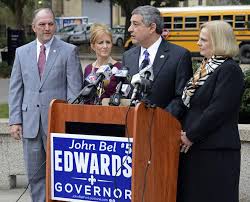
VIDEO: Republican Jay Dardenne Endorses Democrat John Bel Edwards for Louisiana’s Next Governor | deutsch29

VIDEO: Republican Jay Dardenne Endorses Democrat John Bel Edwards for Louisiana’s Next Governor | deutsch29:

VIDEO: Republican Jay Dardenne Endorses Democrat John Bel Edwards for Louisiana’s Next Governor

dardenne edwards
Dardenne Endorses Edwards


In the race for Louisiana governor, Republican David Vitter’s DC Super PAC ran attack ads against both Republican contenders, Jay Dardenne and Scott Angelle.
The October 24, 2015, led to a runoff between the only Democrat John Bel Edwards, who led with 40 percent of the vote, and Vitter, who had 23 percent of the vote. The runoff is scheduled for November 21, 2015.
In his victory speech on October 24, 2015, Edwards invited both of the Republicans who lost, Angelle and Dardenne, to join his efforts to become Louisiana’s next governor.
Even at the risk of being shunned by the Republican Party, Dardenne took Edwards up on his offer at Louisiana State University’s Free Speech Alley, as WWL-TV reports on November 05, 2015:
Dardenne, who was the target of Vitter attack ads during the primary, announced his support for Edwards in “Free Speech Alley” in front of the LSU Student Union, a place he chose for the event.
He said Gov. Bobby Jindal has damaged the GOP brand in Louisiana and believes Vitter would damage it further, while he believes Edwards can unify the state. …
Edwards said he would consider offering Dardenne a place in his administration should he win but denied he promised Dardenne or anyone else a job in exchange for the endorsement.
Dardenne said he will remain a Republican, although he might no longer be welcome in the party.
Louisiana GOP Chairman Roger Villere and Republican National Committee 
VIDEO: Republican Jay Dardenne Endorses Democrat John Bel Edwards for Louisiana’s Next Governor | deutsch29:

Lawsuit Accuses Brooklyn Charter School of Failing to Provide Special Education Services - The New York Times

Lawsuit Accuses Brooklyn Charter School of Failing to Provide Special Education Services - The New York Times:

Lawsuit Accuses Brooklyn Charter School of Failing to Provide Special Education Services


Special education students at a Brooklyn charter school did not get mandated services and were punished for behavior that arose from their disabilities, according to a lawsuit filed in federal court on Thursday.
The suit, filed on behalf of five students at Achievement First Crown Heights, described a “systemic failure to provide them a free appropriate public education, in violation of their rights.” It said that students did not get physical therapy and other services for weeks at a time, and that a student with autism was disciplined for not looking in the direction a teacher instructed or for hiding under his desk.
In addition to the charter network and the school, the suit also named the New York City Department of Education and the New York State Education Department, asserting they failed to make Achievement First, a network with schools in Connecticut and Rhode Island as well as in New York City, live up to its responsibilities.
“Kids with special needs not only should be granted accommodations for their needs, but they must be under federal and state law,” said Michelle Movahed, a senior staff attorney at New York Legal Assistance Group, a nonprofit organization that is representing the students and their families. “This is not just a question of doing the right thing.”
Charter schools are publicly financed, but privately run, and they are required, like regular public schools, to formulate and carry out individual learning plans for children with special needs.
The suit comes at a time when charter schools, especially those in the Success Academy network, have come under scrutiny for their enforcement of strict behavior codes, suspending even the youngest students, some of whom might qualify for special education services. But advocates and families say that in both charters and traditional public schools, it can often be a struggle to ensure children with disabilities receive the services to which they are entitled.
In a statement made shortly after the suit was filed, Achievement First Lawsuit Accuses Brooklyn Charter School of Failing to Provide Special Education Services - The New York Times: