Latest News and Comment from Education

Tuesday, August 18, 2015

Don't Let Me Be Misunderstood | Johnathan Chase | LinkedIn

Don't Let Me Be Misunderstood | Johnathan Chase | LinkedIn:

Don't Let Me Be Misunderstood


Don't Let Me Be Misunderstood


The Common Core English Language Arts standards emphasize text-based instruction and call for "shifts" that state;
"...The reading standards focus on students’ ability to read carefullyand grasp information, arguments, ideas, and details based on evidence in the text... Students should be able to answer a range of text-dependent questions, whose answers require inferences based on careful attention to the text...Further, it is vital for students to have extensive opportunities to build knowledge through texts so they can learn independently."
The Common Core's focus on independent mastery of text does not establish fair conditions or standards of learning that will provide equal opportunities for all students to be successful.
Learners who are delayed and disabled should have the same possibility to develop and demonstrate their diverse talents and abilities, rather than being continually tested, sorted, and rated according to their weaker reading skills.
Successful entrepreneur, Donny Zanger recently described his school experiences as a student with dyslexia.
"Growing up with dyslexia is no walk in the park, and it's an open secret that schools are built to cater to one specific type of student. For the rest of the world--the creative thinkers, the talented artists, the energetic athletes--sitting at a desk for hours on end, memorizing lists and analyzing information in a test-taking format, doesn't necessarily compute with our skill set...
But here's the catch, the covert information that no one tells you as you suffer through years of feeling second class: succeeding in business requires completely different areas of proficiency than succeeding in school...
To those out there who think success in school is a measure of future accomplishment, I am here to say, it is NOT. Don't look at your grades, your test Don't Let Me Be Misunderstood | Johnathan Chase | LinkedIn:

Austin Beutner: A renewed emphasis on education at The Times - LA Times

Austin Beutner: A renewed emphasis on education at The Times - LA Times:

Austin Beutner: A renewed emphasis on education at The Times

San Pedro Elementary


Dear Reader,


Today is the first day of school for hundreds of thousands of children throughout Los Angeles, and for students, teachers and parents, the occasion is cause for both excitement and trepidation.

Education, it has been said, is the soul of society, and few institutions embody our hopes and dreams as much as our public schools. They are the cornerstones of our communities and the foundation for our future, where children from all backgrounds are given the tools to shape their lives and their world.

With the start of a new school year, the Los Angeles Times is rededicating itself to coverage of teaching and learning. Our goal is to provide an ongoing, wide-ranging report card on K-12 education in Los Angeles, California and the nation.

We are calling our initiative Education Matters, and I encourage you to join us as we explore the issues that matter most to you and your child. If you want to understand the latest debate on curriculum or testing, find out about the role of student health in learning, study how charter schools are changing public education or experience a classroom from the perspective of a teacher, then Education Matters will be an essential destination.

With an expanded team of reporters, we will take a fresh approach to our news and analysis starting with today’s stories about the unique challenges facing LAUSD and the last year-round school in Los Angeles. Our editorial pages feature a guest column by U.S. Education Secretary Arne Duncan on the need for more investment in math and science education. You will find our reports at latimes.com/schools in English and Spanish.

In the coming months, we will convene public forums to address topics such as educational education policy, saving for college and talking to your child’s teacher. We intend these conversations to be both thoughtful and practical.

The Times continues to draw more high school students to journalism with HS Insider, available at highschool.latimes.com. And as the school year begins, more college students will receive free access to The Times through our College Connection program, which brings them news and information relevant to their studies and their communities.

A child’s success in the classroom depends on the participation and support of everyone in the community, a view shared by the California Endowment, the Wasserman Foundation and the Baxter Family Foundation, which are providing funds to support Education Matters. The California Community Foundation and United Way of Greater Los Angeles have also supported this effort with grants from the The Broad Foundation. These institutions, like The Times, are dedicated to independent journalism that engages and informs its readers.

Your first assignment is to become involved. Read and share our stories. Attend a discussion in your neighborhood. Sign up for our weekly newsletter, “Education Matters.” Follow us on Twitter at @LATEducation.

As we launch Education Matters, I look forward to hearing from you. Please let me know how we’re doing and how we can best serve your needs.

Austin Beutner,

Publisher and CEO, Los Angeles TimesAustin Beutner: A renewed emphasis on education at The Times - LA Times:

Billionaires Fund Education News at LA Times | Diane Ravitch's blog 

Click on picture to Listen to Diane Ravitch

Just when you thought it couldn’t get worse, you read a story like this.
It is a letter from the publisher of the KA Times informing readers that a group of wealthy foundations are underwriting expanded coverage of education. Not surprising to see the Eli Broad Foundation in the mix. Former Mayor Richard Riordan is not listed but you can be sure he is involved.
These control freaks–er, philanthropists–worry that the LAT has not provided enough space to cover this vital topic.
Publisher Austin Beutner writes:
“We are calling our initiative Education Matters, and I encourage you to join us as we explore the issues that matter most to you and your child. If you want to understand the latest debate on curriculum or testing, find out about the role of student health in learning, study how charter schools are changing public education or experience a classroom from the perspective of a teacher, then Education Matters will be an essential destination.
“With an expanded team of reporters, we will take a fresh approach to our news and analysis starting with today’s stories about the unique challenges facing LAUSD and the last year-round school in Los Angeles. Our editorial pages feature a guest column by U.S. Education Secretary Arne Duncan on the need for more investment in math and science education. You will find our reports at latimes.com/schools in English and Spanish.
“In the coming months, we will convene public forums to address topics such as educational education policy, saving for college and talking to your child’s teacher. We intend these conversations to be both thoughtful and practical.”
A guest column by Arne Duncan! Now there’s a fresh perspective!
I wonder if I will ever be invited to write for the LA Times again?Billionaires Fund Education News at LA Times | Diane Ravitch's blog 

CURMUDGUCATION: What Failing Schools?

CURMUDGUCATION: What Failing Schools?:

What Failing Schools?


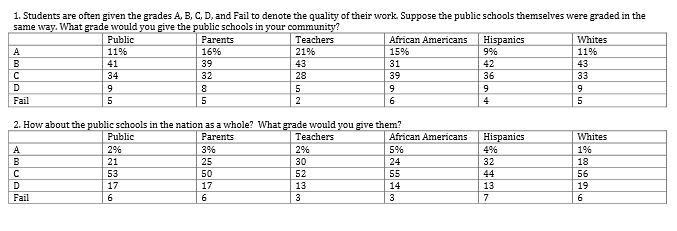
Education Next is trotting out its Big Fat Survey of Educational Stuff for 2015, and for eduwonks it's twenty-three pages of interesting stuff. I'm sure many of us will be parsing, mining and massaging the results, as well as discussing how much the reform-loving sponsors of the survey can be trusted. But as I poked through it, two results jumped out at me immediately.

So, where are the failing schools?

The whole premise of our ongoing onslaught of reformy forces against public education is that we are awash in a sea of terrible schools. So where are they? Where are all the people saying, "Yes, my school is failing."

Even the folks grading Other People's Schools-- it's a regular thing in these surveys that folks think their own schools are better than the national picture, but the difference here is a blip (the only interesting blip is that more African-Americans think their local schools are failing than think the nation's are).

I mean, we can expect a certain percentage of people to think schools are failing for the usual cranky reasons-- school doesn't teach cursive, or it let's pregnant ladies teach, or it didn't play Chris enough on first string, or school officials kept fining them for truancy, or teachers kept flunking Chris just cause Chris never did assigned work and flunked all the tests. Add to that the constant barrage over the last fifteen years that US public schools are terrible, that they must be reformed, that students must be rescued from these deep pits of failing failure.

So why aren't more people convinced? Why aren't more people giving schools a failing grade?

What about teachers?


This, unfortunately, is a less clear data set. Note that the question is different, so I'm not sure how CURMUDGUCATION: What Failing Schools?:

CAP Flubs Again

I'm pretty sure that CAP has lost its collective mind. This months has been marked by a pair of CAP offerings (here and here) that seem to indicate the august allegedly lefty thinky tank is running its PR wing out of a time machine parked in 2013.

Now they are touting the result of a poll they commissioned from Public Policy Polling under the Lesley Knope-ish press release headline:

New PPP Poll Shows that the Development and Aims of the Common Core Are More Popular Than Baseball, Kittens, and Bacon—But Misinformation About the Common Core Pervades

It is hard to know how to take the last part of that header, since the press release that follows it champions a brace of undead misinformation that apparently did not die the last sixty gazillion times it was put to rest. No, here it is, still searching for brains. Let's go shambling down memory lane, shall we?

It's Just the Brand

Remember this one? People totes love the ideas behind Common Core-- they've just been turned off to the branding. Why, 90% (of the 675 people we asked) love the idea of higher standards that would make us competitive in the world, 82% think we should develop standards with teachers and states, 79% think we should have high quality English and math standards while letting local schools 

CAP Flubs Again

Doctor VAM


Periodically you will hear teachers complain about VAM and similar test-and-punish versions of evaluation by saying, "Imagine how ridiculous it would be if they did this to doctors. That would be so stupid they'd never even consider it." These are teachers who don't have friends and family in the medical field. Because (bad news alert) the Powers That Be have totally been doing the same crap to doctors that they've been doing to us.

The idea has been kicking around since the eighties, but one backbone of the Affordable Care Act (and many other proposed health care reforms) is an informed customer base that is able to choose physicians based on solid ratings. This would also, not coincidentally, allow the behemoths whomanage the highly-profitable non-profit health care providers to have a data-based means of deciding which doctors to keep and which to boot.

Of course, the key here is coming up with a metric-- or metrics-- to determine which doctors are effective and which are not effective. And that turns out to be hard.

You know the arguments-- you've already made them. Can we judge a doctor on how effective he is with a patient who is high risk and who insists on engaging in risky behavior? Is it fair to give a 

Doctor VAM

Is New Orleans a Success?


With the release of the latest bundle of number crunching, Doug Harris and the Education Research Alliance have once again launched the Debate of the Decade-- is the New Orleans privatization experiment a success or a failure?
nola school.jpg
The Argument for Success

The ERA is a project of Tulane University where Harris is a professor of economics, and I want not to hold that against him, but the number of economists who have declared themselves educational experts over the past couple of decades is staggering and worthy of its own study.

Harris's argument for success is fairly simple. Before Katrina, test scores in NOLA were really low. Now they are performing at the level they "ought to be" performing as compared to models of imaginary similar students.

So. Test scores were low. Now they're not. Success!

What else?

No, that's it. That's the whole argument. Students in NOLA are getting better scores on standardized math and reading tests. That's the whole thing.

So. Any reasons we shouldn't be excited about this news?

Glad you asked. We could get into a long and involved discussion of ERA's data and the crunching thereof. But if that's your cup of tea, I recommend the work of Mercedes Schneider and Crazy Crawfish, just for starters.

But for the sake or argument, let's go ahead and accept Harris's numbers as accurate and move on. Can we still call the Great NOLA Privatization Experiment a success?

Yes, even if we accept that the numbers are correct, Harris acknowledges that the pursuit of test scores has led to some dicey practices, and NOLA does seem rife with tales of push-outs and creaming, as school principals strive to make their data points.

But there's a bigger question (though no less important) than whether or the numbers are legit. The bigger question is, even if the numbers are legit, are they worth the cost?

Disenfranchised public

Journalist Jennifer Berkshire's recent trip to New Orleans provides a vivid picture of how thoroughly NOLA reformsters have pushed locals aside-- even locals who agree with the 

Is New Orleans a Success?

Arne Duncan: Where California schools need to put their money - LA Times

Arne Duncan: Where California schools need to put their money - LA Times:

Arne Duncan: Where California schools need to put their money


 On the Westside of Los Angeles, there's a school where eighth-graders code and build websites, develop entrepreneurial ventures and use gaming software to design solutions for saving local endangered species. At the Incubator School, teachers leverage technology to individually tailor student learning and track progress toward challenging academic standards. And students regularly participate in a design laboratory in which they study sciences and complete projects based on their personal interests and passions.

High-quality instruction in science, technology, engineering and math — subjects collectively known as STEM — can provide students with a lens to approach and view the world. When students — like those at the Incubator School — engage in hands-on STEM learning, they aren't just gaining subject matter knowledge. They're developing a mind-set that affirms they can use inquiry and their own logic to reach new conclusions and tackle tough problems.

If we want our children to grow into the scientists, researchers, educators and entrepreneurs who will address our most pressing challenges, and if we want our nation to remain a global leader in innovation, we must ensure that all students have access to deep learning in STEM subjects and are taught by talented teachers knowledgeable in these fields.

Yet, across the country, there are disparities in students' access to the full range of math and science courses, including such subjects as algebra, geometry, biology and physics. Nationwide, while 71% of white high school students have access to the complete range of these courses — often required for college admittance — only two-thirds of Latino students and a little more than half of black students do.

This situation is compounded by shortages of qualified math and science teachers, which disproportionately affect schools serving low-income and minority students. In California, teacher shortages in math, science and computer education have persisted for more than a decade. This school year, California districts will need to fill more than 21,000 teaching positions, many in hard-to-staff STEM subjects.


All of this comes at a time when the United States must ramp up to keep up with international competitors — ranking 29th in math and 22nd in science among industrialized nations.

Despite these challenges, I'm optimistic about the future of STEM teaching and learning, in California and throughout the country.

The Galt Joint Union Elementary School District in Sacramento County represents one encouraging example. Through a federal Race to the Top district grant, Galt Joint Union is increasing access to STEM with after-school clubs that offer virtual courses in subjects such as mechanical engineering. At River Oaks Elementary School, it's not uncommon to see children working together to design and program robots. These efforts have led to increased student engagement in STEM, and have prepared Galt Joint Union to be one of eight school districts in California working toward early implementation of the Next Generation Science Standards.

To inspire and prepare more students to excel in STEM and build a strong pipeline of teachers in these disciplines, we need new ways of approaching STEM education, and our efforts must involve everyone: States, districts, schools, tech developers, teacher prep programs and our best scientists, mathematicians and engineers all have roles to play.


At the federal level, President Obama's Educate to Innovate campaign has resulted in more than $1 billion in financial and in-kind support for STEM programs from corporations, philanthropists, colleges and a host of stakeholders. And more than 230 organizations have come together through 100Kin10, answering the president's call to recruit and develop 100,000 excellent STEM teachers over the Arne Duncan: Where California schools need to put their money - LA Times:


Big Education Ape: SES IS A MESS: State’s ESEA waiver request related to tutoring requirement denied | EdSource http://bit.ly/1L714f6

How Whiteness tells the Story of Katrina 10 Years Later | Decolonizing educational research

How Whiteness tells the Story of Katrina 10 Years Later | Decolonizing educational research:

How Whiteness tells the Story of Katrina 10 Years Later


Malcolm Gladwell’s essay on New Orleans ten years after Hurricane Katrina is but one of the many narratives that center whiteness as the protagonist of the city during and after Katrina. The purchase this essay has by virtue of its publication in a nationally renowned news, politics and culture magazine holds lessons not just about how whiteness craves and tells the story of black vulnerability but the fertile reception there is still for this mythic rendition. Whiteness is a default for white people as the referent for intelligence, beauty and objective truth. It operates by naming these explicitly. But it also works, arguably far more impactfully, by implicitly communicating white ideals not as specific but simply the norm, barely uttering it. Gladwell’s essay, “Starting Over,” is an abject lesson in this overt naming and whispering.
Gladwell begins his essay through the perspective of a phenotypically white sociologist, an outsider to the city. Gladwell names this person, qualifies him as an expert sociologist through his pedigreed institution, and includes quotes from this man about his take on being a newcomer to the city after Katrina. Why would the first move to discussing New Orleans be to position a white transplant first? Answer: whiteness. By framing this essay on the effects of Katrina on what is widely known as the Blackest city in the United States, Gladwell basically pulls the same whiteness move that launched Orange is the New Black, and countless other works of fiction and nonfiction. The sociologist here is parallel to white upper class Piper in the TV series; we have to know her first to then know racially minoritized characters. It must have seemed impossible to tell the story of the city through the eyes and perspectives of the city’s thousands of current and former Black residents, residents who emphatically do not use the words “random” and “natural” to describe the breaking of the levees, as Gladwell does. In fact, the only instances in which readers hear from Black New Orleanians, they are filtered through Gladwell’s sampling of research done by social scientists that he takes the time first label as social scientists. It is an egregious erasure through layered annotating.
Gladwell samples from published studies and available data while making sweeping statements about social science that work to erroneously delimit what social science is and benefit inquiries that play fast and loose with how context operates on large and small scales. Several of Gladwell’s statements stand out in this way:
“If a group of poor Americans are stuck in a bad place, then either the place they are stuck in needs to be improved or they need to move to a better place.”
In this statement, Gladwell, purportedly works from the premise of the social science he’s chosen to represent as Science with a capital S. It starts its analysis of generational poverty by erasing the generational, policy-created and durable nature of poverty. While that is itself reason enough to dismiss this statement, which acts as the basic thesis of the essay, it is deeply troubling to continue reading the details of this thesis exploration with the slimmest grasp of U.S. history and its ongoing investment in the investment in attempting to contain and limit Black life. This superficial analysis relies on a claim made early in the essay that it’s not so much national policies (e.g., minimum wage laws, housing policies, healthcare) but just the specific neighborhood you might find yourself in that determines “how you turn out.”
Pardon the blinding flash of the obvious here, but neighborhoods do not spontaneously form themselves. Particularly in an era of unprecedented housing inequality, gentrification, and 2nd and 3rd generations of white flight, such a simplistic claim erases systemic structures of policy, culture, and ideology. It also woefully misses the complex relationship between municipal policies, national policies, and cultural practices. Gladwell facilitates this by consistently using Social Science in big pronouncements. This is the view of systemic vulnerabilization through the lens of whiteness: it begins the story in the current moment, whittles away the structures that have shaped that moment and then poses irresponsible research questions about choice, preference, and better offness. And yet, Gladwell surreptitiously bolsters this as science by noting the scholars he represents through their institutional affiliations and making absolutely false statements such all social scientists seeing “a major move” as a “good thing.” All while ignoring the tradition of equally impactful sociologists, such as W.E.B. duBois, who insisted on reversing the gaze of social science from pathology to structural analysis.
Echoing the choice Gladwell makes to introduce New Orleans after Katrina through the eyes of a white man who is an outsider to the community, Gladwell then introduces the complexity of the education system through experiences of charter personnel. The nation’s first successful private erasure of public schooling is again erased as Gladwell tells the tale of the ways that the adults and children involved in this private charter school worked to reform the school. Gladwell tells the story of education in NOLA through the subtle moves of whiteness. He notes that following Katrina, “all the How Whiteness tells the Story of Katrina 10 Years Later | Decolonizing educational research:

Teachers For Social Justice: Support the Hunger Strike for the Dyett Global Leadership and Green Technology High School

Teachers For Social Justice: Support the Hunger Strike for the Dyett Global Leadership and Green Technology High School:

Support the Hunger Strike for the Dyett Global Leadership and Green Technology High School


12 Parents, grandparents, community members and supporters from around the city started a hunger strike on August, 17th. 

Their demand is simple. Rahm Emanuel and his appointed school board needs to follow the community's wishes and use the now shuttered Dyett High School Building at 555E 51st St. for the innovative, academically excellent and culturally connected Dyett Global Leadership and Green Technology High School. 

There are many ways you can help. 

Come out and support these heroes. They'll be at the Dyett HS location unless there is rain when they'll be at the Rainbow Push Coalition's office at 930 E. 50th St. 

Bring water, ice, fruit juice and your statements of solidarity to help sustain the strikers. 

Spread the word in the real world and on social media. Hashtags: #FightForDyett and #WeAreDyett  

Read and share these stories about the Hunger Strike in the media

http://empathyeducates.org/Journeys-to-and-through/eleven-parents-launch-hunger-strike/ 

http://hpherald.com/2015/08/17/community-goes-on-hunger-strike-for-dyett-high/

http://wgntv.com/2015/08/17/parents-hold-hunger-strike-outside-bronzeville-high-school/

https://www.dnainfo.com/chicago/20150817/grand-boulevard/dyett-activists-launch-hunger-strike-demanding-decision-on-reopening-school

http://progressillinois.com/quick-hits/content/2015/08/17/education-activists-go-hunger-strike-over-dyett-high-schools-future 

http://chicago.cbslocal.com/2015/08/17/dyett-high-school-parents-plan-hunger-strike/

Donate funds to help the hunger strikers at the location or by clicking "Donate" here. 


Call Mayor Emanuel at (312) 744 - 3300 and tell him that you support the Dyett hunger strikers and demand that he support community's wishes for the Dyett Global Leadership & Green Technology HS. 

Search the hashtags and follow TSJ on Twitter for updates @TeachForJustice. 


Efforts to attract new teachers stall in state Legislature | EdSource

Efforts to attract new teachers stall in state Legislature | EdSource:

Efforts to attract new teachers stall in state Legislature


Efforts to reinstate state support to attract new teachers to the profession have stalled in the state Legislature, despite a shrinking supply of teachers that is spreading beyond traditionally high-needs areas such as special education, math and science, and bilingual education.
To help entice teachers to the profession,  Sen. Fran Pavley, D-Agoura Hills (in Los Angeles County), introduced Senate Bill 62 earlier this year, which would have restored funding for a loan program that forgives $11,000 or more in college loans if a new teacher agrees to teach for four years in hard-to-staff schools, such those serving a high proportion of low-income youth, those in rural areas, or those with high numbers of teachers lacking full credentials. Teachers in shortage areas such as math and science would also be eligible.
The bill would have reinstated the Assumption Program of Loans for Educators, or APLE, which Pavley described as “one of California’s most effective and proven recruitment tools” — but which the Legislature stopped funding three years ago.   The program was needed to deal with what she warned fellow lawmakers was “a pending teacher shortage crisis.”
Pavley’s bill also called for restoring the Governor’s Teaching Fellowships, a short-lived program phased out more than a decade ago that provided grants of up to $20,000 for a small number of aspiring teachers who agreed to teach for four years in schools serving struggling students. However, this provision was stripped from the bill during the legislative process.
The bill got the thumbs up from the state Senate, and made it partway through the Assembly.  But the conference committee that approved the 2015-16 state budget in June never authorized any funds for the loan forgiveness program.
Rather than let the bill die, Pavley has has decided to hold the bill until next year — in legislative parlance, converting it into a two-year bill — until a clear funding source for the support programs can be identified.
So Pavley’s bill has yet to make it out of the Legislature, despite being underwritten by almost every major education organization in the state. Writing in support of the legislation, Stanford University professor Linda Darling-Hammond, appointed by Gov. Brown as chair of theCalifornia Commission on Teacher Credentialing, noted that countries where students are outperforming U.S. students on international tests, such as Finland, Singapore and Korea, “are underwriting all the costs of a teacher’s preparation in high quality programs.” “California has no such incentives for entering teaching,” she said.
“Teacher recruitment is a critical issue as entrants into the the teacher pipeline have dropped significantly in the last ten years,”  State Superintendent of Public Instruction Tom Torlakson, a strong supporter of the bill, wrote to lawmakers last June urging them to approve it.
The 2012 “Greatness by Design” report of the Task Force on Educator Excellence established by Torlakson that was co-chaired by Darling-Hammond and Long Beach Unified Superintendent Chris Steinhauser recommended the following:
To ensure a steady stream of talent into high-need subjects and schools, California should underwrite the training costs of high-ability candidates who will Efforts to attract new teachers stall in state Legislature | EdSource:

Blaming Teachers Gets Us All Off the Hook | janresseger

Blaming Teachers Gets Us All Off the Hook | janresseger:

Blaming Teachers Gets Us All Off the Hook


It is important to read stories like Joe Mozingo’s piece, San Bernardino: Broken City, or listen to the NPR broadcast based on Mozingo’s reporting.  The subject is desperation and family homelessness among the destitute in a faded California city where many children reside in cheap motels.  I watched children, ready for school, come out of a strip of such places one morning in Phoenix, and I once watched a school bus drop off children at such a motel in Florida. It’s a jarring sight, partly because of what it says about America these days and partly because most of us, far more privileged, imagine going to school in the context of our own school days or the educational setting we intentionally provided for our children.
I suppose this place in our own more privileged imaginations is why, for many of us, blaming teachers makes sense.  If students in our poorest communities can’t realize our expectations for rising test scores, we are willing to accept it when someone says we have to hold teachers accountable.  As Mozingo paints the picture—meth addiction, homelessness, grueling employment for parents in the huge distribution warehouses out in the desert—San Bernardino is a place where median household income has fallen from $56,278 in 1970 to $37,440 today in inflation-adjusted dollars.  While Mozingo reports on neither the schools nor the test scores, I am certain the schools are caught in the same kind of vicious cycle. I live in the Northeast Rust Belt, and I don’t get to California very often, but when I drive through downtown Gary, Indiana or the devastated neighborhoods of Youngstown, Ohio, I have created a discipline for myself.  To parrot society’s message, I say to myself, “The children’s test scores here are because of the school teachers,” and then I consider the implications of that statement.
There is a whole shelf of sociology books—Karl Alexander’s The Long Shadow, about Baltimore—Robert Sampson’s Great American City: Chicago and the Enduring Neighborhood Effect—Patrick Sharkey’s Stuck in Place: Urban Neighborhoods and the End of Progress Toward Racial Equality—about the concept of neighborhood ecology—all the factors that come together to shape people’s experience of where they live.  Sharkey defines the ecology of neighborhoods very clearly: “To truly understand inequality in America… it is necessary to move beyond a focus on income, occupation, and education, the traditional markers of socioeconomic status, and to consider the ways in which inequality is organized in space.  In doing so, we find that the neighborhood is an independent dimension of stratification, meaning the residential patterning of American neighborhoods is not explained by these other dimensions of stratification—income, occupation, or education… By studying neighborhoods and communities we see a different dimension of inequality, and a more severe brand of racial inequality.” “(T)he spatial clustering of social phenomena, economic opportunities, environmental resources and  hazards, and public institutions has important implications for the life chances of individuals.”(Stuck in Place, p. 15)
Instead of considering something as complicated and nuanced as the ecology of neighborhoods, the rhetoric of No Child Left Behind, which set out to blame somebody and punish the school-perpetrators of low test scores, and the No Child Left Behind Waivers granted to states by the Obama Department of Education, which demanded that states Blaming Teachers Gets Us All Off the Hook | janresseger:

Data Shows Opt-Out Students Are More Numerous But Not So Diverse - US News

Data Shows Opt-Out Students Are More Numerous But Not So Diverse - US News:

Who's Out?

Proponents and opponents are both right about who is opting out of standardized tests.


Speculating about how many and what kind of students were opting out of standardized tests was a fun education parlor game this spring. Highly energized proponents claimed the opt-out movement was a diverse cross-section of public school students. Critics responded that, no, it was a movement of affluent white parents and not that many of them. And, as usual with education debates, most Americans said, "what?" Now, though, we have actual data from opt-out ground zero in New York State, released late last week, and it turns out the proponents and opponents of opt-outs were both right and wrong about what happened.
About 20 percent of eligible test takers in New York refused to take the tests; that's about 200,000 students. Here's the state's official description of who they were:
[READ: Failing Tests]
Department data show that students who did not take the 2015 Grades 3-8 ELA and Math Tests and did not have a recognized, valid reason for not doing so were more likely to be White, more likely to be from a low or average need district, and slightly more likely to have scored at [the two lowest performance levels] in 2014. Students who did not take the test in 2015 and did not have a recognized, valid reason for doing so were less likely to be economically disadvantaged and less likely to be an [English Language Learner].

Refusers were also more concentrated in some communities and charter school parents (who are disproportionately low-income) were unlikely to opt-out. So it turns out opt-out advocates were right that the number of parents opting-out was larger than most people realized. But the critics were right about the opt-out movement's lack of broad diversity and its base being more Whole Foods than community empowerment. Punchline: It's a lot of students but they're mostly better-off white students (who had previously not performed well on tests).
The lack of diversity of the opt-out movement is awkward (especially because its leaders consider themselves upright progressives) and may appear to be a liability, but, in purely political terms, it's actually a strength. That's because – just in case you haven't been paying attention – if most education stakeholders or our political leadership more generally were genuinely concerned about the poor, our education system would look radically different than it does today. The interest of more privileged Americans tends to drive the debate and education politics. If the political struggle on test opt-outs becomes civil rights groups and reformers against well-heeled parents who don't want their kids taking standardized tests then bet on the parents.
So what now?
State and federal officials are facing pressure to take a heavy-handed approach to tamp down the opt-outs by sanctioning schools or the state education department. That's a mistake and will only escalate things. (In addition being a lousy political strategy, I’m biased here because I do think parents should be able to opt-out of tests if they want. It’s ill-advised in my view, but requiring parents to do something they don’t want to seems even more ill-considered. I also think that principle extends more broadly to other choices for parents.)
The opt-out movement, to the extent it is a movement, is organized around what it's against and anger at the status quo. It lacks a positive agenda about what it is for (and don't hold your breath for an embrace of an alternative accountability strategy like school choice). In general, movements like that are hard to sustain in American politics, but one surefire way to perpetuate them is to create easy targets. If I were a leader in the opt-out movement I'd be praying nightly for a clumsy or coercive response from public officials. A new outrage keeps people riled up and will help broaden the campaign from a well-financed and organized advocacy strategy in a few places like New York to something more national.
Instead, a focus on more transparency about tests and communication about what tests do and don't do and how they actually work might go a long way toward deescalating things. The reality is more complicated but also more mundane than the rhetoric and pronouncements of all the amateur psychometricians on Twitter and Facebook. (Standard disclosure: I've been involved on this issue in few capacities as a parent and a professional. I was a state board of education member in Virginia, and so interacted with assessment companies in that role. In the past few years I've consulted for Data Shows Opt-Out Students Are More Numerous But Not So Diverse - US News:

Five steps Cerf can take today to prove he supports local control and public education | Bob Braun's Ledger

Five steps Cerf can take today to prove he supports local control and public education | Bob Braun's Ledger:

Five steps Cerf can take today to prove he supports local control and public education


The Newark school board has scheduled its regular business meeting at 5:30 pm today. It will be the first meeting the newly-imposed state superintendent of Newark schools, Christopher Cerf, will likely attend. He can take five steps tonight to prove he really is in favor of returning the district to local control and supporting neighborhood public schools. Here are the five steps:
1) Formally recommend to state Education Commissioner David Hespe that the school board receive a score of 80 on the QSAC accountability score, thereby returning the governance prerogative to the local board.
2) Put an immediate end to the “One Newark” enrollment plan and allow children to attend their neighborhood schools.
3) Immediately stop the wholesale transfer of teachers required by the “turnaround” plan.
4) Announce an immediate moratorium on the opening or expansion of privately operated, publicly funded charter schools AND return the $25 million in public funds diverted to charter schools from the neighborhood public school budget.
5) Give six months’ notice of his intention to resign his position as state-imposed Five steps Cerf can take today to prove he supports local control and public education | Bob Braun's Ledger:

Mike Klonsky's SmallTalk Blog: Dyett hunger strikers keeping the PUBLIC in public schools

Mike Klonsky's SmallTalk Blog: Dyett hunger strikers keeping the PUBLIC in public schools:

Dyett hunger strikers keeping the PUBLIC in public schools


A SmallTalk Salute goes out to the 12 Dyett hunger strikers who are putting their bodies on the line to keep the public in public education. The community-based movement to put a real public, neighborhood school back into Dyett has drawn support from a coalition that includes the Chicago Teachers Union, the Chicago Botanic Garden, Teachers for Social Justice and other groups.

The movement to save Dyett, first from the condo developers and then from cynical attempts by the mayor and Ald. Will Burns to make it a charter -- or its bastardized version, a "contract school" -- is a fitting response to the mayor's closing of 50 schools. Other communities, ie. Humboldt Park, are watching closely as the idea of re-opening shuttered school buildings as new schools or publicmixed-use sites, percolates.


Dyett activists begin hunger strike. (DNAInfo)
All this takes me back to Mother's Day, Sunday May 13th 2001, when parents and neighborhood activists in Little Village, launched their hunger strike to get a new high school (a campus of 4 small schools) built in their community. The school had been promised by the board. $30 million had been allocated and spent elsewhere, and the land already purchased. But like Dyett, the Mike Klonsky's SmallTalk Blog: Dyett hunger strikers keeping the PUBLIC in public schools: