Latest News and Comment from Education

Monday, July 13, 2015

Special Nite Cap: Catch Up on Today's Post 7/13/15


SPECIAL NITE CAP 

CORPORATE ED REFORM


Two Sides of Hillary Clinton: The American Federation of Teachers’ Big Blunder
Two Sides of Hillary Clinton: The American Federation of Teachers’ Big Blunder: Two Sides of Hillary Clinton: The American Federation of Teachers’ Big BlunderWhere was the debate? Did we miss it? Why was the AFT rapid endorsement of Hillary Clinton such a rash mistake?Hillary Clinton has two sides when it comes to education, and the AFT should have taken more time to haggle with her—nudge her into
With A Brooklyn Accent: Cognitive Dissonance, Testing and the Need to Face Our History: Guest Post by Aixa Rodriguez
With A Brooklyn Accent: Cognitive Dissonance, Testing and the Need to Face Our History: Guest Post by Aixa Rodriguez: Cognitive Dissonance, Testing and the Need to Face Our History: Guest Post by Aixa Rodriguez"In psychology, cognitive dissonance is the mental stress or discomfort experienced by an individual who holds two or more contradictory beliefs, ideas, or values at the same time, or i
Why Clinton needs to craft a broad national education vision - The Hechinger Report
Why Clinton needs to craft a broad national education vision - The Hechinger Report: Why Clinton needs to craft a broad national education visionHaving just secured American Federation of Teachersendorsement and with Republican presidential candidates torn between big donors favoring test-driven accountability and a base strongly opposed, Hillary Clinton has a broad avenue for crafting a coherent
Here are the Amendments to the Every Child Achieves Act | Truth in American Education
Here are the Amendments to the Every Child Achieves Act | Truth in American Education: Here are the Amendments to the Every Child Achieves ActThere isn’t any shortage of amendments to S.1177, the Every Child Achieves Act, a bill introduced by Help Committee Chair U.S. Senator Lamar Alexander (R-TN) and the ranking member for the HELP committee, U.S. Senator Patty Murray (D-WA), that would reauthor
Title I portability: A flawed House proposal would change education funding. Here's how Beverly Hills, 90210 explains it.
Title I portability: A flawed House proposal would change education funding. Here's how Beverly Hills, 90210 explains it.: The Beverly Hills, 90210 Guide to Title I PortabilityThis week marks the closest Congress has come to replacing the widely reviled No Child Left Behind Act since it officially expired in 2007. Democrats and Republicansare squabbling over the usual issues: high-stakes testing a
State Board Sets Principles and Timeline for Developing State Accountability System
SBE News Release for July 9, 2015 - State Board of Education (CA Dept of Education): State Board Sets Principles and Timeline for DevelopingState Accountability SystemThe California State Board of Education (SBE) has set guiding principles and an initial timeline for establishing California’s new state accountability system. The new system will center around the Local Control Funding Formula (LCFF
Will Hillary Clinton Continue Education Reform? -- NYMag
Will Hillary Clinton Continue Education Reform? -- NYMag: Will Hillary Clinton Continue Education Reform?In her economic speech today, Hillary Clinton spoke extensively about policies where her party agrees: inequality, social opportunity, public investment, and family-friendly workplace policy. Clinton’s remarks about primary education were almost literally a placeholder. (Those comments, in thei
Teachers' Union Girds For Supreme Court Setback, Pledges To Grow Membership
Teachers' Union Girds For Supreme Court Setback, Pledges To Grow Membership: Teachers' Union Girds For Supreme Court Setback, Pledges To Grow MembershipWASHINGTON -- Faced with its gravest threat in years from the Supreme Court, one of the country's largest labor unions is preparing for a ruling that could make it much more difficult to collect fees from the workers it represents.This weekend, the
Can Early AFT Endorsement of Clinton Save Her From Sanders and Benghazi? | deutsch29
Can Early AFT Endorsement of Clinton Save Her From Sanders and Benghazi? | deutsch29: Can Early AFT Endorsement of Clinton Save Her From Sanders and Benghazi?On Saturday, July 11, 2015, the American Federation of Teachers (AFT) endorsed Hillary Clinton for the Democratic nomination for president.This news is no surprise, and the AFT’s “long, deliberative process” is pretty much window dressing. It
Want to read some of Mayor Kevin Johnson's emails? Here you go! - Sacramento News & Review
Want to read some of Mayor Kevin Johnson's emails? Here you go! - Page Burner - July 13, 2015 - Blogs - Sacramento News & Review: Want to read some of Mayor Kevin Johnson's emails? Here you go!You’re not supposed to spy on people’s email. But when you’re a public servant, your emails are public record. It’s part of that whole transparency thing. I know, what an inconvenience. Or at least that’
Thompson: Will President Obama's Trip to the Choctaw Nation (& a Federal Prison) Help This Week In Education:
This Week In Education: Thompson: Will President Obama's Trip to the Choctaw Nation (& a Federal Prison) Help Move the Administration Toward Comprehensive Solutions?: Thompson: Will President Obama's Trip to the Choctaw Nation (& a Federal Prison) Help Move the Administration Toward Comprehensive Solutions?The President who I still love will visit the Choctaw Nation this week and look into
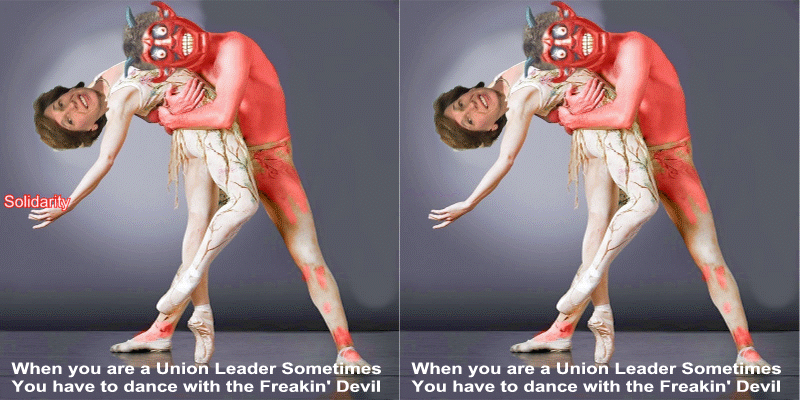
Is AFT's Randi Weingarten Living UAW's Doug Fraser's Nightmare?
Randi Weingarten is under fire from some members of her AFT union for the endorsement of Hillary Clinton for President in 2016. She also takes heat for for trying to find common ground with people who seem to be hell bent on destroying Public Education. Weingarten became president of UFT in 1998 and president of AFT in 2008. Her role as leader of both unions organizations has been at a time of ext
American education system completely misunderstands how to discipline children, says groundbreaking psychologist - Business Insider
American education system completely misunderstands how to discipline children, says groundbreaking psychologist - Business Insider: The American education system completely misunderstands how to discipline children, says groundbreaking psychologistDr. Ross Greene would rather parents and teachers try to understand their misbehaving children than punish them.Greene, a clinical child psychologist a
Save Our Schools March – Join “Walking Man” Jesse Turner for his Arrival in DC!
Save Our Schools March – Join “Walking Man” Jesse Turner for his Arrival in DC!: Join “Walking Man” Jesse Turner for his Arrival in DC!“Walking Man” Jesse Turner, the BATS, UOO, and Save Our Schools invite you to join in on the last mile of his 400 mile walk in Washington DC!If you want to participate here is what you can do:On July 24th, 20152:00 p.m. – Meet in the Courtyard at the Holiday Inn Ca
Mike Klonsky's SmallTalk Blog: AFT's early Clinton endorsement is creating a rank-and-file backlash
Mike Klonsky's SmallTalk Blog: AFT's early Clinton endorsement is creating a rank-and-file backlash: AFT's early Clinton endorsement is creating a rank-and-file backlashThe AFT's early endorsement of Hillary Clinton comes as no surprise, at least to me. Randi Weingarten and the current AFT leadership has long been tied to the Clinton's political organization by a thousand threads.After all, the 1.
CURMUDGUCATION: Who Is Served by the Unions?
CURMUDGUCATION: Who Is Served by the Unions?: Who Is Served by the Unions?We're going to have this argument again because folks are pissed about the early endorsement of Hillary Clinton by the AFT. But there's another issue quietly simmering on the union back burner that is far more significant in dealing with the question of which interests, exactly, are served by the big teachers unions.Who am I
CA looks for options to ‘highly qualified’ teachers for all :: SI&A Cabinet Report :: The Essential Resource for Superintendents and the Cabinet
CA looks for options to ‘highly qualified’ teachers for all :: SI&A Cabinet Report :: The Essential Resource for Superintendents and the Cabinet: CA looks for options to ‘highly qualified’ teachers for all(Calif.) Even as state officials signed off on a federally-mandated plan designed to ensure experienced, quality teachers for all students, they also raised the specter of seeking a waiver fr
We Definitely Don't Need a "National Education Plan" :: Frederick M. Hess
We Definitely Don't Need a "National Education Plan" :: Frederick M. Hess: We Definitely Don't Need a "National Education Plan"Last week, my friend Chris Cross penned a provocative column for Teachers College Record, in which he argued that the U.S. desperately needs a "national education plan." He laments that we don't have an "understanding of our national, as
Will Campbell Brown’s “The 74″ Investigate Charter Scandals? | EduShyster
Will Campbell Brown’s “The 74″ Investigate Charter Scandals? | EduShyster: Will Campbell Brown’s “The 74″ Investigate Charter Scandals?My source says no…Reader: I j’adore investigative journalism. Which is why I was beyond excited to learn that Campbell Brown’s new edu-venture, The 74, will include an investigative component. After all, at a moment characterized by the movement of massive sums fro
Jersey Jazzman: Why U-Ark's Charter School Philanthropy Study Is Just Wrong
Jersey Jazzman: Why U-Ark's Charter School Philanthropy Study Is Just Wrong: Why U-Ark's Charter School Philanthropy Study Is Just Wrong One of the more annoying things about discussing and debating education policy is seeing how misconceptions are born. You can often trace an incorrect notion from a think tank's brief to a reformy "analyst" who only read the press release and wouldn't u
What The Senate Is Sellin’, Informed Parents Aren’t Buyin’ » Missouri Education Watchdog
What The Senate Is Sellin’, Informed Parents Aren’t Buyin’ » Missouri Education Watchdog: What The Senate Is Sellin’, Informed Parents Aren’t Buyin’Thanks to a buy off, I mean buy-in, by the teachers’ unions, the Senate now feels ready to push ahead with their Every Child Achieves Act. They have dressed it up pretty with superficial changes meant to make parents happy, but cross dressing this bad
JEB BUSH: Why Some State Test Results Are Less Profitable Than Others | StateImpact Florida
Why Some State Test Results Are Less Honest Than Others | StateImpact Florida: Why Some State Test Results Are Less Honest Than OthersSome states are telling students and parents they are better at reading, writing, math and other subjects than they really are, according to a new website from theFoundation for Excellence in Education.The website,WhyProficiencyMatters.com, tracks the percentage of
Pennsylvania Manufactures Massive Test Failure | Peter Greene
Pennsylvania Manufactures Massive Test Failure | Peter Greene: Pennsylvania Manufactures Massive Test FailureBrace yourself, Pennsylvanians. The new cut scores for last years Big Standardized Tests have been set, and they are not pretty.It was only this week the State Board of Education met to accept the recommendations of their Council of Basic Education. Because, yes -- cut scores are set after
Evaluating teachers in special subjects: Is it fair to grade music and art teachers on math and reading scores?
Evaluating teachers in special subjects: Is it fair to grade music and art teachers on math and reading scores?: Why Are Some Teachers Being Evaluated Using the Test Scores of Kids They Didn’t Teach?By almost all accounts, Albuquerque, New Mexico, music instructor Nick Prior is an all-star teacher. He runs six choirs, which serve nearly 200 students at the city’s Eisenhower Middle School. His choi
Site Devoted to Education Overhaul Is to Hold Presidential Forums - First Draft. Political News, Now. - The New York Times
Site Devoted to Education Overhaul Is to Hold Presidential Forums - First Draft. Political News, Now. - The New York Times: Site Devoted to Education Overhaul Is to Hold Presidential ForumsAn education-focused news outlet run by the journalist-turned-advocate Campbell Brown plans to host presidential forums for both parties, with the first one held in New Hampshire.The Seventy Four, a site recentl

YESTERDAY

FORBES AND WALL STREET JOURNAl Take on AFT's union Endorsement of Hillary Clinton
Teachers' union endorses Hillary Clinton, but her positions on education issues remain murky: Teachers' union endorses Hillary Clinton, but her positions on education issues remain murkyPresidential candidate Hillary Clinton snagged the Democratic primary endorsement of the American Federation of Teachers on Saturday, but the question remains: Where does she stand on the seismic education issues o
Election 2016 | American Federation of Teachers
Election 2016 | American Federation of Teachers: The AFT executive council voted overwhelmingly on July 11 to endorse Hillary Clinton for the Democratic nomination for president.This is a crucial election. Who we elect can make the difference in reshaping our economy and reclaiming the promise of public education.We've seen what happens when we get involved early—like in Pennsylvania, where early
Special Nite Cap: Catch Up on Today's Post 7/12/15
SPECIAL NITE CAP CORPORATE ED REFORMSeattle Schools Community Forum: Who Will Run Public Education?Seattle Schools Community Forum: Who Will Run Public Education?: Who Will Run Public Education?Some older articles I had on the back burner for far too long.  Compiled, they are a good picture of what is happening in our country today.  It's a two-fold problem.1) Billionaires who decide they (and the


Two Sides of Hillary Clinton: The American Federation of Teachers’ Big Blunder

Two Sides of Hillary Clinton: The American Federation of Teachers’ Big Blunder:

Two opposing regular wooden debate podiums signifying a debate on an isolated white studio background
Two Sides of Hillary Clinton: The American Federation of Teachers’ Big Blunder


Where was the debate? Did we miss it? Why was the AFT rapid endorsement of Hillary Clinton such a rash mistake?

Hillary Clinton has two sides when it comes to education, and the AFT should have taken more time to haggle with her—nudge her into showing her good side. But they didn’t do due diligence and now they have no bargaining chips. Not that they are in the business of bargaining these days.

Now, like past elections, we will vote Republican or Democrat based on other issues. Education will be nothing more than corporate soundbites fed to candidates for transmission to the public by the incredibly rich.

What do I mean by Hillary Clinton’s two sides?

One side is Hillary Clinton the author of It Takes a Village and Other Lessons Children Teach Us.

Anyone who says there’s no difference between Hillary Clinton and Jeb Bush is mistaken and It Takes a Village is proof. She gets much too involved in discussing standards by the end of the book, but the beginning shows the warm side of Hillary Clinton. There’s much hope there, jumping out at us fom those pages.

If you read this book it is easy to capture the sincerity in her words as a reflection of understanding children and individualism. It is poignant. You are with her as she is growing up herself, and you can understand easily that she has always had a deep, abiding love for children.

This is the Hillary Clinton I want for President. This is what a good union should have pushed her towards.

But then there’s the other side.

Common Core

Hillary Clinton, there is no doubt, has bought into harmful school reform. No sooner Two Sides of Hillary Clinton: The American Federation of Teachers’ Big Blunder:

With A Brooklyn Accent: Cognitive Dissonance, Testing and the Need to Face Our History: Guest Post by Aixa Rodriguez

With A Brooklyn Accent: Cognitive Dissonance, Testing and the Need to Face Our History: Guest Post by Aixa Rodriguez:

Cognitive Dissonance, Testing and the Need to Face Our History: Guest Post by Aixa Rodriguez


"In psychology, cognitive dissonance is the mental stress or discomfort experienced by an individual who holds two or more contradictory beliefs, ideas, or values at the same time, or is confronted by new information that conflicts with existing beliefs, ideas, or values.[1][2]" Wikipedia
In watching the coverage of the 20th anniversary of the genocide in Bosnia, the efforts to identify victims with DNA was mentioned. 20 years later and these victims are still unidentified and not resting in peace. The reality that some people still have difficulty calling it what it was , genocide, is a problem. Other words are used to coverup the reality of the monstrous deeds.To this day according to what Christianne Amapour said, there has yet to be serious actions taken to "denazify" the government, or to have a "truth and reconciliation".
Think on this. the language she used alludes to the Holocaust and Apartheid era South Africa. Are these events in history taught well in our nations schools? How quickly would the association have been made by today's High school graduates? I wager not quickly, and at a low percentage.
Thinking on cognitive dissonance, I believe this is the problem with facing ugly things. It is the reason people seek to explain away ugly things. It is the reason word of what is happenning in DR is increasingly being explained away. It is the reason why ugly vicious vigilante justice that is obviously wrong is being explained away as propaganda and bad journalism. The violence itself, video footage of brutality never addressed. It is hard to face realities that dont match your beliefs about yourself , your people, your culture. But it must be confronted. The greatest heroes have woken up and fought to make the ideals of their country real.
After tragedies, the reality of evil committed must be exposed. In this way we honor the dead, we hold perpetrators accountable, we learn the who what where why and how if incidents. If we do not do this, if our discomfort leads to denial, or stalling in taking action, perpetrators get away with heinous actions, repeat them in other locations, infect the next generation with hate and With A Brooklyn Accent: Cognitive Dissonance, Testing and the Need to Face Our History: Guest Post by Aixa Rodriguez:

Why Clinton needs to craft a broad national education vision - The Hechinger Report

Why Clinton needs to craft a broad national education vision - The Hechinger Report:

Why Clinton needs to craft a broad national education vision


Democratic presidential hopeful Hillary Rodham Clinton speaks at a campaign event in New York, Monday, July 13, 2015.
Having just secured American Federation of Teachersendorsement and with Republican presidential candidates torn between big donors favoring test-driven accountability and a base strongly opposed, Hillary Clinton has a broad avenue for crafting a coherent national vision built on her “everyday Americans” campaign theme.
In her speech at the New School July 13, Clinton pointed to her lifelong commitment to education from the start of her career when she worked for the Children’s Defense Fund to guarantee education for children with disabilities. Last month, her Roosevelt Island speech tantalized, but offered few specifics beyond promises of preschool and “teachers second to none in the world [who] receive the respect they deserve for sparking the love of learning in every child.”
What would a clearer educational vision look like? Can Clinton thread the needle between localism and globalism, the two ideological poles roiling Republican politics? Put another way, can she effectively shift from Obama’s centralizing influence without losing advocates of higher standards, accountability, and choice who have dominated the national education discourse for over a decade?
Everyday American education is not sexy but it brought us unparalleled economic success for over a century while sustaining ideals of participatory democracy. Key to this is the resurgent pluralism that marks schooling in this country, compared to other nations.
America’s pluralistic educational system is at the heart of our national identity and current debates over curriculum, testing, standards, choice, and inequality. Understandably, flaws intrinsic to this tradition of educational localism have been under attack for decades, at least since Brown v. Board upended Jim Crow schooling.
Federal requirements are important
Later, with passage of the Elementary and Secondary Education Act (a/k/a No Child Left Behind) and Education for All Handicapped Children Act (now IDEA), many school practices previously left to districts and states came under active federal control.
Today, with annual test mandates under No Child Left Behind, teacher evaluations required under Race to the Top and NCLB waiver provisions, and instructional dictates under the Common Core State Standards, federal requirements have come to dominate electoral concerns. Add to these, recent U.S. Department of Education Why Clinton needs to craft a broad national education vision - The Hechinger Report:


Here are the Amendments to the Every Child Achieves Act | Truth in American Education

Here are the Amendments to the Every Child Achieves Act | Truth in American Education:

Here are the Amendments to the Every Child Achieves Act

Photo credit: UpstateNYer (CC-By-SA 3.0)


There isn’t any shortage of amendments to S.1177, the Every Child Achieves Act, a bill introduced by Help Committee Chair U.S. Senator Lamar Alexander (R-TN) and the ranking member for the HELP committee, U.S. Senator Patty Murray (D-WA), that would reauthorize the Elementary and Secondary Education Act.
Here is a running list of the amendments thus far:
S.Amdt. 2079 (Sen. Fischer): To ensure local governance of education .
— Amendment pending in Senate.
— Amendment SA 2079 agreed to in Senate by Voice Vote.
S.Amdt. 2080 (Sen. Hatch): To establish a committee on student privacy policy .
— Amendment SA 2080 proposed by Senator Alexander for Senator Hatch to Amendment SA 2089.
S.Amdt. 2083 (Sen. Gardner): To enable local educational agencies to use funds under part A of title I for dual or concurrent enrollment programs at eligible schools.
— Amendment SA 2083 proposed by Senator Alexander for Senator Gardner to Amendment SA 2089.
— Amendment SA 2083 agreed to in Senate by Unanimous Consent.
S.Amdt. 2087 (Sen. Feinstein): To provide for additional means of certifying children, youth, parents, and families as homeless.
— Amendment SA 2087 proposed by Senator Murray for Senator Feinstein to Amendment SA 2089.
— Amendment SA 2087 agreed to in Senate by Voice Vote.
S.Amdt. 2089 (Sen. Alexander): In the nature of a substitute.
— Amendment pending in Senate.
S.Amdt. 2092 (Sen. McCaskill): Enabling States, as a consortium, to use certain grant funds to voluntarily develop a process that allows teachers who are licensed or certified in a participating State to teach in other participating States.
— Amendment SA 2092 proposed by Senator Murray for Senator McCaskill to Amendment SA 2089.
— Amendment SA 2092 agreed to in Senate by Unanimous Consent.
S.Amdt. 2093 (Sen. Franken): To end discrimination based on actual or perceived sexual orientation or gender identity in public schools .
— Amendment SA 2093 proposed by Senator Murray for Senator Franken to Amendment SA 2089.
S.Amdt. 2094 (Sen. Toomey): To ensure that States have policies or procedures that prohibit aiding or abetting of sexual abuse, and for other purposes .
— Amendment pending in Senate.
— Amendment SA 2094 as modified agreed to in Senate by Yea-Nay Vote. 98 – 0. Record Vote Number: 228
S.Amdt. 2095 (Sen. Peters): To allow local educational agencies to use parent and family engagement funds for financial literacy activities .
— Amendment pending in Senate.
S.Amdt. 2096 (Sen. Kaine): To add career and technical education as a core academic subject.
— Amendment SA 2096 proposed by Senator Murray for Senator Kaine to Amendment SA 2089.
— Amendment SA 2096 agreed to in Senate by Voice Vote.
S.Amdt. 2099 (Sen. Brown): To amend part A of title IV of the Elementary and Secondary Education Act of 1965 to allow funds provided under such part to be used for a site resource coordinator.
— Amendment SA 2099 proposed by Senator Murray for Senator Brown to Amendment SA 2089.
— Amendment SA 2099 agreed to in Senate by Yea-Nay Vote. 98 – 0. Record Vote Number: 227
S.Amdt. 2103 (Sen. Manchin): To enable local educational agencies to use funds under part A of title IV of the Elementary and Secondary Education Act of 1965 for programs and activities that promote volunteerism and community service.
— Amendment SA 2103 proposed by Senator Murray for Senator Manchin to Amendment SA 2089.
— Amendment SA 2103 agreed to in Senate by Voice Vote.
S.Amdt. 2108 (Sen. Gillibrand): To amend the program under part E of title II to ensure increased access to science, technology, engineering, and mathematics subject fields for underrepresented students, and for other purposes.
— Amendment SA 2108 proposed by Senator Murray for Senator Gillibrand to Amendment SA 2089.
— Amendment SA 2108 agreed to in Senate by Unanimous Consent.
S.Amdt. 2110 (Sen. Daines): To allow a State to submit a declaration of intent to the Secretary of Education to combine certain funds to improve the academic achievement of students.
— Amendment SA 2110 proposed by Senator Daines to Amendment SA 2089.
— Amendment SA 2110, under the order of 7/9/15, not having achieved 60 votes in the affirmative, was not agreed to in Senate by Yea-Nay Vote. 44 – 54. Record Vote Number: 226
S.Amdt. 2118 (Sen. Kaine): To amend the State accountability system under section 1113(b)(3) regarding the measures used to ensure that students are ready to enter postsecondary education or the workforce without the need for postsecondary remediation.
— Amendment SA 2118 proposed by Senator Murray for Senator Kaine to Amendment SA 2089.
S.Amdt. 2119 (Sen. Gardner): To include charter school representatives in the list of entities with whom a State and local educational agency shall consult in the development of plans under title I.
— Amendment SA 2119 proposed by Senator Alexander for Senator Gardner to Amendment SA 2089.
— Amendment SA 2119 agreed to in Senate by Unanimous Consent.
— Notwithstanding the adoption of amendment SA 2119, the amendment is modified by Unanimous Consent.
S.Amdt. 2120 (Sen. Warren): To amend section 1111(d) of the Elementary and Secondary Education Act of 1965 regarding the cross-tabulation of student data.
— Amendment SA 2120 proposed by Senator Murray for Senator Warren to Amendment SA 2089.
S.Amdt. 2121 (Sen. Heller): To ensure timely and meaningful consultation between State educational agencies and Governors in the development of State plans under titles I and II and section 9302.
— Amendment SA 2121 proposed by Senator Alexander for Senator Heller to Amendment SA 2089.
— Amendment SA 2121 agreed to in Senate by Voice Vote.
S.Amdt. 2131 (Sen. Casey): To improve the bill relating to appropriate accommodations for children with disabilities.
— Amendment SA 2131 proposed by Senator Murray for Senator Casey to Amendment SA 2089.
— Amendment SA 2131 agreed to in Senate by Unanimous Consent.
S.Amdt. 2132 (Sen. Scott): To expand opportunity by allowing Title I funds to follow low-income children.
— Amendment SA 2132 proposed by Senator Alexander for Senator Scott to Amendment SA 2089.
S.Amdt. 2138 (Sen. Klobuchar): To amend the Elementary and Secondary Education Act of 1965 relating to improving student academic achievement in science, technology, engineering, and mathematics.
— Amendment SA 2138 proposed by Senator Murray for Senator Klobuchar to Amendment SA 2089.
— Amendment SA 2138 agreed to in Senate by Unanimous Consent.
S.Amdt. 2147 (Sen. Portman): To promote recovery support services for students .
— Amendment SA 2147 proposed by Senator Alexander for Senator Portman to Amendment SA 2089.
— Amendment SA 2147 agreed to in Senate by Voice Vote.
S.Amdt. 2161 (Sen. Kirk): To ensure that States measure and report on indicators of student access to critical educational resources and identify disparities in such resources, and for other purposes,
— Amendment SA 2161 proposed by Senator Alexander for Senator Kirk to Amendment SA 2089.
Here are the Amendments to the Every Child Achieves Act | Truth in American Education:

Title I portability: A flawed House proposal would change education funding. Here's how Beverly Hills, 90210 explains it.

Title I portability: A flawed House proposal would change education funding. Here's how Beverly Hills, 90210 explains it.:

The Beverly Hills, 90210 Guide to Title I Portability


shutterstock_127054166
This week marks the closest Congress has come to replacing the widely reviled No Child Left Behind Act since it officially expired in 2007. Democrats and Republicansare squabbling over the usual issues: high-stakes testing and whether kids should be able to opt out of it; how accountable teachers and schools should be to those test results; and, more broadly, how much control the federal government should have over education (consensus: not nearly as much).
But one of the most divisive issues under consideration, what’s known as Title I portability, or “financial backpacks,” is also one of the most abstruse. There’s a portability provision in the House bill that passed, barely, Wednesday night, but the subject has become such a flashpoint for Democrats that President Obama has threatened to veto any bill that includes it. The final bill almost certainly won’t, since the more moderate Senate bill still being debated has omitted any mention of portability, but it’s still worth understanding what exactly portability is and why it’s such a big deal.
First, a little background on Title I, which came into existence with the 1965 Elementary and Secondary Education Act, still the most sweeping federal education bill ever passed. (No Child Left Behind—ditto the House’s Student Success Act and the Senate’s Every Child Achieves Act now being debated—are all iterations of ESEA.) Because U.S. schools are mostly funded by property taxes, there have always been huge discrepancies between schools with a rich student body and schools with poorer, usually minority populations. In the aftermath of Brown v. Board of Education, Title I was designed to level the playing field by putting federal money in schools with the highest concentrations of poverty.
How Title I funds are allocated is extremely complicated, but basically, the states and districts distribute them by priority based on how many poor kids are in each school: The schools with the highest percentage of poor kids get the lion’s share of the federal money, while some schools that may qualify for Title I, but have a lower concentration of poverty, might get none.
Portability, which allows the money to follow the individual kids, wherever they end up, completely upends the original intent of Title I—and to show why, I’ll have to borrow a scenario from Beverly Hills, 90210, which is apt because the ranking Democrat on the education committee, Rep. Bobby Scott, frequently invokes the funding discrepancies between the Los Angeles Unified School District (which has a lot of poor kids) and the adjacent Beverly Hills Unified School District (which does not) to illustrate why Title I portability is a ruse.

State Board Sets Principles and Timeline for Developing State Accountability System

SBE News Release for July 9, 2015 - State Board of Education (CA Dept of Education):

State Board Sets Principles and Timeline for Developing
State Accountability System


The California State Board of Education (SBE) has set guiding principles and an initial timeline for establishing California’s new state accountability system. The new system will center around the Local Control Funding Formula (LCFF), Local Control and Accountability Plans (LCAPs) and annual updates. The guiding principles articulate the Board’s goals for system planning. The timeline outlines future topics for discussion as well as specific details for the development of evaluation rubrics.
“The state’s new accountability system will take into account multiple measures across the eight state priority areas outlined in LCFF, allowing us to focus on a broader set of outcomes than in the past,” explained SBE president Mike Kirst.
In May, Board members expressed a shared opinion that the October 2015 deadline for the evaluations rubrics, tools to help measure district and charter progress toward state priorities and local goals, needed to be adjusted. Stakeholders agreed and advocated for a revised timeline with lawmakers and the governor. As a result, recent legislation signed by the governor extends the deadline to October 2016 for the SBE to establish the rubrics.
The additional development time will be used to ensure the evaluation rubrics are built on a solid foundation of research and data analysis. It is also consistent with SBE’s overall timeline for developing a state accountability system.
“Our timeline ensures cohesion among the LCFF, local plans and evaluations rubrics,” explained Kirst. “Stakeholders must continue to be engaged and informed so they can weigh in on our deliberations,” added Kirst.
Guiding Principles for Accountability System Planning
Articulate the state’s expectations for districts, charter schools and county offices of education.
  • Promote a broad understanding of the specific goals that need to be met at each level of the educational system.
Foster equity.
  • Create support structures, including technical assistance for districts and schools, to promote success for all students regardless of background, primary language, or socioeconomic status.
  • Continue to disaggregate data by student subgroup for both reporting and accountability purposes.
Provide useful information that helps parents, districts, charter schools, county offices of education and policymakers make important decisions.
  • Assist and engage parents, educators and policymakers through regular communication and transparent, timely reporting of data so they can take action appropriate to their roles.
Build capacity and increase support for districts, charter schools and county offices.
  • Seek to build capacity at all levels by reinforcing the importance of sound teaching and learning practices and providing necessary support to help schools reach their goals.
  • Create multiple ways to celebrate district and school success based on state identified and locally designated metrics. Intervene in persistently underperforming districts to build capacity along a continuum of increasing support and attention through state and regional mechanisms of support. Ensure there are services and skills necessary to meet the needs of the students and families they serve.
Encourage continuous improvement focused on student-level outcomes, using multiple measures for state and local priorities.
  • Focus on ongoing improvement of student outcomes, including college- and career-readiness, using multiple measures that reflect both status and growth. This means, in part, making determinations based on some version of the following two foundational questions:
    • How well is this school/district performing?
    • Is the school/district improving?
  • Tie accountability determinations to multiple measures of student progress, based on the state priorities, integrating data from various forms of assessment, some of which will be locally-determined. Balance validity and reliability demands with the ability to clearly and simply explain results to stakeholders, including the use of a multiple measures dashboard.
Promote system-wide integration and innovation.
  • Purposely and effectively integrate each accountability system component, including groups and technologies, creating a coherent, effective and efficient support structure for districts, charter schools and county offices of education.
  • Recognizing that there is a new context for accountability in the state, the coming years will provide new insights at all levels of the educational system. To that end, it is important to encourage continued learning, innovation, and improvements related to the accountability system as a whole, core elements of the system, and the impact of the system on individual schools and districts.
Initial Timeline for Establishing a State Accountability System
SBE MeetingProposed Transition to New Accountability SystemDevelopment of LCFF Evaluation RubricsUpdate on LCAP Template / Implementation Process
June 2015SBE Information Memorandum on states’ emerging accountability systems.SBE Information Memorandum that summarizes research related to indicators of college and career readiness, early warning systems, and indicator selection.Field test the electronic LCAP template.
July 2015 SBE MeetingReview and reflections of emerging college and career accountability systems from other states that can inform the design of California’s system.Present SBE updated evaluation rubrics development plan and seek feedback regarding policy frame for the evaluation rubrics.N/A
July 2015 - September 2015 Development Activities completed by CDE/SBE/ & WestEd StaffDevelop an Information Memorandum that reviews California accountability components relative to the LCFF state priorities and SBE guiding principles.Develop evaluation rubrics prototypes. Analyze data and present findings in an SBE Information Memorandum to define California context for the LCFF evaluation rubrics.Analysis of LCAP electronic template pilot.
September 2015 SBE MeetingPresent recommendations for proposed policy framework that articulate expectations for districts, schools, charter schools and county offices of education. These recommendations will create support structures to foster transparency, flexibility, and equity.Present recommendations for proposed policy framework to structure the evaluation rubrics prototype to align with the SBE’s policy frame. Discuss the decision points on standards and expectations for improvement and parameters for local metrics to support the proposed framework.Report on LCAP electronic template pilot test results.
September 2015 - December 2015 Development ActivitiesAnalysis of “underbrush” of the existing accountability statutes and regulations that may need to be modified to align with and support California’s new accountability system.Provide process to gather user feedback for select components of the evaluation rubrics based on state representative sample of LEAs participating in User Acceptance Testing (UAT).N/A
November 2015 SBE MeetingRecommendations for a Framework and Implementation Plan for Accountability System – Comprehensive design architecture with specifications reflecting policy implications for a new accountability system.Update on UAT piloting select components of the LCFF evaluation rubrics design options and integration of data.Lessons learned from submitting Year 2 LCAP and first year Annual Update.
January 2016 SBE MeetingDevelop components that provide useful information that helps parents, districts, charter schools, and county offices of education and policymakers make important decisions.Present the SBE with final design features of the evaluation rubrics based on user pilot experiences and feedback.Present the proposed electronic LCAP template to be released in February 2016.
March 2016Discuss strategies to build capacity and increase support for districts, charter schools and county offices.Present the SBE with update on use and evaluation of the rubrics prototype.Discussion on efforts to diagnose and respond to challenges through school-based quality improvement.
May 2016Present system elements that encourage continuous improvement focused on student-level outcomes, using multiple measures for state and local priorities.Finalize evaluation rubrics based on guidance from the SBE, feedback from LEAs, COEs and as appropriate input from stakeholders.N/A
July 2016Promote system-wide integration and innovation.Final LCFF Evaluation Rubrics for SBE Adoption.N/A
For more information about the Board’s efforts on school accountability, please contact Julie White, SBE Communications Director at jwhite@cde.ca.gov or visit the California State Board of Education Web site.
###


SBE News Release for July 9, 2015 - State Board of Education (CA Dept of Education):


Will Hillary Clinton Continue Education Reform? -- NYMag

Will Hillary Clinton Continue Education Reform? -- NYMag:

Will Hillary Clinton Continue Education Reform?


HIllary Rodham Clinton


In her economic speech today, Hillary Clinton spoke extensively about policies where her party agrees: inequality, social opportunity, public investment, and family-friendly workplace policy. Clinton’s remarks about primary education were almost literally a placeholder. (Those comments, in their entirety: “And in the coming weeks and months, I’ll lay out specific steps to improve our schools.”) Clinton’s position on primary education is the most significant outstanding domestic-policy question of the Democratic primary campaign, precisely because it is something upon which her party disagrees, often bitterly.

For all the attention to disagreements between the party’s centrist and populist wings, which Matthew Yglesias runs through ably, the two visions overlap heavily. The moderates focus their attention on using government to reduce inequality after the market has run its course. Populists want to use government to shape the distribution of incomes before taxes and transfers. The argument between the two is more academic than practical, because both camps favor elements of one another’s preferred policy goals. The centrists support a higher minimum wage, full employment, and opposing Republican plans to roll back collective bargaining. And the populists are happy to endorse a higher Earned Income Tax Credit, taxing the rich, and public investment. What makes the debate almost entirely academic is that, with Republicans in control of the House and highly unlikely to lose it under a Democratic president, neither the moderate nor the populist liberal policies stand a chance of enactment.


Education, on the other hand, is an issue where action remains possible, because the president can use administrative waivers to drive reform, or use the threat of waivers as a lever to force Congress to act. It’s also an issue where two Democratic camps propose to move in diametric directions. The Obama administration has embraced the education-reform movement. Reformers believe that new educational structures have the potential to produce dramatic gains for poor children, and can point to spectacular results in a small number of highly effective new urban charter schools. The reformers have concentrated on the importance of teacher quality — which, research shows, varies enormously and has a very large and (therefore) variable impact on student performance. The reformers believe in creating measures of teacher performance, using a mix of tests that measure student learning against an expected baseline, and classroom observation, and to pay them accordingly, including giving schools the Will Hillary Clinton Continue Education Reform? -- NYMag:

Teachers' Union Girds For Supreme Court Setback, Pledges To Grow Membership

Teachers' Union Girds For Supreme Court Setback, Pledges To Grow Membership:

Teachers' Union Girds For Supreme Court Setback, Pledges To Grow Membership


RANDI WEINGARTEN


WASHINGTON -- Faced with its gravest threat in years from the Supreme Court, one of the country's largest labor unions is preparing for a ruling that could make it much more difficult to collect fees from the workers it represents.
This weekend, the American Federation of Teachers passed a resolution pledging to speak individually with each of its 1.6 million members about getting more involved in the union. According to the resolution, union officials are developing a plan they hope will double the number of union activists in their ranks.
The subtext of the move has to do with Friedrichs v. California Teachers Association, a case that the Supreme Court recently announced it will hear in autumn. An unfavorable ruling for public-sector unions could ban what are known as fair share agreements, which require that all workers pay fees to the union to help cover the costs of collective bargaining. A union like the AFT must represent all the workers under a given contract, so the union says it's only fair that everyone contributes.
Though the legitimacy of fair share fees was upheld by the court decades ago, Justice Samuel Alito signaled in another recent union case, Harris v. Quinn, that the conservative-leaning court might strike down fair share fees on the basis of the First Amendment. Due to the financial impact that would have, Friedrichs is widely seen as a case that could devastate public-sector unionism.
The obvious solution, many unions have recognized, is to convince workers of their unions' relevance, so that they support the union even if the court gives them an opportunity to opt out.
"We started talking about it well before Friedrichs, and well before Harris v. Quinn, but I do see it as the antidote to Friedrichs," AFT President Randi Weingarten told Teachers' Union Girds For Supreme Court Setback, Pledges To Grow Membership:

Can Early AFT Endorsement of Clinton Save Her From Sanders and Benghazi? | deutsch29

Can Early AFT Endorsement of Clinton Save Her From Sanders and Benghazi? | deutsch29:

Can Early AFT Endorsement of Clinton Save Her From Sanders and Benghazi?


On Saturday, July 11, 2015, the American Federation of Teachers (AFT) endorsed Hillary Clinton for the Democratic nomination for president.
This news is no surprise, and the AFT’s “long, deliberative process” is pretty much window dressing. It was going to be Hillary.
The July 11, 2015, AFT press release implies that AFT is supporting Clinton for president, but its own FAQ on the issue states that the endorsement is for the Democratic primary and that the vote to endorse Clinton for president has yet to occur:
Q: Is the endorsement only for the Democratic nomination? What about the general election?
A: Yes, the endorsement is for the Democratic nomination. The endorsement for the general election will be made by the delegates to the AFT convention, which will be held in July 2016 in Minneapolis.
So, the support is for the Democratic nomination, but Republicans were invited to vie for AFT support….
That AFT would endorse any Republican for president is unthinkable. AFT President Randi Weingarten “is an active member of the Democratic National Committee.” So, for AFT to state in its FAQ in the Hillary endorsement that it did not consider endorsing a Republican because “no Republican candidate responded to our invitation” is pure political nonsense.
In its announcement, the AFT also included the results of a member survey conducted over the phone between June 22 and 27, 2015. Based on 683 responses, AFT declares the following:
Overall, 60% of AFT members either self-identify as Democrats or self-identify as independent and say they will vote in the Democratic primaries. Following are some of the most important results among these AFT Democratic primary voters.
§ Hillary Clinton enjoys overwhelming support as AFT members’ first choice to be the Democratic presidential nominee. Fully two-thirds (67%) of Democratic primary voters pick Clinton, giving her a commanding 48-point lead over Bernie Sanders (19%) while O’Malley, Webb, and Chafee all 
Can Early AFT Endorsement of Clinton Save Her From Sanders and Benghazi? | deutsch29:

Want to read some of Mayor Kevin Johnson's emails (and Michelle Rhee)? Here you go! - Sacramento News & Review

Want to read some of Mayor Kevin Johnson's emails? Here you go! - Page Burner - July 13, 2015 - Blogs - Sacramento News & Review:

Want to read some of Mayor Kevin Johnson's emails? Here you go!
Wonder What Michelle Rhee Has Been Doing in Her Spare Time?


You’re not supposed to spy on people’s email. But when you’re a public servant, your emails are public record. It’s part of that whole transparency thing. I know, what an inconvenience. Or at least that’s how Mayor Kevin Johnson sees it: He’s sicced his lawyers on SN&R to keep public records from us, and he’s also hiding a grip load of email on private Gmail accounts. The content of these emails are public business—heck, a lot of the emails are campaign and election business mixed with mayoral work (hello, FPPC!)—yet the Gmails remain secret.
Anyway, SN&R has obtained some of K.J.'s emails in recent months (he’s still hiding most of them). So, we figured, why not share them with you, our dear readers. Here they are. This collection includes more than 3,000 pages of emails and records.
Again, here’s the link: https://www.scribd.com/collections/14354387/KJ-email-and-records.
Here is an example of the emails, all of which are archived on Scribd.com:
This email collection on Scribd is searchable for keywords, etc. Have fun. Let me know if you find anything: nickam@newsreview.com.
Want to read some of Mayor Kevin Johnson's emails? Here you go! - Page Burner - July 13, 2015 - Blogs - Sacramento News & Review:


Thompson: Will President Obama's Trip to the Choctaw Nation (& a Federal Prison) Help This Week In Education:

This Week In Education: Thompson: Will President Obama's Trip to the Choctaw Nation (& a Federal Prison) Help Move the Administration Toward Comprehensive Solutions?:

Thompson: Will President Obama's Trip to the Choctaw Nation (& a Federal Prison) Help Move the Administration Toward Comprehensive Solutions?


The President who I still love will visit the Choctaw Nation this week and look into the Promise Zone initiative he launched last year. My first hope for the trip was that President Barack Obama would swing over to the far corner of “Little Dixie,” and visit Frogville. 
But, President Obama has a better plan. The Daily Oklahoman’s Chris Casteel, in President Obama Heading to Oklahoma Next Week, reports that the President will visit the federal prison in El Reno, where inmate Jason Hernandez was housed until Obama commuted his life sentence on drug charges. 
Until recently, President Obama has been especially reticent about hot-button issues such as race and the legacies of generational poverty and discrimination. The 2014 off-year election defeat and tragedies culminating in the Charleston massacre have liberated our President, however, and he has been speaking and singing the truths that previously he held back.  It sounds like we can anticipate another honest conversation with an atypical journalist, this time with HBO’s VICE. 
According to VICE Media, the visit will “give viewers a firsthand look into the president's thinking on criminal justice reform ‘from the policy level down to one-on-one conversations with the men and women living this reality.’” 
Maybe President Obama will return to the Indian Nation and drop in on our family's homestead so we can discuss school reform and its cousin, the War on Drugs, and how these ill-conceived reward and punish policies backfired because they were dismissive of the realities that flesh-and-blood people live in. We could gaze upon the graves of whites, blacks, and Choctaws in the family cemetery, and muse about our long history of living together in peace and conflict, as well as both unity and divisiveness in victory and defeat at the hands of political and economic oppression.
As I explained recently, school reform and the War on Drugs were both deeply rooted in the Reaganism and the lowered horizons of the 1980s. Both were quick, simple, and seemingly cheap solutions to the complex social problems that the War on Poverty did not eradicate.


Now we are seeing comprehensive efforts, such as those embraced by several Oklahoma tribal governments and national Promise Zone pilot projects, to attract private investments in economic development, improve housing, expand educational opportunities, and address crime and violence. Similarly, as the Marshall Project’s Bill Keller writes in the New Yorker, we are seeing a bipartisan effort to tackle the unintended damage to our criminal justice system that was prompted by the War on Drugs. 
The Marshall Project’s Eli Hager explains, "Perhaps the most important similarity between the ever-intertwined school system and criminal justice system is that both are tasked with managing and taking care of those with cognitive, social, and economic deficits caused by poverty." Reformers in both This Week In Education: Thompson: Will President Obama's Trip to the Choctaw Nation (& a Federal Prison) Help Move the Administration Toward Comprehensive Solutions?:

Is AFT's Randi Weingarten Living UAW's Doug Fraser's Nightmare?


Randi Weingarten is under fire from some members of her AFT union for the endorsement of Hillary Clinton for President in 2016. She also takes heat for for trying to find common ground with people who seem to be hell bent on destroying Public Education. Weingarten became president of UFT in 1998 and president of AFT in 2008. Her role as leader of both unions organizations has been at a time of extreme attacks on unions and Public Education.

Like Weingarten, Doug Fraser rose to the presidency of the United Automobile Workers (UAW) at a time that the survival of the American Automobile Industry and the UAW was an unanswered question.

Mr. Fraser, known as Doug to factory workers and corporate chairmen alike, led the union from 1977 to 1983, a period of intense turmoil in the American automobile industry.
Rapidly rising fuel prices and surging sales of fuel-efficient Japanese cars had produced huge financial losses at the Detroit auto companies, particularly at Chrysler, which was heavily dependent on large automobiles.
As Chrysler ran short of cash and faced possible bankruptcy, Mr. Fraser was instrumental in helping to arrange legislation that provided the $1.2 billion in federally guaranteed loans that put Chrysler back on its feet.
The deal called for hourly workers at Chrysler to accept wage cuts of $3 an hour and gave the company permission to cut nearly half of its 100,000 jobs in the United States.
Lee A. Iacocca, then the chief executive at Chrysler, nominated Mr. Fraser as a company director in 1980, making him the first labor leader to join the board of an American automobile company.
Mr. Fraser, however, stressed that he represented Chrysler’s workers, not himself. He was the lone dissenting vote when the board gave generous stock options to Chrysler executives, including Mr. Iacocca. NEW YORK TIMES
Some deeply criticized Fraser's 1979 negotiations, however. They argue that the Chrysler agreement set off a wave of concessionary bargaining among automobile manufacturers which then spread into steel, mining, trucking, meatpacking, airlines and rubber. These critics claim that a 30-year truce between labor and management broke down after 1979, leading auto manufacturers to abandon pattern bargaining and seek an end to job protections and cost-of-living increases.Wikipedia

 Are There Lessons to be Learned?


American education system completely misunderstands how to discipline children, says groundbreaking psychologist - Business Insider

American education system completely misunderstands how to discipline children, says groundbreaking psychologist - Business Insider:

The American education system completely misunderstands how to discipline children, says groundbreaking psychologist

boy crying


Dr. Ross Greene would rather parents and teachers try to understand their misbehaving children than punish them.
Greene, a clinical child psychologist and associate professor at Virginia Tech, first presented that idea in his 1998 book "The Explosive Child," in which he debuted a program he calls Collaborative & Proactive Solutions.
Today, CPS is poised to revolutionize the way American society treats its behaviorally challenging youngsters.
The conventional model of using carrots and sticks to earn kids' cooperation is inherently flawed, Greene says.
According to Greene, kids who act out, sometimes violently, do so because that's how their brains are wired. They don't necessarily want to misbehave; they just can't help it.
"The most important thing you can do to help your explosive kid be less explosive is to understand why he's explosive in the first place," Greene writes in "The Explosive Child."
That means trading in the time outs and harsh words for direct, focused interaction with a child.
If a boy swears in your classroom, save the conversation until class is over to avoid embarrassing him. If a girl refuses to do her work, have the patience to hear her say why.
In the short term, these techniques are bound to drum up some frustration. ("Can't I just show him who's boss?") But over time the effects are clear: CPS corrects behavior.
According to Mother Jones, putting Greene's system to work at Central School in South Berwick, Maine, helped cut punishment rates in the 2009-2010 school year from 146 disciplines referrals and two suspensions down to 45 referrals and zero suspensions two years later.
The school reached this impressive milestone by taking a different approach to discipline —  by "meeting the child's needs and solving problems instead of controlling behavior," principal Nina D'Aran told Mother Jones' Katherine Reynolds Lewis. "That's a big shift."
It could be a big shift for millions more. The latest data shows that roughly 5 million kids have a
Read more: http://www.businessinsider.com/american-education-system-completely-misunderstands-how-to-discipline-children-says-groundbreaking-psychologist-2015-7#ixzz3fmuvOrym