Latest News and Comment from Education

Wednesday, May 20, 2015

Show Me The (Charter Management Fee) Money!

CT News Junkie | OP-ED | Show Me The (Charter Management Fee) Money!:

Show Me The (Charter Management Fee) Money!


When traditional schools pay their bills to educate kids, they usually don’t have much money, if any, remaining. When charter schools pay their bills, they often have money left over to spend. How much? It depends on the school. For a number of charter schools, roughly 10 percent of all of public dollars meant for educating children in these schools go to pay fees for private companies called “charter management organizations.” That’s a problem.
Connecticut law states that a charter management organization (CMO), “means any entity that a charter school contracts with for educational design, implementation or whole school management services.” These CMOs claim that they are private corporations, not public agencies. Organizations that claim to be CMOs in Connecticut include Achievement First; Capital Preparatory Schools; DOMUS, and Jumoke/FUSE, which is now defunct. It’s often hard to tell the difference between the CMO and the charter schools they manage.
So how does this CMO thing work? As state law shows, CMOs are similar to school districts. They can provide the services that a school district would perform for local schools such as management or operations.
Financial Information: Achievement First Hartford Academy FY14 (2013-14) Budget
Roughly 10 percent of a charter school’sbudget can go toward management fees. For example, the New Haven-based CMO called Achievement First charged Achievement First-Hartford Charter School a $1.14 million management fee in 2013-14. The state provided Achievement First-Hartford charter schools more than $11 million to operate. So about 10 percent of that state funding went to Achievement First the CMO, not the charter school in Hartford, which ended the year with a surplus.


For every $100 dollars the public spends on this charter school, the CMO called Achievement First gets $10 off the top.
Multiply this fee by the four Achievement First charter schools in Connecticut, and Achievement First Inc., the CMO, walks away with about $4.45 million in fees.


The charter schools that we know pay charter management fees to CMOs have included the Achievement First schools, Stamford & Trailblazers Academies (DOMUS), and Jumoke until recently. Interestingly, the proposed Capital Prep Harbor School in Bridgeport would pay a 10 percent management fee to the Capital Prep CMO. Recent reports show that lobbyists have spent thousands to get this new charter school established.
Not all charter schools are managed by CMOs or pay these management fees. In 2012-13, most charter schools in Connecticut did not pay a “charter management fee.” These charter schools included: ISAAC, Common Ground, Explorations, Odyssey, New Beginnings, Bridge Academy, Highville, Side by Side, Park City Prep, Integrated Day, and Charter School for Young Children.
Simply put, charter schools can operate without the need to pay fees to CMOs.
There is a pattern here. The groups that would benefit the most from charter management fees are among the most vocal advocates for more charter schools managed by CMOs, like Capital Prep Schools Inc.
The charter schools that don’t pay CMOs are not as active in the massive lobbying effort this year for more charter schools. This is a key difference among Connecticut charter schools.
Instead of operating schools as public responsibilities, CMOs operate charter schools as moneymaking arrangements, almost like fast-food franchises. Companies like Subway Inc. charge local franchises a fee for services ranging from start-up, food supplies, to signage. This is how Subway makes a profit.


The CMOs could be spending this money on millions of dollars in No. 2 pencils, helping to buy foot-long Subway sandwiches at lobbying events, or paying forstudent field trips to rally for more charter school money. It’s just unclear.
It’s also uncertain whether charter schools could simply perform these services on their own without CMOs. The contracts between CMOs and individual charter schools explain their fees. But the financial report above appears to show that the management fees were charged after paying all operating expenses for the school.
All other public schools and districts must disclose how they spend public dollars. Traditional public, magnet, technical, and charter schools must report their dollars.By law there also are regulations for CMOs, including rules about fees. But the CMOs say they are neither public agencies, nor charter schools!
And recently, Achievement First, among others, fought against a now-dead public accountability bill before the Connecticut General Assembly. The bill would have more clearly required that CMOs be subject to the Freedom of Information Act. (It’s already fairly clear, but CMOs don’t think the current rules apply to them.)
Many question where the money is coming from to aggressively lobby for more charter schools. I would add the question, “where are charter management fees going?”
As Rod Tidwell (played by Cuba Gooding Jr.) said to his agent in the film Jerry Maguire, “Show me the money!”
If CMOs won’t show us the money, then maybe we don’t need CMOs or their fees. Charter schools can manage without them.
Robert Cotto Jr. is an elected member of the Hartford Board of Education and a lecturer in the Educational Studies program at Trinity College. Reach him by email here.  CT News Junkie | OP-ED | Show Me The (Charter Management Fee) Money!:

CELEBRATING PRISCILLA SANSTEAD - Badass Teachers Association

Badass Teachers Association:

CELEBRATING PRISCILLA SANSTEAD


On June 14, 2013 Priscilla Sanstead created the Facebook page Badass Teachers Association.  After a discussion with Mark Naison, Priscilla created the beginnings of the structure of BATs to lead us to where we are today.   We are so glad that she did! 
 For almost 2 years her tireless efforts in running the “mothership” of the BATs organization, the Facebook page, have spawned an active community page with over 22,000 hits, a twitter feed that is fast approaching 20,000 followers, a Pinterest page that has over 5,000 followers, a blog that is fast approaching ½ million hits, and a state of the art website.  Along with Mercy South she created 50 state groups, affinity groups that she visualized so  BATs could go and chat with people in their specialty, and on the ground action that has BATs working hard to save public education in every corner of the country.  


Priscilla is working BATs every single day, and has been for close to 2 years.  She is the quintessential people connector and uses this talent to connect people to join the fight to save public education.   We all owe her enormous debt of gratitude for her volunteerism, her commitment to work BATs every day (7 days a week), her fight for social justice, and her drive to save public education!


Priscilla, BATs CELEBRATE YOU!!! Badass Teachers Association:

Top teachers cite anti-poverty programs as No. 1 school reform necessity — survey - The Washington Post

Top teachers cite anti-poverty programs as No. 1 school reform necessity — survey - The Washington Post:

Top teachers cite anti-poverty programs as No. 1 school reform necessity — survey


In January, the Southern Education Foundation issued a report saying that for the first time in at least 50 years, a majority of U.S. public school students — 51 percent — come from low-income families. That statistic came from a new analysis that the foundation did — using 2013 federal data — on the percentage of public school students eligible for free and reduced-price lunch programs, which has for years been used as a rough proxy for poverty. Critics said the figure was inflated because students can qualify for reduced-price lunches if their families earn an annual income of between 135-185 percent of the federal poverty limit, and they qualify for free lunches if their family has an annual income of at or below 130 percent of the poverty line. Given that the official poverty line for a family of four is $24,250, it is clear that many families above the line are struggling mightily to pay their bills every month.
My Post colleague Lyndsey Layton wrote a story about that report that included quotes from a teacher about the condition in which her students come to school. Here’s a sample:
“When they first comes in my door in the morning, the first thing I do is an inventory of immediate needs: Did you eat? Are you clean? A big part of my job is making them feel safe,” said Sonya Romero-Smith, a veteran teacher at Lew Wallace Elementary School in Albuquerque. Fourteen of her 18 kindergartners are eligible for free lunches.
She helps them clean up with bathroom wipes and toothbrushes, and she stocks a drawer with clean socks, underwear, pants and shoes.
Romero-Smith, 40, who has been a teacher for 19 years, became a foster mother in November to two girls, sisters who attend her school. They had been homeless, their father living on the streets and their mother in jail, she said. When she brought the girls home, she was shocked by the disarray of their young lives.
“Getting rid of bedbugs, that took us a while. Night terrors, that took a little while. Hoarding food, flushing a toilet and washing hands, it took us a little while,” she said. “You spend some time with little ones like this and it’s gut wrenching. . . . These kids aren’t thinking, ‘Am I going to take a test today?’ They’re thinking, ‘Am I going to be okay?’ ”
There are many teachers across the country like Romero-Smith, who, day in and day out,work with students who come to class hungry or sick or homeless or traumatized or living in wretched conditions, and who aren’t fully able to concentrate on doing a close reading of a novel excerpt. They know that the conditions in which students live outside class are the biggest impediment to student progress.
These issues, however, have not been at the forefront of school reform efforts, which, under former president George W. Bush and now under President Obama, have concentrated on holding students, teachers and schools Top teachers cite anti-poverty programs as No. 1 school reform necessity — survey - The Washington Post:

Seattle Schools Community Forum: Updates from the Washington State Legislature

Seattle Schools Community Forum: Updates from the Washington State Legislature:

Updates from the Washington State Legislature


The one update I cannot provide?  That the Legislature has finished its work in creating a budget.  The Governor has said if it is not done on time, he will call ANOTHER special session.  

From the Washington State Democratic Party from Governor Inslee:


"Our teachers haven’t had a cost of living adjustment since 2008, but the Citizens' Commission on Salaries decided to raise salaries for elected officials, including me. While I can't legally refuse the raise, I want to make sure it goes to teachers in Washington who need supplies for their classrooms.That’s why I’m giving my raise to teachers through DonorsChoose.org, a site that allows people to help teachers with classroom needs." 

Guest editorial by Christine Kulduff from the Stranger:

Consider our children. Two and a half years ago, the Washington State Supreme Court said the legislature violated its constitutional duty to fully fund our schools. Then, in an extraordinary and historic step, last September the court found the legislature in contempt for failing to make reasonable progress on a required funding plan.

The court stood up for our almost one million Washington students. 

How did the senate respond to the supreme court watching out for the next generation? By proposing a $750,000+ cut to the supreme court itself. That’s the legislative equivalent of cutting someone off on I-5 at 85 miles per hour. It’s disrespectful and harmful to our democracy.


Please tell your representative to support the house budget because we can't have justice without 
Seattle Schools Community Forum: Updates from the Washington State Legislature:

While You Were Sleeping: What Happened to Wisconsin Public Schools - From Monologues of Dissent : blue cheddar

While You Were Sleeping: What Happened to Wisconsin Public Schools - From Monologues of Dissent : blue cheddar:

While You Were Sleeping: What Happened to Wisconsin Public Schools


This is a republication of a blog post from Monologues of Dissent.  It appears at blue cheddar with permission. 
I don’t know if you were following what happened at the Wisconsin Capitol last night, but here is a summary:

The Joint Finance Committee voted along party lines to put forward an education budget that will harm our kids into perpetuity. There IS increased funding (as opposed to the $150/pupil cuts the Governor wanted), but the increase is illusory; expansion of vouchers and changes to the funding formula mean that it’s difficult to tell how much of the “increase” will actually go to public schools. Waiting for the fiscal analysis of that. In the meantime, here’s how Wisconsin schools were sold out from under you while you were sleeping:
The budget includes the worst of what thousands of parents, school board members, administrators, advocacy groups, and grassroots local citizens spoke out against in droves at the hearings and in writing over the past months. In the guise of giving an increase to the public school budget, it creates a new, complicated, confusing & unwanted way of “accounting” for private voucher school students that allows voucher money to be laundered through the public school budget. Districts that do not have voucher schools will lose even more money than they already do, and the voucher money will continue to come “off the top” as the program is expanded statewide. All over the state, communities will be forced to go to referendum and raise taxes to fund local schools. Many of these referenda will fail. The JFC voted against its constitutional obligation to fund public education at a level that allows uniform instruction at all schools. We are a state of haves and have-nots, and the “haves” got a shiny new gift last night.
It also includes two unconscionable and highly controversial measures:
  1.  Inclusion of the Special Needs Vouchers that every single disability rights advocacy group in Wisconsin opposes and that are the heart of an ALEC/AFC campaign to get more public money into private schools by taking advantage of our most vulnerable kids. Private schools do not have to follow federal regulations and discriminate regularly against kids with special needs. They are also not required by the bill to use the vouchers to meet the needs of the children they’re intended to serve. It is the ugliest of entitlements and it was slipped into the budget at the final hour, with no public hearing, because it is the weakest chink in their armor and they knew that public outrage would be widespread, as it was in previous years when the proposal failed on every attempt after much dissent.
  2. Inclusion of a proposal to “phase in” takeover of the highest poverty, lowest performing Milwaukee Public Schools by revoking local control – a few schools at a time, more each year. This is a perverse, unvetted, ill-considered idea that has virtually NO local support, involved NO local leaders, and was given NO forum whatsoever for public input or community engagement. It will bankrupt MPS. It is the most paternalistic “we know best” of ideas and doomed to fail, as it provides no funds for the “wrap around services” it claims it will provide, and essentially hands public property over to privateers despite their having no track record of greater success in working with high-need schools, and despite the failures of similar takeover programs in Detroit, Memphis, New Orleans & Philadelphia. The kicker for the rest of the state, who will pay the tab for this, is that the language of the bill allows for replication of the program in other large cities – Racine and Madison will be next. Under the plan, public schools will be “managed” by an appointed czar and the local community/democratically elected school board will have no say in their governance as they’re converted into a charter or even a private school, though a provision demands no tuition can be charged. Constitutionality is questionable to say the least. In the meantime, the bill would “help” just a few of the schools that most need help and the budget does nothing to meet the needs and call for fair funding and While You Were Sleeping: What Happened to Wisconsin Public Schools - From Monologues of Dissent : blue cheddar:

Focus on standardized tests reduces college readiness - MRT.com: Education

Focus on standardized tests reduces college readiness - MRT.com: Education:

Focus on standardized tests reduces college readiness

Owen Rust
Owen Rust
Owen Rust teaches economics at Midland High School.


In today’s education environment, high schools seem caught in a balancing act. Because of state and federal mandates, high schools have an incentive to graduate as many students as possible. High schools are encouraged to increase academic rigor, while simultaneously trying to keep parents and students reasonably happy. This often leads to accommodating classroom distractions such as cellphones and creating generous retake, redo and exemption policies for assignments and tests.
With the soaring cost of college tuition — which The New York Times reports has nearly quadrupled over the past 35 years — school districts have an obligation to ensure that students who likely will have to take out   student loans are well-prepared for higher education. Graduating an unprepared high school student and shuttling him or her off to college can mean thousands of dollars are wasted on remedial classes, having to retake failed classes and taking extra classes that do not count toward the major.
I worry that state and federal obsessions with graduation rates and standardized test scores are harming college readiness by reducing teacher autonomy, critical-thinking skills among students and the importance of mastering a broad range of material. While I agree that some standardized tests are needed at the secondary level — such as the current five STAAR tests — I worry that concentrating on such tests removes the focus from long-term academic success.
When high school becomes test prep for only a handful of standardized tests, students are not being prepared for the true rigors of higher education. Students should be expected to take final exams in all courses and not be exempt from them for merely having good attendance or for meeting state expectations on standardized tests. While many high school students, particularly seniors, feel stressed out and want to relax at the end of each school year, college does not allow for this.
In college, final exams can make or break a student’s course grade.  There are no retakes or redos. If a student fails, he or she must pay to retake the entire course. There is no credit recovery at a state university.
The state, by focusing heavily on STAAR EOC exams, has reduced teacher autonomy and the ability to prepare high school students for college life. The worst part is that today, with the sky-high cost of college tuition, being underprepared can cost many thousands of dollars. While statistics at the secondary level may look better, what about future student debt statistics? What about college graduation statistics? Policymakers must acknowledge that in today’s environment, high school is the path between primary school and higher education. State legislatures and boards of education cannot pretend that high school graduation is the end-all.
To educate the leaders of tomorrow, we must put in the extra work today, even if it means short-term statistics that aren’t quite so rosy.  Passing the buck on college readiness today means our young citizens lose thousands of bucks tomorrow in lost tuition.
Owen Rust teaches economics at Midland High School.


Read more: Focus on standardized tests reduces college readiness - MRT.com: Education http://www.mrt.com/news/education/article_dee2fbe0-fef4-11e4-95d8-577309252822.html#ixzz3ahmImh7V 
Under Creative Commons License: Attribution

Will Bernie Sanders Take on K12 Education Issues? - Living in Dialogue

Will Bernie Sanders Take on K12 Education Issues? - Living in Dialogue:

Will Bernie Sanders Take on K12 Education Issues? 


By Anthony Cody.
As we enter the campaign for the 2016 presidential race, educators and students are looking for a candidate willing to buck some very powerful trends. In 2008, we were led to believe that Obama would break with the disastrous policies of GW Bush, and bring an end to No Child Left Behind. But instead of change, we got NCLB on steroids through Duncan’s Race to the Top and NCLB waiver program. I think I speak for many when I say we will not be fooled again. As I wrote two months ago, “progressive” Democrats have largely ignored K-12 education issues, focusing only on pre-K and college debt. Unless a candidate is willing to confront the billionaires now driving education policy (and pretty much everything else), I will probably vote, but that is about it.
The current field of candidates in the Democratic party is limited to Hillary Clinton and Bernie Sanders. Clinton has a close association with the Gates Foundation, which has been a major donor to the Clinton Foundation. Clinton has made it clear that she is a solid supporter of the Common Core and believes that such a testing system “helps you organize your whole education system.” So if we want a change from the nation’s current trajectory in education, we need to look elsewhere.
Vermont Senator Bernie Sanders is shaking the race up with some unconventional thinking. His willingness to oppose the Trans Pacific Partnership shows he is willing to stand up to big money. His call for a “political revolution” is focused on driving big money out of its position of control in our political process. This is what we need in education as well.
Sanders has yet to speak out very clearly on education issues, so I want to offer some suggestions here. Our nation’s public education system is reeling from a more than a decade of political attacks. Any candidate who takes a clear stand will attract a huge burst of energy from teachers and students. Here are the key issues that we need addressed:
  1. We need a sharp shift away from federal micro-management of education, and a return to the original goals of ESEA, which was to provide resources to schools to address the effects of poverty. The role of the federal government should be to provide resources to the neediest school communities, so that all public schools receive adequate and equitable funding, not tied to test scores OR zipcodes. Current federal policy puts pressure on states to include test scores in teacher evaluations, and use test scores to close down low-scoring schools. Research continues to show that an emphasis on test preparation is actually leading to less prepared students. This policy sold as the remedy to the “achievement gap” is actually expanding inequities. The information we get from test scores can actually be found with a high level of accuracy simply by looking at socioeconomic indicators. The Senate is currently debating changes to ESEA. We need a candidate willing to oppose annual testing. (See this recent statement written by Jesse Hagopian and the Network for Public Education to understand why annual testing is NOT a civil right.) Rather than a curriculum focused on preparing for tests, our students need a rich curriculum tied to their culture and that of their community. Art, music and sports should be available to all.
  2. Public schools are a basic democratic institution, and they should remain under democratic control. There is an intense drive to shift education funding away from schools governed by elected school boards and towards semi-private charter schools, as well as parochial and private schools Will Bernie Sanders Take on K12 Education Issues? - Living in Dialogue:

NLRB blocks union election at Stetson Charter School

NLRB blocks union election at Stetson Charter School:

NLRB blocks union election at Stetson Charter School


John B. Stetson Charter School


THE NATIONAL Labor Relations Board yesterday blocked a union vote set for later this week at John B. Stetson Charter School after the union behind the organizing efforts filed an unfair-labor-practice charge.

The Alliance of Charter School Employees union claims that Stetson, which is managed by charter operator ASPIRA Inc. of Pennsylvania, has violated federal law. The school has interfered with employee rights under the National Labor Relations Act, according to the union, by:

* Telling employees that "union organizing will be futile."

* Providing benefits to staffers engaged in union organizing, "intended to influence employees' votes or may result in influencing employees' votes."

* Engaging in surveillance of employees involved in union activities.

* "Threatening, intimidating, and coercing" Stetson's organizing leaders by separating them from the rest of the staff during captive-audience meetings.

ASPIRA chief operating officer Thomas Darden did not respond to requests for comment from the Daily News.

The mandatory meetings were run by a group of self-described union-busters who did not give their full names when asked by staffers, employees told the Daily News.

This unidentified group mistakenly believed, for example, that an employee of Olney Charter High School was a Stetson employee when she showed up at Stetson, on B Street near Allegheny Avenue in Kensington, according to the filing. "They said out loud, 'We need her name, we need her name, get the list,' " according to the document, indicating that the "employer is engaging in surveillance of workers."

The union represents Olney Charter and is organizing at Eugenio Maria de Hostos Charter School, both run by ASPIRA. It also filed two unfair-labor-practice charges against Olney and De Hostos.

In Olney's case, the union alleges that the school violated federal law by firing an employee engaged in protected activity and by denying him union representation during a disciplinary meeting. ASPIRA of Pennsylvania schools superintendent Andrea Gonzalez-Kerwin terminated the employee and denied the union rep, according to union sources familiar with the case.

The union alleges that the De Hostos administration made changes to working conditions in response to its organizing effort at the school, on 2nd Street near Godfrey Avenue in Olney.


Read more at http://www.philly.com/philly/education/20150520_NLRB_blocks_union_election_at_Stetson_Charter_School.html#7dlyoPg2K3bUXtiv.99


Thompson: Stand for Children Reports that Testing is Oklahoma Teachers' Top Concern This Week In Education:

This Week In Education: Thompson: Stand for Children Reports that Testing is Oklahoma Teachers' Top Concern:

Thompson: Stand for Children Reports that Testing is Oklahoma Teachers' Top Concern


Oklahoma's underfunded schools had plenty of problems before funding was cut 23%, the most of any state. This year we'll face more cuts and Oklahoma teachers, already ranked 49th nationally in salaries, will probably face another year without a raise.  It is no surprise that the state has a shortage of 1000 teachers, and 40% of new teachers leave the profession or Oklahoma within five years.
Neither should it be a surprise that the Tulsa World's Nora Habib, in Report Says Oklahoma Teachers' Greatest Concern Is Testing, reports that Oklahoma teachers are frustrated  by "overcrowded classrooms, changing reforms, decreased classroom autonomy and a lack of representation in policy discussions."
But, guess what Stand for Children learned in a "Listening Tour" and from focus groups with 81 teachers from across the state? Stand learned that "testing was the issue of greatest concern for teachers." Teachers also believe "reforms written from a 'one size fits all' approach ... ultimately doom any practical implementation."
The section on the concern that gained the most attention began with representative teachers' statements such as, "So much time has been consumed with testing, over testing, to the point kids have lost all motivation for the test that really matters.” It closes with the protest, “The whole focus is on testing and not learning... there’s no passion for learning.”
Stand's most watched conclusion involved the TLE evaluation system (which was adopted in an effort to win a Race to the Top federal grant.) Teachers recognize the problems with all practical policy solutions for evaluating teachers. Stand concludes that the benefits of peer evaluations seemed to outweigh their concerns because they "instigated more interaction and collaboration among teachers." 
The report also concludes, “Teachers believe tying teacher evaluations to student test scores should be delayed until student assessments can be aligned to newly written standards that would better reflect a teacher’s role in student growth.”


Republican State Superintendent Joy Hofmeister joined the chorus, saying that "it was “illuminating” to hear from teachers about the effects of overtesting." She commented, “Teachers statewide said that excessive testing steals valuable instruction time and takes student focus away from actually learning the material.”
The Oklahoma Stand for Children doesn't yet seem ready to completely abandon high stakes tests. But, if they keep listening to educators as teachers, administrators, and families reject test, sort, and punish, I'm confident they will help us repudiate that failed experiment.-JT(@drjohnthompson) This Week In Education: Thompson: Stand for Children Reports that Testing is Oklahoma Teachers' Top Concern:

Thousands Of Seattle Teachers Strike Over Pay, Class Size

Thousands Of Seattle Teachers Strike Over Pay, Class Size:

Thousands Of Seattle Teachers Strike Over Pay, Class Size


EATTLE, May 19 (Reuters) - Thousands of Seattle teachers walked out of class on Tuesday to demand higher pay and smaller class sizes, marking the largest one-day strike in a series of rolling protests by educators in Washington state over public school funding.
More than 50,000 students in Seattle, the state's largest school district, were out of class on Tuesday. To help parents unable to make childcare arrangements, the city's parks department staffed activities at 21 community centers for students from kindergarten to eighth grade.
Dressed in red, teachers and community members marched through downtown Seattle holding signs that read: "Good Schools Require Good Funding," and "On Strike Against Legislature."
About 2,500 Seattle teachers took part in the strike, according to the union, the Seattle Education Association.
Educators in nearly 60 districts statewide have held or approved one-day walkouts, accusing lawmakers in Olympia of failing to meet a state Supreme Court mandate to fund public schools fully.
"Parents and voters need to know that legislators are cutting deals right now that will leave our kids far behind," the union said in a statement. "A strike is far from our first choice, but we can't allow the legislature to continue to fail our kids."
Teachers are also unhappy about a proposal to raise pay by 3 percent over two years, while the state has not increased teacher healthcare funding in five years, according to the Washington Education Association.
They want to ensure the upcoming budget meets a voter mandate to lower class sizes as well, the union said.
Washington averages 23.7 students in elementary classrooms, more than the national average of 21.2, according to the U.S. Department of Education.
The Washington legislature is under a state Supreme Court order to increase funding for public schools by 2019. The current budget being considered is $1.3 billion to $1.4 billion.
Lawmakers in Olympia contend the budget shows the largest increase in education funding in recent years and meets the demands of the court order. They also say that Washington state teachers have some of the highest salaries of any public educators in the country.
Teachers in the Seattle suburbs of Mercer Island and Issaquah were also striking on Tuesday, while a dozen more districts statewide had walkouts planned for later this week.
Seattle Public Schools declined to comment. Students will make up Tuesday's missed day in June.
(Reporting by Victoria Cavaliere and Bill Rigby in Seattle; Editing by Cynthia Johnston, Lisa Lambert and Peter Cooney)Thousands Of Seattle Teachers Strike Over Pay, Class Size:

Mike Klonsky's SmallTalk Blog: At last night's meeting. Support builds for CTU in contract talks

Mike Klonsky's SmallTalk Blog: At last night's meeting. Support builds for CTU in contract talks:

At last night's meeting. Support builds for CTU in contract talks


There was a packed house at Luther Memorial Church last night for the forum on the current teacher contract negotiations. Parents 4 Teachers called the meeting and invited members of the CTU's negotiating teach along with Board Pres. David Vitale and acting schools CEO Jesse Ruiz (Byrd-Bennett is still in hiding). Vitale & Ruiz were no-shows.

CTU's Jesse Sharkey started it off, saying the negotiations are going poorly. The board is stalling. While there's a very real revenue crisis and it's questionable if the board can even afford to open schools in the fall, CPS is "broke on purpose".

Packed house at Luther Memorial last night.
More Sharkey: CPS is hiding money in reserve funds. There's lots of wasteful spending, ie. toxic interest rate swaps and the $20 million no-bid SUPES contract now under investigation by the feds.
They won't tax the LaSalle St. "gamblers", but instead are relying on illegal retiree pension take-backs and casino gambling profits for needed revenue. 
"We're looking for 3% pay increase", says Sharkey. "They're offering 7% cut."

No room for serious negotiations here. So what kind of game is Rahm and the board playing?

Members of the negotiating team made it clear that they're putting much more than teacher pay on the table. Union demands include:


Jim Kenney and Helen Gym Wins | Voters support an end to School Reform Commission

Kenney wins Democratic mayoral primary | PhillyVoice:

Kenney wins Democratic mayoral primary 


05192015_jim_kenney_victory_AP


 Jim Kenney thumped the competition in the Democratic mayoral primary Tuesday, besting a field of six candidates.

The Associated Press declared Kenney the winner shortly after 9 p.m. 
According to unofficial tallies, with 98.1 percent of the precincts reporting, Kenney received 55.79 percent of the vote. His chief competitor, Anthony Hardy Williams, garnered 26.15 percent. Lynne Abraham, with 8.39 percent, was a distant third.
Nelson Diaz, Doug Oliver and Milton Street each received less than 5 percent.
Mayor, Democratic (98.1% of precincts reporting)
Candidate  VotesPercentage 
Jim Kenney  128,398 55.79%
 Anthony Williams 60,196 26.15%
 Lynne Abraham 19,230 8.39%
 Doug Oliver9,7924.25% 
 Nelson Diaz8,549 3.71%
 Milton Street3,887 1.69% 

"Our campaign was a broad and unprecendented coalition of diverse groups, many of whom came together for the first time to support me," Kenney said in his victory speech. "People of every neighborhood all came behind this effort. It was that unity that made us victorious."
Kenney will square off in the general election against Melissa Murray Bailey, who ran unopposed in the Republican primary. 
In a city as heavily Democratic as Philadelphia, that typically is a mere formality. But Bill Green, former chairman of the School Reform Commission, is reportedly mulling a run as an independent.
"The only thing I'm willing to speculate about tonight is that Jim Kenney will be the Democratic nominee," Green told Newsworks.org, noting that "we don't even have the final results. There is a lot of analysis to be done [about] where and how the vote broke down."
Kenney, who received considerable financial support from the city's labor unions, is best known for leading efforts to decriminalize small amounts of marijuana, supporting LGBT issues and maintaining a strong Twitter presence.
Kenney thanked his parents, teachers, campaign workers and diverse supporters. He also praised his former colleagues on city council for shaping him into the man who won the Democratic mayoral nomination.
"You turned me from a freshman councilman who thought he knew everything into one who had a true understanding of this city’s diversity," Kenney said.
Williams, a longtime state senator, told his supporters that their journey continues despite the end of his campaign. He said his vision of creating "one Philadelphia" remains.
"Our campaign has been about building one Philadelphia," Williams said. "A city where everyone has an opportunity for a great education, a job with a future, and the chance to live safely and without fear, no matter what neighborhood you live in. A world-class city that truly lives up to its promise.
"You need to know that I will continue to lead on these issues, because they matter to our future as a city."
After much speculation, Kenney resigned in January from a council seat he had held for two decades, seeking a move into the mayor's office.
Kenney acknowledged the city faces an underfunded school district, poverty and a strained relationship between law enforcement and residents. He reiterated his campaign pledges to bring universal pre-kindergarten and end stop-and-frisk policing.
As mayor, he will have to work alongside Council President Darrell Clarke, who endorsed Kenney just days before the election. Clarke, who opted against running for mayor, often sparred with Mayor Michael Nutter. 
05202015_At-LargeWinnersFrom left, Derek Green, Allan Domb, incumbent Blondell Reynolds Brown, incumbent William Greenlee and Helen Gym.

At-Large City Council, Democratic (98.1% of precincts reporting)
Candidate  VotesPercentage 
Derek Green 67,72510.71%
 Blondell R. Brown 61,8529.78%
 Allan Domb 56,518 8.94%
 William Greenlee49,9647.90% 
 Helen Gym 48,343 7.64%

Derek Green, former special council for Councilwoman Marian Tasco, heads the pack in the Democratic at-large race for council, in which 16 candidates are seeking five nominations. 
Unofficial tallies show Green collected 10.71 percent of the vote. Incumbent Blondell Reynolds Brown and Realtor Allan Domb received 9.78 percent and 8.94 percent, respectively. Incumbent William Greenlee has gained 7.90 percent.
Education advocate Helen Gym, with 7.64 percent, holds a slim margin over Isaiah Thomas, who has 7.47 percent. Incumbents Wilson Goode Jr., with 7.21 percent, and Ed Neilson, with 6.34 percent, lost their seats.Kenney wins Democratic mayoral primary | PhillyVoice:

Without the TEST how will we know? | BustED Pencils

Without the TEST how will we know? | BustED Pencils:

Without the TEST how will we know?


Borg-Queen


Now that opt out season is coming to a close and schools have moved on to field days and violating copyright laws by showing Disney movies in classrooms there is an interesting conversation emerging here in Wisconsin.
What happens if the common core test (the Badger test) we gave isn’t scored? Seriously!  In Wisconsin we are now debating whether or not the state should have the tests scored or if they are scored, whether the results should be made public?
My own point of view on this is that they should be scored and the scores should be posted on every billboard on every highway in Wisconsin so the entire state can finally see the mass failure “manufactured” by the Badger exam.
Remember these tests have purposely set cut scores to create the appearance that public schools are failing. This is why the tests need to be scored and the scores released to the public. Only when white suburban people like me—except not like me because I opt out and I am fully aware of the public school dismantling conspiracy—are informed that their kids have somehow suddenly lost 50 – 70 % of their cognitive prowess in one year will we finally get rid of test and punish accountability.  Only when white kids are found to be performing “below basic” “unacceptable”, and “failing” and only when local school boards are removed in white suburban communities will the insanity—that is modern school reform—stop.  But hey that’s an entirely different blog post so let’s try to get back on track.
As I pointed out people are wondering out loud about what to do if the tests are not scored or if the scores are not released.  In fact in today’s Steven’s Point City Times there was talk of the amount of money wasted, the amount of time wasted, and maybe most importantly, what would be done without test scores?
In fact the superintendent at Stevens Point was quoted as saying,
”Plain and simple, the test failed…without any test in place we have no way of knowing, this year for example, how our students performed. So, we’re without an assessment for grades three through eight.”
Look I get the money and time that was wasted but I’m pretty sure that the Steven’s Point superintendent slightly over reacted.  In fact I posted the following response in the comment section.
Really? What the heck did the teachers do all year with students? What about the pop quiz on Fridays? What about the stories written in 2nd grade writer’s workshop? What about the class projects completed in cooperation with other students. What about performance on teacher made tests? What about the 180 days teachers and students spent together interacting and communicating? What about the shoe box village displays? What about …?

The real problem is thinking that a simple, invalid and unreliable test that discriminates against socio-economic and ethnic and racial minorities is going to tell us anything 
Without the TEST how will we know? | BustED Pencils:

Tuesday, May 19, 2015

Seattle Educators On Strike!: Photos & stories of the struggle | I AM AN EDUCATOR

Seattle Educators On Strike!: Photos & stories of the struggle | I AM AN EDUCATOR:

Seattle Educators On Strike!: Photos & stories of the struggle

Today was an incredible step forward in the struggle to fully fund education in Washington state: our union, the Seattle Education Association (SEA), went on a one day strike, joining over 50 local educators’ unions in a rolling strike wave to demand that the State Legislature spend billions of more dollars on the schools.
I have been part of a rank-and-file organization in Seattle called theSocial Equality Educators (SEE) who have argued for years that if we want to achieve the schools our students deserve, we will have to take collective action to force those in power to back down.  We have helped organize collective action in the victorious MAP test boycott, the successful Garfield High School walkout against the proposed displacement of one of our teachers, and to support the mass boycotts of the SBAC testing this year.  However, we have said that if the union as a whole were to take up these struggles, the power of our thousands of  educators across the city would be strong enough to reverse the attack by the corporate education reformers.
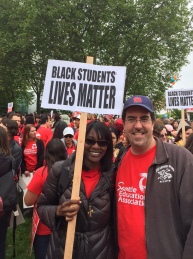
IMG_1933-2Today, the SEA learned from these previous experiences of collective action by the rank-and-file, as well as other smaller locals around the state that began this one day rolling strike wave. The day began with educators, students, and parents rallying at designated high schools. Educators at these spirited morning rallies took up chants beyond the funding issues to also address abuses of high-stakes testing and Black Student Lives Matter.  Then everyone boarded buses and headed for the Space Needle where we gathered to begin our march.   As nurses, counselors, librarians, instructional assistants, family support workers, office staff, teachers, other educators, students, and parents stepped out into the street to begin the rally, I began to realize how many thousands of people were ready to take direct action to Seattle Educators On Strike!: Photos & stories of the struggle | I AM AN EDUCATOR: