Latest News and Comment from Education

Thursday, May 7, 2015

The One about Peter Cunningham, Education Post and Spin... - Badass Teachers Association

Badass Teachers Association:

The One about Peter Cunningham, Education Post and Spin...

BY:  Dr. Mitchell Robinson


John Oliver's recent takedown of standardized testing has met with near-universal praise, and deservedly so. It was a brilliant, thoughtful and bitingly funny analysis of the fatal flaws in the testing business, and was clearly based on extensive research and investigation. There has, however, been one lonely outpost of denial with respect to Mr. Oliver's piece: the intrepid externs at Education Post, and their fearless leader, Peter Cunningham.

Mr. Cunningham is from the long lineage of education leaders who have no degrees in education, have never taught and have zero experience in education outside of decision making and check cashing. By last count, about $12 million of that, as he points out in a recentEduShyster interview:

Cunningham: We hire bloggers and we subsidize bloggers who are already out there and who we want to support or give more lift. I think it’s fine. As you know, I have all this money. I have to spend it.

Mr. Cunningham, using generous donations from the Broad and Walton foundations, among others, has attempted to carve himself a niche as a "reasonable reformer," advocating for a more civil dialogue around the issues he believes are at the core of the reform debate. His agenda is based on 3 "Issues" that form the core of his beliefs about education reform:

1. High Standards for All Students: Is my child learning what is needed to be successful?
Even if our kids are coming home with straight “A”s, how do we really know if they’re learning what they need to succeed in college, in career, and in life?  One teacher’s “A” could be another teacher’s “C”.
We need to have clear and consistent standards for what our kids should be learning.
That is the thinking behind the Common Core — a common set of high learning standards for kids.

As you can see, Mr. Cunningham is a big Common Core booster. He also seems to believe that standardized tests are the only way we will "know if they’re learning what they need to succeed in college, in career, and in life"--which makes sense if you remember that he never taught, so he must not be aware of portfolios, formative assessments, playing checks, demonstrations, essays, poems, term papers, quizzes, drawings, dances, improvisations, compositions, science experiments, interviews, observations, and hundreds of other assessment tools that tell us what students know and can do in rich, meaningful ways.

His essay flagellating Mr. Oliver also uses florid imagery (Oliver throws poor kids under the bus) to defend the Common Core and standardized tests under a cloak of faux-racist indignation, as though more and harder tests will provide the magic solution to lifting poor kids out of poverty. Mr. Cunningham also makes outlandish accusations that exaggerate his importance in the grand scheme of American education:

We know these things because we force the educational bureaucracy to test kids, publish results and take action. Until we demanded real accountability, many states, with a few exceptions, simply ignored these kids.

For a person who has never taught, and holds no elected office, that's a pretty gaudy resume. Mr. Cunningham seems to believe he has the power to "force" schools to test Badass Teachers Association:

Testimony by a mother who knows: The SBAC, graduation, “College and Career Ready” | Seattle Education

Testimony by a mother who knows: The SBAC, graduation, “College and Career Ready” | Seattle Education:


Testimony by a mother who knows: The SBAC, graduation, “College and Career Ready”

JON KRAUSE/NEWS ART
I am a high school math teacher and Richland School District parent. I’ve worked on the SBAC as a contractor for McGraw-Hill and on assessment committees for Washington State’s Office of Superintendent of Public Instruction (OSPI). I am a parent who understands the history of Washington state standards and assessments, and how we came to SBAC and the Common Core State Standards. There was a time that I supported the Common Core. I believe in accountability and rigor. But making a question harder is not rigor and closing the door to a child’s future is not accountability.
Our community’s future grows dark when our children can’t graduate. Without a diploma, they can’t enter the military, apply for trade jobs, and entry into community college or finding work becomes less likely. It’s easy to say “Not our kids” when we’re used to living in a community with an 80% graduation rate. But the probability of our children not graduating will increase with the SBAC. The SBAC designers have predicted an average failure rate of at least 60%. 60% of our children are going to be labeled as failing in school, at learning, and failing at their future before they even step out of high school. They will be labeled failing by a test that doesn’t actually assess what OSPI says it does.
While Pearson, Gates, and McGraw-Hill are draining billions of dollars from our public schools, they are giving us false promises that the SBAC will make our children “college and career ready”. The SBAC can’t do that. Recent studies have shown that even the SAT isn’t an accurate predictor of college readiness. High school students who have scored well on the SAT, but did poorly in high school, were more like to drop out of college than students who did well high school but struggled with testing. If the SAT can’t make these predictions, then neither can the SBAC.
The people who teach our children and live in our community do a far better job of Testimony by a mother who knows: The SBAC, graduation, “College and Career Ready” | Seattle Education:

Why My Charter School Needs a Union | EduShyster

Why My Charter School Needs a Union | EduShyster:

Why My Charter School Needs a Union


Urban Prep teacher Dave Woo says unionization can shine a light *into the dark unknown crevices of charter school management*…
By Dave Woo
Urban_Prep_EnglewoodWhy does my charter school need a union? In a word: accountability. After having worked at Chicago’s Urban Prep Charter Academy for six years, I have serious concerns about how resources are allocated by my own charter network. And my research into whether charter schools are truly public or private entities under the law has convinced me that these problems aren’t confined to schools like Urban Prep or Chicago’s UNO network. There are serious questions that need to be asked about the lack of accountability for charter school operators. Having a union at charters schools will force operators to think twice before doing anything that isn’t in the best interest of students.
Shining a light
When a majority of teachers and staff at Urban Prep decided to organize a union represented by the Chicago Alliance of Charter Teachers and Staff, one of the first actions we took was to file a FOIA request in order to get a better sense of how the Urban Prep network uses the tax dollars and private donations it receives. Here are some of the things we found:
  1. trump towerUrban Prep spends over a quarter of a million dollars a year renting out downtown office space across the street from the Trump International Hotel and Tower for the network administrative staff.
  2. Urban Prep spends $70,000 dollars every year to take all of its staff to St. Charles, IL (a far west suburb almost an hour away from Urban Prep’s closest campus) for a network retreat.
  3. Urban Prep pays its principals salaries that are comparable to the salaries Chicago Public Schools principals, but pays first year teachers  $10,000 less on average than what the average CPS teacher earns.
  4. Urban Prep pays Tim King $220,000 to run 3 schools while the CEO of CPS earns $250,000 to run a district of nearly 200 schools.
  5. Since January 2014, Urban Prep has paid just over $100,000 to public relations firms.
urban prep 2Raising questions
Although the FOIAs haven’t uncovered anything illegal, Urban Prep’s allocation of resources raises questions about whether this money is actually going to improve the education of students. Our decision to form a union at Urban Prep isn’t primarily about compensation. It is about asking Urban Prep why they choose to rent out a space downtown for their administrative offices, when they could use a fraction of their rent to provide better technology to teachers (many teachers have had to purchase their own technology resources or ask for donations from Urban Prep). It is about asking Urban Prep why their administrators deserve Why My Charter School Needs a Union | EduShyster:

What, Exactly, Are We Celebrating About Charter Schools? | Alternet

What, Exactly, Are We Celebrating About Charter Schools? | Alternet:

What, Exactly, Are We Celebrating About Charter Schools?

When Obama asks us to increase support for charter schools, he has missed the larger point.


In his proclamation for National Charter Schools Week, President Barack Obama asks us to accept a truth as yet unproven. He writes: “Today, our nation's very best charter schools are gateways to higher education and endless possibilities, lifting upstudents of all backgrounds and empowering them to achieve a brighter future.”
Obama is not the only one building the hype. Political praise for charter schools emanates from both sides of the aisle; nearly every conservative call for education reform extols charter schools, with said accolades usually accompanying calls for the holy grail of free-market thinking in the educational realm: more parental “choice.”
But no amount of proclaiming and rallying can upend the evidence, which is not good for the charter school camp. Considering that under Obama, the basic framework of education reform has hewn closely to the deeply flawedtemplate created by George W. Bush’s No Child Left Behind Act (and, arguably, raised the stakes even higher), perhaps we should use this week less for celebration and more to seriously consider the evidence. What, exactly, are we meant to celebrate about charter schools? What have they achieved?
Charter Advocacy Fails Against Evidence
For education reformers committed to market forces as a way to force public schools to improve, the initial focus was on vouchers that allowed parents to use public money to pay for private schools. During the Bush administration, however, researchers found that when controlling for student characteristics, private and public schools were mostly alike—both demonstratinga range of quality, the greatest factors being student characteristics.
Since the public has often resisted private-school vouchers, charter schools have become the next great hope that school choice will motivate public schools to reform. Yet in an analysis of charters conducted for the Shanker Institute, researcher Matthew Di Carlo has concluded that “there is nothing about ‘charterness’ that leads to strong results.” In other words, there is nothing about a school being identified as a charter school that excludes other types of schools (regular public, private) from adopting the same policies or practices; there is also nothing about a school operating as a charter school that specifically leads to success. (Take that as your first indication that charter advocacy is more about ideology than evidence-based reform.)
But if there’s nothing about the structure of charters that separates them from the pack, are we celebrating charter schools because of superior student achievement?
In my home state of South Carolina, the picture on student achievement in charters is much like it is in the rest of the U.S. Over a two-year analysis, I have compared SC charter schools with public schools with similar populations of students. Approximately 95% of those charter schools reflect student achievement about the same or worse than comparable public schools.
In other words, charter, public and private schools have about the same range of student outcomes. As Di Carlo stressed in his report, what we know to be true is that the type of school structure matters far less than what schools do and who the students are.
So if it’s not about school structure and it’s not about student achievement, are we celebrating charter schools for reversing the trend of re-segregation in U.S. public schools?
Sixty years after Brown v. Board, public schools across the country have become increasingly segregated by race and class. Few who seek education reform would argue against seeking policies that would counter that trend. Charter schools have demonstrably not met that need because they are significantly segregated—and charter schools also cause serious concern about selectivity, pushing out and under-serving marginalized student What, Exactly, Are We Celebrating About Charter Schools? | Alternet:

solidaridad: Rally against the cuts to Adult Education, Early Education, School Nurses, and Counselors

solidaridad: Rally against the cuts to Adult Education, Early Education, School Nurses, and Counselors:

Rally against the cuts to Adult Education, Early Education, School Nurses, and Counselors


Rally against the cuts to Adult Education, Early Education, School Nurses, and Counselors


All the Pieces Matter

Join us at LAUSD headquarters on Beaudry next Tuesday, May 12, for UTLA's "All the Pieces Matter!" rally against the RIFs.  Come together and show support for our students and Adult Education, and other programs being cut such as Early Education, and counselors. As educators, we are all an important piece in the fight for the Schools L.A. Students Deserve: Parent-enriched Early Education to K-12 to Adult Ed to every classroom to Health and Human Services.

Celebrating National Charter Schools Week: Dark Money Part 4 #CharterSchoolsWeek


Celebrating National Charter Schools Week: Dark Money Part 4  #CharterSchoolsWeek

Celebrating National Charter Schools Week: Re-Segregating America’s Schools Part 3 #CharterSchoolsWeek


The Gates Foundation, The Walton Foundation and the Broad Foundationcould easily be called the un-holy triad of the education reform complex.
While exact numbers are hard to pin down, since 2008 the Bill and Melinda Gates Foundation has spent at least $2 billion, the Walton Foundation at least three-quarters of a billion and the Broad Foundation an estimated half a billion dollars on efforts to “reform” America’s system of education by promoting charter schools, pushing the use of standardized testing, lobbying for teacher evaluation programs based on student’s standardized test results and other corporate-driven initiatives.
The foundations themselves explain their goals and funding strategies through innocuous rhetoric.  For example, the Gates Foundation opines that: “We invest in programs with a common aim to strengthen the connection between teacher and student. To that end, we work with educators, policymakers, parents, and communities to expand and accelerate successful programs and identify innovative new solutions that can help unlock students’ potential.”
But the actual agenda becomes much clearer when one examines their actual list of grantees, which includes most of the country’s charter school management organizations, education reform “think tanks,” and advocacy organizations.
The Gates Foundation: “They’re Everywhere” 
Education reform advocacy organizations that have received Gates money include Jeb Bush’s Foundation for Educational ExcellenceStand for Children, the Center for Reinventing Public Education and the Partnership for Learning and Parent Revolution. Gates has even supported the work of ALEC, the right-wing entity that helps conservative state legislators draft and pass legislation. 
A primary focus of the Gates Foundation has been the push for the extensive use of high-stakes standardized testing.  Although undisputed evidence shows that low standardized test scores are primarily driven by poverty, language barriers, and students’ special education requirements, the Gates Foundation, in its belief that data will solve all problems, has been spending hundreds of millions on developing teacher evaluation systems based on standardized tests, as well as the standardized tests themselves and the huge databases that would be needed to stores and analyze standardized test scores.
To counter the voices and concerns of teachers, the Gates Foundation has also played an essential role in creating pro-education reform teacher organizations includingEducators 4 Excellence and TeachPlus, both of which are dedicated to advocating against unions and teacher tenure and for specific teacher evaluation systems that rely on the use of standardized test scores.  Both Educators for Excellence and TeachPlus were the recipients of significant start-up and operational funds from Gates.
The Gates Foundation is especially fond of funding “independent” think tanks that are involved in studying, reporting and developing education reform models.
The Walton Foundation: “The One Stop Education Reform entity”
If the funding isn’t coming from the Gates Foundation, it is probably coming from the Walton Foundation, the entity created and managed by the family that owns Wal-Mart.
By providing over $750 million in grants to education reform organizations over the last five years, not counting another $35-$40 million to actually pay for reforms in Arkansas, the Walton Foundation is the trendsetter when it comes to funding the development, analysis, advocacy and implementation of education reform.
In Milwaukee, for example, Walton funded the organizations that developed and pushed through the city’s school voucher program. But as a reporter for Gannett News Service discovered, the Walton Foundation also paid for the “external” study of the Milwaukee experiment. Not surprisingly the study, conducted by the School Choice Demonstration Project at the University of Arkansas, concluded that Milwaukee’s voucher experimenthad been a success in raising graduation rates among program participants. Left out of the study was the inconvenient fact that 56% of the students who enrolled in the voucher program left before graduating.
The Walton Foundation also underwrites a growing roster of organizations that focus their resources almost exclusively on advocacy efforts to “insert competition into public education.”  One recent review found that just looking at funds dedicated exclusively to advocacy efforts, Walton money for “Advocacy" Exceeds $100 million.  
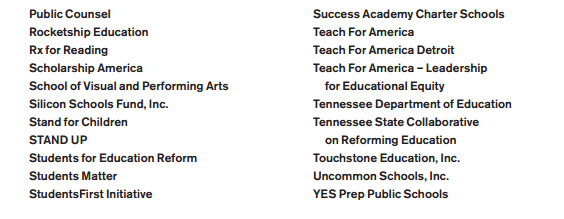
Among the top recipients of Walton funds: StudentsFirst, the advocacy group started and run by controversial former Washington DC schools chancellor Michelle Rhee and Teach for America, which has received more than $50 million since 2011.
And while Advocacy has been a prime activity for the Walton Foundation, the organization has devoted the vast majority of its funds to the proliferation and expansion of charter schools.
Eli Broad Foundation: “Top-Down Education Reform”
And finally the last of the “Big Three” education reform funders is the Eli Broad Foundation which claims to be driven by the mission to, “dramatically improve K-12 urban public education through better governance, management, labor relations and competition.”
Although the Broad Foundation hands out its fair share of money directly to education reform entities, the Foundation’s focus has primarily been to train a cadre of school administrators to go out and take over public school systems and force the reforms using top-down strategies.
The Broad Superintendents Academy and the Broad Residency in Urban Education are the two primary vehicles in that effort.  The Broad Superintendents Academy is an executive management training program that takes “senior executives from business, nonprofit, military, government and education backgrounds to lead urban public school systems.”
The number of Broad Academy graduates in senior public school leadership positions has topped 200 including well over 70 superintendents who are working in more than half the states around the country.
Meanwhile, the Broad Residency program places education reformers in school districts and charter management organizations (CMOs).  Broad Residents receive “two years of professional development,” although taxpayers often end up picking up the costs of salary and benefits for Broad Residents.
The Broad Academy and Broad Residency programs really took off with the election of President Barak Obama.  As the Broad website coos:
“Prior to becoming U.S. secretary of education, Arne Duncan was CEO of Chicago Public Schools, where he hosted 23 Broad Residents. Duncan now has five Broad Residents and alumni working with him in the U.S. Department of Education.”
And, the web site adds, “The election of President Barack Obama and his appointment of Arne Duncan, former CEO of Chicago Public Schools, as the U.S. secretary of education, marked the pinnacle of hope for our work in education reform. In many ways, we feel the stars have finally aligned…With an agenda that echoes our decade of investments—charter schools, performance pay for teachers, accountability, expanded learning time and national standards—the Obama administration is poised to cultivate and bring to fruition the seeds we and other reformers have planted.”
Jonathan Pelto served in the Connecticut state legislature from 1984 until 1993. A communications strategist and public education advocate, he writes the blog “Wait, What?”


Walton Family Foundation 2013 Grant Report


In 2013, the Walton Family Foundation invested more than $325 million in initiatives to expand opportunity for individuals and communities in the United States and internationally. The majority of investments were made in three key areas of focus  K-12 education reform, freshwater and marine conservation and quality of life initiatives in Arkansas and Mississippi.
A full list of grants made in 2013 is below:
Systemic K-12 Education Reform
$164,205,764
Shape Public Policy
63,412,817
Create Quality Schools
70,104,357
Improve Existing Schools
20,586,114
Research and Evaluation
1,127,100
Other Education Grants
8,975,375
Freshwater and Marine Conservation
$93,103,004
Marine Conservation
37,113,766
Freshwater Conservation
33,010,552
Other Environment Grants
22,978,686
Home Region
$32,489,424
Arkansas Education Reform
7,362,269
Northwest Arkansas
18,932,091
Delta Region of AR & MS
6,026,404
Research and Evaluation
168,660
Special Interests
$33,571,010
Grants Less Than $10,000
$1,733,196


Heal Our Schools: documentary on teaching, testing, and more | Education Town Hall Forum: Archives, Announcements, & Extended Discussion on Weekly Broadcasts...

Heal Our Schools: documentary on teaching, testing, and more | Education Town Hall Forum: Archives, Announcements, & Extended Discussion on Weekly Broadcasts...:


Heal Our Schools: documentary on teaching, testing, and more

Laurie Gabriel, veteran teacher and videography, joined the Education Town Hall to discuss the latest version of her documentary film, “Heal Our Schools” (formerly “Hear Our Teachers). The film highlights “virtually cost-free answers to the education crisis” based on real educators’ experience and vision.
healourschoolsGabriel is a veteran teacher and videographer. She has taught grades K-12 in everything from struggling inner-city schools in Denver, CO to rich private schools in Potomac, MD. Her previous video work was classroom-centered. For this film she is partnering with her filmmaker husband, Ethan Gabriel. (see trailer)
Track 2 below —
The Education Town Hall broadcasts from Historic Anacostia in Washington, DC, Thursdays
at 11:00 a.m. Eastern on We Act Radio.
Listen live via TuneIn.
Shows are archived for convenient listening shortly after broadcast.

“Insanity Reigns” in New York |

“Insanity Reigns” in New York |:

“Insanity Reigns” in New York


 As per an article in Capitol Confidential, two weeks ago New York’s Governor Cuomo – the source of many posts, especially lately (see, for example, here, here, here, here, andhere) — was questioned about the school districts that throughout New York were requesting delays in implementing the state’s new teacher evaluation program. Cuomo was also questioned about students in his state who were opting out of the state’s tests.

In response, Cuomo “stressed that the tests used in the evaluations don’t affect the students’ grades.” In his direct words, “[t]he grades are meaningless to the students.”
Yet the tests are to be used to evaluate how effective New York’s teachers are? So, the tests are meaningless to students throughout the state, but the state is to use them to evaluate the effectiveness of students’ teachers throughout the state regardless? The tests won’t count for measuring student knowledge (ostensibly what the tests are designed to measure) but they will be used to evaluate teachers (which the tests were not designed to measure)?
In fact, the tests as per Cuomo, “won’t count at all for the students…for at least the next five years.” Hence, students “can opt out if they want to.” Inversely, if a student decides to take the test the student should consider it “practice” because, again, “the score doesn’t count.” Nor will it count for some time.
In others words, those of a colleague who sent me this article: “Cuomo’s answer to parents who are on the fence about opting out, “oh, it’s just practice.” He expects that when parents hear that testing is low stakes for their kids they will not opt out, but once kids hear that the tests don’t count for them, how hard do you think they are going to try. Low stakes for students, high stakes for the teacher. Insanity reigns!”
This all brings into light the rarely questioned assumption about how the gains that students make on “meaningless” tests actually indicate how much “value” a teacher “adds” to or detracts from his/her students.
What is interesting to point out here is that with No Child Left Behind (NCLB), Governor turned President George W. Bush’s brainchild, the focus was entirely on student-level accountability (i.e., a student must pass a certain test or face the consequences). The goal was that 100% of America’s public school students would be academically proficient in reading and mathematics by 2014 – yes, last year.
When that clearly did not work as politically intended, the focus changed to teacher accountability — thanks to President Obama, his U.S. Secretary of Education Arne Duncan, and their 2009 Race to the Top competition. Approximately $4.35 billion in taxpayer revenues later, we now have educational policies focused on teacher, but no longer student accountability, with similar results (or the lack thereof).
The irony here is that for the most part the students taking these tests are no longer to be held accountable for their performance, but their teachers are to be held for their students’ performance instead, and regardless. Accordingly, across the country we now have teachers, justifiably nervous, who without telling their students that their professional lives are on the line — which is true in many cases — or otherwise lying to their “Insanity Reigns” in New York |: