Latest News and Comment from Education

Wednesday, April 15, 2015

BustED Pencils Trending News: Seattle Opt Out press conference; A child's voice; Teacher Moral plummetting | BustED Pencils

BustED Pencils Trending News: Seattle Opt Out press conference; A child's voice; Teacher Moral plummetting | BustED Pencils:


BustED Pencils Trending News: Seattle Opt Out press conference; A child’s voice; Teacher Moral plummetting

Share
BustEDlogo2news logoBustEDlogo2Seattle’s NAACP stands up against targeted performance testing! WooHoo!! Education Chair, Rita Green, says “costs tied to the test this year is approximately $200,000,000 (two hundred million dollars)…” Did you hear that dollar amount?!  NAACP oppose SBAC and are calling on all parents to opt out and to opt out NOW. Jesse Hagopian, “Teachers in the Seattle public schools are not against tests, in fact they invented tests”. He speaks facts and truth to education. Listen to the whole panel of testifiers/test resisters for quality assessment.
Press Conference on SBAC Testing: Opt Out Movement Biggest in Seattle’s History
BustEDlogo2BustED Pencils blogtalkradio.com show introduces Lacey Slekar as their new Student Issues Correspondent. Listen as Lacey (12) interviews Sydney (9) regarding opt out and standardized tests.  You won’t believe the maturity level of these two girls.  A MUST LISTEN!!
4th Grader and standardized testing expert Sydney Smoot. 
BustEDlogo2If nothing else, this article has a slew of highly informative links for those seeking information about the attacks on public schools and what it’s all about.
Why Has Teacher Moral Plummeted? 

If you’re interested in receiving BustED Pencils Trending News, please go tohttp://bustedpencils.com/ and subscribe

Merryl Tisch Shows How Test Supporters Get It Wrong - View From the Cheap Seats - Education Week Teacher

Merryl Tisch Shows How Test Supporters Get It Wrong - View From the Cheap Seats - Education Week Teacher:

Merryl Tisch Shows How Test Supporters Get It Wrong


New York Chancellor of the Board of Regents Meryl Tisch stopped by All In with Chris Hayes to avoid answering some pointed questions about high stakes testing and the opt out movement in New York. She had the additional disadvantage of sitting beside Diane Ravitch, who did answer questions and made Tisch look even slipperier by comparison, but I think Tisch's appearance is a quick, capsuled look at what promoters of high stakes testing get wrong.
After opening with some background (Atlanta convictions, rising parent opposition, left-and-right wing hatred for Big Standardized Tests), Hayes notes that New York's opt out numbers are huger than ever and turns to Tisch.

Hayes: When you see the reports of opting out, including the high strong numbers from some areas, do you think "People are crazy" or "We are doing something wrong"?
Tisch does not think people are crazy (phew!) and believes that people "should act in what they perceive to be the best interests of their children." That's an important construction because like many BS Test fans, Tisch is also a charter school fan, which puts her in the awkward position of believing that parents should opt out of public school, but not public school testing. Choice is only okay sometimes.
So why the push back? "Perhaps we have not been clear enough in describing the intent of the test." So, opt out is a PR problem, because if people disagree with us, it could only be because they don't understand how right we are. So what is the intent of the test?
"The intent of the test is to give a snapshot of performance and allow parents to know where their children are at any given point in their educational career as compared to their peers."
And there's your first problem, because that doesn't even make sense. "Snapshot" and "at any given point in time" do not go together. I can't see how my child is doing at any point in time because I only have a snapshot from one particular point in time.
Tisch moves on immediately to asserting that income inequality is directly tied to the achievement gap (which is actually the BS Test score gap) for our poor students, and she starts waving the Wait Let Me Speak hand at Hayes because he is completely ready to call her on that piece of baloney, so she squeezes in that poor students can't make more money unless they have access to high quality education. Hayes calls her on her correlation-causation fallacy, but I'd like to call her on her fallacious equating of high quality education and high stakes snapshot testing. What does taking the BS Test have to do with access to high quality education?
The reformster answer (which Tisch doesn't get to) is that BS Test results allow us to target the students who are struggling. The problem here is that 1) we already know where they are and 2) after years of targeting them with BS Testing, we have yet to actually get them additional resources to help them do better.
Ravitch gets her turn and uses it to point out that tests are not vaccinations and these tests are not useful because the results provide no useful information. "There is no diagnostic value to the test," somehow prompts Tisch to smirk, like she has caught the help trying to act like they know how caviar really tastes. Hayes notes that Tisch clearly has something she wants to share with the rest of the class, and she unveils Test Purpose #2.
The tests are a diagnostic tool for curriculum and instruction development on the state level, and a way of making sure the taxpayers get their money's worth.
In other words, a completely different purpose for the tests than the one she offered about two minutes earlier. It's now a snapshot of how our children, schools, and systems are doing-- for the taxpayers. So that business about info for the parents was, what-- just spitballing? Because if this is the actual purpose of the test then 1) what's wrong with the NAEP and 2) why is it necessary to test every child every year?
Hayes points out that Tisch gave a non-response to the observation that the tests are not diagnostically useful for students, parents or children, and she insists that she be allowed to insert a non-response to that point. When parents opt out it messes things up. Also, she was in a doctor's office where a parent wanted to compare their child to a growth chart. Like the vaccination Merryl Tisch Shows How Test Supporters Get It Wrong - View From the Cheap Seats - Education Week Teacher:

Accountability for Whom? | Pedro Noguera

Accountability for Whom? | Pedro Noguera:

Accountability for Whom?


ATLANTA TEACHERS


 So much is wrong about the cheating scandal in Atlanta: the miscarriage of justice in the verdict rendered by Judge Jerry Baxter, the unwillingness of policymakers to recognize their own culpability in the scandal, the lack of attention to the educational needs of the children in Atlanta and hundreds of other communities where failed policies have undermined the quality of education children receive, and of course, the cheating itself.

There is no doubt that cheating occurred in Atlanta Public Schools (APS), and that it was systemic, pervasive and involved dozens of educators across many schools. The fact that there was extreme pressure placed on educators to obtain higher test scores, and that unrealistic goals for improvement were set, may explain why it occurred but it does not justify it. Educators may not get paid like doctors but they are trusted and generally held in high regard by the public (less so by policymakers) for the work they do. The mere fact that we apply the term in loco parentis (in place of parents) to teachers is just one of many indications that they occupy an important role in our society.
Certainly there was considerable pressure to cheat. It was created by demanding, "take no prisoners" administrators, primarily the recently deceased superintendent, Dr. Beverly Hall. Though she never admitted to cheating or knowing about its occurrence, the threats and mass firings of principals she used to get results certainly played a role in creating the atmosphere that allowed cheating to flourish. But the demanding strategies used by Hall have been followed by celebrated superintendents throughout the country, including Michelle Rhee when she was Chancellor of schools in D.C., Joel Klein, the former chancellor of New York, and yet another now deceased superintendent, Arlene Ackerman, who was once highly acclaimed as an educational leader in Philadelphia.
I knew and respected Dr. Hall and I had extensive contact with schools and educators in Atlanta during the years when the cheating occurred. One of the schools I visited was Park Middle School, the site described in a New Yorker article as the epicenter of the cheating conspiracy. When I visited Park for the first time in 2001 it was a chaotic and dysfunctional school, a place not conducive to good teaching or serious learning. Over the course of the next five years I visited the school regularly, met with educators about how to address the needs of their students, and saw the school transformed into a safe, orderly place where teachers collaborated about their work and students appeared to be invested in learning.
I attributed many of the changes I observed at Park and other schools in Atlanta to the demanding leadership of Dr. Hall. Like many others, including Education Secretary Arne Duncan, I was impressed by the progress that was made in Atlanta during the Hall years, 1999-2010, and I did not doubt the stunning results because I had seen concrete evidence of improvement. I had spent time in the Atlanta Public Schools in the past when Ben Canada was superintendent and I had seen the poorly managed schools up close. I was also well aware of the petty political battles among school board members that frequently degenerated into threats and name-calling and were an embarrassment to the entire city. My familiarity with the past was one of the reasons I credited Dr. Hall with the turnaround and for that reason I believed that the awards she received for her accomplishments -- Superintendent of the Year in 2010, a distinguished service award from the American Educational Research Association, an honorary degree from Bank Street College (which I received along with her) -- were well deserved.
Like so many others, I heaped praise upon the district because I'd seen the changes in the state of the schools and there was objective evidence that the improvement was real. An analysis of NAEP (National Assessment of Educational Progress -- also known as the nation's report card, and an assessment on which there was no evidence of cheating) results in 2012 showed that Atlanta made more progress than any other urban district in the country. Low-income African American students gained 22 points in mathematics and 12 points in 8th grade reading. Writing in a blog to explain these results, former Assistant Secretary of Education Michael Smith wrote "The evidence suggests that there was a lot going on in Atlanta from 2003-2011 other than alleged cheating. The good should not be erased or discarded."
During the decade she led the district of 52,000 children, many of them poor and African-American, Atlanta students often outperformed wealthier suburban districts on state tests. These results caught the attention of her admirers and also raised suspicion. Reporters for the Atlanta Journal-Constitution and state education officials repeatedly heard rumors of cheating and began monitoring the district closely. One of my colleagues, a well-known statistician, was brought in to analyze the extraordinary increases in test scores that had occurred from one year to the next. He reported that it was highly unlikely that the increases could be explained by good Accountability for Whom? | Pedro Noguera:
Big Education Ape: Atlanta Schools Cheating Scandal - When Justice is a Crime http://bit.ly/1FLFQvn
Big Education Ape: Mike Klonsky's SmallTalk Blog: Rhee sentenced to 20 years for erasing grades -- Just a dream. http://bit.ly/1EIfoqh
Big Education Ape: One of Georgia's longest-ever criminal trials is over, and it's sending teachers to prison for u... http://bit.ly/1FRSTAO


Alexander on Bipartisan Legislative Agreement to Fix No Child Left Behind - YouTube

Alexander on Bipartisan Legislative Agreement to Fix No Child Left Behind - YouTube:

Alexander on Bipartisan Legislative Agreement to Fix No Child Left Behind 


 At the start of the Senate education committee markup today of bipartisan legislation to fix No Child Left Behind, Chairman Lamar Alexandersaid the bill reflects “remarkable consensus” about how to fix the problems with the law. Alexander said the agreement will "continue the law’s important measurements of academic progress of students but restore to states, school districts, classroom teachers and parents the responsibility for deciding what to do about improving student achievement. This change should produce fewer tests and more appropriate ways to measure student achievement."

High Stakes Testing? It’s all about the power and the money – again. | Reclaim Reform

High Stakes Testing? It’s all about the power and the money – again. | Reclaim Reform:


High Stakes Testing? It’s all about the power and the money – again.

Florida Gov. Rick Scott and the state legislature continue to play power games with high stakes testing while pretending to save the children and all of public education from testing harm.
This political posturing is similar to the man who murdered his parents and then claimed that he should not be jailed because he was an orphan.
Rick Scott plays for controlSince present Florida Gov. Rick Scott plans to run for the U.S. Senate, he is posturing as being better than former Florida governor and presidential candidate Jeb Bush – or tougher, or smarter, or anti-establishment, or whatever his PR department can claim. He is also planning to spend even more education funding to pay a private company to write some kind of review.
Gov. Scott Signs Bill to Limit Standardized Tests: The changes represent a departure for the Republican-controlled Legislature because it a step back from some of the reforms championed by former Gov. Jeb Bush.The new law caps statewide standardized testing at 45 hours a year. It would let school districts move up the start of the school year to Aug. 10.
The legislation would delay the release of this year’s school grades until an independent review of the new test can be performed. Other sanctions associated with annual testing would also be put on hold while the review is underway.– CBS Miami
Senate passes testing bill: The train wreck that is Florida’s accountability system was lambasted by Republican and Democratic senators, even by those who admitted to having voted for the ‘reforms’ over the years. “This is kind of backwards. What we’re doing is giving kids the test and then deciding afterwards whether or not we’re going validate the test,” said Sen. Jeff Clemens, (D-Lake Worth). Sen. Lee called out Bush’s foundation for pushingto maintain the current level of testing for all the wrong reasons…
There are some provisions from the old version of the House bill included in this new improved Senate version and some new language for which we all lobbied. The new version includes: • Reduced impact of test scores on 
High Stakes Testing? It’s all about the power and the money – again. | Reclaim Reform:

Atlanta Schools Cheating Scandal - When Justice is a Crime


Cheating on a Standardize Test


Convicted of Charter School Fraud


OIG Investigative Reports, Charter School Owners Sentenced for Defrauding School to Pay for Lavish Lifestyle http://1.usa.gov/1FLBPqS

Charter school founder convicted on tax charges http://on.freep.com/1FLC1pX

SC charter school head guilty of embezzlement | The State The State http://bit.ly/1FLC8Sl

Charter school founders sentenced in misuse of funds - latimes http://lat.ms/1FLCfxm

Ivy Academia founders sentenced in fraud case http://bit.ly/1FLCrwF

Optometrist, Charter School Manager, and Now Convicted Felon Can Be Added To His Curriculum Vitae: The Continuing S... http://bit.ly/1FLCAQz

Former charter school leader gets plea deal http://cin.ci/1FLCI2x


Need More Google Charter School Fraud

Politicians Try to Union-Bust Their Way to the White House

Politicians Try to Union-Bust Their Way to the White House:

Politicians Try to Union-Bust Their Way to the White House


 Fiery labor icon Mother Jones cannot be resting peacefully beneath the crabgrass in the Union Miners’ Cemetery, not far from Springfield, Illinois, where Bruce Rauner, the recently elected Republican governor, has launched an unprecedented attack on organized labor. Rauner, a former private equity fund chairman, made a reported $62 million in 2013, the year before he was elected. Now the Harvard MBA is challenging public and private unions on several fronts—even pushing the state’s municipalities to create “right-to-work zones,” where workers in unionized jobs could opt out of paying union dues. This town-by-town approach is a relatively new idea and may be of dubious legality, but it’s already caused Cook County, where Chicago is situated, to preemptively declare that it won’t go along.

Rauner is part of a clique of Midwestern Republican governors challenging unions in a region where behemoths like the United Auto Workers and massive public employee unions covering teachers and other state employees have long dominated. In Wisconsin, Governor Scott Walker diminished the power of the state’s public employee unions in 2011 by pushing through a law that cut their benefits and limited their collective bargaining power.


That move, and his survival of a union-led recall effort in 2011, not only propelled Walker into the first tier of Republican presidential candidates; it also emboldened conservative governors and legislators around the Great Lakes. Governor Rick Snyder made Michigan a right-to-work state in 2012, and Indiana’s governor at the time, Mitch Daniels, followed suit, creating a bloc of anti-union states in what was once a labor stronghold. Their latest victory: Last month, Walker signed a law making Wisconsin the nation’s 25th right-to-work state.
Rauner’s efforts in Illinois are getting the closest scrutiny. That state is an unlikely launch pad for a crusade against union power. It has been a solidly blue state in presidential elections since 1992 and had not elected a Republican governor since 1998 until Rauner, a longtime friend of Rahm Emanuel, the Chicago mayor who had also worked in private equity, won office last year. Conservative journalist Stephen Moore called the political newcomer’s campaign “the biggest election of 2014.“ Illinois, he wrote in National Review, “could become a laboratory experiment about whether conservative ideas can work in a state that has been ruled by...unions and a self-serving political machine in Springfield and Chicago.”
Once in office, Rauner issued a “Turnaround Agenda” that begins with this premise: “Government union leaders are funding politicians who negotiate their pay and benefits.” To put an end to that, Rauner issued an executive order challenging collective bargaining agreements with state employees and urged municipalities and counties to create their right-to-work zones.
Rauner frames the issue as one of freedom and local control. The governor says he wants Illinois communities to decide whether “their businesses should be subject to forced unionism or employee choice.” Forced unionism is a familiar phrase among opponents of collective bargaining, but it’s also a misleading one. If a majority of workers vote to form a union, then it’s customary for workers to be compelled to pay dues as a price for being in a union. Those who don’t want to join the union are required to pay something so they aren’t getting a free ride. By giving workers the prerogative not to pay union dues, right-to-work laws undercut the power of unions.
Hoping to spur municipalities to take on public-employee unions, Rauner sent right-to-work resolutions to all of Illinois’s cities and villages. A municipality can just insert its name and vote on it. It’s a smart strategy since the Illinois statehouse is solidly Democratic and won’t pass a right-to-work law. Setting fires in small towns might arouse anti-union sentiment, and it will surely inflame the unions. Last week, unions packed a meeting of the Oswego County board in northern Illinois, where the nonbinding resolution was up for discussion. Scott Roscoe, president of the Fox Valley Building Trades Council in Aurora, told a local journalist, “If we don't stop anti-worker schemes like right-to-work, more families will fall behind.”
04_10_Unions_02Anti right-to-work protester Susan Laurin (C) of Michigan State Employees Union Local 6000 yells with fellow protesters outside of Michigan's state capitol building in Lansing, December 11, 2012. REBECCA COOK/REUTERS
So far, no Illinois communities have voted to become right-to-work zones. Three local legislative bodies have decided not to approve the resolutions, one without even holding a hearing. And there’s some question as to whether the adoptions of such zones is legal. (The National Labor Relations Act seems to give this kind of authority to states and territories, but not towns.)Politicians Try to Union-Bust Their Way to the White House:

'Historic': First Katrina state takeover school returns to New Orleans control | NOLA.com

'Historic': First Katrina state takeover school returns to New Orleans control | NOLA.com:

'Historic': First Katrina state takeover school returns to New Orleans control


 Almost 9 1/2 years after the Louisiana Recovery School District took over 100 New Orleans schools, the first one has moved back. The state Board of Elementary and Secondary Education stamped its OK in committee Tuesday (April 14) to the contract Martin Luther King Jr. Charter has signed with the Orleans Parish School Board.

The board is expected to ratify the decision Wednesday.
A couple of School Board charter groups have taken over failed Recovery charters, but this is the first time a takeover school has chosen to return -- after dozens turned down the opportunity. State Superintendent John White, Recovery Superintendent Patrick Dobard and Orleans Parish Superintendent Henderson Lewis Jr. all used one word to describe the day: "historic." Said Dobard, "This has been a long time coming."
Board member James Garvey of Metairie said it put the lie to critics who say the state is simply interested in taking over schools, not giving them back.
King, a B-graded charter serving pre-kindergarten through 12th grade, has been an anchor in the Lower 9th Ward as the neighborhood rebuilds from Hurricane Katrina. The charter's board "is excited about its new, long-term relationship with OPSB," said Tracie Washington, the Friends of King attorney.
Its road back to the School Board has not been straight. Friends of King initially voted to stay with the state again last fall. Like many other charters, members expressed concern over the School Board's political direction; Lewis started his job last month after 2 1/2 years of interim leadership.
This has been a long time coming." - RSD Superintendent Patrick Dobard
But Friends of King members changed their mind after the Recovery system sought to shorten the length of King's new contract from seven years to five due to allegations the school turned away special education students, a charge the board disputed.
King has a seven-year contract with the School Board, Orleans charter chief Kathleen Padian said. It will continue to control its own finances. And it remains in OneApp, the city's computerized school enrollment program that matches students with open seats without regard to special education status. Nine School Board charters do not use OneApp, running their own lotteries instead.
Dobard on Tuesday said King "has shown great growth and it also shows a commitment to serving all children."
Lewis said King was "returning under the same equity requirements as it's been under with the Recovery School District." He clarified later he meant simply that the school has no entrance requirements.
"When people think of OPSB they think of selective admissions," he said, even though only a few of the A-graded system's 20 schools are test-entry. King is "a school that has done well with receiving all children."
Friends of King also runs Joseph Craig Charter, a Tremé elementary that will remain in the Recovery system, having not yet met the requirements to transfer. Charters may vote to return to local control only if they have been open for at least five years and met certain academic benchmarks.'Historic': First Katrina state takeover school returns to New Orleans control | NOLA.com:

Illinois Governor Suggests Bankruptcy for Chicago Public Schools | Larry Miller's Blog: Educate All Students!

Illinois Governor Suggests Bankruptcy for Chicago Public Schools | Larry Miller's Blog: Educate All Students!:

Illinois Governor Suggests Bankruptcy for Chicago Public Schools


 Rauner likes ‘bankruptcy’ to cure CPS financial woes

By Melissa Sanchez and Sarah Karp 4/15/15 Catalyst Chicago
To resolve Chicago Public Schools’ crippling financial problems, Gov. Bruce Rauner on Tuesday suggested a polemic although not quite legal possibility: declare bankruptcy.
“The state has a crisis, the city has a crisis. I’m concerned that [CPS] is going to have to go bankrupt,” he said during a moderated discussion at a Chicago Public Education Fund luncheon. “Bankruptcy code exists to help the organization get out of financial trouble. There’s a reason for the bankruptcy code.”
Then he told the sympathetic audience – which minutes later gave him a standing ovation – that unions are partly to blame for why municipalities and school districts in Illinois can’t file for bankruptcy in order to renegotiate debt.
“Insiders in our system currently have made bankruptcy in government units illegal because some people never want to restructure contracts – contracts brought into place through insider deals,” said Rauner, who also advocated for right-to-work zones.
The governor’s comments were met with wide disapproval among city leaders and the Chicago Teachers Union – a rare instance of agreement between public figures that are often at odds.
Libby Langsdorf, a spokeswoman for Mayor Rahm Emanuel, assured that CPS is not looking into bankruptcy as a way to solve the $1.14 billion budget deficit it faces next year. Instead, she said, the mayor looks forward to discussing with Rauner issues such as statewide spending on education, and state subsidies to the Chicago teachers pension system. CPS is the only Illinois district that doesn’t get subsidies.
“Instead of proposing to solve the state’s fiscal crisis on the backs of local governments, he should be working to ensure that Chicago, the biggest economic driver in the state, gets back on sound footing,” Langsdorf said in a statement.
Meanwhile, Chicago Teachers Union President Karen Lewis called it “irresponsible” for Rauner to even suggest bankruptcy. “Why would he bring this up and suggest it to CPS other than for it to be a way to get around our contract — and we’re in the middle of negotiations?” she asked.
Jackson Potter, also of the CTU, suggested raising taxes on the wealthy or the so-called LaSalle Street tax to generate revenue to help the state generate more revenue to fund schools. “Instead Rauner is putting us on a trajectory of a downward spiral, where it’s going to worry creditors about not getting their money back, make borrowing more expensive and exacerbate their financial crisis for people who are in debt.”
State would have pass bankruptcy law
Ralph Martire, executive director of the Center for Tax and Budget Accountability, says the state Legislature would have to pass a law in order to allow for bankruptcies – an idea that some conservative lawmakers have recently brought up as a way to get out of public employee obligations. And last year the Illinois Municipal Association held a session on the issue called “Finance: Lessons from Detroit and Pension Cases” during its annual conference, the Better Government Association reported.
Even if bankruptcy were an option, Martire says there would be plenty of drawbacks for a school district like CPS: “There would be a huge loss of confidence in the school district and a mass exodus of qualified teachers and staff who do not want collective bargaining through bankruptcy court. And the district’s ability to [issue debt] would be severely limited,” he says. “It would not be a happy place to be.”
In 1979, CPS went virtually bankrupt after dipping into funds that should have been restricted for debt repayment. The Legislature responded by creating an oversight body that sold bonds to keep the system running and impose budget restrictions. Meanwhile, school staff suffered payless paydays and stiff budget cuts all around.
Few U.S. school districts have ever declared bankruptcy, says Michael Griffith, a school finance consultant with the Education Commission of the States. He says states have to adopt a federal bankruptcy law in order to allow that to happen. Then, a federal judge must determine if a specific government entity qualifies for bankruptcy.
If so, the federal judge becomes responsible for deciding whether the municipality or school district can get out of pension debt by lowering payments to retirees, break contracts or Illinois Governor Suggests Bankruptcy for Chicago Public Schools | Larry Miller's Blog: Educate All Students!:

Mike Klonsky's SmallTalk Blog: Rhee sentenced to 20 years for erasing grades -- Just a dream.

Mike Klonsky's SmallTalk Blog: Rhee sentenced to 20 years for erasing grades -- Just a dream.:

Rhee sentenced to 20 years for erasing grades -- Just a dream.


They're whistling Dixie in Atlanta this morning. 
I had a strange dream last night. Michelle Rhee was standing in front of a crazed, media-hungry judge who sentenced her to 20 years in the penitentiary under RICO statutes for "racketeering" stemming from her leadership role in the D.C. cheating scandal. He also confiscated her Mercedes. Alas, it was just a dream. When I woke up, Arne Duncan (who had promised to visit her in prison) hadn't even taken back the Blue Ribbon he awarded Rhee and the district for the amazing, but temporary bump in test scores.

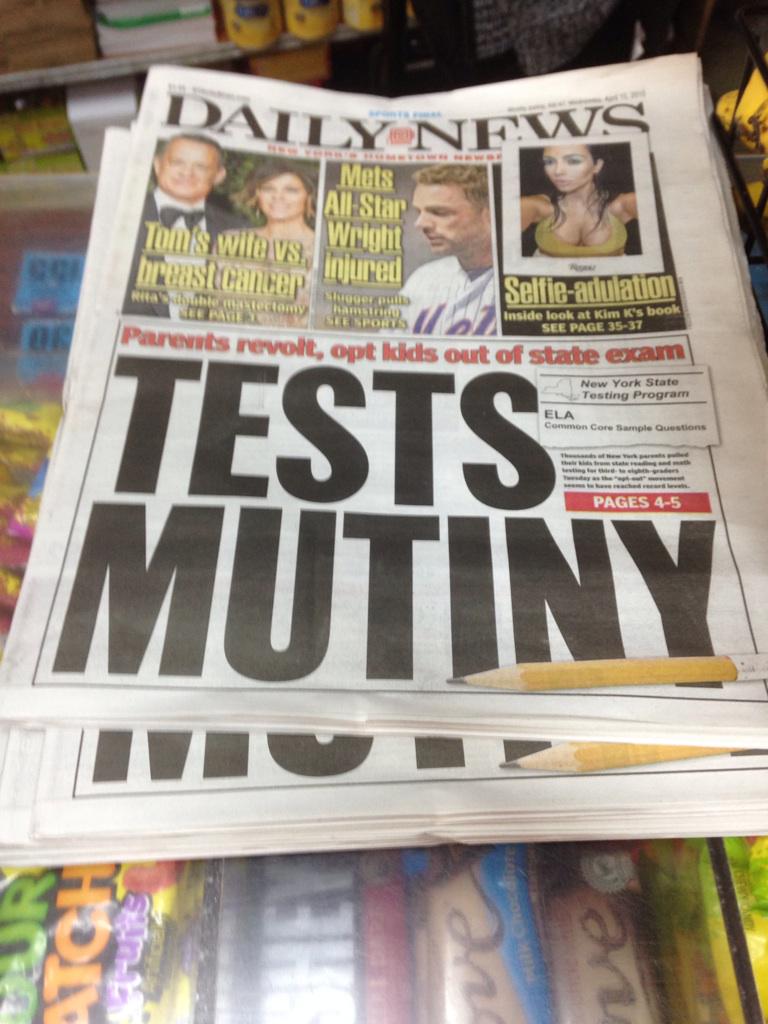
This was not a dream -- Today's Daily News reports:

The entire structure of high-stakes testing in New York crumbled Tuesday, as tens of thousands of fed-up public school parents rebelled against Albany’s fixation with standardized tests and refused to allow their children to take the annual English Language Arts state exam.
 View image on Twitter

 Pay attention, Hillary Clinton.

Rethinking Schools Editorial: The Gathering Resistance to Standardized Tests

Rethinking Schools Editorial: The Gathering Resistance to Standardized Tests:

Editorial: The Gathering Resistance to Standardized Tests


U.S. Secretary of Education Arne Duncan touched off a torrent of criticism last November when he told a group of state school superintendents that opposition to the Common Core State Standards (CCSS) was coming from “white suburban moms who—all of a sudden—their child isn’t as brilliant as they thought they were, and their school isn’t quite as good as they thought.”
White suburban moms, among many others, have certainly played an important role in organizing resistance to high-stakes tests in actions that have led to important victories in Texas, New York, and beyond as they fight to defend their children from abuse by a multibillion-dollar testing industry that is homogenizing education and draining resources from cash strapped school districts. The obsession with data and testing is driving the professionalism out of teaching and the joy out of learning.
But Duncan’s “white suburban moms” comment and the resulting media coverage—portraying this as another inelegant choice of words by a bumbling cabinet official—obscured two essential facts: The high-stakes standardized testing attack has always exacted the highest toll on communities of color. And activists of color are playing leading roles in the movement to curb these abuses.
In the name of closing the achievement gap, entire communities of color in cities around the country have seen classrooms converted to test prep centers, where the time spent on studying strategies for eliminating wrong answer choices has pushed out inquiry, collaboration, creativity, critical thinking, the arts, and culturally relevant pedagogy. Two clear examples of standardized tests supporting institutional racism are Chicago and Philadelphia, where the tests are being used to label schools in communities of color as “failures” and then shut them down at unprecedented rates.

A Sordid History

The United States has a long history of using intelligence tests to support white supremacy and class stratification. Standardized tests first entered the public schools in the 1920s, pushed by eugenicists whose pseudoscience promoted the “natural superiority” of wealthy, white, U.S.-born males. High-stakes standardized tests have disguised class and race privilege as merit ever since. The consistent use of test scores to demonstrate first a “mental ability” gap and now an “achievement” gap exposes the intrinsic nature of these tests: They are built to maintain inequality, not to serve as an antidote to educational disparities.
Fortunately, in the wake of a decade-long barrage of standardized tests unleashed by No Child Left Behind, Race to the Top, and now the Common Core, a movement of resistance has emerged around the country in the last year. This uprising had important antecedents, but reached new levels when educators at Seattle’s Garfield High School refused to administer the MAP test in the winter of the 2012–13 school year. The defiance of Garfield educators inspired others throughout Seattle, and then around the nation, in what came to be known as “Education Spring.” Many hundreds of parents in Long Island opted their children out of tests; students walked out of high-stakes standardized tests in Portland, Chicago, and Colorado; and rallies in Texas helped roll back 10 of 15 required tests for graduation.
In downtown Providence, Rhode Island, pedestrians were startled when a troop of ghastly looking youth—complete with blood-spattered clothes and deathly pale complexions—gathered at the state department of education building, where one student stepped forward to announce:
We are here to protest the use of high-stakes standardized testing, and the zombifying effects it is having on our state’s young people. To base our whole education, our whole future on a single test score is to take away our life—to make us undead. That’s why we’re here today, in front of the Rhode Island Department of Education, as the zombies this policy will turn so many of us into. We’re here to say: No Education, No Life!

A Movement Gathers Steam

As a new barrage of CCSS tests come online, the creativity, dynamism, and power of Education Spring show no signs of abating. Parents at Castle Bridge Elementary School in New York City overwhelmingly opted their children out of a standardized test that ultimately had to be canceled due to the lack of participation. California placed a year-long moratorium on the use of Common Core exams to make “accountability” decisions, a modest step that drew threats from Duncan to withhold hundreds of millions of dollars in federal education aid. The St. Paul Federation of Teachers won contract language that reduces classroom time assigned to test prep and testing. The Portland, Oregon, teachers’ union’s new contract “bars the use of student performance on standardized tests as a basis for involuntary transfers, layoffs, placement on the salary schedule, and/or disciplinary language.” In Chicago, 100 percent of the teachers at Maria Saucedo Scholastic Academy voted to boycott the Illinois Standards Achievement Test, backed by the full support of the Chicago Teachers Union, which called it “an obsolete test [that] has no use to educators or administrators . . . and serves no purpose other than to give students another standardized test.” The boycott vote followed on the heels of a press conference by Chicago parents representing a reported 500 parents who have opted out districtwide.

Confronting Racism

And yet, for this movement to truly fulfill its potential, it needs a deeper understanding of how different communities are being affected by these tests. If the power of solidarity is going to reclaim our schools, more affluent, predominantly white activists will need to develop an anti-racist understanding of the movement against standardized testing and the barriers that communities of color face to joining—including the very real fear from parents of color that their children’s schools will be shut down if they don’t encourage them to score well on the tests. In some instances, parents of color have expressed support for standardized tests as a way to hold school systems accountable for the education of their children, who have far too often been systematically neglected, disproportionately disciplined, and left to cope in the most under-resourced schools.
In this context, it is critical for the opt-out/boycott movement to be consistent and clear: Not only do these tests narrow the curriculum, kill creativity, and degrade the quality of education for everyone, they also funnel black and brown youth into prison in unprecedented numbers. As Michelle Alexander noted in The New Jim Crow: Mass Incarceration in the Age of Colorblindness, “More African Americans are under correctional control today—in prison or jail, on probation or parole—than were enslved in 1850.” The school-to-prison pipeline is a major contributor to that atrocity. Boston University economics professor Kevin Lang’s 2013 study The School-to-Prison Pipeline Exposed reveals that increases in the use of high-stakes standardized high school exit exams are linked to increased incarceration rates.
So it’s no surprise that activists of color have played major roles in advancing some of the most prominent struggles against standardized testing. To name just a few examples: Castle Bridge Elementary PTA co-chairs Đào X. Trần and Elexis Loubriel-Pujols helped lead their school—which serves 72 percent students of color—in the successful opt-out revolt. Karen Lewis, president of the Chicago Teachers Union, has spearheaded the “Let Us Teach!” campaign against high-stakes testing there. High school teacher and Rethinking Schools editorial associate Jesse Hagopian was one of the leaders of the Seattle MAP boycott, which was vigorously supported by the local NAACP.
A multiracial fightback against the testing industrial complex—one that is explicitly ant-racist and takes up issues of class inequality—has the potential to change the terms of the education reform debate and envision a world where authentic assessments are used to support students as they engage in classroom inquiry about how to achieve social justice.

Clear Goals, a Wealth of Strategies

Because the stakes attached to these tests are different for different communities, this new movement against standardized testing would do well to embrace a multifaceted approach. Opting out and boycotting tests can be exemplary individual actsof resistance. But this tactic becomes most powerful when it grows beyond individual to collective action and becomes part of a mass movement of resistance and protest that includes many entry points and expressions. Other possibilities include encouraging politicians to “opt-in” by publicly taking the exams, holding community film screenings on testing, refusing to teach to the tests, and using social justice pedagogy in the classroom to help students think critically about the ugly origins and abuse of standardized testing.
Rethinking Schools is collaborating with a nationally coordinated campaign of grassroots organizations that have united to defend public education against testing abuses. This new coalition has launched what they call “Testing Resistance & Reform Spring” (actionnetwork.org/groups/testing-resistance-reform-spring) in an effort to support testing boycotts, rallies, opt-out organizing, town hall forums, and petition drives. We urge Rethinking Schools readers to send us stories of your own actions of defiance and refusal to reduce students and teachers to test scores. We’ve won the argument against high-stakes standardized tests. Now we need to back that up with organized resistance.Rethinking Schools Editorial: The Gathering Resistance to Standardized Tests:

Research that Counts (Susan Ohanian Speaks Out)

Research that Counts (Susan Ohanian Speaks Out):

The Mismeasure of Education: A Review


Susan Notes:
This essay review of The Mismeasure of Education by Jim Horn and Denise Wilburn
does what a good review should do: Offer insights to the reader about an important book. As Garrison points out: Few educational professionals are aware of the force of assessment history and how the current reform efforts echo so much of the driving force of this history. Certainly if teachers read this book they'd better understand the why and how of the current assault on them and the schools in which they teach.

Take a look at other opinions. These blurbs appear on the book:

"When the Obama Administration decided to spend the billions it got for schools as part of the stimulus package to launch the Race to the Top program and the NCLB waivers, forcing many states to adopt teacher evaluation based on changes in student test scores, leading experts warned that this "value added" system did not have a reliable scientific basis and would often lead to false conclusions. This sobering and important study of the long experience with this system in Tennessee (where it was invented) shows that it did not work, was unfair, and took attention away from other more fundamental issues." Gary Orfield Distinguished Research Professor, UCLA, Co-Director, Civil Rights Project/Proyecto Derechos Civiles, UCLA 


"If The Mismeasure of Education offered only its penetrating new look at Conant and Coleman, it would be worth the price. But that's just the beginning. Horn and Wilburn uncover the obsessive instrumentalist quantification and apocalyptic rhetoric soapboxed by both liberal and conservative political elites. Their autopsy of value-added accountability reveals the pathology of ed reform's claim about teachers not being good enough for the global economy." Susan Ohanian Educator, Author, Activist 


"A well-researched (and frightening) look at examples of shameful pseudoscience in America, the latest manifestation of which is value-added assessment for determining teacher competency... A well-documented and thorough analysis, inescapably leading to the conclusion that student test data cannot be used to determine teacher effectiveness. A must read for policy makers enamored of the idea that value added assessments will do what is claimed for them. They do not!....An excellent and scholarly history of how we got to an educational-testing/industrial complex, now promoting invalid assessment strategies that are transforming education, but not for the better. A scary book that should be thoughtfully read by those who value America's greatest invention, the public schools." David Berliner Regents' Professor Emeritus, Arizona State University 


"The Mismeasure of Education is a magnificent work, an elegantly written, brilliantly argued and erudite exposition on why the "what," "how" and "why" of effective teaching cannot be adequately demonstrated by sets of algorithms spawned in the ideological laboratories of scientific management at the behest of billionaire investors... This book will serve as a sword of Damocles, hanging over the head of the nation's educational tribunals and their adsentatores, ingratiators and sycophants in the business community... The Mismeasure of Education will have a profound resonance with those who are fed up with the hijacking of our nation's education system. This is a book that must be read by everyone interested in the future of our schools. It is a book that advocates real educational justice, for student, teachers, administrators and the public; it is informed by impressive scholarship and compelling argument. It is surely to become a classic work." Peter McLaren Professor, GSEIS, University of California, Los Angeles, Distinguished Fellow in Critical Studies, Chapman University


by Mark Garrison

Recently I was asked to talk to a large group of area educators and parents about the relationship between the Common Core Standards Initiative (CCSI) and the use of student test scores on high stakes standardized tests to evaluate teachers and principals-- so-called valued-added models (VAMs). Public criticism of this disfiguring of teacher evaluation and the Common Core testing regime continues to grow across New York State and elsewhere, giving rise to many public forums such as the one described below. More than 40,000 parents reportedly opted their children out of New York's Common Core tests this year.⁠ Many parents are "refusing the tests" on the grounds that consistent and vocal public concerns about the Regents Reform Agenda have been ignored (e.g., Strauss, 2013).

During the discussion following my talk linking the rise of the test-delivery Common Core regime and VAMs to cuts to education funding and privatization, one teacher likened her experience to being flushed down a toilet, "day after day," struggling but never being able to escape that dark vortex known as "education reform," which, she said, "sucks the life out of education" and renders any authentic work of students and teachers "wasteful." After the crowd had left, the event organizer told me that a teacher sitting next to him during the talk, "cried quietly for the first half hour." When I asked why, he said: "The talk put everything together for her, helped her understand the pain she had been experiencing over the last decade." In no small measure was my ability to "bring everything together" based on having just finished reading Horn and Wilburn's volume, The Mismeasure of Education (MME). Readers should know that MME is imbued with an activist spirit and so it seems imminently fitting to introduce the book in the light of its role in my own work as a public Research that Counts (Susan Ohanian Speaks Out):