Latest News and Comment from Education

Tuesday, April 14, 2015

Large numbers of students refuse standardized tests | wivb.com

Large numbers of students refuse standardized tests | wivb.com:

Large numbers of students refuse standardized tests


BUFFALO, N.Y. (WIVB) – Indications are that more students in western New York are refusing to take New York State’s standardized tests for English.
Testing begins Tuesday for grades three through eight.
In West Seneca 56 percent of students have said they will opt-out of the state exams. That’s a 27 percent increase over last year.
For months, teachers and parents across Western New York have urged the state to stop placing so much emphasis on standardized tests.
State Assemblyman Mickey Kearns co-sponsored a bill that would not penalize districts for students who opt out.
“We’re going to have the standardized test “flu” for those parents who did not opt out ahead of time,” he said.
Students in West Seneca who come to school but don’t take the test will not be made to stare at the wall.
“We will not have children sit and stare,” said West Seneca School Superintendent Dr. Mark Crawford. “Children will be taken to other locations to engage in other learning activities.”
In Buffalo, the teachers union website even spells out to parents the steps to take if they want to refuse the tests for their children.
“The tests are invalid, first of all. They don’t test critical thinking. The don’t test any of the kinds of the things that we think are important,” Buffalo Teachers Federation President Phil Rumore said. “They don’t provide any useful information for the parents and the teachers to help the child.”
Buffalo Interim School Superintendent Donald Ogilvie acknowledges the controversy swirling around the tests and the many rallies held across western New York. But he is urging students to take the tests.
“These tests are important and they were designed to measure the overall improvement in classes and schools and school districts,” he said.
Ogilvie said slightly more than five percent of Buffalo’s students did not take the standardized English and math tests last year. He said he does not have a projection on what this year’s numbers might be.Large numbers of students refuse standardized tests | wivb.com:

The Future Of California's Education System Debated | Neon Tommy

The Future Of California's Education System Debated | Neon Tommy:

The Future Of California's Education System Debated


 Vergara v. California found that unequal education is not just wrong; it’s unconstitutional. 

The case involves nine student plaintiffs who sued the state claiming that certain statutes regarding teacher retention rates violate the California Constitution and thus deny students of equal protection. In August 2014, Judge Rolf M. Treu sided with the plaintiffs, finding all five challenged statutes to be unconstitutional.
These included issues of tenure, teacher dismissal, and last in, first out (LIFO) layoffs. However, Governor Jerry Brown appealed the decision, and the case now awaits a second round in the Supreme Court of California.   
Meanwhile, The Golden State is still deciding how its schools can make the grade. 
On Sunday, the USC Jesse M. Unruh Institute of Politics, USC Rossier School of Education, Los Angeles Unified School District and KLCS held a luncheon forum to predict the future of California’s public schools. Two panels discussed legal and political implications of Vergara on the state’s education system.
“We all agree that we ought to do everything we can to prepare, support, and train our teachers so that students can receive the best education possible,” said Dan Schnur, the director of USC Unruh. 
According to the recent USC Dornsife/Los Angeles Times poll, voters put California public schools in the C+ range. They trust teachers in their community as the group who can change education most, though think tenure should be abandoned.
“A small number of inadequate teachers can impact a large number of students,” said Hillary Moglen, the principal of Rally Public Affairs. “This system is not set up to put our students’ needs first.” 
Teacher Dismissal
According to Students Matter, only 2.2 out of California’s 275,000 teachers are dismissed for unsatisfactory performance per year. 
But Glenn Rothner, an attorney at Rothner, Segall and Greenstone, argues that numbers aren’t always as they seem. 
“Ninety-five percent of dismissal cases never see a hearing because the teacher understands that they need to find a new line of work,” he said.
Firing teachers can be expensive for school districts, with some cases cited as costing $450,000 in LA Unified, but most teacher dismissals are around $30,000, according toEdSource.  
Rothner countered this statistic, saying LA’s school district “is not the best managed in the state.”
The dismissal process can also be lengthy, with most cases taking over a year to be finalized.
Bill AB-215 streamlining the teacher dismissal process was signed into California law on Jun. 25, 2014, though it only deals with teachers who are suspected of serious offenses, such as sexual misconduct, attempted murder, or drug offenses. 
“Everyone is entitled to due process,” said LA Times reporter Howard Blume, who hascovered the case extensively. “But we need to figure out how to make that process better for all stakeholders, including teachers, students and parents.” 
Teacher Tenure 
Before Vergara, teachers could receive tenure after less than two years of teaching, while 41 other states require at least three years, and four states have no tenure at all. 
While California voters are overwhelmingly for longer evaluation periods or no tenure altogether, according to the Dornsife/LA Times poll, Rothner argues that debating the issue can do collateral damage. 
“What it’s doing to the pool of potential candidates is it’s warning them that change is afoot,” he said. “People are questioning whether this is a profession for them.” 
Others argue that longer tenure periods leave more room for accountability, which, for effective teachers, could be beneficial. 
“Educators should be held accountable, and teachers should be paid more for doing a good job,” said Ben Austin, who works for Students Matter on policy development and advocacy.
Still, some say that teachers aren’t the only ones responsible for a child’s education. 
“Parents have an absolutely central and integral role on education systems,” said Douglas Herman, a political strategist for The Strategy Group. “There needs to be a broader focus than just the teacher is the ‘Boogeyman’ here.” 
Austin replied, “You can be a great parent, but if you have to send your kid to an inadequate school with inadequate teachers, that’s going to set you back.”
Last In, First Out
Raylene Monterroza, one of the Vergara plaintiffs, testified that she was “deeply saddened” when her favorite teacher was laid off.
“He would have unique learning plans for each individual student,” she said. 
Monterroza’s class was ranked highest in the district that year on the California State Testing. The teacher also created a debate team, which was subsequently terminated with the educator’s job. 
It is because of this teacher and many like him that Judge Treu declared LIFO unconstitutional.
“We need to move from a time-based system to a quality-based system of layoffs,” said Moglen during the first panel on Sunday.  
Educators seem to agree on this front. A Teachplus study found that 71 percent of teachers think that layoff decisions should be based either partly or entirely on job performance. 
Job performance, they said, can be determined through evaluations, which 75 percent of teachers believe could be designed in a fair manner, according to the same study. 
 For the 24 percent who said layoffs should be based almost entirely on seniority, the other side argues that evaluations could be helpful for all. 
“Evaluation is not to find the bad teachers, it’s to improve the skills of all the teachers,” said Blume. 
Austin agreed. 
“Teachers are not the enemy; teachers need to be part of the solution,” he said. 
Moving Forward
Some believe that Vergara v. California is the 21st century’s Brown v. Board of Education. Though this particular case only deals with California law, other states such as New York face similar lawsuits. 
No matter the outcome of Vergara’s appeal, decisions on how to move forward will need to be made. 
If the court’s decisions are indeed upheld, they’re only half of the equation.
“All the court case does is throw out what we have now, and then the question is, what do we default to?” said Blume.
If some or all of the decisions are overturned, it is apparent that many Californians are unhappy with the current education system. 
Still, there is hope for bipartisan support, meaning Democrats and Republicans, teachers and students, privileged and poverty-stricken. 
“Californians clearly understand that the state is rooted in all going forward together,” said Drew Lieberman, vice president of Greenberg Quinlan Rosner Research. “We can’t continue to create two different school systems; that is not good for the economy or for our children.” 
Contact Reporter Sarah Collins here. Follow her on Twitter hereThe Future Of California's Education System Debated | Neon Tommy:

Is Neighborhood-Based Education Liberal? -- NYMag

Is Neighborhood-Based Education Liberal? -- NYMag:
Is Neighborhood-Based Education Liberal?


 Hillary Clinton's official campaign announcement video is a charming pastiche of ordinary people describing changes in their lives. One woman featured in it says, “My daughter is starting kindergarten next year, and so we’re moving, just so she can belong to a better school.”

This is a completely ordinary account of how parents manage their children’s education. When they approach school age, you usually need to move to a better school district, which in most cases means a wealthier one. Having to pick up and move entirely for the purposes of locating in a more affluent district is such a venerable feature of neighborhood-based public education that few people even question its logic or fairness. It’s so ingrained that it can be treated as the background premise in a cheerful campaign video.
In lieu of a competitive presidential primary, the Democratic Party has instead taken the form of liberal interest groups firing pleas at Hillary Clinton. There are certainly fissures to be found between the party’s activist base and its all-but-certain nominee: on foreign policysocial insurance and long-term deficits, the finance industry, and others. The deepest cleavage may run through education policy. The Obama administration has pursued an aggressive reform agenda, provoking deep opposition from teachers’ unions. The primary _ or, perhaps, the quasi-primary — is their opportunity to try to force Clinton to the left. The Nation has an interesting feature with 15 questions trying to pin Clinton down to the left. The education-policy question was outsourced to pro-union activist Diane Ravitch, who asks, “Secretary Clinton, would you please state where you stand on the expansion of privately managed charter schools, which drain funding from public schools that accept all children.

The wording of Ravitch’s question is misleading in two ways. First, she implies that charter schools do not accept all children. I’ve found this to be an extremely widespread belief. If charter schools were allowed to cherry-pick the best students, the way private schools do, it would be a disaster. But in fact, every state requires them to be open to all students, either within their district or in the entire state. (A state-by-state list of charter admission requirements can be found here.) Charters have to accept all applicants, and if applications exceed openings, they hold random lotteries for admittance. It is true that charter schools tend to get students whose parents have the wherewithal to find a charter school for them, which does skew their enrollment pattern slightly. It is also true that charter schools expel students at a slightly higher than neighborhood schools rate, but the rate is still very low.


The even more misleading part of Ravitch’s statement is her claim that traditional public schools “accept all children.” It would be more accurate to say that they accept all children whose parents can afford the property fee. In my city, like many cities, the most desirable neighborhood schools are located in expensive neighborhoods. If you want to improve your child’s neighborhood school, like the woman in Clinton’s video, you have to save up to move to a more expensive neighborhood. One of the things you pay for when you buy an expensive home is the right to live in a school district where most of the children will come from highly educated two-parent families. Schools that are tied to residential property patterns will inevitably reflect the racially and socioeconomically segregated pattern of American housing. Having to move in order to enroll in a "better" school is reflection of a system that turns public education into an adjunct of private property rights.
The bizarre thing is that this system is the Nation-magazine-approved Is Neighborhood-Based Education Liberal? -- NYMag:


Atlanta Public Schools educators sentenced - WTOC-TV: Savannah, Beaufort, SC, News, Weather & Sports

Atlanta Public Schools educators sentenced - WTOC-TV: Savannah, Beaufort, SC, News, Weather & Sports:

Atlanta Public Schools educators sentenced


 ATLANTA (CBS46) -

Ten Atlanta teachers and administrators who changed answers on students' standardized tests were sentenced Tuesday.

Earlier this month, 11 of 12 educators were found guilty of racketeering, in addition to charges ranging from theft by taking to making false statements.

Only one of the 12, Dessa Curb, was found not guilty on all charges against her.

Monday, Judge Jerry Baxter gave the convicted educators and opportunity to meet with Fulton County District Attorney Paul Howard to work out a plea deal to avoid jail time.The deal states that the defendants will take responsibility for their actions by admitting guilt, apologize to the community and waive the right to an appeal.

Sentences are as follows:

Michael Pitts, School Resource Team Executive Director, SRT-2: 20 years to serve 7 years, 2,000 hours community service, $25,000 fine

Tamara Cotman, School Resource Team Executive Director, SRT-4: 20 years to serve 7 years, 2,000 hours community service, $25,000 fine

Sharon Davis-Williams, School Resource Team, SRT-1: 20 years to serve 7 years, 2,000 hours community service, $25,000 fine

Donald Bullock, Testing Coordinator, Collier Heights Elementary: 5 years probation, 6 months of weekend jail, $5,000 fine and 1,500 hours community service

Dr. Dana Evans, Principal, Dobbs Elementary School: 5 years to serve 1 year and 1,000 hours community service, 1st offender status

Angela Williamson, Teacher, Dobbs Elementary: 5 years to serve 2 years, 1,500 hours community service and $5,000 fine, 1st offender status

Tabeeka Jordan, Assistant Principal, Deerwood Elementary: 5 years to serve 2 years, 1,500 hours community service and $5,000 fine, 1st offender status

Diane Buckner-Webb, Teacher, Dunbar Elementary School: 5 years to serve 2 years, 1,000 hours community service and $1,000 fine, 1st offender status

Theresia Copeland, Testing Coordinator, Benteen Elementary: 5 years to serve 1 year and 1,000 hours community service, 1st offender status

Pamela Cleveland, Teacher, Dunbar Elementary School: 5 years probation with 1 year home confinement from 7 p.m. to 7 a.m., 1,000 hours community service and 1,000 fine

Shani Robinson was found guilty but gave birth over the weekend and will get her sentence in August to allow her to spend time with her child.

CBS46.com will have more information as it becomes available.

Copyright 2015 WGCL-TV (Meredith Corporation). All rights reserved.Atlanta Public Schools educators sentenced - WTOC-TV: Savannah, Beaufort, SC, News, Weather & Sports:

Test Mania: Preparing Students for Life Under Modern Capitalism | The Indypendent

Test Mania: Preparing Students for Life Under Modern Capitalism | The Indypendent:

Test Mania: Preparing Students for Life Under Modern Capitalism


 BY

ISSUE #
205
The psychologist Bill Livant has remarked, “When a liberal sees a beggar, he says the system isn’t working. When a Marxist does, he says it is.” The same insight could be applied today to the entire area of education. The learned journals as well as the popular media are full of studies documenting how little most students know and how fragile their basic skills are. The cry heard almost everywhere is, “The system isn’t working.” Responding to this common complaint, conservatives in both parties have pushed through packages of education reforms — “No Child Left Behind,” “Race to the Top” and “Common Core” — in which increased testing occupies the central place. The typical liberal and even radical response to this has been to demonstrate that such measures are not likely to have the “desired” effect. The assumption, of course, is that we all want more or less the same thing from a system of education, and that conservatives have simply made an error in the means they have chosen to attain our common end. But what if students are already receiving — more or less — the kind of education that conservatives favor? This would cast their proposals for “reform” in another light. What if, as Livant points out in the case of beggars, the system is working?
The 17th century French philosopher Blaise Pascal noted that if you make children get on their knees every day to pray, whatever their initial beliefs, they will end up believing in God. It seems that a practice repeated often enough, especially if it includes particular movements and emotions, can exercise an extraordinary effect on how and what we think. Didn’t Marshall McLuhan warn us in the early years of T.V. that “the medium is the message”? What applies to praying and to watching T.V. applies to taking exams. If you make students at any rung of the educational ladder take lots of exams, the process of doing so will have at least as much influence on what they become as the content of the tests. In short, exams, especially so many exams, teach us even more than they test us. To grasp what it is they teach us is to understand why our system of education already “works” and in what ways conservative proposals for reform would make it “work” still better.
Tests as Teachers
Complaining about exams may be most students’ first truly informed criticism about the society in which they live, informed because they are its victims and know from experience how exams work. Students know, for example, that exams don’t only involve reading questions and writing answers. They also involve forced isolation from other students, prohibitions on talking, walking around and going to the bathroom, writing a lot faster than usual, physical discomfort, worry, fear, anxiety (lots of that) and often guilt. Students are also aware that exams do a poor job of testing what they actually know. What student hasn’t griped about at least some of these things? But it is just here that most of their criticisms run into a brick wall, because most students don’t know enough about society to understand the role that exams — especially taking so many exams — plays in preparing them to take their place in it.
In reality, exams have less to do with testing us for what we are supposed to know than teaching us what the other aspects of instruction cannot get at (or get at as well). To understand what that is we must examine what the capitalist class, who control the main levers of power in our society, require from a system of education. Here, it is clear that capitalists need a system of education that provides young people with the knowledge and skills necessary for their businesses to function and prosper. But they also want schools to give youth the beliefs, attitudes, emotions and associated habits of behavior that make it easy for capitalists to tap into this store of knowledge and skills. And they need all this not only to maximize their profits but also to help reproduce the social, economic and even political conditions and accompanying processes that allow them to extract any profits whatsoever. Without workers, consumers and citizens who are well versed in and accepting of their roles in these processes, the entire capitalist system would grind to a halt. It is here — particularly as regards the behavioral and attitudinal prerequisites of capitalist rule — that the culture of exams has become indispensable.
Well, what does sitting for so many exams, together with the long hours spent and anxiety involved in studying for them, and the shame felt for the imperfect grades obtained on them, “teach” students? Here’s the short list:
1) The crush of tests gets students to believe that one gets what one works for and that the standards by which this is decided are objective and fair, and therefore that those who do well and those who do badly deserve what they get. Students then bring this attitude to what they find in the rest of society, including their own failures later in life, and it inclines them to “blame the victim” (themselves or others) and feel guilty for what is not their fault.
2) Exams are orders that are not open to question — “discuss this,” “outline that,” etc. — and taking so many exams conditions students to accept unthinkingly the orders that will come from their future employers. As with the army, following lots of orders, including many that don’t seem to make much sense, is ideal training for a life in which one will be expected to follow orders.
3) By fitting the infinite variety of possible answers on exams into the straitjacket of A, B, C and D, students get accustomed to the standardization of people as well as of things and the impersonal job categories that will constitute such an important part of their identity later on.
4) Because their teachers know all the right answers to the exams, students tend to assume that those who are above them in other hierarchies — at work and in politics — also know much more than they do.
5) Because most tests are taken individually, striving to do well on a test is treated as something that concerns students only as individuals. Cooperative solutions are equated with cheating, if considered at all. The model implies that this is how students should approach the problems they will confront later in life.
6) With the Damocles sword of a failing — or for some, a mediocre — grade hanging over their heads throughout their years in school, including university, the inhibiting fear of swift and dire punishment never leaves students. The very number of exams also tends to undermine students’ self-confidence and to raise their levels of anxiety, with the result that most young people remain unsure that they will ever know enough to criticize existing institutions, and feel physically uncomfortable at the thought of trying to put anything better in their place.
7) Exams play the key role in determining course content, leaving little time for material that is not on the exam. Among the first things to be omitted in this “tightening” of the curriculum are students’ own reactions to the topics that come up, collective reflection on the urgent problems of the day, alternative points of view and other possibilities generally, explorations of topics triggered by individual curiosity and indeed anything that is likely to promote creative, cooperative or critical thinking. But then our capitalist ruling class is not particularly interested in dealing with workers, consumers and citizens who possess these qualities.
8) Exams also determine the form in which most teaching goes on, since for any given exam there is generally a best way to prepare for it. Repetition, forced memorization, rote learning and frequent quizzes (more exams) leave little time for other more imaginative approaches to conveying, exchanging and questioning facts and ideas.
9) Finally, multiple exams become one of the main factors determining the character of the relation between students (with students viewing each other as competitors for the best grades), the relation between students and teachers (with most students viewing their teachers as examiners and graders first, and most teachers viewing their students largely in terms of how well they have done on exams), the relation between teachers and school administrators (since principals and deans now have an “objective” standard by which to measure teacher performance) and even the relation between school administrations and various state bodies (since the same standard is used by the state to judge the work of schools and school systems). In short, exams mediate all social relations in the educational system in a manner very similar to the way money — that other great mystifier and falsifier — mediates all relations between people in the larger society, and with the same dehumanizing results.
Once we put all these pieces together, it is clear that the current craze for increasing the number of exams for students at all levels has less to do with “raising standards,” as the popular mantra would have it, than with developing more extensive control over the entire educational process. This control, which will allow the ruling class to streamline its necessary work of socialization, is the overriding aim of the government’s current passion for more exams, and it must be understood and criticized as such and not as a misguided effort to “raise standards” that is unlikely to work.
Globalization and the Classroom
The question that arises next is — why now? It is clear that while exams have been with us for a long time, it is only in recent years that the mania for exams and still more exams has begun to affect government policies. The short Test Mania: Preparing Students for Life Under Modern Capitalism | The Indypendent:

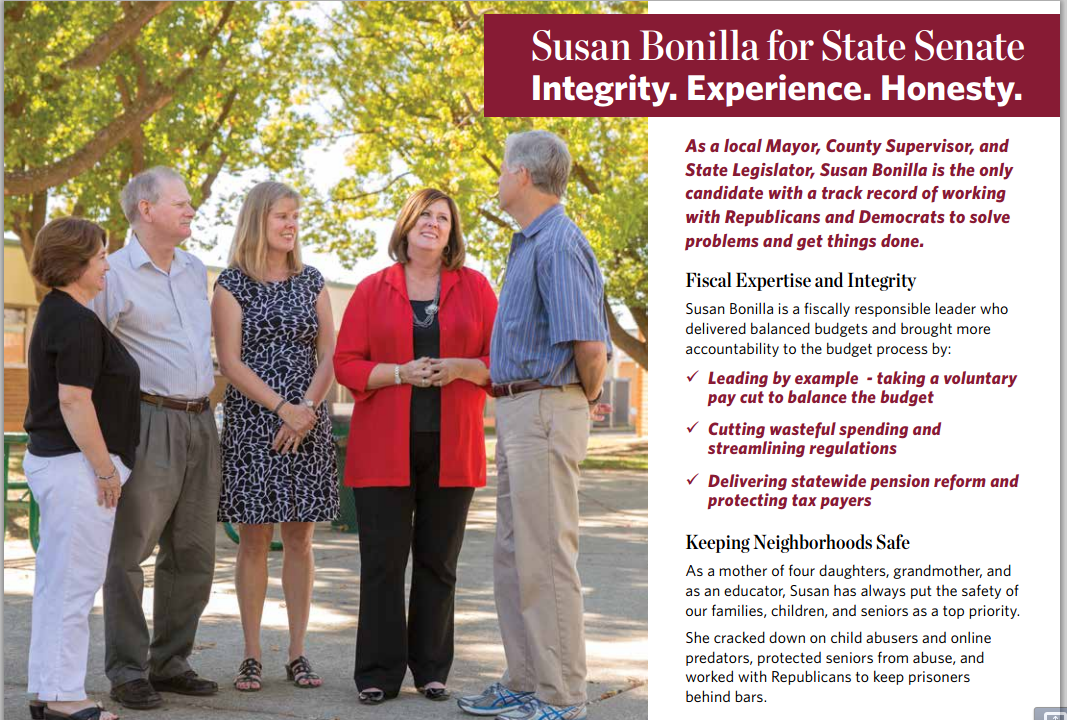
Susan Bonilla for Senate 2015

Susan Bonilla for Senate 2015:


Susan Bonilla for Senate 2015

photo.Susan_Bonilla.140x250
Assemblywoman Susan Bonilla is a former high school teacher, mayor and county supervisor, who has worked to strengthen neighborhood schools, protect public safety services, and support job growth and working families across the state.
Prior to her election to the State Assembly in 2010, Bonilla served as a Contra Costa County Supervisor and as the Mayor of Concord – the largest community in the State Senate District. While serving her local community, Bonilla built and expanded job-training programs and job creation efforts that successfully helped residents get back to work during the recession.
Additionally, Susan Bonilla authored Assembly Bill 484 – an important and revolutionary change to education policy. Signed by the Governor Brown in 2013, the law enables our schools to phrase out outdated STAR tests and prepare students and teachers for better assessments that reflect the real world knowledge needed in tomorrow’s job market.
Susan has provided steadfast leadership in protecting early childhood education programs, saving transitional kindergarten, which provides our youngest learners the foundations they will need to succeed.
Susan authored historic legislation that expanded health care access for women, created the highest safety standards for California industrial sites while protecting manufacturing jobs, and provided more tools for law enforcement to keep our communities safe.
As a member of Contra Costa County’s Board of Supervisors, Assemblywoman Bonilla created the Foster Youth Employment Program, providing youth in the county foster system job opportunities within the county structure. She also developed partnerships to open the Michael Chavez Center for Economic Opportunity to provide job training directly to residents within the Monument Corridor of Concord.
Prior to serving in public office, Susan was an English teacher in the Mt. Diablo Unified School District. She has a B.A. in English from Azusa Pacific University and teaching credentials from CSU Los Angeles. Susan resides in Concord with her husband, John. They have four daughters and three grandchildren.

Susan Bonilla for Senate 2015 http://bit.ly/1JHcmm9

Charters are Cash Cows | Yinzercation

Charters are Cash Cows | Yinzercation:

Charters are Cash Cows 


 Charter schools are cash cows feeding at the public trough. Oh, there are a few good ones here and there, to be sure. But if there was ever any doubt that charter schools have become Big Business, take a look at the list of the largest campaign contributors in Pennsylvania. Three of the top ten on a new “Power Players” report are throwing hundreds of thousands of dollars into state politics to gain favorable legislation for charter schools and we need to be asking why. [Public Source, Power Players report]

Weighing in at #5 is Van Gureghian, who founded Charter School Management Inc. back in 1999 to run a school in Chester, PA, a struggling former industrial town near Philadelphia. Today Gureghian’s company operates 150 charter schools in nine states, and that first school now has half of the district’s student enrollment and is the state’s largest charter school. Gureghian was Gov. Corbett’s single largest campaign donor and served on his education transition team. This is the same guy who is fighting the state’s Right to Know laws to keep from disclosing his salary – which is public knowledge for other public school administrators – while he recently bought two Florida beachfront lots for $28.9 million. He and his wife, another Charter School Management Inc. employee, plan to build a 20,000 square foot “French-inspired Monte Carlo estate.” [Palm Beach Daily News, 2011-11-18Also see “Soaking the Public”]
At #8 and #10 on the list are Joel Greenberg and Arthur Dantchik. Public Source, which put together the report, notes that these two “act as one when making political contributions,” and that if we “consider them as a contributing team, you must include Jeff Yass,” who would be #11 on this list. Greenberg, Dantchik, and Yass went to college together and are founding partners of Susquehanna International Group, a financial broker-dealer in Philadelphia.
Greenberg is on the board of American Federation for Children, a national group with mega-billionaire backers supporting state vouchers for private school students. Dantchik is on the board of the Institute for Justice, a law firm that promotes school choice and Yass is on the board of the Cato Institute, a think tank dedicated to limited government and free markets. [Public Source, Power Players report] In 2010, these three men started Students First PAC to channel millions of their dollars, plus those from out of state donors, into races of pro-voucher candidates. (For more on the American Federation for Children and the Students First PAC, see “It’s All About the Money, Money, Money”.)
For those of you keeping track, that makes four of Pennsylvania’s biggest campaign donors so far this year with school privatization at the top of their to-do lists. Why? Lest you think these men are dabbling in education for the sake of students, take a closer look at the Big Business of charter schools. Back in August, CNBC interviewed the CEO of a major investment company who clearly explained why charter schools are such a great moneymaker. David Brain heads Entertainment Properties Trust, which owns movie theaters, destination recreation sites, and charter schools in 34 states.
When the interviewer asked why people should add charter schools to their investment portfolios, he replied:
“Well I think it’s a very stable business, very recession-resistant. It’s a very high-demand product. There’s 400,000 kids on waiting lists for charter schools … the industry’s growing about 12-14% a year. So it’s a high-growth, very stable, recession-resistant business. It’s a public payer, the state is the payer … if you do business with states with solid treasuries, then it’s a very solid business.”
The anchor also asked if he could buy one type of real estate asset right now, what would it be, and Brain answered:
“Well, probably the charter school business. We said it’s our highest growth and most appealing sector right now of the portfolio. It’s the most high in demand, it’s the most recession-resistant. And a great opportunity set with 500 schools starting every year. It’s a two and a half billion Charters are Cash Cows | Yinzercation:

Monday, April 13, 2015

The Senate ESEA Reauthorization Draft, Part VI– My Final Post | deutsch29

The Senate ESEA Reauthorization Draft, Part VI– My Final Post | deutsch29:

The Senate ESEA Reauthorization Draft, Part VI– My Final Post


On April 7, 2015, the Senate education committee announced the following as part of a press release:
WASHINGTON, D.C., April 7 – Senate education committee Chairman Lamar Alexander (R-Tenn.) and Ranking Member Patty Murray (D-Wash.) today announced a bipartisan agreement on fixing “No Child Left Behind.” They scheduled committee action on their agreement and any amendments to begin at 10 a.m. Tuesday, April 14.
The result of the Lamar-Murray collaboration on the Elementary and Secondary Education Act (ESEA) reauthorization (the latest version of which is renamed No Child Left Behind) is this 601-page document entitled, The Every Child Achieves Act of 2015.
On April 7, 2015, I began reading and writing about the content of those 601 pages. My writing has resulted in a series of six posts.
This is my sixth and final post, just in time for the Senate education committee meetings that will begin on April 14, 2015, regarding this possible ESEA reauthorization draft.
My other five posts on the Alexander-Murray reauthorization draft can be found here:
At the end of part V, I left off with Title VI, “Innovation and Flexibility.”
That is where I begin this final post.
Let’s jump in.
Page 429, Title VI, “Innovation and Felixibility,” involves ESEA money available “to support State and local innovation in preparing all students to meet challenging State standards” and “to provide States and local educational agencies with maximum flexibility in using Federal funds provided under this Act” as well as “to support education in rural areas.”
Title VI is loosely defined because it allows states and local education agencies (LEAs) to submit for consideration of federal funding potential programs (or components of programs) that do not fall under previous titles.
LEAs receiving grants directly from the US secretary must agree to administer assessments “that are consistent with” (pg. 437) the state assessments that states agreed to use to receive Title I funding (see pgs. 35-40 for Title I assessment info). This means that LEAs that receive Title VI money directly from the US secretary will have to establish that the assessments they use for the Title VI funding somehow “match” the state’s chosen assessments for Title I.
As is true throughout the Alexander-Murray draft, the fact that assessments are tied to those “challenging State academic standards” is downplayed by only mentioning “meeting” the standards. However, in sections in which “meeting” the standards is mentioned as a necessary criterion for funding, all goes back to Section 1111(b) of Title I, which involves setting those “challenging State academic standards” and the assessments.
“Meeting challenging State academic standards” is a euphemism for adequate marks on assessments, whatever those adequate marks might be.
The prohibition on federal control is repeated in Title VI:
Nothing in this title shall be construed to authorize an officer or employee of the Federal Government to mandate, direct, or control a State, local educational agency, or school’s specific instructional content, academic standards and assessments, curriculum, or program of instruction, as a condition of eligibility to receive funds under this Act. (pg. 441)
Title VI also includes this interesting rule:
Nothing in this title shall be construed to mandate equalized spending per pupil for a State, local educational agency, or school. (pg. 442)
Next is Title VII, “Indian, Native Hawaiian, and Alaska Native Education” (pg. 442):
It is the purpose of this subpart to support local educational agencies in developing elementary school and secondary school programs for American Indian and Alaska Native students that are designed to—
(1) meet the unique cultural, language, and educational needs of such students; and
(2) ensure that all students meet the challenging State academic standards adopted under section 1111(b)
All goes back to those “challenging State acedemic standards,” the front door for the state assessments.
Page 496: Title VIII, “Impact Aid,” involves grants to LEAs “whose boundaries are the same as a Federal military installation or an island property designated by the Secretary of the Interior to be property that is held in trust by the Federal Government; and that has no taxing authority.” Title VIII was designed to assist schools located on federal property because these schools do not benefit from local taxes. Some language in Title VIII indicates that it also serves districts “located in a State that by State law has eliminated ad valorem tax as a revenue for local educational agencies” (pg. 502) or that serves high percentages of children residing on federal land (for example, see pgs. 503-04).
An interesting note: If a state board of education takes over an LEA eligible for Title VIII money, the LEA remains eligible for Title VIII impact aid for two years (pg. 506).The Senate ESEA Reauthorization Draft, Part VI– My Final Post | deutsch29:

Schneider is a southern Louisiana native, career teacher, trained researcher, and author of the ed reform whistle blower, A Chronicle of Echoes: Who’s Who In the Implosion of American Public Education.

She also has her second book available on pre-order, Common Core Dilemma: Who Owns Our Schools?, due for publication June 12, 2015.

CC book cover

Full Circle Initiative Helps AAPI Students Close Gap - California State University, Sacramento, Pakou Her

Full Circle Initiative Helps AAPI Students Close Gap - Higher Education:

Full Circle Initiative Helps AAPI Students Close Gap


AAPI


 SAN FRANCISCO — Before enrolling at California State University, Sacramento, Pakou Her didn’t contemplate careers beyond what her family suggested. Furthermore, Her didn’t think of herself as Asian American, only Hmong American.

But all that changed in college, where she began participating in Sacramento State’s Full Circle initiative, a federally funded endeavor aimed at reducing educational disparities among Asian American subgroups and improving graduation rates.
“I was a shy girl, and it was a big step for me to leave home for college,” said Her, whose family lives in Marysville, a town of 12,000 about 40 miles north of Sacramento. “My family thinks the best careers are in medicine and law, so I thought I would study nursing. But now that I’m seeing how higher education changes so many lives, especially for low-income people, I might work in higher education instead.”
She added, “I am now better able to express what I want.” 
Her’s comments came last week during the annual conference of the Asian Pacific Americans in Higher Education (APAHE). Since its 1987 inception, the organization has developed programs and addressed issues impacting Asian Americans and Pacific Islanders (AAPIs). It has evolved from a group of almost exclusively Californians into one with national reach.
Her and other Sacramento State undergraduates were panelists at a session titled “Student Leaders Coming Full Circle.” Their reflections illustrate some of the outcomes and benefits produced by initiatives financed by U.S. Department of Education grants for universities designated as Asian American and Native American Pacific Islander-Serving Institutions (AANAPISI). Ten percent or more of undergraduates at each of these schools, including Sacramento State, are AAPI and at least 50 percent of all students there, regardless of race, rely on Pell Grants or other federal aid.
At Sacramento State, a major component of its Full Circle initiative consists of ethnic studies courses aimed at increasing retention of AAPI freshmen. Two courses per semester introduce first-year students to Asian American studies, ethnic studies, and contemporary issues and social change. All of the courses count toward graduation requirements for any academic major.
Among other topics, freshmen in the Full Circle courses learn about the 1968 student-led strike at San Francisco State University that led to the birth of what is now its ethnic studies college. The Sacramento State freshmen organize themselves into teams to pursue a social justice project, whether it’s reducing cruelty to animals or trying to end child abuse. They research their subject, form a partnership with an off-campus group and execute their project. In a series of panel discussions in class, the students share their findings and reflections with their peers.
Although the Full Circle initiative is only in its third school year, some of the academic milestones already show promise, educators said.
For example, 92 percent of Full Circle participants who were freshmen in fall 2012 were still enrolled at the university a year ago, compared with only 82 percent of university freshmen across all racial groups. Yet only 12 percent of that cohort of Full Circle participants had a parent who held a bachelor’s degree — the rate of college graduates was almost twice that among parents of the 2012 freshmen across all racial groups combined — and 80 percent of the Full Circle participants came from families whose annual household income was less than $60,000. Among all 2012 freshmen at Sacramento State, only 57 percent came from such families.
The Full Circle participants from 2012-13 also had higher grade point averages both semesters than their AAPI peers who were nonparticipants. In the fall, the Full Circle freshmen had an average GPA of 3.27, compared with 2.81 for other AAPI freshmen, and in the spring, it was 3.12 versus 2.78.
The retention rate and GPAs are encouraging signs at Sacramento State, where the most populous AAPI subgroups are Filipino and Hmong, educators said. Nationally, only about 13 percent of Hmong Americans hold a bachelor’s degree, while it’s 48 percent among Filipino Americans. 
With a theme of “Many Identities: One Call to Action,” APAHE conference workshops examined challenges in academia that have been overcome as well as those that remain, such as issues faced by AAPI military veterans and foster youth, respectively, on college campuses.
Meanwhile, multiple sessions featured AANAPISI presentations about federal grant-supported initiatives.
At the University of Massachusetts Boston, for example, an AANAPISI grant supports writing seminars aimed at helping AAPI students pass the university’s writing proficiency requirement, which students of every race and most academic majors must fulfill in order to graduate. The requirement calls for students to submit a 20-page portfolio, which includes a five-page composition based on a reading assignment.
The portfolio of writing proves difficult for many AAPI students at UMass Boston, a commuter school, because about 90 Full Circle Initiative Helps AAPI Students Close Gap - Higher Education: