Latest News and Comment from Education

Monday, March 16, 2015

P is for PARCC, Pearson and Pushback (and Peeps) | EduShyster

P is for PARCC, Pearson and Pushback (and Peeps) | EduShyster:

P is for PARCC, Pearson and Pushback (and Peeps)

Before the first day of PARCC testing, the results are in. Push back against indefensible state policies and the state will crack.
peepsThe special time you’ve been waiting for has at last arrived, boys and girls. It’s PARCC testing week! Think Easter but with a few key differences. Like instead of hunting for eggs, you’re after *college and career readiness.* Also, those Peeps in your basket aren’t for realz but are being *piloted* to help determine what should go in your basket next year. Which is to say that it’s never a good idea to put all of the kids’ eggs in one basket, even if the state’s chief educational standards bunny happens to serve as the chair of an egg distributor. 
Easter-Eggs-1PARCC: In an eggshell 
First some answers to your questions: like is she really going to force us to endure an extended Easter metaphor that has little if any relevance to PARCC testing? No reader, because we have more important eggs to fry. You see, starting today, 200,000 young Bay Staters are taking a new, outstandingly predictive test that is so *highly aligned* with college and career readiness that the words college and career readiness are in the name of the actual test. Today’s test drive will help the state determine whether the test is the right 21st century test for the state’s 21st century test takers. Which raises our first high-stakes question: what about 21st century test takes who refuse to take the 21st century test?
In which the state clarifies its clarification
As we learned last year, *there is no provision in Massachusetts state law for parents to ‘opt out’ of the annual statewide assessment program.* Last week the stateclarified it’s position, again, to the effect that if parents should persist in exercising this non-provision, principals should gently but firmly encourage parents to rethink their refusal, reminding them *that students’ and teachers’ experiences will help the state decide whether PARCC is a worthwhile assessment.* And then the kicker: *When P is for PARCC, Pearson and Pushback (and Peeps) | EduShyster:

To Catch a Cheat: More on the Pearson Problem as Our Problem | the becoming radical

To Catch a Cheat: More on the Pearson Problem as Our Problem | the becoming radical:

TO CATCH A CHEAT: MORE ON THE PEARSON PROBLEM AS OUR PROBLEM


 “Cheating by test takers is becoming more common in the United States and throughout the world,” explains T.J. Bliss, adding:

In the past year, multiple news agencies have reported several instances of cheating on high-stakes tests. Recently, news broke that doctors in a variety of specialties had cheated to pass certification exams (Zamost, Griffen, & Ansari, 2012). In another instance, high school students were arrested and charged with misdemeanors and felonies for cheating on the SAT (Anderson, 2011). At a university in Florida, over 200 students admitted to cheating on a midterm exam when faced with accusations based on statistical evidence (Good, 2010).
So what are teachers to do? Bliss offers evidence-based solutions:
There are many ways to detect cheating, some more useful and reliable than others (Cizek, 1999). Proctors and invigilators can walk the exam room and directly observe some forms of cheating, like answer copying. This method will not work, though, if a person cheats by gaining pre-knowledge of exam items (Good, 2010), is taking the exam for someone else (Anderson, 2011), or is trying to memorize items to share with others (Zamost et al. 2012). Some cheating is detected through whistle-blowers, manual comparison of answer and seating charts, and other qualitative approaches (Cizek, 2006). However, in both large-scale and classroom testing situations, statistical approaches have also been used to identify suspected cheaters. Such methods have been successfully utilized to detect several different kinds of cheating, including answer copying, collusion, pre-knowledge, and attempts to memorize items.
And why the increased cheating? It seems legislation, competition, and technology have roles in that:
With the passage of legislation requiring increased school accountability (e.g. No Child Left Behind Act, 2001) and increased compet[ti]iveness for jobs requiring certification (United States Bureau of Labor Statistics, 2010-2011) the stakes for passing standardized and licensure exams have increased dramatically. At the same time, technologies to enable cheating have also increased. For instance, some examinees have begun using smart phones, digital recorders, and other personal electronic devices to cheat during exams. Fortunately, the advent of new methods for administering exams (like Computer Adaptive Testing) and analyzing test results (like Item Response Theory) have led to the development of more complex and sensitive statistical methods to detect cheating.
For classroom teachers seeking ways to prevent cheating and catch students who cheat, the Internet offers a nearly endless supply of strategies:To Catch a Cheat: More on the Pearson Problem as Our Problem | the becoming radical:

State’s choice of testing contractor disputed | EdSource

State’s choice of testing contractor disputed | EdSource:


State’s choice of testing contractor disputed


 The State Board of Education last week endorsed the current contractor’s three-year, quarter-billion-dollar bid to continue administering the state’s standardized testing system – but only if it agrees to extensively involve teachers in scoring the parts of the new tests on the Common Core standards that can’t be done by machine.
Board members voted unanimously to approve Educational Testing Service’s contract on the condition the company duplicate the teacher-participation model that a losing bidder, Pearson School, a division of the textbook and education giant Pearson, had proposed. Pearson’s plan was closer to the original vision of educators such as Linda Darling-Hammond, a professor at Stanford University’s School of Education, who, in pitching the Smarter Balanced test to California education officials, had said that involving teachers in scoring “performance tasks” would improve classroom instruction.
Pearson’s proposal said that training in scoring would be part of a larger professional development effort in the Common Core standards. County offices of education would provide the teacher trainings in local schools. The nonprofit research agency WestEd and the Sacramento County Office of Education would be hired to lead the initiative.
Doug Kubach, CEO and president of Pearson School, said if the state goes through with its plan to adopt Pearson’s strategy to work with teachers even though it rejected the company’s bid, Pearson would probably file a lawsuit. Evidence would show, he said, that state officials preferred ETS from the start.
“We typically don’t do litigation – it’s an uphill struggle with a high barrier of evidence – but this case is so egregious that there may be no State’s choice of testing contractor disputed | EdSource:

Failed deal between KC schools, Academie Lafayette reveals city’s issues with race and education | The Kansas City Star The Kansas City Star

Failed deal between KC schools, Academie Lafayette reveals city’s issues with race and education | The Kansas City Star The Kansas City Star:

Failed deal between KC schools, Academie Lafayette reveals city’s issues with race and education

Read more here: http://www.kansascity.com/news/local/article14543225.html#/tabPane=tabs-b0710947-1-2#storylink=cpy

Charter Schools - Dividing Communities since 1991


Unraveling Kansas City Public Schools’ broken bid to partner with its charter school rival, Academie Lafayette, will be hard. Very hard.
The city’s longstanding divisions over race, economics and the ownership of public education lace the autopsy lying before city leaders and communities.
When the district and the charter last week called off their dramatic plans to roll out a charter-run high school for charter and district students at the former Southwest High School, opposing forces on school and community board rooms could stand down.
But the pressures that prompted the surprising partnership are only mounting.
Families are still leaving Kansas City’s public school system — both district and charter schools — sucking away much of the city’s vitality.
The school district is plagued with gaping spaces in many of its high schools, and the charter system overall continues to lack either the resources or the capacity to turn the tide.
“We need some strong people,” Kansas City Mayor Sly James said, “to step up and fight through their problems and get past uncomfortable feelings with race and with concepts of change.
“If we let our discomfort stop us now, we’ll never solve those problems.”
More “tough dialogue” will come, said Kansas City school board president Jon Hile.
The proposal, though now defeated, “was proof that the district and charters can work together creatively,” Hile said. “But as a community, we’re not quite there yet.”
Support for the school was strong throughout the city, Hile said, and many are “deeply disappointed.”
But opposition also was strong.
At a news conference by multiple community and ministerial groups, the Rev. Rodney Williams of Swope Parkway United Christian Church warned that a partnership with a majority-white, more economically affluent charter school population would be an “insidious” step toward “resegregation.”
The Metropolitan Organization for Racial and Economic Equity (MORE2) and the NAACP stood against the partnership for ceding control of the school from Kansas City’s elected school board to the charter school’s unelected, appointed board.
They worried about the health of the district’s selective school, Lincoln College Preparatory Academy, if Southwest opened as a selective school across town.
Divisions within the Kansas City school board also were threatening the plan. Some board members who opposed the plan argued that handing the building to the charter would involve a sale or lease of the school, which requires six of nine votes to pass. Supporters argued it would be a use agreement that needed only a simple majority of five votes.
Ultimately, district and charter leaders said, they could not devise a palatable solution for serving the roughly 400 current students at Southwest who would be displaced by a fresh-starting high school.
James is leading a call to get the deal back in play. “I ask people to go back to the table,” he said. “Work together. Get past the discomfort. …We have a chance to raise the vision and whole concept of high school in this city.”

Wide gaps

Opposition is complicated, said MORE2 executive director Lora McDonald, and often strikes personal chords.
She knows how some parents bend toward choices outside the Kansas City school district. She made such a choice when she enrolled her son in a small private school.
But she has since come to believe that engaged parents can help secure a high-quality education in their neighborhood public school. Charters, she thinks, dilute resources and attention from children in schools that need them most.
“Academie Lafayette was not the target (of the opposition),” she said. “We want everyone to focus on the students who are in the district.”
More diversity and more parents with resources would bring vital strength, and she wants investments in schools that might help revive confidence and support in neighborhood Kansas City schools.
“But that’s hard,” she said, “because a lot of people are carrying around baggage (of harsh impressions of KC schools) like I was.”
Academie Lafayette, as the lone charter school with a majority white enrollment, arouses complaints that it is resegregating education. But most other charters and most of the area public school systems show broaderFailed deal between KC schools, Academie Lafayette reveals city’s issues with race and education | The Kansas City Star The Kansas City Star:

Read more here: http://www.kansascity.com/news/local/article14543225.html#/tabPane=tabs-b0710947-1-2#storylink=cpy

NYC's plan for prayer break in pre-K classes raises concerns - Yahoo News

NYC's plan for prayer break in pre-K classes raises concerns - Yahoo News:

NYC's plan for prayer break in pre-K classes raises concerns


 NEW YORK (AP) — New York City Mayor Bill de Blasio's ambitious plan to expand public pre-kindergarten for all 4 year-olds depends in part on the participation of Jewish, Christian and Muslim schools, under a proposal that would permit religious instruction and prayers during midday breaks.

But civil liberties groups are already objecting to the plan, which would take effect next fall, saying allowing a prayer break in a publicly funded classroom may violate the constitutional separation of church and state.
"It's kind of like waving a red flag in front of a bull," said Barry Lynn, executive director of the Washington, D.C.-based Americans United for Separation of Church and State. "This seems to be asking for a lawsuit."
De Blasio's free, full-day pre-kindergarten plan began last year as his signature initiative, a way to address his goals of narrowing the wealth gap by saving parents the cost of private pre-K tuition, and jump-starting the academic performance of the city's youngsters. It began last fall with 53,000 children, and the goal is to boost that number this year to 70,000.
Some pre-K classes are in public schools but many are run by religious groups and other community-based organizations under contract to the city. The latest proposal is aimed at increasing the participation of private religious schools, particularly the Orthodox Jewish schools that serve a growing portion of the city's population. A 2012 study by the UJA Federation of New York found that 40 percent of Jews in the city identified themselves as Orthodox up from 33 percent in 2002.
De Blasio's administration announced last month that pre-K classes next year will be permitted to break in the middle of the day for "non-program" activities such as prayer. Additionally, schools will be invited to operate six days a week in order to meet the minimum number of classroom hours.
It is similar to an arrangement at pre-K classes currently operating out of Roman Catholic schools.
Rocio Fidalgo, a spokeswoman for the Roman Catholic Diocese of Brooklyn, said 22 of the diocese's schools are participating now and 14 more have applied for next year. An optional half hour of religious instruction takes place at 8 a.m., with the regular school day starting at 8:30 a.m.
But a prayer break in the middle of the day is seen by civil libertarians as more problematic than a prayer before the regular school day starts. The midday break means schools have to provide a space for any kids who "opt out" of the prayer and something for them to do.
Donna Lieberman, executive director of the New York Civil Liberties Union, called the break "an NYC's plan for prayer break in pre-K classes raises concerns - Yahoo News:

Disabilities group to CPS: Make sure charter schools welcome special ed students | Chicago

Disabilities group to CPS: Make sure charter schools welcome special ed students | Chicago:


Disabilities group to CPS: Make sure charter schools welcome special ed students


 A disabilities-rights group is asking Chicago Public Schools to consider the track records of some charter schools in serving students with special needs before it renews their operating charters this spring.

Equip for Equality examined the number of students with special needs across the district. It found that charter schools — which are publicly funded but privately operated — have fewer students with written plans detailing their special needs and rights than schools run by CPS.
Special needs students at charter schools are also more likely to leave or be expelled than special needs students at CPS schools. And at some charter schools, Equip for Equality says, students with special needs were twice as likely as their classmates to leave or be kicked out.
In an open letter to CPS on Monday, the organization urged the district to hold charter schools accountable.
“These schools were launched with the promise of innovation and spreading educational opportunity,” the letter reads. “Based on the findings in that we highlight in this letter, we encourage CPS to take several steps to enhance its reauthorization process to better protect students with disabilities.”
While 12.5 percent of students in CPS schools have ”Individual Education Plans,” just 9.5 percent of charter school students have IEPs, the letter says.
Despite having fewer special needs students on their books, charter schools expelled and suspended more students with IEPs than the district — students with IEPs constituted about 22.5 percent of students expelled from CPS schools in 2013-14, but 26.2 percent from charter schools, Equip for Equality says.
Two charter high schools, Urban Prep and EPIC, have lost an unusually high number of special needs students, it adds. ”Urban Prep reported a 14.7 percent net drop in students with IEPs during the 2013-14 school year, compared to a total decline of 7.5 percent for Urban Prep students overall,” the letter states. “The gap was greater at EPIC: a 26.7 drop in students with IEPs in 2014 compared to 10.6 percent overall.”
Charter schools operate under governing charters, which last for five years each. So every five years, CPS re-examines each school’s operations to see if it should remain open another term. This spring, CPS is reconsidering 14 charter agreements and a contract school agreement that will expire on June 30.
“We are very explicit that we are not for or against any charter Disabilities group to CPS: Make sure charter schools welcome special ed students | Chicago:

Private school vouchers—the forbidden fruit

Guest editorial: Private school vouchers—the forbidden fruit:

Private school vouchers—the forbidden fruit


Guest editorial: Private school vouchers—the forbidden fruit

"God does not need vouchers"

 In the beginning, temptation appeared as a fruit. Today, it appears as a voucher. As tempting as it may be for private religious schools to pluck the low-hanging fruit of “free” public money, the cost is too great. I say this as a pastor. I say this as a Christian school leader. I say this with certainty.

Has someone bothered to ask faith-based schools if they should take the money? In Florida, 82 percent of students receiving voucher money attended a religious school, according to U.S. News & World Report (Aug. 28, 2014). 
kyle henderson130Kyle HendersonWhat will it mean for hiring employees at the religious school? Will this public money be used to tell the school who they can and can’t hire? Look at incidents around the country where religious schools are being taken to court for releasing employees who undermine the core ethical stances. The courts are telling them which parts of their school qualify as faith-based. 
Strings attached
Vouchers come with government strings attached.
I have been a pastor more than 30 years. I have been the pastor of a 150-year-old Baptist church in East Texas 18 years. We operate a distinctively Christian grade school averaging 75 students. Our students have thrived, going on to high academic success. 
I know how tempting it could be to take voucher money. I know the burden on families who scrimp and save to send their kids to our school. I have bought lots of cookie dough, sponsored walk-a-thons and attended fundraisers. I also know the freedom of operating a school that is able to talk openly about Christ, a place where prayer is a part of each class, where sharing Christian testimony is encouraged, and where chapel and worship are a regular part of the school.
Payouts seek to fill in for faith
These government payouts seek to fill in for faith. They whisper from the shadows they are the answer to the problems of funding a Christian school. 
God does not need vouchers.
Vouchers and all their versions, including “school-choice options,” rightly come with responsibilities and obligations to the government. But Jesus told us we cannot serve two masters. These vouchers are either a grab to control faith-based schools or an irresponsible, unaccountable disbursement of public funds. Either the government will start exerting control over faith-based schools, or it will send money to schools not required to meet any standards. 
The only viable choice for a faith-based school is to reject the funds.
Faith is strong and alive in America because of the freedom of religion and the separation of church and state. In the places where this is not true, the church is an empty shell. Depending on the state for funds is a death sentence for free religion and vibrant faith.
There are, however, some faith-based schools ready to receive the funds. I don’t want tax dollars diverted to them any more than I want them diverted to my school. In North Carolina’s voucher program, 8 percent of the public money is diverted to a single school, the Greensboro Islamic Academy, according to North Carolina Policy Watch. Louisiana’s voucher system only passed the state legislature when an Islamic school’s Guest editorial: Private school vouchers—the forbidden fruit:

Opt-out push urges parents to buck standardized tests

Opt-out push urges parents to buck standardized tests:

Opt-out push urges parents to buck standardized tests


Parents Can Opt Out - United Opt Out National

Click Here to go to United Opt Out National: 


Click Here to go to the WebsiteUnited Opt Out Team
Home
Click Here to go to the Website FairTest


 When it came to testing her kids, Sara Miller used to go with the flow.

"Like other things in school, you just kind of assume that you're going to do it," said Miller, a Clearwater mother of four.
That's no longer the case for Miller and a small-but-growing movement of parents who're pushing back on standardized school testing.
They're opting their children out of tests such as the Minnesota Comprehensive Assessments, citing concerns with growing frequency of standardized tests, the efficacy of such tests and their impact on students and teachers.
St. Cloud-area supporters of the opt-out movement are spreading their message to parents before MCAs start in coming weeks. In St. Cloud school district, most will begin in April.
Miller says she first opted her school-age kids out of standardized tests last year after learning about the movement. She did so again this year, submitting statements to their school principals that said her children were opting out.
In Minnesota, less than 1 percent of students opted out of the MCAs in 2014. Most were in the Minneapolis school district.
Yet Minnesota Department of Education officials acknowledge the opt-out movement, while small, is gaining momentum.
Shannon Essler-Petty is a local parent and education professor who supports the opt-out movement. Essler-Petty said simply making parents aware they can opt their children out has been a big hurdle for the movement.
"It's growing as more parents find out it's an option," Essler-Petty said.
Test results questioned
The opt-out movement is part of a backlash to the national standardized-testing sea change that started in 2002.
That's when former President George W. Bush signed the No Child Left Behind law, which linked federal funding to standardized testing and required schools to make yearly progress in test scores.
In Minnesota, the reading, math and science MCAs meet the requirements of the federal law and measure student progress toward state academic standards.
Students also take other standardized tests, including the STAR reading and math tests and the Optional Local Purpose Assessments, or OLPAs, in reading and math.
Testing proponents see the MCAs and their counterparts in other states as crucial to gauging student performance. They say test scores help teachers and schools know where their students excel and where they need to improve.
Some advocates see test scores as a lever for change in struggling schools.
Testing critics say U.S. schools have become fixated on standardized tests even as Opt-out push urges parents to buck standardized tests:

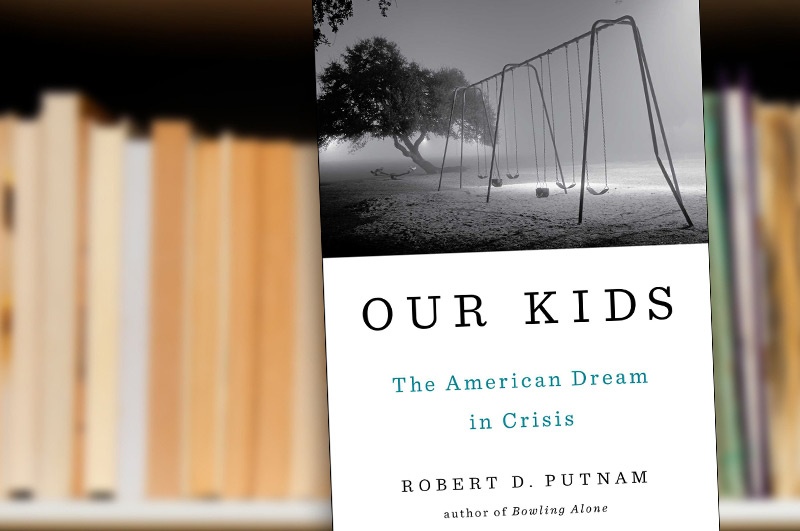
Robert Putnam’s New Book Makes Us See the Invisible Dynamics of Widening Inequality | janresseger

Robert Putnam’s New Book Makes Us See the Invisible Dynamics of Widening Inequality | janresseger:


Robert Putnam’s New Book Makes Us See the Invisible Dynamics of Widening Inequality


 Robert Putnam’s new book, Our Kids: The American Dream in Crisis is an important book.  It has been criticized a bit by social science reviewers because it doesn’t challenge the power and money behind the politics that have created the problems it describes, but I would guess that Putnam’s purpose is different.  This is a book written to make us see what is invisible to most of us: “Ultimately, growing class segregation across neighborhoods, schools, marriages (and probably also civic associations, workplaces, and friendship circles) means that rich Americans and poor Americans are living, learning, and raising children in increasingly separate and unequal worlds, removing the stepping-stones to upward mobility—college going classmates or cousins or middle-class neighbors, who might take a working-class kid from the neighborhood under their wing.” (p. 41) The book is written for a popular—not an academic—audience to illuminate the social science research on which it is based.

While most of us will notice a new stadium or a new convention center or revitalization downtown, we are less likely to see that a neighborhood or community is changing demographically and we are likely to be blind to the social dynamics at work or the meaning of the change until perhaps years later.  Putnam turns our attention directly to growing inequality in the institutions that matter to children: the family, the parents’ marriage and parenting style, the school, the neighborhood.
I confess that my own fascination with Our Kids is my interest in public school inequality and our society’s wrong headed approach to addressing achievement gaps.  After all, Putnam’s book is evidence that the great wave of standardized testing, sanctions for so-called “failing” schools, and privatization of schools cannot possibly address the primary cause of achievement gaps: rapidly widening economic inequality and segregation by family income. Putnam explains, “Our contemporary public debate recognizes this problem but assumes it is largely a ‘schools problem.’ On the contrary we have seen that most of the challenges facing poor kids are not caused by schools.” (p 231)  Schools, according to Putnam’s research, are sites where we can observe inequality but not its primary cause: “In fact, all of the factors that we’ve discussed so far in this book—family structure, parenting, childhood development, peer groups, extracurricular opportunities—have contributed to the widening gap in college graduation rates in recent decades, along with the neighborhood and community influences….” (pp. 188-189)
Four years ago the Stanford University sociologist Sean Reardon published two studies that startled people watching trends in public school achievement.  Reardon documents that the proportion of families in major metropolitan areas living in either very poor or very affluent neighborhoods increased from 15 percent in 1970 to 33 percent by 2009, and the proportion of families living in middle income neighborhoods declined from 65 percent in 1970 to 42 percent in 2009.  Reardon also demonstrates that along with growing residential inequality is a simultaneous jump in an income-inequality school achievement gap among children and adolescents.  The achievement gap between students with income in the top ten percent and students with income in the bottom ten percent is 30-40 percent wider among children born in 2001 than those born in 1975, and is now twice as large as the black-white achievement gap.  Putnam quotes Reardon’s research and then he explains what it means in the daily lives of families and children.
I describe Reardon’s conclusions again and again in this blog, because I think we all have to Robert Putnam’s New Book Makes Us See the Invisible Dynamics of Widening Inequality | janresseger:

Family Engagement in Education Act Reintroduced in Congress - K-12 Parents and the Public - Education Week

Family Engagement in Education Act Reintroduced in Congress - K-12 Parents and the Public - Education Week:


Family Engagement in Education Act Reintroduced in Congress


 Bipartisan legislation that aims to strengthen the relationships between families and schools was reintroduced in Congress March 2.

The Family Engagement in Education Act, which also was introduced in 2011 and 2013, seeks to earmark funds to develop systems that would encourage more parents to become involved in their local public schools.
"We can create a brighter future for our youth by ensuring that educators, community organizations, and family members have the resources they need to work together effectively," Sen. Chris Coons D-Del., said in a press release. Coons is a co-sponsor of the legislation.Representatives Glenn Thompson R-Pa., and Mark Desaulnier D-Calif., are co-sponsoring the bill in the House.
The Family Engagement in Education Act would boost funding tied to family-engagement efforts to 2 percent from 1 percent of school districts' Title I dollars. The legislation also would require school districts to develop and enact standards-based policies and practices to support family-school partnerships. Finally, the bill would set aside 0.3 percent of Title I administrative funds to increase state capacity-building efforts, such as creating statewide family-engagement centers.
Members of the National Family, School, and Community Engagement Working Group, which includes the National PTA, United Way Worldwide, the Harvard Family Research Project, and the National Council of La Raza, provided input into the development of the bill, according to the release.
Otha Thornton, president of the National PTA, called the legislation a "crucial piece in education reform," in a news release. He said the Alexandria, Va.-based organization believes that "family engagement is at the core of student success and school improvement."

Bipartisan legislation that aims to strengthen the relationships between families and schools was reintroduced in Congress March 2.

The Family Engagement in Education Act, which also was introduced in 2011 and 2013, seeks to earmark funds to develop systems that would encourage more parents to become involved in their local public schools.

"We can create a brighter future for our youth by ensuring that educators, community organizations, and family members have the resources they need to work together effectively," Sen. Chris Coons D-Del., said in a press release. Coons is a co-sponsor of the legislation. Representatives Glenn Thompson R-Pa., and Mark Desaulnier D-Calif., are co-sponsoring the bill in the House.

The Family Engagement in Education Act would boost funding tied to family-engagement efforts to 2 percent from 1 percent of school districts' Title I dollars. The legislation also would require school districts to develop and enact standards-based policies and practices to support family-school partnerships. Finally, the bill would set aside 0.3 percent of Title I administrative funds to increase state capacity-building efforts, such as creating statewide family-engagement centers.

Members of the National Family, School, and Community Engagement Working Group, which includes the National PTA, United Way Worldwide, the Harvard Family Research Project, and the National Council of La Raza, provided input into the development of the bill, according to the release.

Otha Thornton, president of the National PTA, called the legislation a "crucial piece in education reform," in a news release. He said the Alexandria, Va.-based organization believes that "family engagement is at the core of student success and school improvement." Family Engagement in Education Act Reintroduced in Congress - K-12 Parents and the Public - Education Week:

Youthanasia - Change The LAUSD

Youthanasia - Change The LAUSD:


Youthanasia


 Tom Torlakson:

The November election between you and Marshall Tuck was billed by many as one that pitted those who would privatize our public education system versus those who would defend it. Based on the belief that you were the candidate who would put student’s needs first, I chose to support you. With this in mind, I hope that you will rescind your support of the “One System: Reforming Education to Serve all Students” report. Some of these proposals will inflict harm on the most fragile members of our population and are already being used by the Los Angeles Unified School District to dismantle programs that are desperately needed.
As you know, all children are unique and a successful education system must reflect this fact. Unfortunately, this report engages in a cookie-cutter approach in it’s first sentence. When it maintains that “far too many children and young adults in California’s schools are not acquiring the skills they will need to succeed in postsecondary education and secure stable employment,” it ignores children like mine. While it would be great if my two daughters grew up so that they could “participate meaningfully in the nation’s economy and democracy,” they reside on the part of the autism spectrum where it would be a great accomplishment for them to reach a point where they could take care of their own basic needs in a highly structured environment. How will considering them “general education students first” help them to achieve this goal? Was anyone on this task force familiar with the needs of our most challenged students?
When the co-executive director of the task force, Vicki Barber, confirmed to the LA School Report that this report called for the closing of special education sites in the Los Angeles Unified School District, she was acknowledging that they had not considered the needs of all students. While “not all students with a particular disability need to be on a separate site,” closing these sites endangers Youthanasia - Change The LAUSD:

Big Education Ape: California Special Education Task Force - One System: Reforming Education to Serve All Students http://bit.ly/1bbMiUI

Big Education Ape: Task force unveils plan to overhaul special education | EdSource http://bit.ly/1bbMjI8

Ditch the Test-and-Punish Model - US News

Ditch the Test-and-Punish Model - US News:


Ditch the Test-and-Punish Model


 The 2002 No Child Left Behind Act started out with good intentions to help improve schools and student performance. But it took a wrong turn in both delivering the funding promised, and in creating, because it focused on the sanctions imposed if student test scores failed to show “adequate yearly progress,” a test-and-punish model of schooling. The law, combined with the greater evaluation and testing requirements of the Obama administration’s Race to the Top program, inspired today’s misuse and overuse of testing. This obsession with testing has all but eclipsed the rich and robust instruction, the engagement of students and the enjoyment of learning that should be going on in every classroom in America.

Public educators’ obligation is to help all children succeed. This is especially important and challenging given that half of all public school students live in poverty. A rich, robust, well-resourced public education is one of the best routes out of poverty and a pathway to prosperity. Yet the test-driven system is not working, and worse, it’s creating a lot of agita for students and gobbling up a lot of learning time.
For instance, an American Federation of Teachers study found that the time students spend taking tests ranges from 20 to 50 hours per year in heavily tested grades. Students can spend 60 to more than 110 hours per year in test prep in high-stakes testing grades.
Why do we see little evidence that school districts’ hyper-testing has paid off?
The rate of progress on the National Assessment of Educational Progress tests, commonly known as the Nation’s Report Card, for grades four and eight was generally faster in the decade before No Child Left Behind took effect than since its launch. This has been consistent for overall results and for individual demographic groups, including black students, English language learners and students with disabilities.
The United States is one of the only countries that has annual high-stakes testing. Yet the results of the Organization for Economic Cooperation and Development’s Program for International Student Assessment consistently show flat performance by U.S. students. Instead of asking why this performance is stagnant, some use it as a hammer to bludgeon public schools as well as their students and teachers.
Those assessments ask students to apply knowledge. While the top-ranked nations focus on that educational approach, the United States focuses instead on rote memorization of facts and figures. American school systems use multiple-choice exams and buy canned programs, sapping teachers of the authority and flexibility to use their judgment to meet the needs of their students.
The Common Core State Standards, and aligned curriculum and assessments, were supposed to usher in an era of change where we, like our OECD counterparts, help all students learn to apply their knowledge and to use problem-solving and critical-thinking skills. But implementation of the Common Core has been wildly flawed. Rather than provide the supports, resources and time teachers and students need to succeed with the new, higher standards, school districts have rushed to attach high-stakes consequences to the new tests – and now, they face a huge backlash and a growing parent opt-out movement.
Research has found that even when students improve their scores on standardized tests, they don’t always improve their cognitive abilities, such as memory, attention and speed. When student performance shows increases on test scores, that improvement is not associated with an increase in “fluid intelligence” – that is, using logical thinking and problem solving in novel situations, rather than recalling previously learned facts and skills.
Beyond these cognitive skills, students also need social and emotional skills – trust, teamwork, persistence, confidence – to succeed in life and career. The OECD recently found that these skills can lead to greater health and behavioral outcomes for students. They also found that this type of learning can be successfully measured, not by high-stakes tests but by teacher observations, student surveys and performance-based assessments. Indeed, student classwork and grades may be the best indicator of this.
It’s time to stop this hyper-testing, sanction-based accountability system. Even the OECD, which administers the Program for International Student Assessment tests, agrees, noting that while U.S. performance data “is often used for purely accountability purposes, other countries tend to give greater Ditch the Test-and-Punish Model - US News: