Latest News and Comment from Education

Sunday, March 15, 2015

Big Brother [The Smarter Balanced Assessment Consortium SBAC] is spying on our children! - Wait What?

Big Brother [The Smarter Balanced Assessment Consortium SBAC] is spying on our children! - Wait What?:


Big Brother [The Smarter Balanced Assessment Consortium SBAC] is spying on our children!


WARNING!
Public school students in grades 3-8 will begin taking the unfair, inappropriate and discriminatory Common Core Smarter Balanced Assessment Consortium (SBAC) Tests this week.  Children in PARCC States, the alternative Common Core Testing Program begin taking their tests last week.
The Common Core SBAC Testing period runs March 17 – June 15, 2015
The following is just one of the many reasons parents should opt their children out of the destructive Common Core SBAC Tests.
Read the following statement that was provided to all states administering the Smarter Balanced Assessment Consortium (SBAC) Tests;
Please note that the social media Web sites are being monitored by Smarter Balanced Communications staff members.
In fact, the SBAC consortium has enlisted the help of state governments, school districts, schools and test administrators to participate in their spying operation.
The SBAC Spying Memo is entitled, “GUIDANCE FOR SOCIAL MEDIA MONITORING DURING THE FIELD TEST,” and it states:
The Consortium is closely monitoring social media networks for security breaches and escalating to states when appropriate.
Test Administration Procedures
To get ahead of the problem and reduce the number of security breaches on social media, we encourage you to refer to the Smarter Balanced Test Administration Manual (Appendix B) for detailed information on the impact and definition of incidences as well as the timeline for reporting these activities.
Sites to Monitor
Twitter (https://twitter.com/.)  If your school has a Twitter account, you can take advantage of following your students by requesting their @username and/or encouraging them to the follow the school Twitter account.
Join Host Dr. James Avington Miller Jr. on the War Report radio show on Sunday as he exposes Pearson as the Orwellian Big Brother in American public education ---- be afraid, be very afraid!

The War Report on Public Education with Dr James Avington Miller Jr


The show will feature Bob Braun of Bob Braun's Ledger who published the NJ Spy Gate story on Friday and had his website attacked and disabled.

The show will also honor Lucianna M. Sanson and her excellent work for public education here on The War Report on Public Education

Click on the website below to listen live and join the discussion:

http://bbsradio.com/thewarreport

A direct listen-in line only
Station 1 - 716-748-0150

To call-in and interact live
Station 1 - 888-627-6008

Principal: How Common Core testing hurts disadvantaged students - The Washington Post

Principal: How Common Core testing hurts disadvantaged students - The Washington Post:


Principal: How Common Core testing hurts disadvantaged students


 March 15 at 10:30 AM  
This is the third in a continuing series of letters between two award-winning school principals, one who likes the Common Core State Standards and the other who doesn’t. The debate over the Common Core State Standards has become so polarized that it is hard to get people who disagree to have reasonable conversations about it. The Hechinger Report, a nonprofit, independent news Web site focused on inequality and innovation in education, is hosting a conversation between Carol Burris of New York and Jayne Ellspermann of Florida (in a format that Education Week once used with Diane Ravitch and Deborah Meier as the authors).  The Report’s editors as well as both principals have given me permission to republish each letter.
Burris has served as principal of South Side High School in the Rockville Centre School District in New York since 2000. In 2010, she was recognized by the School Administrators Association of New York State as their Outstanding Educator of the Year, and in 2013, she was recognized as the New York State High School Principal of the Year. Ellspermann is principal of West Port High School in Ocala, Florida.  She has served as a principal in elementary, middle, and high schools for the past 24 years and is the 2015 Principal of the Year for the National Association of Secondary School Principals.
The first letter was written by Burris, a Core opponent, to Ellspermann, a Core supporter. Burris explains why she once liked the Core but changed her mind after New York State schools began to implement them several years ago. You can read her letter to Ellspermann here. Ellspermann’s replay letter, which you can read here, explains why she thinks the schools in her district benefit from the Common Core.
Here is the third in the series, from Burris back to Ellspermann:

Dear Jayne,
I am grateful to have the opportunity to respond to your letter. In it, you attribute my disappointment with the Common Core to poor implementation in New York State, which you contrast with Florida’s. Although New York’s experience has indeed been rocky, the problems I see go beyond the mechanical issues of implementation. I blame the standards themselves, and I am not sure from your response whether my concerns were heard.
For example, you justify the early childhood standards because your grandsons are comfortable with them. I have no worries that my four-year old granddaughter will also be fine. She attends an outstanding pre-school, and her college-educated parents have jobs that allow them to spend ample time with her. My granddaughter can describe a tide pool because she saw one in Scotland, and she can explain the differences between bison and buffalo from having visited Grand Teton National Park.
If only every child in America grew up in a financially secure home and had Principal: How Common Core testing hurts disadvantaged students - The Washington Post:

Duncan on Standards, ESEA, and Why He Avoided PARCC Protesters - Curriculum Matters - Education Week

Duncan on Standards, ESEA, and Why He Avoided PARCC Protesters - Curriculum Matters - Education Week:


Duncan on Standards, ESEA, and Why He Avoided PARCC Protesters


Chicago
At the National Science Teachers Association's annual conference this week, U.S. Secretary of Education Arne Duncan spoke about the need for higher standards, reductions in "overtesting," and fostering innovation in students. He also expressed some skepticism that reauthorization of the Elementary and Secondary Education Act, currently known as No Child Left Behind, would happen anytime soon.
Just as notable is what the secretary did not do: He did not mention the Common Core State Standards or the Next Generation Science Standards at all by name—even when directly asked about them—nor did he touch on an initiative to prepare 100,000 STEM teachers that the Obama administration has been touting over the last few years.
The secretary gave a short speech to the semi-full ballroom before joining a panel discussion with four science educators. In the speech, he praised science teachers for being "at the forefront of innovation."
"It's pretty clear what top CEOs are looking for. They want employees to be able work as a team, to solve problems, to communicate, to prioritize, to obtain and process information," he said. "I think about all those skills and what better way to teach them than in science classes?"
He went on to make several allusions to the common-core standards without naming them. "Ultimately, all students must graduate from high school truly college and career ready—the simple definition there is not having to take remedial classes," he said. "Teachers are leading this profound change, which focuses on rigor and relevance.
During the teacher panel, the discussion turned to professional development. "Who should own that PD [professional development]—the teacher, school, district, state?" he asked the group. "Who do you empower? That's something we struggle with."
Steven Long, a 40-year veteran chemistry teacher from Arkansas who was on the panel answered: "I think schools have part of that, but a teacher needs to own his or her professional development. What PD schools do is often done to us, not for us." (Mild clapping and snapping ensued.)
Several teachers also voiced the need for performance-based assessments in science. "As there's more inquiry-based [instruction], more problem-solving, I think students should be assessed on performing something, on doing something," said Valia Thompson, who teaches at a STEM elementary school in Chicago. Multiple-choice is no longer going to cut it, she said.
Ignoring Protesters?
In a media-only session before his speech, the secretary also faced questions about an encounter Thursday morning with a group of about 50 parents protesting the PARCC tests. As the Chicago Sun-Times reports, Duncan's SUV took a wrong turn on the way to Ariel Community Academy in Chicago, and he was forced to get out and walk through the protesters, who were there to express their opposition to the new common-core-aligned exams. Duncan did not stop to speak to them.
When Sun-Times reporter Lauren FitzPatrick asked about this, he said, "I've been clear that there are some places that overtest. ... It's important to assess students annually, ... but there's too much Duncan on Standards, ESEA, and Why He Avoided PARCC Protesters - Curriculum Matters - Education Week:


Pope Francis says society today needs good, well paid teachers Vatican Radio

Pope Francis says society today needs good, well paid teachers Vatican Radio:


Pope Francis says society today needs good, well paid teachers


(Vatican Radio) Pope Francis has denounced poor wages for teachers, saying computers can teach content but  it takes a good teacher to instill values and hope in young people today and create harmony in society.
Receiving the Unione Cattolica Italiana Insegnati, Dirigenti, Educatori, Formatori (UCIIM) on their 70th anniversary, the Pope addressed them as colleagues, saying he had fond memories of his own days in the classroom, when he too was a teacher.
He then said: “teaching is a beautiful profession, … it’s a pity teachers are badly paid…because it is not just about the time they spend in school, but the time they spend in preparation, the time they spend on each individual student”. 
The Pope referred to his own country, where many teachers have to work double shifts “just to be able to  earn a decent wage”.
Instead the teaching profession is a great responsibility, he said, likening it to being spiritual parents for students, particularly the most difficult students who can often try a teachers patience.
In a society that struggles to find points of reference, the Pope continued young people need a positive reference point in their school.
But, the school can become this only “if it has teachers capable of giving meaning to the school, to study and culture, without reducing everything to the mere transmission of technical knowledge”. 
“You must not teach just content, but the values and customs of life. A computer can teach content.  Instead there are three things that you must transmit: how to love, how to understand which values and customs create harmony in society.  For that we need good teachers!!”
Teachers, he concluded “must aim to build an educational relationship with each student, who must feel welcomed and loved for what he or she is, with all of their limitations and potential. In this direction, your task is now more necessary than ever”.
Below a Vatican Radio translation of the Holy Father’s prepared text:
Dear colleagues,
allow me to address you as such, given that I too have been a teacher like you and I have fond memories of my days spent in the classroom with students.  I cordially greet you all and thank the President for his kind words.
Teaching is a beautiful profession, … it’s a pity teachers are badly paid…because it is not just about the time they spend in school, but the time they spend in preparation, the time they spend on each individual student.  I think of my own country, where many teachers have to work double shiofts just to be able to get a decent wage. But what state will a teacher be in after a double Pope Francis says society today needs good, well paid teachers Vatican Radio:

A Tale of Two States | Randi Weingarten

A Tale of Two States | Randi Weingarten:


A Tale of Two States

It's a tale of two states.
They sit side by side, each taking in the views of Lake Superior. Their economies both grew from foundations in manufacturing, farming and mining, and they each boast a strong history of organized labor. And in 2010, still reeling from the recession, they elected new governors.
Those two governors took these two states -- Minnesota and Wisconsin -- down two very different paths. Today, Minnesota's unemployment rate is 3.6 percent -- far below the nationwide rate of 5.7 percent - while Wisconsin's job growth has been among the worst in the region and its income growth has been among the worst in the nation.
Since his election, Minnesota Governor Mark Dayton turned his state's budget deficit into a projected surplus of nearly $2 billion. Wisconsin Governor Scott Walker has swollen his state's budget deficit to a projected $2 billion. Meanwhile, Dayton has boosted the minimum wage, invested in public education and supported workers' rights. (And Minnesota has the most union members of any state in the Midwest.)
Trickle-down economics doesn't work and frankly, it never has. If we want to restore a healthy middle class, we need a different approach.
And Walker? He has slashed funding to public schools, and is dismantling the state's public university system. On March 9, he signed a bill that makes Wisconsin the 25th so-called right to work state, which, research shows, contrary to the hype, drives down wages and destroys good jobs. Why? All in an effort to eviscerate Wisconsin's labor unions.
2015-03-14-1426360750-6996733-NYT_201503_graph.png
There's a moral to this story. As my high school students taught me, "You've got to walk the walk, not just talk the talk." If you want a strong middle class, then you can't take out the unions that built it. If you want good jobs with higher wages, then workers need a voice.
Trickle-down economics doesn't work, and frankly, it never has. If we want to restore a healthy middle class, we need a different approach, a virtuous cycle that begins with a high-quality public education that gives students the skills they need to get good jobs with fair wages, helping each generation climb the ladder of opportunity. Another crucial step is to enable more workers to form and join unions.
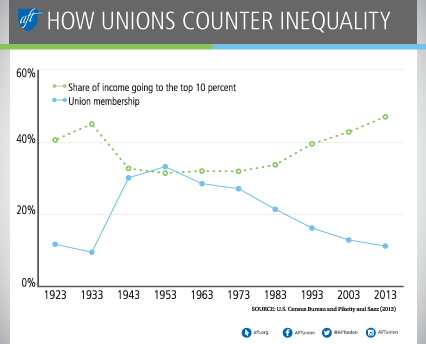
As Hillary Clinton recently noted, "The American middle class was built, in part, by the right for people to organize and bargain." She's right. When unions were at their peak, more workers -- upwards of 50 percent -- were in the middle class. Conversely, a decline in union membership - spurred on by trickle-down economics, ideological attacks and globalization -- is directly linked to the rise in income inequality.
At a time when only the wealthiest 10 percent have reaped the benefits of any gains in productivity, workers once again need a voice on the job. Collective bargaining can lift all boats, even those boats that aren't carrying a union card.
Look at wages. In the heyday of the American labor movement, non-managerial workers' wages went up 75 percent. As unions have been on the decline, these workers have only seen a four percent bump. Still, even today, union workers earn 28 percent more than nonunion workers. When two-thirds of our economic activity is driven by consumer spending, it's critical that working families have more money in their pockets to spend. Broadly shared prosperity will remain elusive as long as workers' buying power is limited.
And then there is retirement security. Eighty-six percent of Americans believe our nation faces a retirement security crisis. Unions bargain a secure retirement on behalf of workers, often in the form of pensions. Pensions both ensure that workers can retire with financial dignity and are important investors in our economy. For every dollar paid in pension benefits, there's $2.37 in economic output. Plus, long-term capital funds create hundreds of thousands of jobs in asset classes like infrastructure, venture capital and real estate.
Collective bargaining has a multiplier effect. So do laws meant to take collective bargaining away.
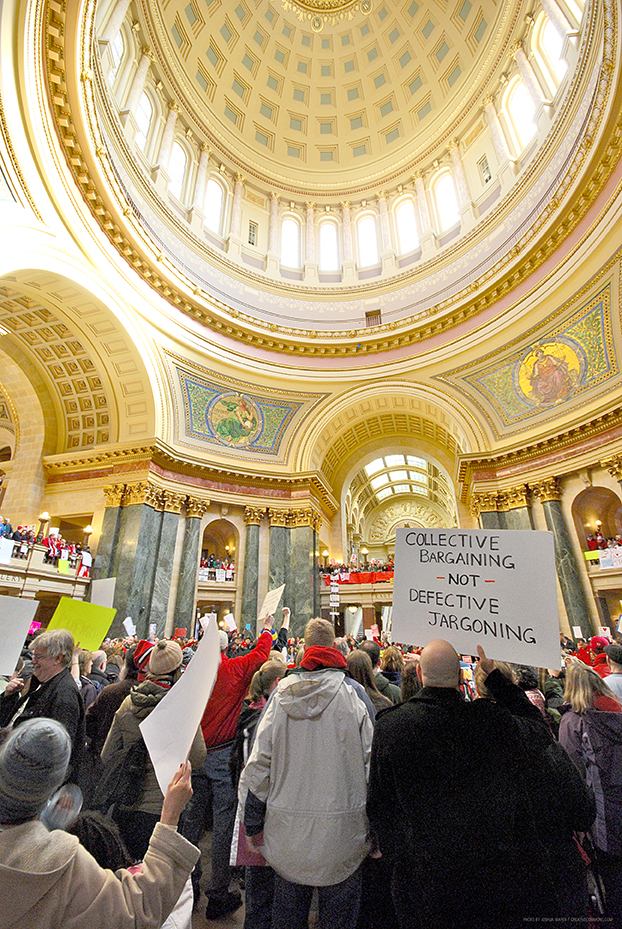
2015-03-14-1426361356-5132125-NYT_201503_PHOTO.jpeg
Workers in so-called right-to-work states make about $1,500 less per year. When wages are lower, workers leave the state, depressing job creation, and there's a sizable economic loss to the state. Marquette University economist Abdur Chowdhury estimates the impact of right-to-work on Wisconsin will be "a net loss of direct and indirect income of at least $5.8 billion annually."
Governors and state policymakers have a clear choice. They can push ideological A Tale of Two States | Randi Weingarten:

Marie Corfield: A 'close read' of reformy #PARCC rhetoric

Marie Corfield: A 'close read' of reformy #PARCC rhetoric:


A 'close read' of reformy #PARCC rhetoric

One of the best books ever for 8 yr. olds

On March 11, The Asbury Park Press ran this op-ed by NJEA President Wendall Steinhauer in which he rightly claimed, "PARCC and other high-stakes tests, by their nature, become the point of learning. High scores are the goal, not just the result."

On March 13, the paper ran this response from Dr. Sandra Alberti with whom Steinhauer engaged in a friendly PARCC debate on NJ 101.5 back in January. Alberti works at Student Achievement Partners, which was founded by the lead writers of the Common Core State Standards including David (people really don’t give a sh*t about what you feel or what you think) Coleman.

As an homage to the Common Core's 'close reading' technique, below is my analysis of Dr. Alberti's piece. Part of the package of 'reforms' that includes Common Core State Standards and high-stakes testing, Pearson defines Close Reading as:   

Close, analytic reading stresses engaging with a text of sufficient complexity directly and examining meaning thoroughly and methodically, encouraging students to read and reread deliberately. Directing student attention on the text itself empowers students to understand the central ideas and key supporting details. It also enables students to reflect on the meanings of individual words and sentences; the order in which sentences unfold; and the development of ideas over the course of the text, which ultimately leads students to arrive at an understanding of the text as a whole. (PARCC, 2011, p. 7)

In other words: your job as a reader isn't to react emotionally to a text because no one cares anyway (did you click on that David Coleman link above?). No, you just need to read it and understand what the author means.The process involves extensive annotation. Students are required to highlight sections of text and write questions, thoughts and ideas about what the author means in the margins or on sticky notes. I have real concerns about this approach, but hey, what do I know? I'm only an art teacher. But if my now 23 year old son, who read every singleCaptain Underpants book multiple times and laughed his butt off in the process, told me he had to do a close read of those books when he was 8, I'd have raised a ruckus. But, I'll give it the 'old college (and career) try'.

Quotes from Dr. Alberti's piece are in red. My 'close read' comments follow.

[the NJEA] is spending millions of dollars on a campaign to propagate anti-testing sentiment.
  • How many hundreds of millions of dollars have been spent on the 'campaign to propagate' the myths of 'failing students', 'failing schools' and 'lazy teachers' over the past few years?
  • How many billions of dollars in public education funding has Gov. Christie Marie Corfield: A 'close read' of reformy #PARCC rhetoric:

Fractured education reform never works

Fractured education reform never works:


Fractured education reform never works


 OK. Let's play a game.

Guess what this is: Its mission is to supervise the lowest achieving 5% of schools in Michigan. Its job is to establish policies that can rapidly improve those schools, coordinate reform efforts with the Department of Education, strengthen teacher effectiveness and convince Michigan to try initiatives that work elsewhere.
So what entity is this?
If you guessed the Education Achievement Authority, which oversees 15 low-performing schools in Detroit, you would be ... wrong.
Those goals belong to Michigan's State School Reform and Redesign Office, whose operations Gov. Rick Snyder moved Thursday from the Department of Education, which he does not oversee, to the Department of Technology, Management and Budget, which he does oversee.
The governor's actions prompt me to ask a series of questions, starting with: "Huh?"
And these:
Why move the reform office staff and 138 of the state's worst-performing schools — including some in Detroit — from the oversight of educators to that of business analysts and number-crunchers? Does that portend a future move of those schools to for-profit management companies?
Why make major changes affecting Detroit children while the Coalition for the Future of Detroit Schoolchildren, a diverse 36-member group of Motown leaders, is working tirelessly to develop recommendations for the governor by March 31?
State Sen. Bert Johnson thinks he knows: The governor did it so he'd be "100% in a position to control those schools."
Retired educator Keith Johnson, former president of the Detroit Federation of Teachers and a member of the 36-strong coalition, was more direct.
"We're going to continue to do our work," he said. "But if we put in all this work and we come back with sound recommendations that he simply ignores, it will give us license to go on the attack against the governor, saying, 'You charged us with coming up with recommendations for the state and then you cut our legs out from under us.'
"These people ... are putting in a lot of thought on a volunteer basis because we all care about the future of education in Detroit and Michigan. I think it's an insult to all of us for him to cut us off at the knees like this — potentially."
Another coalition member, who asked for anonymity until the group's work is done, called the governor's action "disappointing and distracting" but said it now places the governor in the hot seat.
"There are many people who share the governor's discontent that this (reform) office hasn't been used to help low-performing schools," the member said. "This move is bold in the sense that the governor is assuming responsibility to improve schools in the state, that he wants to be accountable.
"Even though I would have preferred for the governor to wait until the coalition has completed its recommendations, he's sending a powerful message that this office was underutilized. He's putting it out there that he wants to be accountable for low-performing schools. The public has to now hold him accountable."
If that is what Snyder intended, he bit off a huge hunk. This job might be harder than Fractured education reform never works:

The Problem with Pearson (and Hyperbole) | the becoming radical

The Problem with Pearson (and Hyperbole) | the becoming radical:

THE PROBLEM WITH PEARSON (AND HYPERBOLE)


The education reform debate—one often derailed by both the tone taken and then the debate about that tone (and not the issues)—appears determined to have an Evil Person (or Evil Corporation) to slay.
There was Michelle Rhee (whose Time cover really was just begging for it), and then Bill Gates. But to be honest, the list of candidates for Evil Person has been pretty long.
If you mention a person directly, you are immediately discounted as using ad hominem (although in many if not most of those cases, legitimate issues have been raised about expertise, experience, and even intentions—and not ad hominem at all).
Now, Pearson has entered the picture and prompted a new round (and maybe a new level) of hyperbole.
Data security about children/students, surveillance of Twitter and social media—Pearson has become the manifestation of Big Brother for those skeptical of technology and high-stakes testing.
To that, I’d say that we can have a reasonable debate about whether the comparison is hyperbole or an apt literary analogy, but the larger point I’d like to make is that in ether the debate or the comparison, we are likely missing the important issue.
Pearson has earned 8 billion—4 billion in the U.S.—in annual sales as a consequence of the accountability policies adopted by those elected to office within a democratic process.
I’m sorry to have to note this fact, but Pearson is not a Evil Demigod or some such.
Pearson and its profits are a consequence of very clear and consistent decisions by people in power and the people who put them in power.
Pearson is the logical conclusion of democracy and capitalism—not some totalitarian monster.
When you look at the Pearson phenomenon, and its relationship with education policy and theThe Problem with Pearson (and Hyperbole) | the becoming radical:

Saturday, March 14, 2015

The Charter Wars Revisited: “Backfill,” Suspensions, Choice and Authentic Assessment at the Manhattan Institute | Ed In The Apple

The Charter Wars Revisited: “Backfill,” Suspensions, Choice and Authentic Assessment at the Manhattan Institute | Ed In The Apple:


The Charter Wars Revisited: “Backfill,” Suspensions, Choice and Authentic Assessment at the Manhattan Institute

The Manhattan Institute (MI) is a conservative think tank, publishes City Journal and supports research; Marcus Winters, a senior fellow and professor at University of Colorado has written a number of papers supporting charter schools. The latest MI event was entitled “Are NYC Charter Schools Doing All They Can to Serve the Neediest Students?”
Winters presented his latest paper, “Pushed Out? Low Performing Students and Charter Schools,” Winters argues,
• Low-performing students are more mobile, regardless of where they are enrolled: in NYC charters as well as traditional public schools, low-performing students are more likely to change schools than their higher-performing peers.
• Low-performing students are not more likely to exit NYC charters than traditional public schools.
• To the extent that higher attrition rates for low-performing NYC students offer cause for concern, they are no less a problem for the city’s traditional public schools than they are for its charters.

Winters agreed there was anecdotal evidence in regard to “push outs,” however due to the lack of transparency there is no hard data, although he did agree that the failure to fill vacated spots in charter schools, commonly called “backfill” was The Charter Wars Revisited: “Backfill,” Suspensions, Choice and Authentic Assessment at the Manhattan Institute | Ed In The Apple:

The Crony Capitalist War against U.S. Public Education | Crazy Normal - the Classroom Exposé

The Crony Capitalist War against U.S. Public Education | Crazy Normal - the Classroom Exposé:


The Crony Capitalist War against U.S. Public Education

14MAR
There are several forms of Capitalism in use throughout the world. Economics Help.org defines them and reports that Crony Capitalism is what’s used in the United States. The Age of Crony Capitalism says, “For most of US history, crony capitalism has been in a struggle with free-market capitalism for the heart and soul of the American economy.  For the past half century, crony capitalism has been gaining the upper hand.”
In addition, Dr. Gary G. Kohls of Global Resaerch.ca says, “The 12 years of unrestrained crony capitalism during the anti-democracy mis-leadership of Republican presidents Ronald Reagan and George H. W. Bush tricked most of us into naively believing in their fraudulent ‘Trickle-down Economics’.”
Crony Capitalism is a term used to refer to the situation where business success is related to strategic influences with civil servants, politicians and those in authority. It could be used to refer to situations in early twentieth century U.S. where business leaders had to buy off politicians in return for favors (e.g. in popular media: Citizen Kane). Arguably a degree of crony capitalism occurs in countries like China, South Korea and Latin America. The power of the Mafia in Italy is also an example of crony capitalism.
The other forms of capitalism mentioned by Economics Help.org are: Turbo Capitalism (also known as unrestrained capitalism or free market capitalism), Responsible Capitalism, Popular Capitalism, Advanced Capitalism and State Capitalism. Visit the site to learn about the differences. I read them all and I think the two that are highlighted in this paragraph are the best choices for the most people.
Timeline for Crony Capitalist's War Against Public Education
In the corporate war against public education—known also as education reform leading to school choice, corporate charter schools and school vouchers—what reports do not support the Crony Capitalist reform movement?
The 1966 Coleman Report—Instead of proving that the quality of schools is the most important factor in a student’s academic success—as its sponsors had expected—the report written by the sociologist James S. Coleman of Johns Hopkins University found that a child’s family background and the school’s socioeconomic makeup are the best predictors. … A better summary of the findings, from Gordon M. Ambach’s perspective, is: Family and socioeconomic backgrounds are so important that it’s difficult for schools to overcome them.

In 1966, the Coleman Report highlighted the impact of poverty on student achievement. In this installment of the Mini-Moments with Big Thinkers series, policy faculty member Jeffrey Henig argues that it’s time to recognize that schools alone cannot ensure that all students succeed equally.
The 1983 report under the Reagan Administration known as A Nation at Risk was characterized by its The Crony Capitalist War against U.S. Public Education | Crazy Normal - the Classroom Exposé:

Join Chuy for the annual South Side Irish St. Patrick's Day Parade - ‪#‎Chuy2015‬ ‪#‎imwithchuy‬

South Side Irish St. Patrick's Day Parade - Jesus "Chuy" Garcia for Mayor of Chicago:


South Side Irish St. Patrick's Day Parade

Sunday, March 15, 2015
12:00 PM

Western Avenue between 103rd and 115th
Chicago, IL
Join Chuy and thousands of parade-goers for the annual South Side Irish St. Patrick's Day Parade on Sunday. 
More information from SouthSideIrishParade.org:
The annual South Side Irish Parade is a great time to spend with family and friends, both in bars and at house parties. We encourage everyone to celebrate responsibly and help keep the annual tradition a safe, family friendly event. Many of the Western Avenue bars support the parade and we hope you will support them in a responsible manner helping us ensure everyone has a safe, enjoyable parade. Sláinte!