Latest News and Comment from Education

Saturday, March 14, 2015

Outrage in Manteca: Teacher Suspended for Hugging Autistic Student Must be Reinstated | ForceChange

Teacher Suspended for Hugging Autistic Student Must be Reinstated | ForceChange:


Big Education Ape Editor (Mike Simpson): I have known Leo for over 10 years. This is so very WRONG! Leo is the most loving and caring person that can be imagined. He spends many hours advocating for children and for public education. Please consider sending your support for Leo in this matter, the kids need him! 

Teacher Suspended for Hugging Autistic Student Must be Reinstated


From Leo's FaceBook page
"Thanks to all the petition signers and supportive commenters. The newest challenge is that CPS has directed Gio's mom to cease all contact between myself and her son under threat of removal for neglect.
This is because I am 'under investigation - though not by CPS. Crazy! Especially since we are approaching 60 days with no tentative dates for completion of the MUSD and MPD investigations. Something is wrong with this process and it is not the parent/teacher solidarity!
Through our advocacy at the County Board of Supervisors and elsewhere we have been able to have the 'child safety plan' modified to 'allowing', though contrary to CPS recommendation, my tutoring and visits in her presence. The threat of removal for noncompliance remains. So much for respecting a mother's judgment and child needs!
Now Terry has to cover the morning child care so that Sharon can work. This had been my role until later each day when Terry was rested enough to share in the service of caregiving. We are trying to get a compromise to let Sharon bring Gio to our home so that Terry can have my help as she adjusts to the new reality of living with IBC.
It takes a village but apparently this is not embraced by our local CPS, MUSD & MPD. Waiting for the 'Family City' to show up smile emoticon Realistically it will probably be an arrest warrant showing up to justify the excessive investment of police and CPS resources. Thankfully we will then be finally in a true presumption of innocence environment. This is all so sad frown emoticon

635598268523698402-635598008650225835-teacher
(Photo: Tim Daly, KXTV-Sacramento)


Target: Jason Messer, Superintendent at Manteca Unified School District
Goal: Reinstate teacher suspended for hugging a special needs student.
A special education teacher has been suspended and barred from being near children after he granted an autistic child’s request for a hug. Leo Bennett-Cauchon, a teacher for 16 years, hugged and picked up an 8-year-old autistic boy at the boy’s request, as he was trained to do. The school district was notified of the act, and called police in to investigate what they have called “possible inappropriate behavior.”
Autism spectrum disorders are immensely varied and complex, and each affected child needs a different kind of care. While some do not like to be touched, others need the sensation of physical stimulation and human contact to calm them. As special needs children are likely to be away from their parents for extended lengths of time at school, it is perfectly reasonable that they may need this contact from a teacher.
Leo Bennett-Cauchon was educated specifically in understanding and addressing the needs of developmentally disabled children. By suspending him, the school is not only punishing Bennett-Cauchon, but his students as well, who need the stability and structure a familiar teacher can provide. Even the child’s mother supports the way the teacher handled her son, and believes he should be reinstated immediately.
Accusing this special needs teacher of inappropriate conduct is ridiculous, and could be detrimental to the way this teacher handles students in the future. By suspending him, the school is showing no regard for the special needs of mentally challenged students. Sign the petition below to demand that the school immediately reinstate this teacher as well as apologize for the trumped-up allegations of misconduct, which have the power to ruin his entire career.
PETITION LETTER:
Dear Mr. Jason Messer,
Leo Bennett-Cauchon, a special needs teacher for 16 years, was recently suspended for hugging an autistic child when the child asked for a hug. Bennett was specially trained to deal with special needs children, who sometimes need human contact to calm themselves.
Not only was the teacher suspended for hugging the child, but the school district decided to involve the police despite the child’s mother asserting that Bennett dealt with her child appropriately. These trumped-up allegations are not only ridiculous, but could even end the teacher’s career.
By suspending Bennett, the school district has shown disregard for the well-being of its special needs students, who need the stability of a regular teacher, and sometimes, physical contact. We, the undersigned, demand that the school district apologize for suspending Bennett for simply doing his job, and that he is immediately allowed to return to work.
Sincerely,
[Your Name Here]
Photo credit: Cynthia_M._Parkhill via Creative Commons

Autism teacher protests removal for hugging


A special education teacher for 16 years is protesting the move by Manteca, Calif. school officials to put him on paid leave, barred from being near children.
Leo Bennett-Cauchon said he was just doing what was best for a severely autistic 8-year old when he made contact with the child in early February.
"I've been trained, if a student asks for a hug, you give a hug. I admit completely that I hugged him and let him sit in my lap when he said 'sit.' I picked him up when he said 'up.' This is a child that needs that physical contact," Bennett-Cauchon said.
He's been holding a sign outside the school district office that says "Let me teach. Bring back joy."
Clark Burke, a representative for the school district, says it's making sure it follows through with both its legal and moral obligations to protect students.
Police in this Northern California town said Tuesday they're investigating the possibility there were "repeated acts of inappropriate behavior" and "there could be multiple victims."
The mother of the 8-year-old boy said she supports how the teacher dealt with her son, but Bennett-Cauchon will be off the job while the incident is investigated by police and the school district. The police investigation is expected to last up to four weeks.
http://www.usatoday.com/story/news/nation-now/2015/02/18/autism-teacher-removal-hugging-california/23601933/


Leo Bennett-Cauchon: Special Education Teacher Suspended For Hugging Autistic Child Who Asked For A Hug


image: http://cdn.inquisitr.com/wp-content/uploads/2015/02/Leo-Bennett-Cauchon-665x385.jpg
Leo Bennett-Cauchon: Special Education Teacher Suspended For Hugging Autistic Child Who Asked For A Hug


Leo Bennett-Cauchon has been a special education teacher for the past 16 years working with students who have severe disabilities, but the well-liked educator is now out of a job after giving a hug to an autistic 8-year-old who reached out to hug him.
Bennett-Cauchon was suspended by the Manteca, California, school district and put on leave, also barring him from being near children.
But Leo Bennet-Cauchon said he didn’t do anything wrong.
“I’ve been trained, if a student asks for a hug, you give a hug. I admit completely that I hugged him and let him sit in my lap when he said ‘sit.’ I picked him up when he said ‘up.’ This is a child that needs that physical contact,” Bennett-Cauchon said.
The school even turned the case over to the Manteca Police Department, who are looking into whether there were “repeated acts of inappropriate behavior.” Police said they are concerned “there could be multiple victims.”
But Leo Bennett-Cauchon said there’s a good reason. Many of the kids he teaches are homeless or in the foster system, and often they just need a hug.
Many parents are in Leo’s corner, including the parents of the boy.
“He has my full support,” Sharon Anaya said. “That’s why I felt that this should have remained at a school district level investigation, rather than involving police.”
This is not the only case of a controversial teacher suspension to make headlines in recent week’s. Back in December, a teacher in Oklahoma was suspended for reading his class a Benjamin Franklin quote that read: “In the dark, all cats are gray.”
The quote, taken from one of Franklin’s letters titled by historians “Advice to a Young Man on Choosing a Mistress,” was meant to illustrate that the founding father was still just a man, and a flawed one at that. But the quote’s sexual undertones attracted the attention of the district, who suspended the teacher.
Meanwhile, Leo Bennett-Cauchon has taken his protest directly to the district, standing outside the administrative offices with a sign that read,”Let me teach. Bring back joy.” Police said their investigation will take up to four weeks.
Read more at http://www.inquisitr.com/1852350/leo-bennett-cauchon-special-education-teacher-suspended-for-hugging-autistic-child-who-asked-for-a-hug/#s3ZBPIpCCKkjlccj.99

Dialogue With the Gates Foundation: How Do We Build the Teaching Profession? - Living in Dialogue

Dialogue With the Gates Foundation: How Do We Build the Teaching Profession? - Living in Dialogue:


Dialogue With the Gates Foundation: How Do We Build the Teaching Profession?


 By Anthony Cody.

(Originally posted here, July 23, 2012. This essay is also included in my book, The Educator and the Oligarch, a Teacher Challenges the Gates Foundation.)
In the summer of 2012  I traveled to Seattle and spent most of the day meeting with leaders of the Gates Foundation, discussing their work around education reform. I have been critical of the impact their agenda has had, but they expressed an interest in opening up a dialogue. This blog post was the first in a series of exchanges that  explored some of the key issues in education. I am re-posting, as these issues remain central to the ongoing debate over how to improve our schools.
In the weeks that followed we got into some nitty gritty issues, such as what it means to “measure” teacher effectiveness? What is the role of poverty in relationship to education reform? What is the purpose of a k-12 education? And what role should the drive for profit play in our schools? But as our starting point, we are took a narrower focus, and tackled something a bit more concrete. This first exchange will focus on these questions: How can educators create a strong professional culture in our schools? How do we build the teaching profession?
The Gates Foundation has presented effective teaching as the focus of its education work for the past few years. Unfortunately much of the reform work of the past few years has focused on the negative side of the teacher-effectiveness equation. Reports like “The Widget Effect” have built up the idea that American schools are places where nobody is ever fired. Films like “Waiting for Superman” have reinforced the concept that due process for teachers means we have “jobs for life.” The Gates Foundation, I believe, has actively promoted these ideas, and in 2010, Bill Gates stated on Oprah that if we could get rid of bad teachers, “our schools would shoot from the bottom of these (international) rankings to the top.”
But there seems to be a growing awareness that real growth will not come from this strategy of rooting out the bottom 5 percent of performers. We will need to do some heavy lifting to reverse some of theDialogue With the Gates Foundation: How Do We Build the Teaching Profession? - Living in Dialogue: 

House Bill 2048: Re-segregation through legislation | Seattle Education

House Bill 2048: Re-segregation through legislation | Seattle Education:


House Bill 2048: Re-segregation through legislation


Mother and Daughter at U.S. Supreme Court
Apartheid (… an Afrikaans word meaning “the state of being apart”, literally “apart-hood”) was a system of racial segregation in South Africa enforced through legislation…
I feel very strongly about this bill because my dad had no other choice but to live in the Central District when he was growing up in Seattle because of a city covenant that did not allow African-Americans to live outside of a boundary determined by the city. That meant little opportunity for my dad to grow beyond that border. He was fortunate enough to have a high school coach, at Franklin High School, who saw his talent and with his coach’s help, my dad, Brice Taylor, was one of the first three African-American students to attend the University of Southern California even against the wishes of the college president, but that’s another story.
My dad went on to become the First All American at USC in football and that opened doors for him. Not everyone had that kind of opportunity. That’s why, what I term the Apartheid Bill, hits home for me. Some people find fault in my use of the term “Apartheid” but that is how I perceive it, through my lens.
The Seattle Public School system reverted back to neighborhood schools from an all-city draw, when students could select the school or program they wanted to attend, not long ago which re-segregated our schools. Then with transportation cuts, it became even more difficult for students to attend special programs outside of their neighborhoods.
Now, Representatives Sharon Tomiko Santos and Eric Pettigrew want to split the city in half along racial lines again, through legislation, into two separate school districts, separate but not equal. This is why politicians should not determine education policy. Either they don’t know enough to make an informed decision or they are following through on a donor’s agenda.
Case in point, House Bill 2048.
The bill, which is very vague, proposes to cut the district in half. I believe the bill is House Bill 2048: Re-segregation through legislation | Seattle Education:

Guess What: Pearson Monitoring on PARCC tests is at the End of the Internet (Disappeared Page)

Page not found « Social Media Management (SMMS) | Tracx:


Disappeared Page

Pearson Streamlines Social Media Listening and Monitoring on PARCC tests With Tracx


Tracx 404 error

From one Ape to Another: I FOUND IT!

Pearson Streamlines Social Media Listening and Monitoring on PARCC tests With Tracx

Pearson Streamlines Social Media Listening and Monitoring With Tracx:

Pearson Streamlines Social Media Listening and Monitoring With Tracx

Big Education Ape: BREAKING: Pearson, NJ, spying on social media of students taking PARCC tests | Bob Braun's Ledgerhttp://bit.ly/1BCz9Ol

Media preview


Pearson is the world’s leading learning company, providing educational materials and services and business information through the Financial Times Group. Pearson serves learners of all ages around the globe, employing 41,000 people in more than 70 countries. Social media plays a business critical role across all of Pearson’s major businesses: PreK-12, Higher Education, Professional and Assessment, as well as from a corporate perspective.

Problem

With organizationally and globally distributed teams, Pearson employees were using dozens of different social media toolsand services. Their primary tool, Radian6, was difficult to use, limited in terms of how many topics they were able to track and very expensive. Providing meaningful measurement across Pearson was challenging and an incredibly manual and time-consuming process. Pearson was seeking a social listening and analytics platform that could be utilized across all its business units and able to scale to support its global businesses.

Solution

After doing a thorough review of social media listening and analytics tools, Pearson chose Tracx for three primary reasons.
1. Usability: 
which refers not only to the clean intuitive user interface of the Tracx platform but also to the ease of getting data and reports needed.

2. Customer Service: 
with a dedicated client services team on tap to not only get the Pearson team up and running but available to help however needed on an ongoing basis.

3. Value: 
since Tracx does not charge additional fees based on the number of user profiles or owned media accounts, both are included and unlimited with Tracx. Pearson uses Tracx daily for social listening and monitoring across all its lines of business.
Today, Pearson uses Tracx to arm nearly 40 employees to do their own social research and reporting and continues to add additional users and geographies every month.

Results

Tracx enabled Pearson to increase organizational efficiencies and cut costs by reducing the number of social tools being used throughout the organization. Tracx has assisted with governance issues including enterprise workflows to ensure appropriate teams are communicated with, as well as approval chains and processes are followed. In addition, Tracx has empowered a wider number of people within the Pearson organization to self-serve social listening, analytics and reporting reducing the pressure on the online marketing group to be the sole provider of this knowledge and reporting.

Pearson Streamlines Social Media Listening and Monitoring With Tracx

Big Education Ape: Companies cash in on Common Core despite controversy http://bit.ly/1Ah00v6


Common Core's contract winners

Rank
Vendor
Project awards 2010-2014
1Pearson27
2Houghton Mifflin Harcourt20
3Staff Development Workshops16
4Scholastic14
5Catapult Learning11
6McGraw-Hill9
7Pivot Learning Partners9
8AP Ventures8
9Action Learning Systems7
10Solution Tree7
Source: Onvia database of awards, based on key words related to "common core"

Bob Braun's Ledger
 Big Education Ape: UPDATE: Pearson, NJ, spying on social media of students taking PARCC tests | Bob Braun's Ledger http://bit.ly/1BCz9Ol


The Powerful, Enforced Silence Around Standardized Testing | deutsch29

The Powerful, Enforced Silence Around Standardized Testing | deutsch29:


The Powerful, Enforced Silence Around Standardized Testing


fish


 Partnership for Assessment of Readiness for College and Careers (PARCC) testingtakes more than ten hours for students in grades 3 through 8 to complete.

These students have spent countless hours preparing for the PARCC tests, and they have heard that the tests are important. However, they will receive no immediate, clear benefit from taking the tests. Their teachers will receive no clear, immediate information to inform instruction. By the time PARCC scores come, the school year is over, and likely another begun.
The teachers know that student scores on PARCC are meant to be used to grade them and their schools.
All of the above makes for a high-stress situation for both kids and teachers.
And once it is over, kids now know that the testing companies and departments of education are trolling social media to see if kids discuss the experience.
Such constitutes an abuse of power.
Pretend I am Pearson. I have just spent ten-plus hours with your child. You have no idea what we “talked” about, what exact ideas I have presented or how I presented them to the tender mind of your child. I can “discuss” whatever I like and present it with authority. I can promote certain people as “good and others as “bad.” I can promote products. And I can shape your child psychologically via my topics and presentation of such topics. Why, I can even collect psychological information on your child.
And once my ten-plus hours of “meetings” with your child are ended, I make it clear that I plan to monitor your child’s public discourse about the experience.
All that this does is protect me, the one already in incredible power.
You did not request that I meet with your child. Your child did not request the The Powerful, Enforced Silence Around Standardized Testing | deutsch29:

Pearson monitoring social media for security breaches during PARCC testing - The Washington Post

Pearson monitoring social media for security breaches during PARCC testing - The Washington Post:

Pearson monitoring social media for security breaches during PARCC testing


 Updated with response from superintendent

Pearson, the world’s largest education company, is monitoring social media during the administration of the new PARCC Common Core test to detect any security breaches, and a spokeswoman said that it was “obligated” to alert authorities when any problems were discovered.
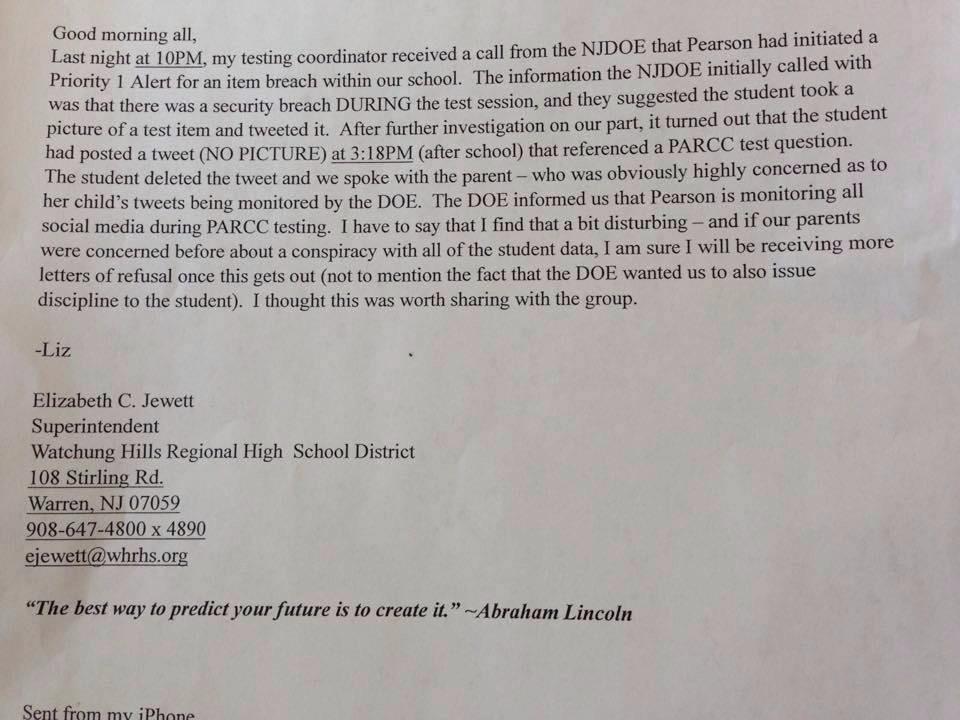
The superintendent of a New Jersey school district wrote an e-mail to colleagues (see below) about the monitoring, saying that she found the practice “a bit disturbing.”
Students in New Jersey are now taking the PARCC, a Common Core test created by the Partnership for the Assessment of Readiness for College and Careers, one of two multi-state consortia given $360 million in federal funds to design new standardized tests that align with the Common Core State Standards. PARCC testing is underway in several other states amid a growing opt-out movement by parents who are refusing to allow their children to take the test. Pearson has a contract of more than $100 million to administer the PARCC in New Jersey.
News of the monitoring of social media was revealed in a message that Superintendent Elizabeth C. Jewett of Watchung Hills Regional High School District in New Jersey sent to colleagues about a disturbing episode that she was made aware of by her district’s testing coordinator. It wasposted on the Web site of Bob Braun, a former reporter, education editor and senior columnist at the Star-Ledger, who called the monitoring of social media nothing less than “spying.”
Asked for a comment about the monitoring of social media during the PARCC administration, Pearson spokeswoman Stacy Skelly said in an e-mail:
The security of a test is critical to ensure fairness for all students and teachers and to ensure that the results of any assessment are trustworthy and valid.
We welcome debate and a variety of opinions. But when test questions or elements are posted publicly to the Internet, we are obligated to alert PARCC and our state customers. Any contact with students or decisions about student discipline are handled at the local level.
We believe that a secure test maintains fairness for every student and the validity, integrity of the test results.

Jewett responded to an e-mail with a link to a letter that she posted on the district’s Web site. It says:
Dear Watchung Hills Regional High School Learning Community,
On Friday, March 13, 2015, Bobbraunsledger.com published a story referencing an email I had sent to other superintendents about issues regarding PARCC testing and Pearson’s monitoring of social media. The email shown in his article is authentic. It was an email I sent on March 10, 2015 at approximately 10:00AM to a group of superintendents to share my concerns and to see if other schools had a similar experience. I did not authorize the release of this email nor am I aware of who did release it. I am also not aware of the motives they may have had behind the release. That said, I completely 
Pearson monitoring social media for security breaches during PARCC testing - The Washington Post:


Jersey Jazzman: When Pearson Monitors Students, They Prove the Inferiority of Their Product

Jersey Jazzman: When Pearson Monitors Students, They Prove the Inferiority of Their Product:

When Pearson Monitors Students, They Prove the Inferiority of Their Product


When Pearson Monitors Students, They Prove the Inferiority of Their Product

UPDATE: Watching Hill Regional High School has released a statement about the incident below.

Full disclosure: my K-8 district "feeds" into WHRHS, but I am not employed there as it is a separate district. I do not know who the student is but it is possible he is a former student.

Most of you probably know by now that Bob Braun, veteran education journalist and a personal friend, published a blockbuster of a story yesterday: Pearson Education, Inc., creator of the PARCC standardized test, has been monitoring students' social media use and, in at least one case, reported what they considered to be a violation of their test security.

Even worse: Bob's site has been under a "denial of service" attack since shortly after he published the report. As of this morning, I'm still not able to access Bob's story at his blog, but not to worry: Bob published his story on Facebook, where it appears to be immune from DOS attacks. Here's an excerpt:

Pearson, the multinational testing and publishing company, is spying on the social media posts of students--including those from New Jersey--while the children are taking their PARCC, statewide tests, this site has learned exclusively. The state education department is cooperating with this spying and has asked at least one school district to discipline students who may have said something inappropriate about the tests. This website discovered the unauthorized and hidden spying thanks to educators who informed it of the practice--a practice happening throughout the state and apparently throughout the country.

The spying--or "monitoring," to use Pearson's word--was confirmed at one school district--the Watchung Hills Regional High School district in Warren by its superintendent, Elizabeth Jewett. Jewett sent out an e-mail--posted here-- to her colleagues expressing concern about the unauthorized spying on students.

She said parents are upset and added that she thought Pearson's behavior would contribute to the growing "opt out" movement. So far, thousands of parents have kept their children away from the tests--and one of the reasons is the fear that Pearson might abuse its access to student data, something it has denied it would do.

- See more at: http://jerseyjazzman.blogspot.com/2015/03/when-pearson-monitors-students-they.html

Schools Matter: Eli Broad funded United Way Greater Los Angeles now also serving CCSA's political arm

Schools Matter: Eli Broad funded United Way Greater Los Angeles now also serving CCSA's political arm:

Eli Broad funded United Way Greater Los Angeles now also serving CCSA's political arm

"By what logic does United Way engage in an activity that is shunned by all the other charities?" — Professor Ralph E. Shaffer

United Way Greater Los Angeles (UWGLA)'s role as a tax deductible lobbying and public relations firm for plutocrats like Eli Broad, Bill Gates, Carrie Walton Penner, and Casey Wasserman is expanding. They are now apparently functioning as adjunct to the deep pocketed California Charter School Association (CCSA). To wit, compare this email from the "non-partisan charity" UWGLA to that of the CCSA trade association's 501c4 wing, CCSA Advocates:

Eli Broad funded United Way of Greater Los Angeles now also serving CCSA's political arm
Notice any similarities?

In a discussion with several other social justice activists, we were trying to decide why UWGLA's well paid political consultants didn't have the good sense to at least change the precise order of the candidates that they and their fellow special interest group, the CCSA, feature on their propaganda pieces. UWGLA could argue, unconvincingly, that they put the names in the same order as candidates received votes in the primary election. However, it's far more likely that they used CCSA's billionaire backed candidates' existing information and then tacked on the other candidate information on as a grudging afterthought.

The first clue that UWGLA has absolutely no respect for the candidates outside of the CCSA privatization pushers like Galatzan and Rodriguez? They misspelled the Honorable Bennett Kayser's name as "BENNET KAYSER" in every occurrence of both the image and text of the communication they sent out. This is the seated school board member, and UWGLA has a mind-blowing multi-million dollar budget, but they get everything else correct except the school board member's name? Moreover, notice how all of the head shots are proportional, but they use the old political trick of making one candidate look abnormal by using a disproportional photo crop. A nasty little Fox News style play probably drawn up by CCSA's arch-reactionary political director Carlos Marquez.

We frequently look to UWGLA's plutocrat funding sources and the neoliberal pay-to-advocate paradigm that UWGLA and other members of the Non-Profit Industrial Complex (NPIC) operate under. Nothing is more telling of UWGLA's complete allegiance to the neoliberal corporate education reform agenda than this 2013 photo of privatizer Monica Garcia, the disgraced John Deasy, millionaire Casey Wasserman, billionaire Eli Broad, and UWGLA's Elise Buik. What we typically don't look at is the staff members UWGLA employs to promulgate their donors' agenda.

UWGLA's current Education Program Officer is Elmer G. Roldan. Prior to his UWGLA stint, Roldan worked for the Camino Nuevo Corporate Charter Chain—known for its unelected board of bankers, finance capitalists, and hedge Schools Matter: Eli Broad funded United Way Greater Los Angeles now also serving CCSA's political arm:


Here are the states that serve the most local food at school - Vox

Here are the states that serve the most local food at school - Vox:

Here are the states that serve the most local food at school


Farm to table map


 In the Northeast, almost all school districts are on board with the farm-to-table movement — but the rest of the country is still pretty far behind, according to this map from the US Department of Agriculture's Farm-to-School census:

In New Hampshire, Maine, Vermont, Delaware, Maryland, and Rhode Island, at least 90 percent of school districts have some kind of farm-to-school program in place, meaning either they buy local produce or they have school gardens.
At the other end of the scale, fewer than 25 percent of school districts in South Dakota, Nebraska, Mississippi, Texas, Nevada, Wyoming, and Arkansas have farm-to-school programs.
But even in states that have embraced the farm-to-table movement, local foods are a small share of the budget. Only 2 percent of Maine schools' food budget is spent locally.
The locavore leader is arguably — no surprise — Oregon. True, just 66 percent of its school districts have some kind of farm-to-school program, less than leading states like Vermont. But in those districts, 24 percent of the food budget is spent on local foods, a greater percentage than anyone else.Here are the states that serve the most local food at school - Vox:

School Funding Inequality Makes Education 'Separate And Unequal,' Arne Duncan Says

School Funding Inequality Makes Education 'Separate And Unequal,' Arne Duncan Says:

School Funding Inequality Makes Education 'Separate And Unequal,' Arne Duncan Says


 Many school systems remain "fundamentally separate and unequal," U.S. Education Secretary Arne Duncan said Friday, with 23 states spending more per pupil in affluent school districts than they do in high-poverty districts. What's more, Duncan said on a call with reporters, the inequality may be getting worse.

Duncan alluded to Republican-backed efforts to overhaul the No Child Left Behind Act, which he said would give even more money to well-off school districts at the expense of struggling districts. In February, House Republicans proposed the Student Success Act as a rewrite of No Child Left Behind. Duncan at the time blasted the bill, which hasn't yet come to a vote, saying a funding provision may have a devastating impact on disadvantaged students.
Duncan on Friday said some Republicans are pushing what he called a "Robin Hood in reverse" funding proposal that "would exacerbate the existing problem by allowing even greater cuts to districts that need the most help."
As it stands, Duncan said, about 6.6 million students from low-income families in 23 states are harmed by local and state funding disparities. The funding inequality data comes from National Center for Education Statistics, a branch of the U.S. Department of Education that collects information on schools.
Federal education funding can help rectify state and local inequalities. But federal dollars aren't meant to balance state and local funding, Duncan told The Washington Post. Instead, federal money is intended to help needy students, he said.
The point of that money was to supplement, recognizing that poor children, and English language-learners, and students with disabilities come to school with additional challenges,” Duncan told the newspaper. “This is about trying to get additional resources to children and communities who everyone knows need additional help.”
The maps below show where funding inequalities are the worst. The first map shows areas affected by state and local funding differences. Negative percentages indicate that high-poverty schools receive less funding than low-poverty schools. The second graph shows funding disparities after federal dollars are taken into consideration.
Pennsylvania has the worst funding disparities between low-income and high-income schools. The state's poorest school districts receive 33 percent less state and local funding than the richest schools. This inequality is currently the subject of a lawsuitbrought by a group of school districts and parents.
"The problem you have in Pennsylvania is not atypical of the problems you have in many states, which is a reluctance to raise enough revenues to send to the districts," Michael Churchill, a lawyer representing the plaintiffs, told The Huffington Post. "The revenues they do send, they send in a progressive manner -- they just don’t send enough to overcome the huge differences in wealth in the districts," said Churchill.
Churchill noted that Pennsylvania relies heavily on local property taxes for school district funding, meaning that wealthier areas, with a larger tax base, have more money.
A Pennsylvania Department of Education spokesman didn't reply to The Huffington Post's request for comment.
On the other end of the spectrum, states like Indiana and Minnesota spend significantly more on their low-income students than they doSchool Funding Inequality Makes Education 'Separate And Unequal,' Arne Duncan Says:

Two closed charter schools’ records unauditable | The Columbus Dispatch

Two closed charter schools’ records unauditable | The Columbus Dispatch:


Two closed charter schools’ records unauditable


The two Talented Tenth Leadership Academies in Columbus have been shut down, their founder has been indicted on criminal theft charges, and now the former charter schools have been placed on Ohio Auditor Dave Yost’s “unauditable” list.
Yost said financial records for the academies — one for boys and one for girls — were either missing or such a mess that he was unable to review them to determine whether tax dollars were accounted for.
Problems for the two academies started shortly after they opened in 2013. Within months, Ohio school Superintendent Richard A. Ross ordered them closed for health and safety reasons.
State officials said the schools were inadequately staffed, there were numerous student fights, and meals weren’t being served or consisted of fast-food carryout. The schools were sponsored by the North Central Ohio Education Center.
The schools’ founder, Andre Rasheen Tucker, faces two counts of theft alleging that he stole checks made out to his charter school totaling about $7,500.
Yost’s office conducts regular audits of charter schools and other entities to ensure that tax dollars are accounted for. The academies are among four charter schools on his unauditable list.
School officials have 90 days to turn over required financial records or face legal action, and the sponsoring service center must provide a written explanation. The sponsor also is prohibited from contracting with additional charter schools.Two closed charter schools’ records unauditable | The Columbus Dispatch: