Latest News and Comment from Education

Saturday, February 28, 2015

A is for Apple B is for Badass What it means to Badassteachers in the Age of Corporate Education Reform Badass Teachers Association

Badass Teachers Association:


A is for Apple B is for Badass 


What it means to Badassteachers in the Age of Corporate Education Reform

By: Dr. Yohuru Williams


One of the persistent questions BATS face centers on the name of our organization and what it means to be one of the Badassteachers. A recent interview with a French journalist reminded me of this fact and the necessity for us to revisit regularly the goals and aims of our collective. So what exactly does it mean to be Badass, she asked sheepishly toward the close of our conversation on the legacy of the Civil Rights Movement. What does the Badassteachers Association believe are the central threats to public education and what makes one a Badass?

It is a question most of us should become adept at answering if we mean to counter the corrosive effect of the narratives of failure that accompany the corporate education reform agenda. As one of the co-founders once observed, we are not trying to resurrect any group from the past. While the rich history of social justice activism informs us, we fully recognize how our situation today calls for organizations and solutions that speak to the unique challenges we face in the present moment.

The essence of what it means to be a Badassteacher can be found in each of the letters that make up our provocative name.

To be clear, the Badassteachers and their allies recognize that the problems we face are

B: Big. The agents of corporate education reform are active in every state of the Union and are financed by individuals like the Koch brothers whose anti-union, anti-teacher schemes have done immeasurable damage to public education. They also understand that corporate education reform is global and that what we fight is one facet of a global education reform movement (GERM) aimed at undermining public education and reducing students worldwide to data points. While we recognize the size and scope of the problem Badassteachers welcome the fight. As our motto states, for too long teachers were forced to suffer in silence as the condition of our public schools eroded and the failure of elected officials to take seriously calls for sober minded reforms such as reducing class sizes and tackling the crippling effects of poverty in our schools. The days of silence have passed. We answer the big challenge with an even bigger commitment to fighting for social justice for our kids and communities across the globe.

A: Action Oriented. What distinguished Badass teachers is their penchant for action. Whether on social media or boots on the ground, real Badassteachers seek to be at the center of the fray, challenging high stakes testing, standing up to politicians, and demanding equity for our students. This is because BATS recognize that the need for action is central to our fight against the corporate education reform industry. We recognize and appreciate the need to challenge the narrative of school failure whenever and wherever it presents itself. We are prepared to vote with our feet as the brave students and education activists have done in New York, Newark, Los Angles, Providence, Philadelphia, and Chicago to stamp out the vestiges of inequality that plague our communities and reclaim our schools.

D. Dedication. Being a Badass requires a level of dedication that transcends casual engagement and takes on an all or nothing mentality with regard to education activism. The state moderators who run this organization from the Bronx to Baton Rouge share a common resolve to get in this fight and stay in this fight until all public school students have the schools they deserve. They share the fundamental belief that schools are the nucleus of communities and that partnership between parents, students, and teachers holds the key to designing schools of the future that will develop our youth and preserve democracy. Badass Teachers and their allies will accept nothing less.

A: Assertive. Badass Teachers know that the only way to check the dangerous incursion of corporate education reform is to be clear and thoughtful in their approach. For this reason, Badassteachers read and study the issues. They read the Bat Blog and other independent sources of information such as Diane Ravitch’s blog that expose the true corporate education reform agenda. They are always ready to share in a fresh and accessible manner our core concerns over issues as high stakes testing, the expansion of charters at the expense of funding for public education, the school to prison pipeline and the need for the recruitment and retention of more teachers of color.

S. Serious. Badass teachers recognize the seriousness of this fight and our need to be steadfast in our approach to fighting for the schools our students deserve. This includes insuring that a full range of academic interventions remains available to our students as well as sustained funding for libraries, music and the arts and other non-negotiable necessities essential to the development of well-rounded students.

S. Surgical. Badass Teachers recognize global education reform as an infectious disease, which, if left unchecked threatens to corrupt the very fabric of our society at the same time it chokes the very life from our schools. We focus on
Badass Teachers Association:

Renewing America's Labor Movement | Randi Weingarten

Renewing America's Labor Movement | Randi Weingarten:

Renewing America's Labor Movement


Across the country, people are clamoring to be heard. They want a voice.
These are people who work hard but never see their wages keep up. After a lifetime of work, they don't have a pension or savings for a secure retirement. They rack up debtso they and their children can get a higher education, which is more necessary now than ever before. People are searching for a way to transform an economic system that benefits the few over the many. They are searching for fairness, opportunity, justice and real change.
I believe that search can and should lead to the labor movement. At this week's Albert Shanker Institute conference, The American Labor Movement at a Crossroads: New Thinking, New Organizing, New Strategies, Labor Secretary Tom Perez reminded us: "The growth of the middle class was linked to a labor movement that was strong."
But we must re-envision and renew our labor movement to face the challenges of the 21st century, to be the voice that today's working people want and the robust engine our economy needs. Because, as we face a new global economy -- one powered on technology and knowledge, where information travels at lightning speed -- we can no longer operate as if we're in a factory. As circumstances change, our nation changes, our world changes -- we too must change.
At the conference, we asked these hard questions: Are we flexible and forward-thinking enough to meet the demands of a 21st-century economy? Can our infrastructure adapt to meet the needs of new generations?
The ideas and strategies were promising. David Rolf, president of SEIU 775, challenged us to innovate: "We have to be willing to stand up and say no court is going to stop workers from building power." Others emphasized the need to work with community. "It's no longer about garnering community alliances for workplace fights. We have to figure out how workplace fights are part of the broader community struggles," said Sarita Gupta, executive director of Jobs with Justice. At the same time, Tefere Gebre, AFL-CIO executive vice president, reminded us that "in order to build a movement, we have to keep workers at the center of our thinking; we need to empower workers to decide for themselves."
As our movement evolves, our values endure: Fairness. Opportunity. Democracy. Justice. These values guide all we do, pressing us to look beyond the four walls of a workplace to the broader community. When we believe in economic and educational justice and opportunity, and in democracy, voting rights and social justice, it inspires us to fight back and to work to ensure all communities have access to high-quality public services, starting with a high-quality public education with fair funding.
Look at New York state. There, we are fighting against a governor who has focused more on settling scores than addressing the funding gap between rich and poor school districts that has only grown under his watch. This past week, Moral Mondays' Rev. William Barber and I joined community activists for a rally for funding equity in New York's schools. If we believe that all children, regardless of their ZIP code, need and deserve a high-quality public education, then we must ensure all children have access to that opportunity -- not just in rhetoric, but in reality.
Across the country, we are standing with community and building power through community. Community is labor's new density. People want a voice: Occupy Wall Renewing America's Labor Movement | Randi Weingarten:

A case for public education | Lehigh University

A case for public education | Lehigh University:


A CASE FOR PUBLIC EDUCATION


Education historian Diane Ravitch, a lightning rod in the national debate on school reform, presented her case for public education Tuesday night in a well-received lecture at the Zoellner Arts Center.
Hosted by Lehigh’s College of Education, Ravitch engaged in an imaginary, yet spirited, debate with a school reformer who’d likely argue that the nation’s public schools are failing, test scores are declining and drastic measures are needed to save the nation from certain ruin.
As she fiercely countered those contentions, Ravitch argued that public schools must be saved for a future generation of children. She called the protection of public education from attempts at privatization as “the civil rights issue of our time.”
“The public schools are the people’s schools,” said Ravitch, author of Reign of Error: The Hoax of the Privatization Movement and the Danger to America’s Public Schools. “Their doors are open to all… Public education must be, as we once hoped, a bastion of equal opportunity. Public education is a public trust. It is not a business opportunity.”
Ravitch, recently named by Education Week as the education scholar with the greatest public influence, spoke at Lehigh as part of COE’s Distinguished Lecture Series. She also sat down for a question-and-answer segment with Dean Gary Sasso, who described the school reform debate as one of the most contentious and polarizing in the world of education. In an effort to find common ground, Sasso said the College of Education also planned to host a speaker who presents an opposing view in the fall.
Ravitch, an educational policy analyst, was an assistant Secretary of Education and Counselor to Secretary of Education Lamar Alexander in the administration of President George H. W. Bush from 1991 to 1993. She is a research professor at New York University’s Steinhardt School of Culture, Education and Human Development.
In an hour-long presentation, Ravitch argued that public schools are not failing and cited several factors: National Assessment of Educational Progress test scores and graduation rates are at their highest in U. S. history and dropout rates are at their lowest.
“Public schools are not mediocre,” she said. “They reflect their communities. Some are outstanding. Some are good but not great. Some are the heart of their community. Some struggle because they serve impoverished communities. We should help them, not close them.”
Anticipating how the debate with a school reformer might unfold, Ravitch countered a number of common arguments:
  • That teacher performance should be evaluated by students’ test scores, in an effort to weed out bad teachers. Ravitch said test scores cannot adequately measure a teacher’s effectiveness. She said those who teach in affluent districts or who teach native English speakers will get higher ratings than those who teach in poor districts, who teach mostly English-as-a-Second-Language learners or who teach the severely disabled. She said peer assistance and review would be a better way to evaluate teachers.
  • That collective bargaining should be banned so that unions can’t protect bad teachers. Ravitch argued that unions helped build the middle class in America and that teachers would be voiceless without unions to protect from them from misguided governors and legislators.
  • That teacher tenure protects bad teachers. Ravitch argued that tenure protects teachers them from being fired for arbitrary reasons. “If bad teachers are getting tenure, then we have an administrator problem, not a teacher problem,” she said to applause.
  • That test scores would go up if teachers had the incentive of merit pay. Ravitch argued that merit pay has never made a difference and pointed to a three-year Vanderbilt University study in Nashville. She said professionals are motivated by idealism, autonomy and sense of purpose, not money.
  • That parents have a right to choose the schools for their children. Ravitch said school vouchers, which would help pay for students to attend private schools, don’t lead to higher test scores for children. ”Why privatize our public schools and destroy an institution that has been central to our democracy?” she asked.
  • That Common Core will close the achievement gap. Ravitch said Common Core standards were set too high and that most students will fail.
For those who worry that the United States is falling behind other countries, such as China, in how well their students score on test, Ravitch argued that test scores are not an indicator of a nation’s economic future or success. 
“America’s trump card has always been freedom, creativity, originality, innovation, ingenuity…,” she said.  In addition to students getting a good education, she said she hopes America’s children are learning to be kind, thoughtful and hard-working and that they will come to possess a zeal for making society better. “That matters more than test scores,” she said to applause.
Ravitch acknowledged all is not well with public education. But rather than privatizing schools or using test scores to evaluate teachers, she said, the country needs to attack the root causes of low academic performance, namely segregation and poverty.
“We need reform intended to improve schools, not close them,” she said. “We need to believe we can solve our problems, not hand them off to entrepreneurs and corporations and well-meaning amateurs. We need to believe that our public institutions can be improved, not privatized, or we will lose our democracy. We must not abandon our ideals.”
Story by Mary Ellen Alu
Photos by Christa Neu

Chicago Elementary School Votes to Oppose PARCC Common Core Tests - Living in Dialogue

Chicago Elementary School Votes to Oppose PARCC Common Core Tests - Living in Dialogue:


Chicago Elementary School Votes to Oppose PARCC Common Core Tests 


 By Michelle Strater Gunderson.

“What the best and wisest parent wants for his child, that must we want for all the children of the community. Anything less is unlovely, and left unchecked, destroys our democracy.”      John Dewey
Last week the Local School Council at Nettelhorst Elementary School in Chicago voted unanimously to write a letter of opposition to the PARCC exam, and gave permission to the parent/teacher organization to distribute testing opt out information to all families.
This is a big deal.
Local School Councils are elected bodies of parent, community, and teacher representatives who are entrusted with governing schools in Chicago. The local school council at Nettelhorst is composed of thoughtful and wise people who gave this action much personal deliberation.
So, why would a Chicago public school that is rated one plus and compliant in almost every school district mandate take this action? Why would a school where most of the children are middle class, speak English at home, and do super great on standardized tests refuse a test? Because opposing the PARCC exam comes from wisdom and a desire for what is lovely in schooling.
This was not a position that was taken hastily and it comes from three distinct conclusions.
First, the test is written at a level far beyond where students are expected to read at each age group (read Russ Walsh’s analysis here). We disagree with the stance that frustration levels for children represents “productive struggle” – a concept promoted by many education reformers. Imagine you are 8 years old, and you are not able to process information on page after page on a test that will last hours. Wise parents do not Chicago Elementary School Votes to Oppose PARCC Common Core Tests - Living in Dialogue:

The Discipline Gap at My High School | John Thompson

The Discipline Gap at My High School | John Thompson:


The Discipline Gap at My High School


I strongly support the work of the Center for Civil Rights Remedies to close the racial "discipline gap." I want to be clear in my agreement with "Are We Closing the School Discipline Gap?" by Daniel Losen et. al.
Part of my support, however, could be described as something that lawyers call a "concurring opinion." Students can't learn if they are not in class and we need to invest in Restorative Justice, and other alternatives to suspensions. Neither do I claim that educators are blameless or that we don't need to invest heavily in professional development. So, I concur with Losen's findings while worrying that systems will, once again, take the cheap and easy approach of claiming that better classroom instruction is enough to reduce suspensions.
Although I intensively studied nearly 15 years of Oklahoma City suspension data, and taught at the state's lowest performing high school, I am surprised that in the two years after I left the classroom that the Oklahoma City Public Schools became "one of the top ten highest-suspending districts at the secondary level for all students, and is the highest suspending district in the nation for black secondary students." Moreover, between 2010 and 2012, "overall suspension rates at the high school level also increased from 24.7 percent to 45.2 percent during the same period."
The latest database shows that at the secondary school level, OKCPS "suspension rates for Black students climbed dramatically from 36.3% to 64.2%." (I have my own theories on why, at a time when education funding was cut by 23%, the rate ballooned, but I will limit myself to what I witnessed and studied.)
The OKCPS experience confirms a key finding in the Consortium on Chicago School Research's Organizing Schools for Improvement. It identified the intertwined factors of discipline and attendance as prime reasons why troubled schools fail to improve. When the Consortium looked deeply into stalled reforms, its "most powerful single finding" was the relationship between attendance problems and the failure to manage disciplinary issues. Moreover, the Consortium, "found virtually no chance of improving attendance in schools that lacked safety and order," and "where instruction alignment was weak or predominantly basic skills oriented."
By 2009-2010 school year that was first studied by Losen et. al, the OKCPS had no choice but to invest all of its discretionary money for high schools in remediation for students who were failing their basic skills graduation exams. We were in the middle of the Great Recession which increased the state's homeless rate by 79%. The district barely had more than 40,000 students at any given time. Oklahoma City had 20,000 students who lived with their grandparents, foster parents, or other guardians, and most attended OKCPS neighborhood schools.
During that year, I had 227 students with the majority being on special education IEPs or English Language Learners; eighteen of my students volunteered that they were mentally ill and I suspected that the diagnosis applied to another dozen. Every The Discipline Gap at My High School | John Thompson:

Steve Zimmer Defends Bennet Kayser Against Charter Industry Attacks | Diane Ravitch's blog

Steve Zimmer Defends Bennet Kayser Against Charter Industry Attacks | Diane Ravitch's blog:


Steve Zimmer Defends Bennet Kayser Against Charter Industry Attacks 
Click on picture to Listen to Diane Ravitch
Los Angeles school board member Steve Zimmer supports fellow board member Bennett Kayser, who has been the target of vicious attacks by the charter industry. Kayser has also been endorsed by Board chairman Dr. Richard Vladovic.
Here is Bennett’s website:
Picture
Here is how to volunteer to help:
Picture
By Steve Zimmer
Exactly two years ago, The California Charter Schools Association (CCSA) sent out a series of campaign hit pieces blaming me for the budget cuts that hit LAUSD during the great recession. They attacked me on every front they could with over three million dollars raised from the likes of Michael Bloomberg, Michelle Rhee and Eli Broad. It was the ugliest, most expensive school board campaign in the history of the nation. We thought it couldn’t get any worse.
Then, last summer CCSA came after Dr. George McKenna with a vengeance. With lies, filth and distortion they tried to mar the career of one of the most beloved educators ever to teach and lead schools in South Los Angeles. The effort failed and McKenna won handily. We thought we had seen the worst.
We were wrong.
In the current School Board election campaign the Charter Schools Association has turned their sights on my colleague Bennett Kayser. In an onslaught of mail, radio and TV commercials, CCSA has gone completely off the rails in their effort to vilify Bennett Kayser. The first mailer attacks Kayser as a racist (http://bit.ly/racistattack) despite the fact that he has a 100% voting record on every major district transformation supported by civil rights groups. They claim he protected child molesters (http://bit.ly/distortingrecordsondismissals) when the entire Board has voted to dismiss every single teacher accused of crimes against children . The most disgusting TV advertisement (http://bit.ly/MockingDisability) directly mocks and mimics his public fight against Parkinson’s.
We have never, ever seen attacks like these in political campaigns.
Bennett Kayser is a good man. His entire adult life has been devoted to public service. And he is an outstanding policy maker. He has been a leading advocate on the Board in support of Early Childhood Education, Adult Education, Arts Education and Immigrant Rights. His courage in his fight against Parkinson’s has been a ray of hope to families fighting neurological diseases.
So why is the Charter Schools Association so hell bent on destroying this man?
One reason and one reason only: he votes against charter schools. Not all charter schools. But most. He has many explanations for this including that charter schools do not serve an equitable number of special education students.
It is fair to disagree with Kayser. In a tough campaign it is fair to attack him for voting against charters. But this is not what the Charter Schools Association is doing.
CCSA seeks to take over the Board of Education by any means necessary. The Association believes in a private sector, corporate model for privatizing our public schools. If CCSA’s candidate, Ref Rodriguez, wins on March 3rd, CCSA will gain control of the LAUSD Board. This will mean an even greater expansion of charter schools and a much greater number of colocations on district campuses, without concern for the financial stability of our district or its impact on district students.
But that’s not the most important reason we should stand against what CCSA is doing.
We should stand against this because it is morally and ethically wrong. By equating voting against a charter school to racism, CCSA cheapens the deep struggles that still face our city and our nation. The crimes against children in school districts are both heinous acts and moral outrages. But to use the suffering of children and families as a campaign issue is the lowest form of political exploitation I have ever seen.
The most shocking attack is the attack on Mr. Kayser’s disability. I have seen very closely how difficult Bennett’s struggle against Parkinson’s is. It is a disease that affects his mobility, physical stability and his speech. But Parkinson’s does not affect Bennett Kayser cognitively nor does it impair his conscience. Bennett Kayser is absolutely fit to serve a second term on the school board. Bennett talks openly about Parkinson’s and uses his profile to raise awareness and allay fears about his disease. His courage to face down illness and to battle publicly should be celebrated not derided.
Do not let the Charter School Association get away with this. They are not only destroying a man; they are degrading our entire electoral process. This is one of those moments when if you do not directly stand against this, you are complicit.
This is especially true for every charter school that is a member of CCSA. If you think it is wrong to dehumanize a person, call upon the leadership of the organization that represents your schools to take these ads down.
Do not let Ref Rodriguez get away with this.
The candidate will tell you he has nothing to do with this. But when a candidate directly or indirectly accepts the dehumanization of his or her opponent it raises serious questions about their character. The willingness to view those who disagree with you as less than human is what actually raises questions about one’s fitness to serve. I have grave concerns that the ethical recklessness that has driven this campaign will become the operational norm of the Board of Education if CCSA is successful in taking control.
Finally, it is a time to lead. We cannot let Bennett Kayser stand alone.
I call on all of our elected leadership and community leadership to stand against the moral low bar of this campaign. If we allow the public tar and feathering of those who follow their conscience to become an acceptable norm, we are endangering the very republic itself; we are rupturing the fibers of our social contract. Stand up and call on CCSA to take down its commercials and apologize for its mailers (jed@calcharters.org). Stand next to the courageous charters to withdraw their membership from CCSA.
And most importantly, let us all commit to re-focusing our attention on children, their families and their school communities. While we argue and hurt one another their dreams languish. It is these dreams, after all, to which we are all accountable.Steve Zimmer Defends Bennet Kayser Against Charter Industry Attacks | Diane Ravitch's blog:
Picture
The Choice 
         Of Students 

                Of Teachers

                      Of Community
Here is Bennett’s website:

Inside Rick Scott’s Budget Proposals For Education | Scathing Purple Musings

Inside Rick Scott’s Budget Proposals For Education | Scathing Purple Musings:


Inside Rick Scott’s Budget Proposals For Education


Rate This


Writing for PolitiFact, the joint Miami Herald-Tampa Bay Times venture, Joshua Gillin and Amy Sherman have a useful overview of Florida Governor Rick Scott’s budgetary initiatives for education. There’s good and bad. Let’s take a look:
(Scott) pledged to investigate every standardized test, and he’s taken action on this even before the session.Scott asked the Department of Education to prepare a report about every district’s testing data. After the report was released on Feb. 18, Scott issued an executive order suspending an 11th-grade language arts test. His agency is also asking the Legislature to consider several other recommendations about end-of-course exams and progress monitoring. Meanwhile, a Department-led focus group will discuss issues about implementing the controversial new Florida Standards, which are similar to the Common Core.
Scathing Purple Musings agrees.
But Floridians must be ready for more high-stakes testing drama. This year’s “pilot tests” have been “rented” from Utah for three years, and some Utah republican legislators are ready to scrap the whole thing. It may turn out that Florida’s teachers pull republicans chestnuts out of the fire as they are battle-hardened by the narrow expectation of testing. Yet they have no idea what these new tests look like. Stay tuned.
The “focus group” won’t be an actual focus group if it’s dominated by education commissioner Pam Stewart. But at least for once, naysayers will have a seat at the table.
Two other promises Scott made for K-12 education are to increase school security spending and double investment in digital learning initiatives. Scott is recommending increasing the Safe Schools Allocation, a fund that school districts use to pay for after-school programs, school resource officers and detection dogs, as well as programs aimed at preventing suicide or bullying. Scott is recommending a $14.25 million increase to bring the total up to $78.7 million. On digital learning, more money will go toward improving school district information technology infrastructure and providing computers for students. Scott is proposing doubling that money, from $40 million to $80 million.
Scathing Purple Musings gives kudos to Scott on proposing new funding for both of these need areas.
Scott’s recognition that “after-school programs, school resource officers and detection dogs, as well as programs aimed at preventing suicide or bullying” is indeed timely – Inside Rick Scott’s Budget Proposals For Education | Scathing Purple Musings:

Who really gets tested by state exams - The Washington Post

Who really gets tested by state exams - The Washington Post:


Who really gets tested by state exams

Parents Can Opt Out - United Opt Out National

Click Here to go to United Opt Out National: 


Click Here to go to the WebsiteUnited Opt Out Team

I entered my classroom on test day, armed with a positive attitude and a calm smile. Neither guaranteed test success or reflected my true feelings. Both made me feel better.
Preparation for the Virginia Standards of Learning tests had begun in September. Third grade was an especially demanding year, since it was the first time the children had been tested. Merely practicing for the test wasn’t enough. We practiced for the practice for the practice test. Online testing meant that a large part of the computer lab had been transformed from a time of creative discovery into endless drills. The counselor even directed a skit that was full of test tips: If you feel anxious, breathe deeply and slowly count to 10. Remember to go to bed early the night before the test. Eat a healthy breakfast on the morning of the test. Our efforts couldn’t guarantee higher test scores, but they made us feel better.
These tests were high stakes for the classroom teachers and for the schoolbut not for the 8-year-olds. The children would be promoted even if they failed the tests, and the scores would not appear on their progress reports. My goal was to be sure that my students did their best, in spite of the fact that there were no consequences — for them.
“Mrs. Baker, why do I have to do a good job on the test, if my grade doesn’t really count?”
“Well, it’s important to always do your best. Your parents and I will receive a copy of your test scores. In fact, even the principal will know how you did, and the results will always be part of your permanent record.”
“Oh, but my dad told me that the permanent record is a myth.”
So much for my goal of persuading this particular student to take the test seriously, although my explanation did make me feel a bit better.
The first child who entered my classroom on the morning of the test had red, puffy eyes, and her cheeks were streaked from leftover tears. She hated her newly (quite poorly) trimmed bangs. A bad hair day was certainly not a valid reason to exempt her from testing. However, I knew that her botched bangs would affect her score. I gave her a hug and then moved on to a particularly needy student. After getting his attention — a test in itself — I looked him in the eyes and said, “I know you are going to do well today. Just remember to answer every question and to always do your best.” He squared his shoulders and confidently replied, “Eric’s my name, and guessing’s my game!”
At that point, I took a deep breath and slowly counted to 10. My anxiety was unabated, and somehow I did not feel any better. I moved on to the Who really gets tested by state exams - The Washington Post:

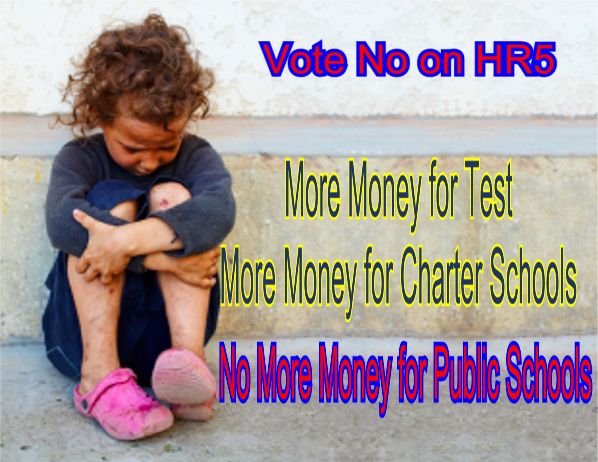
House Republicans Slip Anti-Abortion Language Into Education Bill ‪#‎NOonHR5‬

House Republicans Slip Anti-Abortion Language Into Education Bill:


House Republicans Slip Anti-Abortion Language Into Education Bill

RANDY NEUGEBAUER
Rep. Randy Neugebauer (R-Texas) speaks at a House Financial Services subcommittee field hearing on mortgage markets in New York on Wednesday, Sept. 7, 2011. (Scott Eells/Bloomberg via Getty Images) | Bloomberg via Getty Images


House Republicans attached language to a major education bill Wednesday night that would financially penalize school districts that allow school-based health centers to provide information about abortion to pregnant high school students.
The amendment to the Student Success Act, a GOP overhaul of No Child Left Behind, would withhold federal funding from school districts that contract with health centers unless the center certifies that it will not provide abortions or give students any information about abortion, including directions to the nearest abortion provider. (School-based health centers already do not provide abortion services.)
The House Rules Committee slipped the new language into a part of the bill known as the "manager's amendment," which is normally reserved for non-controversial fixes to a piece of legislation that are agreed to ahead of time.
"This amendment is a cowardly attack on young people's access to the full range of information about their reproductive health care," said Cecile Richards, president of the Planned Parenthood Action Fund. "This provision ties the hands of health care professionals in schools, and would deny teens access to important and basic information about their health care options."
"Once again, abortion opponents in the House went after women's health under the dark of night," Richards continued. "And because they know this attack on abortion is deeply unpopular, [they] won't take an actual vote on it."
Rep. Randy Neugebauer (R-Texas), who authored the amendment, did not respond to a request for comment.
Republicans also tried to attach an anti-birth control amendment to the bill, but it was ruled out of order, or irrelevant to the main legislation. That amendment, authored by Rep. Doug Lamborn (R-Colo.), would have prohibited federal funds to any school that provides emergency contraception, or a prescription for it, on the premises of a high school or elementary school. The "morning-after pill" is an example of such contraception.
The House is expected to vote on the education bill Friday. The bill would strip the federal government of much of its current power to lift up struggling schools in low-income districts, instead giving the states the authority to make such decisions.
The White House has said President Barack Obama will veto the bill if it passes, arguing that it "abdicates the historic federal role in elementary and secondary education of ensuring the educational progress of all of America's students, including students from low-income families, students with disabilities, English learners, and House Republicans Slip Anti-Abortion Language Into Education Bill:

Call and Tweet your House Rep and ask him/her to vote ‪#‎NOonHR5‬ http://bit.ly/17s6O1b

Embedded image permalink