Latest News and Comment from Education

Wednesday, February 25, 2015

The Quinn Rule comes to Chicago. | Fred Klonsky

The Quinn Rule comes to Chicago. | Fred Klonsky:


The Quinn Rule comes to Chicago.

FEBRUARY 25, 2015
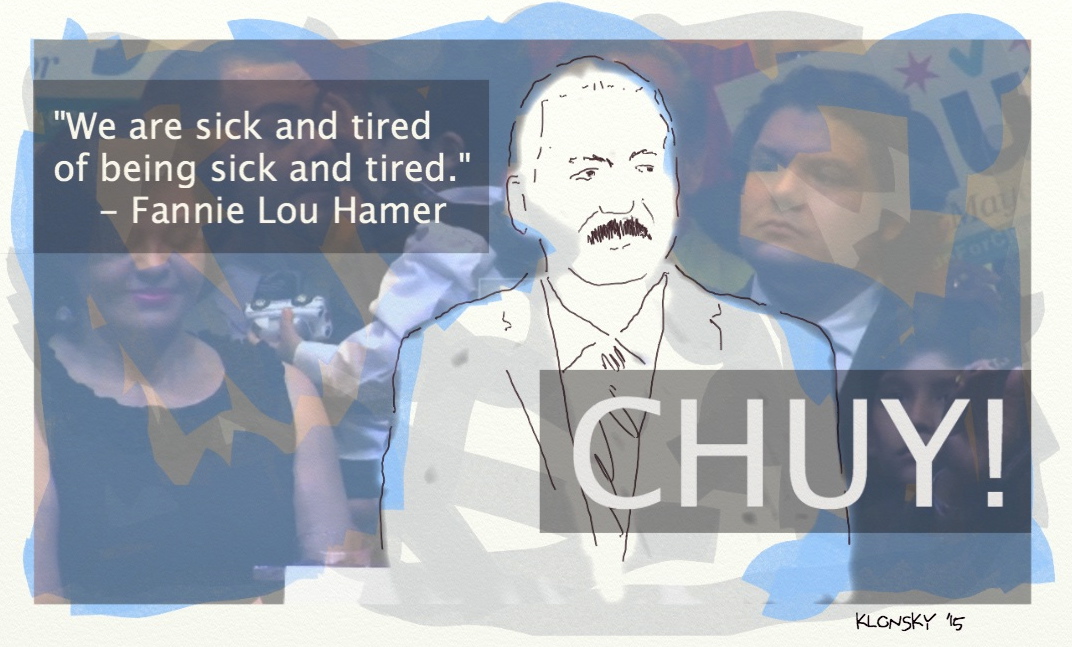
CHUY.
The Quinn Rule: If you desert us, come election day we will desert you.
When Democratic Governor Pat Quinn lost by 150,000 votes last November I explained The Quinn Rule. Quinn had the power of incumbency, the support of the President of the United States, Democratic Party leaders and most union leaders. Yet his years of hostility towards the very unions who supported him and his claim that he was put on this earth to solve the pension issue, by which he meant cutting constitutionally guaranteed pensions, meant tens of thousands of public employees and pensioners left the ballot line for governor blank.
Unfortunately the failure to provide a pro-working class alternative to Quinn opened the door for Bruce Rauner.
Yesterday in Chicago it was the same story with a different result.
We are building a progressive alternative in Chicago so that The Quinn Rule meant that thousands of working class Democrats deserted the Democratic Party Mayor in numbers not seen since Harold Washington beat Jane Byrne for mayor over thirty years ago.
That is what CTU President Karen Lewis means when she says we must change the political landscape.
The deal isn’t sealed yet. The run off election between Mayor Rahm Emanuel and Chuy Garcia is in six weeks.
Can you govern as a Republican and get elected as a Democrat in Chicago?
I’m betting not.
Now for a moment of local pride.
Not only did Chuy get 60% of the vote in our Logan Square neighborhood, but our young Latino Whitney Young high school graduate Carlos Rosa beat the pants off of the incumbent, Rey Colon. No run off. Carlos Rosa will now be Alderman Rosa.
While Carlos was the only challenger to unseat a sitting alderman last night, many incumbents failed to avoid a run off. More can be picked off in April.
Rahm’s $2 million PAC, Chicago Forward, failed to unseat a single member of the Progressive Caucus. Only one faces a run off in an always contentious ward.
Progressive Caucus member Scott Waguespack from Logan Square’s 32nd ward The Quinn Rule comes to Chicago. | Fred Klonsky:

Mike Klonsky's SmallTalk Blog: Hey Little Emperor...

Mike Klonsky's SmallTalk Blog: Hey Little Emperor...:


Hey Little Emperor...


Hey little Emperor, come down from your throne
The hourglass is empty, your time has come and gone
The battlements are crumblin’ the walls are tumblin’ down
Your counselors and concubines are getting’ out of town 
-- Steve Earle

Even though I didn't drink last night (honest) I feel hung over this morning after 14 hours of poll watching and then hitting Carlos Rosa's victory party at the Levee. I can't remember a victory like this since Harold Washington won the Democratic mayoral primary in 1983 (Yes, we once had party primaries in Chicago). Yesterday's citywide defeat of Rahm's overstuffed political machine, and Chuy Garcia's forcing of Rahm into a runoff, was as close to being on par with that as it gets.

Rosa's stunning win over a Rahm-backed incumbent was but a small piece of the pie (which I'm still digesting). In my diverse Logan Square neighborhood, it comes on the heels of Rep. Will Guzzardi's devastating rout of  machine daughter Toni Berrios last March. Rosa, a 26-year-old community activist, more than doubled the vote of the mayor's guy, discredited incumbent Rey Colon.

Ramirez-Rosa was joined on stage at The Levee, 4035 W. Fullerton Ave, by 39th District State Representative Will Guzzardi and a crowd of friends and family around 8:30 p.m. The incoming alderman then claimed his victory in the ward, which represents portions of Logan Square, Avondale, Hermosa, Irving Park and Albany Park.
"This is not about switching one alderman for another; it was about a movement," Ramirez-Rosa said following his acceptance. "We aspire Mike Klonsky's SmallTalk Blog: Hey Little Emperor...:

 
Click here to go to Jesus "Chuy" Garcia for Mayor of Chicago  Website
Big Education Ape: Chicago Inc. Rahm Emanuel Dances for Corporate Money - Vote for Chuy!!! http://bit.ly/1AaLZT1
Big Education Ape: Elected School Board referendum wins by a landslide in 37 wards – Chicago's Students Deserve an ... http://bit.ly/1Bs365m


Charter Schools Take on Their Enemy, LAUSD's Constant "No" Voter Bennett Kayser - Los Angeles | Los Angeles News and Events | LA Weekly

Charter Schools Take on Their Enemy, LAUSD's Constant "No" Voter Bennett Kayser - Los Angeles | Los Angeles News and Events | LA Weekly:


CHARTER SCHOOLS TAKE ON THEIR ENEMY, LAUSD'S CONSTANT "NO" VOTER BENNETT KAYSER

Charter Schools Take on Their Enemy, LAUSD's Constant "No" Voter Bennett Kayser


 The first charter school in L.A. was the Open School, an elementary school that petitioned the school district to be converted into a charter in 1993, allowing it to operate autonomously, beyond the thicket of LAUSD rules. One of the parents who signed that petition was a teacher named Bennett Kayser, whose youngest son attended the school.

Twenty-two years later, Kayser, now on the L.A. Unified School District Board of Education, is the bête noire of the growing charter school movement.
By law, every proposed new charter school must go before the elected, seven-member LAUSD board for approval. And every five years the same seven politicians must renew every school's "charter" — rules by which charter schools operate outside the reach of LAUSD.
Most charter schools are approved with little to no discussion. Even controversial schools are often approved, despite the worries of some on the board that the charter schools are draining away students.
But Kayser takes it to a whole other level. The one-time parent of a child in L.A.'s first charter school votes against charter schools — nearly every chance he gets.
"[Steve] Ratliff and [Monica] Zimmer, they're open to listening," says Gary Borden of the California Charter Schools Association Advocates. "They judge each issue on its merits. We can work with them." But Kayser's "nearly 100 percent" opposition is "a reflexively reactionary vote."
Borden's advocacy group, CCSA Advocates, wants to push Kayser, who's up for re-election in L.A.'s March 3 primary, off the school board.
The group is spending hundreds of thousands of dollars on glossy mailers, radio ads, even TV ads, trashing Kayser. They hope to elect Ref Rodriguez, co-founder of Partnerships to Uplift Communities, or PUC, a chain of charter schools spread from Eagle Rock to Sylmar serving primarily minority and working-class kids.
PUC students earn academic scores well above the state average, the kind of scores seen in the nicest suburbs.
Meanwhile, the teachers union, UTLA, is spending hundreds of thousands of dollars touting Kayser and blasting Ref Rodriguez.
Rodriguez agrees that LAUSD should close down underperforming charter schools. But he's disturbed by Kayser's nuclear option of opposing even the ones where minority children are excelling.
Last year, the board voted to close Aspire Antonio Maria Lugo Academy, a heavily Latino school whose low-income kids were thriving academically. Rodriguez calls the vote "morally reprehensible." The board had insisted the school use LAUSD's special education plan, not its own.
Says Rodriguez: "Here's a high-performing school, by all measures, in a city that does not have a whole Charter Schools Take on Their Enemy, LAUSD's Constant "No" Voter Bennett Kayser - Los Angeles | Los Angeles News and Events | LA Weekly:

No Child Left Behind 101: where lawmakers agree, disagree - CSMonitor #NOonHR5

No Child Left Behind 101: where lawmakers agree, disagree - CSMonitor.com:


No Child Left Behind 101: where lawmakers agree, disagree

The No Child Left Behind Act is overdue for a rewrite. The House takes up floor debate on a mostly GOP version Wednesday, and Senate committee leaders are working toward crafting a bipartisan proposal.


 Congress is working toward a long-overdue rewrite of the high-profile and often controversial federal K-12 education law known as No Child Left Behind (NCLB). Here’s what to keep in mind as the House takes up floor debate on a mostly GOP version Wednesday and as Senate committee leaders work toward crafting a bipartisan proposal.

What is NCLB?
NCLB is the current name for the 1965 Elementary and Secondary Education Act (ESEA) and is largely known for its Title I grants to support low-income students. NCLB had bipartisan support and took effect in 2002, using annual testing to hold schools accountable for academic performance and for narrowing achievement gaps. It required all students to reach proficiency by 2014, but most schools haven’t been able to reach that target.
Recommended: Are you as well-read as a 12th grader?
Why are lawmakers focused on it now?
NCLB has been due for reauthorization by Congress since 2007. There’s bipartisan agreement that the law is broken, but agreeing on how to fix it has proved difficult so far. Many states have waivers from the US Department of Education to pursue alternative systems of accountability.
Now that Republicans control both the House and Senate, however, efforts to push through a major overhaul are again under way. Many current members of Congress have either experienced the dysfunction of NCLB as governors or state lawmakers, or are hearing complaints from constituents, so “there’s a lot of pressure from a lot of different directions to finally get this done,” says Patrick McGuinn, a political science professor at Drew University in Madison, N.J.
Which aspects of the law present the best opportunity for bipartisanship?
Although debates about testing are to be expected, maintaining annual testing requirements is likely to find bipartisan support, education policy experts say. Even with pressure from anti-testing groups and some conservative Republicans to get rid of those federal requirements, most Republicans and Democrats see value in the tests as a way to measure progress and not lose sight of whether historically lower-performing groups are catching up. 
It’s also likely that many Democrats and Republicans will agree not to pressure states to tie those test results to teacher evaluations. The Obama administration’s efforts to reward states for such links have been controversial.
What are the biggest areas of disagreement?
Accountability, for one. There’s huge debate about what role the federal government should play in holding schools accountable for student performance. The bill that passed out of the House Education and the Workforce Committee Feb. 11 (with no Democratic support) would let states decide their own accountability systems. Known as the Student Success Act, it’s generating pushback from civil rights groups and many Democrats, who say that ESEA must include some requirements for states to ensure that students from all backgrounds are being equitably prepared for college or careers.
Under NCLB, schools that aren’t meeting accountability goals have to offer various options to students and adopt turnaround plans. The new version will probably give a great deal of flexibility to states, but not necessarily as much as the House bill offers.
Another point of contention: how funds are distributed. The House bill offers “portability” for Title I dollars – meaning they would follow a low-income student to any public school he or she attends, including a charter school (which typically has autonomy rather than having to follow district rules). Some Republicans want the money to flow even to private schools – akin to vouchers – but House committee leaders avoided that, knowing it would have been “a bridge too far,” says Michael McShane, a research fellow in education policy studies at the American Enterprise Institute in Washington.
Republicans also favor consolidating dozens of federal programs and offering block grants to states to cover, as they see fit, teacher professional development and after-school programs. The House bill would also allow states and localities to reduce their own education funding as federal dollars come in, ditching the current “maintenance of effort” requirement.
Democratic lawmakers and the White House have slammed these GOP proposals as an abdication of the federal role to channel aid to the neediest students.
Other issues that will require compromise include how much funding the law should receive overall and whether early-childhood education No Child Left Behind 101: where lawmakers agree, disagree - CSMonitor.com:
 #NOonHR5

#STOPHR5 #NOonHR5 US Representatives on Twitter Find your Member Hit them with a Vote No on HR5 Tweet http://bit.ly/17s6O1b

Dumb And Dumber In The Republican House Education Bill #NOonHR5

Dumb And Dumber In The Republican House Education Bill:


Education Opportunity Network -


Dumb And Dumber In The Republican House Education Bill


 For sure, there is a lot for Democrats to dislike about the current version of No Child Left Behind federal education legislation steaming toward approval in the US House of Representatives. The bill, HR5 the Student Success Act, was written completely by Republicans, passed through committee without any Democratic support, and has already drawn strong opposition from the Obama administration and others.

But with Republicans firmly in charge of efforts to rewrite NCLB, it’s important to identify specifics in the bill that should become bright lines Democrats can’t cross and points for inclusion to fight for in Senate negotiations and joint deliberations.
What’s Dumb
At the top of the list of what Democrats oppose in the Student Success Act is the insistence among Republicans that federal money for public schools be further constricted.
While a number of state governors and prominent voices on Capitol Hill have come to the realization that levels of spending on education need to increase substantially, the bill from the Republican controlled House would ensure long terms cuts. Quick to criticize this, President Obama was quoted in Beltway news outlet The Hill saying the Republican bill would “lock in cuts to schools for the rest of this decade.” A White House report elaborated, explaining how the bill would cement education cuts demanded by the 2013 sequester and ensure federal education funding will be lower in 2021 than it was in 2012.
At The Huffington Post, president of the American Federation of Teachers Randi Weingarten voiced similar criticism that the Republican bill would “lock in recession-driven cuts to education. It would allow state and local governments to walk away from their responsibility to maintain funding from year to year.”
And as Valerie Strauss reported on her blog at The Washington Post, 115 education groups contend the funding levels proposed in the House bill “are inadequate to properly support K-12 public education.” In a letter to Congressional leaders, these organizations argue, “HR5 locks in over $1.7 billion in education cuts” at a time when “public school enrollment will increase by more than 2.2 million students.”
There is definitive research that spending at sufficient levels is really important if we want “student success,” as the Republican bill purports to legislate. And the federal government has a very important role to play in providing this funding, especially because most states are currently reliant on federal money to help them maintain education funding from year to year.
What’s also galvanizing Democratic Party opposition to HR5 is the bill’s complete neglect of funding for preschool education. Education Week reporter Alyson Klein reported US Secretary Arne Duncan opposes the Dumb And Dumber In The Republican House Education Bill:


 #NOonHR5

#STOPHR5 #NOonHR5 US Representatives on Twitter Find your Member Hit them with a Vote No on HR5 Tweet http://bit.ly/17s6O1b

White House threatens veto of GOP bill to fix education law - US News #NOonHR5

White House threatens veto of GOP bill to fix education law - US News:


White House threatens veto of GOP bill to fix maligned No Child Left Behind education law


By KIMBERLY HEFLING, AP Education Writer
WASHINGTON (AP) — The White House is threating to veto a Republican bill to fix the widely criticized No Child Left Behind law that is set for debate in the House on Wednesday, calling it "a significant step backwards."
Republicans say the bill would restore local control in schools and stop top-down education mandates. Democrats say it would allow billions in federal dollars to flow out without ensuring they will improve student learning.
The White House said the measure "abdicates the historic federal role in elementary and secondary education of ensuring the educational progress of all of America's students, including students from low-income families, students with disabilities, English learners, and students of color."
The White House's statement Wednesday is the latest in a series of veto threats issued since both chambers of Congress went under Republican control last month for the first time in Barack Obama's presidency.
A vote is expected on Friday, and it's possible that members will vote strictly along party lines. That's what happened with a similar bill in 2013.
The bill maintains annual federal testing requirements. It consolidates or eliminates many federal programs, creates a single local grant program and allows public money to follow low-income children to different public schools. It would also prohibit the federal education secretary from demanding changes to state standards or imposing conditions on states in exchange for a waiver around federal law.
The bipartisan law President George W. Bush signed in 2002 sought to close significant gaps in the achievement of historically underserved group of students and their more affluent peers. It mandated annual testing in reading and math for students in grades three to eight and again in high school. Schools had to show student growth or face consequences.
No Child Left Behind required that all students be able to read and do math at grade level by 2014. The Obama administration in 2012 began allowing waivers around some of the law's more stringent requirements if schools agreed to certain conditions, like using college- and career-ready standards such as Common Core.
House Republican leaders view the bill as a way to show their opposition to the Obama administration's encouragement of the Common Core state standards. The standards have been adopted in more than 40 states and spell out what English and math skills students should master at each level. They have become a political issue in many states because they are viewed by critics as a federal effort even though they were developed by U.S. governors.
In the Senate, there appears to be more of a bipartisan effort to fix the law. Sen. Lamar Alexander, R-Tenn., the chairman of the Senate Committee on Health, Education, Labor and Pensions, and the committee's senior Democrat, Sen. Patty Murray, D-Wash., have said they were working together on a proposal. Alexander said this week he wants to get a bill to the full Senate in March.White House threatens veto of GOP bill to fix education law - US News:
#STOPHR5 #NOonHR5 US Representatives on Twitter Find your Member Hit them with a Vote No on HR5 Tweet http://bit.ly/17s6O1b
Media preview

Moales and Charter School Industry go down to crushing defeat in Bridgeport - Again - Wait What?

Moales and Charter School Industry go down to crushing defeat in Bridgeport - Again - Wait What?:


Moales and Charter School Industry go down to crushing defeat in Bridgeport – Again


Despite the support of Governor Malloy’s political operatives, including Bridgeport Mayor Finch and the ConnCAN/Achievement First Inc. charter school industry, pro-charter school candidate Reverend Kenneth Moales Jr. couldn’t even muster enough voters to impact yesterday’s Special Election for a seat in the Connecticut State Senate.
The infamous Reverend Kenneth Moales Jr. came in a distant 3rd place in yesterday’s Special Election collecting only 503 votes compared to the winner, Working Families Party candidate and former state senator Ed Gomes, who received 1,504.  The Democratic Party endorsed candidate Richard DeJesus, who Finch initially supported before turning to Moales, garnered 791 voters.
According to the Working Families Party, Ed Gomes becomes the first candidate in the country to win a legislative seat running only on the Working Families Party line.
Kenneth Moales Jr. has been one of the most outspoken supporters of Governor Malloy’s Corporate Education Reform Industry initiatives.
Moales was not only a leading champion of education reformer extraordinaire Paul Vallas but has been a major proponent of Steve Perry’s plan to open a charter school in Bridgeport.
The Reverend Kenneth Moales Jr. sits on the Board of Directors for Perry’s charter school and was a lone voice on the Bridgeport Board of Education when the democratically-elected board asked the Malloy administration NOT TO approve Perry’s charter school application.
However, Malloy’s Commissioner of Education and his political appointees on the State Moales and Charter School Industry go down to crushing defeat in Bridgeport - Again - Wait What?:

Before Book Deal, Andrew Cuomo Backed Bills That Helped News Corporation

Before Book Deal, Andrew Cuomo Backed Bills That Helped News Corporation:


Before Book Deal, Andrew Cuomo Backed Bills That Helped News Corporation


New York Gov. Andrew Cuomo likes to portray himself as a crusader against corruption in Albany, the state's capital, taking a hardline position against allowing state lawmakers to collect outside income that may be connected to pending legislation. He has championed a bill that would require lawmakers to disclose more of their outside income lest they write bills that benefit special interests in pursuit of private cash.
"We must prove once again that state government can be trusted, and that means passing tough new ethics laws and creating a system that deters, detects and punishes individuals who seek to abuse and corrupt," he said last week in a statement announcing ethics reform legislation. "We must bring sunlight to ethical shadows. New Yorkers deserve nothing less."
But the Democratic governor's strong words don’t quite square with his own personal appetite for cash earned outside the confines of his state work. Cuomo has so far raked in more than $188,000 from HarperCollins, a News Corporation subsidiary. That is part of a book deal that could ultimately net him more than $700,000. With Albany’s transactional politics now the subject of a federal probe, the context of that April 2013 book deal is particularly significant: An International Business Times review of New York state documents reveals that News Corporation gave Cuomo a book contract after Cuomo’s administration backed a series of state initiatives that benefited the media giant.
One of the initiatives was a bill that created a special sales tax break for online-only publications that charge for subscriptions. News Corporation, which was one of the two companies that lobbied for the bill, was at the time investing tens of millions of dollars in such a publication. Another initiative was a special tax exemption that Cuomo’s administration created for electronic books, which are sold by, among others, HarperCollins. State records list News Corporation as lobbying Cuomo’s tax department in the months before the exemption was announced. And, while News Corporation lobbied the governor’s office in 2012, Cuomo championed an expansion of controversial film and television tax credits that have benefited News Corporation’s films, and that News Corporation had lobbied for in the past.
News Corporation did not respond to IBTimes’ request for comment. Cuomo’s office -- his calls for transparency notwithstanding -- declined IBTimes’ request to release the text of the contract for the book, which has reportedly sold just 3,000 copies. The governor’s office also declined to comment about the legislation he signed and the administrative tax change his officials enacted. The governor has Before Book Deal, Andrew Cuomo Backed Bills That Helped News Corporation:

How Twitter is changing the national Common Core debate - The Washington Post

How Twitter is changing the national Common Core debate - The Washington Post:


How Twitter is changing the national Common Core debate


Is Twitter affecting the national debate on the Common Core State Standards initiative? Three researchers working on a digital reporting project say “yes” — and they call this the first national policy conversation played out in social media.
The university researchers looked at hundreds of thousands of tweets at #commoncore over a six-month period and analyzed them not only for content but also by author. One key finding:  Twitter is “making the invisible visible,” giving people who usually have no voice in national discussions power to express their opinions and affect discourse. The researchers also noted that the debate over the Core isn’t only about the Core standards themselves, but, rather, about issues such as the federal involvement in local education issues, student privacy,  standardized testing, the role poverty plays in student achievement and how for-profit companies are affecting education.
The researchers undertaking the project are Jonathan Supovitz, professor of education policy at the University of Pennsylvania’s Graduate School of Education and co-director of the Consortium for Policy Research in Education; Alan J. Daly, chair of the Department of Education Studies at the University of California, San Diego; and Miguel del Fresno, a communications professor at the Universidad Nacional de Educación a Distancia in Spain.
They analyzed some 190,000 Tweets from September 2013 to February 2014 at #common core from 52,994 Tweeters (and are now analyzing hundreds of thousands more Tweets). Most of the tweets were written in opposition to the Core or related reforms, though the researchers said they found  only two specific sets of complaints about the standards themselves:
Claims that the Standards are developmentally inappropriate because they were back-mapped from college- and career-ready outcomes to early childhood expectations;
and
Critiques that the Common Core focused solely on academic skills and expectations while ignoring equally important social and emotional development.
Noting that “politics makes strange bedfellows,” the researchers divided the tweeters into three “particular structural communities”: one that generally supported the Common Core, one made up of educators who opposed the Common Core, and the third comprising actors from outside of education who opposed the Common Core primarily due to their connecting it to larger social issues.” The most active participants using #commoncore on Twitter came from the third group. Supovitz wrote:
But another important lesson from our analysis of the Common 
How Twitter is changing the national Common Core debate - The Washington Post:
Big Education Ape: #commoncore Project - How social media is changing the politics of education http://bit.ly/18hHH23

Russ on Reading: From Text Complexity to Considerate Text

Russ on Reading: From Text Complexity to Considerate Text:


From Text Complexity to Considerate Text

The Common Core State Standards call for kids to read lots of complex nonfiction text so they can be "college and career ready." As Appendix A of the English Language Arts section of the Common Core rather breathlessly puts it,

[T]he clear, alarming picture that emerges from the evidence... is that while the reading demands of college, workforce training programs, and citizenship have held steady or risen over the past fifty years or so, K–12 texts have, if anything, become less demanding. This finding is the impetus behind the Standards’ strongemphasis on increasing text complexity as a key requirement in reading.

As I have discussed in previous posts herehere and here, this Common Core call for employing more complex texts has led to much confusion and inappropriate instruction. The statement is also demonstrably wrongwhen it comes to readability on the K-3 level.

There is, however, another issue related to text complexity that I have yet to see anyone explore in the Common Core context. Text complexity is not an unqualified good. Indeed, it may be more reflective of the writer than of the reader. Just what is the responsibility of the author to the reader when writing any text?

Any act of reading is by definition an effort by a reader to comprehend, but it is also an attempt by a writer to be understood. There exists, in whatLouise Rosenblatt has called the reading "transaction", an implicit contract between writer and reader. The writer promises to make every effort to be understood and the reader promises to make every effort to understand.  So, if a reader's comprehension breaks down when faced with a complex text, is that a failing of the reader or a failing of the writer or a little bit of both?

Nathaniel Hawthorne said, "Easy reading is damned hard 
Russ on Reading: From Text Complexity to Considerate Text:

Elected School Board referendum wins by a landslide in 37 wards – Chicago's Students Deserve an Elected School Board

Elected School Board referendum wins by a landslide in 37 wards – Chicago's Students Deserve an Elected School Board:


Elected School Board referendum wins by a landslide in 37 wards


Elected School Board referendum wins by a landslide in 37 wards
Chicagoans’ preference for an elected board will continue to be pushed in Springfield
CHICAGO – Today an overwhelming number of voters in 37 wards across Chicago voted yes to an elected school board (totals below), signaling a vote of no confidence in the past twenty years of failed school reforms by mayor-appointed board members. Voters made clear that the appointed members have not made the grade and going forward a democratic process must be used to keep school board members accountable, like every other district in the Illinois. 97% of school boards in the United States are elected. The next move for the Campaign for an Elected, Representative School Board is to bring these vote totals to Springfield and push state legislators to change the law allowing Chicago taxpayers to vote for the people running Chicago’s schools.
The referendum appeared on the ballot after a month-long canvassing and petition drive by thousands of volunteers across the city. The elected school board measure is being pushed by a broad coalition of parents, teachers, and community organizations from every corner of the city. Chicagoans took this campaign to the streets on Martin Luther King Day and again on Presidents Day, when canvassers spread throughout the city going door-to-door urging voters to support the elected school board referendum. Some activists took it directly to the mayor’s doorstep, but were asked to leave by the police.
“Chicago parents, teachers and students understand that the current school board works for the mayor, not for us,” said Irene Robinson, member of the Kenwood Oakland Community Organization and parent and grandparent of students whose school was closed in 2013. “Their job is to rubberstamp the mayor’s privatization agenda, which seeks to destabilize and ultimately close neighborhood schools—regardless of how the community feels about it.”
“It’s time for the school board to be accountable to the people the schools serve, parents, teachers, students and community residents across the city,” Janeth Herrera, member of the Brighton Park Neighborhood Council, added. “We are the ones who know best what our schools and our children need and we deserve a say in the critical decisions that affect them.”
Mayoral control with an appointed school board began with the 1995 Amendatory Act – a state law that handed school governance over to the Mayor. Failed reforms from Mayor Daley’s “Renaissance 2010” to Mayor Rahm Emanuel’s closing of 50 schools in 2013 were forged through, despite overwhelming community opposition. In 2012, a similar referendum for an elected board was on the ballot in 13% of Chicago precincts and 87% voters in those precincts voted yes to an elected school board.
“An elected school board is the first step to ensure parents and the community have a say in the direction of public education,” said Jose Caraballo, member of Communities United and parent at Hanson Park Elementary.