Latest News and Comment from Education

Friday, February 6, 2015

NEW JERSEY PARENTS TAKE A STAND TO SPEAK FOR THEMSELVES.Badass Teachers Association

Badass Teachers Association:


NEW JERSEY PARENTS TAKE A STAND TO SPEAK FOR THEMSELVES.


FOR IMMEDIATE RELEASE      
New Jersey   February 6, 2015
NEW JERSEY PARENTS TAKE A STAND TO SPEAK FOR THEMSELVES.
Parents all over New Jersey demand that their voices be heard.

Dissatisfied with how high stakes standardized testing is eclipsing their children’s education, parents all over New Jersey are insisting upon their right to make decisions that impact their child's education by exercising their right to refuse their children from the harmful practice of high stakes standardized testing.

In an effort to appease the call for legislation to slow down the use of high stakes standardized testing in NJ, Governor Christie created the Study Commission on the use of Student Assessments to study the new reforms, including the PARCC assessment and the Common Core State Standards.

Recently, the study commission has held several public forum testimony sessions where parents, educators, and other taxpayers have come together to voice their concerns. At the Jersey City meeting on Wednesday, January 28th the members of the public heard from Ms. Catherine M. Lindenbaum, who introduced herself as the Parent Representative on the Commission.  Ms. Lindenbaum is one of the governor-appointed members of the Study Commission as well as a NJ Parent and Teacher Association Representative.

The parents of New Jersey's test refusal movement take issue with the fact that National PTA, which leads NJPTA, has accepted monetary contributions from the Gates Foundation.  The Gates Foundation has also invested millions of dollars in the Common Core State Standards and the parents feel that there is a definite conflict of interest.

“I am a parent and she definitely does not represent me in this discussion,” states Colleen Martinez of Montclair, NJ. Colleen has actively been advocating for maintaining local and state control of public education.

“Any organization that accepts money from the Gates Foundation cannot be trusted to not have an agenda to support his educational initiatives,” says Melissa Tomlinson, a special education teacher. “The tests are designed in a way that there will never be success for specific populations of our students. Statistically, they are invalid and of little actual use to us in classroom decisions.”

Text of the letter that was signed by nearly 500 New Jersey parents and taxpayers is attached.
Contact: Colleen Martinez 
Contact: Melissa Tomlinson 
See below for letter


From: New Jersey Parents
To: Ms. Catherine M. Lindenbaum
NJPTA
8 Quakerbridge Plaza, Suite F
Mercerville, NJ 08619

February 4, 2015
To Ms. Catherine M. Lindenbaum, a member of the Study Commission on the Use of Student Assessments in New Jersey:
Ms. Lindenbaum, On January 28th, at an open meeting in Jersey City, you introduced yourself as the “Parent Representative” serving on this commission.
Well Ms. Lindenbaum, I too am a parent, and if you support high-stakes standardized testing you don't represent me.
If you support hours upon hours of valuable instruction time lost in favor of teaching to a test, you don't represent me.
If you support millions of dollars being funneled away from music, arts and enrichment programs to pay for this test, you don't represent me.
If you support pushing children to developmental levels that many can't possibly reach, you don't Badass Teachers Association:

Write Congress to demand less testing, an end to high stakes. | FairTest #ESEA

Write Congress to demand less testing, an end to high stakes. | FairTest:

Write Congress to demand less testing, an end to high stakes.


Your voice can help make a difference! Use this letter to urge your Senators and Representative in the U.S. Congress to support a reduction in standardized testing to once each in elementary, middle and high schools, while ending punitive sanctions. The House and Senate education committees plan to start re-writing the Elementary and Secondary Education Act (also known as NCLB) by mid-February. You can strengthen your message by adding your own comments, such as your and your children’s personal experiences with overtesting.
Thank you.
FOR YOUR INFORMATION (PLEASE READ):
Congress is moving swiftly.
The House plans a committee vote in the next two weeks followed by full House floor debate the last week of February. Education Committee Chairman John Kline supports testing every grade. Those of us who want grade-span testing and flexibility must over-ride Kline in committee or win a floor amendment. Rep. Gibson's grade-span testing bill provides a vehicle.
In the Senate, the HELP committee is expected to act before the end of the month with the full Senate taking it up shortly after. Chair Alexander's 'Option 1' on assessment provides a vehicle, but he also has 'Option 2' which retains every-grade testing.
In both cases, however, it will not be easy to win. Our only real chance is grassroots pressure.
*** DEMAND LESS TESTING AND AN END TO HIGH STAKES. ***
Link to our latest call for people to contact their Senators and Representatives.
Send your email now!
http://www.fairtest.org/roll-back-standardized-testing-send…
Thanks,
Monty Neill, Executive Director
FairTest

Parents Can Opt Out United Opt Out National

Click Here to go to United Opt Out National: 


Click Here to go to the WebsiteUnited Opt Out Team


Big Education Ape: #ASKARNE What'sup? with SEC. 1118. PARENTAL INVOLVEMENT in the New ESEA? http://bit.ly/18G4hzI

Big Education Ape: Arne Duncan Urges Parents to Weigh In on NCLB Rewrite; Will It Work? - Politics K-12 - Education...http://bit.ly/1zBIyTU

Big Education Ape: When Will Congress Hear from Parents on Reauthorizing No Child Left Behind? - #ESEA http://bit.ly/1DNcQUH

When Will Congress Hear from Parents on Reauthorizing No Child Left Behind? - #ESEA

When Will Congress Hear from Parents on Reauthorizing No Child Left Behind? - Breitbart:


WHEN WILL CONGRESS HEAR FROM PARENTS ON REAUTHORIZING NO CHILD LEFT BEHIND?


Big Education Ape: #ASKARNE What'sup? with SEC. 1118. PARENTAL INVOLVEMENT in the New ESEA? http://bit.ly/18G4hzI
Big Education Ape: Arne Duncan Urges Parents to Weigh In on NCLB Rewrite; Will It Work? - Politics K-12 - Education... http://bit.ly/1zBIyTU

One of the major problems that the adoption of Common Core’s standards has led to is excessive testing—at all grade levels from kindergarten on—sometimes more than one test per grade level.

It is not yet clear if current drafts for the reauthorization of the Elementary and Secondary Education Act (also known as No Child Left Behind or NCLB in its 2002 reauthorization) are going to let states and local school boards choose, not only how many tests to mandate for the children in the state, but also the grade levels at which schools must administer these Common Core-based tests.
Although one would think that providing options for testing would be a strong signal by Congress that it wants to give back to local and state educational agencies some of the educational authority the US Department of Education has taken away from them, arguments are now being made to Congress to keep in place the NCLB testing mandates. Who exactly would benefit from this testing regime—certainly not the teachers and the students in our classrooms, nor their parents.
Professor Martin West at the Harvard Graduate School of Education makes it clear who would benefit from the excessive testing regime mandated by NCLB and possibly continued in the reauthorization of ESEA (which, incidentally, required no tests when it was first authorized in 1965). In no case are teachers and their students benefiting. In written testimony dated January 21, 2015, provided to a Congressional hearing, he gave the following six reasons for keeping annual testing. I have commented on each of his reasons.
Eliminating annual testing is unnecessary because the annual tests in math and reading (and grade-span testing in science) currently required under NCLB typically account for less than half of the total amount of time students spend taking standardized tests.
Professor West needs to speak to teachers directly. Teachers can estimate how much time they actually are teaching to Common Core-based tests, knowing they are being evaluated by test results. The research that Professor West may be referring to did not ask teachers how much instructional time they would spend or are already spending teaching to Common Core-based tests when their annual evaluations are based, in large part, in many states on student test scores.
Measures based on the amount students learn from one year to the next can provide a more accurate gauge of schools’ contribution to student learning. These kinds of measures are only possible, however, when students are tested in adjacent grades.
Professor West needs to speak to teachers directly. Teachers quickly find out what their students learned the previous year by giving them a review quiz in the first weeks of school. At least, they used to do this. They don’t need results from a standardized test that is not directly related to the curriculum that students studied the year before.
Accountability based on grade-span testing judges schools based on the students they serve, not how well they serve them.
Common Core-based test results are not going to be used for judging schools. The US Department of Education has made it very clear that they will be used for judging teachers.
In addition to preventing the development of better and fairer measures of school performance, eliminating annual testing would have other negative consequences: First, it would all but eliminate school-level information about the learning of student subgroups…
Is it really the case that all African-American students learn in the same way? And do all Hispanic students learn in the same way and in ways that are different from the ways in which other kinds of students learn? Where is the research evidence to support these When Will Congress Hear from Parents on Reauthorizing No Child Left Behind? - Breitbart:

WHO SUPPORTS DEMOCRATIC, FREE, MAIN STREAM PUBLIC SCHOOLS?


Civics education is essential to democracy | The Sacramento Bee The Sacramento Bee

Civics education is essential to democracy | The Sacramento Bee The Sacramento Bee:


Civics education is essential to democracy 


 After every election comes the inevitable hand-wringing. Voting experts and other people who care about preserving our democracy shake their heads over turnout numbers among young people and wonder what this world is coming to.

Californians between 18 and 34 aren’t short on opinions when it comes to, say, “American Idol.” But an overwhelming majority of them decline to cast a vote for governor or mayor, let alone the Sacramento Metropolitan Fire District board of directors.
Many smart people have spent many hours pondering why and have come to a conclusion: If young people lack a sense of civic responsibility, perhaps no one taught them to have one.
Like so many other once-important subjects in public K-12 classrooms – art, music, home economics, penmanship – civics education is being de-emphasized, to our collective detriment.
Policymakers must have reasoned that kids could learn about how laws are made after they grasp algebra, French, U.S. history. The result of this educational neglect has come home to roost in dismal election turnouts, not just among young people, but for all Californians. The state ranks 38th out of 50 in civic engagement.
Yes, it could be worse, but let’s not wait to get to No. 50 to act. Failing to prepare the next generation to be civically engaged dooms it to having their lives determined by an increasingly small minority and threatens democracy. We must do better.
Opinion about the value of civic learning, however, has started to turn around. In coming months, groups of prominent people in Sacramento, Butte, Fresno and three other California counties will be asking their school districts to recommit to teaching civics. And not just in the senior year of high school or in AP classes, either – but for all students starting as early as elementary school.
This effort, called Power of Democracy, sprang out of the deliberations of the California Task Force on K-12 Civic Learning. The task force, co-chaired by Sacramento County Office of Education Superintendent David Gordon and Judith McConnell, administrative presiding justice for the Court of Appeal, Fourth Appellate District, developed a plan for rebuilding civics in state schools.
Rather than force these recommendations on districts dealing with big educational policy changes as part of Common Core and Local Control Funding, the task force decided to go the route of gentle persuasion. ToCivics education is essential to democracy | The Sacramento Bee The Sacramento Bee:

Read more here: http://www.sacbee.com/opinion/editorials/article9373664.html#storylink=cpy

Recalling Another Brian Williams "Bungle" - Living in Dialogue

Recalling Another Brian Williams "Bungle" - Living in Dialogue:


Recalling Another Brian Williams "Bungle"


By Anthony Cody.
This week, Brian Williams is suffering from a public backlash because of the way a story about helicopters under fire in Iraq evolved over the years, leading to a version that inaccurately described the incident as one where his own life was in danger.
But this was not the first journalistic bungle by the popular NBC newscaster. About four years ago, during the second edition of the NBC News production of Education Nation, Brian Williams interviewed Melinda Gates. The Gates Foundation had underwritten the broadcast, but nonetheless, this was a journalistic endeavor. The Education Writers Association had awarded NBC News director Steve Capus with a first place award for a news series. When Williams interviewed Melinda Gates, however, he displayed none of the objectivity one might expect from a journalist. Here is what he said when he introduced her:
We’re also going to be joined by Melinda Gates, co-chair of the Bill and Melinda Gates Foundation. Gates Foundation, one of the sponsors of this event, and the largest single funder of education anywhere in the world. It’s their facts that we’re going to be referring to often to help along our conversation.
You could refer to our guest as the top funder of education in the world. A partner and sponsor of this year’s gathering. Also spending half a billion dollars to devise a way figure out what makes a great teacher, what makes them most effective. The estimates are the Gates Foundation has already spent, obviously a record for any education spending, spent or committed to spending five to seven billion dollars.
This gushing introduction, and particular his statement that the Gates Foundation’s “facts” were going to be guiding the discussion, represent a low point for American journalism.
The Education Writers Association recently declared that I was ineligible to compete for their prizes, even though I have won three awards, including a first place prize last year in the opinion category for my series on the Common Core. But there was not a peep from the EWA when Brian Williams declared his complete Recalling Another Brian Williams "Bungle" - Living in Dialogue:

The Buffalo School District and its Shiny New Police State | The Public

The BPS and its Shiny New Police State | The Public:


The BPS and its Shiny New Police State

by  / Feb. 6, 2015 7am EST
The underlying goal isn’t unique to the Buffalo School District. Throughout New York State, tea party reactionaries have aligned themselves with the state government to bring about a simple equation. 
1. De-fund the schools; 
2. Cut electives and programs; fire teachers;
3. Break the teachers’ union;
4. Label schools as “low performing”;
5. Create “charter” schools;
6. Segregate better students into charters; exclude troubled, poor, and special education students; 
7. Ensure that charters rent space from private landlords; 
8. Profit. 
That’s more or less what’s being attempted in Buffalo. It’s a district that has more than its share of socioeconomic crises, but instead of helping the most troubled and disadvantaged kids, powerful, monied interests now controlling the district seems to be writing them off. Instead, it’s moving forward with publicly funded private, exclusive charter schools, not all of which are all that high performing, either, thank you very much. 
It’s not just Buffalo, by the way. In tony, conservative Clarence, a small but well-funded band of tea party activists have succeeded in de-funding the schools, which in turn led to cutting teachers, programs, electives, and every social worker in the district. Kids suffer so that some of western New York’s wealthiest residents can save pennies on their tax bill. No district, teacher, board, or student is safe from this new American movement to destroy public education. 
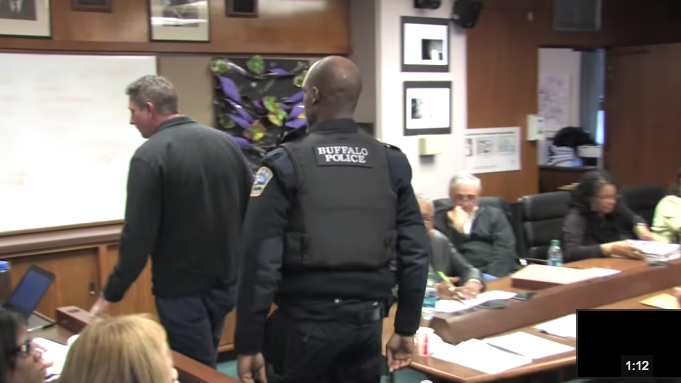
But what apparently happened Thursday at a hastily organized public Buffalo Board of Education meeting is something new and chilling. Kevin Gibson is the Secretary of the Buffalo Teacher’s Federation, and has every right to be present at a Buffalo school board meeting, and to speak. He began his remarks with, “My name is Kevin Gibson, and I’m a teacher in Buffalo”. Just a few weeks ago, he gave this powerful presentation, blasting one local charter as being just as “low performing” as any other school. 
But this Thursday, Gibson never got a chance to speak. It was a public meeting, and a public comment period. But when Gibson got up, this happened. Keep an eye on Larry Quinn, who seemingly has no patience for this job that he ran for The BPS and its Shiny New Police State | The Public:

A history of Pearson’s testing problems worldwide - The Washington Post

A history of Pearson’s testing problems worldwide - The Washington Post:


A history of Pearson’s testing problems worldwide


 Now that Pearson, the worldwide education company, has won a huge contract with PARCC,  one of the two multi-state consortia designing new Common Core-aligned tests with federal funds, it seems like a good time to review problems Pearson has had with previous projects.

I’ve run one of these before but this is an updated list compiled by Bob Schaeffer, public education director of FairTest, the National Center for Fair & Open Testing, which is dedicated to ending the misuse of standardized tests. Take a look at not just the number of problems but the variety in 14 states — Virginia, Florida, Texas, California, South Carolina, Oklahoma, Minnesota, Arizona, Mississippi, Wyoming, New York, Arkansas, Illinois, Iowa, — as well as in Guam and elsewhere around the world.

1998
California – Test score delivery is delayed.
1999-2000
Arizona – 12,000 tests misgraded due to flawed answer key.
 2000
Florida – Test score delivery is delayed, resulting in $4 million fine.
Minnesota – 45,739  graduation tests misgraded, leading to lawsuit with $11 million settlement; judge finds “years of quality control problems” and a “culture emphasizing profitability and cost-cutting.”  (FairTest consulted with plaintiffs’ attorneys)
Washington – 204,000 writing Washington Assessment of Student Learning exams have to be rescored.
2002
Florida — Dozens of school districts received no state grades for their 2002 scores because of a “programming error” at the state Department of Education. One Montessori school never received scores because NCS Pearson claimed not to have received the tests.
2005
Michigan — Scores are delayed and fines levied per contract.
Virginia   –  Five students get $5,000 scholarships based on misgraded computerized test.
2005-2006
SAT college admissions test – 4400 tests wrongly scored; $3 million settlement after lawsuit (note FairTest was an expert witness for plaintiffs)
2007-2011
Mississippi – Subcontractor programs correct answer as incorrect, A history of Pearson’s testing problems worldwide - The Washington Post:

Fewer Top Graduates Want to Join Teach for America - NYTimes.com

Fewer Top Graduates Want to Join Teach for America - NYTimes.com:


Fewer Top Graduates Want to Join Teach for America


Teach for America, the education powerhouse that has sent thousands of handpicked college graduates to teach in some of the nation’s most troubled schools, is suddenly having recruitment problems.
For the second year in a row, applicants for the elite program have dropped, breaking a 15-year growth trend. Applications are down by about 10 percent from a year earlier on college campuses around the country as of the end of last month.
The group, which has sought to transform education in close alignment with the charter school movement, has advised schools that the size of its teacher corps this fall could be down by as much as a quarter and has closed two of its eight national summer training sites, in New York City and Los Angeles.
“I want the numbers to be higher, because the demand from districts is extremely high and we’re not going to meet it this year,” said Matt Kramer, a co-chief executive of Teach for America. But, he added, “it is not existentially concerning.”
Last year, the highly selective program accepted about 15 percent of its applicants. Mr. Kramer said there were no plans to lower standards for the current year simply to yield a larger corps of teachers.
Photo


Some say the decline in applicants could point to a loss of luster for the program, which rose to prominence through the idea that teaching the nation’s poorest, most needy students could be a crusade, like the Peace Corps. Teach for America has sent hundreds of graduates to Capitol Hill, school superintendents’ offices and education reform groups, seeding a movement that has supported testing and standards, teacher evaluations tethered to student test scores, and a weakening of teacher tenure.
“We are sort of at 2.0 of education reform, and its future direction seems a little bit uncertain at this point,” said David M. Steiner, the dean of the Hunter College School of Education in New York.
Leaders of the organization say their biggest problem is that the rebounding economy has given high-achieving college graduates more job choices.
“It’s so different from three years ago, where suddenly you have candidates that may have an offer from Facebook and Wells Fargo and an offer to join the T.F.A. corps, and clearly, the money is going to be radically different,” said Lida Jennings, executive director of the Los Angeles office of Teach for America.
Mr. Kramer dismissed the idea that the group’s philosophy was driving candidates away. “As I talk to people on campuses, it is not like the central thing I hear,” he said. “I don’t hear people say, ‘Oh, I hear this criticism and therefore I don’t want to do Teach for America.’ ”
Teaching in general has been losing favor. From 2010 to 2013, the number of student candidates enrolled in teacher training programs fell 12.5 percent, according to federal data.
But Teach for America’s belief that new college graduates can jump into teaching without much training, as well as its ties through prominent alumni to the testing and standards movement, may also be taking a toll, driving away the kind of students the program once attracted.
When Haleigh Duncan, a junior at Macalester College in St. Paul, first came across Teach for America recruiters on campus during her freshman year in 2012, she was captivated by the group’s mission to address educational inequality.
Ms. Duncan, an English major, went back to her dormitory room and pinned the group’s pamphlet on a bulletin board. She was also attracted by the fact that it would be a fast route into teaching. “I felt like I didn’t want to waste time and wanted to jump into the field,” she said.
But as she learned more about the organization, Ms. Duncan lost faith in its short training and grew skeptical of its ties to certain donors, including the Walton Family Foundation, a philanthropic group governed by the family that founded Walmart. She decided she needed to go to a teachers’ college after graduation. “I had a little too much confidence in my ability to override my lack of experience through sheer good will,” she said.
Founded in 1990 by Wendy Kopp, a Princeton University student who proposed the idea in her senior thesis, Teach for America started as a kind of civil rights crusade, with 500 novice teachers in six regions across the country.
The nonprofit organization faced financial and management challenges during its first decade, but since 2000 had been growing its teaching corps by close to 20 percent every year. Ms. Kopp, who now runs Teach for All, a global spinoff initiative she founded, declined to be interviewed for this article.
With corporate sponsors like Wells Fargo and Comcast NBCUniversal,charitable contributions from the Walton family, and foundations overseen by the families of the billionaires John D. Arnold and Eli Broad, Teach for America now has 10,500 teachers in classrooms in 35 states and employs 2,400 people across its regional offices. Last year, it had revenue of $196.2 Fewer Top Graduates Want to Join Teach for America - NYTimes.com: