Wednesday, October 1, 2014

Choosing Democracy: NAME Calls for Ethnic Studies in Schools

Choosing Democracy: NAME Calls for Ethnic Studies in Schools:


NAME Calls for Ethnic Studies in Schools


From:  National Association for Multicultural Education (NAME)

Re:       Statement of Support for Ethnic Studies in the Los Angeles Unified School District

 The National Association for Multicultural Education (NAME) supports the campaign (http://www.EthnicStudiesNow.com) to make Ethnic Studies a graduation requirement in the Los Angeles Unified School District (LAUSD).


Since its founding almost a quarter century ago NAME has advocated for equity and justice, particularly for groups most underserved in our public school systems.  We believe that education can rise to the highest levels of quality and equity when it is centered on multicultural curriculum and instruction.  That is, education can offer a strong foundation for building communities that reflect core American values of democracy and ideals of educational success for all children when it (a) reflects and values the many ways that we are similar to and different from one another, (b) prepares all children to flourish in their personal and professional lives amidst this diversity, and (c) refuses to ignore the inequities that often accompany differences along lines of race, ethnicity, nation, social class, gender, sexuality, language, religion, disability, and other dimensions.  Such ideals manifest in the core goals and principles of Ethnic Studies, and as such, we support the proposal for LAUSD to make Ethnic Studies a graduation requirement.

Ethnic Studies programs contribute to the educational enterprise significantly in a number of ways.  For ethnic groups that have historically been marginalized in schools and society, Ethnic Studies fosters a more positive sense of self, which in turn affects engagement and improves academic performance and social engagement.  For all ethnic groups, Ethnic Studies fills deep gaps in traditional curriculum, offering to all students, regardless of ethnic identity, an opportunity to learn about more diverse experiences and perspectives, ask different kinds of questions, and grapple with more contradictions and complexities.  Ethnic Studies is essential for any student to flourish as well as to develop critical thinking skills that can address the increasingly complex problems in our diverse society.


Unfortunately, many so-called “reforms” and initiatives are underway across the United States that move curriculum and instruction in the exact opposite direction from what research tells us to be most effective.  High-stakes testing is increasing the amount of time that students spend preparing for standardized tests that assess narrowly what students know and can do, often with curriculum that includes a narrow range of subject areas, a lower level of cognitive skills, and an inability to make connections to the lives and communities of our students, despite the research that shows the importance of offering curriculum that is engaged, interdisciplinary, and challenging.  Overlapping with calls for curriculum standards is a deep and widespread belief that education can and should be racially neutral or “color-blind,” despite compelling research that reveals how curriculum cannot help but to include only some perspectives and experiences and not others.  Such color-blind ideology helps us to understand why some critics of Ethnic Studies argue that such curriculum is “biased” or “un-American.”  The controversy in Tucson is illustrative.  The critics of the Mexican American Studies program in the Tucson Unified School District argued that Mexican American Studies is biased but failed to see the reverse, namely, that a curriculum with deep gaps in the history and literature of Mexican Americans is necessarily one that centers and normalizes White Americans, but which is insidiously framed as un-biased.  In 2010, NAME issued a statement (available on our website,http://nameorg.org) that assails the state of Arizona’s banning of Ethnic Studies in schools.  Over the past year, as the struggles moved to the courts, we have continued to support Tucson’s students, educators, and community members in their fight for the right to democratic education in their schools.

The School Board of the Los Angeles Unified School District stands at a key historical juncture, where your decision to make Ethnic Studies a graduation requirement in the third largest school district in the United States can serve as a model for districts everywhere.  We urge the School Board to adopt this requirement, and we urge our membership and allies to support this struggle to make the goals of Ethnic Studies central to public education in Los Angeles and beyond.Choosing Democracy: NAME Calls for Ethnic Studies in Schools:

PA Permits Cigarette Tax, But Crisis in Philly Schools Drags On | janresseger

PA Permits Cigarette Tax, But Crisis in Philly Schools Drags On | janresseger:


PA Permits Cigarette Tax, But Crisis in Philly Schools Drags On

After months of legislative dithering, both houses of the Pennsylvania legislature finally passed and Pennsylvania Governor Tom Corbett signed into law enabling legislation for the School District of Philadelphia to levy a sin tax on its residents to raise money for the public schools.  The school district can levy a $2-per-pack cigarette tax to try to make up at least a bit for what the state has cut in recent years.  Of course, because car owners can drive to the suburbs or Delaware to purchase cigarettes, the poorest of the poor who do not own automobiles will pay the tax, which may not even come close to raising the revenue needed to run the school district.
In a scathing and prophetic September 29th editorial, the Philadelphia Public School Notebookcommented on all this: “It’s hard to overstate the deplorable conditions facing Philadelphia school children again this fall: another year of bare-bones education, overcrowded classrooms, and gaps in essential services like counseling and nursing.” The Notebook blames the state for a wave of devastating cuts to education that has washed across many school districts in addition to Philadelphia: “More than one-fourth of districts were expected to cut extracurricular activities this year….  Allentown’s school district axed more than 60 teaching positions—on top of more than 400 cut in the three prior years…  A district near Scranton announced it can no longer afford music instruction….  Something is seriously wrong with this picture.  Pennsylvania is not a poor state and is situated in one of the richest countries in the world.  But many districts can’t provide our children with school personnel we once took for granted.”
The reasons are complex.  Corbett and the legislature have cut state funding—a reduction of $1,300-per-pupil to Philadelphia in 2011 alone.  The state dismantled its school funding distribution formula. “Harrisburg has been committed to preserving corporate tax breaks…” and “Corbett and the legislature have also diverted millions of public dollars to private schools through tax credits and maintained a sweetheart deal for funding cyber charters, many of which are run for profit.”  Like other states Pennsylvania relies on local property taxes to fund schools: “So even within the same county there are often obscene inequities in resources—Radnor Township raises $9,000 more per pupil than nearby Upper Darby.”
Amplifying the history behind such an editorial, this week The Nation magazine has published a fascinating and detailed history of the ongoing crisis in the School District of Philadelphia. Daniel Denvir has, for several years now, covered the Philadelphia schools for thePhiladelphia City Paper.  His new piece in The Nation is: How to Destroy a Public-School System, part of an October 13 special issue of the magazine on public education.
Denvir begins with the story of parents organizing last spring to prevent the charter school takeover of their neighborhood Steel Elementary School by the no-excuses Mastery Charter Schools.  After Parents United for Public Education, the Philadelphia Federation of Teachers, and Concerned Neighbors of Nicetown organized to block the charter takeover, the parents at Steel eventually voted 121-55 to keep Steel a public school—and the parents’ vote was PA Permits Cigarette Tax, But Crisis in Philly Schools Drags On | janresseger:

Mike Klonsky's SmallTalk Blog: Educating Albert and STEM

Mike Klonsky's SmallTalk Blog: Educating Albert and STEM:


Educating Albert and STEM

Speaking of STEM schools -- and isn't everybody -- I was talking STEM recently with my old UIC prof and colleague,Bill Schubert, who turned me on to Walter Isaacson'sbiography of Albert Einstein.


It seems Einstein, who was brilliant in math and science, could not pass his exams in French, literature, politics and several other subjects. His troubles seemed to stem (no pun intended) from his conflicts with his teachers. Albert had an "allergic reaction" to any and all forms of dogma and authority.


 He especially rebelled against the authoritarian approach to education that prevailed in the German schools he attended. How many kids do you know like that?

Einstein had, in the words of  Isaacson, “a deep suspicion of authority in general and of educational authority in particular...This contempt for authority did not endear him to the German ‘lieutenants’ who taught him at his school. As a result, one of his teachers proclaimed that his insolence made him unwelcome in class. When Einstein insisted that he had committed no offense, the teacher replied, ‘Yes, that is true, but you sit there in the back row and smile, and your mere presence here spoils the respect of the class for me.’” 
Pestallozi
Eventually, Einstein left (or was expelled from) that school and eventually attended a preparatory school in Aarau, Switzerland.

“It was a perfect school for Einstein. The teaching was based on the philosophy of a Mike Klonsky's SmallTalk Blog: Educating Albert and STEM:

Teaching in Black and White - Fall 2014 - Rethinking Schools Online

Volume 29, No.1 - Fall 2014 - Rethinking Schools Online:


FREE Black Like Me

By Renée Watson
A poem—and the history behind it—about being invisible, yet stereotyped, as an African American student bused to a predominantly white school.

FREE Dear White Teacher

By Chrysanthius Lathan
An African American middle school teacher calls on white teachers to think before they routinely send black children to black teachers when there is a problem.

FREE Queridos maestros blancos

Por Chrysanthius Lathan
Una maestra afroamericana de secundaria les pide a los maestros blancos que piensen antes de mandarles los niños negros a los maestros negros cada vez que tengan un problema con ellos.

Teaching the N-Word

By Michelle Kenney
A white high school teacher prepares her students to read August Wilson’s Fences by leading an exploration of the n-word.

FEATURES

Rocketship to Profits

By David Bacon
Rocketship Education, a rapidly expanding charter school chain, shows what happens when the rich control our schools.

“Aren’t You on the Parent Listserv?”

By Grace Cornell Gonzales
A kindergarten teacher tries to change the power imbalance between Spanish- and English-speaking parents in her classroom and school.

FREE ¿No estás registrado en la lista de correos electrónicos?

Por Grace Cornell Gonzales
Una maestra de kínder intenta cambiar el balance de poder entre los padres hispanohablantes y angloparlantes en su salón y su escuela.

FREE The Military Invasion of My High School

By Sylvia McGauley
A high school teacher describes the problematic impact of the Junior Reserve Officers’ Training Corps at her school.

DEPARTMENTS

FREE EDITORIAL:
Restorative Justice

By the editors of Rethinking Schools
What it is and is not

FREE EDITORIAL:
The Children of Gaza

By the editors of Rethinking Schools

FREE RESOURCES

FREE GOOD STUFF:
When Girls Are Activists

By Elizabeth Marshall
Got an idea for an article? Got a letter for us?

Contact Jody Sokolower, managing editor:
jody@rethinkingschools.org

NYC Educator: Luxury

NYC Educator: Luxury:


Luxury


I've been chapter leader now for five years. There are a lot of challenges having a job like that in a large school. Things are always happening. You get notices in your box to show up for this meeting, that meeting, and 500 other meetings. You go, because it's your job.

But if you're in a school like mine and you work in the trailer, it can be very trying. Imagine you're in the principal's office, deep in conference about something very important. Or even something not that important. It really makes no difference, because when the bell rings, you have to pick up your stuff and run like hell to the trailers. This is pretty tough when the halls are crowded, and 15 teenagers have a Very Important Social Happening right by the stairway.

I mean, you can't just knock people down and climb over them. People frown upon that sort of behavior. And if Campbell Brown got a hold of it, forget about it, you'd be on page 6 of the Post every day for a year. Sometimes you're lucky. I was once with a female teacher of diminutive stature who claimed to hail from the Bronx, and parted the crowd before me as though it were the proverbial Red Sea. But alas, I've never lived in the Bronx, and on my own I have to muddle through as best I can.

I am quite a sight, with my bag full of books and who knows what else, dashing down the hall as fast as I can.  Sometimes I could get out of the building and run outside, largely unobstructed. Although if the odd gate is locked sometimes you have to backtrack. It's particularly tough on teachers like me when we're late, because I give the kids an awfully hard time about being late. And every little thing I've said to them is recorded in their photographic memories and recited back verbatim on those occasions.

However, since I've been unceremoniously ousted from the trailer and placed in a classroom, things have changed. When the bell rings I still panic, NYC Educator: Luxury:

Shanker Blog » Building And Sustaining Research-Practice Partnerships

Shanker Blog » Building And Sustaining Research-Practice Partnerships:


Building And Sustaining Research-Practice Partnerships

Posted by  on October 1, 2014


Our guest author today is Bill Penuel, professor of educational psychology and learning sciences at the University of Colorado Boulder. He leads the National Center for Research in Policy and Practice, which investigates how school and district leaders use research in decision-making. Bill is co-Principal Investigator of the Research+Practice Collaboratory (funded by the National Science Foundation) and of a study about research use in research-practice partnerships (supported by the William T. Grant Foundation). This is the second of two posts on research-practice partnerships – read the part one here; both posts are part of The Social Side of Reform Shanker Blog series.
In my first post on research-practice partnerships, I highlighted the need for partnerships and pointed to some potential benefits of long-term collaborations between researchers and practitioners. But how do you know when an arrangement between researchers and practitioners is a research-practice partnership? Where can people go to learn about how to form and sustain research-practice partnerships? Who funds this work?
In this post I answer these questions and point to some resources researchers and practitioners can use to develop and sustain partnerships.

Defining Research-Practice Partnerships
In a white paper developed for the William T. Grant Foundation, my colleagues Cynthia Coburn, Kimberly Geil, and I identified some defining features of partnerships. After reviewing the literature and interviewing leaders from a number of partnerships, here’s what we found:

Partnerships are long-term. In a partnership, everyone’s in it for the long haul. A good indicator that a collaboration is a partnership proper is they’ve made it through turnover, and the participants have worked on more than one project together. In other words, they’ve had to grapple with two big threats to partnerships, changing people and the end of funding.

Partnerships are mutualistic. In a partnership, there’s a commitment to contributors benefiting from their participation in joint work. Here, “benefit” means more than an exchange of money for services or data. It means that there’s a give-and-take with respect to the focus of the work, and a genuine interest in helping other people address their problems, whether that’s a teacher who needs better curriculum materials or a researcher who needs data on a new approach to professional development she’s developed.

Partnerships are intentionally organized. Partnerships don’t happen by accident. Teams forming partnerships need to carefully consider who needs to be at the table, how they are going to decide on the focus of their work, and how they’ll know when they are successful. They need to attend to equity, taking into account what voices typically get left out when naming problems and searching for solutions.

Partnerships are focused on problems of practice. Researchers typically study what other researchers think is important to study. But, in a research-practice partnership, the focus is on problems of practice defined in collaboration with educational practitioners. Successful partnerships may also include youth, family, and community voices in defining the problems to be studied and addressed.
Collaborations that share these features are not particularly common in education. They require a lot of effort to develop and maintain. The outcomes are often difficult to define, and it’s easy for participants to become discouraged by turnover in the partnership and sudden changes to the priorities of policymakers at the federal, state, and district level. At the same time, lots of people are excited about partnerships, and they want to know how to get started and how to find resources to support their work.

Getting Started with Research-Practice Partnerships
There are a number of places to read about examples of research-practice partnerships and to find tools that can help newly forming partnerships decide on a focus of their work together and study the impacts of solutions they Shanker Blog » Building And Sustaining Research-Practice Partnerships:

Don’t like Common Core, the over-testing of your children, the big money takeover of our schools? You are not alone: Facebook connections | Seattle Education

Don’t like Common Core, the over-testing of your children, the big money takeover of our schools? You are not alone: Facebook connections | Seattle Education:

Don’t like Common Core, the over-testing of your children, the big money takeover of our schools? You are not alone: Facebook connections

puzzle-pieces-filling-in

AZ Parents & Teachers Against CCS and TESTS

Badass Teachers Association

Children are more than test scores

ConversationEd

Florida Stop Common Core Groups

Long Island Opt-out Info

Los Angeles Questions Common Core

NYS Refuse the Tests

Opt Out of State Standardized Tests – Florida

Opt Out of State Standardized Tests – New York

Opt-Out Orlando

Parents and Teachers Against the Common Core

Parents and Educators Against the Common Core Standards

Principals with Principles

Schools Against the Neoliberal Rule…A Reader

Special Ed Advocates to Stop Common Core

Stop the TN Testing Madness

Teachers for Social Justice

Teachers Letters to Obama

Truth in American Education

Teachers Letters to Obama

UnCOMMONly Good Education

United Opt Out

Washington State Against Common Core Standards

Wear Red For Public Ed
 Don’t like Common Core, the over-testing of your children, the big money takeover of our schools? You are not alone: Facebook connections | Seattle Education:

Tomorrow’s First #CPChat for #CE14 Addresses How School Leaders Can Best Support Technology Integration Efforts | Connected Principals

First steps at protecting students’ privacy. | Connected Principals:


Tomorrow’s First #CPChat for #CE14 Addresses How School Leaders Can Best Support Technology Integration Efforts
Jason Markey Rosie Vojtek We are excited that for the second straight year Connected Principals will be working in conjunction with the National Association of Secondary School Principals (NASSP) and the National Association of Elementary School Principals (NAESP) during the month of October to help promote Connected Educator Month and National Principals Month. This week’s Twitter Chat will take


First steps at protecting students’ privacy.


IMG_7359
This post was originally published on my blog, Learning in Technicolor. This topic requires consideration by all current building and district-level administrators and school leaders!
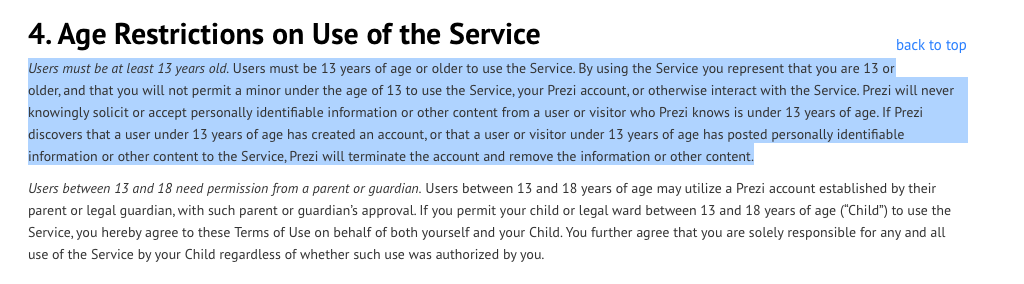
I admit that at one point in time I was one of those educators who allowed students to sign into a site using a teacher’s credentials in order to gain access, for example, some of our intermediate students used Prezi for project work and signed in under the same generic Gmail account maintained by the teacher.
Nope:
Screen Shot 2014-09-28 at 7.21.09 AM
Over the past two years, however, thanks to the work of Audrey Watters, Bill Fitzgerald, and many others, maintaining the privacy and protecting my students online has become one of my main priorities as elementary technology coach. Prompted by a statewide communication last year from the education solicitors, our district set to work on making sure that parents were informed and involved in the decisions to allow their children to have accounts established at various educational websites and productivity services.
My scope is elementary, so I read a lot of Terms of Service/Terms of Use and privacy policies to make sure that our kids are even permitted to click on the website let alone establish accounts there. For example, we had been using Today’s Meet to organize classroom conversations in some of our intermediate classes. “No accounts are required, great!” was my initial reaction, and it worked well. I used it with staff in meetings, and I loved the ease and simplicity of use. Dig deeper, read its Terms of Use, and you’ll see that students under the age of 13 are not permitted to use Today’s Meet. Thus, I First steps at protecting students’ privacy. | Connected Principals: