Latest News and Comment from Education

Tuesday, December 10, 2013

12-10-13 Jersey Jazzman

Jersey Jazzman:


What Planet Do the StudentsFirst People Live On?
No, gentle reader, this did not come from The Onion:User Actions  FollowStudentsFirstNYVerified account‏@StudentsFirstNYBecause of #CommonCore, kids in Bed-Stuy will be able to compete in the same global economy as kids in wealthy suburban districts....7:15 PM - 10 Dec 13Silly me: I actually read stuff, so I was thinking maybe poverty and racism and inequity and poverty and poverty and poverty and


How The "Reform" Virus Is Spreading To NJ's Suburban Schools
New Jersey's schools are considered to be at the top of the nation; our suburban schools, in particular, are among some of the very best in the world. Nonetheless: the "reform" virus is spreading out from the urban areas into the 'burbs with frightening speed.How is this happening? Let's look at a test case:Last month, I told the tale of one Tim Capone, superintendent of the Highland Par


12-8-13 Jersey Jazzman
Jersey Jazzman: The Mustache of Understanding Tries To Do EducationA couple of weeks ago, I noted that Tom Friedman - the NY Times's own Mustache of Understanding - was in danger of losing his Wanker-In-Chief title to Frank Bruni. The bald-faced food critic, you see, had attempted to opine on education, with predictably disastrous results; how could bushy-nosed Friedman ever top Bruni's stunning d

Charter Schools Continue Dramatic Growth Despite Controversies

Charter Schools Continue Dramatic Growth Despite Controversies:

Charter Schools Continue Dramatic Growth Despite Controversies

Posted:   |  Updated: 12/10/2013 2:19 pm EST
charter schools
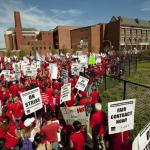
Protesters demonstrated outside Freire Charter School during a visit by House Majority Leader Eric Cantor (R-Va.), Monday, Sept. 23, 2013, in Philadelphia. In Cantor's remarks he demanded that Attorney General Eric Holder drop a lawsuit over school vouchers or face the wrath of Congress. (AP Photo/Matt Rourke) | ASSOCIATED PRESS

NEW YORK -- Charter schools remain the subject of intense debate, particularly in New York City, where incoming Mayor Bill de Blasio (D) won on a platform that was explicitly less friendly toward such schools than the policies of the outgoing mayor have been. But even as the political debate rages on, charter schools continue to grow dramatically throughout the country.
Overall, 1 in 20 students -- 2.3 million in total -- now attend charter schools, which represents an increase of 225,000 students over the 2012-13 school year. And that growth is particularly pronounced in urban areas, according to a new report released Tuesday by the National Alliance for Public Charter Schools that looked at market share in cities with the highest number of charter schools.
According to the report, New Orleans, whose school system was rebuilt in the wake of Hurricane Katrina, has 79 percent of its students in charter schools, which are publicly funded but can be privately and independently run. For the first time, Detroit had more than half of its students in such schools, with 51 percent. Washington, D.C., is working its way there, with 43 percent of its students now in charter schools. The top six school districts with the highest rates of enrollment -- which also include Flint,Mich., Kansas City, Mo., and Gary, Ind. -- each have 30 percent or more of students in a charter school.
The nation's largest cities also have high numbers of charter school students, 

Why Illiterate Educators? | My Island View

Why Illiterate Educators? | My Island View:

Why Illiterate Educators?


When it comes to an understanding of the term “literacy” most people understand it as the ability to read and write in an effort to communicate, understand and learn. That has been the accepted understanding of literacy for centuries. Of course with the advancement of technology in our world today that simple understanding of literacy has rapidly expanded. It has probably expanded so much, and so fast that most people have yet to grasp all of the new literacies that have come about in this technology-driven society in which we live. There is actually a growing list of new literacies.
The very tools that we used for centuries in support of literacy have disappeared under this wave of technology. The typewriter is no longer with us. Photographic cameras using film are becoming scarce. The print media itself no longer relies on huge printing presses. VCR’s, although state of the art at one time, are now DVR’s, even more state of the art. The world has been changed and continues to do so at a rate never before imagined. Technology continues to expand and catalogue all knowledge. The methods we use to access, curate, communicate, and analyze all of this information have undergone continuing change in the last few years.
We have come to recognize that technology has expanded our access to so much information, in so many different forms, that there is a need to recognize many other literacies beyond just reading and writing. In a technology-driven society being literate enough to only read and write may be enough for our kids to get by, but will they be able to compete, thrive, and succeed? Digital Literacy has blossomed with this digital age. It provides an understanding and ability to adapt and use digital tools to access, curate, communicate, and analyze 

12-10-13 THE WHOLE CHILD BLOG ED Pulse Poll Results: How Interested Are You in Multicultural Competency Training? — Whole Child Education

ED Pulse Poll Results: How Interested Are You in Multicultural Competency Training? — Whole Child Education:


ED Pulse Poll Results: How Interested Are You in Multicultural Competency Training?
ASCD continually seeks to provide solutions to the challenges that face educators of all levels. Recently, the ASCD SmartBrief ED Pulse poll addressed the need for and the interest in multicultural competency training in education. As demographics change in communities across the U.S., the importance of training educators to interact effectively with people of different cultures grows. Some feel


12-9-13 THE WHOLE CHILD BLOG Insights on Getting Students to Mastery — Whole Child Education
Insights on Getting Students to Mastery — Whole Child Education: Insights on Getting Students to MasteryWhat does it mean to master a subject? And how can schools help students get there? The December 2013/January 2014 issue of Educational Leadership focuses on how educators can help students achieve mastery as they learn. But what does mastery mean? And how can teachers be sure students have achi

Is Andy Shallal the next Bill de Blasio? | Ward 8 DC Teacher

Is Andy Shallal the next Bill de Blasio? | Ward 8 DC Teacher:

Is Andy Shallal the next Bill de Blasio?

Image
If yesterday’s WTU-sponsored town hall event is any sign of things to come, then the 2014 D.C. mayoral race will turn out a “game changer” in the education reform landscape within the nation’s capital. Although education reform in D.C. is often a one-sided debate, one candidate is separating himself from the pack by challenging the core beliefs of the current reform system. Since most candidates toe the education reform party line, Andy Shallal has the potential to drastically alter the current mayoral race. While Andy Shallal has yet to become a political household name, his proposals can literally change the face of education reform in D.C.
During the town hall event, seven D.C. mayoral candidates took center stage to discuss their views on the District’s public education policies. Although the audience, at times, was boisterous, the sentiment in the auditorium was clearly pro public education. The mayoral candidates in attendance included Mayor Vincent Gray, restaurateur Andy Shallal, Councilmember Tommy Wells, Councilmember Vincent Orange, Councilmember Jack Evans, former State Department official Reta Jo Lewis, and former D.C. contractor Christian Carter. In my opinion, here’s a brief breakdown of the candidates’ performances:
D.C. Mayor Vincent Gray (Incumbent):
D.C. Mayor Vincent Gray holds several advantages over the other candidates in the current 

Did Michelle Rhee's Policies In D.C. Work?

Did Michelle Rhee's Policies In D.C. Work?:

Did Michelle Rhee's Policies In D.C. Work?


Our goal, if we are to learn from nations like Finland, for example, should be to build a stronger teaching profession, one that is respected and admired. This is very different from the present policy advocated by Rhee of using test scores to find and fire “bad” teachers.
Rhee’s defenders point to a recent study to claim that the teacher evaluation system she created

On the way to Madiba's Freedom there was Stephen Bantu Biko | South African History Online

Stephen Bantu Biko | South African History Online:


Names: Biko, Stephen Bantu
Born: 18 December 1946, Tylden, Eastern Province (now Eastern Cape), South Africa
Died: 12 September 1977, Pretoria, South Africa
In summary: Black Consciousness Movement (BCM) leader, South Africa’s most influential and radical student leader in the 1970s, law student, banned person, political prisoner. Biko was killed in detention.
Stephen (Steve) Bantu Biko was born in Tylden in the Eastern Province (now Eastern Cape) on 18 December 1946.Biko's early life was modest. His main pre-occupation was the pursuit of academic excellence, which was in line with his father's expectations. His father encouraged all his children to pursue an education as the only possible route to upward social movement and independence. Biko started his education around 1952 (the exact date varies from source to source) against the background of the Bantu Education Act - introduced to stifle Black education. Essentially, the Act was designed to provide Blacks with sufficient education which would not allow "a future without back-breaking labour." Hendrik Frensch Verwoerd, who authored the Bill, said "There is no place for him [the Bantu] in the European community above the level of certain forms of labour."
Exposed to this type of education since primary school which he attended, such as Brownlee Primary, Charles Morgan Higher Primary, Lovedale Institute (which was eventually closed due to student protest) and finally, St Francis (a Catholic boarding School outside Durban), his political orientation emerged. While Biko was a student at Lovedale, his brother was arrested and jailed for nine months during a government crackdown for being a suspected member ofPOQO (later APLA), the military wing of the Pan-Africanist Congress (PAC). Biko was interrogated by the police and subsequently expelled from Lovedale after only attending for three months. This incident inculcated in Biko a "strong resentment toward white authority", which would shape his political career.
After Biko's expulsion from school, his career was characterised by political activism which culminated in him engaging in educating and making Black people conscious of their plight under an oppressive system. His untiring commitment to Black Consciousness is the legacy he has bequeathed to South Africa's struggle for freedom.
After matriculating from St Francis, he enrolled at the University of Natal (now University of kwaZulu-Natal). It was here that Biko's political activism began to blossom. He devoted much of his time to the cause of Black emancipation. At university his desire to study medicine was hampered by his constant involvement in political activities and organisations such as NUSAS. He became so immersed in politics that his performance declined to levels that compelled university authorities to deregister him. This happened at a time when he had also grown critical of the generally anti-Black structure of NUSAS. Due to the fact that NUSAS's power base was centred at the major White universities, it was virtually impossible for Black students to achieve positions of leadership. In fact, a NUSAS leader, Clive Nettleton, accused the organisation of "preaching the ideal of non-racism" while some members were "unable to live out their ideals." Thus, in 1968 Biko established a new all-Black organisation, the South African Students Organisation (SASO). He was elected as its first President in July 1969. One year later he was appointed Publicity Secretary of the organisation.
SASO adopted a new pro-Black and radical doctrine that became known as Black Consciousness which, by Biko's own definition, was the "cultural and political revival of an oppressed people."
A nation weeps. Mourners gather to pay their last respects as Steve Biko's body lies in state in his home before the funeral, attended by 20,000 mourners at King William's Town, November 1977. Photo: Bailey's African History Archives)
By 1971, the Black Consciousness Movement had grown into a formidable force throughout the country. In an attempt to reform SASO (which originally comprised students) and incorporate an adult element, Biko established the Black People's Convention (BPC) as well as Black Community Programmes (BCP).
The development of the BCM clearly threatened the establishment. In 1973, he was banned and confined to the magisterial district of King William's Town, his birth place. Among other things, the banning prohibited him from teaching or making public addresses (or speaking to more than one person at a time), preventing him from entering educational institutions and ordering him to report to the local police station once every week. In spite of being banned, Biko continued to advance the work of Black Consciousness. For instance, he established an Eastern Cape branch of BCP and through BCP he organised literacy and dressmaking classes as well as health education programmes. Quite significantly, he set up a health clinic outside King William's Town for poor rural Blacks who battled to access city hospitals. 
The banning and detention of several SASO and BPC leaders under the Terrorism Act, for organizing a rally in support of Mozambique’s FRELIMO threatened to cripple the Black Consciousness Movement. However, the accused used the seventeen-month trial that followed as a platform to publicise the case of Black Consciousness. Although they were found guilty and sentenced to various terms of imprisonment for revolutionary conspiracy they were later acquitted. Their convictions further strengthened the Black Consciousness movement. The repression instituted under the Terrorism Act caused Blacks to lose sympathy with moderate revolutionary policies, leading to increased militancy and hope for emancipation. During the Soweto riots of June 1976 there were violent clashes between high school students (protesting the use of Afrikaans as medium of academic instruction) and police, marking the beginning of widespread urban unrest and threatening law and order.
The wave of strikes during and after the Soweto uprising demonstrated, to a large extent, the influence Biko exerted on South African socio-political life. Although he did not directly take part in these uprisings, the influence of Black Consciousness ideas encouraged students to fight an unjust system - particularly after they were compelled to accept Afrikaans as a language for use in schools. In the wake of the urban revolt of 1976 and with the prospects of national revolution becoming increasingly real, the security police detained Biko, on 18 August 1977. At this time, Biko had begun studying law through the University of South Africa (UNISA).
He was thirty years old and was reportedly extremely fit when arrested. He was taken to Port Elizabeth but later transferred to Pretoria where he died in detention on 12 September 1977 as a result of brain injuries.
Thirteen Western nations sent diplomats to his funeral on 25 September. Police action prevented thousands of mourners from reaching the funeral venue from Johannesburg, Durban, Cape Town and other areas on the grounds that this would lead to lawlessness. Armed with FN rifles and machine guns, police erected and manned a number of roadblocks to prevent thousands of mourners from all over the country to converge on the town for the funeral of Steve Biko. Mourners from the Transvaal were barred from attending the funeral when permits were refused for buses. One of the speakers, Dr. Nthato Motlana, who flew from Johannesburg after he was blocked off when attempting to travel by road, said at the funeral that he had watched with disgust as Black police hauled mourners off the buses in Soweto and assaulted them with truncheons. The physician said he had treated 30 of the mourners, some for fractured skulls, and allegedly witnessed a number of young women being raped.
Biko was buried after a marathon funeral that was as much a protest rally against the White minority government's racial policies as it was a commemoration of the country's foremost Black leader. Several thousand Black mourners punched the air with clenched fists and shouted "Power!" as Biko's coffin was lowered into the grave. The crowd of more than ten thousand listened to successive speakers warning the government that Biko's death would push Blacks further towards violence in their quest for racial equality.
Due to local and international outcry, his death prompted an inquest which at first did not adequately reveal the circumstances surrounding his death. Police alleged that he died from a hunger strike; however independent sources said he was brutally murdered by police. Although his death was attributed to "a prison accident," evidence presented during the 15-day inquest into Biko's death revealed otherwise. During his detention in a Port Elizabeth police cell he had been chained to a grill at night and left to lie in urine-soaked blankets. He had been stripped naked and kept in leg-irons for 48 hours in his cell. A blow in a scuffle with security police led to him suffering brain damage by the time he was driven naked and manacled in the back of a police van to Pretoria, where he died.
Two years later a South African Medical and Dental Council (SAMDC) disciplinary committee found there was no prima facie case against the two doctors who had treated Biko shortly before his death. Dissatisfied doctors, seeking another inquiry into the role of the medical authorities who had treated Biko shortly before his death, presented a petition to the SAMDC in February 1982, but this was rejected on the grounds that no new evidence had come to light. Biko's death caught the attention of the international community, increasing the pressure on the South African government to abolish its detention policies and calling for an international probe on the cause of his death. Even close allies of South Africa, Britain and the United States of America, expressed deep concern about the death of Biko and added their support to those asking for an international probe.
It took eight years and intense pressure before the South African Medical and Dental Council (SAMDC) took disciplinary action. On 30 January, 1985, the Pretoria Supreme Court ordered the SAMDC to hold an inquiry into the conduct of the two doctors who treated Biko during the five days before he died. Judge President of the Transvaal, Justice W G Boshoff, said in a landmark judgment that there was prima facie evidence of improper or disgraceful conduct on the part of the "Biko" doctors in a professional respect.
He is survived by his two sons.

12-10-13 Seattle Schools Community Forum

Seattle Schools Community Forum:


West Seattle High Student Fends Off Would-Be Attacker Outside School
From the West Seattle Blog:"1:58 PM: Seattle Police are searching for a man reported to have jumped out of the bushes near the east side of West Seattle High School, in the Walnut/Stevens vicinity. Police say the man was reported to have grabbed the arm of a passing female, who hit him and ran into the school. Police were not able to tell us if she is a student. She was not hurt. The man was

New Seattle Schools PTA/PTO Resource Page
This new webpage at SPS is a welcome addition.  It has an FAQ page (chock-full of info), Building Rentals page and a Contacts page.  The main page, called PTSA/PTO Resources, also has links for forms/documents, policies and procedures and info for various groups/individuals.  I am also glad to see PTOs given the same rank and recognition as PTA/PTSAs.  It's the right thing to do. 
No Grandfathering for Grades 6/7 at Hamilton or Eckstein Next Year
From the Superintendent:Dear Seattle Public Schools families and staff,As many of you know, the Seattle School Board on Nov. 20 approved boundary changes for the 2014-15 school year to help address our growing enrollment and to plan for three new middle schools.We have heard from several families -- especially from parents of 7th grade Hamilton International Middle School APP students and parents

Orca K-8 Shelter in Place; Everything Fine and Under Control
Reader Southpaw reported that Orca K-8 was sheltering in place (somewhere around 1:15 p.m.). The issue was a person - reportedly a 15-year old - who had been shot somewhere else came to the school to see a family member.  The school likely sheltered in place as a precautionary measure. There was no gunman at Orca. No real info on the victim (who it is and where the person came from) but he/she is

Tuesday Open Thread
So no snow in my area so here's hoping yours is dry as well. I received my Seattle Public Library newsletter and wanted to alert readers with high school students about a new scholarship opportunity.  It's the Stim Bullitt Civic Courage Scholarship.  (This is a bequest from the late Stimson Bullitt who supported public libraries.) High school seniors and undergraduate students who live, work or at
12-9-13 Seattle Schools Community Forum
Seattle Schools Community Forum: If You Can't Say Anything NiceI saw that phrase in needlepoint on a pillow once.  I laughed because well, I did find it apt and funny.Now along comes Gawker with a great (and very long article) by Tom Scocca called "On Smarm."  Boy, does it hit a lot of high points with me."Haters", snark, and smarm - he covers them all.  (And he uses Thumper -

FCMAT » Cali Education Headlines Tuesday, December 10, 2013

FCMAT » Fiscal Crisis & Management Assistance Team:

California schools fear losing millions for low-income students


Education Headlines

Tuesday, December 10, 2013
FCMAT provides links to California K-12 news stories as a service to the industry. However, some stories may not be accessible because of newspapers' subscription policies.

Tracy Unified, union reach deal

A tentative contract agreement raising salaries by more than 2 percent has been reached between the Tracy Unified School District and the union representing classified employees such as custodians, bus drivers and food service workers following a year of negotiations.

Claremont Unified approves surplus property sale to homebuilder

The Claremont Unified School District made $18.88 million from the sale of an approximately 9.7-acre surplus property site recently.

Return of school bus service requested after death in Rancho Cucamonga

Concerned parents at two schools located near the site where a pickup recently struck a girl and her younger brother, killing the girl, have begun two separate online petitions asking the Etiwanda School District to bring back bus service.

Chino Valley Unified continues to test drinking water for lead contamination

Chino Valley Unified officials continue to test water samples at various school campuses after lead was recently detected in drinking water at a dozen school sites.

School-based health clinics popping up in Valley districts

Federal Affordable Care Act dollars intended to support school-based health centers are bankrolling clinics that offer low or no-fee services to kids at several Valley districts.

Modesto school board takes on funding changes, naming field for coach

Modesto City Schools board members got a primer on the state funding overhaul for education and took the first step toward renaming Beyer High’s varsity baseball field for longtime coach Paul Cornwell.

New official leads technology initiative in West Contra Costa schools

Chief Technology Officer Mary Phillips joined the West Contra Costa school district last summer with one of the most important mandates facing schools nationwide: Improve education by bringing students and teachers up to date in learning technology.

Teachers protest L.A. Unified's process for misconduct investigations

Critics say district's approach to misconduct allegations presumes guilt and results in dismissal for even small infractions.

Adams: Community schools gaining traction under state’s new funding formul

Efforts to create full-service community schools that focus on serving the “whole child” with a wide array of services are gaining traction under the state’s new funding formula for schools.

California schools fear losing millions for low-income students

Major California school districts fear they will be shortchanged millions of dollars in funding for their low-income students under new state rules requiring them to verify family incomes every year.

Report: In Silicon Valley, 'successful' schools fail poor and English-learning students

Silicon Valley public schools are largely failing poor students and English learners, a report issued Monday asserts, indicating that even schools in wealthy neighborhoods perceived to be highly successful are inadequately preparing these students, considered the hardest to educate.
Monday, December 9, 2013

Bakersfield students taste test the future at school cafeteria trade show

Robert Terrazas has strong opinions about the cafeteria food at CLC-Tech, an alternative school run by the Kern County Superintendent of Schools office.

Diabetes part of life for some students in Lodi Unified School District

The rate of students with Type 1 diabetes has remained stable, according to county education officials, but some 90 to 100 students within the district's schools need daily help with their disease.

Long Beach elementary students to receive new progress reports aligned with Common Core

Beginning next week, Long Beach elementary school students will receive new progress reports this trimester instead of the traditional report cards issued by the school district.

Nonprofits help Long Beach USD, others fill arts education void left by budget cuts

The day before directing a professional orchestra in front of thousands at the Long Beach Arena, conductor Matt Catingub was up early standing in front of about two dozen young musicians in a small middle school band room.

Choosing Democracy: Reclaim School Reform from the Corporate Raiders

Choosing Democracy: Reclaim School Reform from the Corporate Raiders:

Reclaim School Reform from the Corporate Raiders

Reclaim School Reform 

The Nation
One of the greatest challenges facing American education today is a fantasy, spun by billionaire-funded “think tanks” and often repeated uncritically by
politicians and pundits, that our schools are failing, that teachers are shirking their responsibilities and that unions are
the root of the problem. Unfortunately, the peddlers of these distortions have held the microphone for so long that the word “reform” is now associated with the crudest assaults on the very infrastructure of public education.
It’s not that reform isn’t called for. Schools are beset with difficulties, mostly born of the inequalities rampant in the larger society. But, as ought to be obvious, education reform must be in the public interest—on behalf of public schools and the children who attend them—rather than private interests, furthering “the corporate agenda for public schools, which disregards our voices and attempts to impose a system of winners and losers,” to quote the mission statement of a new coalition of teachers and their unions, along with parent, student, religious and community groups. This coalition has set itself the task of nothing less than reclaiming “the promise of public education as our nation’s 

Common Core Standards Distract From Real Educational Reform - US News and World Report

Common Core Standards Distract From Real Educational Reform - US News and World Report:

A Distraction from Real Education Reform

The emphasis on common standards is drawing attention away from bigger problems

October 28, 2013 RSS Feed Print
Create an SAT or ACT study schedule that allows you to pace yourself to avoid burnout.
Policymakers and reform advocates alike have rallied around introducing a set of national content standards, suggesting that this will jump-start the stagnating achievement of U.S. students. As history clearly indicates, simply calling for students to know more is not the same as ensuring they will learn more. Discussions of the Common Core standards are actually sucking all of the air out of the room, distracting attention from any serious efforts to reform our schools.
To be sure, it is a real problem when students in one state learn very different things than those in other states, and in particular when many students lack the skills needed for our modern economy. We really do have a national labor market, implying that significant numbers of our population end up living and working in a state with different needs than the one where they were born and went to school. The presumption behind having national standards (whether voluntary or coerced) is that having a clearer and more consistent statement of learning objectives across states will tend to lessen the problem of students bringing heterogeneous skills to the labor market. However, the fundamental problem is lack of minimal skills and not the heterogeneity of skills per se.
We currently have very different standards across states, and experience from the states provides little support for the argument that simply declaring more clearly what we want children to learn will have much impact. Proponents of national standards point to Massachusetts: strong standards and top results. But