Latest News and Comment from Education

Wednesday, June 22, 2011

Eastern Michigan faculty side with teachers' unions, refuse to work in Detroit schools | Detroit Free Press | freep.com

Eastern Michigan faculty side with teachers' unions, refuse to work in Detroit schools | Detroit Free Press | freep.com

Eastern Michigan faculty side with teachers' unions, refuse to work in Detroit schools


Emergency manager Roy Roberts


As Eastern Michigan University's Board of Regents voted Tuesday to take part in a new school district to reform Michigan's worst performing schools, faculty leaders promised not to do any work in Detroit that might help bust union contracts.
Detroit Public Schools emergency manager Roy Roberts would lead the new district, called the Education Achievement System, or EAS. And he has the power to nullify or change union contracts -- a sore point.
EMU President Susan Martin said no faculty would be assigned to any work in a school in Detroit. But union leaders were skeptical, saying Monday's announcements appeared to pledge faculty involvement to help turn around Michigan's failing schools, starting

Victory! Dept. of Ed Confirms Student Loan Default Is Not Criminal | Change.org News

Victory! Dept. of Ed Confirms Student Loan Default Is Not Criminal | Change.org News

Victory! Dept. of Ed Confirms Student Loan Default Is Not Criminal

When you saw the news reports last week of a man being SWAT teamed for not paying his student loans, you may have wondered: are they coming for me next?

Well, worry no more. The team from the film Default: The Student Loan Documentary started a petition on Change.orgto end this rampant confusion about whether or not students with outstanding loans could be criminally prosecuted. And they're declaring victory today, as the Department of Education released a statement, saying that defaulting on your school loans is not a criminal offense.

Sara Gast, spokesperson for the Department of Education, made the distinction. Students can be arrested for criminal activity like fraud. But not being able to pay your loans back isn't something you'll be thrown in jail for.

"Generally, defaulting on student loans is not itself a crime," said Gast. "However, there are a number of

NEA RA: Teacher evaluation and accountability. « Fred Klonsky's blog

NEA RA: Teacher evaluation and accountability. « Fred Klonsky's blog

NEA RA: Teacher evaluation and accountability.

One of the main issues of debate at the NEA RA to be held in Chicago June 30 through July 5 will be the “NEA Policy Statement on Teacher Evaluation and Accountability.”

The NEA leadership will present the policy statement to the delegates for their approval and they recommend that they approve it. So does the IEA leadership.

At first glance I notice two things. One is the permission given to state and local associations to use student test scores as one of the criteria for evaluating teachers.

Second is that it does not go nearly as far as the IEA supported Senate Bill 7 in undermining tenure and seniority rights.

What else do you see?

NEA POLICY STATEMENT ON TEACHER EVALUATION AND ACCOUNTABILITY
Presented by the NEA Work Group on Educator Excellence

SIGNIFICANCE OF THE POLICY DOCUMENT – 10 key points
1. The policy statement puts the focus on what is best for the student and the profession of

Mike Klonsky's SmallTalk Blog: Great way to spend the morning

Mike Klonsky's SmallTalk Blog: Great way to spend the morning

Great way to spend the morning

"This is what democracy looks like!" (M. Klonsky pic)
I got to march this morning, with thousands of Chicago teachers and supporters who surrounded CPS headquarters to protest the mayor's latest assaults on their collective bargaining rights. Chanting, "Shame on the Board!" "Save our schools!" and "Banks got bailed out, we got sold out!" the marchers proceeded to the Bank of America and other downtown corporate offices, chanting and making a loud, but beautifully harmonious noise. Dozens of cars honked their support.

The mayor's hand-picked school board meets this afternoon to put their rubber stamp on his reneging on the pay raise teachers supposedly won in the last contract negotiations and there should be plenty of noise in the conference room as well.

V.P. Sharkey (M. Klonsky pic)
CTU Vice-President Jesse Sharkey (left) standing atop a mailbox, addressed

AGING POPULATION REQUIRES BROADER HIGHER EDUCATION FUNDING AND POLICIES

CLASP: Policy Solutions That Work for Low-Income People

AGING POPULATION REQUIRES BROADER HIGHER EDUCATION FUNDING AND POLICIES
New Paper Finds Number of High School Students Shrinking, Makes Case for Increasing Number of Adults and Nontraditional Students Earning Postsecondary Education and Credentials

(Washington, D.C.) – Just as the nation’s economy is demanding that more workers have some postsecondary education or training, the traditional source of such workers – high school graduates – is leveling off and even declining in some states. A new paper released today by CLASP, the Center for Law and Social Policy, and the National Center for Higher Education Management Systems (NCHEMS) demonstrates why ensuring more adults have access to and complete college is critical for the nation’s continuing economic competitiveness.

The paper, Not Just Kid Stuff Anymore: The Economic Imperative for More Adults to Complete College, finds that over the next decade, there will be no national growth in the number of high school graduates, and some states will see the number of high school graduates decline by as much as 18 to 20 percent. The report includes state-by-state projections of the number of high school graduates through 2020. It finds that the flow of young workers into the workforce is drying up, especially in states in the Midwest and New England such as Ohio, Michigan, North Dakota, Massachusetts, Connecticut, and New York.

By 2018 the demand for college-educated workers will rise 16 percent, while demand for other workers will stay flat. At the same time, nearly two-thirds of jobs in 2018 will require some postsecondary education or training. Leading the nation in job openings requiring postsecondary education are Massachusetts, Colorado, Minnesota, Washington state, and the District of Columbia.

“The country’s economic competitiveness rests on more people accessing postsecondary education and credentials,” said Patrick Kelly, a senior associate at NCHEMS and coauthor of the report. “And with the aging of our population and decline in number of recent high school graduates entering college and the workforce, we need to make sure even more adults and nontraditional students have the skills they need to fill tomorrow’s jobs.”

“Our public policies have an important role to play by making postsecondary education more accessible for adult and nontraditional students, including by protecting funding for federal aid, especially Pell Grants, and improving policies to expand access and completion for an undergraduate population that looks much different today than 20 years ago,” said Vickie Choitz, a senior policy analyst at CLASP.

While research projects adult enrollment in college will grow twice as fast as enrollments by traditional age students, it’s important to note nontraditional students already are a significant percent of the college population: 36 percent of undergraduates are age 25 or older, 47 percent are considered “independent” from their parents , 23 percent of undergraduates are parents, and 40 percent are low-income. The changing student population has different needs from traditional students.

“It is critical that federal student aid be responsive to the needs of adults who often must juggle work, family and school responsibilities and who are on their own financially,” the report states.

In Congress and among organizations in Washington, D.C., there are a variety of proposals to slash the Pell grant program. These cuts will disproportionately harm nontraditional students. Cutting student aid and limiting nontraditional students' ability to access education and skills will significantly undermine the nation's ability to meet the demands for increasing skills and credentials into the next decade. At a time when economists project unemployment rates will remain high for the foreseeable future and with more workers struggling to get the skills they need to access jobs, this is the wrong direction.

“Just like our state governments and colleges must recognize that adult and nontraditional students are a substantial and growing share of the undergraduate student population, so too must Congress,” Choitz said. “All levels of government should revisit their higher education policies to make sure the nation has a skilled workforce and can remain economically competitive.”

###

CLASP develops and advocates for policies at the federal, state and local levels that improve the lives of low-income people. We focus on policies that strengthen families and create pathways to education and work. Through careful research and analysis and effective advocacy, we develop and promote new ideas, mobilize others, and directly assist governments and advocates to put in place successful strategies that deliver results that matter to people across America. Visit www.clasp.org for more information.

In corporatized Chicago, this IS what democracy looks like. « Fred Klonsky's blog

In corporatized Chicago, this IS what democracy looks like. « Fred Klonsky's blog

In corporatized Chicago, this IS what democracy looks like.

9AM Wednesday morning.

The Chicago Teachers Union, in response to Rahm Emanuel’s school board shredding the bargained agreement for a 4% pay raise next year, has called for a picket line at the CPS headquarters at 125 S. Clark Street.

By 9:15 the line circles the block twice. One circle going clockwise. The other circle going counter-clockwise.

“This is what democracy looks like!”

The slogan suddenly has a double meaning.

Democracy is certainly teachers in the street demanding what was promised and bargained.

In Rahm Emanuel’s corporatized Chicago, democracy is also public school teachers having their pay raises

Students Know Best on High Suspension Rates and Zero Tolerance in NYC Schools « EdVox

Students Know Best on High Suspension Rates and Zero Tolerance in NYC Schools « EdVox

Students Know Best on High Suspension Rates and Zero Tolerance in NYC Schools

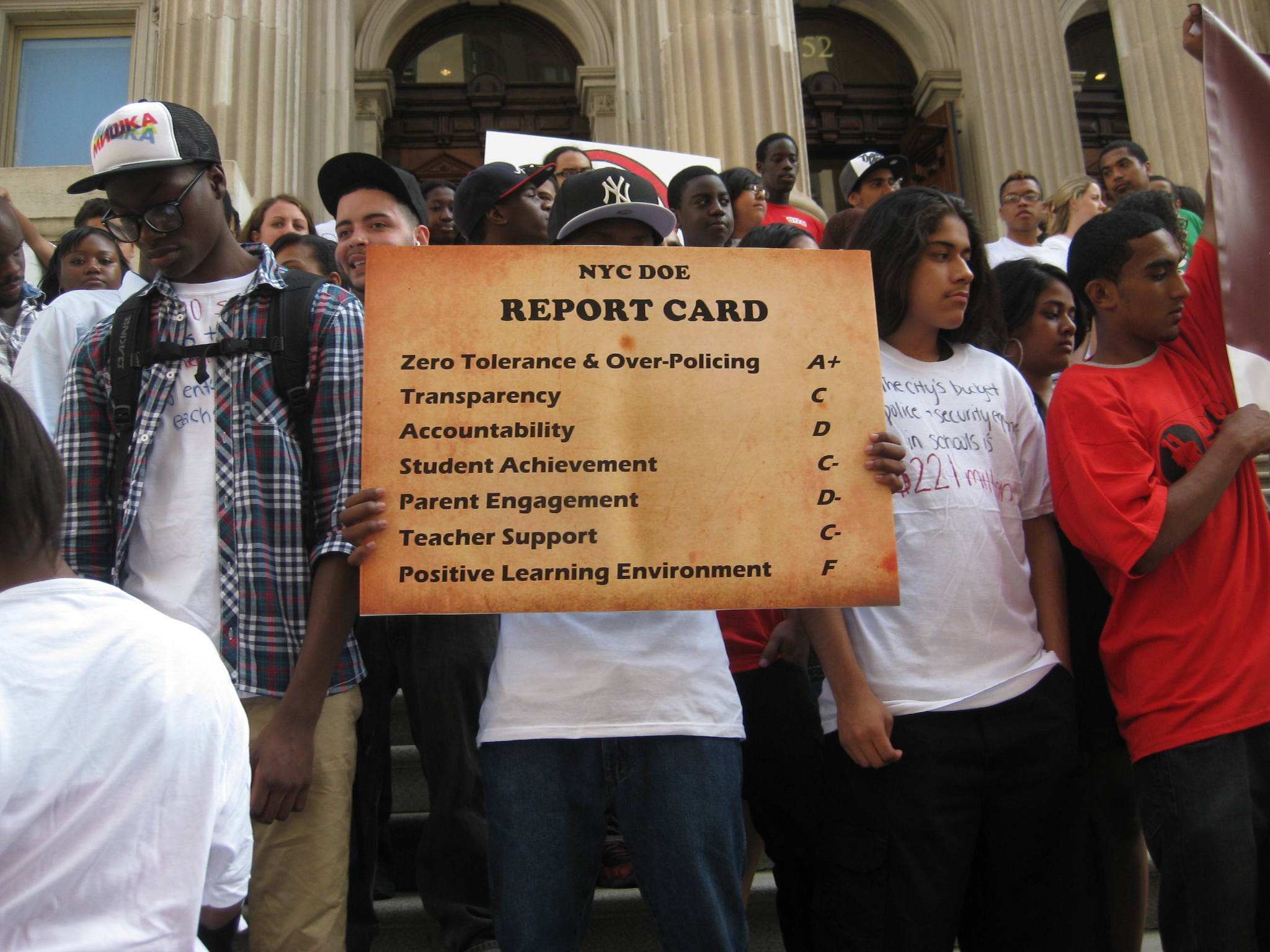
Over 100 students, parents, educators, advocates and elected officials spoke out against rising suspensions and demanded positive alternatives at a press conference and public hearing on proposed revisions to the NYC Department of Education’s Discipline Code. Suspensions in NYC have increased at an alarming rate. Between 2001 and 2010, the number of infractions in the Discipline Code increased by 49% and the number of zero tolerance infractions requiring a suspension increased by 200%. In 2008-2009, there were 73,000 suspensions in NYC public schools. These punitive policies target students of color at higher rates, contributing to the achievement gap and low graduation rates. Black students, who make up 33% of the population, received 53% of

Summer Meal Service Sites - Food Programs (CA Dept of Education)

Summer Meal Service Sites - Food Programs (CA Dept of Education)

Summer Meal Service Sites

Provides parents and referral agencies with a list of locations where children may receive free nutritious meals during school vacation and off-track periods.

2011 Summer Meal Service

2011 Summer Meal Service Sites (New 21-Jun-2011)

The New American Dictator: Emergency Manager law from A to Z | Michigan Messenger

The Emergency Manager law from A to Z | Michigan Messenger
labor-protest

The Emergency Manager law from A to Z

How the state's most controversial law came to be
By Ed Brayton | 06.22.11 | 9:31 am

With the filing of a state lawsuit to challenge the state’s Emergency Manager law, formally known as the Local Government and School District Fiscal Accountability Act, we thought it would be worthwhile to take a look at how this controversial law came to be.

On Jan. 1 of this year, Rick Snyder was sworn in as governor along with the newly elected state legislature and the Republicans had full control of all three branches of the state government. Passing a law giving unprecedented new powers over cities and public school systems to state-appointed Emergency Managers was clearly a top priority. It was passed, in fact, as Public Act 4 — the 4th bill signed into law by Gov. Snyder.

Before the legislature had even voted on it, Gov. Snyder was already on the defensive about the enormous powers granted to Emergency Managers in the bill. He told one reporter that the expansive language of the bill may not reflect the way those powers are actually implemented and he promised “a good dialogue with organized labor about what’s going on and how we can do this constructively.”

That message seems not to have reached the state’s unions, who organized a massive

Stop Blaming Teachers for Poor Student Performance | Dissident Voice

Stop Blaming Teachers for Poor Student Performance | Dissident Voice

Stop Blaming Teachers for Poor Student Performance

The Baltimore City Council, spurred by Councilwoman Mary Pat Clarke, deserves praise for its resolution endorsing the Save Our Schools March and National Call to Action, to be held in Washington, D.C., on July 30. This march, and the national attention it brings to the plight of our public schools, is long overdue — especially as it falls on the heels of the mass hysteria around blaming teachers for the questionable lack of student performance on high-stakes tests.

This resolution comes at a very important time for education policy-making in Maryland. Gov. Martin O’Malley must appoint a new state schools superintendent, now that Nancy Grasmick is retiring. Perhaps the governor will take the hint from Baltimore City that we need to reverse course immediately.

Ms. Grasmick was a strong proponent of Race to the Top, which has been more appropriately labeled “Race to the Bottom” and even “Rat Race to the Top.” The entire focus of President Barack Obama’s educational policy is to replace public schools with charter and non-union schools; bust the teachers unions by stripping teachers of collective bargaining rights; rely on extremely nebulous, faulty and often fraudulent data to assess school and student performances; tie teacher salaries to standardized test scores; and ignore economic reality in order to shift blame for apparent failures.

The politics around blaming teachers is simple. If you’re not going to go after the legitimate targets for

Charter Schooling & Citizenship :: Frederick M. Hess

Charter Schooling & Citizenship :: Frederick M. Hess

Jose Antonio Vargas Illegal | Jose Antonio Vargas DREAM Act | Video | Mediaite

Jose Antonio Vargas Illegal | Jose Antonio Vargas DREAM Act | Video | Mediaite

Pulitzer Prize Winning Journalist Outs Himself As Illegal Immigrant To ABC News

VIDEO

ABC News reports that Pulitzer Prize-winning journalist Jose Antonio Vargas is revealing his illegal immigration status in order to fight for the passage of the DREAM Act.

In an emotional interview with Dan Harris, Vargas, who was brought to the U.S. from the Philippines when he was 12, recounts learning about his illegal status while trying to apply for a driver’s license as a teen:

I remember the very first instinct was, okay, that’s it, get rid of the accent… Because I just thought to myself, you know, I couldn’t give anybody any reason to ever doubt that I’m an American.

He was partially inspired to finally come out about his immigration status, he shares, after witnessing the work accomplished by students who marched from Miami to DC in an effort to convince Congress to pass the DREAM (Development, Relief and Education for Alien Minors) Act, a bill that

Include Early Education in ESEA «

Include Early Education in ESEA «

Include Early Education in ESEA

Pre-K Now ad

As Congress considers reauthorization of the Elementary and Secondary Education Act (aka No Child Left Behind), U.S. Secretary of Education Arne Duncan writes on the Politico website that if Congress doesn’t act soon, the administration “will be prepared with a process that will enable schools to move ahead with reform in the fall.” And advocates continue to view the reauthorization as an opportunity to expand it to include pre-kindergarten and early education.

Pre-K Now, a program of the Pew Center on the States, recently produced an ad on the subject and sent a letter to Congress urging members to “recognize the importance of high-quality pre-k as the first step in education reform.”

In the letter, Pre-K Now urges Congress to integrate state-funded, Head Start and community-based early learning programs into ESEA by taking steps to:

Charting a New Course to Retirement: How Charter Schools Handle Teacher Pensions

Charting a New Course to Retirement: How Charter Schools Handle Teacher Pensions

Charting a New Course to Retirement: How Charter Schools Handle Teacher Pensions

June 22, 2011

by Amanda Olberg, Michael Podgursky

In this new "Ed Short" from the Thomas B. Fordham Institute, Amanda Olberg and Michael Podgursky examine how public charter schools handle pensions for their teachers. Some states give these schools the freedom to opt out of the traditional teacher-pension system; when given that option, how many charter schools take it? Olberg and Podgursky examine data from six charter-heavy states and find that charter participation rates in traditional pension systems vary greatly—from over 90 percent in California to less than one out of every four charters in Florida. As for what happens when schools choose not to participate in state pension plans, the authors

Man Robs Bank of $1 To Get Health Care in Prison | Mother Jones

Man Robs Bank of $1 To Get Health Care in Prison | Mother Jones

Man Robs Bank of $1 To Get Health Care in Prison

| Tue Jun. 21, 2011 12:56 PM PDT

No, it's not an Onion article. An unemployed, sickly man in North Carolina robbed a bank of a single dollar in hopes of being arrested and receiving free health care in prison. The New York Times relays the story, which seems destined to become a political anecdote about our dysfunctional health care system:

James Verone, an unemployed 59-year-old with a bad back, a sore foot and an undiagnosed growth on his chest, limped into a bank in Gastonia, N.C., this month and handed the teller a note, explaining that this was an unarmed robbery, but she'd better turn over $1 and call the cops. That, he figured, would be enough to get himself

Schools Matter: Strawman argument is all they have

Schools Matter: Strawman argument is all they have

Strawman argument is all they have

In the comments of Diane Ravitch's recent EdWeek Bridging Differences, "Why I Am Marching on July 30," one comment captures the bankrupt support for the new reformer movement coming from Secretary Duncan, Bill Gates, and Michelle Rhee.

paulhoss@hotmail.com takes this swipe at those such as Ravitch challenging the new reformers:

"What to say about SOS? In theory it could have promise. In reality SOS will have little to no impact. Jonathan Kozol, Monty Neill, Deborah Meier, Diane Ravitch, etc., are of a common mindset, the bottom line of which is anti-accountability for everyone and everything in our schools."

The problem? This is a classic strawman argument: Misrepresent those you want to demonize and then banter

Save Our Schools

Tim Wise » Bill of Whites: Historical Memory Through the Racial Looking Glass

Tim Wise » Bill of Whites: Historical Memory Through the Racial Looking Glass

Bill of Whites: Historical Memory Through the Racial Looking Glass

Published as a ZNet Commentary, July 24, 2000

In 1992, white supremacist Jared Taylor lamented the ostensibly growing influence of people of color in the U.S. when he wrote:

“The old, standard history united Americans…It emphasized one point of view and ignored others. It was history about white people for white people…This served the country well, so long as Blacks and Indians did not have voices. All that changed (in) the 1960s. The civil rights movement gave voices to Blacks and Indians…It was the end of a certain kind of America.”

To listen to Taylor, whites are no longer in control of the nation’s dominant historical narrative thanks to a rising tide of multiculturalism forcing us to listen to the perspectives of others. Frankly, we should be