Latest News and Comment from Education

Tuesday, January 7, 2020

In Sacramento, Youth Activists Push to Get Police Out of Schools

In Sacramento, Youth Activists Push to Get Police Out of Schools

In Sacramento, Youth Activists Push to Get Police Out of Schools


As a 10th grader at Sacramento’s Luther Burbank High School, Stephanie Lopez remembers when she saw a school resource officer treat her brother like a criminal.
Her brother had bumped into the officer and apologized, Lopez said. But the officer proceeded to question him and asked him for his ID.
“It was all new to me,” said Lopez, now 17 and a senior, of the aggressive approach the officer used with her brother. “When I was younger, I wanted to be a police officer. When I got to high school, I finally saw what it’s like for us, for people of color. It really angered me, because I didn’t notice it in my childhood.”
As a result, more students such as Stephanie are organizing to confront school boards in California about feeling threatened, uneasy and unsafe with the police presence on their campuses. The goal is to pressure school boards to drop contracts to staff school resource officers, or SROs, and use the funds to pay for more mental health experts, counselors, nurses, librarians and other staff they say are lacking on their campuses.
The campaigns have not completely pushed out SROs, but some districts have drafted memorandums of understanding to address how school resource officers are used and the kind of services they can and cannot provide.
“A lot of our work is getting folks organized … we’re the train moving in the opposite direction,” said Carrie Lorraine Ayala, the regional connector for Central Valley Movement Building. Her organization is CONTINUE READING: In Sacramento, Youth Activists Push to Get Police Out of Schools


More Latinos Earned Degrees This Past Decade Than Any Time In History

More Latinos Earned Degrees This Past Decade Than Any Time In History

More Latinos Earned Degrees This Past Decade Than Any Time In History
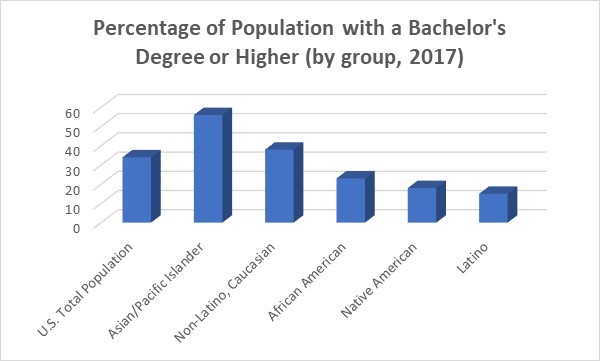
70% more Latinos earned degrees in the past decade than any previous decade.

Last month, the National Center for Education Statistics (NCES) released a comprehensive data analysis on the state of education across all educational levels, and it appears enrollment of Latino students at college campuses has increased.
But while Latino enrollment has increased overall, the Latino student population as a whole still lags behind the enrollment rate of other groups. The same pattern exists with the number of college degrees awarded to Latino students.
During the 2017-2018 cycle, there was around 26 million students enrolled in postsecondary institutions in the U.S., including degree and technical/non-degree programs.
While 18-24 year olds enrolled in degree-granting postsecondary institutions only made up 40 percent of the student population in 2017, the majority of the students were non-traditional (above 25 years of age).


Also, according to the NCES data, the year 2010 experienced the largest number of enrolled students, a number which is estimated to be surpassed later in 2028. 
Another fact to consider is that from 2007 to 2017, there was only a slight increase of enrolled CONTINUE READING: More Latinos Earned Degrees This Past Decade Than Any Time In History

Why Are Grades Important? Some Teachers Say They Do More Harm Than Good | Teen Vogue

Why Are Grades Important? Some Teachers Say They Do More Harm Than Good | Teen Vogue

Why Are Grades Important? Some Teachers Say They Do More Harm Than Good
Schooled is a series by Zach Schermele, a freshman at Columbia University, that explores the nuances of the American education system.


English teacher Gina Benz began to worry when several Advanced Placement (AP) students she knew were hospitalized for behavioral health problems in 2010. The need to “keep a high GPA, get that high ACT score, and get into that certain college” was taking a toll, she said. And she felt it, too. Benz used to spend hours grading papers at home — time that she said could have been better spent with family and friends and caring for herself instead of “drowning in the waters of competitive academic culture.” Something needed to change.
“Initially, I waded into the gradeless classroom waters for my own wellbeing,” she told Teen Vogue. “I wanted to reduce the hours of schoolwork I was doing at home each night. After only a few weeks, I realized that I wasn't getting the benefits I'd hoped for, but my students were experiencing benefits I never anticipated.”
Benz decided to make her classroom “gradeless” two years ago. Instead of “slapping a letter or number at the top of an assessment,” she now focuses on providing her students with high-quality feedback instead. Her students test ideas, make discoveries and embrace failure in an environment where learning is “transformational, not transactional.” Although she is technically required to give a final grade at the end of the semester, that number is based on cumulative evidence of her students’ progress, not a grade average. Benz says her students’ AP test scores haven’t dropped because of the change, and that parents have embraced it. Students tell her they have more “joy for learning” and better emotional health.
“Every week, I hear students talk about being awake until 1, 2, or even 3 in the morning doing homework,” she said. “The gradeless classroom releases students of the pressure CONTINUE READING: Why Are Grades Important? Some Teachers Say They Do More Harm Than Good | Teen Vogue

Monday, January 6, 2020

Why isn't our teacher workforce diverse enough?

Why isn't our teacher workforce diverse enough?

Why aren’t our teachers as diverse as their students?Several states and districts have pledged to try to close the diversity gap


Diversity is growing among students in most U.S. schools, but not among teachers, The Washington Post reports
Only one-tenth of 1 percent of Latino students attend a school system where the portion of Latino teachers equals or exceeds the percentage of Latino students, according to the Post’s analysis.
For black students, that figure is 7 percent, while for white children, it’s nearly 100%, the newspaper reported.
“Representation absolutely matters and it matters for … almost every educational outcome you can think of,” Seth Gershenson, a public policy professor at American University, told the Post. 
In Chicago Public Schools, the district school board recently held a hearing with stakeholders who said there aren’t enough teachers of color in the district and questioned why the ones who have worked have left, the Chicago Sun-Times reported.
While only 10% of the district’s students are white, half of its teachers are, according to the Sun-Times. “We’re down to only 20 percent of our educators in CPS being black. That’s unacceptable,” Chicago Teachers Union chief of staff Jennifer Johnson said at the hearing, according to the newspaper. “I was often the only black educator that many of my students saw in the high school where I taught.”


In Rhode Island, Johns Hopkins University researchers found that lack of diversity among teachers at Providence Public Schools was a major concern, but it that was not being address by education leaders, according 89.3-FM, The Public’s Radio.
The state education department, which took over the district this fall, says it plans to address the CONTINUE READING: Why isn't our teacher workforce diverse enough?

Fraud, waste, misconduct: Inspector General’s report details year of cases in Chicago schools

Fraud, waste, misconduct: Inspector General’s report details year of cases in Chicago schools

Fraud, waste, misconduct: Inspector General’s report details year of cases in Chicago schools


Chicago schools’ investigative office discovered a swim coach who pocketed nearly $30,000 in pool-rental fees, the district’s failure to collect nearly $2 million in pre-kindergarten payments, and school employees underreporting their income to obtain free preschool. And the office opened nearly 500 investigations into alleged sexual abuse.
The board of education’s Office of the Inspector General details those and other findings of waste and misdeeds in a 72-page report released Monday summing up last school year’s cases in Chicago Public Schools.
By far the largest portion of complaints, more than one-fifth, that the independent office received dealt with alleged sexual abuse. That may be because of heightened public awareness from stories in the Chicago Tribune detailing school-related sexual assaults, and the inspector general forming a specialized unit to deal with them. 
The report from the office of Nicholas Schuler details the district’s response to the findings, which included termination and debarment in some cases. 
“We take seriously our duty to hold accountable any individual who commits serious breaches of district policy or seeks to cause harm,” said a school district spokeswoman, Emily Bolton, in a statement.  “The district appreciates the Office of the Inspector General’s continued efforts to investigate wrongdoing as we work to CONTINUE READING: Fraud, waste, misconduct: Inspector General’s report details year of cases in Chicago schools

Charlotte, N.C.: Voucher School Abruptly Closes Mid-Year | Diane Ravitch's blog

Charlotte, N.C.: Voucher School Abruptly Closes Mid-Year | Diane Ravitch's blog

Charlotte, N.C.: Voucher School Abruptly Closes Mid-Year


The Legacy Prep School in Charlotte, North Carolina, closed its doors at the end of the holidays, leaving parents and students on their own to find a school.
Legacy Prep was a private school that relied on vouchers from the state.
Parents were stunned.
Yes, 100% caught off-guard,” said Jackie Davis, whose son attends Legacy Prep. 
On Friday, she and other parents whose children were enjoying holiday break, received an email from Stacey Rose, the school’s principal, that told them the school would not re-open on January 7th due to funding issues. 
It is with a heavy heart that I must inform you that Legacy Preparatory will have to close its doors and cease all operations immediately.  As such, we will not reopen for classes on January 7th (or any time thereafter) as originally planned,” Rose wrote in-part.
“It’s a burden,” Davis said. “I’m thinking I’m in a CONTINUE READING: Charlotte, N.C.: Voucher School Abruptly Closes Mid-Year | Diane Ravitch's blog

Prison “Reform” To Incarcerate The World: “Smart” Justice & Global Finance – Wrench in the Gears

Prison “Reform” To Incarcerate The World: “Smart” Justice & Global Finance – Wrench in the Gears

Prison “Reform” To Incarcerate The World: “Smart” Justice & Global Finance


Imposition of social control through brutal policing, incarceration, state supervision, exorbitant fines, and forced labor has a long, well-documented history in the United States. The ongoing harm, and devastating legacy of trauma linked to it, disproportionately affects Indigenous and Black communities, the very ones upon whose stolen land and labor this nation’s wealth has been extracted. Dismantling the prison industrial complex MUST be a priority, and yet care should be taken that we do not allow short-term “wins” to inadvertently pave the way for long-term disasters.
For the past month and a half I’ve been attempting to sort out the deep-pocketed interests behind what is being represented as prison “reform.” Many names I encountered were familiar to me from my previous education and impact investing research including the MacArthur, Ford, and Casey Foundations, Arnold Ventures, and Chan Zuckerberg. The same folks aiming to engineer the futures of preschoolers as human capital have their sights on incarcerated populations, too.
There’s actually quite a lot of overlap between communities accepting MacArthur Foundation “Safety + Justice” grants and those involved in “cradle to career” efforts implemented through Strive Together and other “collective impact” organizations. I will discuss this more in future posts, but below is a map to give you a sense of it. Use the link to the interactive CONTINUE READING: Prison “Reform” To Incarcerate The World: “Smart” Justice & Global Finance – Wrench in the Gears

CURMUDGUCATION: NC: Whitewashing The Charter Report

CURMUDGUCATION: NC: Whitewashing The Charter Report

NC: Whitewashing The Charter Report

North Carolina's 2020 Annual Charter Schools Report has caused some consternation among members of the state's Charter Schools Advisory Board (CSAB). They've seen the first draft and requested a rewrite, because, well, members of the public might become confused by the information that suggests Bad Things about North Carolina's charter industry.

This is not the first time the issue has come up. Back in 2016 the Lt. Governor called the report "too negative" and pushed to have it made "more fair." The report was not substantially changed-- just more data added. But in 2016 it still showed that North Carolina's charter schools mostly serve whiter, wealthier student bodies. This prompted a remarkable explanation:

Darrell Allison, president of Parents for Educational Freedom in North Carolina, said that fact is simply a reflection of which families are applying to charters.


Well, yes. Education reform in North Carolina has been about crushing the teachers' unions and teachers themselves, while also being aimed at enabling white flight and accelerating segregation. One might be inclined to deduce that they hope to set up a spiffy private system for whiter, wealthier folks (including a corporate reserve-your-own-seats policy) along with vouchers, while simultaneously cutting the public system to the bone so that wealthy taxpayers don't have to spend so much educating Those People's Children. North Carolina has done plenty to earn a spot in the education policy hall of shameenabled by some of the worst gerrymandering in the country.

But while NC legislators don't seem to experience much shame over what they do, they sometimes CONTINUE READING: 
CURMUDGUCATION: NC: Whitewashing The Charter Report


Vouchers: Should States Be Subsidizing Private Education at a Steep Cost to Public Schools? | janresseger

Vouchers: Should States Be Subsidizing Private Education at a Steep Cost to Public Schools? | janresseger

Vouchers: Should States Be Subsidizing Private Education at a Steep Cost to Public Schools?

Wisconsin and Ohio were the pioneers, the states which launched school vouchers—public tax dollars covering private school tuition.  Wisconsin launched Milwaukee vouchers in 1990, and Ohio followed suit in 1996 with a Cleveland voucher program.
What are the problems with the idea of vouchers?
Vouchers have always been endorsed by their proponents as providing an escape for promising students from so-called “failing” public schools—as measured by test scores.  But research demonstrates (see here and here) that test scores correlate not with school quality but instead with the aggregate income of the neighborhoods where public schools are located and the families who live there.  Research demonstrates that ameliorating student poverty would more directly address students’ needs.
The idea that vouchers help students academically hasn’t held up either.  A study by the pro-voucher Thomas Fordham Institute demonstrates that in Ohio, voucher students regularly fall behind their public school counterparts.  But proponents of school privatization (including the Thomas Fordham Institute itself) regularly ignore the evidence.
In a recent summary published in The NationJennifer Berkshire explains that while there is a lack of empirical evidence justifying vouchers, their proponents support them ideologically: “But the GOP’s true policy aim these days is much more ambitious: private school vouchers for all. In Ohio, students in two-thirds of the state’s school districts are now eligible for vouchers, a ballooning program that is on track to cost taxpayers $350 million by the end of the school year. And in Florida, school vouchers are now being offered to middle-class students, the latest gambit by conservatives in their effort to redefine public education as anything parents want to spend taxpayer money on. ‘For me, if the taxpayer is paying for the education, it’s public education,’ Florida’s governor Ron DeSantis proclaimed earlier this year.”
In Ohio, based on state report card grades which legislators from both parties seem to agree are deeply flawed, vouchers are now to be awarded to students in so-called ‘under- CONTINUE READING: Vouchers: Should States Be Subsidizing Private Education at a Steep Cost to Public Schools? | janresseger

Sunday, January 5, 2020

Emails btwn Excelencia Charter Academy founder Ruben Alonzo & some lawyers at Young Minney Corr expose LA charter industry's nefarious tactics for stalling public records access! -Michael Kohlhaas dot org

Michael Kohlhaas dot org

EMAILS BETWEEN EXCELENCIA CHARTER ACADEMY FOUNDER RUBEN ALONZO AND VARIOUS LAWYERS AT PRIVATIZING LAW FIRM  REVEAL STRATEGIES OF OBSTRUCTION AND DELAY – 


EMAILS BETWEEN EXCELENCIA CHARTER ACADEMY FOUNDER RUBEN ALONZO AND VARIOUS LAWYERS AT POWERHOUSE PRIVATIZING LAW FIRM YOUNG MINNEY CORR – DISCUSSING HOW TO RESPOND TO MY REQUEST FOR PUBLIC RECORDS – REVEAL STRATEGIES OF OBSTRUCTION AND DELAY – AND HINT AT A COORDINATED CAMPAIGN OF INTELLIGENCE-GATHERING AND INVESTIGATION OF ME – INCLUDING IDIOTIC INTERPRETATIONS OF MY MOTIVES AND MY PLACE OF EMPLOYMENT – PRETTY CREEPY STUFF ON WHICH TO BE SPENDING PUBLIC MONEY MEANT FOR THE EDUCATION OF CHILDREN – BUT NOT ESPECIALLY SURPRISING


In October 2018 I sent a California Public Records Act request for a bunch of emails to Ruben Alonzo, self-proclaimed founder of Excelencia Charter Academy, a creepy co-locating conspiracy currently occupying the Boyle Heights campus of Sunrise Elementary School. And about six weeks later, at the end of November, Alonzo handed over a suprisingly complete set of responsive records. And what important material it turned out to be.
From it we learned about a demand letter that the United Teachers of Los Angeles sent to Excelencia in June 2018 alleging violations of the Brown Act. And about how insidious privateer brigade the California Charter School Association provides free lawyers to charters to help them co-locate on the campuses of actual public schools. And about how charter school operators use all kinds of shenanaganistic financial maneuvers to skim money from the public funds they receive and funnel it into the coffers of their zillionaire sponsors. And about how Ruben Alonzo is a whiny crybaby stalker who hates democracy and freedom.
And not only was all that stuff revealed but Alonzo was kind enough to produce a set of emails between him and a couple of lawyers, Sarah Kollman and Kimberly Rodriguez, from metaphorically mobbed-up charter school law conspiracy Young Minney & Corr advising him on how to respond to my request and giving him apparently illegal suggestions for how to delay my access to the records. I’m exceedingly familiar with the end result of the anti-CPRA machinations of public agencies, but it’s rare, and very interesting, not to mention useful in deciding how to respond and proceed against them, to get a glimpse of the little folks behind the curtain who create the responses sent out over the signatures of their feckless clients.
The emails also include a series of weirdly puerile and self-serving CONTINUE READING: Michael Kohlhaas dot org

Wendy Lecker: Putting a price tag on public schools - StamfordAdvocate

Wendy Lecker: Putting a price tag on public schools - StamfordAdvocate

Wendy Lecker: Putting a price tag on public schools

When it comes to using one’s fortune to influence American policy, billionaire brothers Charles and David Koch stand out.
The Kochs have spent a fortune pushing American politics and policy to the right. Their secretive organization, Americans for Prosperity, is a major player in anti-labor activities, such as Wisconsin’s slashing of union rights, and fighting minimum wage increases nationwide. The Kochs poured money into the American Legislative Exchange Council (“ALEC”) a stealth lobby organization that writes bills that advance Koch industries’ interests specifically and the Koch’s extreme free market ideology in general, and then gets legislators all over the country to introduce them.
They have also donated millions of dollars to establish research centers at universities to push their brand of unregulated capitalism. They impose conditions and performance obligations on the donations, interfere in hiring decisions, and make curriculum and programming decisions. The Kochs often demand pre-approval of any public statements and include anti-transparency provisions in donor agreements. This research is then cited as the scholarly basis for Congressional decisions favoring the Kochs’ interests. The Kochs are proud of their integrated strategy to build a pipeline of influence. The president of the Charles G. Koch Charitable Foundation boasted that “(n)o one else has this infrastructure.”
Eli Broad, a billionaire who made his fortune through real estate and insurance, seeks to build a Koch-style infrastructure to CONTINUE READING: Wendy Lecker: Putting a price tag on public schools - StamfordAdvocate


When Disruptive Students Are Coddled, the Whole Class Suffers - Quillette

When Disruptive Students Are Coddled, the Whole Class Suffers - Quillette

When Disruptive Students Are Coddled, the Whole Class Suffers


Last month, NBC Nightly News aired a segment on the latest classroom-management technique to sweep America’s schools: “room clears”: When a child throws a tantrum that could physically endanger his peers, teachers evacuate all of the other students from the classroom until the troublemaker has vented his rage upon empty desks, tables and chairs. The technique was virtually unheard of five years ago. But 56 percent of surveyed teachers and parents in Oregon now report having experienced a room clear in their or their child’s classroom over the last year.
Surrendering the classroom to a single student: The average reader might well ask why anyone thinks this would be a good idea. Yet the policies that make this approach inevitable have been applauded by a wide range of authorities, from the Southern Poverty Law Center to the Trump-administration’s Department of Education.
The emergence of room clears is a product of several fashionable education-policy trends designed to protect the rights of troubled students, often with little regard for the rights of their classmates. These include the provisions contained in the federal Individuals with Disabilities Education Act (IDEA), which mandates that special-education students be subject to the “least restrictive environment” possible. When it comes to students who are hard of hearing, dyslexic or CONTINUE READING: When Disruptive Students Are Coddled, the Whole Class Suffers - Quillette

CATCH UP WITH CURMUDGUCATION + ICYMI: Off To A Great New Year's Start Edition (1/5)

CURMUDGUCATION: ICYMI: Off To A Great New Year's Start Edition (1/5)


Off To A Great New Year's Start Edition (1/5)

Marking the new year always strikes me as a bit odd-- we draw an arbitrary line in the chronological sand, then get all excited about examining it. Humans are fun.

In the meantime, this week's list is loaded with some exceptionally good readings. Remember to share the ons that speak to you. Amplifying voices is what the interwebz are all about.

The Surprising Source of the NPE Data
The pushback against NPE's report on charter waste and fraud has been considerable, but here Carol Burris provides a measured and detailed response. And guess where some of the data in question comes from...

The Dangers of Disinformation
Last Sunday I failed to do due diligence on one of the posts and recommended something from an untrustworthy source (the post is no longer on the list).  The up side is that it prompted this thoughtful post from Dad Gone Wild.

The Democrats' School Choice Problem
Jennifer Berkshire breaks it down for the Nation in a thoughtful take that spins off the Pittsburgh education forum. It's a good look at some of the political dynamics involved.

The 100 Worst Ed-Tech Debacles of the Decade
This Audrey Watters post is the bomb, and if you somehow haven't read it yet, then stop procrastinating. It's a horrifying stroll down memory lane.

Teachers "Never Broke The Law"
Remember when Matt "Sore Loser" Bevin tried to throw some laws at teachers who walked out? It's one more bad policy that his successor has reversed.

Closing the Minority Teacher Gap
Bill Tucker at the St. Louis Post Dispatch takes another look at this continued problem. There's lots of good stuff here, including this sentence: "Teachers are known for working for less pay and respect, but that is a big ask for a minority student, whose family has been underpaid and not respected." There's also another look at the issue in the Washington Post this week.

Novelist Cormac McCarthy paper writing tips 
McCarthy has been helping faculty and students at Santa Fe Institute with editing. Who knew? Here's a distillation of some of his writing advice.

School Grade Cards Gotta Go
The editorial board of the Toledo Blade argues for an end to Ohio's letter grade policy for schools.

Why the Charter School Proposals by Bernie Sanders and Elizabeth Warren Shouldn’t Be Controversial
Gotham Gazette has this piece from a former charter teacher and a former charter parent (the parent involved in an infamous Success Academy discipline scandal). Clear and compelling.

Lies, Lies, and More Lies
In the Troy Daily News, a former Ohio superintendent has some blistering words for Ohio's ed reform. He may be late to the party, but he is not holding back a bit.

Economists Ate My School 
Steven Singer looks at the damage done by imagining that teaching is simply one more transaction .

The Greatest Ed Tech Goof of All Time
Ed historian Adam Laats takes us back to an early example of terrible tech ideas for education, showing once again that hardly any modern innovations are actually innovations.

Montessori schools embrace kid-tracking devices  
What would make Montessori schools even better? How about constant student surveillance. This is your hate read for the week.


CURMUDGUCATION: ICYMI: Off To A Great New Year's Start Edition (1/5)

CATCH UP WITH CURMUDGUCATION


The Ed Reform Glossary You Need

If that Amazon gift certificate is burning a hole in your pocket, I have a few suggestions. Let's start with this one. In 2006, education historian Diane Ravitch published EdSpeak , a glossary of education policy jargon to help those folks who found it all, well, jargonny. But the education world has shifted around just a tad since 2006, and it is time for a brand new version of the critical guid
Michelle Rhee Has Been Robbed

As the various lists of faces, names, moments that defined the education policy debates of the last decade have been tallied up, one name has been, I think, unfairly overlooked-- Michelle Rhee. No, really, bear with me. The very fact that I don't really need to review her story makes part of my point. Rhee was the previous decade's best-known public face of education reform, culminating in that in
New Report: Charter Fraud And Waste Worse Than We Thought

Last March, the Network for Public Education released a report showing that the federal government has lost a billion dollars to charter school waste and fraud . But the organization had not stopped sifting through the data. Their follow-up report , “ Still Asleep At The Wheel: How the Federal Charter Schools Program Results in as Pileup of Fraud ands Waste ,” reveals that the situation is even w
I Have One Good New Years Story

New Year's Eve is not one of my favorite holidays, and some of them have been downright unpleasant, but I have one good story. It involves the Olympic torch. This was the route. I wasn't kidding with "circuitous." Back on New Year's Day of 2002, the Olympic flame was on its way to Salt Lake City, and on its long circuitous route out West, the flame passed through Erie, Pennsylvania, which is just
OH: Ohio Excels and the Hostile Takeover of Education

Ohio is one of many states in which business leaders have appointed themselves education overseers. The most recent version of this phenomenon is Ohio Excels , a lobbying group that believes that Ohio's education system owes them better meat widgets for job fodder. "improving the quality of education will give students a better chance to succeed and will help Ohio businesses grow and innovate, fue
The Ground Level Ed Reform Decade Retrospective

Yeah, it's time for everyone to do decade lists (including "Ten Reasons The New Decade Doesn't Start For Another Year") from the list of education faces that Alexander Russo is doing on Twitter to this absolutely-the-only-list-you-need-to-read from Audrey Watters, " The 100 Worst Ed Tech Debacles of the Decade. " I'm not going to try to sum up the decade in education. Or rather, I'm going to sum u
The Height Of A Dead Salmon

A while back someone sent me an article with a striking lead : The methodology is straightforward. You take your subject and slide them into an fMRI machine, a humongous sleek, white ring, like a donut designed by Apple. Then you show the subject images of people engaging in social activities — shopping, talking, eating dinner. You flash 48 different photos in front of your subject's eyes, and ask
ICYMI: Almost A New Decade Edition (12/29)

Yep, soon anything from the 1900s will be "a long time ago." But we can meditate on how experience fades into the dim past some other day. Right now we'll just worry about last week. Here's some of the worthwhile reading; it's a short list because holiday time. Remember to amplify the stuff that speaks to you! How Ibram X. Kendi's Definition of Antiracism Applies to Schools If you don't know Kendi
Dana Goldstein's Common Core Ten Year Tale, Annotated

Dana Goldstein's NYT ten year retrospective of Common Core has been sitting on my desktop since it was published, making me grumpy. It's yet another example of how the stories we are told about modern disruptive education reform are subtly sugared and carefully crafted to avoid discussing some of the larger issues. I don't know-- after all, Goldstein is a published book author and writes for the A
VA: Ideas About How To Recruit and Retain Teachers

As squawking about the teacher "shortage" many states have developed methods to either take advantage of the situation ("Now we can finally break the teachers union and public education by letting any warm body stand in front of a classroom because, hey, there's a shortage") or try to figure out a way to actually solve the problem. In Virginia, a coalition appears to be t aking a shot at the latte


Big Brother U & The Surveillance State

If you missed this article at Washington Post about on campus surveillance of students-- well, congratulations on having one less troubling thought in your head over the past week. Because the surveillance is continuing its slow, 
CURMUDGUCATION - http://curmudgucation.blogspot.com/