Thursday, March 28, 2019

CURMUDGUCATION: What To Look For In A Teacher School

CURMUDGUCATION: What To Look For In A Teacher School

What To Look For In A Teacher School

Robert Pondiscio just reviewed a new NCTQ book for high school students about how to become a teacher. I haven't seen the book, so I'm in no position to comment on it, but it does remind me that we don't spend nearly enough time talking about teacher prep, not from a policy point of view, but the point of view of high school students who want to end up teaching some day.

I am not the person to come to for a spirited defense of traditional teacher prep programs. I've sent students off to them and hosted student teachers from them, and the fact is that some are fine and some suck with the suckage of a thousand black holes. There are many current alternative paths to the classroom that also suck, but dammit, we asked for it by letting North Shmeretown State Teachers College get away with doing a terrible job. I've written before about fixing that, but this time, let's talk about your teen should be looking for when she goes teacher school shopping.

If you (or your child) want to become a teacher, what qualities should you look for in a teacher prep program?

1) Emphasis on content. 

My own program prepared me to be an English teacher by requiring me to be an English major, so I was shocked to discover that some teachers were arriving in the classroom with no more subject matter knowledge in some areas than they remembered from their own high school classes. CONTINUE READING: 
CURMUDGUCATION: What To Look For In A Teacher School

What Has Betsy DeVos Accomplished? Part I | janresseger

What Has Betsy DeVos Accomplished? Part I | janresseger

What Has Betsy DeVos Accomplished? Part I


The other day I had the opportunity to talk with a U.S. senator’s staffer who told me that opposition to the appointment of Betsy DeVos early in 2017 was unprecedented as measured by the number of calls—tens of thousands against DeVos’s confirmation and only three or four thousand in favor.  Those of us who made those calls and marched in the streets and made formal visits to the offices of our U.S. senators were terrified about what it would mean if one of the biggest opponents of our society’s system of public schools were confirmed to be the U.S. Secretary of Education.
Of course, DeVos was confirmed, but only after the Vice President, for the first time in history, was called in to break a tie on the Senate’s confirmation of a President’s appointee.
Now two years have passed.  So… how’s it going?
On Tuesday, DeVos went before the House Appropriations Committee to defend her department’s request in the President’s recently proposed fiscal year 2020 federal budget. This is Trump’s third annual budget proposal, and it declares DeVos’s values and priorities for the third consecutive year.
This week DeVos defended an education budget proposal that is $8.5 billion lower than last year’s allocation. She made no attempt to justify freezes to Title I and IDEA funding, and the elimination of several programs including the popular the 21st Century Learning Centers after-school program, along with Title II and Title IV grants to support professional development for teachers, smaller class sizes, and curricular enrichment—and even her department’s contribution to the Special Olympics.
DeVos’s comments at the recent hearing betray her lack of concern for the kind of improved classroom conditions striking teachers  have been demanding all year and her failure to care deeply about long running programs that help schools serve the needs of poor children and students with special needs. The Detroit Free Press‘s Todd Spangler quotes DeVos’s reasoning: “We are not doing our children any favors when we borrow from their future in order to CONTINUE READING: What Has Betsy DeVos Accomplished? Part I | janresseger

Wild Wild West: Arizona’s Charter School Experiment – Have You Heard

Wild Wild West: Arizona’s Charter School Experiment – Have You Heard

Wild Wild West: Arizona’s Charter School Experiment


Did you hear the one about the Arizona state legislator who made a cool $14 million from selling his network of charter schools to a nonprofit that he set up, which then inked a lucrative lease deal with him, hired him as a consultant, and hired his brother as the chief executive? That’s just one of the stories of charter school fraud and corruption that Craig Harris and his colleagues at the Arizona Republic exposed in their award-winning series “The Charter Gamble.”
In the latest episode of Have You Heard, we talk to Harris about how charter schools became Arizona’s new cash crop. You can read a full transcript of the episode here. And if you’re a fan of Have You Heard, please consider becoming a supporter on Patreon.


Wild Wild West: Arizona’s Charter School Experiment – Have You Heard

Wednesday, March 27, 2019

Betsy DeVos vs. the disabled: What is wrong with this woman? - New York Daily News

Betsy DeVos vs. the disabled: What is wrong with this woman? - New York Daily News

Betsy DeVos vs. the disabled: What is wrong with this woman?


Lost amid the swirl of post-Mueller analysis and gloating, the Jussie Smollett case and Donald Trump’s renewed push to gut Obamacare, on March 26, Education Secretary Betsy DeVos went before a House panel to discuss her proposed 10% cut to her department’s overall budget. Along with cuts to school-improvement funding and the use of technology in the classroom, the administration proposes cutting $17.6 million in federal funding to the Special Olympics, suggesting programs like it would best be funded by private donors.
Oh, come on — the Special Olympics? What is wrong with this woman? Does it come naturally, or is she simply trying way too hard to be evil?
I can’t say I was terribly shocked to hear this. Even before she took office, DeVos made it abundantly clear she had a real problem with the disabled. Maybe we frighten her. Maybe we just make her a little uncomfortable. Maybe she considers us an unsightly burden. Who knows? Whatever the case, she clearly wishes we’d just go away. Lord knows she doesn’t want to turn on ESPN one Saturday and see a bunch of kids with Down’s Syndrome playing basketball.
While proposing major cuts to seemingly fundamental programs, she also proposed funneling another $60 million into her pet charter school program. That didn’t surprise me either.

One of the unspoken side effects of that plan is it could potentially leave disabled students out in the cold.
In theory, publicly funded but privately run charter schools are supposed to comply with the Americans with Disabilities Act (ADA) and the adjunct Individuals with Disabilities in Education Act (IDEA), the latter of which guaranteed accessibility and civil rights protection for disabled public school students.

Some charters do comply, others don’t. With DeVos, it’s apparently all about choice.
During her Senate confirmation hearing, Trump’s pick to become education secretary openly CONTINUE READING: Betsy DeVos vs. the disabled: What is wrong with this woman? - New York Daily News


As Purdue Pharma Settles Oklahoma Lawsuit, Those Receiving Sackler Money Need to Make a Decision | deutsch29

As Purdue Pharma Settles Oklahoma Lawsuit, Those Receiving Sackler Money Need to Make a Decision | deutsch29

As Purdue Pharma Settles Oklahoma Lawsuit, Those Receiving Sackler Money Need to Make a Decision


On Tuesday, March 26, 2019, the drug company Purdue Pharma has agreed to settle with the State of Oklahoma, which sued Purdue Pharma, Johnson & Johnson, and Teva Pharmaceutical for the state’s opioid crisis. The $270M settlement appears to have been in the works for months, with the help of a court-appointed mediator.
All three companies were scheduled to go to trial on May 28, 2019; only Purdue Pharma decided to settle thus far.
Purdue Pharma is owned by the billionaire Sackler family, of which ed reformer Jonathan Sackler is a member. The Oklahoma lawsuit (see here also) did not name the Sacklers as defendants.
Tracking the Sackler fortune has been difficult; in this March 08, 2019, post about Purdue Pharma, the Massachusetts lawsuit, Jonathan Sackler, and his spending his opioid profit-derived fortune on ed reform organizations, I reference a Wall Street Journal article that notes Purdue Pharma profits have largely landed in Sackler family pockets.
One way for Purdue Pharma to escape liability via hundreds of lawsuits for its role in America’s opioid crisis is to file for bankruptcy. However, according to May 26, 2019, Politico, Oklhoma’s $270M settlement with Purdue Pharma is “bankruptcy proof”:
[The Oklahoma settlement] is the first major settlement to result from all those lawsuits and comes as Purdue officials mulled bankruptcy protection. Filing for Chapter 11 could stop litigation and make it hard to collect on any judgment, which [Oklahoma Attorney General Mike] Hunter admitted played into his decision to reach this accord.
“We had to take into account that they were modeling bankruptcy,” he said. “That was a serious exercise with them.”
He said his office has made “extensive efforts” to ensure this settlement is “bankruptcy proof.”
“We’ve got a commitment they are not filing bankruptcy in the near term,” he said. “We’ve gone to great lengths to ensure this is real money, that it’s not at risk in the event Purdue declares bankruptcy.“
In its press release on the settlement, Purdue Pharma paints the issue as a “landmark agreement… to advance the treatment of addiction.”
One day later, on March 27, 2019, Rhode Island Governor Gina Raimondo is facing criticism for refusing to return a $12,500 campaign donation from Jonathan CONTINUE READING: As Purdue Pharma Settles Oklahoma Lawsuit, Those Receiving Sackler Money Need to Make a Decision | deutsch29


Sell Your Soul to the Testocracy: Kamala Harris’s Faustian Teacher Raises | gadflyonthewallblog

Sell Your Soul to the Testocracy: Kamala Harris’s Faustian Teacher Raises | gadflyonthewallblog

Sell Your Soul to the Testocracy: Kamala Harris’s Faustian Teacher Raises


I love the idea of Kamala Harris’ plan to give teachers a pay raise.
But once we get past ideas, it’s way more troubling.
The California Senator and Democratic Presidential hopeful is proposing a $13,500 pay increase for the average teacher, with the exact number based on the size of each state’s pay gap.
That’s $315 billion more over a decade through federal matching funds, which amounts to a 23 percent salary increase for most educators.
Yes, please!
I could certainly use a raise.
But as Joe Moore said, “You can’t trust a promise someone makes while they’re drunk, in love, hungry, or running for office.”
And Harris IS running for office.
With this policy she’s wooing the national teachers unions and filling the neoliberal seat left by Hillary Clinton in 2016.
I love my union, but its leadership is like a college kid during spring break – ready to jump into bed with anyone who says the right words.
Arne Duncan likes it.
Obama’s first Education Secretary. The guy who thought Hurricane Katrina was the best thing to happen to New Orleans because it allowed the government to close the CONTINUE READING: Sell Your Soul to the Testocracy: Kamala Harris’s Faustian Teacher Raises | gadflyonthewallblog

California School Accountability Report: Sign this petition to hold charter schools accountable – In the Public Interest

California School Accountability Report: Sign this petition to hold charter schools accountable – In the Public Interest

California School Accountability Report: Sign this petition to hold charter schools accountable

Here’s our pick of recent news about the ongoing effort to privatize public education in California. Not a subscriber? Sign up here.

Sign this petition to hold charter schools accountable. Educators for Democratic Schools has launched a petition calling for “an immediate moratorium on certifying new charter schools in California, as they are draining funds from public schools and destabilizing school districts.” Sign it here.
“A microcosm of the state’s charter school debate.” Palo Alto Online digs deep into the history of California’s charter school battles, concluding that rapid charter school growth has left school districts scrambling for funding and students. Palo Alto Online

It’s time to limit charter schools. Our own Jeremy Mohler weighs in on growing concerns about the fiscal impact of too many charter schools: “Charter schools have become a politically complicated issue in recent years—highly contentious yet sometimes a little overblown. But there’s no question it’s time to slow their growth.” San Francisco Chronicle

ICYMI. Gov. Gavin Newsom signed into law a bill that requires charter schools to be as transparent to the public about how they operate as traditional, neighborhood public school districts. This brings California on board with the 38 other states that do so. The Washington Post

And at the national level… According to a new report from the Network for Public Education (NPE), the federal government has wasted up to $1 billion on charter schools that never opened, or opened and then closed because of mismanagement and other reasons. The Washington Post


California School Accountability Report: Sign this petition to hold charter schools accountable – In the Public Interest

Dr. Jackson Speaks in Support of the Education PROMISE Act | Schott Foundation for Public Education

Dr. Jackson Speaks in Support of the Education PROMISE Act | Schott Foundation for Public Education

Dr. Jackson Speaks in Support of the Education PROMISE Act

The following is testimony in support of the Education PROMISE Act (S.238/H.586), which aims to provide public schools the funding they need to deliver high-quality, equitable education across Massachusetts.
Members of the committee,
My name is John Jackson and I am the President & CEO of the Schott Foundation for Public Education, whose national headquarters is in Quincy.
I speak today in strong support of the Education PROMISE Act—and want to share Schott’s research and extensive experience working to ensure that all children, regardless of zip code, race, or family income, have an equitable and substantive opportunity to learn.
The lens of race gives us one measure of educational inequity in Massachusetts.  Our state is often celebrated for its statewide high school graduation rate—but Schott’s 2014 report documented the stark reality that Massachusetts has the second highest gap of any state in the nation, behind only New Jersey, between graduation rates for Black and Latino males compared to white males. (www.blackboysreport.org)
This is only one snapshot.  I don’t have time in this hearing to present all the statistics for children of color and low-income communities in Massachusetts.  But I want to underscore that inequities in educational supports can create an insurmountable chasm that consigns them to intergenerational cycles of poverty and limited chances to succeed in life.
Failure to act to correct these inequities does irreparable harm to our children—and it is not a legacy worthy of the state that can claim to be the birthplace of publicly-funded education in the U.S.
The only way to close the achievement gap is to close the opportunity gap.  And closing the gap can only be accomplished through a comprehensive approach to equitable school financing.  It requires the state working in partnership with localities to help ensure that education funding dollars for low-income, low property tax base communities—those where students experience the greatest need for supports—are brought into line with Massachusetts more affluent communities’ per pupil expenditures.
The Education PROMISE Act lays this groundwork—to level the playing field and improve educational opportunity for children of color and those from low-income families.  I urge the committee—and the Massachusetts legislature—to take this important step.
Among many highly effective components of the PROMISE Act is that the revised formula addresses healthcare costs, one of the most critical supports needed for a student to have the opportunity to succeed, indeed to thrive.
Dr. Jackson Speaks in Support of the Education PROMISE Act | Schott Foundation for Public Education


Webinar: What if We Used Wealth to Heal, not Harm? | Schott Foundation for Public Education

Webinar: What if We Used Wealth to Heal, not Harm? | Schott Foundation for Public Education

Webinar: What if We Used Wealth to Heal, not Harm?

What if we used wealth to heal, not harm? What if money was spent trying out concepts that challenge or shatter the structures and systems that have created inequity and disparity?

This is the core argument explored by author and nationally-recognized philanthropy expert and Schott Foundation Vice President Edgar Villanueva in his new book Decolonizing Wealth: Indigenous Wisdom to Heal Divides and Restore Balance. Using his own personal experiences as a Native American grant-maker and foundation executive (along with field data and dozens of funder interviews) Villanueva reveals the racial and colonialist dynamics at play in philanthropy and finance, including banks, investment funds, and aid organizations.

Join Schott as we continue to engage in lively conversations about how foundations can lead with racial equity and better serve the needs of communities of color. Speakers for this webinar include Chicago-based funders Megan Bang (Spencer Foundation), Bruce Boyd (Arabella Advisors), and Angelique Power (Field Foundation).
Come with questions, insights, and calls to action!
Join the conversation on Twitter using the hashtag #GrassrootsEd.
Our speakers will include:
  • Megan Bang, Senior Vice President, Spencer Foundation
  • Bruce Boyd, Principal and Senior Managing Director, Arabella Advisors
  • Angelique Power, President, The Field Foundation of Illinois
  • Edgar Villanueva (moderator), Vice President of Programs & Advocacy, Schott Foundation for Public Education


Webinar: What if We Used Wealth to Heal, not Harm? | Schott Foundation for Public Education

AFT President Randi Weingarten Celebrates Public Schools Week | American Federation of Teachers

AFT President Randi Weingarten Celebrates Public Schools Week | American Federation of Teachers

AFT President Randi Weingarten Celebrates Public Schools Week

WASHINGTON—March 25-29 is Public Schools Week, a time when the nation comes together to celebrate one of our greatest values: the promise of public education. The AFT is proud to join educators, parents, community advocates, businesses and others in celebrating the schools that 91 percent of American students attend. We celebrate not just to lift up the great things happening in our public schools, but to call for strengthening all of them, including providing the necessary investment.
AFT President Randi Weingarten issued the following statement:
“Public schools in America are foundational to our democracy, and to our economy. They are the only institution that promises to help all children—regardless of who they are or where they’re from—realize their dreams and aspirations. And every day, educators across this country devote themselves to making our public schools safe, welcoming spaces where kids can learn and thrive.
“Our public schools prepare the next generation of artists, engineers, linguists and athletes; our schools sit at the center of our communities, bringing people together to make life better. Over the last year and a half, while educators around the country have walked out of their classrooms to demand more investment in public schools, a record number of parents and allies have stood with them.
“That’s why the AFT has launched the Fund Our Future campaign, a nationwide effort to build on the momentum of educators, parents and communities coming together to demand adequate and sustainable investment in our public schools. Neither demography nor geography can dictate destiny. Opportunity must.
“And it’s why we fight, so that students—particularly our most vulnerable and at-risk children—have the resources they need to succeed, and schools where they feel nurtured and safe. We fight so that every school in this country has access to appropriate and up-to-date textbooks and instructional resources, counselors and nurses, and manageable class sizes. And we call on federal legislators to fulfill the promises made by Congress, including supporting the bipartisan Full Funding for IDEA bill being introduced by U.S. Sens. Chris Van Hollen and Pat Roberts, and led by Rep. Jared Huffman in the House.
“This week, and every week, we fight to fund our future, so every public school can be a place where parents want to send their kids, teachers want to teach, and children are engaged.”
AFT President Randi Weingarten Celebrates Public Schools Week | American Federation of Teachers


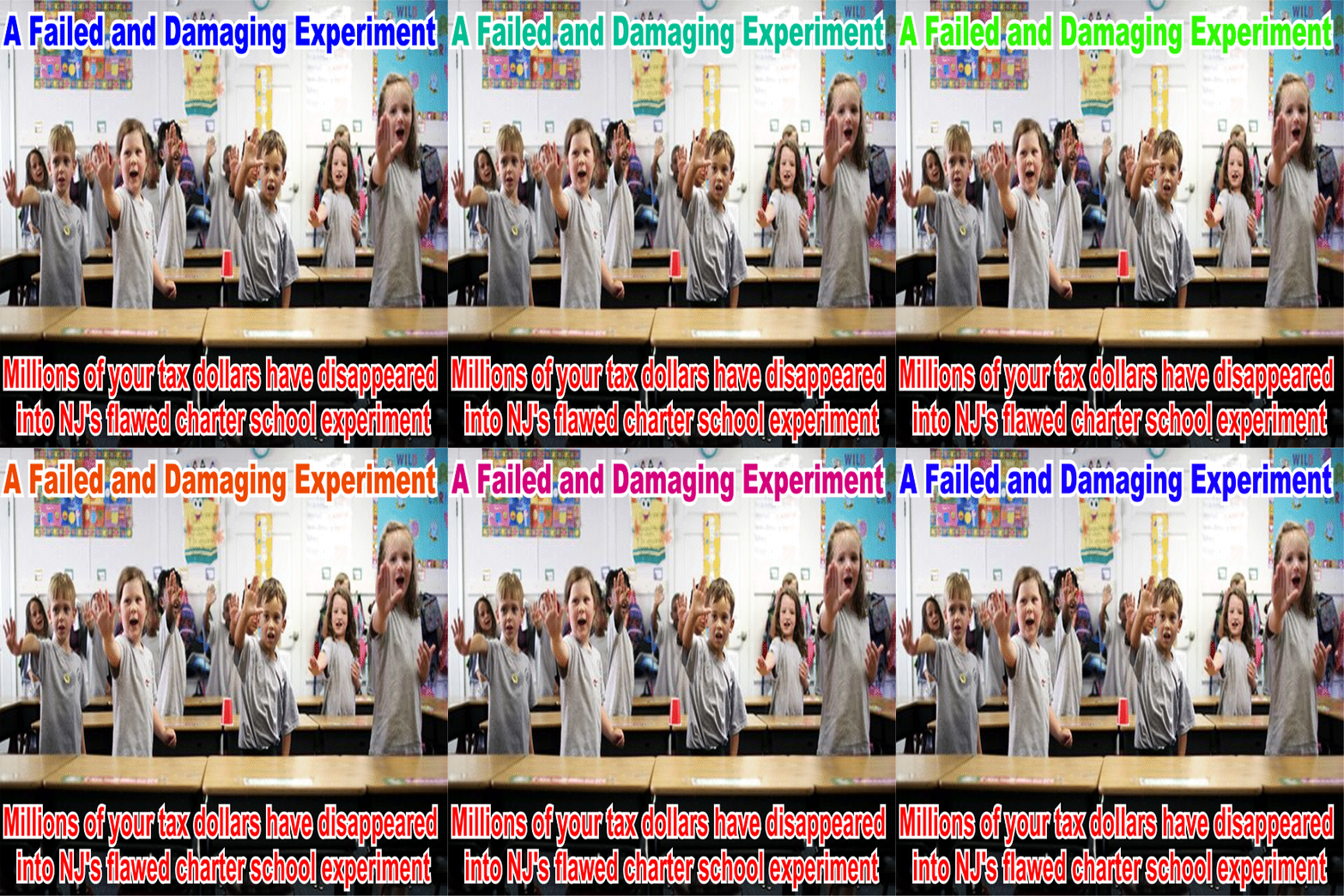
NJ charter schools: Tax money is disappearing into a flawed experiment

NJ charter schools: Tax money is disappearing into a flawed experiment

Millions of your tax dollars have disappeared into NJ's flawed charter school experiment


CASHING IN ON CHARTER SCHOOLS: PART ONE
NJ taxpayers are spending hundreds of millions of dollars to construct and renovate charter school buildings, but the public doesn't own them.

School buildings that are paid for with millions of dollars in public money but owned by private groups.
Inflated rents, high interest rates and unexplained costs borne by taxpayers.
And tax dollars used to pay rents that far exceed the debt on some school buildings.
This is the world of charter school real estate in New Jersey.
Where public money can disappear in a maze of intertwined companies.
Where businesses and investors can turn a profit at taxpayer expense.
And where decisions about millions in tax dollars are made privately, with little public input and little to no oversight by multiple state agencies.

More than two decades into the state’s experiment to create charter schools, which were conceived to provide residents with choices and to spur innovation, serious flaws in the design of the system have led to the diversion of millions of dollars in taxpayer money to private companies that control real estate.  
Two of the state's largest charter school operators, KIPP New Jersey and Uncommon Schools, have been permitted by the state to monopolize hundreds of millions of dollars in federal aid for public school construction, helping them to create networks of privately owned buildings. 

And investors positioned themselves to make millions from taxpayers, including real estate entrepreneurs, developers and a range of lenders.

The current situation was born, in some ways, out of necessity.
No system was put in place to help charter operators find and finance school buildings to house and educate tens of thousands of students. In fact, an author of the state's charter school law, which Gov. Christine Todd Whitman signed in 1996, says facilities weren’t addressed to avoid controversy with the state teachers' union and others over the creation of the independent public schools.
A lack of clarity and vagaries in the charter school law ― and what some education experts say is bad policy or no policy at all ― has created a confusing and tangled landscape where transactions are often secret, or buried so deeply in documents that the public has virtually no way of scrutinizing how their tax dollars are being spent.
Private groups that are created to support charter schools ― and own and finance their real estate ― sometimes share board members or officers and lend money to one another. These groups end up owning and controlling facilities leased by the schools, setting rents as they see fit.

“We’re putting a lot of public dollars into the acquisition of assets for private hands,” said Bruce Baker, a Rutgers University professor and a nationally recognized expert on education financing. "All of these crazy, funky, convoluted relationships and kind of specially crafted, third-party organizations are really all a function of just bad policy.”  
“We left these organizations to come up with a way to gain access to properties and to retrofit and renovate urban facilities in expensive areas," he added. "And it costs a lot of money, so they had to get creative.”  
What that means is that millions of your tax dollars are being siphoned off by private interests to pay for buildings ― often without your knowledge ― that you don't own.
NorthJersey.com and the USA TODAY NETWORK New Jersey reviewed tens of thousands of pages of documents, including lease, property and financing records, state-issued bond sales and audits involving a cross section of charter schools around the state. The findings raise troubling questions about waste, the use of public money, and accountability in a system that receives some $760 million annually from traditional public school districts and educates more than 50,000 students. Another 35,000 are on waiting lists. CONTINUE READING: NJ charter schools: Tax money is disappearing into a flawed experiment

A series in five parts


The teacher shortage is real, large and growing, and worse than we thought: The first report in “The Perfect Storm in the Teacher Labor Market” series | Economic Policy Institute

The teacher shortage is real, large and growing, and worse than we thought: The first report in “The Perfect Storm in the Teacher Labor Market” series | Economic Policy Institute

The teacher shortage is real, large and growing, and worse than we thought
The first report in “The Perfect Storm in the Teacher Labor Market” series


This report is the first in a series examining the magnitude of the teacher shortage and the working conditions and other factors that contribute to the shortage.
What this report finds: The teacher shortage is real, large and growing, and worse than we thought. When indicators of teacher quality (certification, relevant training, experience, etc.) are taken into account, the shortage is even more acute than currently estimated, with high-poverty schools suffering the most from the shortage of credentialed teachers.
Why it matters: A shortage of teachers harms students, teachers, and the public education system as a whole. Lack of sufficient, qualified teachers and staff instability threaten students’ ability to learn and reduce teachers’ effectiveness, and high teacher turnover consumes economic resources that could be better deployed elsewhere. The teacher shortage makes it more difficult to build a solid reputation for teaching and to professionalize it, which further contribute to perpetuating the shortage. In addition, the fact that the shortage is distributed so unevenly among students of different socioeconomic backgrounds challenges the U.S. education system’s goal of providing a sound education equitably to all children.
What we can do about it: Tackle the working conditions and other factors that are prompting teachers to quit and dissuading people from entering the profession, thus making it harder for school districts to retain and attract highly qualified teachers: low pay, a challenging school environment, and weak professional development support and recognition. In addition to tackling these factors for all schools, we must provide extra supports and funding to high-poverty schools, where teacher shortages are even more of a problem.

The teacher shortage is real and has serious consequences

In recent years, education researchers and journalists who cover education have called attention to the growing teacher shortage in the nation’s K–12 schools. They cite a variety of indicators of the shortage, including state-by-state subject area vacancies, personal testimonials and data from state and school district officials, and declining enrollment in teacher preparation programs.1 These indicators are critical signals. They help analysts detect when there are not enough qualified teachers to fill staffing needs in a labor market that does not operate like other labor markets. School teachers’ wages are not subject to market pressures—they are set by school districts through contracts that take time to negotiate. Therefore, economists can’t use trends in wages—sudden or sustained wage increases—to establish that there is a labor market shortage (as the textbook explanation would indicate). It is also hard to produce direct measurements of the number of teachers needed and available (i.e., “missing”).
To date, the only direct estimate of the size of the teacher shortage nationally comes from the Learning Policy Institute’s seminal 2016 report, A Coming Crisis in Teaching? Teacher Supply, Demand, and Shortages in the U.S. (Sutcher, Darling-Hammond, and Carver-Thomas 2016). The report noted that many school districts—finally hiring again after years of teacher layoffs during the Great Recession and in its wake—“had serious difficulty finding qualified teachers for their positions.” As the authors noted, school districts were challenged with not only restoring student-to-teacher ratios to pre-crisis levels but also with broadening curriculum offerings and meeting projected increases in student populations. Defining shortages as “the inability to staff vacancies at current wages with individuals qualified to teach in the fields needed,” the authors estimated that, barring any major changes, the annual teacher shortage would reach about 110,000 by the 2017–2018 school year.
Figure A replicates Figure 1 in their report and shows the gap between the supply of teachers available to enter the classroom in a given year and the demand for new hires. As recently as the 2011–2012 school year, the estimated supply of teachers available to be hired exceeded the demand for them—i.e., there was a surplus of teachers in that year’s labor market. But estimated projected demand soon exceeded the estimated supply and the projected gap grew sharply in just a handful of years—from around 20,000 in 2012–2013, to 64,000 teachers in the 2015–16 school year, to over 110,000 in 2017–2018. In other words, the shortage of teachers was projected to more than quadruple in just five years and the gap to remain at those 2017–2018 levels thereafter.