Thursday, December 13, 2018

New Federal Case Launched in Rhode Island to Establish Educational Equity as a Federally Protected Right | janresseger

New Federal Case Launched in Rhode Island to Establish Educational Equity as a Federally Protected Right | janresseger

New Federal Case Launched in Rhode Island to Establish Educational Equity as a Federally Protected Right


If you think about it, you’ll remember that for more than forty years, school equity cases have been filed under the education clauses of the 50 state constitutions. That’s because, in a 1973 decision, San Antonio v. Rodriguez, the Warren Burger, U.S. Supreme Court decided that, because education is not mentioned in the U.S. Constitution, education is not protected as a fundamental right under the Fourteenth Amendment.  But late last month a new federal lawsuit was filed, a case intended by the plaintiffs and their attorneys to establish that education is indeed a fundamental right, protected for all students by the U.S. Constitution.
The Associated Press’s Jennifer McDermott reports: “The Center for Educational Equity at Columbia University’s Teachers College and the Rhode Island Center for Justice filed the lawsuit.  Michael Rebell, lead counsel and a professor at Teachers College said citizenship has always been the prime purpose of education in the United states and schools have increasingly failed to carry out this responsibility nationwide.  Rhode Island, in particular, stands out because there is no requirement for students to take a civics course and no indication that teachers receive specialized training to teach the topic, among other issues, Rebell added.  He said the case is timely because, ‘we’re living in troubled times, Our democratic institutions are being challenged like never before.'”
The NY Times‘ Dana Goldstein describes the goals of the plaintiffs: “The lawyers for the plaintiffs hope the case will have implications far beyond Rhode Island, and potentially prompt the Supreme Court to reconsider its 45-year-old ruling that equal access to a quality education is not a constitutionally guaranteed right.  ‘Our real hope for reinvigorating our democratic institutions comes with the young people and the next generation,’ said Michael Rebell, the lead lawyer for the plaintiffs. ‘What we’re really seeking is for the courts, especially CONTINUE READING: New Federal Case Launched in Rhode Island to Establish Educational Equity as a Federally Protected Right | janresseger

Wednesday, December 12, 2018

Opposing Changes Redefining the Concept of Gender - Year 2018 (CA Dept of Education)

Opposing Changes Redefining the Concept of Gender - Year 2018 (CA Dept of Education)

State Superintendent Torlakson, Washington and Oregon Education Officials Oppose Federal Changes Redefining the Concept of Gender


SACRAMENTO—State Superintendent of Public Instruction Tom Torlakson  partnered with the top education officials from Oregon and Washington to send a letter opposing federal attempts to redefine the concept of sex and gender government-wide, making that definition purely biological. The joint letter was sent to the U.S. Department of Health and Human Services today in coordination with Oregon Department of Education Director Colt Gill and Washington Superintendent of Public Instruction Chris Reykdal.
“This damaging proposal would seriously harm our nation’s children and eliminate the ability for some people to fight back against discrimination,” said Torlakson, who was a high school science teacher and coach. “Policies and facilities that assume individuals fall strictly within two categories and assume that identity is visually identifiable risk excluding and alienating individuals. This policy would allow discrimination against those whose gender identity does not line up with their biological sex.”
“Washington state law explicitly prohibits discrimination based on a student’s gender expression or identity in our public schools,” said Chris Reykdal, Washington State Superintendent of Public Instruction. “To our students who are transgender: We hear you. We see you. We support you. We will protect you.”
“It is our responsibility to create caring school environments that are safe and welcoming for all students,” said Colt Gill, Oregon Department of Education Director. “Denying a person’s gender identity or forcing conformity to this federal rule change is disrespectful, discriminatory, and harmful. Each of our children deserve more. They deserve schools that accept, respect, and serve them well.”
The assumption underlying California policy is that gender is a spectrum that is not necessarily linked to biological sex. State legislation allows all individuals, including students, to self-certify to their chosen gender category of male, female, or nonbinary—starting on January 1, 2019. While biological sex is defined by chromosomes in most cases, gender and gender identity are much more complex concepts.
“At an age when self-identity is still being formed, telling a student that their identity is invalid because it does not pair with two specific chromosomes can be deeply damaging,” the letter states. “When coming to school feels uncomfortable or even unsafe, students are implicitly prevented from receiving the same education as their gender-conforming peers. Such policies can thus create lifelong emotional, psychological, and economic harm.”
Resources for LGBTQ youth are available on the CDE’s Statewide & National Sexual Health Resources web page. Copies of the letter are available upon request.
Opposing Changes Redefining the Concept of Gender - Year 2018 (CA Dept of Education)

The ​U.S. Department of Education Will Reorganize in January | Truth in American Education

The ​U.S. Department of Education Will Reorganize in January | Truth in American Education

The ​U.S. Department of Education Will Reorganize in January


The U.S. Department of Education will undergo an internal reorganization set for January 6th, but will take several months to implement, CNN reports:
The new Education Department structure consolidates a number of offices within the agency. The Office of the Secretary will merge with the Office of the Deputy Secretary. The Office of the Chief Financial Officer will merge with the Office of Management to become a new Office of Finance and Operations, according to the email.

The new Office of Finance and Operations will also take on certain responsibilities of other agency offices including the Office of the Chief Information Officer, Office of the Deputy Secretary, and the Office of Planning, Evaluation and Policy Development, according to the email.
 The Office of Innovation and Improvement will also “integrate” into the Office of CONTINUE READING: The ​U.S. Department of Education Will Reorganize in January | Truth in American Education


A Scary Mix of Journalism & Strategic Philanthropy: Gates Spends Big on Education Journalism - Non Profit News | Nonprofit Quarterly

A Scary Mix of Journalism & Strategic Philanthropy: Gates Spends Big on Education Journalism - Non Profit News | Nonprofit Quarterly

A Scary Mix of Journalism & Strategic Philanthropy: Gates Spends Big on Education Journalism


Advertising Philanthropic Initiatives after They Bomb: Gates’s New Embarrassment - Non Profit News | Nonprofit Quarterly - https://nonprofitquarterly.org/?p=2963263

October 15, 2015; Poynter

Anyone watching the philanthropic landscape who cares about democracy should start worrying about the confluence of top-down strategic philanthropy with the rise of philanthropically-backed journalism.
Case in point: NPQ has reported previously on grants made by the Gates Foundation to media outlets covering areas where its sometimes-controversial philanthropic activity is focused, but last week, the Poynter Institute revealed that over the last five years, the Foundation has been spending about $7 million a year on education-related journalism coverage through such outlets as NPR, Hechinger, ChalkbeatEdWeek, and the Educational Writers Association. It also has partnerships with outlets like Univision and the PBS NewsHour.
Alexander Russo, author at the new education blog The Grade, points out the obvious problem with this in terms of its potential to hijack the public discourse, saying, “I don’t think that the Gates Foundation would be spending this kind of money if they didn’t think it helped their cause, however indirectly, and I’m under no illusions that newsrooms are able to completely ignore the sources of their funding, whether in the form of advertising or nonprofit funding.”
But then he backs away from that critique, saying, “The Gates Foundation agenda is focused on relatively moderate ideas like teacher quality and high standards, and it’s been pretty open about its journalism grants…So its media partnerships are less problematic to me than they would be if their agenda was ending tenure, charter school growth, or a Teach For America takeover—or if they were hiding the grants or seeming to pressure editors.”
Not everyone believes that the Gates Foundation agenda for America’s public schools is so neutral, as NPQ’s Marty Levine wrote last week and Liana Heiten wrote for Education Week, and these are certainly not the first concerns to be voiced about Gates’ funding of issues in which it is heavily involved. As far back as 2011, a well-researched and detailed article in the Seattle Times, entitled “Does Gates Funding of Media Taint Objectivity,” looked at the foundation’s funding of health journalism. At that time, it reported:
To garner attention for the issues it cares about, the foundation has invested millions in training programs for journalists. It funds research on the most effective ways to craft media messages. Gates-backed think tanks turn out media fact sheets and newspaper opinion pieces. Magazines and scientific journals get Gates money to publish research and articles. Experts coached in Gates-funded programs write columns that appear in media outlets from The New York Times to The Huffington Post, while digital portals blur the line between journalism and spin.
The efforts are part of what the foundation calls “advocacy and policy.” Over the past decade, Gates has devoted $1 billion to these programs, which now account for about a tenth of the giant philanthropy’s $3 billion-a-year spending. The Gates Foundation spends more on policy and advocacy than most big foundations—including Rockefeller and MacArthur—spend in total.
But Gates is not the only philanthropy investing in topic-specific journalism. Individual CONTINUE REAIDNG: A Scary Mix of Journalism & Strategic Philanthropy: Gates Spends Big on Education Journalism - Non Profit News | Nonprofit Quarterly


Urban Schools Are Improving, Despite Parents’ Beliefs - The Atlantic

Urban Schools Are Improving, Despite Parents’ Beliefs - The Atlantic

Parents Are Biased Against Even Quality ‘Urban’ Schools
Many of these schools are improving, but the persistent stigma against them contributes to segregation.


In recent years, many of America’s urban schools have improved significantly. A 2016 report from the Urban Institute found that while all the country’s public-school students improved in the decade starting in 2005, the gain for those in large cities was double that of the U.S. average; the advances are especially pronounced in kids’ reading scores. With these strides, the achievement gap between city districts and their suburban and rural counterparts closed by roughly a third during that same period.
In some cases, the gap is all but nonexistent. Take, for example, Chicago, which in the late 1980s was notoriously deemed the country’s “worst school system” by then-Education Secretary William J. Bennett. A number of recent studies have shown that while standardized-test scores across Illinois have been flattening for the past decade or so, achievement in Chicago Public Schools has been steadily rising.
In fact, data from 11,000 school districts studied by Stanford researchers last year suggest that CPS ranks first in the nation for academic growth, and state statistics show that its students’ college-attendance rates are steadily improving, too: 65 percent of the districts 2018 graduates enrolled in college within a year after getting their diploma, compared with an average of 75 percent across the state. CPS students’ college-going prospects still fall toward the bottom when compared with those in most nearby districts, but they’re far from the worst—and the Stanford researchers’ findings around future growth in CPS indicate its students’ postsecondary-achievement levels are poised to CONTINUE READING: Urban Schools Are Improving, Despite Parents’ Beliefs - The Atlantic


Protesters shut down Los Angeles Board of Education meeting - Los Angeles Times

Protesters shut down Los Angeles Board of Education meeting - Los Angeles Times

Protesters shut down Los Angeles Board of Education meeting


School district officials are busy “reimagining” the nation’s second-largest school system, but what happened Tuesday was not exactly what they had in mind.
A group of at least 50 protesters shut down the Los Angeles Board of Education meeting early — just before a debate that was expected to get a little testy on its own.

These days, two major possibilities color just about everything in Los Angeles Unified — the growing prospect of a teachers strike and Supt. Austin Beutner’s still largely confidential plan for a massive district reorganization.
The major theme of the protest, organized by teachers union allies, was support for the teachers, though student demands also were a part of it.
“The more involved I become, the more I become aware of what is happening and the things that are not happening,” said Ruby Gordillo, who was accompanied by her daughter Alandra, a fifth-grader at 10th Street Elementary in Pico-Union. “Our schools are very misleading in the way they answer questions. They give us answers in a way that makes me believe they don’t have interest in our community.”
District officials and the teachers union have been in negotiations for more than 18 months, and a January strike appears increasingly likely. The two sides are nearly done with fact-finding, the final step of a negotiation process set out under state law.
The draft of a report from a fact-finding panel is expected on Friday. A final version will be made public about 10 days later, if it isn’t leaked sooner. After that, the school district could impose a contract and the union leadership could call a strike.
Friday is the last day of school before winter recess. Classes are scheduled to resume Jan. 7.
The protesters echoed the contention of United Teachers Los Angeles that the district — whose general fund budget this year is about $7.5 billion — is hoarding a massive reserve that could be used to pay teachers more and improve conditions for students. They point to last year’s ending balance of nearly $2 billion.
“I just don’t believe the numbers,” Gordillo said. “Honestly, it’s crazy.”
A senior at King/Drew Magnet High School of Medicine and Science, who identified herself only as Cheyanne because she said she felt at risk for speaking out, talked of the need for CONTINUE READING: Protesters shut down Los Angeles Board of Education meeting - Los Angeles Times


CURMUDGUCATION: Chris Cerf: Who, Us?

CURMUDGUCATION: Chris Cerf: Who, Us?

Chris Cerf: Who, Us?


After Robin Lake decided to reject the "reformy" mantle, Chris Perf has decided to add his two cents, but I'm not sure that his two cents is not overpriced.

Cerf came up in the Klein-Bloomberrg overhaul of NYC pubic schools, by virtue of having taught at a private school for a year, then working as a lawyer in Joel Klein's law firm. The arrangement was a curious one-- his salary was paid not by the city, but by private donors. From there he went on to run New Jersey's department of education (thanks Chris Chistie); he also spent some time as a lobbyist for the National Alliance for Public Charter Schools. He left New Jersey to join Amplifyunder his old boss, Klein. After fleeing that disaster, he resurfaced as Superintendent of Newark Schools. He appears to be between gigs at the moment, but like most reformsters, Perf has a network for falling upward.

Short form: Cerf is certainly familiar withe the reformy world.

His brief essay at The 74 has just a few points to make, and all of them are either disingenuous or deliberately misleading.

In a curious linguistic twist, over the past decade, opponents of transformational change have co-opted the word “reform” and essentially converted it into a malediction.

"Gosh, you guys. I have no idea how the term "reform" collected bad connotations. Our evil opponents must have done it!"

Nope. Reformsters grabbed the term and held on tight because it had the power to immediately frame ed reform as a bunch of white hat heroes coming to rescue education from the Powers of Badness as typified by teachers, unions, regulations, etc. Those of us in the defense of public ed camp worked hard not to let them have the word-- hence the use of words like reformster, rephormes, privatizers, colonizers, GERM, etc-- but CONTINUE READING: 
CURMUDGUCATION: Chris Cerf: Who, Us?


Alliance to Reclaim Our Schools Tells New Congress: Fully Fund Title I and IDEA | janresseger

Alliance to Reclaim Our Schools Tells New Congress: Fully Fund Title I and IDEA | janresseger

Alliance to Reclaim Our Schools Tells New Congress: Fully Fund Title I and IDEA


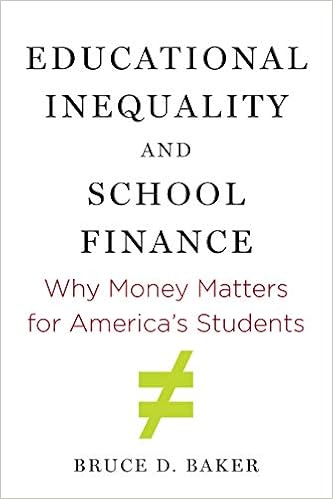
In his new book, Educational Inequality and School Finance, the Rutgers University school finance expert Bruce Baker carefully refutes some long-running and persistent myths about the funding of public education—Eric Hanushek’s claim that money doesn’t really make any difference when it comes to raising student achievement, for example, and the contention that public schools’ expenditures have skyrocketed over the decades while achievement as measured by test scores has remained flat.
Assessing the overall impact of public investment in education, Baker concludes: “Rigorous, well-designed, and policy relevant empirical research finds that: Money matters for schools and in determining school quality and student outcomes. More specifically, substantive sustained, and targeted state school finance reforms can significantly boost short-term and long-run student outcomes and reduce gaps among low-income students and their more advantaged peers. Money matters in common sense ways. Increased funding provides for additional staff, including reduced class sizes, longer school days and years, and more competitive compensation. Cuts do cause harm. The equity of student outcomes is eroded by reducing the equity of real resources across children of varied economic backgrounds. (Educational Inequality and School Finance p. 101, emphasis in the original)
Early in the fall, in hopes that the 2018 midterm election might bring a more hopeful climate for adequately funding public education, the Alliance to Reclaim Our Schools (AROS) published a major report, Confronting the Education Debt to define its members’ priorities for addressing decades of failure adequately to fund schools serving concentrations of poor CONTINUE READING: Alliance to Reclaim Our Schools Tells New Congress: Fully Fund Title I and IDEA | janresseger

Educational Inequality and School Finance: Why Money Matters for America's Students: Bruce D. Baker: 9781682532423: Amazon.com: Books - https://www.amazon.com/Educational-Inequality-School-Finance-Americas/dp/1682532429

'Education is Political': Neutrality in the Classroom Shortchanges Students

'Education is Political': Neutrality in the Classroom Shortchanges Students

‘Education is Political’: Neutrality in the Classroom Shortchanges Students


When teaching about U.S. elections or politics many educators will strive for neutrality. They may insist these discussions have no place in the classroom, while others argue that standardization and a lack of time make them a non-starter. Even if there was an opening, the slightest hint of bias could attract the ire of an administrator or parent. In this hyper-polarized political climate, that’s a line that’s easy to stumble across.
All this neutrality or avoidance may work for the teacher – but what about the student?
Alyssa Hadley Dunn, Assistant Professor of Teacher Education at Michigan State University, believes that a strict adherence to “neutrality” – not expressing your views to students and/or avoiding political topics – is a tactic that can actually marginalize many students.
Neutrality is itself a political choice, Dunn argues, and is one that bolsters the status quo. What results is a classroom that potentially ignores the fears, interests, and concerns of many students.
To be clear, Dunn is not talking about a teacher who stands in front of the class and reads aloud endorsements for local, state and federal political office and then urges students to go home and tell their parents to vote accordingly.
The kind of neutrality that concerns Dunn is, for example, a decision to avoid discussion of  “controversial” issues – racism, inequity, climate change, or gun violence, for example – out of fear of appearing political or partisan.
Education, at it’s core, is inherently political, says Dunn.
“Everything in education—from the textbooks to the curriculum to the policies that govern teachers’ work and students’ learning—is political and ideologically-CONTINUE READING: 'Education is Political': Neutrality in the Classroom Shortchanges Students


Tuesday, December 11, 2018

Diane Ravitch on Gavin Newsom's Three Education Challenges | Capital & Main

Diane Ravitch on Gavin Newsom's Three Education Challenges | Capital & Main

Diane Ravitch on Gavin Newsom’s Three Education Challenges
California is one of the richest states in the nation but spends about the same on its students as states like Iowa, Kansas, Louisiana and South Carolina, where the cost of living is far less than in California.


The incoming administration of Governor-elect Gavin Newsom will not be cleaning up a mess. Governor Jerry Brown has been a good steward of the state during his time in office.
But Newsom faces three distinct challenges in the field of education. Although Governor Brown significantly increased spending for education, California has large unmet needs and much catching-up to do to maintain its edge as an incubator of talent and innovation, and of equal opportunity for all.
First, the state must substantially increase funding for K-12 education, which would enable districts to pay teachers better salaries, reduce class sizes and assure that all children, regardless of where they live, have access to a well-equipped, well-staffed school. The latest federal data (2016) show that California spends somewhat less than the national average per pupil. California’s per-pupil spending is $11,420, compared to a national average of $11,841. California is one of the richest states in the nation but spends far less than states such as New York, New Jersey, Connecticut, Massachusetts, Maryland, Wyoming and North Dakota. California spends about the same on its students as states like Iowa, Kansas, Louisiana and South Carolina, where the cost of living is far less than in California.
Second, California must recommit to the long established tradition that tuition for higher education must be free to all residents of the state. This principle was reiterated in the state’s Master Plan in 1960, but ended by Governor Ronald Reagan. The low-cost availability of higher education and the large pool of educated talent it created were  CONTINUE READING: Diane Ravitch on Gavin Newsom's Three Education Challenges | Capital & Main

 COMLOG1

Capital & Main - Investigating Power & Politics - https://wp.me/PadDuN-erf via @capitalandmain

Charter school leaders should talk more about racism

Charter school leaders should talk more about racism

Charter school leaders should talk more about racism
Praising charters for “doing more with less” ignores how racist systems have devalued black communities, starving kids in both traditional and charter schools of resources


"Charter schools can do more with less” is a common refrain of school choice advocates, who criticize traditional public schools for wasting money. The promise of greater efficiency has been an attractive argument for charters as states struggle to keep up with ever rising educational expenses. Many charter supporters go so far as to say poverty is a poor excuse for underachievement.

In fact, income and wealth consistently rank as the strongest predictors of academic success. But racism is the reason students in black neighborhoods don’t get the finances they need.
Racism creates systems that undervalue black schools, homes and lives, leading to fewer resources for the people who need every cent. If charter backers and other school reformers are really going to uplift black and brown students, they must recognize this and fight funding inequities created by that devaluation of black worth.


Our new research shows that homes in black neighborhoods are devalued, draining critical sources of revenue for school districts – property taxes. Jonathan Rothwell of Gallup, David Harshbarger of Brookings and I found in the average U.S. metropolitan area, homes in neighborhoods where black residents are 50 percent of the population are valued at roughly half the price as homes in neighborhoods with no black residents.
Some might assume that’s because black residents are concentrated in older or less desirable neighborhoods. Segregation and redlining, which deemed black neighborhoods too risky for banks to award loans they gave their white counterparts, certainly kept investments at bay, accelerating depreciation and social decline. But differences in home and neighborhood quality do not fully explain the lower prices of homes in black neighborhoods. Homes of similar quality in majority black neighborhoods with similar amenities are worth 23 percent less than neighborhoods where the black population is 1 percent or fewer. The difference equates to $48,000 per home on average, amounting to $156 billion in cumulative losses in majority black neighborhoods.


There is not a superintendent or school leader in either charter or CONTINUE READING: Charter school leaders should talk more about racism

Billionaire philanthropists like Gates and Buffett keep accumulating more wealth - Vox

Billionaire philanthropists like Gates and Buffett keep accumulating more wealth - Vox

It’s surprisingly hard to give away billions of dollars
Even billionaires who want to give all their money away keep accumulating more. Here’s why.

David Callahan caused a stir with a piece last week at Inside Philanthropy, which pointed out that the wealthiest people in the world are sitting on $4 trillion, and accumulating money much faster than they give it away.
“[Bill] Gates was worth $54 billion in 2010, the year the Giving Pledge debuted; he’s worth $97 billion today. [Warren] Buffett’s wealth has also nearly doubled, to $90 billion, despite annual transfers of Berkshire Hathaway stock to the Gates Foundation and the four foundations controlled by his three children,” Callahan wrote.
With some billionaires, there’s a simple explanation for why they don’t give away more money: They don’t really feel like it.
But that doesn’t seem like a fully satisfying explanation when it comes to Gates, Buffett, or other billionaires who’ve pledged to give away their wealth before they die. I want to speak up in their partial defense here: It’s actually shockingly challenging to effectively give away vast sums of money, especially at the rates billionaires would need to give to keep up with their recent gains on the stock market.

Philanthropy is harder than you think

It can strain credulity that it’s really that challenging to give away money. But when you look at the track record of many poorly planned, failed philanthropy projects, it gets clearer.
This year, the data came out from a $575 million multi-year project to improve schools, spearheaded by more than $200 million from the Gates Foundation — and the expensive intervention didn’t improve student outcomes at all. Mark Zuckerberg spent $100 million to improve schools and saw some modest gains — but they were small and accompanied by outrage and local backlash. (My colleague Dylan Matthews has pleaded for philanthropists to stay out of education, where their track records are particularly disappointing.)
The charity evaluator GiveWell, which researches promising interventions, found that these failures aren’t the exception, but the norm. “We think that charities can easily fail to have impact, even when they’re doing exactly what they say they are,” they write. “[M]any of the problems charities aim to address are extremely difficult problems that foundations, governments and experts have struggled with for decades. Many well-funded, well-executed, logical programs haven’t had the desired results.”
GiveWell recounts what went wrong with one intervention that didn’t live up to expectations: PlayPumps, a merry-go-round that was also supposed to pump water and which replaced CONTINUE READING: Billionaire philanthropists like Gates and Buffett keep accumulating more wealth - Vox


Controversial Virtual School Operator K12 Pivots to Job Training | Education News | US News

Controversial Virtual School Operator K12 Pivots to Job Training | Education News | US News

Controversial Virtual School Operator Pivots to Job Training
The for-profit educator has been under fire for years over charges that it has provided degrees and certificates that have been of little worth to students.


K12 INC., THE controversial for-profit virtual charter school operator, plans to pivot its entire platform to career education and has laid the groundwork to offer the new programs in 40 states over the next three years.
"This is a pivot, absolutely," says Kevin Chavous, president of academics, policy and schools at K12. "We were the first ones to do the online education in a big way. Now, this is a pivot where we have a laser focus on academics and student growth, but the corresponding focus on [career] gives kids more opportunity than they otherwise wouldn't have."
In an interview with U.S. News, Chavous and Executive Vice President Shaun McAlmont, who was hired in August to direct the shift toward career readiness, outlined K12's new direction.
The company is focusing on a handful of core industries, including information technology, business, manufacturing, health sciences or health care, and agriculture. McAlmont says they plan to peg different industry course offerings to specific parts of the country. Schools in Ohio and Michigan will offer specialized courses IT and health care, for example, while its schools in California will offer specialized courses in all the industries.
K12 already has 13 programs in place, which the company brands as "destination career academies." They serve approximately 7,000 students. The goal is to roll out the new offerings over the course of the next three years across 40 states and ultimately have all of K12's 120,000 students taking a least some career education classes.
Students enrolled in specific industry tracks will take two to three courses in that track each year with the goal to have 10 to 12 courses completed by graduation, along with a certificate that allows for immediate employment. The new programs will also involve a job-shadowing component, which will be up and running in seven states by the end of this academic year, they say.
"We really want to be the comprehensive national provider of career education, and we feel that nobody is doing it at that scale right now," McAlmont says. "We are looking for industry partners at the national level and local level to build that."
K12's shift raises obvious questions as the for-profit model in the higher education world has CONTINUE READING: Controversial Virtual School Operator K12 Pivots to Job Training | Education News | US News


Screen time kids study: Groundbreaking study examines effects of screen time on kids - 60 Minutes - CBS News

Screen time kids study: Groundbreaking study examines effects of screen time on kids - 60 Minutes - CBS News

Groundbreaking study examines effects of screen time on kids

60 Minutes goes inside a landmark government study of young minds to see if phones, tablets and other screens are impacting adolescent brain development


If you have kids and wonder if all that time they spend on their smartphones endlessly scrolling, snapping and texting is affecting their brains, you might want to put down your own phone and pay attention. The federal government, through the National Institutes of Health, has launched the most ambitious study of adolescent brain development ever attempted. In part, scientists are trying to understand what no one currently does: how all that screen time impacts the physical structure of your kids' brains, as well as their emotional development and mental health.
At 21 sites across the country scientists have begun interviewing nine and ten-year-olds and scanning their brains. They'll follow more than 11,000 kids for a decade, and spend $300 million doing it. Dr. Gaya Dowling of the National Institutes of Health gave us a glimpse of what they've learned so far.
Dr. Gaya Dowling: The focus when we first started talking about doing this study was tobacco, marijuana, all drugs the screen time component really came into play because we were wondering what is the impact? I mean, clearly kids spend so much time on screens.
The first wave of data from brain scans of 4,500 participants is in and it has Dr. Dowling of the NIH and other scientists intrigued.
The MRI's found significant differences in the brains of some kids who use smartphones, tablets, and video games more than seven hours a day.

"We're sort of in the midst of a natural kind of uncontrolled experiment on the next generation of children."

Dr. Gaya Dowling: What we can say is that this is what the brains look like of kids who spend a lot of time on screens. And it's not just one pattern.
Anderson Cooper: That's fascinating.
Dr. Gaya Dowling: It's very fascinating.
The colors show differences in the nine and ten-year-olds' brains. The red color represents premature thinning of the cortex. That's the wrinkly outermost layer of the brain that CONTINUE READING: Screen time kids study: Groundbreaking study examines effects of screen time on kids - 60 Minutes - CBS News